%52%6f%62%6f%74%69%63%73
-
 KAIST Develops a Beetle-Inspired Soft Robot That Operates with Artificial Muscles and Sensory Feedback
Researchers have developed a technology that lets a user move a small robot by bending and straightening a finger. The user can also pick up and move objects while checking the images and contact information that the robot sends back. The system combines artificial muscles, a camera, and tactile sensors in a small soft robot modeled on a beetle. It is expected to be used in remote tasks, such as inspecting narrow spaces that are difficult for people to reach and retrieving small objects.
KAIST (President Choongsik Bae) announced on October 13 that a research team led by Professor Sang Ouk Kim from the Department of Materials Science and Engineering has developed a small soft robot called “BeetleBot.” The team worked with the research groups of Professor Wei Gao at the California Institute of Technology (Caltech) and Professor Hirotaka Sato at NTU.
When people grasp an object, they use their eyes to find where it is and the sensation in their fingertips to check the contact. A robot that adjusts its work to its surroundings also needs its movement and sensing functions to be connected. Soft robots are built from soft, deformable materials. In these robots, however, actuation, sensing, and control are often built as separate parts or depend on complex devices. This has made it difficult to integrate several functions into a small robot.
The researchers designed the robot to walk and grip objects using artificial muscles that contract in a similar way to biological muscles. They linked these muscles with a camera, a pressure sensor, and a stretchable sensor patch worn on the finger. With this setup, the user can control the robot while checking its surroundings and its contact with objects.
The team first analyzed how the leg muscles of a beetle relate to the movement of its joints. They used the results to decide where to place BeetleBot’s artificial muscles and how to design its legs. The artificial muscles were made by 3D printing a liquid crystal elastomer (LCE), a polymer that contracts when heated. They were combined with an actuation module that produces heat from electricity. The muscles in each part of the robot can be operated independently, and the order in which they operate can be adjusted. This allows the robot to walk forward and turn left or right.
The researchers also built a soft gripper based on the mandibles that beetles use to hold their prey. The gripper combines artificial muscles with a capacitive pressure sensor, so it can grip an object and detect the contact. When the artificial muscles contract, the gripper closes around the object. The pressure sensor then detects the pressure applied during contact. When the object presses on the sensor, the distance between its internal electrodes changes, and so does its capacitance. The sensor uses this change to determine the contact state.
To control the robot, the team used a stretchable sensor patch whose electrical resistance changes as the finger moves. When the finger bends and stretches the patch, the conductive paths formed by carbon nanotubes (CNTs) inside it change, which changes the resistance signal. The researchers sorted these signals into four commands: move forward, turn left, turn right, and grip an object. The commands are sent to BeetleBot over Bluetooth Low Energy, and the robot carries out the matching action.
The user views the robot’s surroundings through a small onboard camera and checks contact with objects using data from the pressure sensor in the gripper. Based on this information, the user decides on the next action and sends a command with a finger movement. In this way, the system provides bidirectional feedback. Commands go from the user to the robot, and the information the robot detects goes back to the user.
Using this control method, the researchers showed that BeetleBot could avoid obstacles, approach a target object, and then grip and carry it. By connecting artificial muscle-based walking and gripping, visual and tactile sensing, and user control in a single system, the study shows that small soft robots can carry out practical tasks.
The results are expected to support the development of soft robots for remote tasks, such as checking conditions and retrieving small objects in spaces that are hard for people to access. Before the robot can be used more widely, for example in environmental exploration or industrial equipment inspection, the actuation speed, energy efficiency, and power supply of the artificial muscles will need to be improved. Its performance will also need to be tested in real working environments.
“This study expands the potential uses of soft robots by connecting the movement of artificial muscles, sensing, and user control in a single system,” said Professor Sang Ouk Kim. He added that he expects the joint research with Caltech and other partners to contribute to soft robots that can work in spaces that are difficult for people to access.
“A key feature of this work is the bidirectional feedback, which links the information detected by the robot to the user’s next action,” said Professor Inho Kim of Sungkyunkwan University, the first author. He added that he plans to increase the actuation speed and energy efficiency of the artificial muscles and improve control methods that use sensory information, so that the robot can be developed into a soft robot that works in a variety of environments.
Professor Inho Kim earned his Ph.D. from the KAIST Department of Materials Science and Engineering. He is now an assistant professor in the Department of Chemistry at Sungkyunkwan University, and he took part in the study as first author while working as a postdoctoral researcher at Caltech. Professor Sang Ouk Kim of KAIST and Professor Wei Gao of Caltech are co-corresponding authors. The results were published in Science Advances on August 19, 2026.
Paper title: BeetleBot: An integrated bioinspired soft robot for multimodal sensing and adaptive interaction,
DOI: 10.1126/sciadv.aeg8849
This research was supported by the Heritage Medical Research Institute, the Meta Caltech Research Award, the National Research Foundation of Korea (RS-2024-00411904, RS-2025-00521316, RS-2025-25442577), and the Singapore Ministry of Education (RG140/20, RG82/24).
2026.10.13 View 2352
-
 KAIST Develops a Venus Flytrap-Inspired 'Robot Hand' Material That Detects What Comes Near and Grasps It Under UV Light
A Venus flytrap closes its leaves to trap prey when it senses a stimulus. Taking inspiration from this plant, KAIST researchers have combined the roles of a skin that senses approaching objects and a muscle that grasps them in a single soft material. When an electrically charged object comes near, ions inside the material move and produce an electrical signal. When ultraviolet (UV) light is applied, the material bends and grasps the object. Because it holds its deformed shape for more than 10 minutes after the light is turned off, the material shows potential for soft robotic hands that require fewer components and less wiring.
KAIST (President Choongsik Bae) announced on September 30 that a research team led by Professor Hong Chul Moon from the Department of Chemical and Biomolecular Engineering has developed the ‘Ionograsper,’ an ionic soft robot that senses nearby objects and moves in response to light. An ionic material contains ions, small particles that carry a positive or negative electric charge, which allow the material to respond to electrical changes in its surroundings.
Humans notice objects with their eyes or skin and grasp them by moving their muscles. Robots likewise need sensors to detect their surroundings and actuators to generate movement. However, when these devices are attached separately to a soft robot, which bends flexibly, the number of components and the amount of wiring increase, and the structure becomes more complex.
The research team combined the roles of a robot’s skin and muscle in a single soft polymer material. Polymers are substances made of small molecules linked into long chains; plastics and rubber are common examples. The team combined azobenzene, a compound that changes shape when exposed to light, with a hygroscopic polymer that absorbs moisture from the air. This produced a network structure in which ions can move.
When a charged object approaches, its electric field causes the positive and negative ions inside the material to redistribute. As a result, changes occur inside the material even without direct contact. The researchers used the resulting electrical signal to detect the approach and movement of objects without applying a separate sensing voltage.
To make the material move, the researchers irradiate it with UV light. Azobenzene changes its molecular shape when it absorbs light, and moisture escapes from the irradiated side of the material. This causes the material to bend toward the light, which can be used to grasp an object.
When the light is turned off, moisture re-enters the material through nanoscale pores that formed on its surface during irradiation. The material then bends in the opposite direction and holds its deformed shape for more than 10 minutes, until the polymer structure slowly relaxes. This means the light does not need to stay on for the material to maintain its grasping position.
A defining feature of the study is that three functions, sensing an object, moving, and retaining a changed shape for a period of time, are realized in a single material. The researchers also analyzed how light-induced changes in the molecules and in moisture content lead to bidirectional bending and shape retention.
This material design approach could help reduce the components and wiring required when sensors and actuators are mounted separately on soft robots. The work, however, remains at the research stage: the material currently detects charged objects and is actuated by UV light. The team plans to increase the sensing distance, actuation speed, durability under repeated use, and load-bearing capacity, and to make the material responsive to visible or near-infrared light.
“Rather than attaching a robot’s skin and muscles separately, we created a single material that senses objects and moves when it receives light, and a key feature is that it maintains its deformed shape even after the light is turned off,” said Professor Hong Chul Moon. He added that the team plans to combine the material with AI control technologies and develop it into a sensing and actuation material for physical AI robots.
Professor Yong Min Kim of the School of Chemical Engineering at Jeonbuk National University served as the first author, and Professor Hong Chul Moon of KAIST’s Department of Chemical and Biomolecular Engineering served as the corresponding author. The study was published online in the international journal Advanced Materials on September 14, 2026, and was selected as the front cover article of Issue 62.
Paper title: A Multifunctional Ionograsper Enabling Ion-Redistribution Proximity Sensing and Structural-Reconfiguration-Driven Bidirectional Actuation,
DOI: 10.1002/adma.74981
Authors: Yong Min Kim (Jeonbuk National University, first author); Jin Han Kwon, Hyeon Woo Yang, Sungryong Kim, and Gyeong Rok Lee (KAIST, co-authors); Hong Chul Moon (KAIST, corresponding author)
Related Video: https://advanced.onlinelibrary.wiley.com/doi/10.1002/adma.74981
This research was supported by a National Research Foundation of Korea (NRF) grant funded by the Korean government (Ministry of Science and ICT, MSIT) (RS-2025-00554260) and by the Nano & Material Technology Development Program through the NRF, funded by the MSIT (RS-2025-02221332).
2026.09.30 View 2976
-
 KAIST’s World-First Full-Course Robot Marathon Completion Published in Nature
A quadruped robot ran 42.195 km, a distance that is not easy even for humans to complete, without replacing its battery. KAIST researchers have developed this world-first achievement into design principles for long-distance operation, published the results in Nature, and are now moving toward commercializing robots that can be used in real industrial environments.
KAIST (President Choongsik Bae) announced on the September 24 that the long-distance running technology of RAIBO2, a quadruped robot developed by a research team led by Professor Jemin Hwangbo from the Department of Mechanical Engineering, and the results of its actual marathon completion were published in the international journal Nature.
This is the first time that robotics research conducted in Korea has been published in the main journal of Nature. Even globally, it is extremely rare for robotics research to be published in Nature, making this achievement an important demonstration of both the technological capability and academic level of Korean robotics research.
RAIBO2 completed the full 42.195 km course of the Sangju Dried Persimmon Marathon held in November 2024 in 4 hours, 19 minutes, and 52 seconds without charging or replacing its battery. It was the world’s first case of a quadruped robot completing the full course of an actual marathon event.
The core significance of this paper does not lie simply in the record of a robot running 42.195 km. In the global robotics industry, competition has recently intensified over the running speeds and obstacle-negotiation capabilities of quadruped robots and humanoids. However, to operate robots for long periods in real industrial environments, it is necessary to secure not only momentary locomotion performance but also energy efficiency, thermal management, battery performance, and actuator stability.
The research team approached long-distance operation not as a performance issue involving individual components such as batteries or motors, but as a “whole-robot system problem” in which mechanical structure, electrical systems, and locomotion control are closely interconnected.
Quadruped robots lose energy in multiple areas – including actuators, electrical systems, and mechanical components – as they repeatedly move their legs. Improving the efficiency of only one component makes it difficult to achieve both fast and stable locomotion performance and long travel distances at the same time.
The research team systematically analyzed energy losses throughout the entire robot and jointly designed the mechanical, electrical, actuation, and control systems so that energy consumption could be reduced while maintaining high locomotion performance. Through this approach, the researchers presented specific design principles for which factors must be considered together to enable quadruped robots to move stably for extended periods.
In particular, the research team went beyond short-distance laboratory running tests or maximum travel distances estimated through calculations and validated the technology on an actual full marathon course.
During the marathon, the team recorded the robot’s internal voltage, current, temperature, and battery status in real time and synchronized the data with position, speed, and altitude information measured by GPS. RAIBO2 was officially registered as a participant, allowing formal split times to be recorded, while the researchers ran alongside the robot and filmed the entire journey, lasting more than four hours from the starting line to the finish.
While the 42.195 km completion record demonstrated RAIBO2’s performance, the data accumulated throughout the process provided scientific evidence showing how that performance was made possible and how it was maintained in a real-world environment. The research team developed a single impressive demonstration into research results based on system design principles and actual measurement data that can be analyzed and revalidated.
The research team’s next challenge is to transfer the performance achieved with a single research robot into a product that can be used repeatedly in industrial environments.
RAIBO2 is a research robot that was designed and built by hand by the researchers themselves. To develop it into a product that can be deployed in real industrial environments, the same performance must be achieved reliably across multiple robots while also reducing production costs. The product must also meet industrial reliability requirements, including water and dust resistance, operation across a wide temperature range, durability against shock and vibration, and electromagnetic interference and compatibility requirements (EMI/EMC).
Raion Robotics, a KAIST faculty startup that originated from Professor Hwang’s laboratory, is responsible for connecting the research results to actual products. During the development of RAIBO2, Raion Robotics’ manufacturing technology also contributed to maintaining the high energy efficiency and locomotion performance achieved in the laboratory for more than four hours during the actual marathon.
The research team and Raion Robotics developed not only the mechanical and electrical systems, software, and artificial intelligence but also the motor drivers that precisely control the robot’s motors, allowing them to optimize the entire system.
Currently, Raion Robotics is using this systems-design capability to develop commercialization and mass-production technologies for quadruped robots that can operate for extended periods in real environments, going beyond research prototypes. The goal is to reproduce the world-class performance demonstrated by a single laboratory robot across multiple products and enable stable operation in a wide variety of environments.
Professor Jemin Hwang said, “This study goes beyond demonstrating how far a quadruped robot can run. Using actual marathon data, we demonstrated how the entire robot must be designed to achieve both high locomotion performance and energy efficiency,” adding, “We will connect the world-class performance achieved in the laboratory to products that anyone can use reliably in industrial environments.”
Dr. Choongin Lee and students Donghoon Youm and Jeongsoo Park of the KAIST Department of Mechanical Engineering participated in the study as co-first authors, and the research results were published in the international journal Nature on September 23 (local time).
Paper title: A quadruped robot designed to complete a marathon on a single battery charge, DOI: 10.1038/s41586-026-11102-5
Related photos and videos:
Comprehensive photo/video collection on Google Drive: https://drive.google.com/drive/folders/1ye82tTr2dCK2Bt7Ih0hSgWqkgqlVXk6X?usp=sharing
Full video of the marathon completion on YouTube: https://www.youtube.com/watch?v=-HMFoa3g9nA
The entire process of RAIBO2 completing the marathon can be viewed in the YouTube video.
2026.09.28 View 4084
-
 KAIST Develops a Soft 3D-Printed Robotic Hand that Gently Grips Everything from Eggs to a 1 kg Water Bottle
3D printers that once could only produce rigid objects can now create products as soft and stretchable as rubber. A team of Korean researchers used AI to identify the optimal "recipe" for a material that can be printed into complex shapes while stretching to more than six times its original length. The material is expected to expand the range of applications for 3D printing, from robotic hands to form-fitting wearable devices and custom medical devices.
KAIST (President Choong-Sik Bae) announced on September 1 that a research team led by Professor Seungchul Lee from the Department of Mechanical Engineering, working with Dr. Jongbeom Na's team at the Korea Institute of Science and Technology’s (KIST, President Sang-Rok Oh) Extreme Materials Research Center and Professor Bumsoo Park from the Department of Manufacturing Systems and Design Engineering (MSDE) at Seoul National University of Science and Technology (SEOULTECH, President Dong-Hwan Kim), had used AI to develop a material that is both 3D-printable and highly stretchable, like rubber.
The need for such materials — soft, stretchable, and capable of forming complex shapes — has been growing as soft robots that come into direct contact with people, wearable devices worn on the body, and medical devices custom-fitted to patients have drawn increasing attention.
The 3D printing technology the team used, Digital Light Processing (DLP), cures a liquid material into a desired shape by exposing it to light. While DLP can quickly produce complex structures, making a material more stretchable and durable tends to raise its viscosity to the point that it no longer flows well enough to be printed. Conversely, thinning the material to make it easier to print reduces its stretchability and strength. Thus, developing a material that is both easy to print and highly stretchable was the central challenge.
The team used AI to identify the optimal "material recipe" that satisfies both conditions. Notably, the training data included not only materials that print well, but also highly viscous materials that are difficult to print.
The researchers cured various liquid material formulations in small molds and measured how stretchable and hard they were, how quickly they cured under light, and how well they flowed. This produced a dataset linking a wide range of material formulations to their respective properties.
The team then used machine learning to examine the relationship between material formulation and performance. Based on this, the AI identified the optimal material combination that is both 3D-printable and highly stretchable.
The material identified by the AI printed reliably on a DLP 3D printer and showed high stretchability, extending to more than six times its original length when pulled, without easily tearing.
To verify its real-world potential, the team 3D-printed a "soft actuator" using the material. A soft actuator is a device that uses air pressure and other means to create gentle, muscle-like movement. When inflated with air, it expanded like a balloon and bent as naturally as a human finger.
A soft robotic hand made by combining several actuators lifted a 1 kg water bottle and successfully and stably grasped objects of varying shapes and rigidity, from fragile eggs to glass bottles, an egg carton, and a computer mouse.
Beyond developing a single highly stretchable material, this research is significant for presenting an AI-based method for more quickly identifying materials with desired properties.
Previously, researchers had to directly formulate and test countless materials to find the optimal combination. Going forward, AI can first identify promising material combinations based on experimental data, which researchers then verify through testing, thereby reducing trial and error and shortening material development time.
"This research is significant as it shows that combining researchers' experimental data with artificial intelligence can efficiently identify optimal material combinations that were previously difficult to find," explained Professor Seungchul Lee. "We expect it to be used to more rapidly develop 3D-printing materials with the performance needed across a range of fields, including soft robots, wearable devices, and custom medical devices."
The study, with Dr. Younghan Song and Professor Bumsoo Park as co-first authors, was published in the international journal Nature Communications on June 4.
Paper title: Machine learning guided formulation design of digital light processing printable elastomers beyond viscosity stretchability tradeoff
DOI: https://doi.org/10.1038/s41467-026-73735-4
This research was supported by the Ministry of Trade, Industry and Resource's Machinery and Equipment Industry Technology Development Program (20023762), and by the Ministry of Science and ICT's Nano & Material Technology Development Program (RS-2026-25534767) and Excellent New Researcher Program (RS-2024-00350423).
2026.09.01 View 6331
-
 KAIST Develops Robot That Judges Its Surroundings and Walks, Runs, and Jumps Like an Animal
An era in which robots decide "how to walk" on their own has arrived. A four-legged robot has been developed that, much like a person or an animal, autonomously chooses the appropriate gait strategy for its surroundings — changing its gait on stairs, leaping over gaps, and keeping its balance on forest trails.
KAIST (President Choongsik Bae) announced on the 16th of July that a research team led by Professor Hae-Won Park from the Department of Mechanical Engineering has developed a core control technology for four-legged robots that lets a single controller select and switch in real time among walking, running, jumping, and other locomotion skills, allowing the robot to move quickly and stably, even in real outdoor environments.
Four-legged robots move on four legs, giving them an advantage over wheeled robots on rough terrain. But in real outdoor settings, obstacles such as stairs, ledges, stepping stones, gaps, and tree branches appear one after another in different forms, meaning the ability to simply walk and run fast is not enough.
Existing four-legged robots have excelled at running quickly across flat ground or clearing simple obstacles, but they have struggled to maintain both speed and stability in real-world environments where obstacles combine in complex ways. Because walking, running, jumping, and other gaits had to be controlled individually, the robots were also limited in how naturally they could switch between them as conditions changed.
To overcome these limitations, the research team developed a new learning-based control technology called APT-RL (Action Pretrained Transformer-based Reinforcement Learning).
APT-RL is a control technology designed to enable a robot to first learn a range of locomotion skills — such as walking, running, and jumping — and then freely combine and transition among them in real-world environments as the situation demands.
Rather than filming the movements of real people or animals, the team generated 15.5 hours of training data covering a variety of gaits using computer simulations alone, in just eight minutes. That data was used to teach the robot basic movement capabilities, drawing on robot dynamics (a mathematical model of how a robot moves) and trajectory optimization (a technique for calculating the efficient path of movement). The approach is far faster and more efficient than earlier methods that relied on motion capture, a technology that records human or animal movement using sensors.
The team then applied reinforcement learning — an artificial intelligence technique in which an agent learns optimal behavior through repeated trial and error — so the robot could autonomously select and switch gaits suited to complex three-dimensional terrain such as stairs, ledges, and gaps. Finally, the team combined a depth camera (which measures the distance to objects in order to obtain three-dimensional information) with LiDAR (Laser Detection and Ranging, a sensor that uses lasers to measure the distance and shape of the surrounding environment in three dimensions), enabling the robot to recognize its surroundings and target speed in real time and choose the most appropriate walking strategy.
The team tested the control technology on its own four-legged robot, 'KAIST HOUND.' The experiments were conducted not only on an indoor obstacle course but also in real outdoor environments, including KAIST’s campus and forest trails.
KAIST HOUND moved stably across urban terrain that included stairs, grass, and slopes, as well as irregular natural terrain such as fallen trees, exposed roots, and paths covered in fallen leaves, switching gaits in real time to match the conditions. In rugged terrain with obstacles, the robot reached a peak instantaneous speed of six meters per second (about 22 kilometers per hour), demonstrating that it can achieve both fast movement and stability in real outdoor environments.
The experiments showed that KAIST HOUND autonomously selected and switched between a trot (alternating diagonal legs) and a bound (a leaping gait using the front and back leg pairs together) depending on the terrain and target speed, and that it could integrate walking, running, jumping, and ledge-clearing into a single controller.
Professor Hae-Won Park said "We expect this to become a foundational technology that expands the potential uses of physical-AI-based walking robots in rugged environments such as disaster sites, defense missions, and industrial facility inspections."
Jun-Gill Kang (affiliated with the Agency for Defense Development (ADD) at the time of the research) and Jaehyun Park, a Ph.D. candidate in KAIST's Department of Mechanical Engineering, are co-first authors of the study. Professor Hae-Won Park and Professor Seungwoo Hong from Korea University are co-corresponding authors. The research was selected as the cover paper for the July issue of Science Robotics, the world's leading academic journal in robotics, and was published on July 15 (U.S. Eastern time).
Paper title: Agile perceptive multi-skill locomotion for quadrupedal robots in the wild
DOI: 10.1126/scirobotics.adz7397
Authors: Jun-Gill Kang (the Agency for Defense Development at the time of the research, co-first author), Jaehyun Park (KAIST, co-first author), Hae-Won Park (KAIST, corresponding author), Seungwoo Hong (Korea University, corresponding author)
This research was supported by funding from the Ministry of Trade, Industry and Resources (MOTIR) and the Korea Planning & Evaluation of Industrial Technology (KEIT) (RS-2024-00427719), as well as by the Agency for Defense Development's Future Challenge Defense Technology R&D program (912768601).
2026.07.16 View 7434
-
 KAIST Begins Developing the World’s First Brain-to-Robot Technology, Moving Robots by Thought and Sending Sensation Back to the Brain
KAIST researchers have begun developing a next-generation brain-robot interface platform that uses human brain signals to control an exoskeleton in real time and sends the tactile and force information sensed by the robot back to the brain.
KAIST, led by President Kwang-Hyung Lee, announced on the 25th that research teams led by Professors Kyoungchul Kong and Jung Kim of its Department of Mechanical Engineering, together with Angel Robotics Co., Ltd., have launched the world’s first bidirectional “Brain-to-Robot” system as a flagship initiative of the Korea Medical Device Development Fund (KMDF). The project runs from April 2026 to December 2032.
Professor Kyoungchul Kong is a world-renowned wearable-robotics researcher who founded Angel Robotics, a developer of walking-assist exoskeletons, and led his team to back-to-back gold medals at Cybathlon, the international competition for assistive technologies for people with disabilities. Professor Jung Kim is a globally recognized researcher who received the Scientist and Engineer of the Month Award for his work on robotic skin. Together, the two teams have formed a consortium to develop a Brain-to-Robot platform that merges neural interfaces with exoskeleton robotics.
Brain interface technologies that let users move a cursor or operate a smartphone with brain signals have already reached the stage of human clinical trials, and U.S. companies such as Neuralink and Synchron are accelerating their development. Existing approaches, however, have struggled to link actual movement and sensory feedback at the same time. They have also concentrated largely on advancing signal decoding itself, without clearly defining the target of control, namely what the brain signals actually drive and what kind of sensory information is returned.
Brain-to-Robot is designed to overcome these limitations head-on. It sets the exoskeleton itself as the control target: brain signals read the user’s movement intentions to drive the robot, and at the same time the robot’s sensory readings are delivered back to the brain. These readings include ground reaction force (the force the floor exerts on the foot), joint torque (rotational force at the joints), and tactile information. The aim is a complete bidirectional interface.
According to the research team, no fully bidirectional Brain-to-Robot system that combines exoskeleton control with sensory feedback has yet been reported anywhere in the world, and the project is expected to mark a turning point in brain interface technology.
Within this system, the KAIST teams are responsible for the core technologies. Professor Kong’s team will develop wearable-robot control and AI-based interpretation of movement intention, and will design a somatosensory interface, a system for transmitting bodily sensory information, that delivers the robot’s sensory data accurately to the Brain Chip, the semiconductor that processes brain signals.
Professor Kim’s team will develop robotic skin that senses in place of impaired sensation for people with disabilities, along with AI-based interpretation of somatosensory information.
The teams will also develop AI-based encoding and decoding algorithms that turn brain signals into robot commands and send the robot’s sensory information back to the brain. A key challenge is processing hundreds of channels of cortical signals, the neural signals generated in the cerebral cortex, while stably maintaining an ultra-low-latency closed loop, a control cycle in which signals are exchanged continuously in real time.
Commercialization of the flagship project will be led by Angel Robotics (KOSDAQ: 455900), the company founded by Professor Kong. The team plans to pursue full-cycle commercialization, from regulatory approval by the Ministry of Food and Drug Safety through to real-world deployment.
“If this technology succeeds, it will open a new rehabilitation paradigm in which people with quadriplegia can move beyond the hospital to walk on their own, pick up objects, and even feel sensation at their fingertips in everyday life,” Professor Kong said.
The research team stressed that, because this is an unprecedented and highly complex convergence technology never attempted at home or abroad, long-term safety, clinical validation, and a regulatory approval framework must advance in parallel with the technology itself. To reach the global market, they added, safety and efficacy testing, the accumulation of clinical evidence, a risk-management system, protection of brain-signal data, cybersecurity, and ethical review must all be addressed in an integrated way.
Meanwhile, KAIST is conducting a wide range of fundamental research in the field of brain interfaces. A research team led by Professor Hyung-Soon Park of the Department of Mechanical Engineering is studying wearable rehabilitation robot technologies based on neural intention-recognition interfaces, which identify users’ movement intentions from brain signals, for the effective treatment of neurological disorders. A research team led by Professor Sungho Cho of the School of Computing is developing AI-based brain-signal interpretation technologies.
A research team led by Professor Jihoon Lee of the Department of Brain and Cognitive Sciences is conducting next-generation brain–machine interface research focused on ultra-low-power bio/neural interface circuits, which connect and process biological and neural signals with low power consumption; wireless neural signal measurement technologies, which measure neural signals without wires; and on-device AI-based closed-loop neuromodulation technologies, which use cyclical control structures to exchange signals in real time.
In addition, a research team led by Professor Hyunjoo Lee of the School of Electrical Engineering is conducting research on high-resolution neural signal measurement and precision brain stimulation based on ultra-miniaturized multimodal neural electrodes, which can simultaneously measure and stimulate multiple types of neural signals. A research team led by Professor Minkyu Je of the Department of AI Semiconductor Systems is studying AI-based semiconductor integrated circuits and system technologies for next-generation neural interfaces. A research team led by Professor Jae-Woong Jeong of the School of Electrical Engineering is conducting research on high-precision brain-signal measurement, which precisely measures neural signals generated in the brain, and neuroengineering based on neural stimulation.
“This Brain-to-Robot flagship project is a world-class, highly challenging convergence research initiative led by the teams of Professors Kyoungchul Kong and Jung Kim,” said KAIST President Kwang-Hyung Lee. “KAIST has a wide range of researchers studying fundamental technologies in brain interfaces, AI, semiconductors, and robotics, and based on this foundation, we will lead innovation in next-generation Brain-to-Robot technologies.”
2026.06.25 View 7699
-
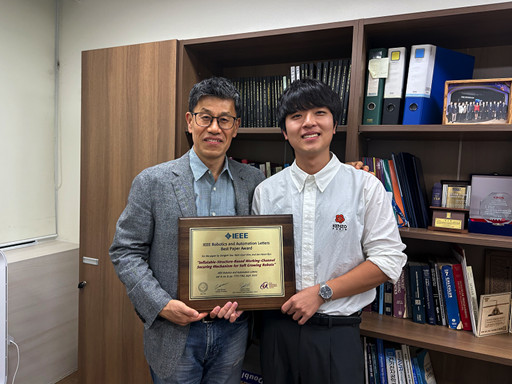 KAIST Professor Jee-Hwan Ryu Receives Global IEEE Robotics Journal Best Paper Award
- Professor Jee-Hwan Ryu of Civil and Environmental Engineering receives the Best Paper Award from the Institute of Electrical and Electronics Engineers (IEEE) Robotics Journal, officially presented at ICRA, a world-renowned robotics conference.
- This is the highest level of international recognition, awarded to only the top 5 papers out of approximately 1,500 published in 2024.
- Securing a new working channel technology for soft growing robots expands the practicality and application possibilities in the field of soft robotics.
< Professor Jee-Hwan Ryu (left), Nam Gyun Kim, Ph.D. Candidate (right) from the KAIST Department of Civil and Environmental Engineering and KAIST Robotics Program >
KAIST (President Kwang-Hyung Lee) announced on the 6th that Professor Jee-Hwan Ryu from the Department of Civil and Environmental Engineering received the 2024 Best Paper Award from the Robotics and Automation Letters (RA-L), a premier journal under the IEEE, at the '2025 IEEE International Conference on Robotics and Automation (ICRA)' held in Atlanta, USA, on May 22nd.
This Best Paper Award is a prestigious honor presented to only the top 5 papers out of approximately 1,500 published in 2024, boasting high international competition and authority.
The award-winning paper by Professor Ryu proposes a novel working channel securing mechanism that significantly expands the practicality and application possibilities of 'Soft Growing Robots,' which are based on soft materials that move or perform tasks through a growing motion similar to plant roots.
< IEEE Robotics Journal Award Ceremony >
Existing soft growing robots move by inflating or contracting their bodies through increasing or decreasing internal pressure, which can lead to blockages in their internal passages. In contrast, the newly developed soft growing robot achieves a growing function while maintaining the internal passage pressure equal to the external atmospheric pressure, thereby successfully securing an internal passage while retaining the robot's flexible and soft characteristics.
This structure allows various materials or tools to be freely delivered through the internal passage (working channel) within the robot and offers the advantage of performing multi-purpose tasks by flexibly replacing equipment according to the working environment.
The research team fabricated a prototype to prove the effectiveness of this technology and verified its performance through various experiments. Specifically, in the slide plate experiment, they confirmed whether materials or equipment could pass through the robot's internal channel without obstruction, and in the pipe pulling experiment, they verified if a long pipe-shaped tool could be pulled through the internal channel.
< Figure 1. Overall hardware structure of the proposed soft growing robot (left) and a cross-sectional view composing the inflatable structure (right) >
Experimental results demonstrated that the internal channel remained stable even while the robot was growing, serving as a key basis for supporting the technology's practicality and scalability.
Professor Jee-Hwan Ryu stated, "This award is very meaningful as it signifies the global recognition of Korea's robotics technology and academic achievements. Especially, it holds great significance in achieving technical progress that can greatly expand the practicality and application fields of soft growing robots. This achievement was possible thanks to the dedication and collaboration of the research team, and I will continue to contribute to the development of robotics technology through innovative research."
< Figure 2. Material supplying mechanism of the Soft Growing Robot >
This research was co-authored by Dongoh Seo, Ph.D. Candidate in Civil and Environmental Engineering, and Nam Gyun Kim, Ph.D. Candidate in Robotics. It was published in IEEE Robotics and Automation Letters on September 1, 2024.
(Paper Title: Inflatable-Structure-Based Working-Channel Securing Mechanism for Soft Growing Robots, DOI: 10.1109/LRA.2024.3426322)
This project was supported simultaneously by the National Research Foundation of Korea's Future Promising Convergence Technology Pioneer Research Project and Mid-career Researcher Project.
2025.06.09 View 17596
-
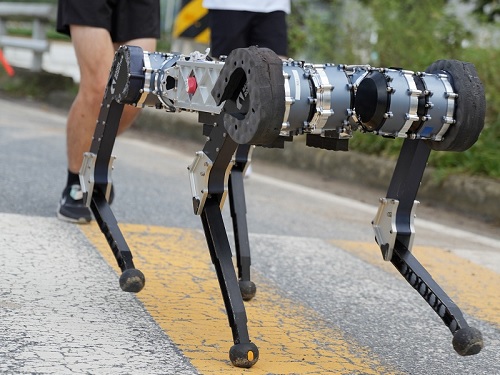 RAIBO Runs over Walls with Feline Agility... Ready for Effortless Search over Mountaineous and Rough Terrains
< Photo 1. Research Team Photo (Professor Jemin Hwangbo, second from right in the front row) >
KAIST's quadrupedal robot, RAIBO, can now move at high speed across discontinuous and complex terrains such as stairs, gaps, walls, and debris. It has demonstrated its ability to run on vertical walls, leap over 1.3-meter-wide gaps, sprint at approximately 14.4 km/h over stepping stones, and move quickly and nimbly on terrain combining 30° slopes, stairs, and stepping stones. RAIBO is expected to be deployed soon for practical missions such as disaster site exploration and mountain searches.
Professor Jemin Hwangbo's research team in the Department of Mechanical Engineering at our university announced on June 3rd that they have developed a quadrupedal robot navigation framework capable of high-speed locomotion at 14.4 km/h (4m/s) even on discontinuous and complex terrains such as walls, stairs, and stepping stones.
The research team developed a quadrupedal navigation system that enables the robot to reach its target destination quickly and safely in complex and discontinuous terrain.
To achieve this, they approached the problem by breaking it down into two stages: first, developing a planner for planning foothold positions, and second, developing a tracker to accurately follow the planned foothold positions.
First, the planner module quickly searches for physically feasible foothold positions using a sampling-based optimization method with neural network-based heuristics and verifies the optimal path through simulation rollouts.
While existing methods considered various factors such as contact timing and robot posture in addition to foothold positions, this research significantly reduced computational complexity by setting only foothold positions as the search space. Furthermore, inspired by the walking method of cats, the introduction of a structure where the hind feet step on the same spots as the front feet further significantly reduced computational complexity.
< Figure 1. High-speed navigation across various discontinuous terrains >
Second, the tracker module is trained to accurately step on planned positions, and tracking training is conducted through a generative model that competes in environments of appropriate difficulty.
The tracker is trained through reinforcement learning to accurately step on planned plots, and during this process, a generative model called the 'map generator' provides the target distribution.
This generative model is trained simultaneously and adversarially with the tracker to allow the tracker to progressively adapt to more challenging difficulties. Subsequently, a sampling-based planner was designed to generate feasible foothold plans that can reflect the characteristics and performance of the trained tracker.
This hierarchical structure showed superior performance in both planning speed and stability compared to existing techniques, and experiments proved its high-speed locomotion capabilities across various obstacles and discontinuous terrains, as well as its general applicability to unseen terrains.
Professor Jemin Hwangbo stated, "We approached the problem of high-speed navigation in discontinuous terrain, which previously required a significantly large amount of computation, from the simple perspective of how to select the footprint positions. Inspired by the placements of cat's paw, allowing the hind feet to step where the front feet stepped drastically reduced computation. We expect this to significantly expand the range of discontinuous terrain that walking robots can overcome and enable them to traverse it at high speeds, contributing to the robot's ability to perform practical missions such as disaster site exploration and mountain searches."
This research achievement was published in the May 2025 issue of the international journal Science Robotics.
Paper Title: High-speed control and navigation for quadrupedal robots on complex and discrete terrain, (https://www.science.org/doi/10.1126/scirobotics.ads6192)YouTube Link: https://youtu.be/EZbM594T3c4?si=kfxLF2XnVUvYVIyk
2025.06.04 View 20444
-
 Professor Hyun Myung's Team Wins First Place in a Challenge at ICRA by IEEE
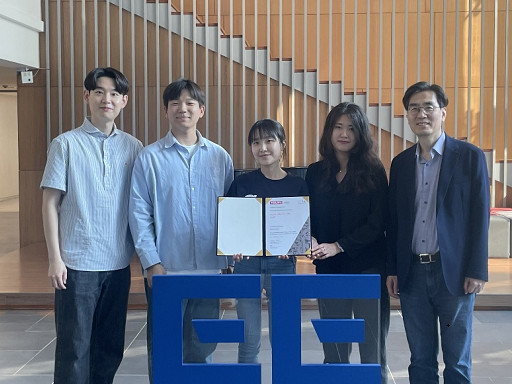
< Photo 1. (From left) Daebeom Kim (Team Leader, Ph.D. student), Seungjae Lee (Ph.D. student), Seoyeon Jang (Ph.D. student), Jei Kong (Master's student), Professor Hyun Myung >
A team of the Urban Robotics Lab, led by Professor Hyun Myung from the KAIST School of Electrical Engineering, achieved a remarkable first-place overall victory in the Nothing Stands Still Challenge (NSS Challenge) 2025, held at the 2025 IEEE International Conference on Robotics and Automation (ICRA), the world's most prestigious robotics conference, from May 19 to 23 in Atlanta, USA.
The NSS Challenge was co-hosted by HILTI, a global construction company based in Liechtenstein, and Stanford University's Gradient Spaces Group. It is an expanded version of the HILTI SLAM (Simultaneous Localization and Mapping)* Challenge, which has been held since 2021, and is considered one of the most prominent challenges at 2025 IEEE ICRA.*SLAM: Refers to Simultaneous Localization and Mapping, a technology where robots, drones, autonomous vehicles, etc., determine their own position and simultaneously create a map of their surroundings.
< Photo 2. A scene from the oral presentation on the winning team's technology (Speakers: Seungjae Lee and Seoyeon Jang, Ph.D. candidates of KAIST School of Electrical Engineering) >
This challenge primarily evaluates how accurately and robustly LiDAR scan data, collected at various times, can be registered in situations with frequent structural changes, such as construction and industrial environments. In particular, it is regarded as a highly technical competition because it deals with multi-session localization and mapping (Multi-session SLAM) technology that responds to structural changes occurring over multiple timeframes, rather than just single-point registration accuracy.
The Urban Robotics Lab team secured first place overall, surpassing National Taiwan University (3rd place) and Northwestern Polytechnical University of China (2nd place) by a significant margin, with their unique localization and mapping technology that solves the problem of registering LiDAR data collected across multiple times and spaces. The winning team will be awarded a prize of $4,000.
< Figure 1. Example of Multiway-Registration for Registering Multiple Scans >
The Urban Robotics Lab team independently developed a multiway-registration framework that can robustly register multiple scans even without prior connection information. This framework consists of an algorithm for summarizing feature points within scans and finding correspondences (CubicFeat), an algorithm for performing global registration based on the found correspondences (Quatro), and an algorithm for refining results based on change detection (Chamelion). This combination of technologies ensures stable registration performance based on fixed structures, even in highly dynamic industrial environments.
< Figure 2. Example of Change Detection Using the Chamelion Algorithm>
LiDAR scan registration technology is a core component of SLAM (Simultaneous Localization And Mapping) in various autonomous systems such as autonomous vehicles, autonomous robots, autonomous walking systems, and autonomous flying vehicles.
Professor Hyun Myung of the School of Electrical Engineering stated, "This award-winning technology is evaluated as a case that simultaneously proves both academic value and industrial applicability by maximizing the performance of precisely estimating the relative positions between different scans even in complex environments. I am grateful to the students who challenged themselves and never gave up, even when many teams abandoned due to the high difficulty."
< Figure 3. Competition Result Board, Lower RMSE (Root Mean Squared Error) Indicates Higher Score (Unit: meters)>
The Urban Robotics Lab team first participated in the SLAM Challenge in 2022, winning second place among academic teams, and in 2023, they secured first place overall in the LiDAR category and first place among academic teams in the vision category.
2025.05.30 View 24422
-
 KAIST Wins CES 2025 Innovation Award, Showcasing Innovative Technologies
KAIST will showcase innovative technologies at the world’s largest technology fair, the Consumer Electronics Show (CES 2025). In addition, KAIST startups VIRNECT Inc., Standard Energy Inc., A2US Inc., and Panmnesia, Inc. won the 2025 CES Innovation Awards.
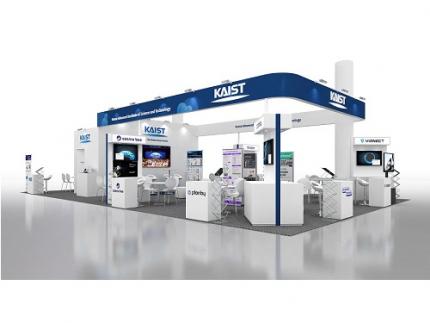
< Image 1. 3D-Graphical Profile of CES 2025 KAIST Exhibition Booth >
KAIST (President Kwang-Hyung Lee) announced on the 31st that it will operate a 140㎡ standalone booth at CES Eureka Park, which will be held in Las Vegas, USA from January 7th to 10th next year, to showcase KAIST's innovative technologies to global companies and investors.
KAIST startups VIRNECT, Standard Energy, A2US, and Panmnesia, Inc. won the 2025 CES Innovation Awards. ▴VIRNECT won the Innovation Award in the ‘Industrial Equipment and Machinery’ category for ‘VisionX’, an AI-based smart glass for industrial sites; ▴Standard Energy Co., Ltd. won the Innovation Award in the ‘Smart City’ category for developing the world’s first vanadium-ion battery; ▴A2US won the Innovation Award in the ‘Environment & Energy’ category for its portable air purifier that eliminates bacteria, odors, and fine dust in the air with just water droplets; ▴Panmnesia, Inc. won the Innovation Award in the ‘Computer Peripherals and Accessories’ category for its ‘CXL-based GPU Memory Expansion Kit’ that can drastically reduce the cost of building AI infrastructure.
< Image 2. (From left on the top row) VIRNECT, Standard Energy, (From left on the bottom row) A2US, Panmnesia, Inc. >
This exhibition will feature 15 startups that are standing out in cutting-edge technologies such as artificial intelligence (AI), robotics, mobility, and sustainability. In particular, AI-based deep tech startups in various industries such as logistics, architecture, and medicine will take up half of the total, showcasing the companies’ innovative AI technologies.
Polyphenol Factory Co.,Ltd introduces ‘Grabity’, a hair loss shampoo launched domestically, which applies the patented ingredient ‘LiftMax 308™’ that forms an instantaneous protective layer on the hair during the shampooing process. A real-time demonstration will be held at this exhibition hall so that visitors can experience the effects of the ingredient directly, and plans to enter the global market starting with the launch on Amazon in the US in January 2025.
VIRNECT will present ‘VisionX’, a prototype that won the Innovation Award this time. The product provides a chatbot AI through an AI voice interface, and has a function that allows users to check the status of the equipment in real time through conversations with the AI and receive troubleshooting guidance through voice conversations, so users can experience it directly at the KAIST Hall.
‘Standard Energy’ plans to exhibit ‘Energy Tile’, an indoor ESS that utilizes the world’s first vanadium ion battery (hereinafter referred to as VIB). VIB is absolutely safe from fire and has high installation flexibility, so it can be applied to smart cities and AI data centers.
‘A2US’ is the only company in the world that has hydroxyl radical water production technology, and won the Innovation Award for its first product, an air purifier. In the future, it is expected to be widely commercialized in air and water purification, smart farms, food tech, and semiconductor cleaning using safe and environmentally friendly hydroxyl radical water.
Panmnesia, Inc. won the CES Innovation Award for its GPU memory expansion solution equipped with its CXL 3.1 IP. By connecting a memory expansion device using Panmnesia’s CXL IP, the GPU’s memory capacity can be expanded to the terabyte level. Following the Innovation Award for ‘CXL-equipped AI Accelerator’ at CES 2024 last year, it is the only company to have won the Innovation Award for its AI-oriented CXL solution for two consecutive years.
In addition, technologies from a total of 15 companies will be introduced, including ▴Omelet ▴NEXTWAVE ▴Planby Technologies ▴Cosmo Bee ▴ImpactAI ▴Roen Surgical ▴DIDEN Roboticss ▴Autopedia ▴OAQ ▴HydroXpand ▴BOOKEND ▴Sterri.
On the central stage of the KAIST Hall, KAIST students selected as CES Student Supporters will conduct interviews with participating companies and promote the companies' innovative technologies and solutions. On the 8th, from 5 PM to 7 PM, a KAIST NIGHT event will be held where pre-invited investors and participating companies can network.
Keon Jae Lee, the head of the Institute of Technology Value Creation, said, “Through CES 2025, we will showcase innovative technologies and solutions from startups based on KAIST’s deep science and deep tech, and lead commercialization in cutting-edge technology fields such as AI, robotics, mobility, and environment/energy. KAIST plans to further promote technology commercialization by supporting the growth and marketing of innovative startups through the Institute of Technology Value Creation and by strengthening global networks and expanding cooperation opportunities.”
2024.12.31 View 24938
-
 KAIST’s RAIBO2 becomes the World’s First Robo-dog to Successfully Complete a Full-course Marathon
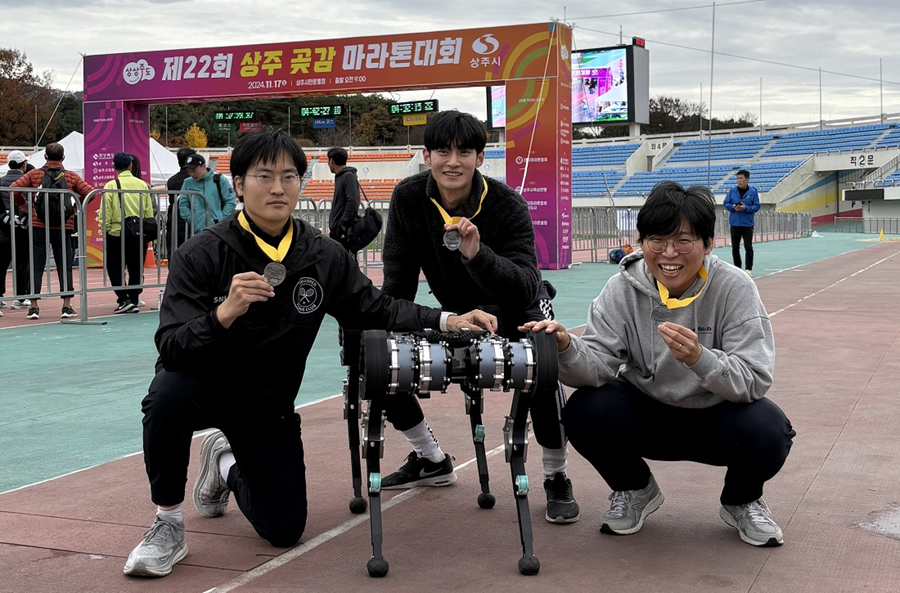
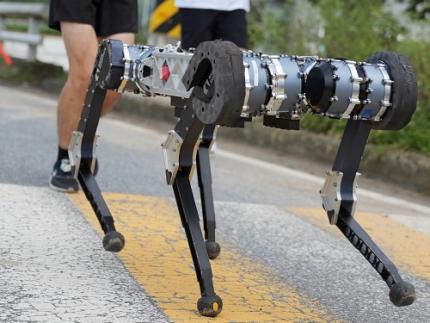
KAIST's quadrupedal walking robot "RAIBO", which can run seamlessly on sandy beaches, has now evolved into "RAIBO2"and achieved the groundbreaking milestone by becomeing the world's first quadrupedal robot to successfully complete a full-course marathon in an official event.
< Photo 1. A group photo of RAIBO2 and the team after completing the full-course marathon >
KAIST (President Kwang Hyung Lee) announced on the 17th of November that Professor Je Min Hwangbo's research team of the Department of Mechanical Engineering participated in the 22nd Sangju Dried-Persimmon Marathon and completed the full-course race (42.195 km) with a time of 4 hours 19 minutes and 52 seconds.
< Photo 2. RAIBO2 after completing the full-course marathon with its official record presented on the photo wall >
The Sangju Dried Persimmon Marathon is known for its challenging course featuring two 50 m elevation climbs, each at the 14 km and 28 km marks, making it defficult for amateur runners. This made it an especially demanding challenge for the walking robot, as unexpected losses in efficiency could occur.
< Photo 3. RAIBO2 with the completion medal around its neck >
To prepare RAIBO2, Professor Hwangbo's team developed a walking controller using reinforcement learning algorithms within their proprietary simulation environment "RaiSim". This simulator allowed the team to simlate diverse terrains such as slopes, stairs, and icy roads to ensure stable walking performance.
In particular, RAIBO2's high torque transparency joint mechanism enable the robot to efficiently harvest energy on the downhill slopes to regain some of the energy used in climbing up steep hill.
In addition, the stability of the robot was greatly improved through the collaboration with RAION ROBOTICS Inc., a company founded by the researchers from Professor Hwangbo’s lab.
< Figure 1. Conceptual diagram of power flow employed by the quadrupedal robot >
< Figure 2. The process of leg posture change of RAIBO2 walking at the most efficient walking speed of 3 m/s. By reducing the ground contact speed of the feet, the collision energy loss was reduced, and by minimizing the slipperiness of the foot upon contact, the body's kinetic energy was maintained towards the direction of the movement. >
Due to the nature of walking, pedal robots must employ highly complex systems that can withstand periodic vibrations from the frequent impacts that occur upon contact with the ground surface. Immediately after development, high efficiency was already recorded in short-distance experiments in the laboratory at the beginning of the year, but the manufacturing technology of RAION ROBOTICS significantly bolstered RAIBO's performance in running safely for a prolonged time of more than 4 hours among random pack of people in an actual marathon.
Compared to previous studies on improving walking efficiency, where external parts or software could not be changed and only limited improvements were made in some areas, Professor Hwangbo’s research team cited the fact that they were able to comprehensively solve problems by developing all steps and parts in-house, including mechanism design, electrical design, software, and artificial intelligence, as a key factor in improving efficiency.
Following the development of RAIBO1, the research team developed RAIBO2 and optimized all aspects of the robot. In particular, the team integrated the motor driver circuitry directly into the robot to minimize actuator losses and increase the control bandwidth, greatly improving walking efficiency and stability.
< Photo 4. RAIBO2 running the full-course marathon along human participants >
Choongin Lee, a Ph.D. Student that co-first author of the studies on RAIBO, said, “Through the marathon project, we demonstrated that RAIBO2 has the walking performance to stably execute services such as delivery and patrol in urban environments with many people and random objects,” and “In follow-up research, we will add autonomous navigation functions to RAIBO and strive to achieve the world’s best walking performance in mountainous and disaster environments.”
< Photo 5. RAIBO2 and co-first authors of the related research at the Ph.D. program of the Department of Mechanical Engineering at KAIST. (From left) Choongin Lee, Donghoon Youm, and Jeongsoo Park >
This research was conducted with the support of Samsung Electronics Future Technology Promotion Center and RAION ROBOTICS Inc.
2024.11.17 View 24005
-
 KAIST’s Beach-Roaming Quadrupedal Robot “RAIBO” to Run a Marathon!
“RAIBO”, KAIST’s four-legged robot featuring remarkable agility even on challenging terrains like sandy beaches, is now set to be the first in the world to complete a full marathon.
< Photo 1. A group photo of the research team of Professor Je Min Hwangbo (second from the right in the front row) of the Department of Mechanical Engineering who participated in the marathon event at 2024 Geumsan Insam Festival last September >
On the 17th of November, KAIST (represented by President Kwang Hyung Lee) announced that Professor Je Min Hwangbo’s team from the Department of Mechanical Engineering has developed an upgraded version, “RAIBO2,” which will take on the full 42.195-kilometer course at the "Sangju Dried-Persimmon Marathon".
This is over double the previous maximum distance achieved by quadruped robots, which was limited to around 20 kilometers. The KAIST team has successfully developed a robot that can walk continuously for 43 kilometers on a single charge, completing the course in 4 hours and 40 minutes by following a GPS-guided path on the university’s main athletic field. Through this marathon, the team aims to demonstrate RAIBO2’s walking performance in an actual urban environment.
Previously, most measurements of walking robots’ travel distances were confined to controlled laboratory conditions or theoretical data. This marathon challenge is thus significant in that the robot will run alongside the general public in a real urban setting, marking the first attempt to validate the practical potential of four-legged robots in real environments.
Quadruped robots have shown advantages in challenging terrains, such as ice, sand, and mountainous areas, where they can walk stably. However, limited travel distance and running time have long been obstacles to wider applications.
< Figure 1. Conceptual diagram of power flow employed by the quadruped robot >
Professor Hwangbo’s team designed every component of the robot, from its actuators to its mechanical structure, to overcome these limitations. Notably, they implemented an efficient walking control system based on reinforcement learning using their proprietary dynamic simulator “RaiSim”.
The team also collected and analyzed walking data from outdoor environments, creating a model to address walking losses. This model was then used to iteratively improve walking efficiency over one full year.
< Figure 2. The leg posture change process of RAIBO2 walking at the most efficient walking speed of 3 m/s. By reducing the ground contact speed of the feet, the collision energy loss was reduced, and by minimizing the slipperiness of the foot upon contact, the body's kinetic energy was maintained towards the direction of the movement. >
This is the team’s second attempt. Their first was during the marathon event at “Geumsan Insam Festival” in September when the robot’s battery ran out at the 37-kilometer mark, falling short of completion. The battery drained 10 kilometers earlier than expected due to frequent speed changes as the robot adjusted to the pacing of other runners on the course.
Following the initial attempt, the team focused on technical improvements for a successful finish. They enhanced control efficiency by implementing joint stiffness control directly onto the motor actuator and increased battery capacity by 33% by refining the internal structure. These improvements enabled the robot to cover a maximum distance of 67 kilometers on straight paths.
< Figure 3. Data from completing 43 km on a single charge at the main sports field on campus. Left) GPS data of the driving course used during autonomous running. Middle) Covered distance by the hour. Right) Energy consumption by module >
Choongin Lee, a Ph.D. student of RAI Lab who is one of the co-first author of this study, explained, “Our comprehensive analysis of walking losses in terms of mechanics, electrical systems, and walking methods was crucial to improving walking efficiency. This research marks an important milestone in extending the operating range of quadruped robots to urban environments.”
< Photo 2. A Photo from Practice Run>
This research was supported by the Samsung Electronics Future Technology Development Center and RAION ROBOTICS Co., Ltd.
< Photo 3. A Photo from Practice Run >
2024.11.15 View 18045