research
A KAIST research team has developed a new context-awareness technology that enables AI assistants to determine when to talk to their users based on user circumstances. This technology can contribute to developing advanced AI assistants that can offer pre-emptive services such as reminding users to take medication on time or modifying schedules based on the actual progress of planned tasks.
Unlike conventional AI assistants that used to act passively upon users’ commands, today’s AI assistants are evolving to provide more proactive services through self-reasoning of user circumstances. This opens up new opportunities for AI assistants to better support users in their daily lives. However, if AI assistants do not talk at the right time, they could rather interrupt their users instead of helping them.
The right time for talking is more difficult for AI assistants to determine than it appears. This is because the context can differ depending on the state of the user or the surrounding environment.
A group of researchers led by Professor Uichin Lee from the KAIST School of Computing identified key contextual factors in user circumstances that determine when the AI assistant should start, stop, or resume engaging in voice services in smart home environments. Their findings were published in the Proceedings of the ACM on Interactive, Mobile, Wearable and Ubiquitous Technologies (IMWUT) in September.
The group conducted this study in collaboration with Professor Jae-Gil Lee’s group in the KAIST School of Computing, Professor Sangsu Lee’s group in the KAIST Department of Industrial Design, and Professor Auk Kim’s group at Kangwon National University.
After developing smart speakers equipped with AI assistant function for experimental use, the researchers installed them in the rooms of 40 students who live in double-occupancy campus dormitories and collected a total of 3,500 in-situ user response data records over a period of a week.
The smart speakers repeatedly asked the students a question, “Is now a good time to talk?” at random intervals or whenever a student’s movement was detected. Students answered with either “yes” or “no” and then explained why, describing what they had been doing before being questioned by the smart speakers.
Data analysis revealed that 47% of user responses were “no” indicating they did not want to be interrupted. The research team then created 19 home activity categories to cross-analyze the key contextual factors that determine opportune moments for AI assistants to talk, and classified these factors into ‘personal,’ ‘movement,’ and ‘social’ factors respectively.
Personal factors, for instance, include:
1. the degree of concentration on or engagement in activities,
2. the degree urgency and busyness,
3. the state of user’s mental or physical condition, and
4. the state of being able to talk or listen while multitasking.
While users were busy concentrating on studying, tired, or drying hair, they found it difficult to engage in conversational interactions with the smart speakers.
Some representative movement factors include departure, entrance, and physical activity transitions. Interestingly, in movement scenarios, the team found that the communication range was an important factor. Departure is an outbound movement from the smart speaker, and entrance is an inbound movement. Users were much more available during inbound movement scenarios as opposed to outbound movement scenarios.
In general, smart speakers are located in a shared place at home, such as a living room, where multiple family members gather at the same time. In Professor Lee’s group’s experiment, almost half of the in-situ user responses were collected when both roommates were present. The group found social presence also influenced interruptibility. Roommates often wanted to minimize possible interpersonal conflicts, such as disturbing their roommates' sleep or work.
Narae Cha, the lead author of this study, explained, “By considering personal, movement, and social factors, we can envision a smart speaker that can intelligently manage the timing of conversations with users.”
She believes that this work lays the foundation for the future of AI assistants, adding, “Multi-modal sensory data can be used for context sensing, and this context information will help smart speakers proactively determine when it is a good time to start, stop, or resume conversations with their users.”
This work was supported by the National Research Foundation (NRF) of Korea.
< Image 1. In-situ experience sampling of user availability for conversations with AI assistants >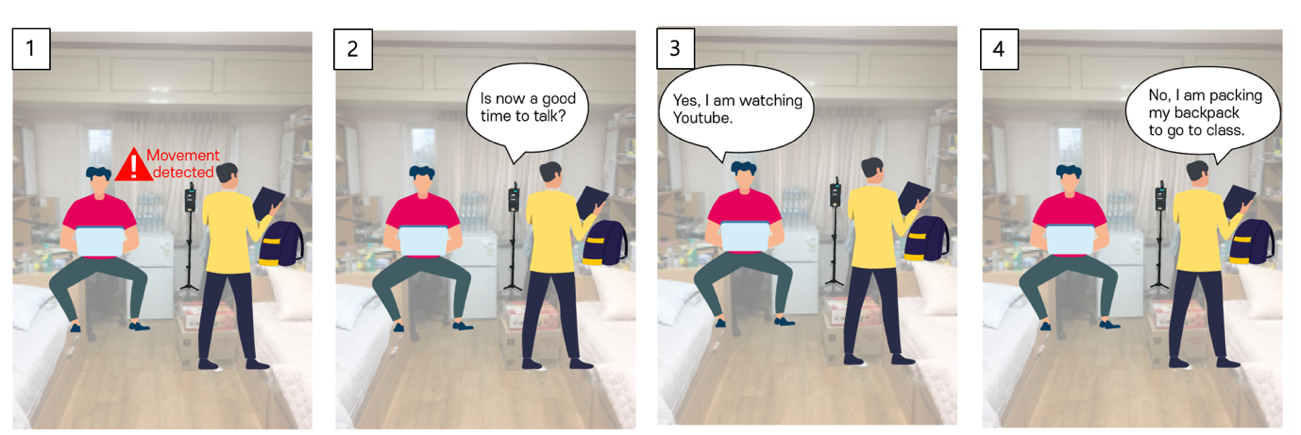
< Image 2. Key Contextual Factors that Determine Optimal Timing for AI Assistants to Talk >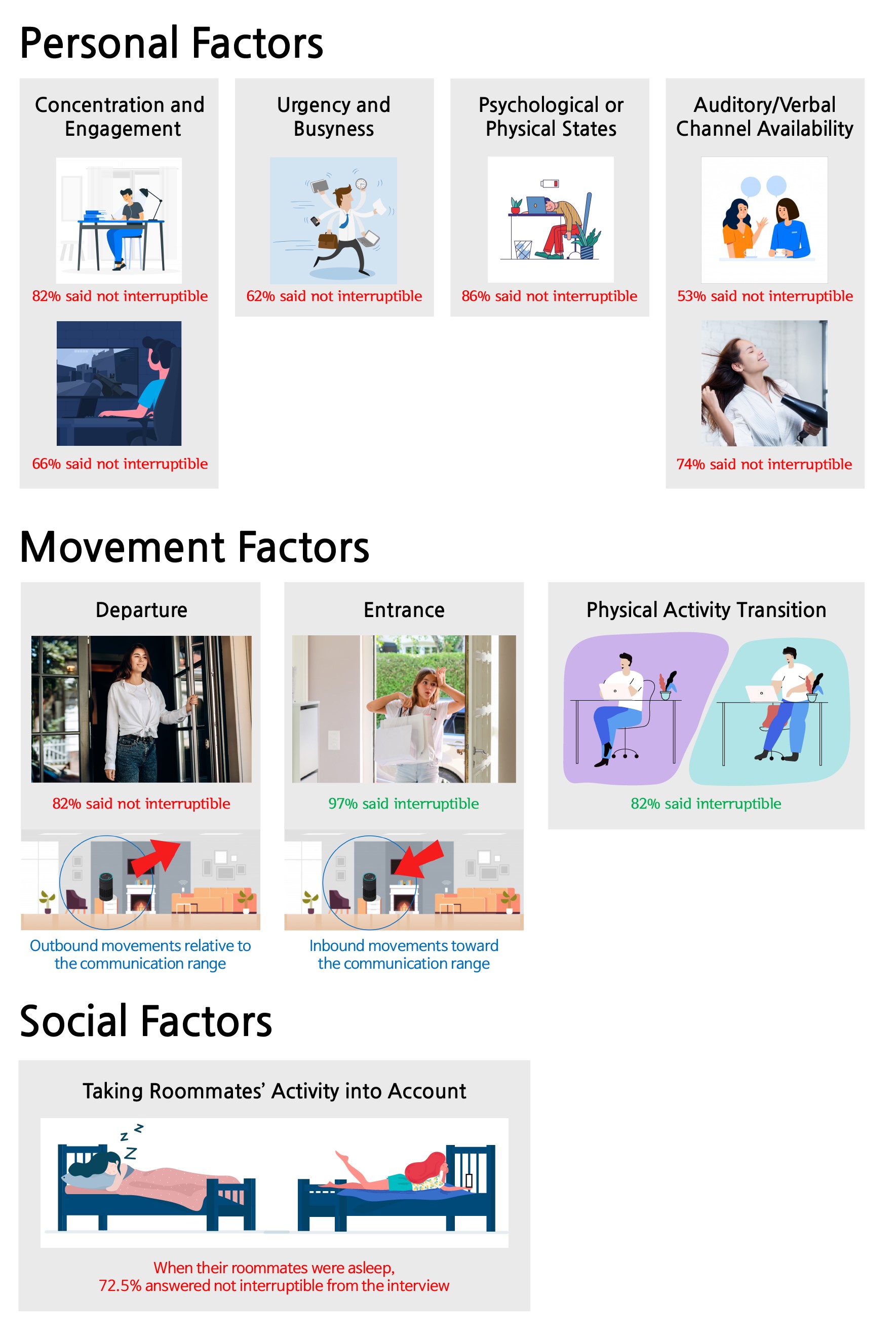
Publication:
Cha, N, et al. (2020) “Hello There! Is Now a Good Time to Talk?”: Opportune Moments for Proactive Interactions with Smart Speakers. Proceedings of the ACM on Interactive, Mobile, Wearable and Ubiquitous Technologies (IMWUT), Vol. 4, No. 3, Article No. 74, pp. 1-28. Available online at https://doi.org/10.1145/3411810
Link to Introductory Video:
https://youtu.be/AA8CTi2hEf0
Profile:
Uichin Lee
Associate Professor
uclee@kaist.ac.kr
http://ic.kaist.ac.kr
Interactive Computing Lab.
School of Computing
https://www.kaist.ac.kr
Korea Advanced Institute of Science and Technology (KAIST)
Daejeon, Republic of Korea
(END)
-
research KAIST Develops Vector Database Technology for Reliable Retrieval of Up-to-Date Information
When new information is continually added and old information is removed, an AI system may fail to find the correct material even when that material exists. KAIST researchers have developed a vector database technology that preserves the search paths leading to the needed information as data changes. This allows AI to find up-to-date information more accurately and quickly. KAIST (President Choongsik Bae) announced on October 5 that a research team led by Professor Min-Soo Kim from the School
2026-10-06 -
research KAIST Develops AI Chip That Recognizes Changes in Motion over Time
For a wearable device to distinguish walking from a brief swing of the arm, it must recognize how a movement changes over time. Korean researchers have developed a technology that stacks semiconductor devices with different response speeds, allowing them to recognize both a change that has just occurred and the changes before it. The technology could be applied to small devices that are worn on or attached to the body to analyze movement and physiological signals. KAIST (President Choongsik B
2026-09-29 -
research KAIST’s World-First Full-Course Robot Marathon Completion Published in Nature
A quadruped robot ran 42.195 km, a distance that is not easy even for humans to complete, without replacing its battery. KAIST researchers have developed this world-first achievement into design principles for long-distance operation, published the results in Nature, and are now moving toward commercializing robots that can be used in real industrial environments. KAIST (President Choongsik Bae) announced on the September 24 that the long-distance running technology of RAIBO2, a quadruped rob
2026-09-28 -
people KAIST Names Former Samsung Electronics Chairman and CEO Oh Hyun Kwon as Chair of Its Board of Trustees
KAIST announced that its Board of Trustees elected Oh Hyun Kwon, former Chairman and CEO of Samsung Electronics and Chairman of the Orange Planet startup foundation, as its new chair at the board’s 298th extraordinary meeting in Seoul on September 21, 2026. Prior to the election, Kichul Cha, a KAIST trustee and CEO of InBody, had served as acting chair since the term of former Chair Myung Ja Kim ended in late June. Kwon earned a bachelor’s degree in electrical engineering from Seo
2026-09-22 -
research KAIST Develops Smartphone AI That Uses Past Solutions to Tackle Similar Problems
A new AI technology has been developed that retains and reuses knowledge, much like writing down a solution in a notebook and applying it to similar problems rather than asking an expert for help each time. Researchers at KAIST have developed a way for small AI models running on smartphones to store and reuse knowledge from a large server model. The approach reduced server calls by an average of 55.61% compared with a non-cumulative approach while maintaining high accuracy, suggesting that mob
2026-09-21