research
A KAIST research team has developed a new context-awareness technology that enables AI assistants to determine when to talk to their users based on user circumstances. This technology can contribute to developing advanced AI assistants that can offer pre-emptive services such as reminding users to take medication on time or modifying schedules based on the actual progress of planned tasks.
Unlike conventional AI assistants that used to act passively upon users’ commands, today’s AI assistants are evolving to provide more proactive services through self-reasoning of user circumstances. This opens up new opportunities for AI assistants to better support users in their daily lives. However, if AI assistants do not talk at the right time, they could rather interrupt their users instead of helping them.
The right time for talking is more difficult for AI assistants to determine than it appears. This is because the context can differ depending on the state of the user or the surrounding environment.
A group of researchers led by Professor Uichin Lee from the KAIST School of Computing identified key contextual factors in user circumstances that determine when the AI assistant should start, stop, or resume engaging in voice services in smart home environments. Their findings were published in the Proceedings of the ACM on Interactive, Mobile, Wearable and Ubiquitous Technologies (IMWUT) in September.
The group conducted this study in collaboration with Professor Jae-Gil Lee’s group in the KAIST School of Computing, Professor Sangsu Lee’s group in the KAIST Department of Industrial Design, and Professor Auk Kim’s group at Kangwon National University.
After developing smart speakers equipped with AI assistant function for experimental use, the researchers installed them in the rooms of 40 students who live in double-occupancy campus dormitories and collected a total of 3,500 in-situ user response data records over a period of a week.
The smart speakers repeatedly asked the students a question, “Is now a good time to talk?” at random intervals or whenever a student’s movement was detected. Students answered with either “yes” or “no” and then explained why, describing what they had been doing before being questioned by the smart speakers.
Data analysis revealed that 47% of user responses were “no” indicating they did not want to be interrupted. The research team then created 19 home activity categories to cross-analyze the key contextual factors that determine opportune moments for AI assistants to talk, and classified these factors into ‘personal,’ ‘movement,’ and ‘social’ factors respectively.
Personal factors, for instance, include:
1. the degree of concentration on or engagement in activities,
2. the degree urgency and busyness,
3. the state of user’s mental or physical condition, and
4. the state of being able to talk or listen while multitasking.
While users were busy concentrating on studying, tired, or drying hair, they found it difficult to engage in conversational interactions with the smart speakers.
Some representative movement factors include departure, entrance, and physical activity transitions. Interestingly, in movement scenarios, the team found that the communication range was an important factor. Departure is an outbound movement from the smart speaker, and entrance is an inbound movement. Users were much more available during inbound movement scenarios as opposed to outbound movement scenarios.
In general, smart speakers are located in a shared place at home, such as a living room, where multiple family members gather at the same time. In Professor Lee’s group’s experiment, almost half of the in-situ user responses were collected when both roommates were present. The group found social presence also influenced interruptibility. Roommates often wanted to minimize possible interpersonal conflicts, such as disturbing their roommates' sleep or work.
Narae Cha, the lead author of this study, explained, “By considering personal, movement, and social factors, we can envision a smart speaker that can intelligently manage the timing of conversations with users.”
She believes that this work lays the foundation for the future of AI assistants, adding, “Multi-modal sensory data can be used for context sensing, and this context information will help smart speakers proactively determine when it is a good time to start, stop, or resume conversations with their users.”
This work was supported by the National Research Foundation (NRF) of Korea.
< Image 1. In-situ experience sampling of user availability for conversations with AI assistants >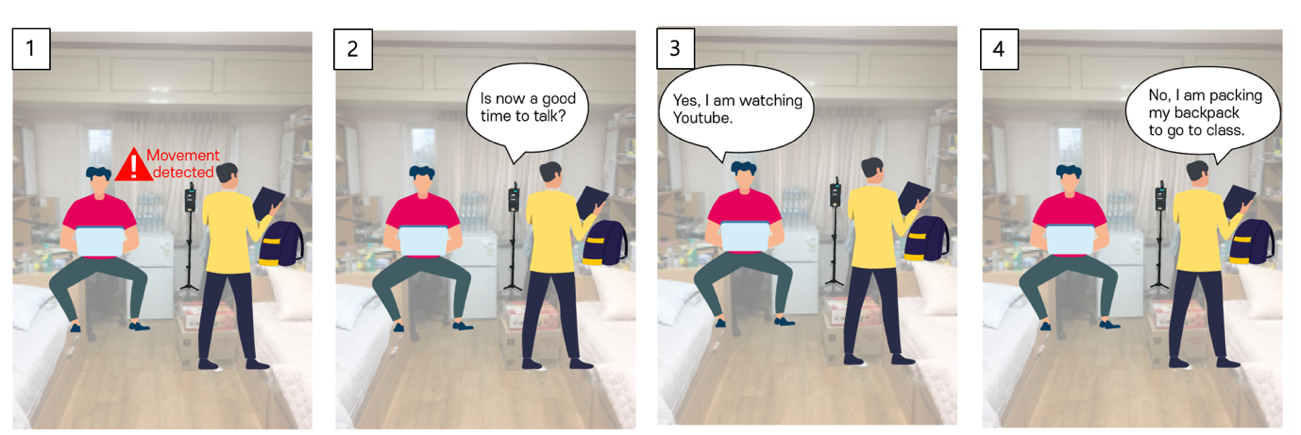
< Image 2. Key Contextual Factors that Determine Optimal Timing for AI Assistants to Talk >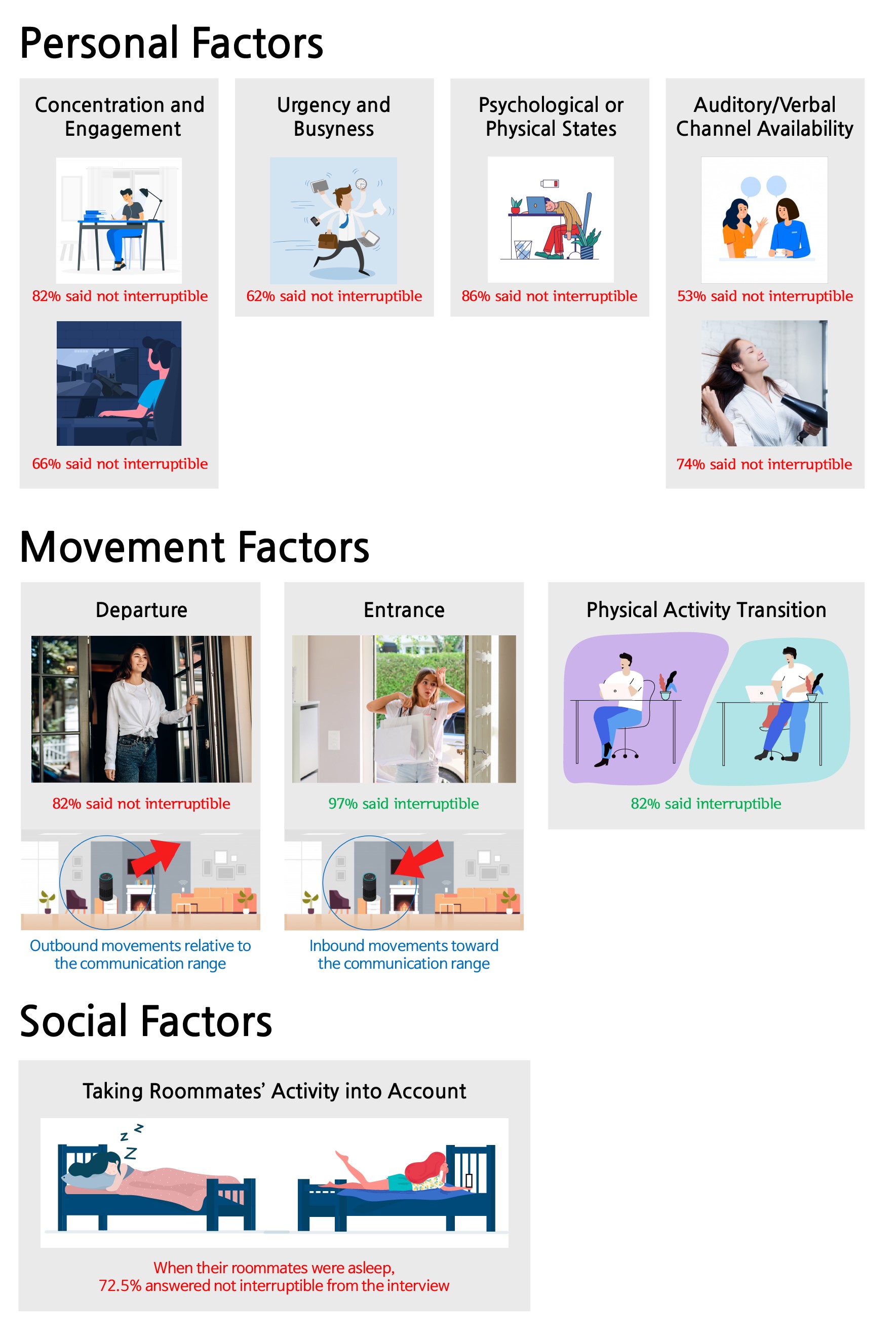
Publication:
Cha, N, et al. (2020) “Hello There! Is Now a Good Time to Talk?”: Opportune Moments for Proactive Interactions with Smart Speakers. Proceedings of the ACM on Interactive, Mobile, Wearable and Ubiquitous Technologies (IMWUT), Vol. 4, No. 3, Article No. 74, pp. 1-28. Available online at https://doi.org/10.1145/3411810
Link to Introductory Video:
https://youtu.be/AA8CTi2hEf0
Profile:
Uichin Lee
Associate Professor
uclee@kaist.ac.kr
http://ic.kaist.ac.kr
Interactive Computing Lab.
School of Computing
https://www.kaist.ac.kr
Korea Advanced Institute of Science and Technology (KAIST)
Daejeon, Republic of Korea
(END)
-
event KAIST, Kyoto, and MIT Ask Together: “How Should Humans Live in the AI Era?”
AI is moving beyond answering questions and solving problems into an era in which it acts through robots and forms relationships with people. Amid these changes, how will the roles and responsibilities of humans change, and what should we value as we live our lives? KAIST, together with participating institutions from Kyoto and MIT, is creating a forum to discuss human life and the future in the AI era. KAIST (President Choongsik Bae) announced on the 13th of November that the KAIST AI Philos
2026-11-13 -
research KAIST Removes “Speed Bottleneck” in Flash Storage… Expected to Accelerate AI Inference
Even with high-performance storage devices, inefficient data management can prevent them from reaching their full speed. KAIST researchers have developed a technology that improves the process of moving and reorganizing data to reuse storage space, increasing the data-processing performance of next-generation flash storage devices. KAIST (President Choongsik Bae) announced on November 11 that a research team led by Professor Youjip Won of the School of Electrical Engineering identified the so
2026-11-11 -
research Devilray Exposes Blind Spots in FBS Detection
DAEJEON, South Korea — Governments use them to track phones. Criminals drive them through city streets and send texts that look like they came from your bank. For 20 years, researchers have been building tools to catch these fake cell towers. They have tested those tools mostly against fake towers they built themselves. That loop has left gaps. Researchers at KAIST built a platform called Devilray that reproduces 2,592 distinct fake-base-station behaviors. They ran it against seven existi
2026-11-04 -
research KAIST Cuts AI Fine-Tuning from 10 Hours to 3… Faster Development of Medical and Coding AI
Can AI fine-tuning, that once took 10 hours, be completed in just 3 hours? KAIST researchers have developed a technology that selects the most useful training data and distributes it evenly across multiple GPUs. By reducing repetitive learning of similar data, the method shortened training time by up to 69.6% while maintaining nearly the same AI performance. The technology is expected to help develop AI tailored to specific tasks, such as corporate customer service or assisting medical profess
2026-11-02 -
event KAIST Hosts 4th Failure Society to Celebrate “Failed Projects” and Anticipate Failures in the AI Era
KAIST will host an event where participants can proudly share failed projects and imagine in advance the kinds of failures that may occur in the AI era. From setbacks already experienced to risks that have yet to emerge, participants will explore together what can be learned from failure. KAIST (President Choongsik Bae) announced on October 30 that it will hold the “4th KAIST Failure Society” from Wednesday, November 4 to Friday, November 13 under the theme “The Future and F
2026-10-30