research
The interface is easy to insert into the body when dry, but behaves ‘stealthily’ inside the brain when wet

< Figure 1. Schematic of Hydrogel Hybrid Brain-Machine Interfaces >
Professor Seongjun Park’s research team and collaborators revealed a newly developed hydrogel-based flexible brain-machine interface. To study the structure of the brain or to identify and treat neurological diseases, it is crucial to develop an interface that can stimulate the brain and detect its signals in real time. However, existing neural interfaces are mechanically and chemically different from real brain tissue. This causes foreign body response and forms an insulating layer (glial scar) around the interface, which shortens its lifespan.
To solve this problem, the research team developed a ‘brain-mimicking interface’ by inserting a custom-made multifunctional fiber bundle into the hydrogel body. The device is composed not only of an optical fiber that controls specific nerve cells with light in order to perform optogenetic procedures, but it also has an electrode bundle to read brain signals and a microfluidic channel to deliver drugs to the brain.
The interface is easy to insert into the body when dry, as hydrogels become solid. But once in the body, the hydrogel will quickly absorb body fluids and resemble the properties of its surrounding tissues, thereby minimizing foreign body response.
The research team applied the device on animal models, and showed that it was possible to detect neural signals for up to six months, which is far beyond what had been previously recorded. It was also possible to conduct long-term optogenetic and behavioral experiments on freely moving mice with a significant reduction in foreign body responses such as glial and immunological activation compared to existing devices.
“This research is significant in that it was the first to utilize a hydrogel as part of a multifunctional neural interface probe, which increased its lifespan dramatically,” said Professor Park. “With our discovery, we look forward to advancements in research on neurological disorders like Alzheimer’s or Parkinson’s disease that require long-term observation.”
The research was published in Nature Communications on June 8, 2021. (Title: Adaptive and multifunctional hydrogel hybrid probes for long-term sensing and modulation of neural activity) The study was conducted jointly with an MIT research team composed of Professor Polina Anikeeva, Professor Xuanhe Zhao, and Dr. Hyunwoo Yook.
This research was supported by the National Research Foundation (NRF) grant for emerging research, Korea Medical Device Development Fund, KK-JRC Smart Project, KAIST Global Initiative Program, and Post-AI Project.
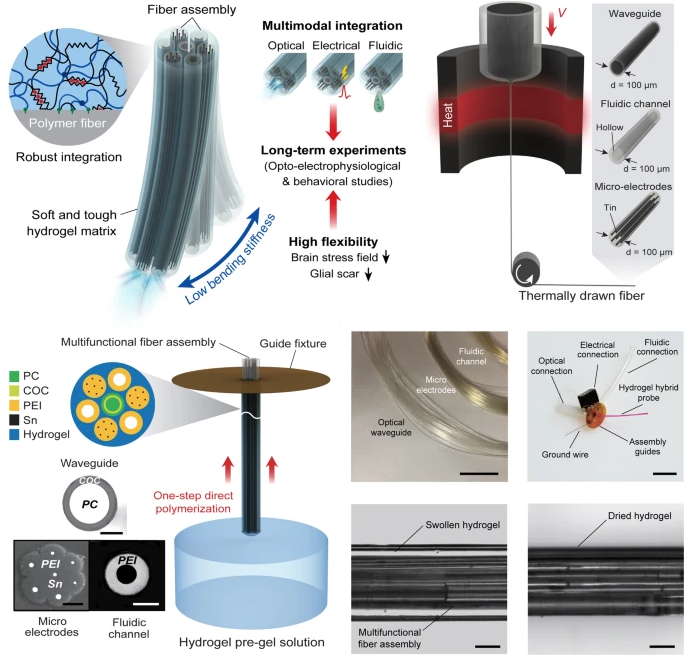
< Figure 2. Design and Fabrication of Multifunctional Hydrogel Hybrid Probes >
-Publication
Park, S., Yuk, H., Zhao, R. et al. Adaptive and multifunctional hydrogel hybrid probes for long-term sensing and modulation of neural activity. Nat Commun 12, 3435 (2021). https://doi.org/10.1038/s41467-021-23802-9
-Profile
Professor Seongjun Park
Bio and Neural Interfaces Laboratory
Department of Bio and Brain Engineering
KAIST
-
research KAIST Researchers Uncover How Neurons Deliver RNA to Where It Is Needed
Much like a courier reading an address on a package, neurons must deliver RNA to the precise locations where it is needed. A KAIST research team has discovered how a small chemical modification on RNA acts as a “delivery tag,” helping selected RNAs travel to distant regions of neurons. The findings provide a basis for investigating RNA “delivery errors” in brain disorders—cases in which RNA is produced normally but fails to reach its intended destination—an
2026-09-14 -
research Vitamin A Derivative Preserves T Cells’ Function as KAIST Points to a New Strategy for Treating Intractable Brain Tumors
Immune cells can become exhausted after prolonged exposure to cancer, gradually losing their ability to attack tumor cells. This phenomenon is particularly pronounced in aggressive brain tumors and can severely limit the effectiveness of immunotherapy. A KAIST research team has now discovered that all-trans retinoic acid (ATRA), a vitamin A derivative, may help prevent such exhaustion and enhance the efficacy of immune checkpoint inhibitors. KAIST (President Choongsik Bae) announced on Septem
2026-09-08 -
research Neural Implant in Korea Remotely Controlled from the United States, Bringing Brain Research into the IoT Era
A researcher in Chicago remotely controls a miniaturized brain implant in Daejeon, Korea — over the internet. Korean researchers have developed a wireless device that can deliver drugs and light to precisely modulate targeted neurons from anywhere in the world. The technology is expected to overcome the constraints of distance and location, supporting long-term studies of brain disorders and the future development of therapeutic devices. KAIST (President Choongsik Bae) announced on Augu
2026-08-27 -
research KAIST Develops Core Technology to Reverse Biological Changes Once Thought Irreversible, Opening New Possibilities for Aging and Cancer Research
Once a cell has locked into an abnormal state — the way cancer cells do — can it ever be restored back to normal? A KAIST research team has identified the ‘molecular lock’ that keeps cells trapped in an altered state, opening a new path toward releasing that lock and reversing a cell’s fate. KAIST (President Choongsik Bae) announced on the 21st of August that a research team led by Professor Kwang-Hyun Cho of the Department of Bio and Brain Engineering has, for t
2026-08-21 -
research KAIST Uncovers the “Hidden Key” to Immunotherapy for Intractable Brain Tumors
Researchers have uncovered a clue to why immune checkpoint inhibitors—cancer therapies that release the immune “brakes” exploited by tumors to evade attack—show limited efficacy in some brain tumors. A KAIST research team found that B cell and antibody responses initiated in tumor-draining lymph nodes, rather than T cells alone, are critical to the antitumor effects of anti-CTLA-4 therapy, opening a new avenue for treating intractable brain tumors. KAIST (President
2026-07-20