policy
The benchmark for the responsible usage of AI technology in the healthcare sector will promote clarity and high standards for technological applications
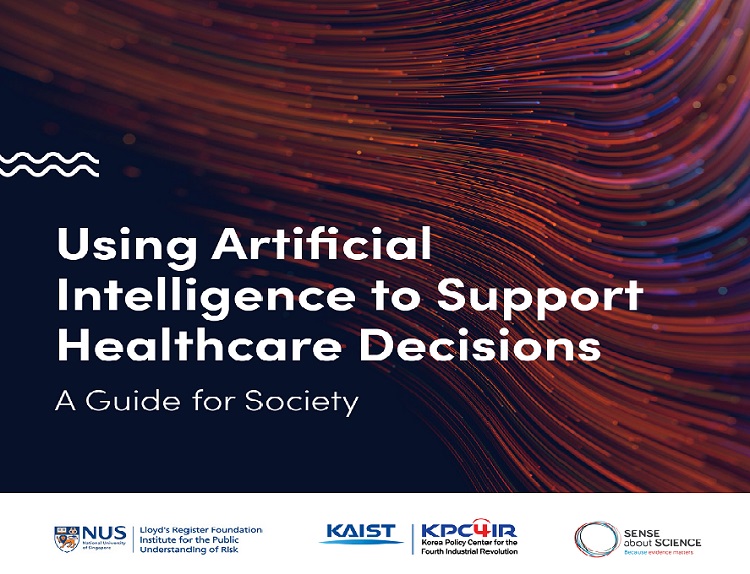
< AI Guide for healthcare sector published by KAIST, NUS, and Sense about Science. >
The KAIST Korea Policy Center for the Fourth Industrial Revolution (KPC4IR) published 'Using AI to Support Healthcare Decisions: A Guide for Society.' This global guide is designed to serve as a benchmark for the responsible usage of AI technologies, and will promote clarity and high standards for technological applications in the healthcare sector. The guide details what should be considered when making clinical decisions to help reduce the chances of the AI giving false or misleading results.
The KPC4IR presented the guide in collaboration with the Lloyd’s Register Foundation Institute for the Public Understanding of Risk at the National University of Singapore (NUS IPUR) and Sense about Science, a non-profit organization in the UK specialized in science communication, during the 2021 SIG-KDD (Special Interest Group on Knowledge Discovery and Data Mining) Conference on August 15.
AI technology is being widely used in the healthcare sector and has already proved its accuracy and efficiency in diagnosing and predicting diseases. Despite its huge impact on our daily lives in every sector of society, AI technology has some drawbacks and comes with risks, especially due to biased algorithms.
“We focused on the ‘reliability’ of AI applications in the healthcare sector to make all data well represented, in good quality. The technology will eventually innovate to better serve the people’s new demand, especially critical demands for safety and precision in healthcare services. This global guide will help both developers and people’s understanding of the appropriate technology applications,” says Director So Young Kim at the KPC4IR.
The guide, for instance, says that to scrutinize quality and reliability, the source of the data must be clearly known; the data must have been collected or selected for the purpose it’s being used for; the limitations and assumptions for that purpose have been clearly stated; the biases have been addressed; and it has been properly tested in the real world. It also reflects the importance of the representativeness of data that will affect the accuracy of the AI applications.
“By being transparent and demonstrating the steps taken to check that the AI is reliable, researchers and developers can help give people confidence about providing their data,” the guide states.
For this guide, the KPC4IR and its collaborators collected data after working with numerous experts from the Graduate School of AI at KAIST, the Science and Technology Policy Institute in Korea, Asan Medical Center in Seoul, Seoul National University Bundang Hospital, and AI solution companies.

< From left: Director So Young Kim at KAIST KPC4IR, Director Chan Ghee Koh at NUS IPUR, and Director Tracey Brown OBE at Sense about Science. >
-
event KAIST to Chart a Platform-FirstCourse for “Physical AI” Beyond Humanoids
KAIST hosted “Physical AI KOREA 2026” at its Daejeon campus on October 13. At the event, KAIST presented physical AI platform technologies that can be applied not only to manufacturing but also to healthcare, defense, logistics, and everyday life, as well as strategies for research, education, and entrepreneurship that can be utilized by a wide range of companies. Humanoid robots are beginning to surpass human records in robotic competitions modeled after Olympic events such as tr
2026-10-12 -
event KAIST to Showcase Noise Reduction and Robotics Technologies at 2026 Tech Fair
Technologies that reduce noise using thin, lightweight structures, make wireless charging devices lighter, and enable robots to navigate and perform tasks autonomously will be on display at the 2026 KAIST Tech Fair. The event will give companies an opportunity to explore technologies developed in KAIST laboratories and discuss potential applications in their products and manufacturing processes directly with the researchers. KAIST announced on October 12 that it will hold the 2026 KAIST Tech
2026-10-12 -
research KAIST Develops Vector Database Technology for Reliable Retrieval of Up-to-Date Information
When new information is continually added and old information is removed, an AI system may fail to find the correct material even when that material exists. KAIST researchers have developed a vector database technology that preserves the search paths leading to the needed information as data changes. This allows AI to find up-to-date information more accurately and quickly. KAIST (President Choongsik Bae) announced on October 5 that a research team led by Professor Min-Soo Kim from the School
2026-10-06 -
research KAIST Develops AI Chip That Recognizes Changes in Motion over Time
For a wearable device to distinguish walking from a brief swing of the arm, it must recognize how a movement changes over time. Korean researchers have developed a technology that stacks semiconductor devices with different response speeds, allowing them to recognize both a change that has just occurred and the changes before it. The technology could be applied to small devices that are worn on or attached to the body to analyze movement and physiological signals. KAIST (President Choongsik B
2026-09-29 -
research KAIST’s World-First Full-Course Robot Marathon Completion Published in Nature
A quadruped robot ran 42.195 km, a distance that is not easy even for humans to complete, without replacing its battery. KAIST researchers have developed this world-first achievement into design principles for long-distance operation, published the results in Nature, and are now moving toward commercializing robots that can be used in real industrial environments. KAIST (President Choongsik Bae) announced on the September 24 that the long-distance running technology of RAIBO2, a quadruped rob
2026-09-28