people
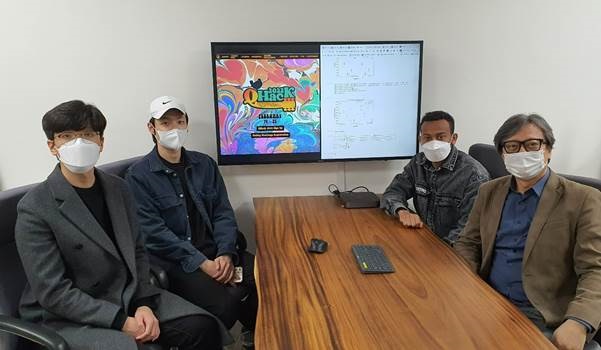
< From left: Ju-young Ryu, Jeung-rak Lee, and Eyuel Elala in Professor June-Koo Rhee >
The research team consisting of three master students Ju-Young Ryu, Jeung-rak Lee, and Eyel Elala in Professor June-Koo Rhee’s group from the KAIST IRTC of Quantum Computing for AI has won the first place at the QHack 2022 Open Hackathon Science Challenge.
The QHack 2022 Open Hackathon is one of the world’s prestigious quantum software hackathon events held by US Xanadu, in which 250 people from 100 countries participate. Major sponsors such as IBM Quantum, AWS, CERN QTI, and Google Quantum AI proposed challenging problems, and a winning team is selected judged on team projects in each of the 13 challenges.
The KAIST team supervised by Professor Rhee received the First Place prize on the Science Challenge which was organized by the CERN QTI of the European Communities. The team will be awarded an opportunity to tour CERN’s research lab in Europe for one week along with an online internship.
The students on the team presented a method for “Leaning Based Error Mitigation for VQE,” in which they implemented an LBEM protocol to lower the error in quantum computing, and leveraged the protocol in the VQU algorithm which is used to calculate the ground state energy of a given molecule.
Their research successfully demonstrated the ability to effectively mitigate the error in IBM Quantum hardware and the virtual error model. In conjunction, Professor June-Koo (Kevin) Rhee founded a quantum computing venture start-up, Qunova Computing(https://qunovacomputing.com), with technology tranfer from the KAIST ITRC of Quantum Computing for AI. Qunova Computing is one of the frontier of the quantum software industry in Korea.
-
research Devilray Exposes Blind Spots in FBS Detection
DAEJEON, South Korea — Governments use them to track phones. Criminals drive them through city streets and send texts that look like they came from your bank. For 20 years, researchers have been building tools to catch these fake cell towers. They have tested those tools mostly against fake towers they built themselves. That loop has left gaps. Researchers at KAIST built a platform called Devilray that reproduces 2,592 distinct fake-base-station behaviors. They ran it against seven existi
2026-11-04 -
research KAIST Cuts AI Fine-Tuning from 10 Hours to 3… Faster Development of Medical and Coding AI
Can AI fine-tuning, that once took 10 hours, be completed in just 3 hours? KAIST researchers have developed a technology that selects the most useful training data and distributes it evenly across multiple GPUs. By reducing repetitive learning of similar data, the method shortened training time by up to 69.6% while maintaining nearly the same AI performance. The technology is expected to help develop AI tailored to specific tasks, such as corporate customer service or assisting medical profess
2026-11-02 -
event KAIST Hosts 4th Failure Society to Celebrate “Failed Projects” and Anticipate Failures in the AI Era
KAIST will host an event where participants can proudly share failed projects and imagine in advance the kinds of failures that may occur in the AI era. From setbacks already experienced to risks that have yet to emerge, participants will explore together what can be learned from failure. KAIST (President Choongsik Bae) announced on October 30 that it will hold the “4th KAIST Failure Society” from Wednesday, November 4 to Friday, November 13 under the theme “The Future and F
2026-10-30 -
research KAIST Develops AI That Reconstructs Cloud-Covered Ground in Satellite Images with Photo-Like Clarity
Satellite images of the Earth are not always easy to use. Clouds can block the view of the ground, and images captured with certain imaging methods look different from ordinary photographs, which makes them difficult to interpret. A KAIST research team has developed an artificial intelligence (AI) model that learns the appearance of diverse terrain and cities. The model can restore cloud-covered images and convert radar images into images that resemble ordinary photographs. It applies what it
2026-10-20 -
event KAIST Presents “Jazz AI Artists” That Respond Spontaneously to Human Performers at the Jarasum Jazz Festival
When a jazz pianist stopped playing, a “jazz AI artist” followed the flow of the performance and continued on the piano. Even when the musician’s tempo and rhythm changed, the AI continued its part smoothly. When a pianist began improvising, artificial intelligence (AI) also generated bass and drum accompaniment. KAIST researchers presented music AI technology that listens and responds to human performers and creates music together with them on an actual jazz stage. KAIST
2026-10-19