people
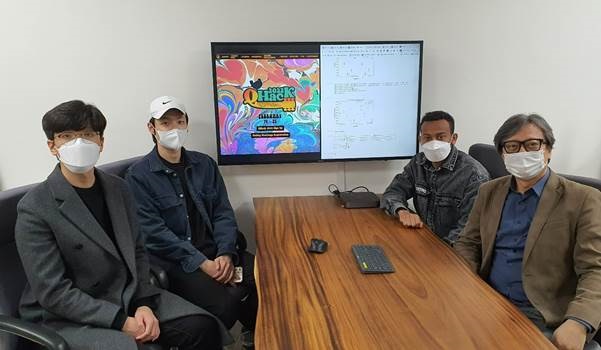
< From left: Ju-young Ryu, Jeung-rak Lee, and Eyuel Elala in Professor June-Koo Rhee >
The research team consisting of three master students Ju-Young Ryu, Jeung-rak Lee, and Eyel Elala in Professor June-Koo Rhee’s group from the KAIST IRTC of Quantum Computing for AI has won the first place at the QHack 2022 Open Hackathon Science Challenge.
The QHack 2022 Open Hackathon is one of the world’s prestigious quantum software hackathon events held by US Xanadu, in which 250 people from 100 countries participate. Major sponsors such as IBM Quantum, AWS, CERN QTI, and Google Quantum AI proposed challenging problems, and a winning team is selected judged on team projects in each of the 13 challenges.
The KAIST team supervised by Professor Rhee received the First Place prize on the Science Challenge which was organized by the CERN QTI of the European Communities. The team will be awarded an opportunity to tour CERN’s research lab in Europe for one week along with an online internship.
The students on the team presented a method for “Leaning Based Error Mitigation for VQE,” in which they implemented an LBEM protocol to lower the error in quantum computing, and leveraged the protocol in the VQU algorithm which is used to calculate the ground state energy of a given molecule.
Their research successfully demonstrated the ability to effectively mitigate the error in IBM Quantum hardware and the virtual error model. In conjunction, Professor June-Koo (Kevin) Rhee founded a quantum computing venture start-up, Qunova Computing(https://qunovacomputing.com), with technology tranfer from the KAIST ITRC of Quantum Computing for AI. Qunova Computing is one of the frontier of the quantum software industry in Korea.
-
research KAIST Develops Vector Database Technology for Reliable Retrieval of Up-to-Date Information
When new information is continually added and old information is removed, an AI system may fail to find the correct material even when that material exists. KAIST researchers have developed a vector database technology that preserves the search paths leading to the needed information as data changes. This allows AI to find up-to-date information more accurately and quickly. KAIST (President Choongsik Bae) announced on October 5 that a research team led by Professor Min-Soo Kim from the School
2026-10-06 -
research KAIST Develops AI Chip That Recognizes Changes in Motion over Time
For a wearable device to distinguish walking from a brief swing of the arm, it must recognize how a movement changes over time. Korean researchers have developed a technology that stacks semiconductor devices with different response speeds, allowing them to recognize both a change that has just occurred and the changes before it. The technology could be applied to small devices that are worn on or attached to the body to analyze movement and physiological signals. KAIST (President Choongsik B
2026-09-29 -
research KAIST’s World-First Full-Course Robot Marathon Completion Published in Nature
A quadruped robot ran 42.195 km, a distance that is not easy even for humans to complete, without replacing its battery. KAIST researchers have developed this world-first achievement into design principles for long-distance operation, published the results in Nature, and are now moving toward commercializing robots that can be used in real industrial environments. KAIST (President Choongsik Bae) announced on the September 24 that the long-distance running technology of RAIBO2, a quadruped rob
2026-09-28 -
people KAIST Names Former Samsung Electronics Chairman and CEO Oh Hyun Kwon as Chair of Its Board of Trustees
KAIST announced that its Board of Trustees elected Oh Hyun Kwon, former Chairman and CEO of Samsung Electronics and Chairman of the Orange Planet startup foundation, as its new chair at the board’s 298th extraordinary meeting in Seoul on September 21, 2026. Prior to the election, Kichul Cha, a KAIST trustee and CEO of InBody, had served as acting chair since the term of former Chair Myung Ja Kim ended in late June. Kwon earned a bachelor’s degree in electrical engineering from Seo
2026-09-22 -
research KAIST Develops Smartphone AI That Uses Past Solutions to Tackle Similar Problems
A new AI technology has been developed that retains and reuses knowledge, much like writing down a solution in a notebook and applying it to similar problems rather than asking an expert for help each time. Researchers at KAIST have developed a way for small AI models running on smartphones to store and reuse knowledge from a large server model. The approach reduced server calls by an average of 55.61% compared with a non-cumulative approach while maintaining high accuracy, suggesting that mob
2026-09-21