policy
Courtesy of École Centrale Paris News: http://www.ecp.fr/lang/en/home/news?actuID=48892
Strengthening of the partnership betwenn CentraleSupélec and KAIST University, South Korea
The two institutions signed a new agreement.
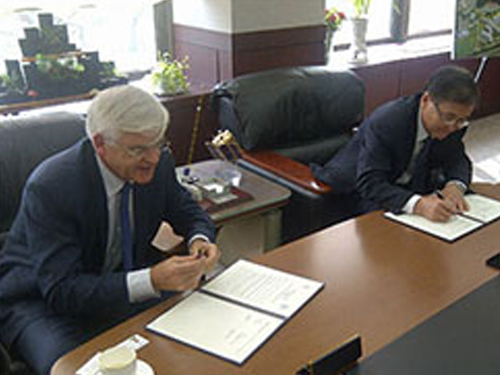
Hervé Biausser (left in the picture), Director of CentraleSupélec, has met Sung-Mo Steve Kang (right in the picture), the President of the Korea Advanced Institute of Science and Technology (KAIST). They signed an agreement aiming to strengthen the partnership between the two institutions concerning research and higher education.
CentraleSupélec and KAIST have cooperated since 2010 on research projects in the context of the Erasmus Mundus BEAM and EASED programs, which are coordinated by CentraleSupélec.
The next step is now the application of graduate academic mobility in the common fields of excellency of the institutions: energy, electronic, physics and mathematics.
-
research KAIST Opens a “Highway” for Lithium Ions with Liquid-Crystalline Polymers, Developing Next-Generation Fast-Charging Battery Technology
When using electric vehicles or smartphones, users often experience inconvenience from long charging times and gradually shortening battery life. To increase charging speed and extend usage time, next-generation batteries with high energy density are essential. However, fast charging has had limitations because deposits can accumulate inside batteries, degrading performance and even increasing the risk of fire. A Korean research team has developed a new foundational technology to address this
2026-11-09 -
research KAIST Uses Surface ‘Defects’ to Enhance Droplet Formation and Removal, Achieving Up to 5.5 Times the Heat Transfer Performance of Conventional Surfaces
A technology that boosts condensation heat transfer performance by up to 5.5 times that of conventional copper surfaces has been developed by helping water droplets form more readily and detach more quickly. It is expected to help improve the energy efficiency of power plants and desalination facilities and enhance the cooling performance of electronic devices. KAIST (President Choongsik Bae) announced on August 23 that a joint research team led by Professor Youngsuk Nam from the Department o
2026-08-24 -
research KAIST Transforms Hydrogen Energy by Flattening Granular Catalysts into Paper-Thin Sheets
<(From Left) Ph.D candidate HyunWoo J Yang, Ph.D candidate SangJae Lee, Professor EunAe Cho, Ph.D candidate DongWon Shin> Catalysts are the “invisible engines” of hydrogen energy, governing both hydrogen production and electricity generation. Conventional catalysts are typically fabricated in granular particle form, which is easy to synthesize but suffers from inefficient use of precious metals and limited durability. KAIST researchers have introduced a paper-thin sheet arch
2026-01-23 -
research KAIST, Production Temperature ↓ by 500°C, Power Output ↑ 2x… Next-Generation Ceramic Electrochemical Cell Reborn
<(Top row, from left) Professor Kang Taek Lee, Ph.D candidate Yejin Kang, Dr. Dongyeon Kim, (Bottom row, from left) M.S candidate Mincheol Lee, Ph.D candidate Seeun Oh, Ph.D candidate Seungsoo Jang, Ph.D candidate Hyeonggeun Kim> As power demand surges in the AI era, the “protonic ceramic electrochemical cell (PCEC),” which can simultaneously produce electricity and hydrogen, is gaining attention as a next-generation energy technology. However, this cell has faced the techni
2025-12-05 -
research Batteries Make 12Minute Charge for 800km Drive a Reality
<Photo 1. (From left in the front row) Dr. Hyeokjin Kwon from Chemical and Biomolecular Engineering, Professor Hee Tak Kim, and Professor Seong Su Kim from Mechanical Engineering> Korean researchers have ushered in a new era for electric vehicle (EV) battery technology by solving the long-standing dendrite problem in lithium-metal batteries. While conventional lithium-ion batteries are limited to a maximum range of 600 km, the new battery can achieve a range of 800 km on a single charge
2025-09-04