research
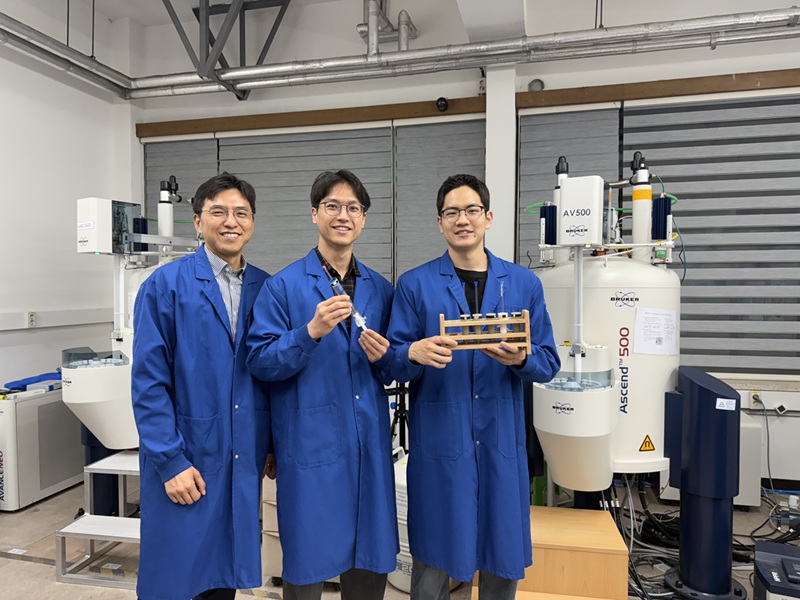
< Photo 1. (From left) Professor Hyunwoo Kim and students Donghun Kim and Gyeongseon Choi in the Integrated M.S./Ph.D. program of the Department of Chemistry >
Thalidomide, a drug once used to alleviate morning sickness in pregnant women, exhibits distinct properties due to its optical isomers* in the body: one isomer has a sedative effect, while the other causes severe side effects like birth defects. As this example illustrates, precise organic synthesis techniques, which selectively synthesize only the desired optical isomer, are crucial in new drug development. Overcoming the traditional methods that struggled with simultaneously analyzing multiple reactants, our research team has developed the world's first technology to precisely analyze 21 types of reactants simultaneously. This breakthrough is expected to make a significant contribution to new drug development utilizing AI and robots.
*Optical Isomers: A pair of molecules with the same chemical formula that are mirror images of each other and cannot be superimposed due to their asymmetric structure. This is analogous to a left and right hand, which are similar in form but cannot be perfectly overlaid.
KAIST's Professor Hyunwoo Kim's research team in the Department of Chemistry announced on the 16th that they have developed an innovative optical isomer analysis technology suitable for the era of AI-driven autonomous synthesis*. This research is the world's first technology to precisely analyze asymmetric catalytic reactions involving multiple reactants simultaneously using high-resolution fluorine nuclear magnetic resonance spectroscopy (19F NMR). It is expected to make groundbreaking contributions to various fields, including new drug development and catalyst optimization.
*AI-driven Autonomous Synthesis: An advanced technology that automates and optimizes chemical substance synthesis processes using artificial intelligence (AI). It is gaining attention as a core element for realizing automated and intelligent research environments in future laboratories. AI predicts and adjusts experimental conditions, interprets results, and designs subsequent experiments independently, minimizing human intervention in repetitive experiments and significantly increasing research efficiency and innovativeness.
Currently, while autonomous synthesis systems can automate everything from reaction design to execution, reaction analysis still relies on individual processing using traditional equipment. This leads to slower speeds and bottlenecks, making it unsuitable for high-speed repetitive experiments.
Furthermore, multi-substrate simultaneous screening techniques proposed in the 1990s garnered attention as a strategy to maximize reaction analysis efficiency. However, limitations of existing chromatography-based analysis methods restricted the number of applicable substrates. In asymmetric synthesis reactions, which selectively synthesize only the desired optical isomer, simultaneously analyzing more than 10 types of substrates was nearly impossible.
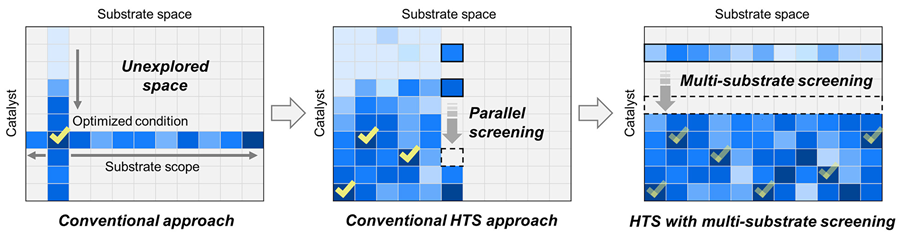
< Figure 1. Conventional organic reaction evaluation methods follow a process of deriving optimal reaction conditions using a single substrate, then expanding the substrate scope one by one under those conditions, leaving potential reaction areas unexplored. To overcome this, high-throughput screening is introduced to broadly explore catalyst reactivity for various substrates. When combined with multi-substrate screening, this approach allows for a much broader and more systematic understanding of reaction scope and trends. >
To overcome these limitations, the research team developed a 19F NMR-based multi-substrate simultaneous screening technology. This method involves performing asymmetric catalytic reactions with multiple reactants in a single reaction vessel, introducing a fluorine functional group into the products, and then applying their self-developed chiral cobalt reagent to clearly quantify all optical isomers using 19F NMR.
Utilizing the excellent resolution and sensitivity of 19F NMR, the research team successfully performed asymmetric synthesis reactions of 21 substrates simultaneously in a single reaction vessel and quantitatively measured the product yield and optical isomer ratio without any separate purification steps.
Professor Hyunwoo Kim stated, "While anyone can perform asymmetric synthesis reactions with multiple substrates in one reactor, accurately analyzing all the products has been a challenging problem to solve until now. We expect that achieving world-class multi-substrate screening analysis technology will greatly contribute to enhancing the analytical capabilities of AI-driven autonomous synthesis platforms."
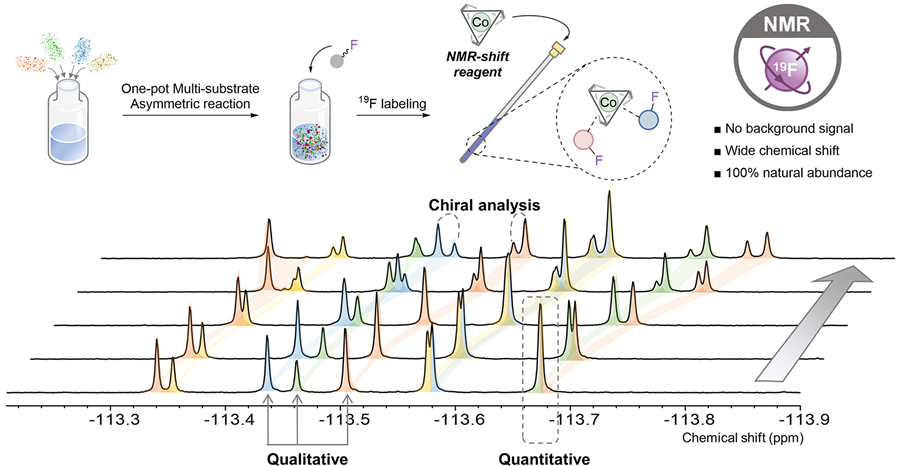
< Figure 2. A method for analyzing multi-substrate asymmetric catalytic reactions, where different substrates react simultaneously in a single reactor, using fluorine nuclear magnetic resonance has been implemented. By utilizing the characteristics of fluorine nuclear magnetic resonance, which has a clean background signal and a wide chemical shift range, the reactivity of each substrate can be quantitatively analyzed. It is also shown that the optical activity of all reactants can be simultaneously measured using a cobalt metal complex. >
He further added, "This research provides a technology that can rapidly verify the efficiency and selectivity of asymmetric catalytic reactions essential for new drug development, and it is expected to be utilized as a core analytical tool for AI-driven autonomous research."
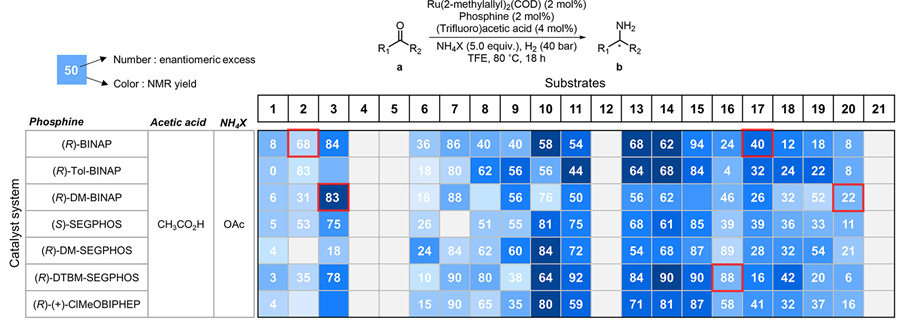
< Figure 3. It can be seen that in a multi-substrate reductive amination reaction using a total of 21 substrates, the yield and optical activity of the reactants according to the catalyst system were simultaneously measured using a fluorine nuclear magnetic resonance-based analysis platform. The yield of each reactant is indicated by color saturation, and the optical activity by numbers. >
Donghun Kim (first author, Integrated M.S./Ph.D. program) and Gyeongseon Choi (second author, Integrated M.S./Ph.D. program) from the KAIST Department of Chemistry participated in this research. The study was published online in the Journal of the American Chemical Society on May 27, 2025.
※ Paper Title: One-pot Multisubstrate Screening for Asymmetric Catalysis Enabled by 19F NMR-based Simultaneous Chiral Analysis
※ DOI: 10.1021/jacs.5c03446
This research was supported by the National Research Foundation of Korea's Mid-Career Researcher Program, the Asymmetric Catalytic Reaction Design Center, and the KAIST KC30 Project.
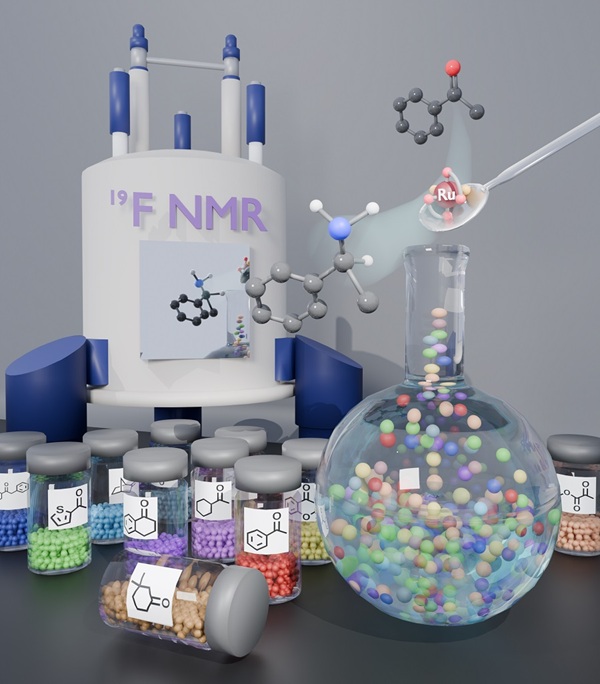
< Figure 4. Conceptual diagram of performing multi-substrate screening reactions and utilizing fluorine nuclear magnetic resonance spectroscopy. >
-
event KAIST, Kyoto, and MIT Ask Together: “How Should Humans Live in the AI Era?”
AI is moving beyond answering questions and solving problems into an era in which it acts through robots and forms relationships with people. Amid these changes, how will the roles and responsibilities of humans change, and what should we value as we live our lives? KAIST, together with participating institutions from Kyoto and MIT, is creating a forum to discuss human life and the future in the AI era. KAIST (President Choongsik Bae) announced on the 13th of November that the KAIST AI Philos
2026-11-13 -
research KAIST Removes “Speed Bottleneck” in Flash Storage… Expected to Accelerate AI Inference
Even with high-performance storage devices, inefficient data management can prevent them from reaching their full speed. KAIST researchers have developed a technology that improves the process of moving and reorganizing data to reuse storage space, increasing the data-processing performance of next-generation flash storage devices. KAIST (President Choongsik Bae) announced on November 11 that a research team led by Professor Youjip Won of the School of Electrical Engineering identified the so
2026-11-11 -
research Devilray Exposes Blind Spots in FBS Detection
DAEJEON, South Korea — Governments use them to track phones. Criminals drive them through city streets and send texts that look like they came from your bank. For 20 years, researchers have been building tools to catch these fake cell towers. They have tested those tools mostly against fake towers they built themselves. That loop has left gaps. Researchers at KAIST built a platform called Devilray that reproduces 2,592 distinct fake-base-station behaviors. They ran it against seven existi
2026-11-04 -
research KAIST Cuts AI Fine-Tuning from 10 Hours to 3… Faster Development of Medical and Coding AI
Can AI fine-tuning, that once took 10 hours, be completed in just 3 hours? KAIST researchers have developed a technology that selects the most useful training data and distributes it evenly across multiple GPUs. By reducing repetitive learning of similar data, the method shortened training time by up to 69.6% while maintaining nearly the same AI performance. The technology is expected to help develop AI tailored to specific tasks, such as corporate customer service or assisting medical profess
2026-11-02 -
event KAIST Hosts 4th Failure Society to Celebrate “Failed Projects” and Anticipate Failures in the AI Era
KAIST will host an event where participants can proudly share failed projects and imagine in advance the kinds of failures that may occur in the AI era. From setbacks already experienced to risks that have yet to emerge, participants will explore together what can be learned from failure. KAIST (President Choongsik Bae) announced on October 30 that it will hold the “4th KAIST Failure Society” from Wednesday, November 4 to Friday, November 13 under the theme “The Future and F
2026-10-30