research
< Photo 1. Professor Jaesik Choi, KAIST Kim Jaechul Graduate School of AI >
Recently, text-based image generation models can automatically create high-resolution, high-quality images solely from natural language descriptions. However, when a typical example like the Stable Diffusion model is given the text "creative," its ability to generate truly creative images remains limited. KAIST researchers have developed a technology that can enhance the creativity of text-based image generation models such as Stable Diffusion without additional training, allowing AI to draw creative chair designs that are far from ordinary.
Professor Jaesik Choi's research team at KAIST Kim Jaechul Graduate School of AI, in collaboration with NAVER AI Lab, developed this technology to enhance the creative generation of AI generative models without the need for additional training.
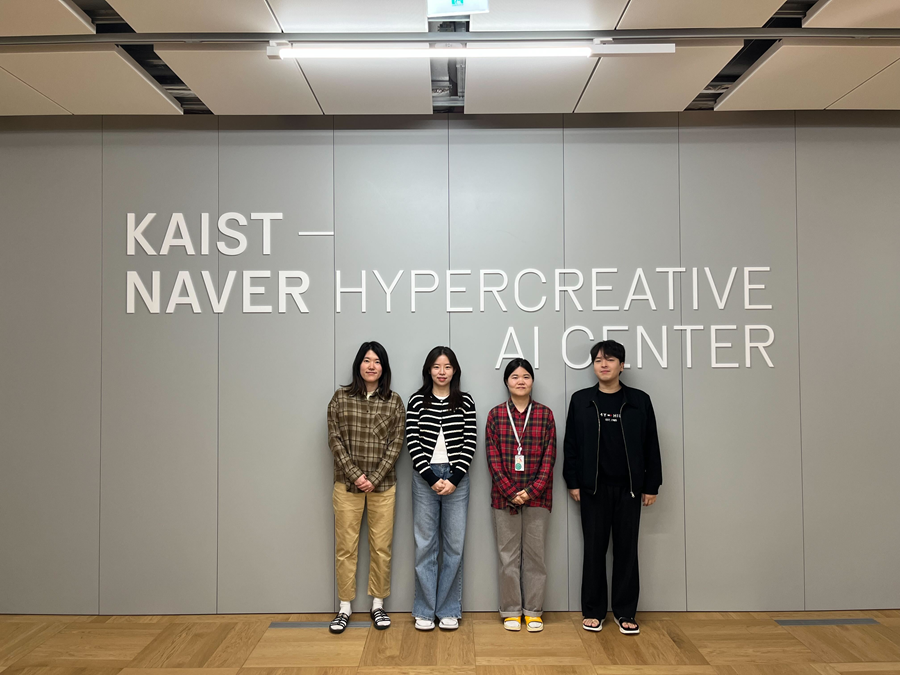
< Photo 2. Gayoung Lee, Researcher at NAVER AI Lab; Dahee Kwon, Ph.D. Candidate at KAIST Kim Jaechul Graduate School of AI; Jiyeon Han, Ph.D. Candidate at KAIST Kim Jaechul Graduate School of AI; Junho Kim, Researcher at NAVER AI Lab >
Professor Choi's research team developed a technology to enhance creative generation by amplifying the internal feature maps of text-based image generation models. They also discovered that shallow blocks within the model play a crucial role in creative generation. They confirmed that amplifying values in the high-frequency region after converting feature maps to the frequency domain can lead to noise or fragmented color patterns. Accordingly, the research team demonstrated that amplifying the low-frequency region of shallow blocks can effectively enhance creative generation.
Considering originality and usefulness as two key elements defining creativity, the research team proposed an algorithm that automatically selects the optimal amplification value for each block within the generative model.
Through the developed algorithm, appropriate amplification of the internal feature maps of a pre-trained Stable Diffusion model was able to enhance creative generation without additional classification data or training.

< Figure 1. Overview of the methodology researched by the development team. After converting the internal feature map of a pre-trained generative model into the frequency domain through Fast Fourier Transform, the low-frequency region of the feature map is amplified, then re-transformed into the feature space via Inverse Fast Fourier Transform to generate an image. >
The research team quantitatively proved, using various metrics, that their developed algorithm can generate images that are more novel than those from existing models, without significantly compromising utility.
In particular, they confirmed an increase in image diversity by mitigating the mode collapse problem that occurs in the SDXL-Turbo model, which was developed to significantly improve the image generation speed of the Stable Diffusion XL (SDXL) model. Furthermore, user studies showed that human evaluation also confirmed a significant improvement in novelty relative to utility compared to existing methods.
Jiyeon Han and Dahee Kwon, Ph.D. candidates at KAIST and co-first authors of the paper, stated, "This is the first methodology to enhance the creative generation of generative models without new training or fine-tuning. We have shown that the latent creativity within trained AI generative models can be enhanced through feature map manipulation."
They added, "This research makes it easy to generate creative images using only text from existing trained models. It is expected to provide new inspiration in various fields, such as creative product design, and contribute to the practical and useful application of AI models in the creative ecosystem."
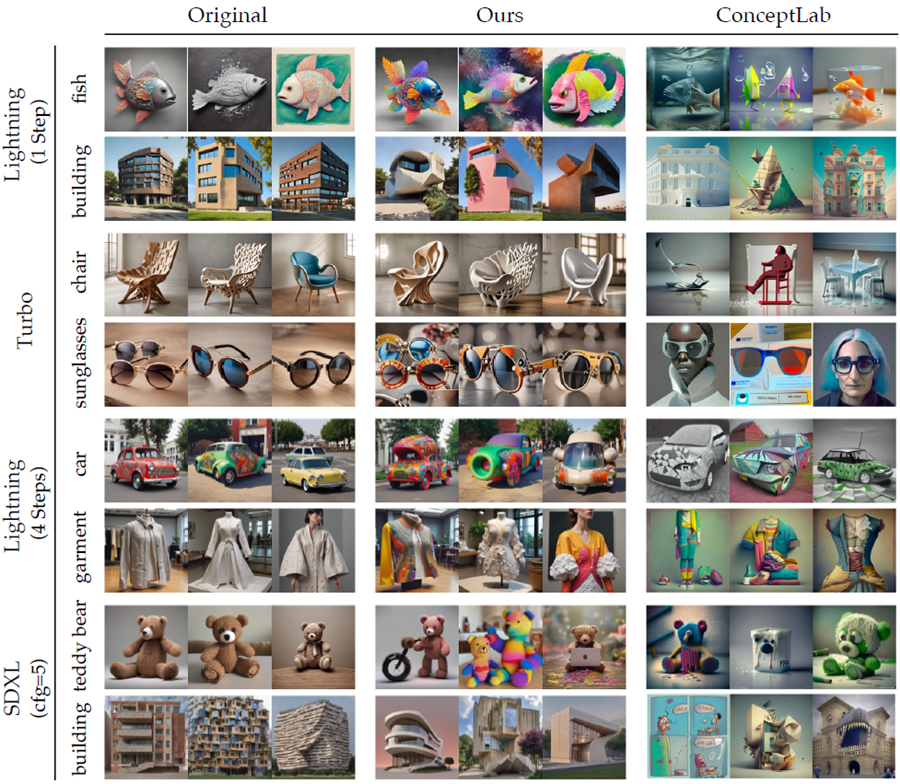
< Figure 2. Application examples of the methodology researched by the development team. Various Stable Diffusion models generate novel images compared to existing generations while maintaining the meaning of the generated object. >
This research, co-authored by Jiyeon Han and Dahee Kwon, Ph.D. candidates at KAIST Kim Jaechul Graduate School of AI, was presented on June 16 at the International Conference on Computer Vision and Pattern Recognition (CVPR), an international academic conference.
* Paper Title: Enhancing Creative Generation on Stable Diffusion-based Models
* DOI: https://doi.org/10.48550/arXiv.2503.23538
This research was supported by the KAIST-NAVER Ultra-creative AI Research Center, the Innovation Growth Engine Project Explainable AI, the AI Research Hub Project, and research on flexible evolving AI technology development in line with increasingly strengthened ethical policies, all funded by the Ministry of Science and ICT through the Institute for Information & Communications Technology Promotion. It also received support from the KAIST AI Graduate School Program and was carried out at the KAIST Future Defense AI Specialized Research Center with support from the Defense Acquisition Program Administration and the Agency for Defense Development.
-
event KAIST, Kyoto, and MIT Ask Together: “How Should Humans Live in the AI Era?”
AI is moving beyond answering questions and solving problems into an era in which it acts through robots and forms relationships with people. Amid these changes, how will the roles and responsibilities of humans change, and what should we value as we live our lives? KAIST, together with participating institutions from Kyoto and MIT, is creating a forum to discuss human life and the future in the AI era. KAIST (President Choongsik Bae) announced on the 13th of November that the KAIST AI Philos
2026-11-13 -
research Devilray Exposes Blind Spots in FBS Detection
DAEJEON, South Korea — Governments use them to track phones. Criminals drive them through city streets and send texts that look like they came from your bank. For 20 years, researchers have been building tools to catch these fake cell towers. They have tested those tools mostly against fake towers they built themselves. That loop has left gaps. Researchers at KAIST built a platform called Devilray that reproduces 2,592 distinct fake-base-station behaviors. They ran it against seven existi
2026-11-04 -
event KAIST to Chart a Platform-FirstCourse for “Physical AI” Beyond Humanoids
KAIST hosted “Physical AI KOREA 2026” at its Daejeon campus on October 13. At the event, KAIST presented physical AI platform technologies that can be applied not only to manufacturing but also to healthcare, defense, logistics, and everyday life, as well as strategies for research, education, and entrepreneurship that can be utilized by a wide range of companies. Humanoid robots are beginning to surpass human records in robotic competitions modeled after Olympic events such as tr
2026-10-12 -
research KAIST Develops Smartphone-Based Technology to Detect Hidden Cameras
A smartphone can now be transformed into a “hidden-camera detector.” KAIST researchers have developed an AI technology that can detect hidden cameras using only a smartphone and a low-cost LED device. This new security technology enables users to protect their privacy more easily and is expected to help prevent illegal filming in everyday spaces such as hotels and short-term rentals. KAIST (President Choongsik Bae) announced on August 30 that a research team led by Professor Jun
2026-08-31 -
research KAIST Solves 3D Memory Reliability Problem with "Oxygen Tunnel" Structure, Boosting AI Chip Performance and Reducing Power Consumption
As AI systems become more advanced, memory is required to transfer larger amounts of data at higher speeds. But conventional planar semiconductor scaling is running out of room. A KAIST research team has now addressed a key weakness in three-dimensional, vertically stacked memory devices, opening a new path to faster, more power-efficient AI semiconductors. KAIST (President Choongsik Bae) announced on August 25 that a research team led by Professor Jimin Kwon from the School of Electrical Eng
2026-08-20