research
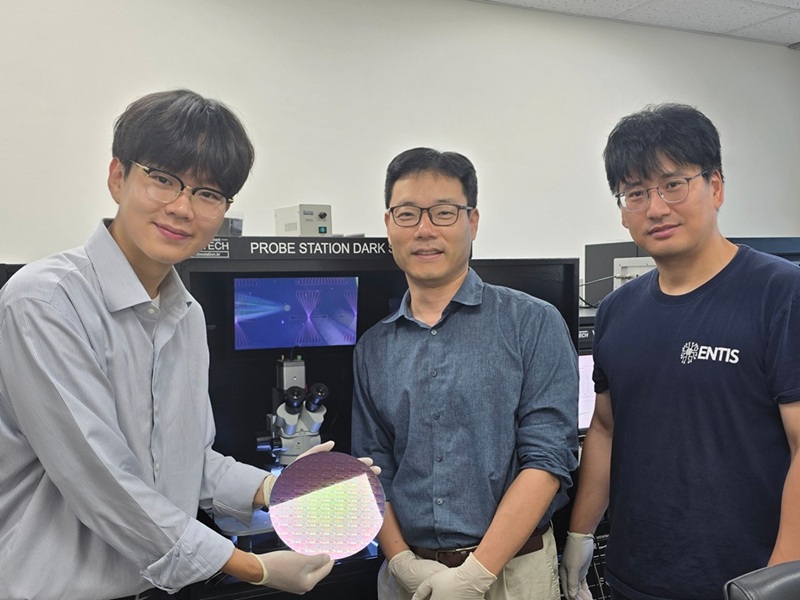
<(From left) Ph.D candidate See-On Park, Professor Jongwon Lee, and Professor Shinhyun Choi>
In the midst of the co-development of artificial intelligence and robotic advancements, developing technologies that enable robots to efficiently perceive and respond to their surroundings like humans has become a crucial task. In this context, Korean researchers are gaining attention for newly implementing an artificial sensory nervous system that mimics the sensory nervous system of living organisms without the need for separate complex software or circuitry. This breakthrough technology is expected to be applied in fields such as in ultra-small robots and robotic prosthetics, where intelligent and energy-efficient responses to external stimuli are essential.
KAIST (President Kwang Hyung Lee) announced on July15th that a joint research team led by Endowed Chair Professor Shinhyun Choi of the School of Electrical Engineering at KAIST and Professor Jongwon Lee of the Department of Semiconductor Convergence at Chungnam National University (President Jung Kyum Kim) developed a next-generation neuromorphic semiconductor-based artificial sensory nervous system. This system mimics the functions of a living organism's sensory nervous system, and enables a new type of robotic system that can efficiently responds to external stimuli.
In nature, animals — including humans — ignore safe or familiar stimuli and selectively react sensitively to important or dangerous ones. This selective response helps prevent unnecessary energy consumption while maintaining rapid awareness of critical signals. For instance, the sound of an air conditioner or the feel of clothing against the skin soon become familiar and are disregarded. However, if someone calls your name or a sharp object touches your skin, a rapid focus and response occur. These behaviors are regulated by the 'habituation' and 'sensitization' functions in the sensory nervous system. Attempts have been consistently made to apply these sensory nervous system functions of living organisms in order to create robots that efficiently respond to external environments like humans.
However, implementing complex neural characteristics such as habituation and sensitization in robots has faced difficulties in miniaturization and energy efficiency due to the need for separate software or complex circuitry. In particular, there have been attempts to utilize memristors, a neuromorphic semiconductor. A memristor is a next-generation electrical device, which has been widely utilized as an artificial synapse due to its ability to store analog value in the form of device resistance. However, existing memristors had limitations in mimicking the complex characteristics of the nervous system because they only allowed simple monotonic changes in conductivity.
To overcome these limitations, the research team developed a new memristor capable of reproducing complex neural response patterns such as habituation and sensitization within a single device. By introducing additional layer inside the memristor that alter conductivity in opposite directions, the device can more realistically emulate the dynamic synaptic behaviors of a real nervous system — for example, decreasing its response to repeated safe stimuli but quickly regaining sensitivity when a danger signal is detected.
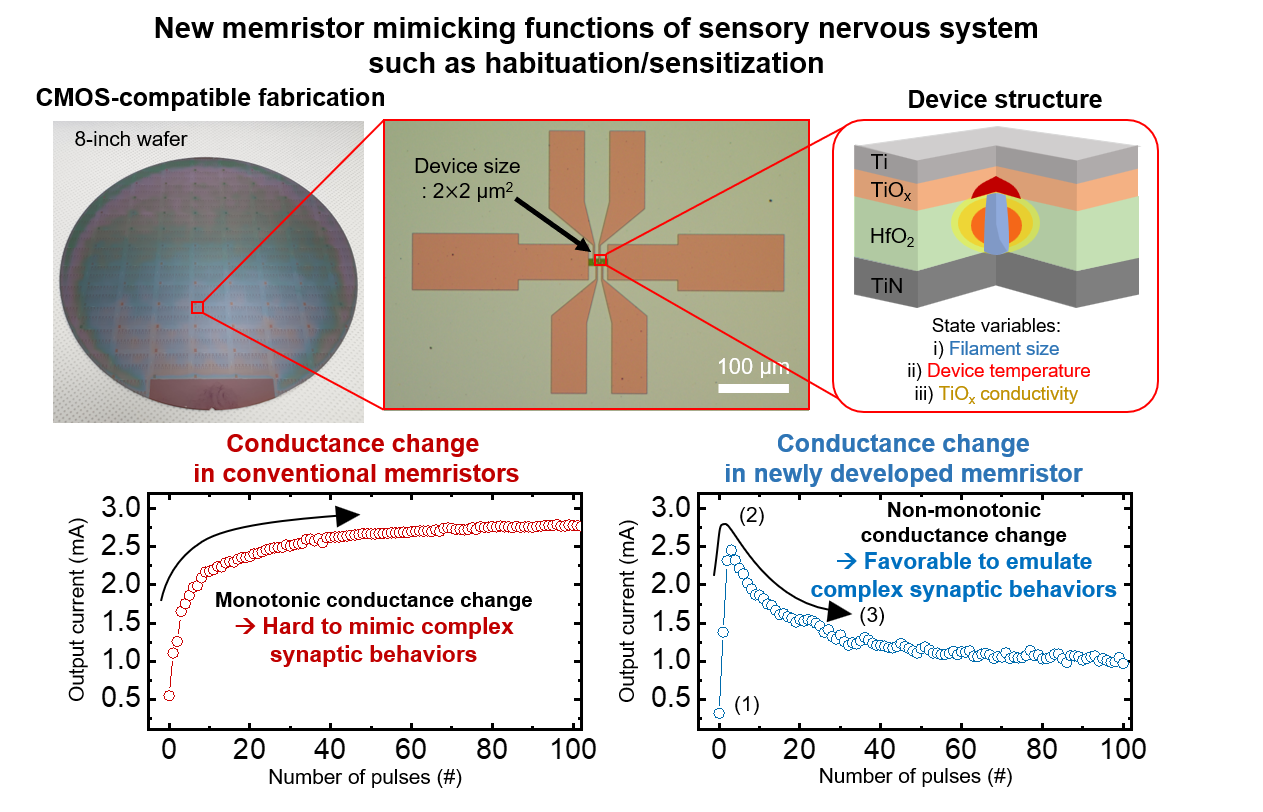
<New memristor mimicking functions of sensory nervous system such as habituation/sensitization>
Using this new memristor, the research team built an artificial sensory nervous system capable of recognizing touch and pain, an applied it to a robotic hand to test its performance. When safe tactile stimuli were repeatedly applied, the robot hand, which initially reacted sensitively to unfamiliar tactile stimuli, gradually showed habituation characteristics by ignoring the stimuli. Later, when stimuli were applied along with an electric shock, it recognized this as a danger signal and showed sensitization characteristics by reacting sensitively again. Through this, it was experimentally proven that robots can efficiently respond to stimuli like humans without separate complex software or processors, verifying the possibility of developing energy-efficient neuro-inspired robots.
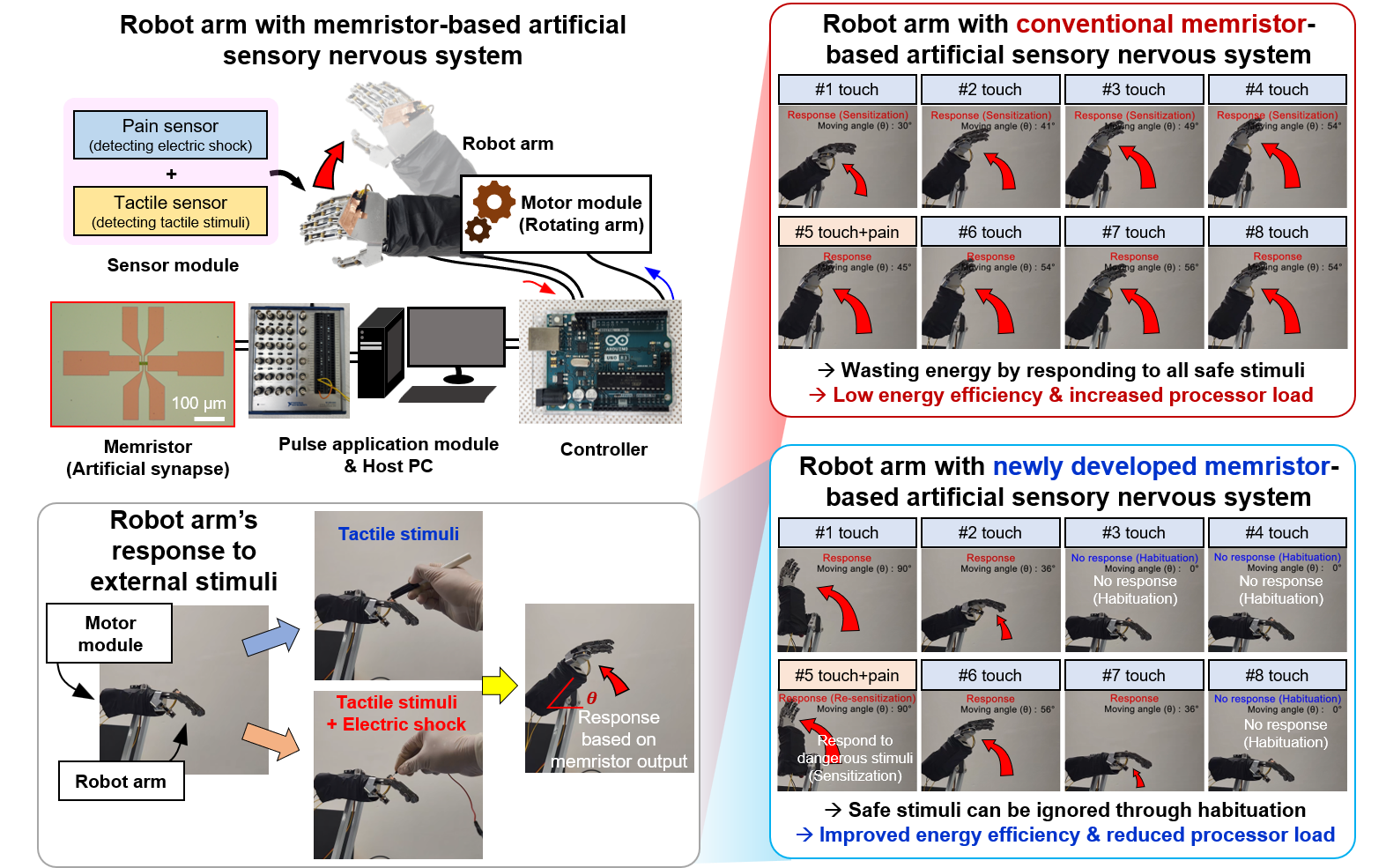
<Robot arm with memristor-based artificial sensory nervous system>
See-On Park, researcher at KAIST, stated, "By mimicking the human sensory nervous system with next-generation semiconductors, we have opened up the possibility of implementing a new concept of robots that are smarter and more energy-efficient in responding to external environments." He added, "This technology is expected to be utilized in various fusion fields of next-generation semiconductors and robotics, such as ultra-small robots, military robots, and medical robots like robotic prosthetics".
This research was published online on July 1st in the international journal 'Nature Communications,' with Ph.D candidate See-On Park as the first author.
- Paper Title: Experimental demonstration of third-order memristor-based artificial sensory nervous system for neuro-inspired robotics
- DOI: https://doi.org/10.1038/s41467-025-60818-x
This research was supported by the Korea National Research Foundation's Next-Generation Intelligent Semiconductor Technology Development Project, the Mid-Career Researcher Program, the PIM Artificial Intelligence Semiconductor Core Technology Development Project, the Excellent New Researcher Program, and the Nano Convergence Technology Division, National Nanofab Center's (NNFC) Nano-Medical Device Project.
-
research KAIST Develops a Beetle-Inspired Soft Robot That Operates with Artificial Muscles and Sensory Feedback
Researchers have developed a technology that lets a user move a small robot by bending and straightening a finger. The user can also pick up and move objects while checking the images and contact information that the robot sends back. The system combines artificial muscles, a camera, and tactile sensors in a small soft robot modeled on a beetle. It is expected to be used in remote tasks, such as inspecting narrow spaces that are difficult for people to reach and retrieving small objects. KAIS
2026-10-13 -
research KAIST Develops a Venus Flytrap-Inspired 'Robot Hand' Material That Detects What Comes Near and Grasps It Under UV Light
A Venus flytrap closes its leaves to trap prey when it senses a stimulus. Taking inspiration from this plant, KAIST researchers have combined the roles of a skin that senses approaching objects and a muscle that grasps them in a single soft material. When an electrically charged object comes near, ions inside the material move and produce an electrical signal. When ultraviolet (UV) light is applied, the material bends and grasps the object. Because it holds its deformed shape for more than 10
2026-09-30 -
research KAIST’s World-First Full-Course Robot Marathon Completion Published in Nature
A quadruped robot ran 42.195 km, a distance that is not easy even for humans to complete, without replacing its battery. KAIST researchers have developed this world-first achievement into design principles for long-distance operation, published the results in Nature, and are now moving toward commercializing robots that can be used in real industrial environments. KAIST (President Choongsik Bae) announced on the September 24 that the long-distance running technology of RAIBO2, a quadruped rob
2026-09-28 -
research KAIST Robot That Follows Verbal Directions and Checks Its Own Work Takes First and Second Place in International Competitions
A robot that can follow a single verbal instruction, navigate an unfamiliar building, and verify that it has reached the correct destination has earned top honors in two international competitions. KAIST (President Chungsik Bae) announced on September 11 that a team led by Professor Hyun Myung of the Urban Robotics Lab in the School of Electrical Engineering took first place in an international challenge held in conjunction with ECCV 2026, a leading computer vision conference, and second plac
2026-09-16 -
research KAIST Develops a Soft 3D-Printed Robotic Hand that Gently Grips Everything from Eggs to a 1 kg Water Bottle
3D printers that once could only produce rigid objects can now create products as soft and stretchable as rubber. A team of Korean researchers used AI to identify the optimal "recipe" for a material that can be printed into complex shapes while stretching to more than six times its original length. The material is expected to expand the range of applications for 3D printing, from robotic hands to form-fitting wearable devices and custom medical devices. KAIST (President Choong-Sik Bae) announ
2026-09-01