research
< (From Left)Jaewook Myung from KAIST, Sunho Park from KAIST, Dr. Chungheon Shin from Stanford University, Prof. Craig S. Criddle from Stanford University >
KAIST announced that a research team led by Professor Jaewook Myung from the Department of Civil and Environmental Engineering, in collaboration with Stanford University, has identified how ethane (C2H6)—a major constituent of natural gas—affects the core metabolic pathways of the obligate methanotroph Methylosinus trichosporium OB3b.
Methane (CH4), a greenhouse gas with roughly 25 times the global warming potential of carbon dioxide, is rarely emitted alone into the environment. It is typically released in mixtures with other gases. In the case of natural gas, ethane can comprise up to 15% of the total composition.
Methanotrophs are aerobic bacteria that can utilize methane as their sole source of carbon and energy. Obligate methanotrophs, in particular, strictly utilize only C1 compounds such as methane or methanol. Until now, little was known about how these organisms respond to C2 compounds like ethane, which they cannot use for growth.

< Figure 1. Conceptual overview of obligate methanotroph metabolism and PHB biosynthesis under mixed-substrate conditions of methane and ethane >
This study reveals that although ethane cannot serve as a growth substrate, its presence significantly affects key metabolic functions in M. trichosporium OB3b—including methane oxidation, cell proliferation, and the intracellular synthesis of polyhydroxybutyrate (PHB), a biodegradable polymer.
Under varying methane and oxygen conditions, the team observed that ethane addition consistently resulted in three metabolic effects: reduced cell growth, lower methane consumption, and increased PHB accumulation. These effects intensified with rising ethane concentrations. Notably, ethane oxidation occurred only when methane was present, confirming that it is co-oxidized via particulate methane monooxygenase (pMMO), the key enzyme responsible for methane oxidation.
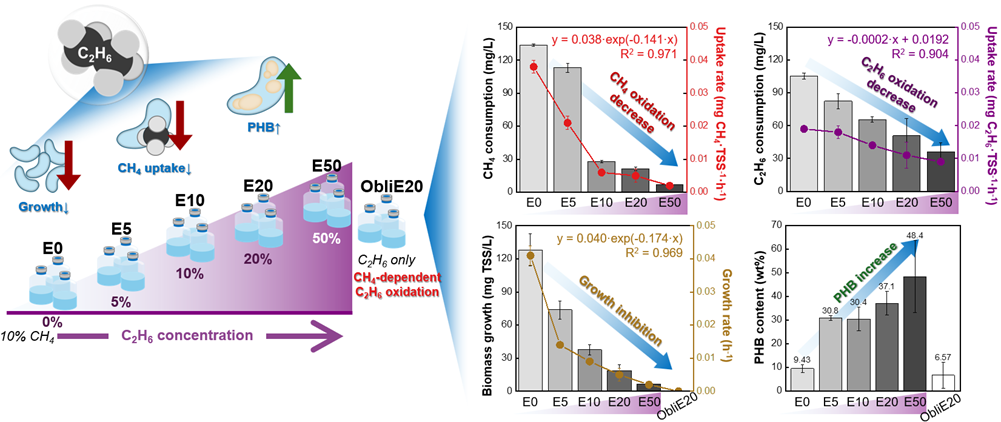
< Figure2. Effects of increasing ethane concentrations on methane and ethane consumption, cell growth, and PHB production in Methylosinus trichosporium OB3b >
Further analysis showed that acetate, an intermediate formed during ethane oxidation, played a pivotal role in this response. Higher acetate levels inhibited growth but enhanced PHB production, suggesting that ethane-derived acetate drives contrasting carbon assimilation patterns depending on nutrient conditions—nutrient-balanced growth phase and nutrient-imbalanced PHB accumulation phas.
In addition, when external reducing power was supplemented (via methanol or formate), ethane consumption was enhanced significantly, while methane oxidation remained largely unaffected. This finding suggests that ethane, despite not supporting growth, actively competes for intracellular resources such as reducing equivalents. It offers new insights into substrate prioritization and resource allocation in methanotrophs under mixed-substrate conditions.
Interestingly, while methane uptake declined in the presence of ethane, the expression of pmoA, the gene encoding pMMO, remained unchanged. This suggests that ethane’s impact occurs beyond the transcriptional level—likely via post-transcriptional or enzymatic regulation.
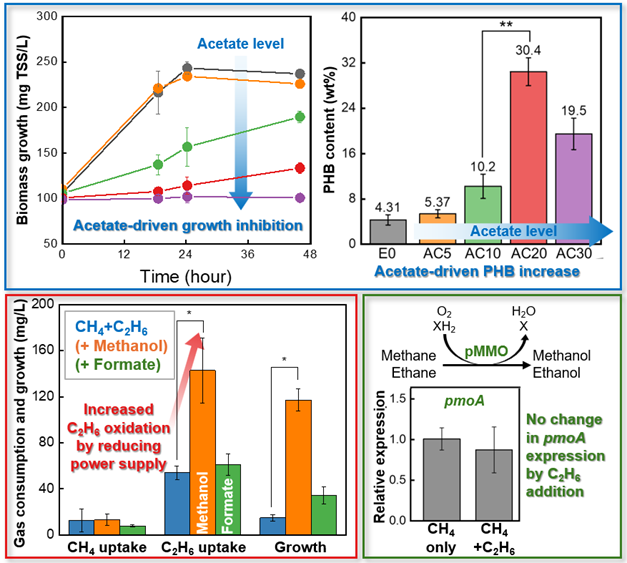
< Figure2. Effects of increasing ethane concentrations on methane and ethane consumption, cell growth, and PHB production in Methylosinus trichosporium OB3b >
“This is the first study to systematically investigate how obligate methanotrophs respond to complex gas mixtures involving ethane,” said Professor Jaewook Myung. “Our findings show that even non-growth substrates can meaningfully influence microbial metabolism and biopolymer synthesis, opening new possibilities for methane-based biotechnologies and bioplastic production.”
The study was supported by the National Research Foundation of Korea, the Ministry of Land, Infrastructure and Transport, and the Ministry of Oceans and Fisheries. The results were published in Applied and Environmental Microbiology, a journal of the American Society for Microbiology.
-
research KAIST Develops Lip-Reading AI That Decodes Clear Words First to Resolve Ambiguous Mouth Movements
Understanding speech from lip movements alone is difficult, particularly in noisy environments. A research team at the Korea Advanced Institute of Science and Technology (KAIST) has developed an AI technology that first recognizes words it can identify with high confidence and then uses the surrounding context to resolve ambiguous parts of the sentence. The technology is expected to enable communication without relying on sound. For example, it could convert speech obscured by noise into text
2026-11-16 -
people KAIST Professor Kyung-In Jang Selected for ERC Synergy Grant to Study How the Brain Controls Movement in Freely Moving Monkeys
How does the brain process sensory information and use it to control movement when we walk or touch an object? An international research team involving KAIST will investigate this question by monitoring brain activity in freely moving monkeys. The goal is to uncover the principles underlying the brain’s control of movement and, in the long term, lay the foundation for technologies that help patients with injuries to the nervous system return to everyday life. KAIST (President Choongsik
2026-11-16 -
event KAIST Receives KRW 100 Million in Research Equipment from XYZ, a Robotics Company Founded by a KAIST Alumnus
KAIST (President Choongsik Bae) announced on November 13 that it had signed a donation agreement with AI robotics company XYZ Inc. (CEO Sungjae Hwang) at the Graduate School of Culture Technology on November 12. Under the agreement, XYZ will donate research equipment, including robots, valued at KRW 100 million (approximately USD 74,000 as of November 2026) to support research and education in human-robot interaction. KAIST will use the donated equipment to establish human-robot interaction (
2026-11-13 -
event KAIST, Kyoto, and MIT Ask Together: “How Should Humans Live in the AI Era?”
AI is moving beyond answering questions and solving problems into an era in which it acts through robots and forms relationships with people. Amid these changes, how will the roles and responsibilities of humans change, and what should we value as we live our lives? KAIST, together with participating institutions from Kyoto and MIT, is creating a forum to discuss human life and the future in the AI era. KAIST (President Choongsik Bae) announced on the 13th of November that the KAIST AI Philos
2026-11-13 -
research KAIST Uses 3D Imaging to Show How Nanoscale Electrode Protrusions Influence Current Pathways in Next-Generation Memory
Researchers at the Korea Advanced Institute of Science and Technology (KAIST) used three-dimensional imaging to map a nanoscale current pathway inside a capacitor for resistive random-access memory (RRAM) device. They found that it connected to a tiny protrusion on the bottom electrode. The finding suggests that shaping the electrode could help control where these pathways form. KAIST (President Choongsik Bae) announced the findings on November 12. Professor Seungbum Hong led the study in col
2026-11-12