research

< (From left of the award recipients) Ph. D candidate Sungjae Min, Ph. D candidate Gyuree Kang, Professor David Hyunchul Shim, Ph.D candidate Hyungjoo Kim >
KAIST announced on June 5th that a paper proposing an aircraft autonomous piloting framework based on the humanoid robot pilot ‘PIBOT,’ developed by a research team led by Professor David Hyunchul Shim of the School of Electrical Engineering, was selected as the Best Paper Award among the papers published in the IEEE Robotics & Automation Magazine (IEEE RAM) in 2025.

< The proposed PIBOT system framework capable of piloting based on aviation manuals and voice communication without modifying existing aircraft >
This award is highly meaningful as it signifies that grassroots research based entirely on domestic, independent initiatives has been recognized as a world-class achievement in robotics. The award ceremony took place in Vienna, Austria, on June 4, 2026 (local time) during the International Conference on Robotics and Automation (ICRA 2026). IEEE Robotics & Automation Magazine (IEEE RAM) is a prestigious academic magazine published by the IEEE Robotics and Automation Society (RAS), under the umbrella of IEEE, the world's largest technical professional organization. It is well known for delivering the latest research achievements, industry trends, and tutorials in the fields of robotics and automation, widely conveying robot technologies applicable to actual industrial sites to researchers in both industry and academia. As of 2025, IEEE RAM recorded an Impact Factor (IF) of 7.1, holding the second highest impact among IEEE publications in the field of robotics. In particular, it presents the Best Paper Award to research that has a significant academic and industrial impact among the papers published after undergoing rigorous peer review. This study was selected as a Future Challenge Defense Technology Research and Development Project by the Agency for Defense Development (ADD) in 2021 and was conducted based purely on domestic technology with support of approximately 5.7 billion won over five years. The research team received high praise for implementing Physical AI technology at an exceptionally high level, enabling a humanoid robot to systematically and adaptively perform complex tasks such as piloting aircraft based on artificial intelligence, going beyond simple walking or carrying items. Recently, humanoid robot technology has been developing rapidly in terms of athletic performance, such as tumbling or implementing complex movements. However, in the industrial sector, the applicability to actual industrial sites is drawing attention as a more critical factor. The pilot robot ‘PIBOT’ being developed by Professor David Hyunchul Shim's research team is designed to acquire specialized knowledge required for aircraft operation and to recognize and respond to actual flight situations in real time, going beyond simple repetitive tasks or logistics processing. Accordingly, it is evaluated as presenting a new direction for the utilization of humanoid robot technology, termed as Expert Physical AI.

< The research team's PIBOT sitting in an actual aircraft (KLA-100) and operating the instruments and control stick >
The research team has successfully completed Phase 1 of the research since the project launched in 2021, and since 2024, they have been developing Phase 2 of the pilot robot, which features a human-like physique and joint structure suitable for actual aircraft piloting. In addition, they are pursuing collaborative research with relevant organizations to expand and apply this technology to various mobile vehicle piloting fields, such as ground vehicles and ships, as well as aircraft.
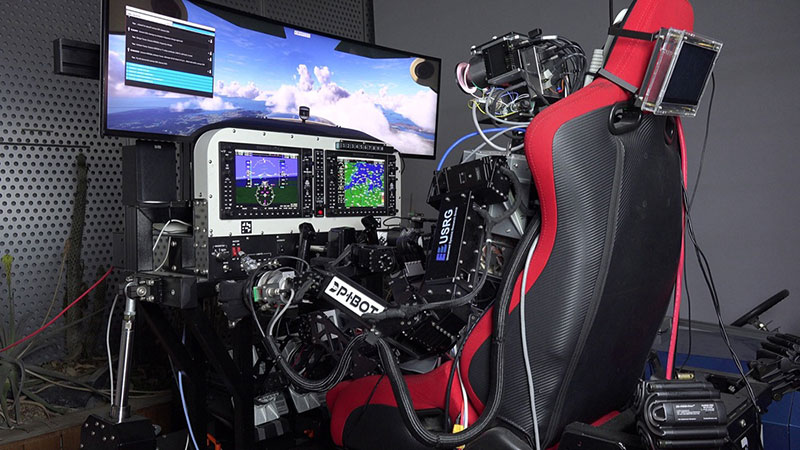
< PIBOT performing piloting in an aircraft simulator device >
Professor David Hyunchul Shim said, “It is very meaningful that the pilot robot technology, proposed for the first time in the world by Korean researchers, has been recognized as a world-class research achievement thanks to the support of a large-scale national project. We will further develop our research in a direction where humanoid robots can help humans in real-world environments and safely operate complex systems.” In this study, PhD students Sungjae Min, Gyuree Kang, and Hyungjoo Kim participated as co-first authors, and Professor David Hyunchul Shim served as the corresponding author. The paper can be found through IEEE Xplore. ※ Paper Title: “Toward Fully Autonomous Aviation: PIBOT, a Humanoid Robot Pilot for Human-Centric Aircraft Cockpits”, Paper Links:
-
research KAIST Develops a Venus Flytrap-Inspired 'Robot Hand' Material That Detects What Comes Near and Grasps It Under UV Light
A Venus flytrap closes its leaves to trap prey when it senses a stimulus. Taking inspiration from this plant, KAIST researchers have combined the roles of a skin that senses approaching objects and a muscle that grasps them in a single soft material. When an electrically charged object comes near, ions inside the material move and produce an electrical signal. When ultraviolet (UV) light is applied, the material bends and grasps the object. Because it holds its deformed shape for more than 10
2026-09-30 -
research KAIST’s World-First Full-Course Robot Marathon Completion Published in Nature
A quadruped robot ran 42.195 km, a distance that is not easy even for humans to complete, without replacing its battery. KAIST researchers have developed this world-first achievement into design principles for long-distance operation, published the results in Nature, and are now moving toward commercializing robots that can be used in real industrial environments. KAIST (President Choongsik Bae) announced on the September 24 that the long-distance running technology of RAIBO2, a quadruped rob
2026-09-28 -
research KAIST Robot That Follows Verbal Directions and Checks Its Own Work Takes First and Second Place in International Competitions
A robot that can follow a single verbal instruction, navigate an unfamiliar building, and verify that it has reached the correct destination has earned top honors in two international competitions. KAIST (President Chungsik Bae) announced on September 11 that a team led by Professor Hyun Myung of the Urban Robotics Lab in the School of Electrical Engineering took first place in an international challenge held in conjunction with ECCV 2026, a leading computer vision conference, and second plac
2026-09-16 -
research KAIST Develops a Soft 3D-Printed Robotic Hand that Gently Grips Everything from Eggs to a 1 kg Water Bottle
3D printers that once could only produce rigid objects can now create products as soft and stretchable as rubber. A team of Korean researchers used AI to identify the optimal "recipe" for a material that can be printed into complex shapes while stretching to more than six times its original length. The material is expected to expand the range of applications for 3D printing, from robotic hands to form-fitting wearable devices and custom medical devices. KAIST (President Choong-Sik Bae) announ
2026-09-01 -
event KAIST and Seoul National University Students Hold 100-Hour Robot Hackathon to Nurture Physical AI Talent
KAIST (President Choongsik Bae) announced on August 4 that RoboticUS, a joint student organization formed by students from KAIST and Seoul National University, is holding the inaugural Robot Hackathon at KAIST from August 3 to 8. "In the era of Physical AI, we need convergence talent who can go beyond building good AI to design and implement robots and systems that move the real world based on AI," said Choongsik Bae, President of KAIST. "This hackathon, planned and run entirely by students
2026-08-04