event
- To research the prevention of the illegal production of security technologies
- Total 1.5 billion won of research expenses and 102 researchers to be invested for the next three years
- Opening ceremony at the computer science building, KAIST on April 13 at 10 am
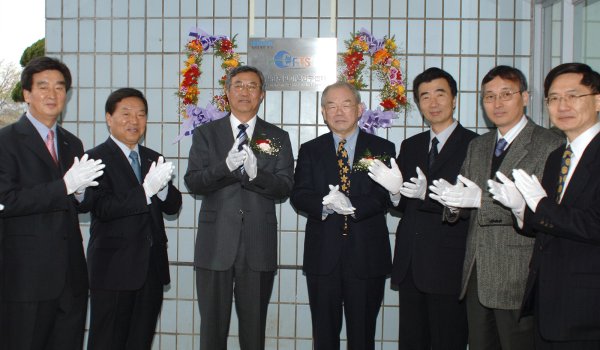
KAIST (President Nam-Pyo Suh) will open ‘the Center of Fusion Technology for Security (CFTS)’ under the auspices of the Korea Minting & Security Printing Corporation (KOMSCO, President Hae-Sung Lee) to undertake researches over the prevention of illegal reproduction of security technologies. The opening ceremony was held at the computer science building, KAIST on Friday, April 13.
Total .1.5 billion won of research expenses and 102 researchers will be invested in the center for the next three years.
Main research fields are ▲ advanced IT-based information concealment methods ▲ utilization of energy transfer luminescence in host guest nano-substances ▲ the utilization of quantum-dot, non-crystal carbon and piezoelectric elements ▲ development of radio frequency identification (RFID), optical, biological security element-applied technologies, etc.
“We’ll develop fusion technologies for security that can easily detect forgeries and alterations of security products by introducing advanced IT, optical, chemical engineering, and biological elements. The development of core technologies applied to security products will activate domestic security markets and enable the export of relevant technologies,” said General Research Director Heung-Kyu Lee, a professor of Computer Sciences.
-
people KAIST Names Former Samsung Electronics Chairman and CEO Oh Hyun Kwon as Chair of Its Board of Trustees
KAIST announced that its Board of Trustees elected Oh Hyun Kwon, former Chairman and CEO of Samsung Electronics and Chairman of the Orange Planet startup foundation, as its new chair at the board’s 298th extraordinary meeting in Seoul on September 21, 2026. Prior to the election, Kichul Cha, a KAIST trustee and CEO of InBody, had served as acting chair since the term of former Chair Myung Ja Kim ended in late June. Kwon earned a bachelor’s degree in electrical engineering from Seo
2026-09-22 -
research Next-Generation Biological Foundation Model, K-Fold
“Design a drug candidate that binds effectively to this protein.” In response to such a request, AI predicts the protein’s three-dimensional structure, analyzes which compounds are most likely to bind to it, and designs promising drug candidates. KAIST researchers have developed K-Fold, the world's fastest Bio-AI model for protein structure prediction, which also supports drug candidate design. KAIST (President Choongsik Bae) announced on August 28 that it had formed &ldquo
2026-08-28 -
research KAIST Develops Semiconductor Neuron That Tunes Noise to Selectively Process Signals
In electronic devices, irregular fluctuations in signals are generally referred to as “noise.” Because noise interferes with accurate information processing, conventional semiconductor technology has mainly treated it as something to be reduced or eliminated. However, neurons in the human brain do not respond in exactly the same way every time, even to the same stimulus. Tiny internal variations in neurons change when and how often neurons are fired, and this probabilistic operatio
2026-08-18 -
event KAIST Held Inauguration Ceremony for 18th President Choongsik Bae, Unveiling Vision of "Fundamentals First, Innovation Forward"
KAIST announced that it held an inauguration ceremony for its 18th president, Choongsik Bae, at the KAIST Auditorium on Monday, August 10. At the ceremony, the university unveiled "Fundamentals First, Innovation Forward" as its new vision. The ceremony officially presented President Bae's philosophy on university governance and his vision for KAIST's future to the KAIST community and the public. Departing from the conventional format of a formal inaugural address, President Bae personally exp
2026-08-10 -
event KAIST and Seoul National University Students Hold 100-Hour Robot Hackathon to Nurture Physical AI Talent
KAIST (President Choongsik Bae) announced on August 4 that RoboticUS, a joint student organization formed by students from KAIST and Seoul National University, is holding the inaugural Robot Hackathon at KAIST from August 3 to 8. "In the era of Physical AI, we need convergence talent who can go beyond building good AI to design and implement robots and systems that move the real world based on AI," said Choongsik Bae, President of KAIST. "This hackathon, planned and run entirely by students
2026-08-04