%57%6f%72%6c%64%20%43%6c%61%73%73
-
 Where did this fish come from? Securing World-Class Seafood Traceability Technology
< (From left) KAIST Ph.D. candidate Hyeontaek Hwang, Research Professor Yalew Kidane, Senior Researcher Young-jong Lee, Researcher Geon-woo Park, and (Top) Professor Daeyoung Kim >
When buying seafood at a supermarket, you may have wondered where the fish was caught and what process it went through to reach your dinner table. However, due to complex distribution processes, it has been difficult to transparently track that path. KAIST’s research team has developed a digital technology that solves this problem, allowing the movement path of seafood to be checked at a glance based on international standards recognized worldwide.
KAIST announced on December 19th that "OLIOPASS," a GS1 international standard-based digital transformation solution developed by Director Daeyoung Kim (Professor, School of Computing) of the KAIST Auto-ID Labs Busan Innovation Center, has passed the rigorous performance verification of the GDST (Global Dialogue on Seafood Traceability). It is the first in Korea to obtain the "GDST Capable Solution" certification.
< (Left) GDST Global Certification Logo, (Right) KAIST OLIOPASS Platform Logo >
Only 13 technologies worldwide have received this GDST certification. Among them, only 7 entities, including KAIST, support "Full Chain" traceability technology, which manages the entire process from production and processing to distribution and sales.
The GDST is an international organization established in 2015 at the suggestion of the World Economic Forum (WEF). It helps record and share information on all seafood movement processes digitally, according to the GS1 international standard agreed upon by the global community. This can be compared to creating a "common language for the supply chain" used worldwide.
The GDST is a global standard system that increases the reliability of seafood history information by defining Key Data Elements (KDEs) that must be recorded during the movement of seafood and Critical Tracking Events (CTEs) that define when, where, and what moved, based on international standards.
As major food distribution companies in the United States and Europe have recently begun requiring GDST compliance, this standard is becoming a de facto essential requirement for entering the global market. Since 2019, KAIST has participated as a founding member of GDST and has played a key role in designing seafood traceability models and system-to-system information interoperability.
In particular, with the U.S. Food and Drug Administration (FDA) announcing the mandatory enforcement of food traceability (FSMA 204) starting in July 2028, this certification is significant as it secures a technical solution for domestic companies to meet global market regulations.
OLIOPASS, which received certification on November 5th, is a digital traceability platform that combines KAIST's IoT technology with international standards (GS1 EPCIS 2.0, GS1 Digital Link). It records and shares movement information of various products and assets in a standardized language and utilizes blockchain technology to fundamentally prevent forgery or alteration. Even if systems differ between companies, history data is seamlessly linked.
Furthermore, OLIOPASS is designed as an "AI-ready data" infrastructure, allowing for the easy application of next-generation AI technologies such as Large Multimodal Models (LMM), AI agents, knowledge graphs, and ontologies. This allows it to serve as a platform that supports both digital and AI transformation beyond simple history management.
Daeyoung Kim, Director of the KAIST Auto-ID Labs Busan Innovation Center, stated, "This certification is an international recognition of our capability in reliable data technology across the global supply chain. We will expand OLIOPASS beyond seafood and food into various fields such as pharmaceuticals, logistics, defense, and smart cities, ensuring KAIST’s technology grows into a platform used by the world."
※ Related Link: https://thegdst.org/verified-gdst-capable-solutions/
< List of Certified Organizations >
2025.12.22 View 3652
-
 Synthesis of a New Organic Supermolecule Succeeded
From left to right: Prof.Stoddart, Prof.Goddard and Prof.Jang Wook Choi
KAIST EEWS graduate school’s research team led by Prof. Stoddart, Prof. Goddard and Prof. Jang Wook Choi has succeeded the synthesis of a new organic supermolecule that is stable in a radical condition under room temperature.
Prof. Stoddart, who mainly led this research, is the world’s great scholar on orgaic molecular structure especially on catenane with an interconnection of several ring structures. Catenane is originated from Latin “catenane” referring to “chain”. The brief structure of the synthesized catenane is as following:
Usually radicals are known to be unstable since they are electronically neutral and have very high reactivity. However, the radicals from this research showed air- and water- stability. It also showed a reversible change in oxidation number from o to +8 through chemical/electrochemical oxidation-reduction reaction. The phenomenon where paramagnetic and diamagnetic characteristics change according to the oxidation number has also been observed.
Thus, the research like this - on the molecules showing various characteristics with stable radical - is expected to give a new direction to the next-generation electromemory system, semiconductor and energy storage system research.
Meanwhile, this research, led by Prof.Stoddart team with Prof.Goddard and Prof. Jang Wook Choi’s team, is conducted under the support of Science and Technology’s World Class University project by Ministry of Education and published in ‘Science’ on 25th of Jan.
2013.02.24 View 19272
-
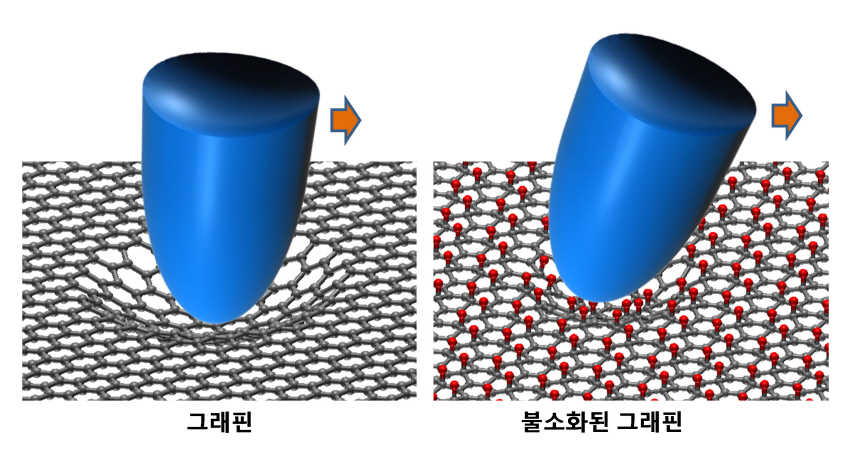 KAIST researchers verify and control the mechanical properties of graphene
KAIST researchers have successfully verified and controlled the mechanical properties of graphene, a next-generation material. Professor Park Jung Yong from the EEWS Graduate School and Professor Kim Yong Hyun from the Graduate School of Nanoscience and Technology have succeeded in fluorinating a single atomic-layered graphene sample and controlling its frictional and adhesive properties. This is the first time the frictional properties of graphene have been examined at the atomic level, and the technology is expected to be applied to nano-sized robots and microscopic joints.
Graphene is often dubbed “the dream material” because of its ability to conduct high amounts of electricity even when bent, making it the next-generation substitute for silicon semiconductors, paving the way for flexible display and wearable computer technologies. Graphene also has high potential applications in mechanical engineering because of its great material strength, but its mechanical properties remained elusive until now.
Professor Park’s research team successfully produced individual graphene samples with fluorine-deficiency at the atomic level by placing the samples in Fluoro-xenon (XeF2) gas and applying heat. The surface of the graphene was scanned using a micro probe and a high vacuum atomic microscope to measure its dynamic properties.
The research team found that the fluorinated graphene sample had 6 times more friction and 0.7 times more adhesiveness than the original graphene. Electrical measurements confirmed the fluorination process, and the analysis of the findings helped setup the theory of frictional changes in graphene.
Professor Park stated that “graphene can be used for the lubrication of joints in nano-sized devices” and that this research has numerous applications such as the coating of graphene-based microdynamic devices.
This research was published in the online June edition of Nano Letters and was supported by the Ministry of Science, Technology, and Education and the National Research Foundation as part of the World Class University (WCU) program.
2012.07.24 View 26937
-
 Biomimetic reflective display technology developed
Professor Shin Jung Hoon
The bright colors of a rainbow or a peacock are produced by the reflection and interference of light in transparent periodic structures, producing what is called a structural color. These colors are very bright and change according to the viewing angle. On the other hand, the wings of a morpho-butterfly also have structural colors but are predominantly blue over a wide range of angles. This is because the unique structure of the morpho-butterfly’s wings contains both order and chaos.
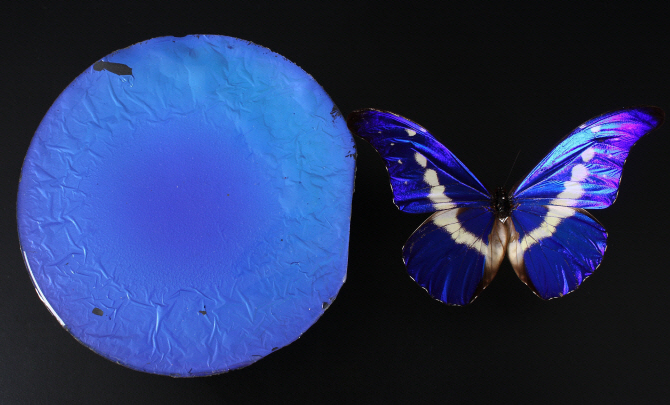
Professor Shin Jung Hoon’s team from the Department of Physics and the Graduate School of Nanoscience and Technology at KAIST produced a display that mimics the structure of the morpho-butterfly’s wings using glass beads.
This research successfully produced a reflective display (one that reflects external light to project images), which could be used to make very bright displays with low energy consumption. This technology can also be used to make anti-counterfeit bills, as well as coating materials for mobile phones and wallets.
The structure of the morpho-butterfly’s wings seems to be in periodic order at the 1-micrometer level, but contains disorder at the 100-nanometer level. So far, no one had succeeded in reproducing a structure with both order and disorder at the nanometer level.
Professor Shin’s team randomly aligned differently sized glass beads of a few hundred nanometers to create chaos and placed a thin periodic film on top of it using the semiconductor deposition method, thereby creating the morpho-butterfly-like structure over a large area.
This new development produced better color and brightness than the morpho-butterfly wing and even exhibited less color change according to angle. The team sealed the film in thin plastic, which helped to maintain the superior properties whilst making it more firm and paper-like.
Professor Shin emphasized that the results were an exemplary success in the field of biomimetics and that structural colors could have other applications in sensors and fashion, for example.
The results were first introduced on May 3rd in Nature as one of the Research Highlights and will be published in the online version of the material science magazine, Advanced Materials.
This research was jointly conducted by Professor Shin Jung Hoon (Department of Physics / Graduate School of Nanoscience and Technology at KAIST), Professor Park NamKyoo (Department of Electrical and Computer Engineering at Seoul National University), and Samsung Advanced Institute of Technology. The funding was provided by the National Research Foundation of Korea and the Ministry of Education, Science and Technology as part of the World Class University (WCU) project.
Figure 2. The biomimetic film can express many different colors
Figure 3. The biomimetic diplay and a morpho-butterfly
2012.05.07 View 24519
-
New York Times, "First, Catch Your Faculty-A Recipe for Excellence"
The World Bank has recently published a new book entitled “The Road to Academic Excellence: The Making of World Class Research Universities.” The report (book) examined the recent experience of 11 universities in 9 countries (for Korea, it sampled Pohang University of Science and Technology, established in 1986) that have undergone transformations in order to become world-class universities. The book has received a wide coverage from the media all around the world since its publication in late September, among others, the latest article by New York Times (NYT), dated October 16, 2011. The gist of the book, i.e., what elements are required should a research university to become “truly prestigious” in the global scene, is well introduced by the NYT article, and here’s the link:
New York Times, “First, Catch Your Faculty-A Recipe for Excellence”
http://www.nytimes.com/2011/10/17/world/americas/17iht-educLede17.html
2011.10.17 View 17382