%6b%61%69%73%74%69%61%6e
-
 Professor Kyung-Jin Lee of the Department of Physics Selected for the KAISTian of the Year’ Award
< Professor Kyung-Jin Lee at the ceremony >
KAIST announced on February 12th that it has selected Professor Kyung-Jin Lee from the Department of Physics as the recipient of the ‘KAISTian of the Year’ award in celebration of the university's 55th anniversary. Established in 2001, the ‘KAISTian of the Year’ award is the university’s highest honor, presented to members who have significantly enhanced KAIST's global prestige through exceptional academic and research milestones.
As the 25th recipient of this award, Professor Kyung-Jin Lee was recognized for his groundbreaking work in identifying the phenomenon of ‘Quantum Spin Pumping,’ effectively overturning 30-year-old conventional assumptions in spin transfer theory. While existing theories treated spin as a classical physical quantity, Professor Lee focused on the fact that spins within materials possess intrinsic quantum properties, much like electrons. To verify this, he researched Iron-Rhodium (FeRh), a magnetic material where spin magnitude changes abruptly under specific conditions. He became the first to observe a quantum transition in which the spin magnitude of Rhodium (Rh) atoms increased suddenly rather than gradually, theorizing that this very change serves as a new mechanism for inducing electron movement. Experimental data showed that this effect is more than 10 times greater than what previous theories had predicted. This achievement is hailed as a major breakthrough that redefines the core premises of spin transfer theory and provides a vital theoretical foundation for next-generation ultra-low-power magnetic memory and quantum information devices. The study gained worldwide acclaim following its publication in the journal ‘Nature’ last year.
The anniversary ceremony also honored 58 faculty members for their excellence in education, research, and international cooperation. Professor Wonho Choe of the Department of Nuclear and Quantum Engineering received the ‘Academic Achievement Grand Prize’ for his world-first identification of physical phenomena in low-temperature atmospheric pressure plasma and his contributions to medical and space technologies. The ‘Creative Teaching Grand Prize’ went to Professor Hyung-soo Kim of the Department of Mechanical Engineering for his innovative sports fluid mechanics curriculum. Professor Park Bum-soon of the Graduate School of Science and Technology Policy was awarded the ‘Outstanding Teaching Grand Prize’ for his interdisciplinary ‘Anthropocene Humanities’ courses that bridge science, art, and policy.
Furthermore, Professor Hyeon-Min Bae of the School of Electrical Engineering received the ‘Distinguished Service Grand Prize’ for his leadership in accelerating deep-tech prototyping and fostering a robust startup ecosystem. Professor Shin-Hyun Kim of the Department of Chemical and Biomolecular Engineering was honored with the ‘International Cooperation Grand Prize’ for establishing the T2KN consortium between Korea, Japan, China, and ASEAN, facilitating global academic exchange for over 120 students.
KAIST President Kwang-Hyung Lee stated, “The true spirit of KAIST lies in the dedication of our members who venture into uncharted territories and strive to transcend existing limits. I hope today serves as a moment for all our members to share in the joy and celebrate the remarkable achievements of our awardees.”
2026.02.12 View 3768
-
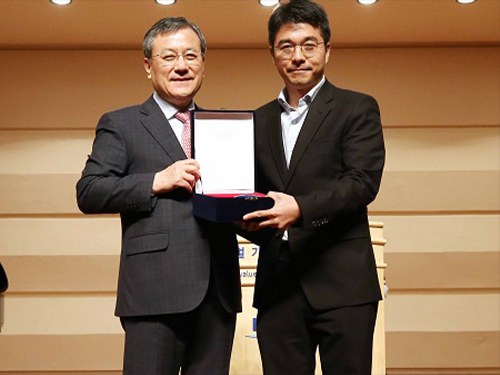 Professor Jeong-Ho Lee Named the KAISTian of 2018
(Professor Jeong-Ho Lee (right) poses with President Sung-Chul Shin)
Professor Jeong-Ho Lee from the Graduate School of Medical Science and Engineering was selected as the KAISTian of the Year of 2018. The award was established in 2001 and recognizes the most outstanding scholars who have made significant research and scholastic achievements during the year. Professor Lee was awarded during the New Year ceremony held in the auditorium on January 2.
Professor Lee has investigated mutations arising in the brain for decades and has published in renowned journals such as Nature, Nature Medicine, and Cell. Last August, Professor Lee reported breakthrough research on glioblastoma in Nature, giving insight into understanding how the mutation causing glioblastoma starts and suggested novel ways to treat glioblastoma, which was thought to be incurable. (Click for more)
Professor Lee’s Translational Neurogenetics Laboratory lab is investigating innovative diagnostics and therapeutics for untreatable brain disorders including intractable epilepsy and glioblastoma. To commercialize his technology, he established the tech-startup SoVarGen and now works as its CTO.
Professor Lee credited all his lab colleagues and staff. “I know all of this research would not have possible without their sweat and effort. I am happy to receive this honorable award on behalf of them.”
Remembering the beginning of his career at KAIST in 2012, Professor Lee said “KAIST seemed to be a very high and formidable barrier for me, after completing my medical education in Korea. I thank my department professors and colleagues who led me to focus on the research path that I really wanted. They provided everything for my research environment to help make good results.”
“I will continue to strive for promoting the well-being of humanity by addressing various incurable diseases as well as developing novel therapeutics. That will be the way to promote the stature of KAIST at home and abroad,” he added.
2019.01.02 View 11097
-
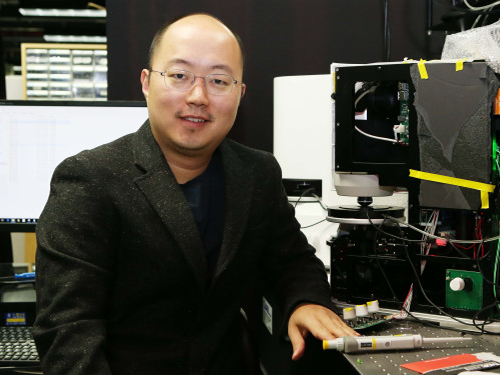 Meet the KAISTian of 2017, Professor YongKeun Park
Professor YongKeun Park from the Department of Physics is one of the star professors in KAIST. Rising to the academic stardom, Professor Park’s daily schedule is filled with series of business meetings in addition to lab meetings and lectures.
The year 2017 must have been special for him. During the year, he published numerous papers in international journals, such as Nature Photonics, Nature Communications and Science Advances. These high performances drew international attention from renowned media, including Newsweek and Forbes. Moreover, recognizing his research performance, he was elected as a fellow member of the Optical Society (OSA) in his mid-30s. Noting that the members’ age ranges from late 50s to early 60s, Professor Park’s case considered to be quite exceptional.
Adding to his academic achievement, he has launched two startups powered of his own technologies. One is called Tomocube, a company specialized in 3-D imaging microscope using holotomography technology. His company is currently exporting the products to multiple countries, including the United States and Japan. The other one is The.Wave.Talk which has technologies for examining pre-existing bacteria anywhere and anytime.
His research career and entrepreneurship are well deserved recipient of many honors. At the 2018 kick-off ceremony, Professor Park was awarded the KAISTian of 2017 in recognition of his developing holographic measure and control technology as well as founding a new field for technology application.
KAISTian of the Year, first presented in 2001, is an award to recognize the achievements and exemplary contribution of KAIST member who has put significant effort nationally and internationally, enhancing the value of KAIST.
While receiving the award, he thanked his colleagues and his students who have achieved this far together. He said, “I would like to thank KAIST for providing environment for young professors like me so that we can engage themselves in research. Also, I would like to mention that I am an idea seeder and my students do the most of the research. So, I appreciate my students for their hard works, and it is very pleasure to have them. Lastly, I thank the professors for teaching these outstanding students. I feel great responsibility over this title. I will dedicate myself to make further progress in commercializing technology in KAIST.”
Expecting his successful startup cases as a model and great inspiration to students as well as professors, KAIST interviewed Professor Park.
Q What made you decide to found your startups?
A I believed that my research areas could be further used. As a professor, I believe that it is a university’s role to create added value through commercializing technology and creating startups.
Q You have co-founded two startups. What is your role in each company?
A So, basically I have two full-time jobs, professor in KAIST and CTO in Tomocube. After transferring the technology, I hold the position of advisor in The.Wave.Talk.
(Holographic images captured by the product Professor Park developed)
Q Do your students also participate in your companies or can they?
A No, the school and companies are separate spaces; in other words, they are not participating in my companies. They have trained my employees when transferring the technologies, but they are not directly working for the companies.
However, they can participate if they want to. If there’s a need to develop a certain technology, an industry-academia contract can be made. According to the agreement, students can work for the companies.
Q Were there any hardships when preparing the startups?
A At the initial stage, I did not have a financial problem, thanks to support from Startup KAIST. Yet, inviting capital is the beginning, and I think every step I made to operate, generate revenue, and so on is not easy.
Q Do you believe KAIST is startup-friendly?
A Yes, there’s no school like KAIST in Korea and any other country. Besides various programs to support startup activities, Startup KAIST has many professors equipped with a great deal of experience. Therefore, I believe that KAIST provides an excellent environment for both students and professors to create startups.
Q Do you have any suggestion to KAIST institutionally?
A Well, I would like to make a comment to students and professors in KAIST. I strongly recommend them to challenge themselves by launching startups if they have good ideas. Many students wish to begin their jobs in government-funded research institutes or major corporates, but I believe that engaging in a startup company will also give them valuable and very productive experience.
Unlike before, startup institutions are well established, so attracting good capital is not so hard. There are various activities offered by Startup KAIST, so it’s worthwhile giving it a try.
Q What is your goal for 2018 as a professor and entrepreneur?
A I don’t have a grand plan, but I will work harder to produce good students with new topics in KAIST while adding power to my companies to grow bigger.
By Se Yi Kim from the PR Office
2018.01.03 View 20597
-
 Professor Lee Jeong Yong Receives 2012 'KAISTian of the Year' Award
Professor Lee Jeong Yong (Department of Material Science and Engineering) received the 2012 ‘KAISTian of the Year’ Award.
Professor Lee had successfully developed a technique that allowed the observation and analysis of liquid in atomic scale.
The technique is expected to have great impact on nano-material synthesis in solution, explaining electrode and electrolyte reaction, liquid and catalysis reaction research, and etc. and was therefore named as the best experimental accomplishment in KAIST in 2012.
Professor Lee and his team’s finding has been published in the April edition of Science magazine and has had attracted the attention of the world. In addition, BBC News, and Science & Environment reported on the findings as their respective top articles.
The optical microscope is incapable of atomic scale observation and the electron microscopes are capable but because of the vacuum state all liquids undergo evaporation making it impossible to observe liquids in an atomic scale.
Professor Lee’s team wrapped the liquid with a layer of grapheme to prevent evaporation and successfully observed real time the platinum growth process in solution.
Professor Lee’s findings were introduced as an example of exemplar research case in the Presidential address for ‘Science Day’ in April.
2013.01.22 View 14598