%6d%65%61%73%75%72%65%6d%65%6e%74
-
 Ultra High Speed Optical Measurement Technology Developed
< (From left) Tae Jin Ha, CEO of VIRNECT, Kwang Hyung Lee, President of KAIST >
An open platform for industry-academia-research collaboration, which has accumulated K-Metaverse technology capabilities that break down the boundaries between reality and virtuality and share experiences beyond the limits of time and space, is expected to be built on our university campus.
Our university announced on the 13th that it’s signing an agreement for the establishment and operation of a 'Virtual Convergence Research Center' with the Graduate School of Metaverse and VIRNECT Co., Ltd. (CEO Tae Jin Ha), a domestic augmented/virtual reality (XR) specialized company and a startup founded by a KAIST alumnus.
The Virtual Convergence Research Center, which will be newly constructed on our university campus, plans to prepare for the future participation of related government-funded research institutes, and is expected to function as a national strategic hub that creates future growth engines for the Republic of Korea, going beyond simple industry-academia cooperation. VIRNECT Co., Ltd. plans to create the research center as an open research collaboration platform in which domestic and international industry, academia, and research institutes jointly participate with KAIST.
This research center is expected to experiment with the convergence of reality and virtuality and establish itself as a global hub for the 'K-Metaverse Innovation Ecosystem' where technology development, talent cultivation, and industrial diffusion are in a virtuous cycle.
VIRNECT Co., Ltd. was founded by KAIST alumnus Tae Jin Ha, listed on KOSDAQ in 2023, and won the CES Innovation Award for developing the industrial AI smart goggles 'VisionX'. It has grown into a representative domestic spatial computing company based on various industrial innovation technologies such as AI/XR solutions and digital twin. Synergistic co-prosperity with KAIST is anticipated through this collaboration.
Spatial computing and XR technology are areas where global big techs like Apple, Meta, Google, Microsoft, and Samsung are engaged in fierce competition for dominance, paying attention to them as the next-generation AI platforms. With major countries such as the US and China investing enormous capital and capabilities, the launch of the KAIST Virtual Convergence Research Center is evaluated as a strategic response for South Korea not to fall behind in the competition of the post-metaverse era.
The research center plans to lead both industrial productivity and social innovation as an R&BD (Research & Business Development) hub that integrates core technologies such as digital twin, metaverse, spatial/physical intelligence, and wearable XR. Furthermore, it will quickly verify the applicability to industrial sites and support the creation of new industries through a full-cycle system covering education, research, demonstration, commercialization, and diffusion.
Moreover, the research center will create national synergy by being closely linked with government policies. Strengthening the link between education and research, fostering a sustainable metaverse ecosystem, and expanding global leadership through an open industry-academia-research platform align with the government's strategy for advancing the virtual convergence industry.
< Executives from both organizations attending the signing ceremony >
VIRNECT CEO Tae Jin Ha said, "The long-term cooperation with KAIST is a stepping stone for us to leap forward as a game-changer in the global XR industry," adding, "We will strengthen virtual convergence technology competitiveness through research and education infrastructure and accelerate commercialization through demonstration."
Professor Woontack Woo, Dean of the Graduate School of Metaverse, emphasized, "The Virtual Convergence Research Center will serve as an open platform where industry, academia, and research institutes jointly experiment with K-Metaverse innovation, and a 'Meta Power Plant' that cultivates future core personnel and disseminates research results to the industry."
KAIST President Kwang Hyung Lee said, "This agreement is a strategic investment to secure global leadership by breaking down the boundaries between research and industry, going beyond simply creating a new research center," and "KAIST will spare no support for the research center."
With the future designation of the KAIST Virtual Convergence Research Center as a government-specialized graduate school/research center for the virtual convergence industry and increased industry cooperation, it will establish itself as a national innovation platform that concentrates South Korea's metaverse capabilities. This is expected to lead to the creation of new value for the future society and the strengthening of national competitiveness, going beyond simple technology development.
2025.10.13 View 4781
-
 Accurate Real time ECG Measurement While Comfortably Lying Down at Home
< (From left) Professor Chul Kim of the Department of Bio and Brain Engineering, Ph.D. candidate Minjae Kim, researcher Premravee Teeravichayangoon >
KAIST's research team has developed a technology that can measure electrocardiogram (ECG) and heart rate variability (HRV) in real time by simply lying on a bed with clothes on, without having to go to the hospital. This technology is expected to evolve into a daily heart health monitoring platform in conjunction with remote healthcare, and further expand into various bio-healthcare fields such as sleep and stress analysis, contributing to personalized prevention and early diagnosis for patients.
KAIST announced on the 19th that Professor Chul Kim's research team from the Department of Bio and Brain Engineering has developed an 'in-bed cardiac monitoring on-device system'.
The research team manufactured a flexible substrate sensor that integrates the electronic circuit and electrodes into one to increase precision, and implemented an integrated system that can perform signal-noise separation, heart beat signal (R-peak) detection, and heart rate variability analysis in real time through on-device signal processing.
Existing ECG measurement had the inconvenience of visiting a hospital, taking off clothes, and attaching wet electrodes to the skin. Because of this, long-term monitoring was difficult, and it was not easy for the elderly or patients with chronic diseases to use it daily. Non-contact methods also had a technical limitation of being vulnerable to external noise.
To solve these problems, the research team applied a circuit that blocks external noise (active shielding) and a circuit that stably captures minute current changes in the human body (right-leg drive circuit). In addition, they implemented a mathematical transformation technique (wavelet transform) that extracts only the important parts from the heart beat signal and a calculation method (peak detection algorithm) that accurately identifies the moment of the heart's electrical beat (R-peak) as on-device signal processing techniques, allowing for precise real-time analysis of the signal.
As a result, users can obtain stable and accurate ECG signals even when lying on their backs with clothes on.
< Figure. Overall structural diagram of the developed non-contact in-bed cardiac monitoring on-device system, schematic diagram of the R-peak detection algorithm, real-time ECG and HRV measurement screen >
This research presents new possibilities for managing chronic cardiovascular diseases and supporting the health of the elderly, as it can be easily used not only in hospitals but also at home.
Professor Chul Kim said, "This system, which can extract signals in real time even in a noisy environment, can be used to easily check heart health in daily life," and added, "In the future, it will become the foundation of sleep health management by adding the measurement of various bio-signals."
This paper, in which Ph.D. candidate Minjae Kim and researcher Premravee Teeravichayangoon from the Department of Bio and Brain Engineering participated as co-first authors, was published online in the international journal 'Biosensors and Bioelectronics' on August 9, 2025.
※ Paper title: A homecare in-bed hardware system for precise real-time ECG and HRV monitoring with layered clothing. DOI: https://doi.org/10.1016/j.bios.2025.117838
※ Author information: Minjae Kim (KAIST Department of Bio and Brain Engineering, First Author), Premravee Teeravichayangoon (KAIST Department of Bio and Brain Engineering, First Author), Chul Kim (KAIST Department of Bio and Brain Engineering, Corresponding Author)
Meanwhile, this research was carried out with the support of the National Research Foundation of Korea's Basic Research Lab and Bio-medical Technology Development Project, and the KAIST-Ceragem Future Healthcare Research Center.
2025.09.19 View 4313
-
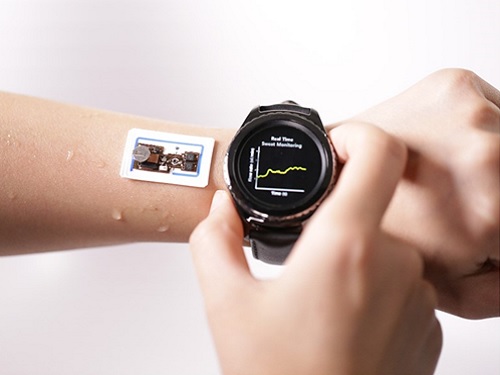 Wearable Device to Monitor Sweat in Real Time
An on-skin platform for the wireless monitoring of flow rate, cumulative loss, and temperature of sweat in real time
An electronic patch can monitor your sweating and check your health status. Even more, the soft microfluidic device that adheres to the surface of the skin, captures, stores, and performs biomarker analysis of sweat as it is released through the eccrine glands.
This wearable and wireless electronic device developed by Professor Kyeongha Kwon and her collaborators is a digital and wireless platform that could help track the so-called ‘filling process’ of sweat without having to visually examine the device. The platform was integrated with microfluidic systems to analyze the sweat’s components.
To monitor the sweat release rate in real time, the researchers created a ‘thermal flow sensing module.’ They designed a sophisticated microfluidic channel to allow the collected sweat to flow through a narrow passage and a heat source was placed on the outer surface of the channel to induce a heat exchange between the sweat and the heated channel.
As a result, the researchers could develop a wireless electronic patch that can measure the temperature difference in a specific location upstream and downstream of the heat source with an electronic circuit and convert it into a digital signal to measure the sweat release rate in real time. The patch accurately measured the perspiration rate in the range of 0-5 microliters/minute (μl/min), which was considered physiologically significant. The sensor can measure the flow of sweat directly and then use the information it collected to quantify total sweat loss. Moreover, the device features advanced microfluidic systems and colorimetric chemical reagents to gather pH measurements and determine the concentration of chloride, creatinine, and glucose in a user's sweat.
Professor Kwon said that these indicators could be used to diagnose various diseases related with sweating such as cystic fibrosis, diabetes, kidney dysfunction, and metabolic alkalosis. “As the sweat flowing in the microfluidic channel is completely separated from the electronic circuit, the new patch overcame the shortcomings of existing flow rate measuring devices, which were vulnerable to corrosion and aging,” she explained.
The patch can be easily attached to the skin with flexible circuit board printing technology and silicone sealing technology. It has an additional sensor that detects changes in skin temperature. Using a smartphone app, a user can check the data measured by the wearable patch in real time.
Professor Kwon added, “This patch can be widely used for personal hydration strategies, the detection of dehydration symptoms, and other health management purposes. It can also be used in a systematic drug delivery system, such as for measuring the blood flow rate in blood vessels near the skin’s surface or measuring a drug’s release rate in real time to calculate the exact dosage.”
-PublicationKyeongha Kwon, Jong Uk Kim, John A. Rogers, et al. “An on-skin platform for wireless monitoring of flow rate, cumulative loss and temperature of sweat in real time.” Nature Electronics (doi.org/10.1038/s41928-021-00556-2)
-ProfileProfessor Kyeongha KwonSchool of Electrical EngineeringKAIST
2021.06.25 View 22399
-
 Professor Jungwon Kim Wins Haerim Optics and Photonics Award
(Professor Jungwon Kim)
Professor Jungwon Kim from the Department of Mechanical Engineering received the 8th Haerim Optics and Photonics Award from the Optical Society of Korea (OSK).
He was recognized for his dedication to pioneering the field of microwave photonics by developing ultra-low noise fiber photonics lasers.
The Haerim Optics and Photonics Award is given to an outstanding researcher who has made academic contributions in the field of optics and photonics for the last five years.
The name of the award (Haerim) comes from the pen-name of the renowned scholar, Professor Un-Chul Paek, because it is maintained using funds he contributed to the OSK.
The OSK will confer the award on February 8 during the 29th OSK Annual Meeting and Winter Conference of 2018.
2018.02.07 View 15499
-
 Nature Photonics, a peer-reviewed scientific journal, released a paper written by a KAIST research team on the time-of-flight measurement.
Professor Seung-Woo Kim of the Mechanical Engineering Department, KAIST, and his research team published the result of their study on the measurement of 1 nanometer (nm) precision.
“The time-of-flight of light pulses has long been used as a direct measure of distance, but state-of-the-art measurement precision using conventional light pulses or microwaves peaks at only several hundreds of micrometers. Here, we improve the time-of-flight precision to the nanometer regime by timing femtosecond pulses through phase-locking control of the pulse repetition rate using the optical cross-correlation technique,” Professor Kim said.
According to the experiment conducted by the research team, “An Allan deviation of 117 nm in measuring a 700m distance in air at a sampling rate of 5 millisecond (ms) once the pulse repetition is phased-locked, which reduces to 7 nm as the averaging time increases to 1 second (s).”
When measuring an object located in a far distance, a laser beam is projected to the object, and the reflected light is analyzed; the light is then converted into an electric signal to calculate the distance. In so doing, Professor Kim said, the conventional method of measurement creates at least 1 mm of deviation.
He argues, “This enhanced capability is maintained at long range without periodic ambiguity, and is well suited to lidar applications. This method could also be applied to future space missions involving formation-flying satellites for synthetic aperture imaging and remote experiments related to general relativity theory."
Nature Photonics published the article online on August 8, 2010.
2010.08.18 View 21218
-
 Gold prize for Sungkoo Yeo and silver prize for Youngsik Kim at 'Samsung Electrics paper contest'
Gold prize for Sungkoo Yeo and silver prize for Youngsik Kim at ‘Samsung Electrics paper contest’
Sungkoo Yeo, doctorate student at the division of Electrical Engineering, and Youngsik Kim, doctorate students at the division of Mechanical Engineering, won gold and silver prizes respectively at ‘the 2nd Inside edge paper contest’ organized by Samsung Electronics.
Yeo, under the supervisory of Professor Youngse Kwon, won the glory of gold prize in recognition of his highly evaluated researches in the fields of silicon-based micro mold manufacturing technologies and fine shaping technologies revealed by his paper of ‘"Fabrication of Microlens array Using PDMS Replica Molding and Oxidized Porous Silicon Bulk Micromachining’.
Kim, under the supervisory of Professor Seungwoo Kim, also won the silver prize for his research performances over the thickness pattern measuring technologies of transparent thin film coated on the pattern of an opaque metal in the field of optical technology unveiled by his paper of "Dispersive white-light interferometry for in-line inspection of thin-film layers on patterned structures".
Inside Edge paper contest is an academic paper contest organized by Samsung Electronics to reveal the fresh ideas and potential technologies of the young talented.
2006.11.27 View 27918