%6f%72%69%65%6e%74%61%74%69%6f%6e
-
 See You at KAIST: Freshman Keeps His Promise as 2026 Matriculation Ceremony Begins
<2026 Undergraduate Matriculation Ceremony>
KAIST announced that it will hold the 2026 Undergraduate Matriculation Ceremony today, February 25, at 10:00 AM in the Auditorium of the Main Campus in Daejeon. The event marks the first step for freshmen who will lead the future of South Korea’s science and technology.
In his welcoming remarks, President Kwang Hyung Lee plans to emphasize that “KAIST is a university built upon a spirit of inquiry that never stops questioning and a drive for challenge that does not fear failure.” He will encourage the students, stating, “I hope you challenge yourselves to your heart's content, and even if you fall, stand back up to blaze new trails that the world has never seen before.”
President Lee will also highlight that the role of talent in science and technology is more critical than ever in this era of massive transformation driven by Artificial Intelligence (AI) and digital transition. He plans to urge students to grow into responsible scientists and engineers who contribute to humanity and society through cooperation and communication, adding, “KAIST will spare no effort in supporting you to ensure your challenges become a reality.”
Marking the 40th class of incoming freshmen, this year’s ceremony will be attended by approximately 1,500 people, including students, parents, and distinguished guests, to celebrate this new beginning.
The speech by Junseop Shin, the student representative taking the podium, begins with the theme of a “promise.” He plans to share how the words “See you at KAIST,” spoken to him by President Kwang Hyung Lee at a defense industry forum three years ago, turned a vague dream into a definitive goal.
<Student Representative Junseop Shin delivering his speech>
Having contemplated his role in an era where science and technology dictate national competitiveness, Shin chose the challenging path of researching “small drone detection technology” instead of a more stable route. Despite numerous failures, frustrations, and discouragement from those around him, he persevered by remembering that promise, eventually achieving a technical breakthrough that garnered attention from international academic societies.
“I learned that keeping a promise isn't about never falling, but about getting back up every time you do,” Shin plans to say, vowing that his new beginning at KAIST will be a journey of fearless challenge.
The ceremony will also introduce the KAIST AI Future Challenge, themed “New and Innovative Ideas for the Future AI Era.” Any KAIST student can participate individually or as a team to tackle future societal issues with creative and feasible ideas. The winning teams will be honored at the “Education Innovation Day” ceremony in May.
<Students taking the matriculation oath>
Following the matriculation ceremony, an orientation will be held to assist students with their first steps into university life. This will include introductions to freshman programs, as well as essential training on community guidelines, mental health services, violence prevention, and safety education to support the students' stable transition into their studies and research.
Furthermore, the three-day “Freshman Start-up (Saenaegi Saerobaumteo)” will feature a diverse range of programs, including club performances, fairs, campus tours, and a welcoming broadcast festival. Freshmen will have the opportunity to experience KAIST culture firsthand and socialize with seniors and peers to shape their vision for university life.
2026.02.25 View 3222
-
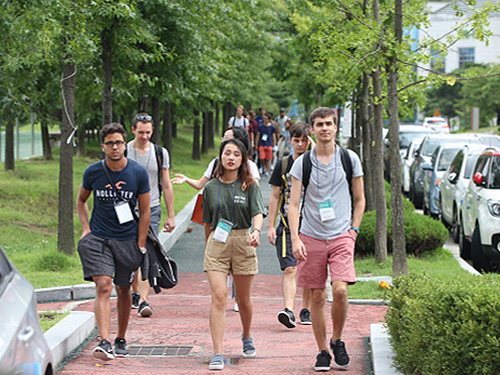 International Students Start a New Semester at KAIST
(International students during a campus tour)
The 2017 fall semester began on August 28 and new and returning students are filling the campus. Our international students are one of the reasons the campus is becoming more dynamic and energetic.
It was easy to see groups of smiling international students walking around the campus. Every semester, KAIST welcomes hundreds of students from around the world to give them the opportunity to study at a world-leading university in science and technology.
This semester, approximately 150 students in degree-seeking programs and 220 exchange students from a total of 74 countries, including Germany, the United States, and France entered KAIST.
(Frederik Hansen, a student from DTU)
Frederik Hansen is an exchange student who came to KAIST this semester from Copenhagen, Denmark. He completed the undergraduate program at the Technical University of Denmark (DTU) and is now pursuing a master’s degree.
He decided to join KAIST because he felt the university is up-to-date with subjects in his field of interest.
Frederik, who majored in mechanical engineering, looks forward taking classes related to robotics and solid mechanics. Noting that it’s his first time visiting Asia, he hopes to experience and learn about Korean culture.
In an effort to help foreign students’ soft landing in KAIST, the International Office held a series of orientation programs over three days. The buddy program provides international freshmen with an opportunity to make Korean friends for a more successful life at KAIST, while giving domestic students a chance to learn about different cultures and perhaps build on the global capacity required for becoming a global leader. Information sessions also provided educational information that can support international students living in KAIST. Finally, the counseling program gives information about the KAIST counseling center and ISSS (International Scholar and Student Service). It provides a psychometric test service to those who wish to take it.
If you are interested in pursuing academic programs at KAIST, please visit the International Office via http://io.kaist.ac.kr/index.do .
2017.08.30 View 12149
-
 Paving the Way to Next Generation Display
A new type of LCD that does not require polymer orientation films has been developed by researchers within the country. This technology will enable the creation of thiner and higher definition display.
Prof. Hee Tae Jung form KAIST’s biochemical engineering department led the research and Hyun Soo Jung, Hwan Jin Jeon doctoral students (1st co-authors), Doctor Yun Ho Kim from Korea Chemistry Research Center, and Prof. Shin Woong Kang from Jeon Buk University ( co-author) have participated in this research. This research has been funded by the WCU program and middle-grade researcher support program. The results of the research has been published as the online update of ‘‘Nature Asia Materials(NPG Asia Materials)” which is a sister magazine of the world renowned academic magazine ‘Nature’.
The flat display industry is the core industry leading the 21st century’s IT industry. The LCD is the main area of research. Korea is the leader of this industry, holding more than 50% of the world market. Many technologies are combined to make the electro-optic devices of the LCD function. The most important technology, which determines the indicating element’s quality and function is the technology to align the liquid crystals in one direction.
Currently, all LCD products are created by mechanically cutting into the surface of the polymer film and orienting the liquid crystal material along these cuts. However, the creation of polymer orientation films cost much time and money, and the high temperature processes necessary to stabilize the polymers does not allow for the free selection of circuit boards, and thus does not allow for the use in flexible display.
Prof. Hee Tae Jung devised a method to orient liquid display without the use of a polymer film using ITOs. Prof. Jung’s base technology has been tested on ITOs to maintain the necessary transparency and conductivity after forming a pattern with high decomposition rates and slenderness ratios.
The technology developed by the research team can horizontally or vertically align the transparent conductors without the use of polymer orientation films. Thus, the manufacturing processes have become much shortened and the LCDs can be made in much thinner from a few micrometers to a few centimeters. Also, it has a lower functioning voltage and faster response speed, showing the prospects of a high definition ultra-fast screen display development. Furthermore, this technology can be used for any type of board, and can be adjusted to a nanometer scale. This enables for its use in LCD based flexible or multi-domain modes.
Also, the transparent conductor patterning technology devised by the research team can be used not only for displays, but also for touch panels with highly increased sensitivity.
Prof. Jung said, “It was a long desire of the industry and academia to find a way to replace the polymer orientation film. This new technology does not need any polymer orientation films, and we can still use the original boards used for LCDs. This mean a lot to the industry. Also, this technology will increase the sensitivity of the touch panels for tablet PCs and smart phones. It can be used in many areas of future electronics base technology.”
2012.04.04 View 17635