%72%75%62%62%65%72
-
 Physics Informed AI Excels at Large Scale Discovery of New Materials!
<(From left) Ph.D candidates Songho Lee, Donggeun Park, and Hyeonbin Moon, and Professor Seunghwa Ryu from the Department of Mechanical Engineering; (top) Professor Jae Hyuk Lim from Kyung Hee University and Dr. Wabi Demeke from KAIST>
One of the key steps in developing new materials is “property identification,” which has long relied on massive amounts of experimental data and expensive equipment, limiting research efficiency. A KAIST research team has introduced a new technique that combines “physical laws,” which govern deformation and interaction of materials and energy, with artificial intelligence. This approach allows for rapid exploration of new materials even under data-scarce conditions and provides a foundation for accelerating design and verification across multiple engineering fields, including materials, mechanics, energy, and electronics.
KAIST (President Kwang Hyung Lee) announced on the 2nd of October that Professor Seunghwa Ryu’s research group in the Department of Mechanical Engineering, in collaboration with Professor Jae Hyuk Lim’s group at Kyung Hee University (President Jinsang Kim) and Dr. Byungki Ryu at the Korea Electrotechnology Research Institute (President Namkyun Kim), proposed a new method that can accurately determine material properties with only limited data. The method uses Physics-Informed Machine Learning (PIML), which directly incorporates physical laws into the AI learning process.
<Schematic Diagram of a Physics-Based Machine Learning Methodology for Understanding Material Properties>
In the first study, the researchers focused on hyperelastic materials, such as rubber. They presented a Physics-Informed Neural Network (PINN) method that can identify both the deformation behavior and the properties of materials using only a small amount of data obtained from a single experiment. Whereas previous approaches required large, complex datasets, this research demonstrated that material characteristics can be reliably reproduced even when data is scarce, limited, or noisy.
In the second study, the team turned to thermoelectric materials—new materials that convert heat into electricity and electricity into heat. They proposed a PINN-based inverse inference technique that can estimate key indicators, such as thermal conductivity (how well heat is transferred) and the Seebeck coefficient (how efficiently electricity is generated), from just a few measurements.
Going further, the researchers introduced a Physics-Informed Neural Operator (PINO), an AI model that understands the physical laws of nature, and showed that it can generalize to previously unseen materials without requiring retraining.
In fact, after training the system on 20 materials, they tested it on 60 entirely new materials, and in all cases it predicted their properties with high accuracy. This breakthrough points to a future where large-scale, high-speed screening of countless candidate materials becomes possible.
This achievement goes beyond simply reducing the need for experiments. By intricately combining physical laws with AI, the researchers provided the first example of improving experimental efficiency while preserving reliability.
Professor Seunghwa Ryu, who led both studies, stated, “This is the first case of applying AI that understands physical laws to real material research. It enables reliable identification of material properties even when data availability is limited, and it is expected to expand into various engineering fields.”
The first paper, co-first-authored by KAIST Mechanical Engineering PhD candidates Hyeonbin Moon and Donggeun Park, was published on August 13 in Computer Methods in Applied Mechanics and Engineering.
※ Paper title: “Physics-informed neural network-based discovery of hyperelastic constitutive models from extremely scarce data”
※ DOI: https://doi.org/10.1016/j.cma.2025.118258
The second paper, co-first-authored by KAIST Mechanical Engineering PhD candidates Hyeonbin Moon and Songho Lee, and Dr. Wabi Demeke, was published on August 22 in npj Computational Materials.
※ Paper title: “Physics-informed neural operators for generalizable and label-free inference of temperature-dependent thermoelectric properties” ※ DOI: https://doi.org/10.1038/s41524-025-01769-1
Meanwhile, the first study was supported by the Korea Research Foundation and the Ministry of Science and ICT’s INNOCore Program, as well as by a research project from the Ministry of Food and Drug Safety. The second study was carried out with support from the Korea Research Foundation and the Ministry of Science and ICT’s INNOCore Program.
2025.10.10 View 6141
-
 In KAIST, Robots Now Untie Rubber Bands and Insert Wires Like Humans
The technology that allows robots to handle deformable objects such as wires, clothing, and rubber bands has long been regarded as a key task in the automation of manufacturing and service industries. However, since such deformable objects do not have a fixed shape and their movements are difficult to predict, robots have faced great difficulties in accurately recognizing and manipulating them. KAIST researchers have developed a robot technology that can precisely grasp the state of deformable objects and handle them skillfully, even with incomplete visual information. This achievement is expected to contribute to intelligent automation in various industrial and service fields, including cable and wire assembly, manufacturing that handles soft components, and clothing organization and packaging.
KAIST (President Kwang Hyung Lee) announced on the 21st of August that the research team led by Professor Daehyung Park of the School of Computing developed an artificial intelligence technology called “INR-DOM (Implicit Neural-Representation for Deformable Object Manipulation),” which enables robots to skillfully handle objects whose shape continuously changes like elastic bands and which are visually difficult to distinguish.
Professor Park’s research team developed a technology that allows robots to completely reconstruct the overall shape of a deformable object from partially observed three-dimensional information and to learn manipulation strategies based on it. Additionally, the team introduced a new two-stage learning framework that combines reinforcement learning and contrastive learning so that robots can efficiently learn specific tasks. The trained controller achieved significantly higher task success rates compared to existing technologies in a simulation environment, and in real robot experiments, it demonstrated a high level of manipulation capability, such as untying complicatedly entangled rubber bands, thereby greatly expanding the applicability of robots in handling deformable objects.
Deformable Object Manipulation (DOM) is one of the long-standing challenges in robotics. This is because deformable objects have infinite degrees of freedom, making their movements difficult to predict, and the phenomenon of self-occlusion, in which the object hides parts of itself, makes it difficult for robots to grasp their overall state.
To solve these problems, representation methods of deformable object states and control technologies based on reinforcement learning have been widely studied. However, existing representation methods could not accurately represent continuously deforming surfaces or complex three-dimensional structures of deformable objects, and since state representation and reinforcement learning were separated, there was a limitation in constructing a suitable state representation space needed for object manipulation.
To overcome these limitations, the research team utilized “Implicit Neural Representation.” This technology receives partial three-dimensional information (point cloud*) observed by the robot and reconstructs the overall shape of the object, including unseen parts, as a continuous surface (signed distance function, SDF). This enables robots to imagine and understand the overall shape of the object just like humans.
*Point cloud 3D information: a method of representing the three-dimensional shape of an object as a “set of points” on its surface.
Furthermore, the research team introduced a two-stage learning framework. In the first stage of pre-training, a model is trained to reconstruct the complete shape from incomplete point cloud data, securing a state representation module that is robust to occlusion and capable of well representing the surfaces of stretching objects. In the second stage of fine-tuning, reinforcement learning and contrastive learning are used together to optimize the control policy and state representation module so that the robot can clearly distinguish subtle differences between the current state and the goal state and efficiently find the optimal action required for task execution.
When the INR-DOM technology developed by the research team was mounted on a robot and tested, it showed overwhelmingly higher success rates than the best existing technologies in three complex tasks in a simulation environment: inserting a rubber ring into a groove (sealing), installing an O-ring onto a part (installation), and untying tangled rubber bands (disentanglement). In particular, in the most challenging task, disentanglement, the success rate reached 75%, which was about 49% higher than the best existing technology (ACID, 26%).
The research team also verified that INR-DOM technology is applicable in real environments by combining sample-efficient robotic reinforcement learning with INR-DOM and performing reinforcement learning in a real-world environment.
As a result, in actual environments, the robot performed insertion, installation, and disentanglement tasks with a success rate of over 90%, and in particular, in the visually difficult bidirectional disentanglement task, it achieved a 25% higher success rate compared to existing image-based reinforcement learning methods, proving that robust manipulation is possible despite visual ambiguity.
Minseok Song, a master’s student and first author of this research, stated that “this research has shown the possibility that robots can understand the overall shape of deformable objects even with incomplete information and perform complex manipulation based on that understanding.” He added, “It will greatly contribute to the advancement of robot technology that performs sophisticated tasks in cooperation with humans or in place of humans in various fields such as manufacturing, logistics, and medicine.”
This study, with KAIST School of Computing master’s student Minseok Song as first author, was presented at the top international robotics conference, Robotics: Science and Systems (RSS) 2025, held June 21–25 at USC in Los Angeles.
※ Paper title: “Implicit Neural-Representation Learning for Elastic Deformable-Object Manipulations”
※ DOI: https://www.roboticsproceedings.org/ (to be released), currently https://arxiv.org/abs/2505.00500
This research was supported by the Ministry of Science and ICT through the Institute of Information & Communications Technology Planning & Evaluation (IITP)’s projects “Core Software Technology Development for Complex-Intelligence Autonomous Agents” (RS-2024-00336738; Development of Mission Execution Procedure Generation Technology for Autonomous Agents’ Complex Task Autonomy), “Core Technology Development for Human-Centered Artificial Intelligence” (RS-2022-II220311; Goal-Oriented Reinforcement Learning Technology for Multi-Contact Robot Manipulation of Everyday Objects), “Core Computing Technology” (RS-2024-00509279; Global AI Frontier Lab), as well as support from Samsung Electronics. More details can be found at https://inr-dom.github.io.
2025.08.21 View 7136
-
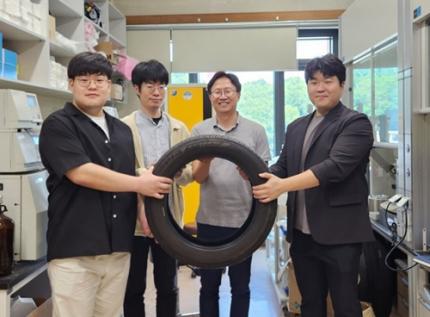 New and Highly Efficient Recycling Technology to Turn Used Tires into Raw Materials for Rubber and Nylon
< (From left) Kyungmin Choi (MS-Ph.D. integrated course, Department of Chemistry), Dr. Beomsoon Park, Professor Soon Hyeok Hong, Dr. Kyoungil Cho >
Approximately 1.5 billions of tires are discarded globally every year, and this is identified as one of the major causes of serious environmental pollution. The research team at the Department of Chemistry at KAIST has achieved a breakthrough by selectively converting waste tires into high-purity cyclic alkenes, valuable chemical building blocks used in the production of rubber and nylon fibers. This advance marks a new milestone in chemical recycling technology for waste tires.
The team, led by Professor Soon Hyeok Hong, has developed a dual-catalyst-based reaction system that overcomes the long-standing challenges associated with recycling vulcanized rubber materials.
Tires are composed of complex blends of synthetic and natural rubber, and their physical strength and durability are reinforced with additives such as silica, carbon black, and antioxidants. In particular, cross-linking between rubber chains is formed through the vulcanization process, giving them a structure resistant to heat and pressure, which is one of the main reasons why chemical recycling of waste tires is difficult.
Until now, waste tire recycling has mainly relied on pyrolysis or mechanical recycling methods. The pyrolysis method is a technology that decomposes polymer chains at high temperatures of 350-800°C to convert them into fuel oil, but it clearly has limitations such as high energy consumption, low selectivity, and the production of low-quality hydrocarbon mixtures.
To solve these problems, the research team developed a method to convert waste rubber into useful chemicals using dual catalysis. The first catalyst helps to break down rubber molecules by changing their bonding structure, and the second catalyst creates cyclic compounds through a ring-closing reaction.
This process shows high selectivity of up to 92% and a yield of 82%. The produced cyclopentene can be recycled into rubber, and cyclohexene can be used as a raw material for nylon fibers, making them industrially very valuable.
The research team successfully applied the developed system to discarded waste tires, achieving selective conversion into high-purity cyclic alkenes. Unlike the existing pyrolysis method, this is evaluated as a new turning point in the field of waste tire recycling as it can produce high-value chemicals through low-temperature precision catalytic reactions.
In addition, this catalytic platform is compatible with a wide range of synthetic and waste rubbers, positioning it as a promising foundation for scalable, circular solutions in the polymer and materials industries.
< Figure 1. Development of a Catalytic Method for Chemical Recycling of Waste Rubber >
Professor Hong stated, "This research offers an innovative solution for the chemical recycling of waste tires. We aim to develop next-generation high-efficiency catalysts and lay the groundwork for commercialization to enhance economic feasibility. Ultimately, our goal is to contribute to solving the broader waste plastic problem through fundamental chemistry."
This research, in which Beomsoon Park, Kyoungil Cho, and Kyungmin Choi participated, was supported by the National Research Foundation of Korea and was published online in the internationally renowned academic journal ‘Chem’ on June 18th.
※Paper Title: Catalytic and Selective Chemical Recycling of Post-Consumer Rubbers into Cycloalkenes
※DOI: 10.1016/j.chempr.2025.102625
2025.06.26 View 12410