%73%65%6d%69%6e%61%72
-
 KAIST Hosts 4th Failure Society to Celebrate “Failed Projects” and Anticipate Failures in the AI Era
KAIST will host an event where participants can proudly share failed projects and imagine in advance the kinds of failures that may occur in the AI era. From setbacks already experienced to risks that have yet to emerge, participants will explore together what can be learned from failure.
KAIST (President Choongsik Bae) announced on October 30 that it will hold the “4th KAIST Failure Society” from Wednesday, November 4 to Friday, November 13 under the theme “The Future and Failure.”
Organized by the KAIST Center for Ambitious Failure (CAF), the event will feature a “Failed Project Showcase” where students share their experiences of failure, conversations with winners of the failure essay contest, and an exhibition of future AI failure scenarios. The event will focus not only on experiences that ultimately ended in success, but also on ongoing processes in which answers have yet to be found, while encouraging participants to consider what choices are needed today to prepare for future risks.
President Choongsik Bae said, “A university should be a place that values and learns not only from successful outcomes but also from the trial and error encountered in the process of taking on challenges,” adding, “I hope this Failure Society will be an opportunity for participants to gain courage for their next challenge from one another’s experiences and to think together about the issues we may face in the AI era.”
The opening program of the event will be the “Failed Tasks Festival,” held at 6 p.m. on Wednesday, November 4, at John Hannah Hall on the fifth floor of the KAIST Academic Cultural Complex.
Co-organized by CAF and the student organization ICISTS, the event is a fair-style interactive program in which KAIST students create their own booths using photos, videos, and other materials and share frustrations and trial-and-error experiences from academics, research, and everyday life. Audience voting will select winning teams in five categories: ▲Best of the Best ▲Sky-High Status ▲Spectacular Takeoff ▲Beautiful Afterimage ▲Admirable Effort. Students will share their experiences of failure in a lighthearted way while empathizing with one another’s challenges and efforts.
On Friday, November 6, the failure seminar “Failures in Progress, Questions from the Future” will be held at the Yang Seungtaik Auditorium in the KAIST Academic Cultural Complex.
Part 1, “The Tenses of Failure: KAIST Students’ Stories of Failure in Progress” will feature this year’s winners of the failure essay contest: Sungpil Wang, a Ph.D. student at the Graduate School of Culture Technology; Yunjeong Kim, a Ph.D. student at the School of Electrical Engineering; and Won-il Kang, a master’s student in the Department of Mechanical Engineering. Based on their own experiences, including the difficulties of interdisciplinary research, research and career paths that unfolded differently from expectations, and repeated trial and error, they will discuss how the meaning of failure changes over time.
In Part 2, Professor Yongseok Seo of the KAIST Graduate School of Future Strategy will give a lecture titled “Why Failure Matters More as AI Gets Smarter” The session will examine what capabilities humans need in an era when AI provides answers, what kinds of problems society and institutions may face amid technological development, and what responsible choices should be considered for the future.
During the event period, the exhibition “2036 AI Future Scenarios: Lessons from Future Failures” will be held in the first-floor lobby of the KAIST Creative Learning Building. Based on analysis of the nationwide AI × Failure Idea Contest, the exhibition will present scenes of failure in 2036 imagined by citizens. Visitors will also be able to explore an “AI Future Risk Map” summarizing risks that AI could bring, along with the conditions that could make those risks more severe.
The event will also feature “Failure Photovoice” works in which KAIST students document everyday failures through photographs and writing. Through scenes and stories captured directly by students, the exhibition will provide an opportunity to view everyday failures from different perspectives.
The Failure Society will also introduce two publications containing the experiences and imaginations of students and citizens. The essay collection “The Tenses of Failure” includes 16 winning works from the 2026 KAISTian Failure Story Essay Contest, held under the theme “The Future and Failure.” The essays address fears of failures that have not yet occurred, life paths that diverged from plans, and changes after failure. The collection includes not only successful stories of overcoming failure, but also ongoing efforts in which answers have yet to be found.
“2036 AI Future Failure Scenarios: Anticipating Failures in the AI Era Through Citizens’ Imagination” is a report analyzing 429 scenarios that met the analysis criteria among submissions from 732 citizens who participated in the AI × Failure Idea Contest.
The report focuses not only on AI malfunctions but also on problems that could arise even when AI functions exactly as intended. It examines citizens’ concerns that reliance on AI could reduce opportunities for human judgment and learning, or make it unclear who should bear responsibility when problems arise. Based on these concerns, the report presents questions that should be considered now in order to prepare for future risks.
Sungho Cho, Director of the KAIST CAF, said, “This Failure Society is a place where students and citizens can share their own accounts of failure and visions of the future,” adding, “I hope we can turn individual experiences of failure into shared learning that helps us reflect on one another’s choices and the future of society.”
All programs of the 2026 KAIST Failure Society are open to anyone interested. The two publications will be released as e-books through the CAF website. Detailed schedules and participation information are available on the KAIST CAF website (caf.kaist.ac.kr).
2026.10.30 View 756
-
 KAIST Office of Global Initiative Hosts 2024 Global Startup Internship Seminar
< Photo of ImpriMed CEO Sungwon Lim’s lecture >
The Office of Global Initiative at KAIST successfully hosted the 2024 Global Startup Internship Seminar (GSIS) from Wednesday, November 20, to Friday, November 22.
Now in its third year, following the 2022 Global Startup Internship Fair, the GSIS aims to introduce KAIST students to internship opportunities at U.S.-based startups and encourage participation in global internship programs, particularly for students with entrepreneurial aspirations. This year’s seminar featured notable startups including ImpriMed, a precision medical AI company; Klleon, an AI culture tech firm; and Bear Robotics, renowned for its autonomous serving robots. Approximately 80 KAIST students attended the event through prior registration.
A key highlight of this year’s seminar was the participation of the CEOs from Bear Robotics and ImpriMed, two prominent Silicon Valley startups. Both CEOs, who had previously participated in the 2024 Global Entrepreneurship Summer School (GESS) last June, offered insights into their companies, provided one-on-one career counseling sessions, and discussed the concept of global entrepreneurship with students interested in U.S. startup internships.
In addition to company presentations, the seminar offered practical workshops on resume and email writing tailored for U.S. internships, testimonials from current KAIST students and alumni who interned at Silicon Valley startups, and a J1 Visa Information Session, all aimed at preparing students for internships in the United States.
So Young Kim, Vice President of the International Office and Director of the Office of Global Initiative, expressed her hopes for the event, stating, “through this event, KAIST students will be inspired by the global entrepreneurial spirit of mentors who have started businesses abroad, and that it will help further spread a culture of challenging adversity and overcoming the risks of failure.” She further added that KAIST is committed to continuously developing programs that cultivate a global entrepreneurial mindset among its students.
The 2024 Global Startup Internship Seminar successfully concluded, providing KAIST students with vision and opportunities in global entrepreneurship.
2024.11.25 View 9003
-
 2023 Global Startup Internship Seminar (GSIS)
The Center for Global Strategies and Planning at KAIST hosted the 2023 Global Startup Internship Seminar (GSIS) both online and offline from November 29th to December 1st.
Following the success of the 2022 Global Startup Internship Fair (GSIF), the 2023 KAIST GSIS was organized in an enhanced format. This event provided students with the opportunity to explore internship opportunities with U.S. startups. Six startups in the fields of AI, bio, digital healthcare, drones, and e-commerce, Imprimed, Soundable Health, Vessl AI, B Garage, UNEEKOR, and Bringko, all founded by KAIST alumni, were invited. More than 80 KAIST students registered in advance to participate in the event.
The participating companies in this seminar shared who they and what they do and provided career mentoring for KAIST students. Catherine Song, the CEO of Soundable Health and a KAIST alumna, said, "It is very meaningful to introduce our company to KAIST students and provide them with the opportunity to take part in global internships."
In addition to startup company information and mentoring sessions, the seminar included sessions on preparing CVs, cover letters, and business emails for U.S. internships, and how to settle in Silicon Valley. Internship experiences were also shared by current KAIST students. Finally, a J-1 visa information session was conducted, providing useful tips for students preparing for U.S. internships.
Man-Sung Yim, the Vice President of the International Office at KAIST, said, "We hope that KAIST students, who have nurtured a global entrepreneurial spirit through this event, will grow into aspiring entrepreneurs with confidence on the global stage." He also mentioned plans to leverage the success of this event by connecting it with other KAIST global entrepreneurship programs.
2023.12.05 View 17357
-
 2017 Summer Nuclear Nonproliferation Education Program
The Nuclear Nonproliferation Education and Research Center (NEREC) at KAIST announced its 30 scholarship recipients for the 2017 Summer Nuclear Nonproliferation Education Program on April 18. The six-week program, starting from July 10, will be run in Korea, Japan, and China.
The program provides young global scholars with focused and challenging nuclear nonproliferation studies. Young scholars will be exposed to diverse science and technology policies and practices concurrently conducted in many countries and the future direction for enhancing nuclear nonproliferation. They will participate in a series of seminars, projects, international conferences, and field trips.
Since its launch in 2014, the program has educated 71 young scholars. This year, more than 150 scholars from 37 countries applied for the program, reflecting the growing reputation of the program both at home and abroad. The director of the NEREC, Professor Man-Sung Yim of the Department of Nuclear and Quantum Engineering at KAIST said that young scholars from very prestigious foreign universities have shown strong interest in the program. According to Professor Yim, this year’s recipients are from 26 universities from 16 countries including Harvard University, Oxford University, the National Research Nuclear University of Russia, and the Tokyo Institute of Technology
2017.04.19 View 17364
-
 KAIST's Graduate School of Culture Technology Celebrates Its Tenth Anniversary
The Graduate School of Culture Technology (GSCT) at KAIST hosted a ceremony and a variety of events to celebrate its tenth anniversary on October 22, 2015, on campus.
Established in 2005 with the support of the Ministry of Culture, Sports and Tourism of the Republic of Korea, GSCT offers an intensive, in-depth education in culture technology, an interdisciplinary field first introduced in Korea by KAIST, which brings arts, humanities, science, and technology together in an academic and research arena.
Over the years, the graduate school has fostered top-notch researchers and professionals who have played a leading role in the development of a Korean culture contents industry that includes movies, broadcasting programs, music, games, and culture events.
After the anniversary ceremony, GSCT held a "Demo Day" to showcase its major research projects. A total of 41 projects were presented under the themes of “Art and Science,” “Human and Humane,” and “Virtual Reality vs Reality.”
In addition, there was a seminar held on GSTC’s ten-year accomplishment and future planning with the school’s Professors Sunghee Lee, Juyong Park, and Juhan Nam; a cultural event for the public called the “Talk Concert,” which included many professionals in culture industry and academia to share ideas and views; and the Homecoming Day for GSTC graduates. So far, the graduate school has produced 295 masters and 34 doctors. About 34% of its graduates are employed in the movie, game, and broadcasting sectors, 33% in the social networking service and Internet industry, and 33% in performing art and exhibition and event.
Dong-Man Lee, the Dean of KAIST's Graduate School of Culture Technology, said,
“We will continue to develop our school to lead the advancement of the Korean culture industry, contributing to the growth of Korean Wave, the popularity of Korean culture, in the global community.”
In the picture below, Dean Lee delivers a speech to celebrate the school’s tenth anniversary.
Soo-Man Lee, the founding chairman of S.M. Entertainment, speaks at the Talk Concert.
Scenes from the Demo Day
2015.10.26 View 15549
-
 Minister of Higher Education of Saudi Arabia Visited KAIST to Sign Agreement on Joint Research Projects
Khaled bin Mohammad Al-Anqari, the Minister of Higher Education of Saudi Arabia, visited KAIST on October 26th to conclude a joint agreement with KAIST.
The group of Saudi Arabian visitors included Abdullah bin Abdularhman Al-Othman, President of the King Saud University, Osama bin Sadiq Tayeb, President of King Abdulaziz University, and Khalid bin Salih Al-Sultan, President of the best Saudi Arabian technological university, King Fahad University of Petroleum and Minerals.
Through research agreement between KAIST and the King Saud University and King Fahad University of Petroleum and Minerals, joint research projects, mutual visitations of research professors, interchange of academic programs, joint seminars and scientific societies will be held to promote the lively interchange between higher education institutions of Korea and Saudi Arabia.
In particular, King Saud University and KAIST has signed an agreement on joint research projects in the fields of “Solar-Ocean Thermal Exchange Desalination,” “Develop New Energy Management Service for Residential and Commercial Customers Using Smart Metering and Sensor Network Information” and “Superior Production of Lactic Acid from Saudi Dates Using Bioprocess Technology.”
The projects will be funded by the Saudi Arabian government, and their scope will be determined in the future
“Compared to the robust industrial economic interactions between the Middle East and Korea, the interchange of the two countries’ higher education institutions has been poor,” said Jong Hyun Kim, Visiting Professor of Nuclear & Quantum Engineering Department of KAIST who will be conducting one of the joint programs with the Electrical Engineering Department of the King Saud University. “Like this joint research, I hope KAIST will, in many different ways, lead the way in cooperating and interacting with higher education institutions of the Middle EAST.”
Al-Anquari, Minister of Higher Education of Saudi Arabia, who showed great interest in KAIST’s innovative research and high technology development, expressed his will to put more effort into extending the interchange between universities of Saudi Arabia and of Korea, including KAIST.
2010.11.03 View 28364
-
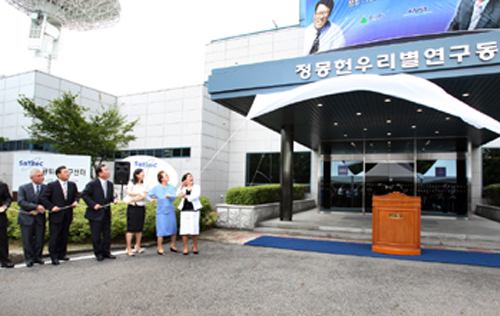 Satellite Research Lab Named After Late Hyundai Chairman Chung
KAIST, Aug. 11, 2008 -- KAIST held a naming ceremony for a research lab which was named after the late Hyundai Asan Chairman Mong-Hun Chung on Monday (Aug. 11) at the KAIST Satellite Technology Research Center.
During the ceremony, a seminar room was also named after Dr. Soon-dal Choi, President of Daeduk College, for his distinguished contributions to the development of Korean space science.
Back in 1992, the late chairman Chung donated 3.4 billion won (US$3.4 million) to KAIST to build a satellite laboratory for the development of core space technologies and the nurturing of skilled manpower.
The naming ceremony was held in commemoration of the 16th anniversary of the launch of Korea"s first small satellite "Uribyeol 1" on Aug. 11, 1992. Chung died in 2003.
Dr. Soon-Dal Choi who laid the ground work for Korea"s space development program, served as the inaugural director general of the KAIST Satellite Technology Research Center, the birthplace of Korea"s artificial satellite.
On hand at the naming ceremony were a slew of dignitaries including Jeong-Eun Hyun, Hyundai Group Chairwoman and wife of the late Chung; and about 10 chief executives of Hyundai Group companies; Seong-Hyo Park, Mayor of the Daejeon Metropolitan City; Ms. So-Yeon Lee, Korea"s first astronaut; and KAIST President Nam-Pyo Suh.
President Suh noted that late Chairman Chung made great contributions to Korea"s artificial satellite development with his donation to the satellite laboratory. He said Dr. Choi is the father of the nation"s satellite program who provided the vision of space development in Korea at a time when Korea lagged behind in the artificial satellite technology.
2008.08.12 View 25729
-
 Prof. Chung To Make a Keynote Address at Overseas Seminar
“Instilling Korea’s design promotion policies into Chile”Prof. Kyung-Won Chung will make a keynote address at a design policy seminar in Chile
Prof. Kyung-Won Chung, Department of Industrial Design, will make a keynote address at a seminar named ‘public policies for design industries’, which will be held at Santiago, Chile, July 24 -25.
In the lecture entitled ‘The development model of public policies for design promotion ? Korea’s experiences’, Prof. Chung will present the relationship between national economic development policy and design industry promotion strategy with some real case studies.
The seminar co-hosted by the Technology Cooperation Agency (SERCOTEC) and the Economy Development Agency (CDRFO) of Chile is intended to enable Chilean government to set up appropriate policies to effectively foster design industries for the enhancement of small and medium businesses’ competitiveness.
Prof. Chung has served as the president of Korea Institute of Design Promotion (KIDP) from Feb 2000 thru May 2003.
2007.07.24 View 19134