research
- A KAIST research team led by Professor Keon Jae Lee demonstrates the transfer printing of a large number of micro-sized inorganic semiconductor chips via the selective modulation of micro-vacuum force.
MicroLEDs are a light source for next-generation displays that utilize inorganic LED chips with a size of less than 100 μm. MicroLEDs have attracted a great deal of attention due to their superior electrical/optical properties, reliability, and stability compared to conventional displays such as LCD, OLED, and QD. To commercialize microLEDs, transfer printing technology is essential for rearranging microLED dies from a growth substrate onto the final substrate with a desired layout and precise alignment. However, previous transfer methods still have many challenges such as the need for additional adhesives, misalignment, low transfer yield, and chip damage.
Professor Lee’s research team has developed a micro-vacuum assisted selective transfer printing (µVAST) technology to transfer a large number of microLED chips by adjusting the micro-vacuum suction force.
The key technology relies on a laser-induced etching (LIE) method for forming 20 μm-sized micro-hole arrays with a high aspect ratio on glass substrates at fabrication speed of up to 7,000 holes per second. The LIE-drilled glass is connected to the vacuum channels, controlling the micro-vacuum force at desired hole arrays to selectively pick up and release the microLEDs. The micro-vacuum assisted transfer printing accomplishes a higher adhesion switchability compared to previous transfer methods, enabling the assembly of micro-sized semiconductors with various heterogeneous materials, sizes, shapes, and thicknesses onto arbitrary substrates with high transfer yields.
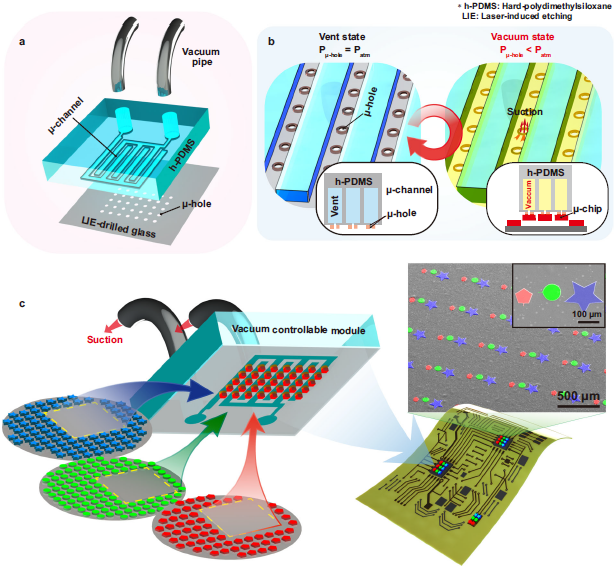
< Figure 01. Concept of micro-vacuum assisted selective transfer printing (μVAST). >
Professor Keon Jae Lee said, “The micro-vacuum assisted transfer provides an interesting tool for large-scale, selective integration of microscale high-performance inorganic semiconductors. Currently, we are investigating the transfer printing of commercial microLED chips with an ejector system for commercializing next-generation displays (Large screen TVs, flexible/stretchable devices) and wearable phototherapy patches.”
This result titled “Universal selective transfer printing via micro-vacuum force” was published in Nature Communications on November 26th, 2023. (DOI: 10.1038/S41467-023-43342-8)
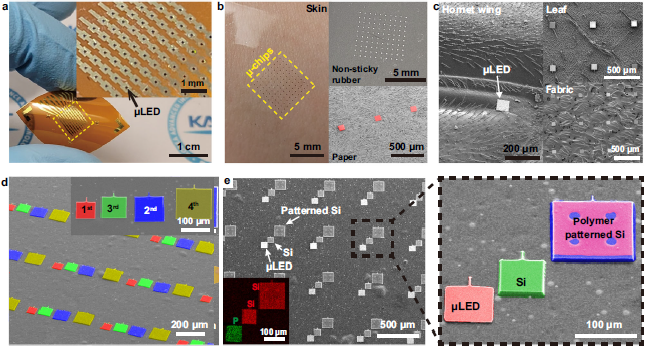
< Figure 02. Universal transfer printing of thin-film semiconductors via μVAST. >
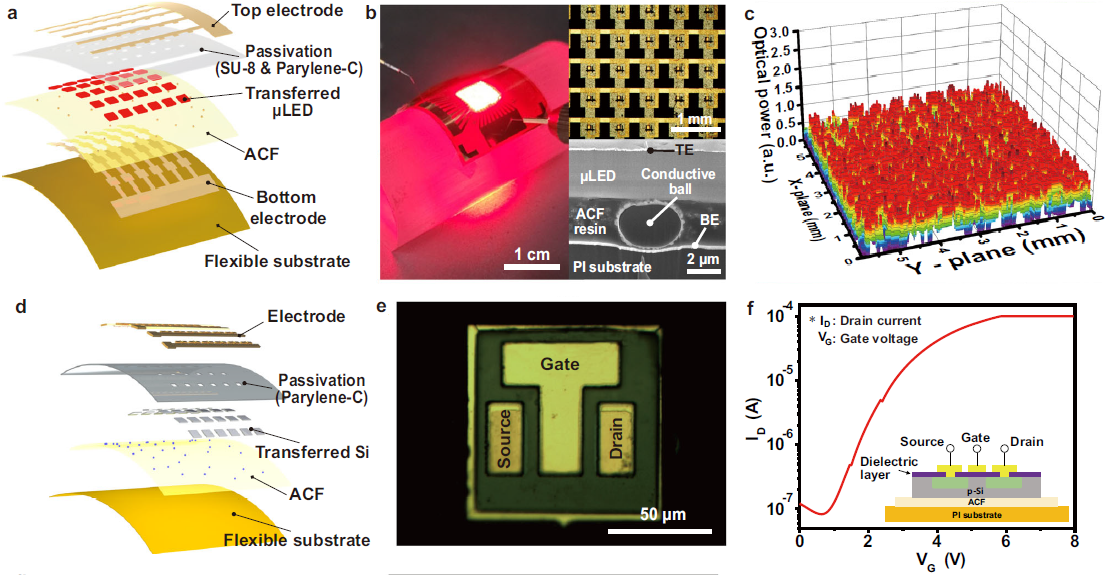
< Figure 03. Flexible devices fabricated by μVAST. >
Title: Entire process including LIE and µVAST
Vimeo link: https://vimeo.com/894430416?share=copy
-
research KAIST Reveals How Information Is Written in Ferroelectric Memory at the Nanoscale
What happens at the nanoscale when information is written to memory? Researchers at KAIST have shown how tiny regions with a new polarization direction form while previously formed regions continue to expand in a promising ferroelectric material. By linking these nanoscale changes to electrical measurements, the team developed a model that captures both processes, offering a basis for designing faster and more stable memory. KAIST (President Choongsik Bae) announced on October 8 that a team l
2026-10-08 -
research KAIST, “BTS” Heads to Space… Five NEONSAT Microsatellites to Launch on Nuri
To monitor areas affected by wildfires or floods using satellites, it is necessary to be able to image those locations again when needed. With a single satellite, it takes time to revisit the same area, but operating multiple satellites together can increase observation opportunities. Five NEONSAT microsatellites, part of a constellation development project led by KAIST, are heading into space aboard the Nuri launch vehicle. KAIST (President Choongsik Bae) announced on October 6 that NEONSAT
2026-10-06 -
research KAIST Develops Vector Database Technology for Reliable Retrieval of Up-to-Date Information
When new information is continually added and old information is removed, an AI system may fail to find the correct material even when that material exists. KAIST researchers have developed a vector database technology that preserves the search paths leading to the needed information as data changes. This allows AI to find up-to-date information more accurately and quickly. KAIST (President Choongsik Bae) announced on October 5 that a research team led by Professor Min-Soo Kim from the School
2026-10-06 -
research KAIST Identifies a “Hidden Amplification Switch” in Lymphangiogenic Signaling
Lymphatic vessels act as the body’s “drainage system,” collecting excess fluid from tissues. When lymphatic drainage is impaired because lymphatic vessels are underdeveloped, damaged, or dysfunctional, lymphedema can develop, causing swelling, particularly in the arms and legs. Conversely, excessive lymphatic vessel growth around tumors can facilitate cancer metastasis by providing routes for tumor cells to spread. Korean researchers have discovered that VEGF-C brings two VEG
2026-10-02 -
research KAIST Reveals How the Light-Responsive Molecular Switch Azobenzene Changes Shape
Azobenzene is one of the best-known molecules that can be switched between two forms by light. However, the question of how the molecule moves in the first few picoseconds (trillionths of a second) after it absorbs light has remained unresolved for nearly 50 years. A Korean research team has now shown that, during the initial stage of the reaction, the molecule changes shape through a coordinated motion of the two nitrogen atoms at its center, while its two benzene rings stay nearly in place.
2026-10-02