KAIST
-
 KAIST holds its first ‘KAIST Tech Fair’ in New York, USA
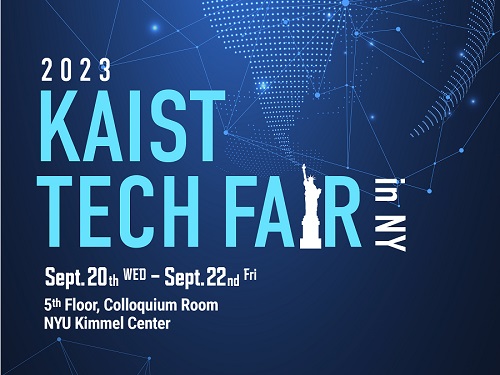
< Photo 1. 2023 KAIST Tech Fair in New York >
KAIST (President Kwang-Hyung Lee) announced on the 11th that it will hold the ‘2023 KAIST Tech Fair in New York’ at the Kimmel Center at New York University in Manhattan, USA, on the 22nd of this month. It is an event designed to be the starting point for KAIST to expand its startup ecosystem into the global stage, and it is to attract investments and secure global customers in New York by demonstrating the technological value of KAIST startup companies directly at location.
< Photo 2. President Kwang Hyung Lee at the 2023 KAIST Tech Fair in New York >
KAIST has been holding briefing sessions for technology transfer in Korea every year since 2018, and this year is the first time to hold a tech fair overseas for global companies.
KAIST Institute of Technology Value Creation (Director Sung-Yool Choi) has prepared for this event over the past six months with the Korea International Trade Association (hereinafter KITA, CEO Christopher Koo) to survey customer base and investment companies to conduct market analysis.
Among the companies founded with the technologies developed by the faculty and students of KAIST and their partners, 7 companies were selected to be matched with companies overseas that expressed interests in these technologies. Global multinational companies in the fields of IT, artificial intelligence, environment, logistics, distribution, and retail are participating as demand agencies and are testing the marketability of the start-up's technology as of September.
Daim Research, founded by Professor Young Jae Jang of the Department of Industrial and Systems Engineering, is a company specializing in smart factory automation solutions and is knocking on the door of the global market with a platform technology optimized for automated logistics systems.
< Photo 3. Presentation by Professor Young Jae Jang for DAIM Research >
It is a ‘collaborative intelligence’ solution that maximizes work productivity by having a number of robots used in industrial settings collaborate with one another. The strength of their solution is that logistics robots equipped with AI reinforced learning technology can respond to processes and environmental changes on their own, minimizing maintenance costs and the system can achieve excellent performance even with a small amount of data when it is combined with the digital twin technology the company has developed on its own.
A student startup, ‘Aniai’, is entering the US market, the home of hamburgers, with hamburger patty automation equipments and solutions. This is a robot kitchen startup founded by its CEO Gunpil Hwang, a graduate of KAIST’s School of Electrical Engineering which gathered together the experts in the fields of robot control, design, and artificial intelligence and cognitive technology to develop technology to automatically cook hamburger patties.
At the touch of a button, both sides of the patty are cooked simultaneously for consistent taste and quality according to the set condition. Since it can cook about 200 dishes in an hour, it is attracting attention as a technology that can not only solve manpower shortages but also accelerate the digital transformation of the restaurant industry.
Also, at the tech fair to be held at the Kimmel Center of New York University on the 22nd, the following startups who are currently under market verification in the U.S. will be participating: ▴'TheWaveTalk', which developed a water quality management system that can measure external substances and metal ions by transferring original technology from KAIST; ▴‘VIRNECT’, which helps workers improve their skills by remotely managing industrial sites using XR*; ▴‘Datumo’, a solution that helps process and analyze artificial intelligence big data, ▴‘VESSL AI’, the provider of a solution to eliminate the overhead** of machine learning systems; and ▴ ‘DolbomDream’, which developed an inflatable vest that helps the psychological stability of people with developmental disabilities.
* XR (eXtended Reality): Ultra-realistic technology that enhances immersion by utilizing augmented reality, virtual reality, and mixed reality technologies
** Overhead: Additional time required for stable processing of the program
In addition, two companies (Plasmapp and NotaAI) that are participating in the D-Unicorn program with the support of the Daejeon City and two companies (Enget and ILIAS Biologics) that are receiving support from the Scale Up Tips of the Ministry of SMEs and Startups, three companies (WiPowerOne, IDK Lab, and Artificial Photosynthesis Lab) that are continuing to realize the sustainable development goals for a total of 14 KAIST startups, will hold a corporate information session with about 100 invited guests from global companies and venture capital.
< Photo 4. Presentation for AP Lab >
Prior to this event, participating startups will be visiting the New York Economic Development Corporation and large law firms to receive advice on U.S. government support programs and on their attemps to enter the U.S. market. In addition, the participating companies plan to visit a startup support investment institution pursuing sustainable development goals and the Leslie eLab, New York University's one-stop startup support space, to lay the foundation for KAIST's leap forward in global technology commercialization.
< Photo 5. Sung-Yool Choi, the Director of KAIST Institute of Technology Value Creation (left) at the 2023 KAIST Tech Fair in New York with the key participants >
Sung-Yool Choi, the Director of KAIST Institute of Technology Value Creation, said, “KAIST prepared this event to realize its vision of being a leading university in creating global value.” He added, “We hope that our startups founded with KAIST technology would successfully completed market verification to be successful in securing global demands and in attracting investments for their endeavors.”
2023.09.11 View 18437
KAIST holds its first ‘KAIST Tech Fair’ in New York, USA
< Photo 1. 2023 KAIST Tech Fair in New York >
KAIST (President Kwang-Hyung Lee) announced on the 11th that it will hold the ‘2023 KAIST Tech Fair in New York’ at the Kimmel Center at New York University in Manhattan, USA, on the 22nd of this month. It is an event designed to be the starting point for KAIST to expand its startup ecosystem into the global stage, and it is to attract investments and secure global customers in New York by demonstrating the technological value of KAIST startup companies directly at location.
< Photo 2. President Kwang Hyung Lee at the 2023 KAIST Tech Fair in New York >
KAIST has been holding briefing sessions for technology transfer in Korea every year since 2018, and this year is the first time to hold a tech fair overseas for global companies.
KAIST Institute of Technology Value Creation (Director Sung-Yool Choi) has prepared for this event over the past six months with the Korea International Trade Association (hereinafter KITA, CEO Christopher Koo) to survey customer base and investment companies to conduct market analysis.
Among the companies founded with the technologies developed by the faculty and students of KAIST and their partners, 7 companies were selected to be matched with companies overseas that expressed interests in these technologies. Global multinational companies in the fields of IT, artificial intelligence, environment, logistics, distribution, and retail are participating as demand agencies and are testing the marketability of the start-up's technology as of September.
Daim Research, founded by Professor Young Jae Jang of the Department of Industrial and Systems Engineering, is a company specializing in smart factory automation solutions and is knocking on the door of the global market with a platform technology optimized for automated logistics systems.
< Photo 3. Presentation by Professor Young Jae Jang for DAIM Research >
It is a ‘collaborative intelligence’ solution that maximizes work productivity by having a number of robots used in industrial settings collaborate with one another. The strength of their solution is that logistics robots equipped with AI reinforced learning technology can respond to processes and environmental changes on their own, minimizing maintenance costs and the system can achieve excellent performance even with a small amount of data when it is combined with the digital twin technology the company has developed on its own.
A student startup, ‘Aniai’, is entering the US market, the home of hamburgers, with hamburger patty automation equipments and solutions. This is a robot kitchen startup founded by its CEO Gunpil Hwang, a graduate of KAIST’s School of Electrical Engineering which gathered together the experts in the fields of robot control, design, and artificial intelligence and cognitive technology to develop technology to automatically cook hamburger patties.
At the touch of a button, both sides of the patty are cooked simultaneously for consistent taste and quality according to the set condition. Since it can cook about 200 dishes in an hour, it is attracting attention as a technology that can not only solve manpower shortages but also accelerate the digital transformation of the restaurant industry.
Also, at the tech fair to be held at the Kimmel Center of New York University on the 22nd, the following startups who are currently under market verification in the U.S. will be participating: ▴'TheWaveTalk', which developed a water quality management system that can measure external substances and metal ions by transferring original technology from KAIST; ▴‘VIRNECT’, which helps workers improve their skills by remotely managing industrial sites using XR*; ▴‘Datumo’, a solution that helps process and analyze artificial intelligence big data, ▴‘VESSL AI’, the provider of a solution to eliminate the overhead** of machine learning systems; and ▴ ‘DolbomDream’, which developed an inflatable vest that helps the psychological stability of people with developmental disabilities.
* XR (eXtended Reality): Ultra-realistic technology that enhances immersion by utilizing augmented reality, virtual reality, and mixed reality technologies
** Overhead: Additional time required for stable processing of the program
In addition, two companies (Plasmapp and NotaAI) that are participating in the D-Unicorn program with the support of the Daejeon City and two companies (Enget and ILIAS Biologics) that are receiving support from the Scale Up Tips of the Ministry of SMEs and Startups, three companies (WiPowerOne, IDK Lab, and Artificial Photosynthesis Lab) that are continuing to realize the sustainable development goals for a total of 14 KAIST startups, will hold a corporate information session with about 100 invited guests from global companies and venture capital.
< Photo 4. Presentation for AP Lab >
Prior to this event, participating startups will be visiting the New York Economic Development Corporation and large law firms to receive advice on U.S. government support programs and on their attemps to enter the U.S. market. In addition, the participating companies plan to visit a startup support investment institution pursuing sustainable development goals and the Leslie eLab, New York University's one-stop startup support space, to lay the foundation for KAIST's leap forward in global technology commercialization.
< Photo 5. Sung-Yool Choi, the Director of KAIST Institute of Technology Value Creation (left) at the 2023 KAIST Tech Fair in New York with the key participants >
Sung-Yool Choi, the Director of KAIST Institute of Technology Value Creation, said, “KAIST prepared this event to realize its vision of being a leading university in creating global value.” He added, “We hope that our startups founded with KAIST technology would successfully completed market verification to be successful in securing global demands and in attracting investments for their endeavors.”
2023.09.11 View 18437 -
 MVITRO Co., Ltd. Signs to Donate KRW 1 Billion as Development Fund toward KAIST-NYU Joint Campus
KAIST (President Kwang Hyung Lee) announced on the 29th that it has solicited a development fund of KRW 1 billion from MVITRO (CEO Young Woo Lee) for joint research at the KAIST-NYU Joint Campus, which is being pursued to be KAIST's first campus on the United States.
KAIST plans to use this development fund for research and development of various solutions in the field of 'Healthcare at Home' among several joint researches being conducted with New York University (hereinafter referred to as NYU).
Young Woo Lee, the CEO of MVITRO, said, "We decided to make the donation with the hope that the KAIST-NYU Joint Campus will become an ecosystem that would help with Korean companies’ advancement into the US."
After announcing its plans to enter New York in 2021, KAIST has formed partnerships with NYU and New York City last year. Currently, NYU and KAIST are devising plans for mid- to long-term joint research in nine fields of studies including AI and bio-medicine and technology, and are promoting cooperation in the field of education, including exchange students, minors, double majors, and joint degrees under the joint campus agreement,
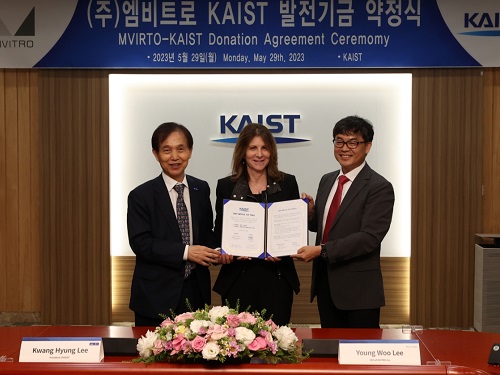
The ceremony for the consigning of MVITRO Co., Ltd.’s donation was held at the main campus of KAIST in the afternoon of the 29th and was attended by KAIST officials such as President Kwang Hyung Lee and Jae-Hung Han, the executive director of KAIST Development Foundation, along with the NYU President-Designate Linda G. Mills, and the CEO of MVITRO, Young Woo Lee.
< Photo. (from left) Kwang Hyung Lee, the President of KAIST, Linda G. Mills, the President-Designate of NYU, and Young Woo Lee, the CEO of MVITRO, pose for the photo with the signed letter of donation on May 29, 2023 at KAIST >
Linda Mills, the nominee designated to be NYU president next term said, “I am proud to join our colleagues in celebrating this important gift from MVITRO, which will help support the partnership between KAIST and NYU. This global partnership leverages the distinctive strengths of both universities to drive advances in research poised to deliver profound impact, such as the intersections of healthcare, technology, and AI."
President Kwang Hyung Lee said, "The KAIST-NYU Joint Campus will be the first step in extending KAIST's excellent science and technology capabilities to the international stage and will serve as a bridgehead to help excellent technological advancements venture into the United States." Then, President Lee added, "I would like to express my gratitude to MVITRO for sympathizing with this vision. I will work with NYU to lead the creation of global values.”
On a different note, MVITRO Co., Ltd., is a home medical device maker that collaborated with Hyundai Futurenet Co., Ltd. to develop an IoT product that combined a painless laser lancet (blood collector) and a blood glucose meter into one for a convenient at-home health support, which received favorable reviews from overseas buyers at CES 2023.
2023.05.30 View 10373
MVITRO Co., Ltd. Signs to Donate KRW 1 Billion as Development Fund toward KAIST-NYU Joint Campus
KAIST (President Kwang Hyung Lee) announced on the 29th that it has solicited a development fund of KRW 1 billion from MVITRO (CEO Young Woo Lee) for joint research at the KAIST-NYU Joint Campus, which is being pursued to be KAIST's first campus on the United States.
KAIST plans to use this development fund for research and development of various solutions in the field of 'Healthcare at Home' among several joint researches being conducted with New York University (hereinafter referred to as NYU).
Young Woo Lee, the CEO of MVITRO, said, "We decided to make the donation with the hope that the KAIST-NYU Joint Campus will become an ecosystem that would help with Korean companies’ advancement into the US."
After announcing its plans to enter New York in 2021, KAIST has formed partnerships with NYU and New York City last year. Currently, NYU and KAIST are devising plans for mid- to long-term joint research in nine fields of studies including AI and bio-medicine and technology, and are promoting cooperation in the field of education, including exchange students, minors, double majors, and joint degrees under the joint campus agreement,
The ceremony for the consigning of MVITRO Co., Ltd.’s donation was held at the main campus of KAIST in the afternoon of the 29th and was attended by KAIST officials such as President Kwang Hyung Lee and Jae-Hung Han, the executive director of KAIST Development Foundation, along with the NYU President-Designate Linda G. Mills, and the CEO of MVITRO, Young Woo Lee.
< Photo. (from left) Kwang Hyung Lee, the President of KAIST, Linda G. Mills, the President-Designate of NYU, and Young Woo Lee, the CEO of MVITRO, pose for the photo with the signed letter of donation on May 29, 2023 at KAIST >
Linda Mills, the nominee designated to be NYU president next term said, “I am proud to join our colleagues in celebrating this important gift from MVITRO, which will help support the partnership between KAIST and NYU. This global partnership leverages the distinctive strengths of both universities to drive advances in research poised to deliver profound impact, such as the intersections of healthcare, technology, and AI."
President Kwang Hyung Lee said, "The KAIST-NYU Joint Campus will be the first step in extending KAIST's excellent science and technology capabilities to the international stage and will serve as a bridgehead to help excellent technological advancements venture into the United States." Then, President Lee added, "I would like to express my gratitude to MVITRO for sympathizing with this vision. I will work with NYU to lead the creation of global values.”
On a different note, MVITRO Co., Ltd., is a home medical device maker that collaborated with Hyundai Futurenet Co., Ltd. to develop an IoT product that combined a painless laser lancet (blood collector) and a blood glucose meter into one for a convenient at-home health support, which received favorable reviews from overseas buyers at CES 2023.
2023.05.30 View 10373 -
 KAIST Holds 2023 Commencement Ceremony
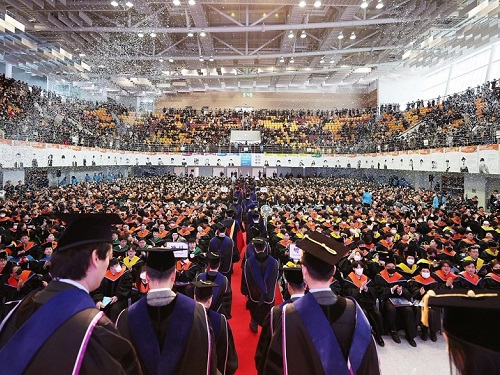
< Photo 1. On the 17th, KAIST held the 2023 Commencement Ceremony for a total of 2,870 students, including 691 doctors. >
KAIST held its 2023 commencement ceremony at the Sports Complex of its main campus in Daejeon at 2 p.m. on February 27. It was the first commencement ceremony to invite all its graduates since the start of COVID-19 quarantine measures.
KAIST awarded a total of 2,870 degrees including 691 PhD degrees, 1,464 master’s degrees, and 715 bachelor’s degrees, which adds to the total of 74,999 degrees KAIST has conferred since its foundation in 1971, which includes 15,772 PhD, 38,360 master’s and 20,867 bachelor’s degrees.
This year’s Cum Laude, Gabin Ryu, from the Department of Mechanical Engineering received the Minister of Science and ICT Award. Seung-ju Lee from the School of Computing received the Chairman of the KAIST Board of Trustees Award, while Jantakan Nedsaengtip, an international student from Thailand received the KAIST Presidential Award, and Jaeyong Hwang from the Department of Physics and Junmo Lee from the Department of Industrial and Systems Engineering each received the President of the Alumni Association Award and the Chairman of the KAIST Development Foundation Award, respectively.
Minister Jong-ho Lee of the Ministry of Science and ICT awarded the recipients of the academic awards and delivered a congratulatory speech.
Yujin Cha from the Department of Bio and Brain Engineering, who received a PhD degree after 19 years since his entrance to KAIST as an undergraduate student in 2004 gave a speech on behalf of the graduates to move and inspire the graduates and the guests.
After Cha received a bachelor’s degree from the Department of Nuclear and Quantum Engineering, he entered a medical graduate school and became a radiation oncology specialist. But after experiencing the death of a young patient who suffered from osteosarcoma, he returned to his alma mater to become a scientist. As he believes that science and technology is the ultimate solution to the limitations of modern medicine, he started as a PhD student at the Department of Bio and Brain Engineering in 2018, hoping to find such solutions.
During his course, he identified the characteristics of the decision-making process of doctors during diagnosis, and developed a brain-inspired AI algorithm. It is an original and challenging study that attempted to develop a fundamental machine learning theory from the data he collected from 200 doctors of different specialties.
Cha said, “Humans and AI can cooperate by humans utilizing the unique learning abilities of AI to develop our expertise, while AIs can mimic us humans’ learning abilities to improve.” He added, “My ultimate goal is to develop technology to a level at which humans and machines influence each other and ‘coevolve’, and applying it not only to medicine, but in all areas.”
Cha, who is currently an assistant professor at the KAIST Biomedical Research Center, has also written Artificial Intelligence for Doctors in 2017 to help medical personnel use AI in clinical fields, and the book was selected as one of the 2018 Sejong Books in the academic category.
During his speech at this year’s commencement ceremony, he shared that “there are so many things in the world that are difficult to solve and many things to solve them with, but I believe the things that can really broaden the horizons of the world and find fundamental solutions to the problems at hand are science and technology.”
Meanwhile, singer-songwriter Sae Byul Park who studied at the KAIST Graduate School of Culture Technology will also receive her PhD degree.
Natural language processing (NLP) is a field in AI that teaches a computer to understand and analyze human language that is actively being studied. An example of NLP is ChatGTP, which recently received a lot of attention. For her research, Park analyzed music rather than language using NLP technology.
To analyze music, which is in the form of sound, using the methods for NLP, it is necessary to rebuild notes and beats into a form of words or sentences as in a language. For this, Park designed an algorithm called Mel2Word and applied it to her research.
She also suggested that by converting melodies into texts for analysis, one would be able to quantitatively express music as sentences or words with meaning and context rather than as simple sounds representing a certain note.
Park said, “music has always been considered as a product of subjective emotion, but this research provides a framework that can calculate and analyze music.”
Park’s study can later be developed into a tool to measure the similarities between musical work, as well as a piece’s originality, artistry and popularity, and it can be used as a clue to explore the fundamental principles of how humans respond to music from a cognitive science perspective.
Park began her Ph.D. program in 2014, while carrying on with her musical activities as well as public and university lectures alongside, and dealing with personally major events including marriage and childbirth during the course of years. She already met the requirements to receive her degree in 2019, but delayed her graduation in order to improve the level of completion of her research, and finally graduated with her current achievements after nine years.
Professor Juhan Nam, who supervised Park’s research, said, “Park, who has a bachelor’s degree in psychology, later learned to code for graduate school, and has complete high-quality research in the field of artificial intelligence.” He added, “Though it took a long time, her attitude of not giving up until the end as a researcher is also excellent.”
Sae Byul Park is currently lecturing courses entitled Culture Technology and Music Information Retrieval at the Underwood International College of Yonsei University.
Park said, “the 10 or so years I’ve spent at KAIST as a graduate student was a time I could learn and prosper not only academically but from all angles of life.” She added, “having received a doctorate degree is not the end, but a ‘commencement’. Therefore, I will start to root deeper from the seeds I sowed and work harder as a both a scholar and an artist.”
< Photo 2. From left) Yujin Cha (Valedictorian, Medical-Scientist Program Ph.D. graduate), Saebyeol Park (a singer-songwriter, Ph.D. graduate from the Graduate School of Culture and Technology), Junseok Moon and Inah Seo (the two highlighted CEO graduates from the Department of Management Engineering's master’s program) >
Young entrepreneurs who dream of solving social problems will also be wearing their graduation caps. Two such graduates are Jun-seok Moon and Inah Seo, receiving their master’s degrees in social entrepreneurship MBA from the KAIST College of Business.
Before entrance, Moon ran a café helping African refugees stand on their own feet. Then, he entered KAIST to later expand his business and learn social entrepreneurship in order to sustainably help refugees in the blind spots of human rights and welfare.
During his master’s course, Moon realized that he could achieve active carbon reduction by changing the coffee alone, and switched his business field and founded Equal Table. The amount of carbon an individual can reduce by refraining from using a single paper cup is 10g, while changing the coffee itself can reduce it by 300g.
1kg of coffee emits 15kg of carbon over the course of its production, distribution, processing, and consumption, but Moon produces nearly carbon-neutral coffee beans by having innovated the entire process. In particular, the company-to-company ESG business solution is Moon’s new start-up area. It provides companies with carbon-reduced coffee made by roasting raw beans from carbon-neutral certified farms with 100% renewable energy, and shows how much carbon has been reduced in its making. Equal Table will launch the service this month in collaboration with SK Telecom, its first partner.
Inah Seo, who also graduated with Moon, founded Conscious Wear to start a fashion business reducing environmental pollution. In order to realize her mission, she felt the need to gain the appropriate expertise in management, and enrolled for the social entrepreneurship MBA.
Out of the various fashion industries, Seo focused on the leather market, which is worth 80 trillion won. Due to thickness or contamination issues, only about 60% of animal skin fabric is used, and the rest is discarded. Heavy metals are used during such processes, which also directly affects the environment.
During the social entrepreneurship MBA course, Seo collaborated with SK Chemicals, which had links through the program, and launched eco-friendly leather bags. The bags used discarded leather that was recycled by grinding and reprocessing into a biomaterial called PO3G. It was the first case in which PO3G that is over 90% biodegradable was applied to regenerated leather. In other words, it can reduce environmental pollution in the processing and disposal stages, while also reducing carbon emissions and water usage by one-tenth compared to existing cowhide products.
The social entrepreneurship MBA course, from which Moon and Seo graduated, will run in integration with the Graduate School of Green Growth as an Impact MBA program starting this year. KAIST plans to steadily foster entrepreneurs who will lead meaningful changes in the environment and society as well as economic values through innovative technologies and ideas.
< Photo 3. NYU President Emeritus John Sexton (left), who received this year's honorary doctorate of science, poses with President Kwang Hyung Lee >
Meanwhile, during this day’s commencement ceremony, KAIST also presented President Emeritus John Sexton of New York University with an honorary doctorate in science. He was recognized for laying the foundation for the cooperation between KAIST and New York University, such as promoting joint campuses.
< Photo 4. At the commencement ceremony of KAIST held on the 17th, President Kwang Hyung Lee is encouraging the graduates with his commencement address. >
President Kwang Hyung Lee emphasized in his commencement speech that, “if you can draw up the future and work hard toward your goal, the future can become a work of art that you create with your own hands,” and added, “Never stop on the journey toward your dreams, and do not give up even when you are met with failure. Failure happens to everyone, all the time. The important thing is to know 'why you failed', and to use those elements of failure as the driving force for the next try.”
2023.02.20 View 21960
KAIST Holds 2023 Commencement Ceremony
< Photo 1. On the 17th, KAIST held the 2023 Commencement Ceremony for a total of 2,870 students, including 691 doctors. >
KAIST held its 2023 commencement ceremony at the Sports Complex of its main campus in Daejeon at 2 p.m. on February 27. It was the first commencement ceremony to invite all its graduates since the start of COVID-19 quarantine measures.
KAIST awarded a total of 2,870 degrees including 691 PhD degrees, 1,464 master’s degrees, and 715 bachelor’s degrees, which adds to the total of 74,999 degrees KAIST has conferred since its foundation in 1971, which includes 15,772 PhD, 38,360 master’s and 20,867 bachelor’s degrees.
This year’s Cum Laude, Gabin Ryu, from the Department of Mechanical Engineering received the Minister of Science and ICT Award. Seung-ju Lee from the School of Computing received the Chairman of the KAIST Board of Trustees Award, while Jantakan Nedsaengtip, an international student from Thailand received the KAIST Presidential Award, and Jaeyong Hwang from the Department of Physics and Junmo Lee from the Department of Industrial and Systems Engineering each received the President of the Alumni Association Award and the Chairman of the KAIST Development Foundation Award, respectively.
Minister Jong-ho Lee of the Ministry of Science and ICT awarded the recipients of the academic awards and delivered a congratulatory speech.
Yujin Cha from the Department of Bio and Brain Engineering, who received a PhD degree after 19 years since his entrance to KAIST as an undergraduate student in 2004 gave a speech on behalf of the graduates to move and inspire the graduates and the guests.
After Cha received a bachelor’s degree from the Department of Nuclear and Quantum Engineering, he entered a medical graduate school and became a radiation oncology specialist. But after experiencing the death of a young patient who suffered from osteosarcoma, he returned to his alma mater to become a scientist. As he believes that science and technology is the ultimate solution to the limitations of modern medicine, he started as a PhD student at the Department of Bio and Brain Engineering in 2018, hoping to find such solutions.
During his course, he identified the characteristics of the decision-making process of doctors during diagnosis, and developed a brain-inspired AI algorithm. It is an original and challenging study that attempted to develop a fundamental machine learning theory from the data he collected from 200 doctors of different specialties.
Cha said, “Humans and AI can cooperate by humans utilizing the unique learning abilities of AI to develop our expertise, while AIs can mimic us humans’ learning abilities to improve.” He added, “My ultimate goal is to develop technology to a level at which humans and machines influence each other and ‘coevolve’, and applying it not only to medicine, but in all areas.”
Cha, who is currently an assistant professor at the KAIST Biomedical Research Center, has also written Artificial Intelligence for Doctors in 2017 to help medical personnel use AI in clinical fields, and the book was selected as one of the 2018 Sejong Books in the academic category.
During his speech at this year’s commencement ceremony, he shared that “there are so many things in the world that are difficult to solve and many things to solve them with, but I believe the things that can really broaden the horizons of the world and find fundamental solutions to the problems at hand are science and technology.”
Meanwhile, singer-songwriter Sae Byul Park who studied at the KAIST Graduate School of Culture Technology will also receive her PhD degree.
Natural language processing (NLP) is a field in AI that teaches a computer to understand and analyze human language that is actively being studied. An example of NLP is ChatGTP, which recently received a lot of attention. For her research, Park analyzed music rather than language using NLP technology.
To analyze music, which is in the form of sound, using the methods for NLP, it is necessary to rebuild notes and beats into a form of words or sentences as in a language. For this, Park designed an algorithm called Mel2Word and applied it to her research.
She also suggested that by converting melodies into texts for analysis, one would be able to quantitatively express music as sentences or words with meaning and context rather than as simple sounds representing a certain note.
Park said, “music has always been considered as a product of subjective emotion, but this research provides a framework that can calculate and analyze music.”
Park’s study can later be developed into a tool to measure the similarities between musical work, as well as a piece’s originality, artistry and popularity, and it can be used as a clue to explore the fundamental principles of how humans respond to music from a cognitive science perspective.
Park began her Ph.D. program in 2014, while carrying on with her musical activities as well as public and university lectures alongside, and dealing with personally major events including marriage and childbirth during the course of years. She already met the requirements to receive her degree in 2019, but delayed her graduation in order to improve the level of completion of her research, and finally graduated with her current achievements after nine years.
Professor Juhan Nam, who supervised Park’s research, said, “Park, who has a bachelor’s degree in psychology, later learned to code for graduate school, and has complete high-quality research in the field of artificial intelligence.” He added, “Though it took a long time, her attitude of not giving up until the end as a researcher is also excellent.”
Sae Byul Park is currently lecturing courses entitled Culture Technology and Music Information Retrieval at the Underwood International College of Yonsei University.
Park said, “the 10 or so years I’ve spent at KAIST as a graduate student was a time I could learn and prosper not only academically but from all angles of life.” She added, “having received a doctorate degree is not the end, but a ‘commencement’. Therefore, I will start to root deeper from the seeds I sowed and work harder as a both a scholar and an artist.”
< Photo 2. From left) Yujin Cha (Valedictorian, Medical-Scientist Program Ph.D. graduate), Saebyeol Park (a singer-songwriter, Ph.D. graduate from the Graduate School of Culture and Technology), Junseok Moon and Inah Seo (the two highlighted CEO graduates from the Department of Management Engineering's master’s program) >
Young entrepreneurs who dream of solving social problems will also be wearing their graduation caps. Two such graduates are Jun-seok Moon and Inah Seo, receiving their master’s degrees in social entrepreneurship MBA from the KAIST College of Business.
Before entrance, Moon ran a café helping African refugees stand on their own feet. Then, he entered KAIST to later expand his business and learn social entrepreneurship in order to sustainably help refugees in the blind spots of human rights and welfare.
During his master’s course, Moon realized that he could achieve active carbon reduction by changing the coffee alone, and switched his business field and founded Equal Table. The amount of carbon an individual can reduce by refraining from using a single paper cup is 10g, while changing the coffee itself can reduce it by 300g.
1kg of coffee emits 15kg of carbon over the course of its production, distribution, processing, and consumption, but Moon produces nearly carbon-neutral coffee beans by having innovated the entire process. In particular, the company-to-company ESG business solution is Moon’s new start-up area. It provides companies with carbon-reduced coffee made by roasting raw beans from carbon-neutral certified farms with 100% renewable energy, and shows how much carbon has been reduced in its making. Equal Table will launch the service this month in collaboration with SK Telecom, its first partner.
Inah Seo, who also graduated with Moon, founded Conscious Wear to start a fashion business reducing environmental pollution. In order to realize her mission, she felt the need to gain the appropriate expertise in management, and enrolled for the social entrepreneurship MBA.
Out of the various fashion industries, Seo focused on the leather market, which is worth 80 trillion won. Due to thickness or contamination issues, only about 60% of animal skin fabric is used, and the rest is discarded. Heavy metals are used during such processes, which also directly affects the environment.
During the social entrepreneurship MBA course, Seo collaborated with SK Chemicals, which had links through the program, and launched eco-friendly leather bags. The bags used discarded leather that was recycled by grinding and reprocessing into a biomaterial called PO3G. It was the first case in which PO3G that is over 90% biodegradable was applied to regenerated leather. In other words, it can reduce environmental pollution in the processing and disposal stages, while also reducing carbon emissions and water usage by one-tenth compared to existing cowhide products.
The social entrepreneurship MBA course, from which Moon and Seo graduated, will run in integration with the Graduate School of Green Growth as an Impact MBA program starting this year. KAIST plans to steadily foster entrepreneurs who will lead meaningful changes in the environment and society as well as economic values through innovative technologies and ideas.
< Photo 3. NYU President Emeritus John Sexton (left), who received this year's honorary doctorate of science, poses with President Kwang Hyung Lee >
Meanwhile, during this day’s commencement ceremony, KAIST also presented President Emeritus John Sexton of New York University with an honorary doctorate in science. He was recognized for laying the foundation for the cooperation between KAIST and New York University, such as promoting joint campuses.
< Photo 4. At the commencement ceremony of KAIST held on the 17th, President Kwang Hyung Lee is encouraging the graduates with his commencement address. >
President Kwang Hyung Lee emphasized in his commencement speech that, “if you can draw up the future and work hard toward your goal, the future can become a work of art that you create with your own hands,” and added, “Never stop on the journey toward your dreams, and do not give up even when you are met with failure. Failure happens to everyone, all the time. The important thing is to know 'why you failed', and to use those elements of failure as the driving force for the next try.”
2023.02.20 View 21960 -
 UAE Space Program Leaders named to be the 1st of the honorees of KAIST Alumni Association's special recognition for graduates of foreign nationality
The KAIST Alumni Association (Chairman, Chil-Hee Chung) announced on the 12th that the winners of the 2023 KAIST Distinguished Alumni Award and International Alumni Award has been selected.
The KAIST Distinguished Alumni Award, which produced the first recipient in 1992, is an award given to alumni who have contributed to the development of the nation and society, or who have glorified the honor of their alma mater with outstanding academic achievements and social and/or communal contributions.
On a special note, this year, there has been an addition to the honors, “the KAIST Distinguished International Alumni Award” to honor and encourage overseas alumni who are making their marks in the international community that will boost positive recognition of KAIST in the global setting and will later become a bridge that will expedite Korea's international efforts in the future.
As of 2022, the number of international students who succeeded in earning KAIST degrees has exceeded 1,700, and they are actively doing their part back in their home countries as leaders in various fields in which they belong, spanning from science and technology, to politics, industry and other corners of the society.
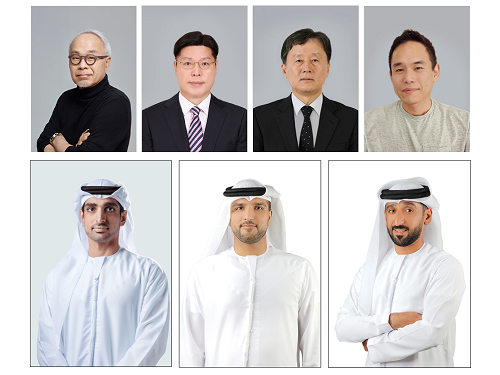
(From left) Omran Sharaf, the Assistant Minister of UAE Foreign Affairs and International Cooperation for Advanced Science and Technology, Amer Al Sayegh the Director General of Space Project at MBRSC, and Mohammed Al Harmi the Director General of Administration at MBRSC (Photos provided by the courtesy of MBRSC)
To celebrate and honor their outstanding achievements, the KAIST Alumni Association selected a team of three alumni of the United Arab Emirates (UAE) to receive the Distinguished International Alumni Award for the first time. The named honorees are Omran Sharaf, a master’s graduate from the Graduate School of Science and Technology Policy, and Amer Al Sayegh and Mohammed Al Harmi, master’s graduates of the Department of Aerospace Engineering - all three of the class of 2013 in leading positions in the UAE space program to lead the advancement of the science and technology of the country.
Currently, the three alums are in directorship of the Mohammed Bin Rashid Space Centre (MBRSC) with Mr. Omran Sharaf, who has recently been appointed as the Assistant Minister in charge of Advanced Science and Technology at the UAE Ministry of Foreign Affairs and International Cooperation, being the Project Director of the Emirates Mars Mission of MBRSC and Mr. Amer Al Sayegh in the Director General position in charge of Space Project and Mr. Mohammed Al Harmi, the Director General of Administration, at MBRSC.
They received technology transfer from “SatRec I”, Korea's first satellite system exporter and KAIST alumni company, for about 10 years from 2006, while carrying out their master’s studies at the same time.
Afterwards, they returned to UAE to lead the Emirates Mars Mission, which is already showing tangible progress including the successful launch of the Mars probe "Amal" (ال امل, meaning ‘Hope’ in Arabic), which was the first in the Arab world and the fifth in the world to successfully enter into orbit around Mars, and the UAE’s first independently developed Earth observation satellite "KhalifaSat".
An official from the KAIST Alumni Association said, "We selected the Distinguished International Alumni after evaluating their industrious leadership in promoting various space industry strategies, ranging from the development of Mars probes and Earth observation satellites, as well as lunar exploration, asteroid exploration, and Mars residence plans."
(From left) Joo-Sun Choi, President & CEO of Samsung Display Co. Ltd., Jung Goo Cho, the CEO of Green Power Co. Ltd., Jong Seung Park, the President of Agency for Defense Development (ADD), Kyunghyun Cho, Professor of New York University (NYU)
Also, four of the Korean graduates, Joo-Sun Choi, the CEO of Samsung Display, Jung Goo Cho, the CEO of Green Power Co. Ltd., Jong Seung Park, the President of Agency for Defense Development (ADD), and Kyunghyun Cho, a Professor of New York University (NYU), were selected as the winners of the “Distinguished Alumni Award”.
Mr. Joo-Sun Choi (Electrical and Electronic Engineering, M.S. in 1989, Ph.D. in 1995), the CEO of Samsung Display, led the successful development and mass-production of the world's first ultra-high-definition QD-OLED Displays, and preemptively transformed the structure of business of the industry and has been leading the way in technological innovation.
Mr. Jung Goo Cho (Electrical and Electronic Engineering, M.S. in 1988, Ph.D. in 1992), the CEO of Green Power Co. Ltd., developed wireless power technology for the first time in Korea in the early 2000s and applied it to semiconductor/display lines and led the wireless power charging technology in various fields, such as developing KAIST On-Line Electric Vehicles (OLEV) and commercializing the world's first wireless charger for 11kW electric vehicles.
Mr. Jong Seung Park (Mechanical Engineering, M.S. in 1988, Ph.D., in 1991), The President of ADD is an expert with abundant science and technology knowledge and organizational management capabilities. He is contributing greatly to national defense and security through science and technology.
Mr. Kyunghyun Cho (Computer Science, B.S., in 2009), the Professor of Computer Science and Data Science at NYU, is a world-renowned expert in Artificial Intelligence (AI), advancing the concept of 'Neural Machine Translation' in the field of natural language processing, to make great contributions to AI translation technology and related industries.
Chairman Chil-Hee Chung, the 26th Chair of KAIST Alumni Association “As each year goes by, I feel that the influence of KAIST alumni goes beyond science and technology to affect our society as a whole.” He went on to say, “This year, as it was more meaningful to extend the award to honor the international members of our Alums, we look forward to seeing more of our alumni continuing their social and academic endeavors to play an active role in the global stage in taking on the global challenges.”
The Ceremony for KAIST Distinguished Alumni and International Alumni Award Honorees will be conducted at the Annual New Year’s Event of KAIST Alumni Association for 2023 to be held on Friday, January 13th, at the Grand InterContinental Seoul Parnas.
2023.01.12 View 16684
UAE Space Program Leaders named to be the 1st of the honorees of KAIST Alumni Association's special recognition for graduates of foreign nationality
The KAIST Alumni Association (Chairman, Chil-Hee Chung) announced on the 12th that the winners of the 2023 KAIST Distinguished Alumni Award and International Alumni Award has been selected.
The KAIST Distinguished Alumni Award, which produced the first recipient in 1992, is an award given to alumni who have contributed to the development of the nation and society, or who have glorified the honor of their alma mater with outstanding academic achievements and social and/or communal contributions.
On a special note, this year, there has been an addition to the honors, “the KAIST Distinguished International Alumni Award” to honor and encourage overseas alumni who are making their marks in the international community that will boost positive recognition of KAIST in the global setting and will later become a bridge that will expedite Korea's international efforts in the future.
As of 2022, the number of international students who succeeded in earning KAIST degrees has exceeded 1,700, and they are actively doing their part back in their home countries as leaders in various fields in which they belong, spanning from science and technology, to politics, industry and other corners of the society.
(From left) Omran Sharaf, the Assistant Minister of UAE Foreign Affairs and International Cooperation for Advanced Science and Technology, Amer Al Sayegh the Director General of Space Project at MBRSC, and Mohammed Al Harmi the Director General of Administration at MBRSC (Photos provided by the courtesy of MBRSC)
To celebrate and honor their outstanding achievements, the KAIST Alumni Association selected a team of three alumni of the United Arab Emirates (UAE) to receive the Distinguished International Alumni Award for the first time. The named honorees are Omran Sharaf, a master’s graduate from the Graduate School of Science and Technology Policy, and Amer Al Sayegh and Mohammed Al Harmi, master’s graduates of the Department of Aerospace Engineering - all three of the class of 2013 in leading positions in the UAE space program to lead the advancement of the science and technology of the country.
Currently, the three alums are in directorship of the Mohammed Bin Rashid Space Centre (MBRSC) with Mr. Omran Sharaf, who has recently been appointed as the Assistant Minister in charge of Advanced Science and Technology at the UAE Ministry of Foreign Affairs and International Cooperation, being the Project Director of the Emirates Mars Mission of MBRSC and Mr. Amer Al Sayegh in the Director General position in charge of Space Project and Mr. Mohammed Al Harmi, the Director General of Administration, at MBRSC.
They received technology transfer from “SatRec I”, Korea's first satellite system exporter and KAIST alumni company, for about 10 years from 2006, while carrying out their master’s studies at the same time.
Afterwards, they returned to UAE to lead the Emirates Mars Mission, which is already showing tangible progress including the successful launch of the Mars probe "Amal" (ال امل, meaning ‘Hope’ in Arabic), which was the first in the Arab world and the fifth in the world to successfully enter into orbit around Mars, and the UAE’s first independently developed Earth observation satellite "KhalifaSat".
An official from the KAIST Alumni Association said, "We selected the Distinguished International Alumni after evaluating their industrious leadership in promoting various space industry strategies, ranging from the development of Mars probes and Earth observation satellites, as well as lunar exploration, asteroid exploration, and Mars residence plans."
(From left) Joo-Sun Choi, President & CEO of Samsung Display Co. Ltd., Jung Goo Cho, the CEO of Green Power Co. Ltd., Jong Seung Park, the President of Agency for Defense Development (ADD), Kyunghyun Cho, Professor of New York University (NYU)
Also, four of the Korean graduates, Joo-Sun Choi, the CEO of Samsung Display, Jung Goo Cho, the CEO of Green Power Co. Ltd., Jong Seung Park, the President of Agency for Defense Development (ADD), and Kyunghyun Cho, a Professor of New York University (NYU), were selected as the winners of the “Distinguished Alumni Award”.
Mr. Joo-Sun Choi (Electrical and Electronic Engineering, M.S. in 1989, Ph.D. in 1995), the CEO of Samsung Display, led the successful development and mass-production of the world's first ultra-high-definition QD-OLED Displays, and preemptively transformed the structure of business of the industry and has been leading the way in technological innovation.
Mr. Jung Goo Cho (Electrical and Electronic Engineering, M.S. in 1988, Ph.D. in 1992), the CEO of Green Power Co. Ltd., developed wireless power technology for the first time in Korea in the early 2000s and applied it to semiconductor/display lines and led the wireless power charging technology in various fields, such as developing KAIST On-Line Electric Vehicles (OLEV) and commercializing the world's first wireless charger for 11kW electric vehicles.
Mr. Jong Seung Park (Mechanical Engineering, M.S. in 1988, Ph.D., in 1991), The President of ADD is an expert with abundant science and technology knowledge and organizational management capabilities. He is contributing greatly to national defense and security through science and technology.
Mr. Kyunghyun Cho (Computer Science, B.S., in 2009), the Professor of Computer Science and Data Science at NYU, is a world-renowned expert in Artificial Intelligence (AI), advancing the concept of 'Neural Machine Translation' in the field of natural language processing, to make great contributions to AI translation technology and related industries.
Chairman Chil-Hee Chung, the 26th Chair of KAIST Alumni Association “As each year goes by, I feel that the influence of KAIST alumni goes beyond science and technology to affect our society as a whole.” He went on to say, “This year, as it was more meaningful to extend the award to honor the international members of our Alums, we look forward to seeing more of our alumni continuing their social and academic endeavors to play an active role in the global stage in taking on the global challenges.”
The Ceremony for KAIST Distinguished Alumni and International Alumni Award Honorees will be conducted at the Annual New Year’s Event of KAIST Alumni Association for 2023 to be held on Friday, January 13th, at the Grand InterContinental Seoul Parnas.
2023.01.12 View 16684 -
 NYC-KAIST Cooperation Agreement Signed in New York for KAIST NYU Joint Campus
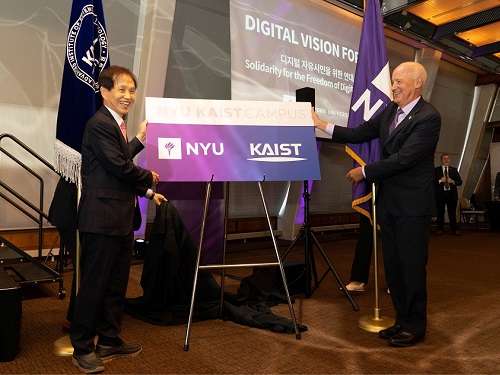
A ceremony was held to celebrate the signing of the Cooperative Agreement between NYC and KAIST and the presentation of the signage for KAIST NYU Joint Campus at NYU’s Kimmel Center in Manhattan.
KAIST President Kwang Hyung Lee (left) and NYU President Andrew Hamilton (right)
KAIST (President Kwang Hyung Lee) signed a cooperative agreement with the City of New York and had an official showing of the signage for the Joint Campus of KAIST and New York University (NYU) on September 21 at 4:00 pm (Eastern Standard Time) at NYU’s Kimmel Center in New York City with the NYC Mayor Eric Adams, the Korean Minister of Science and ICT Dr. Lee Jong-ho, NYU Chairman William Berkley, NYU President Andrew Hamilton, and other distinguished guests in attendance.
KAIST and NYU signed a Memorandum of Understanding in June about building a joint campus in an effort to educate global talent. As a follow-up measure, NYU has provided KAIST with space to begin joint research programs and held a ceremony to present the signage designed for the future KAIST NYU Campus. In line with these efforts, KAIST has also signed an agreement with New York City, the administrative authority in charge of the establishment of the campus, for mutual cooperation.
NYU is a prestigious university headquartered in Manhattan, New York. It has nurtured outstanding talents in the humanities, art, and basic sciences, including 38 Nobel Prize winners, 5 Fields Prize winners, 26 Pulitzer Prize winners, and 38 Academy Award winners to be deserving of the evaluation.
The proposed joint campus is to be centered on science, technology, engineering, and mathematics (STEM) by combining NYU's excellent basic sciences and convergence research capabilities with KAIST's globally renowned science and technology capabilities. The joint initiative is expected to launch in 2023; its programs will focus on areas such as AI Basic Science, AI Convergence Brain Science, AI-Applied Cyber Security, Cyber Security, and Sustainable High-Tech Smart City/Climate Change in order to lead the Digital Era and to solve the problems that surfaced following the COVID-19 pandemic. In addition, in order to prepare for the Post-AI Era, it was decided to create the “New Engineering” program for undergraduate program that employs a hyper-convergence learning model that combines project-based, problem-solving learning (PBL, PSL) pedagogy.
▲ Biomedical Engineering- Research and development of technology to respond to the entire cycle (prevention-treatment-diagnosis-prediction) for a new infectious disease (Disease X) by converging new technologies such as IT and NT with biomedical technologies
▲ AI Convergence Neuroscience- Research on brain-machine interaction and brain-based machine learning through AI technology convergence
▲ AI Science- Algorithm development and in-depth research in preparation for the post AI era
▲ Sustainability and Climate Change- R&DB for advanced smart cities, sustainability for the global environment and carbon zero
▲ Next-generation Wireless Communications- From ICT to AIT: Research on 6G/7G related technologies, new communications theories, and etc.
▲ Cyber Security- Advanced research on protection of digital information and information safety/reliability
KAIST President Kwang Hyung Lee (left) and NYC Mayor Eric Adams (right)
The KAIST NYU Joint Campus has started enlisting professors and researchers from both institutions to participate in the collaboration. The campus will also function as the headquarter that will oversee the operation of the joint research program. At Daejeon, KAIST is also setting up a location for NYU on its main campus to provide space for NYU researchers upon their visit to KAIST.
The KAIST NYU Joint Campus, which has begun to take basic shape with the space for collaboration rendered this time, is to be upgraded to “KAIST New York Campus” in the future to function also as an industry-academic cooperation campus in which that promotes strategic cooperation with industries and expands start-up opportunities. To this end, the related procedures from the detailing of the establishment plans through a preliminary feasibility studies, to deliberation and decision on whether to proceed with the establishment by the KAIST Board of Trustees, will be taken.
The KAIST NYU Campus is expected to serve as a stepping stone for the outstanding talents of KAIST to pursue their dreams in the global market and research environment while seizing the attention of the world-class talents drawn to New York at the same time. In addition, by combining NYU's strong basic academic capabilities with KAIST’s strengths, it is expected to contribute to achieving 'global innovation' by creating synergies in various fields such as education, research, and entrepreneurship. The future KAIST-NYU Campus is also expected to encompass an industry-academic cooperation campus with industrial partners and startups.
Meanwhile, KAIST is planning to expand its excellent scientific and technological capabilities to the global stage through the cooperative agreement with New York City, and to prepare a pathway for KAIST students, faculty, and startups to enter their respective fields in the global markets. In the future, KAIST plans to explore areas of cooperation in different fields, such as education, economy, society, and culture, to prepare and implement detailed cooperation plans.
< KAIST-New York City Cooperation Items (Example) >
▲ Education: Joint degree program with a university in New York City, training of key talents in the field of artificial intelligence, etc.
▲ Economy: A hub for technology startups, job creation in the tech sector, etc.
▲ Society: Economics, finance, media-related engineering research, etc.
▲ Culture: Diversity-based culture and art-tech research, etc.▲ Etc: Joint research in the field of artificial intelligence healthcare, etc.
As a global mecca for startups, education, and investment, New York has a well-developed global network for cultural diversity and successful career development, and has great power to attract various resources including funds and talented individuals. Based on this, it has established itself as a mecca of global tech companies and global top media groups, and is building the reputation as 'Silicon Alley' in addition to its legends of the ‘Wall Street'.
Dr. Andrew Hamilton, the president of NYU, said, “We’re delighted by our newly established partnership with KAIST. We see great potential in the opportunities to collaborate on development of courses, research, cutting edge technologies, university-level courses, degrees, entrepreneurship initiatives and industrial partnerships, and exchanges. We believe this partnership is very much in line with NYU’s commitment to global engagement and will make important contributions to New York’s tech sector. It’s exciting to think how much NYU and KAIST have much to learn from one another, and how much we may accomplish together.”
New York City Mayor Eric Adams said, “We’re proud to have helped facilitate this partnership between KAIST and New York University, which will be a real win for students and help drive continued innovation in our city.” He added, “From the time that senior members of our administration learned about this opportunity during a recent trip to South Korea, we have worked closely with KAIST to develop strategies for increasing their presence and investments in New York. This is the start of a relationship that I am confident will bring even more academic, business, and technological opportunities to the five boroughs.”
Dr. Kwang Hyung Lee, the president of KAIST, urged, “Based on the KAIST-NYU partnership, we must create an interdisciplinary hyper-convergence model of collaboration and use cutting-edge tools to create an innovative model for new type of problem-solving engineering education to prepare to solve the challenges facing the world.” He went on to stress, “The new fusion engineering degree program will leverage the unique strengths of the two institutions to provide a uniquely colored education not found anywhere else.” In addition, he added, “KAIST will utilize the advantages that are unique to the global city of New York to contribute to advancing the science and technology research in New York City and creating jobs in the tech sector to lead the renaissance of Silicon Alley.”
2022.09.27 View 14342
NYC-KAIST Cooperation Agreement Signed in New York for KAIST NYU Joint Campus
A ceremony was held to celebrate the signing of the Cooperative Agreement between NYC and KAIST and the presentation of the signage for KAIST NYU Joint Campus at NYU’s Kimmel Center in Manhattan.
KAIST President Kwang Hyung Lee (left) and NYU President Andrew Hamilton (right)
KAIST (President Kwang Hyung Lee) signed a cooperative agreement with the City of New York and had an official showing of the signage for the Joint Campus of KAIST and New York University (NYU) on September 21 at 4:00 pm (Eastern Standard Time) at NYU’s Kimmel Center in New York City with the NYC Mayor Eric Adams, the Korean Minister of Science and ICT Dr. Lee Jong-ho, NYU Chairman William Berkley, NYU President Andrew Hamilton, and other distinguished guests in attendance.
KAIST and NYU signed a Memorandum of Understanding in June about building a joint campus in an effort to educate global talent. As a follow-up measure, NYU has provided KAIST with space to begin joint research programs and held a ceremony to present the signage designed for the future KAIST NYU Campus. In line with these efforts, KAIST has also signed an agreement with New York City, the administrative authority in charge of the establishment of the campus, for mutual cooperation.
NYU is a prestigious university headquartered in Manhattan, New York. It has nurtured outstanding talents in the humanities, art, and basic sciences, including 38 Nobel Prize winners, 5 Fields Prize winners, 26 Pulitzer Prize winners, and 38 Academy Award winners to be deserving of the evaluation.
The proposed joint campus is to be centered on science, technology, engineering, and mathematics (STEM) by combining NYU's excellent basic sciences and convergence research capabilities with KAIST's globally renowned science and technology capabilities. The joint initiative is expected to launch in 2023; its programs will focus on areas such as AI Basic Science, AI Convergence Brain Science, AI-Applied Cyber Security, Cyber Security, and Sustainable High-Tech Smart City/Climate Change in order to lead the Digital Era and to solve the problems that surfaced following the COVID-19 pandemic. In addition, in order to prepare for the Post-AI Era, it was decided to create the “New Engineering” program for undergraduate program that employs a hyper-convergence learning model that combines project-based, problem-solving learning (PBL, PSL) pedagogy.
▲ Biomedical Engineering- Research and development of technology to respond to the entire cycle (prevention-treatment-diagnosis-prediction) for a new infectious disease (Disease X) by converging new technologies such as IT and NT with biomedical technologies
▲ AI Convergence Neuroscience- Research on brain-machine interaction and brain-based machine learning through AI technology convergence
▲ AI Science- Algorithm development and in-depth research in preparation for the post AI era
▲ Sustainability and Climate Change- R&DB for advanced smart cities, sustainability for the global environment and carbon zero
▲ Next-generation Wireless Communications- From ICT to AIT: Research on 6G/7G related technologies, new communications theories, and etc.
▲ Cyber Security- Advanced research on protection of digital information and information safety/reliability
KAIST President Kwang Hyung Lee (left) and NYC Mayor Eric Adams (right)
The KAIST NYU Joint Campus has started enlisting professors and researchers from both institutions to participate in the collaboration. The campus will also function as the headquarter that will oversee the operation of the joint research program. At Daejeon, KAIST is also setting up a location for NYU on its main campus to provide space for NYU researchers upon their visit to KAIST.
The KAIST NYU Joint Campus, which has begun to take basic shape with the space for collaboration rendered this time, is to be upgraded to “KAIST New York Campus” in the future to function also as an industry-academic cooperation campus in which that promotes strategic cooperation with industries and expands start-up opportunities. To this end, the related procedures from the detailing of the establishment plans through a preliminary feasibility studies, to deliberation and decision on whether to proceed with the establishment by the KAIST Board of Trustees, will be taken.
The KAIST NYU Campus is expected to serve as a stepping stone for the outstanding talents of KAIST to pursue their dreams in the global market and research environment while seizing the attention of the world-class talents drawn to New York at the same time. In addition, by combining NYU's strong basic academic capabilities with KAIST’s strengths, it is expected to contribute to achieving 'global innovation' by creating synergies in various fields such as education, research, and entrepreneurship. The future KAIST-NYU Campus is also expected to encompass an industry-academic cooperation campus with industrial partners and startups.
Meanwhile, KAIST is planning to expand its excellent scientific and technological capabilities to the global stage through the cooperative agreement with New York City, and to prepare a pathway for KAIST students, faculty, and startups to enter their respective fields in the global markets. In the future, KAIST plans to explore areas of cooperation in different fields, such as education, economy, society, and culture, to prepare and implement detailed cooperation plans.
< KAIST-New York City Cooperation Items (Example) >
▲ Education: Joint degree program with a university in New York City, training of key talents in the field of artificial intelligence, etc.
▲ Economy: A hub for technology startups, job creation in the tech sector, etc.
▲ Society: Economics, finance, media-related engineering research, etc.
▲ Culture: Diversity-based culture and art-tech research, etc.▲ Etc: Joint research in the field of artificial intelligence healthcare, etc.
As a global mecca for startups, education, and investment, New York has a well-developed global network for cultural diversity and successful career development, and has great power to attract various resources including funds and talented individuals. Based on this, it has established itself as a mecca of global tech companies and global top media groups, and is building the reputation as 'Silicon Alley' in addition to its legends of the ‘Wall Street'.
Dr. Andrew Hamilton, the president of NYU, said, “We’re delighted by our newly established partnership with KAIST. We see great potential in the opportunities to collaborate on development of courses, research, cutting edge technologies, university-level courses, degrees, entrepreneurship initiatives and industrial partnerships, and exchanges. We believe this partnership is very much in line with NYU’s commitment to global engagement and will make important contributions to New York’s tech sector. It’s exciting to think how much NYU and KAIST have much to learn from one another, and how much we may accomplish together.”
New York City Mayor Eric Adams said, “We’re proud to have helped facilitate this partnership between KAIST and New York University, which will be a real win for students and help drive continued innovation in our city.” He added, “From the time that senior members of our administration learned about this opportunity during a recent trip to South Korea, we have worked closely with KAIST to develop strategies for increasing their presence and investments in New York. This is the start of a relationship that I am confident will bring even more academic, business, and technological opportunities to the five boroughs.”
Dr. Kwang Hyung Lee, the president of KAIST, urged, “Based on the KAIST-NYU partnership, we must create an interdisciplinary hyper-convergence model of collaboration and use cutting-edge tools to create an innovative model for new type of problem-solving engineering education to prepare to solve the challenges facing the world.” He went on to stress, “The new fusion engineering degree program will leverage the unique strengths of the two institutions to provide a uniquely colored education not found anywhere else.” In addition, he added, “KAIST will utilize the advantages that are unique to the global city of New York to contribute to advancing the science and technology research in New York City and creating jobs in the tech sector to lead the renaissance of Silicon Alley.”
2022.09.27 View 14342 -
 KAIST Honors BMW and Hyundai with the 2022 Future Mobility of the Year Award
BMW ‘iVision Circular’, Commercial Vehicle-Hyundai Motors ‘Trailer Drone’ selected as winners of the international awards for concept cars established by KAIST Cho Chun Shik Graduate School of Mobility to honor car makers that strive to present new visions in the field of eco-friendly design of automobiles and unmanned logistics.
KAIST (President Kwang Hyung Lee) hosted the “2022 Future Mobility of the Year (FMOTY) Awards” at the Convention Hall of the BEXCO International Motor Show at Busan in the afternoon of the 14th.
The Future Mobility of the Year Awards is an award ceremony that selects a model that showcases useful transportation technology and innovative service concepts for the future society among the set of concept cars exhibited at the motor show.
As a one-of-a-kind international concept car awards established by KAIST's Cho Chun Shik Graduate School of Mobility (Headed by Professor Jang In-Gwon), the auto journalists from 11 countries were invited to be the jurors to select the winner. With the inaugural awards ceremony held in 2019, over the past three years, automakers from around the globe, including internationally renowned automakers, such as, Volvo/Toyota (2019), Honda/Hyundai (2020), and Renault (2021), even a new start-up car manufacturer like Canoo, the winner of last year’s award for commercial vehicles, were honored for their award-winning works.
At this year’s awards ceremony, the 4th of its kind, BMW's “iVision Circular” and Hyundai's “'Trailer Drone” were selected as the best concept cars of the year, the former from the Private Mobility category and the latter from the Public & Commercial Vehicles category.
The jury consisting of 16 domestic and foreign auto journalists, including BBC Top Gear's Paul Horrell and Car Magazine’s Georg Kacher, evaluated 53 concept car contestants that made their entry last year. The jurors’ general comment was that while the trend of the global automobile market flowing fast towards electric vehicles, this year's award-winning works presented a new vision in the field of eco-friendly design and unmanned logistics.
Private Mobility Categry Winner: BMW iVision Circular
BMW's 'iVision Circular', the winner of the Private Mobility category, is an eco-friendly compact car in which all parts of the vehicle are designed with recycled and/or natural materials. It has received favorable reviews for its in-depth implementation of the concept of a futuristic eco-friendly car by manufacturing the tires from natural rubber and adopting a design that made recycling of its parts very easily when the car is to be disposed of.
Public & Commercial Vehicles Categry Winner: Hyundai Trailer Drone
Hyundai Motor Company’s “Trailer Drone”, the winner of the Public & Commercial Vehicles category, is an eco-friendly autonomous driving truck that can transport large-scale logistics from a port to a destination without a human driver while two unmanned vehicles push and drag a trailer. The concept car won supports from a large number of judges for the blueprint it presented for a groundbreaking logistics service that applied both eco-friendly hydrogen fuel cell and fully autonomous driving technology.
Jurors from overseas congratulated the development team of BMW and Hyundai Motor Company via a video message for providing a new direction for the global automobile industry as it strives to transform in line with the changes in the post-pandemic era.
Professor Bo-won Kim, the Vice President for Planning and Budget of KAIST, who presented the awards, said, “It is time for the K-Mobility wave to sweep over the global mobility industry.” “KAIST will lead in the various fields of mobility technologies to support global automakers,” he added.
Splitting the center are KAIST Vice President Bo-Won Kim on the right, and Seong-Kwon Lee,
the Deputy Mayor of the City of Busan on the left. To Kim's left is the Senior VP of BMW Asia-Pacific, Eastern Europe, Middle East, Africa, Jean-Philippe Parain, and to Lee's Right is Sangyup Lee,
the Head of Hyundai Motor Design Center and the Executive VP of Hyundai Motors.
At the ceremony, along with KAIST officials, including Vice President Bo-Won Kim and Professor In-Gwon Jang, the Head of Cho Chun Shik Graduate School of Mobility, are the Deputy Mayor Seong-Kwon Lee of the City of Busan and the figures from the automobile industry, including Jean-Philippe Parain, the Senior Vice President of BMW Asia-Pacific, Eastern Europe, Middle East, Africa, who is visiting Korea to receive the '2022 Future Mobility' award, and Sangyup Lee, the Head of Hyundai Motor Design Center and the Executive Vice President of Hyundai Motor Company, were in the attendance.
More information about the awards ceremony and winning works are available at the official website of this year's Future Mobility Awards (www.fmoty.org).
Profile:In-Gwon Jang, Ph.D.Presidentthe Organizing Committeethe Future Mobility of the Year Awardshttp://www.fmoty.org/
Head ProfessorKAIST Cho Chun Shik Graduate School of Mobilityhttps://gt.kaist.ac.kr
2022.07.14 View 16172
KAIST Honors BMW and Hyundai with the 2022 Future Mobility of the Year Award
BMW ‘iVision Circular’, Commercial Vehicle-Hyundai Motors ‘Trailer Drone’ selected as winners of the international awards for concept cars established by KAIST Cho Chun Shik Graduate School of Mobility to honor car makers that strive to present new visions in the field of eco-friendly design of automobiles and unmanned logistics.
KAIST (President Kwang Hyung Lee) hosted the “2022 Future Mobility of the Year (FMOTY) Awards” at the Convention Hall of the BEXCO International Motor Show at Busan in the afternoon of the 14th.
The Future Mobility of the Year Awards is an award ceremony that selects a model that showcases useful transportation technology and innovative service concepts for the future society among the set of concept cars exhibited at the motor show.
As a one-of-a-kind international concept car awards established by KAIST's Cho Chun Shik Graduate School of Mobility (Headed by Professor Jang In-Gwon), the auto journalists from 11 countries were invited to be the jurors to select the winner. With the inaugural awards ceremony held in 2019, over the past three years, automakers from around the globe, including internationally renowned automakers, such as, Volvo/Toyota (2019), Honda/Hyundai (2020), and Renault (2021), even a new start-up car manufacturer like Canoo, the winner of last year’s award for commercial vehicles, were honored for their award-winning works.
At this year’s awards ceremony, the 4th of its kind, BMW's “iVision Circular” and Hyundai's “'Trailer Drone” were selected as the best concept cars of the year, the former from the Private Mobility category and the latter from the Public & Commercial Vehicles category.
The jury consisting of 16 domestic and foreign auto journalists, including BBC Top Gear's Paul Horrell and Car Magazine’s Georg Kacher, evaluated 53 concept car contestants that made their entry last year. The jurors’ general comment was that while the trend of the global automobile market flowing fast towards electric vehicles, this year's award-winning works presented a new vision in the field of eco-friendly design and unmanned logistics.
Private Mobility Categry Winner: BMW iVision Circular
BMW's 'iVision Circular', the winner of the Private Mobility category, is an eco-friendly compact car in which all parts of the vehicle are designed with recycled and/or natural materials. It has received favorable reviews for its in-depth implementation of the concept of a futuristic eco-friendly car by manufacturing the tires from natural rubber and adopting a design that made recycling of its parts very easily when the car is to be disposed of.
Public & Commercial Vehicles Categry Winner: Hyundai Trailer Drone
Hyundai Motor Company’s “Trailer Drone”, the winner of the Public & Commercial Vehicles category, is an eco-friendly autonomous driving truck that can transport large-scale logistics from a port to a destination without a human driver while two unmanned vehicles push and drag a trailer. The concept car won supports from a large number of judges for the blueprint it presented for a groundbreaking logistics service that applied both eco-friendly hydrogen fuel cell and fully autonomous driving technology.
Jurors from overseas congratulated the development team of BMW and Hyundai Motor Company via a video message for providing a new direction for the global automobile industry as it strives to transform in line with the changes in the post-pandemic era.
Professor Bo-won Kim, the Vice President for Planning and Budget of KAIST, who presented the awards, said, “It is time for the K-Mobility wave to sweep over the global mobility industry.” “KAIST will lead in the various fields of mobility technologies to support global automakers,” he added.
Splitting the center are KAIST Vice President Bo-Won Kim on the right, and Seong-Kwon Lee,
the Deputy Mayor of the City of Busan on the left. To Kim's left is the Senior VP of BMW Asia-Pacific, Eastern Europe, Middle East, Africa, Jean-Philippe Parain, and to Lee's Right is Sangyup Lee,
the Head of Hyundai Motor Design Center and the Executive VP of Hyundai Motors.
At the ceremony, along with KAIST officials, including Vice President Bo-Won Kim and Professor In-Gwon Jang, the Head of Cho Chun Shik Graduate School of Mobility, are the Deputy Mayor Seong-Kwon Lee of the City of Busan and the figures from the automobile industry, including Jean-Philippe Parain, the Senior Vice President of BMW Asia-Pacific, Eastern Europe, Middle East, Africa, who is visiting Korea to receive the '2022 Future Mobility' award, and Sangyup Lee, the Head of Hyundai Motor Design Center and the Executive Vice President of Hyundai Motor Company, were in the attendance.
More information about the awards ceremony and winning works are available at the official website of this year's Future Mobility Awards (www.fmoty.org).
Profile:In-Gwon Jang, Ph.D.Presidentthe Organizing Committeethe Future Mobility of the Year Awardshttp://www.fmoty.org/
Head ProfessorKAIST Cho Chun Shik Graduate School of Mobilityhttps://gt.kaist.ac.kr
2022.07.14 View 16172 -
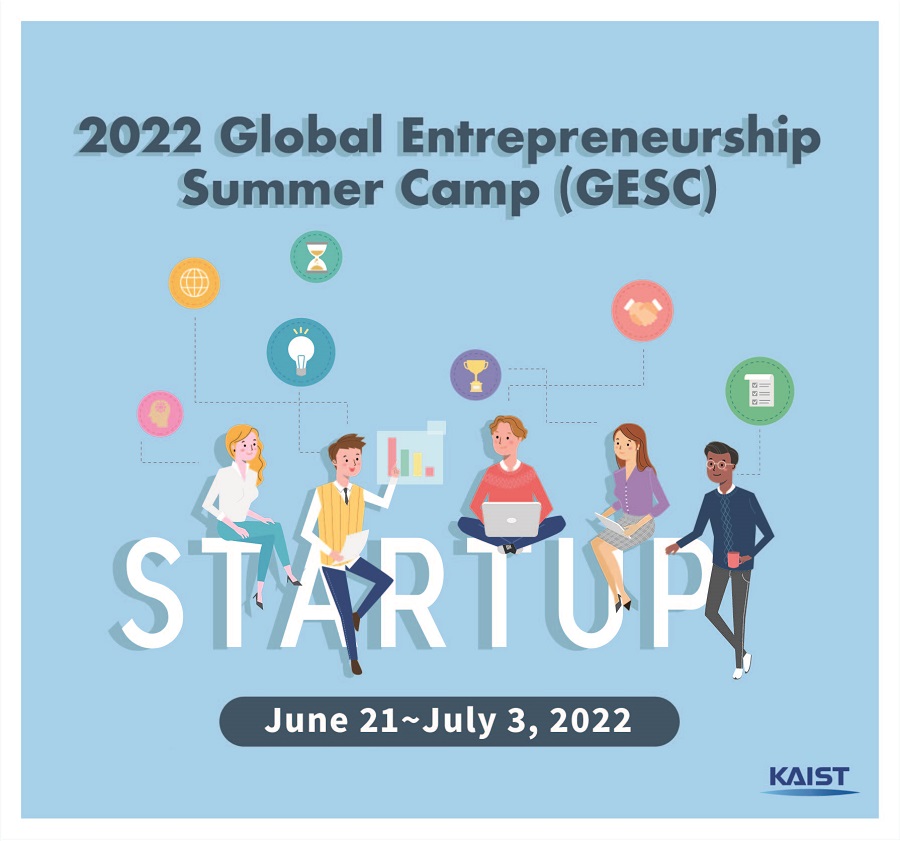 The 1st Global Entrepreneurship Summer Camp bridges KAIST and Silicon Valley, US
Twenty KAIST students gave a go at selling their business ideas to investors at Silicon Valley on the “Pitch Day” at 2022 Global Entrepreneurship Summer Camp.
From Tuesday, June 21 to Monday, July 4, 2022, KAIST held the first Global Entrepreneurship Summer Camp (GESC).
The 2022 GESC, which was organized in collaboration with Stanford Technology Ventures Program (STVP), KOTRA Silicon Valley IT Center, and KAIST Alumni at Silicon Valley, was a pilot program that offered opportunities of experiencing and learning about the cases of startup companies in Silicon Valley and a chance to expand businesses to Silicon Valley through networking.
Twenty KAIST students, including pre-startup entrepreneurs and students interested in global entrepreneurship with less than one year of business experience were selected. The first week of the program was organized by Startup KAIST while the second week program was organized by the Center for Global Strategies and Planning (GSP) at KAIST in collaboration with the Stanford Technology Venture Program (STVP), KAIST Alumni at Silicon Valley, and KOTRA at Silicon Valley.
Dr. Mo-Yun Lei Fong, the Executive Director of STVP, said, “The program offered an opportunity for us to realize our vision of empowering aspiring entrepreneurs to become global citizens who create and scale responsible innovation. By collaborating with KAIST and offering entrepreneurial insights to Korean students, we are able to have a positive impact on a global scale.” Mo added, “The program also enabled STVP to build bridges, learn from the students, and refine our culturally relevant curriculum by understanding Korean culture and ideas.”
On the “Pitch Day” on July 1, following a special talk by Dr. Chong-Moon Lee, the Chairman of AmBex Venture Partners, the students presented their team business ideas such as an AI-assisted, noise-canceling pillow devised for better sleep, a metaverse dating application, an XR virtual conferencing system, and an AI language tutoring application to the entice global investors’ curiosity. The invited investors, majorly based in Silicon Valley, commented that all the presentation was very exciting, and the level of pitches was beyond the expectation considering that the students have given only two weeks.
Ms. Seunghee Lee of the team “Bored KAIST Yacht Club”, which was awarded the first prize, explained, “our item, called ‘Meta-Everland’, is a service that offers real-time dating experiences similar to off-line dates. The GESC taught me that anybody can launch a startup as long as they are willing. Developing a business model from ideation and taking it to the actual pitching was challenging, but it was a very thrilling experience at the same time.” Lee added, “Most importantly, over the course of the program and the final pitch, I found out that an interesting idea can attract investors interest even at a very early stage of the launching.”
Mr. Byunghoon Hwang, a student who attended the program said, “Having learned the thoughts and attitudes the people at the front line of Silicon Valley, my views on career and launching of a start-up have been expanded a lot.”
Ms. Marina Mondragon, another attendee at the program, also said that the program was very meaningful because she was able to learn the difference between the ecosystem for the new start-up businesses at Korea and at Silicon Valley through her talks with the CEOs at Silicon Valley.
The program was co-organized by the Center for Global Strategies and Planning at KAIST International Office and Startup of KAIST. Dr. Man-Sung Yim, the Associate Vice President for KAIST International Office, who guided students in Silicon Valley, said, “I believe the GESC program broadened the views and entrepreneurial mindset of students. After joining this program, students stepped forward to become a founder of startups.” In addition, Dr. Young-Tae Kim, the Associate Vice President of the Institute for Startup KAIST, addressed “Startup KAIST will support business items founded via the program through various other programs in order to enhance their competitiveness in the global market.”
The GSP and Startup KAIST will continuously revamp the program by selecting distinguished fellows to join the program and coming up with innovative startup items.
Profile:
Sooa Lee, Ph.D.
Research Assistant Professor
slee900@kaist.ac.kr
Center for Global Strategies and Planning
Office of Global Initiatives
KAIST International Office
https://io.kaist.ac.kr
Korea Advanced Institute of Science and Technology (KAIST)Daejeon, Republic of Korea
2022.07.05 View 13592
The 1st Global Entrepreneurship Summer Camp bridges KAIST and Silicon Valley, US
Twenty KAIST students gave a go at selling their business ideas to investors at Silicon Valley on the “Pitch Day” at 2022 Global Entrepreneurship Summer Camp.
From Tuesday, June 21 to Monday, July 4, 2022, KAIST held the first Global Entrepreneurship Summer Camp (GESC).
The 2022 GESC, which was organized in collaboration with Stanford Technology Ventures Program (STVP), KOTRA Silicon Valley IT Center, and KAIST Alumni at Silicon Valley, was a pilot program that offered opportunities of experiencing and learning about the cases of startup companies in Silicon Valley and a chance to expand businesses to Silicon Valley through networking.
Twenty KAIST students, including pre-startup entrepreneurs and students interested in global entrepreneurship with less than one year of business experience were selected. The first week of the program was organized by Startup KAIST while the second week program was organized by the Center for Global Strategies and Planning (GSP) at KAIST in collaboration with the Stanford Technology Venture Program (STVP), KAIST Alumni at Silicon Valley, and KOTRA at Silicon Valley.
Dr. Mo-Yun Lei Fong, the Executive Director of STVP, said, “The program offered an opportunity for us to realize our vision of empowering aspiring entrepreneurs to become global citizens who create and scale responsible innovation. By collaborating with KAIST and offering entrepreneurial insights to Korean students, we are able to have a positive impact on a global scale.” Mo added, “The program also enabled STVP to build bridges, learn from the students, and refine our culturally relevant curriculum by understanding Korean culture and ideas.”
On the “Pitch Day” on July 1, following a special talk by Dr. Chong-Moon Lee, the Chairman of AmBex Venture Partners, the students presented their team business ideas such as an AI-assisted, noise-canceling pillow devised for better sleep, a metaverse dating application, an XR virtual conferencing system, and an AI language tutoring application to the entice global investors’ curiosity. The invited investors, majorly based in Silicon Valley, commented that all the presentation was very exciting, and the level of pitches was beyond the expectation considering that the students have given only two weeks.
Ms. Seunghee Lee of the team “Bored KAIST Yacht Club”, which was awarded the first prize, explained, “our item, called ‘Meta-Everland’, is a service that offers real-time dating experiences similar to off-line dates. The GESC taught me that anybody can launch a startup as long as they are willing. Developing a business model from ideation and taking it to the actual pitching was challenging, but it was a very thrilling experience at the same time.” Lee added, “Most importantly, over the course of the program and the final pitch, I found out that an interesting idea can attract investors interest even at a very early stage of the launching.”
Mr. Byunghoon Hwang, a student who attended the program said, “Having learned the thoughts and attitudes the people at the front line of Silicon Valley, my views on career and launching of a start-up have been expanded a lot.”
Ms. Marina Mondragon, another attendee at the program, also said that the program was very meaningful because she was able to learn the difference between the ecosystem for the new start-up businesses at Korea and at Silicon Valley through her talks with the CEOs at Silicon Valley.
The program was co-organized by the Center for Global Strategies and Planning at KAIST International Office and Startup of KAIST. Dr. Man-Sung Yim, the Associate Vice President for KAIST International Office, who guided students in Silicon Valley, said, “I believe the GESC program broadened the views and entrepreneurial mindset of students. After joining this program, students stepped forward to become a founder of startups.” In addition, Dr. Young-Tae Kim, the Associate Vice President of the Institute for Startup KAIST, addressed “Startup KAIST will support business items founded via the program through various other programs in order to enhance their competitiveness in the global market.”
The GSP and Startup KAIST will continuously revamp the program by selecting distinguished fellows to join the program and coming up with innovative startup items.
Profile:
Sooa Lee, Ph.D.
Research Assistant Professor
slee900@kaist.ac.kr
Center for Global Strategies and Planning
Office of Global Initiatives
KAIST International Office
https://io.kaist.ac.kr
Korea Advanced Institute of Science and Technology (KAIST)Daejeon, Republic of Korea
2022.07.05 View 13592 -
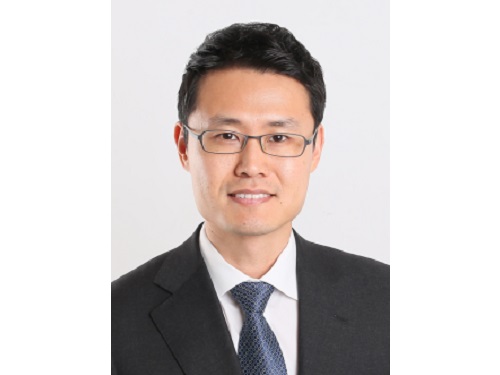 Professor Jae-Woong Jeong Receives Hyonwoo KAIST Academic Award
Professor Jae-Woong Jeong from the School of Electrical Engineering was selected for the Hyonwoo KAIST Academic Award, funded by the HyonWoo Cultural Foundation (Chairman Soo-il Kwak, honorary professor at Seoul National University Business School).
The Hyonwoo KAIST Academic Award, presented for the first time in 2021, is an award newly founded by the donations of Chairman Soo-il Kwak of the HyonWoo Cultural Foundation, who aims to reward excellent KAIST scholars who have made outstanding academic achievements.
Every year, through the strict evaluations of the selection committee of the HyonWoo Cultural Foundation and the faculty reward recommendation board, KAIST will choose one faculty member that may represent the school with their excellent academic achievement, and reward them with a plaque and 100 million won.
Professor Jae-Woong Jeong, the winner of this year’s award, developed the first IoT-based wireless remote brain neural network control system to overcome brain diseases, and has been leading the field. The research was published in 2021 in Nature Biomedical Engineering, one of world’s best scientific journals, and has been recognized as a novel technology that suggested a new vision for the automation of brain research and disease treatment. This study, led by Professor Jeong’s research team, was part of the KAIST College of Engineering Global Initiative Interdisciplinary Research Project, and was jointly studied by Washington University School of Medicine through an international research collaboration. The technology was introduced more than 60 times through both domestic and international media, including Medical Xpress, MBC News, and Maeil Business News.
Professor Jeong has also developed a wirelessly chargeable soft machine for brain transplants, and the results were published in Nature Communications. He thereby opened a new paradigm for implantable semi-permanent devices for transplants, and is making unprecedented research achievements.
2022.06.13 View 9320
Professor Jae-Woong Jeong Receives Hyonwoo KAIST Academic Award
Professor Jae-Woong Jeong from the School of Electrical Engineering was selected for the Hyonwoo KAIST Academic Award, funded by the HyonWoo Cultural Foundation (Chairman Soo-il Kwak, honorary professor at Seoul National University Business School).
The Hyonwoo KAIST Academic Award, presented for the first time in 2021, is an award newly founded by the donations of Chairman Soo-il Kwak of the HyonWoo Cultural Foundation, who aims to reward excellent KAIST scholars who have made outstanding academic achievements.
Every year, through the strict evaluations of the selection committee of the HyonWoo Cultural Foundation and the faculty reward recommendation board, KAIST will choose one faculty member that may represent the school with their excellent academic achievement, and reward them with a plaque and 100 million won.
Professor Jae-Woong Jeong, the winner of this year’s award, developed the first IoT-based wireless remote brain neural network control system to overcome brain diseases, and has been leading the field. The research was published in 2021 in Nature Biomedical Engineering, one of world’s best scientific journals, and has been recognized as a novel technology that suggested a new vision for the automation of brain research and disease treatment. This study, led by Professor Jeong’s research team, was part of the KAIST College of Engineering Global Initiative Interdisciplinary Research Project, and was jointly studied by Washington University School of Medicine through an international research collaboration. The technology was introduced more than 60 times through both domestic and international media, including Medical Xpress, MBC News, and Maeil Business News.
Professor Jeong has also developed a wirelessly chargeable soft machine for brain transplants, and the results were published in Nature Communications. He thereby opened a new paradigm for implantable semi-permanent devices for transplants, and is making unprecedented research achievements.
2022.06.13 View 9320 -
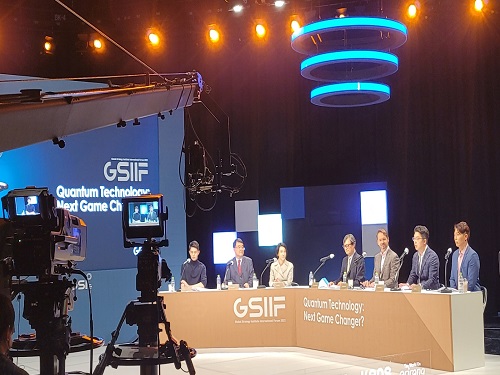 Quantum Technology: the Next Game Changer?
The 6th KAIST Global Strategy Institute Forum explores how quantum technology has evolved into a new growth engine for the future
The participants of the 6th KAIST Global Strategy Institute (GSI) Forum on April 20 agreed that the emerging technology of quantum computing will be a game changer of the future. As KAIST President Kwang Hyung Lee said in his opening remarks, the future is quantum and that future is rapidly approaching. Keynote speakers and panelists presented their insights on the disruptive innovations we are already experiencing.
The three keynote speakers included Dr. Jerry M. Chow, IBM fellow and director of quantum infrastructure, Professor John Preskill from Caltech, and Professor Jungsang Kim from Duke University. They discussed the academic impact and industrial applications of quantum technology, and its prospects for the future.
Dr. Chow leads IBM Quantum’s hardware system development efforts, focusing on research and system deployment. Professor Preskill is one of the leading quantum information science and quantum computation scholars. He coined the term “quantum supremacy.” Professor Kim is the co-founder and CTO of IonQ Inc., which develops general-purpose trapped ion quantum computers and software to generate, optimize, and execute quantum circuits.
Two leading quantum scholars from KAIST, Professor June-Koo Kevin Rhee and Professor Youngik Sohn, and Professor Andreas Heinrich from the IBS Center for Quantum Nanoscience also participated in the forum as panelists. Professor Rhee is the founder of the nation’s first quantum computing software company and leads the AI Quantum Computing IT Research Center at KAIST.
During the panel session, Professor Rhee said that although it is undeniable the quantum computing will be a game changer, there are several challenges. For instance, the first actual quantum computer is NISQ (Noisy intermediate-scale quantum era), which is still incomplete. However, it is expected to outperform a supercomputer. Until then, it is important to advance the accuracy of quantum computation in order to offer super computation speeds.
Professor Sohn, who worked at PsiQuantum, detailed how quantum computers will affect our society. He said that PsiQuantum is developing silicon photonics that will control photons. We can’t begin to imagine how silicon photonics will transform our society. Things will change slowly but the scale would be massive.
The keynote speakers presented how quantum cryptography communications and its sensing technology will serve as disruptive innovations. Dr. Chow stressed that to realize the potential growth and innovation, additional R&D is needed. More research groups and scholars should be nurtured. Only then will the rich R&D resources be able to create breakthroughs in quantum-related industries. Lastly, the commercialization of quantum computing must be advanced, which will enable the provision of diverse services. In addition, more technological and industrial infrastructure must be built to better accommodate quantum computing.
Professor Preskill believes that quantum computing will benefit humanity. He cited two basic reasons for his optimistic prediction: quantum complexity and quantum error corrections. He explained why quantum computing is so powerful: quantum computer can easily solve the problems classically considered difficult, such as factorization. In addition, quantum computer has the potential to efficiently simulate all of the physical processes taking place in nature.
Despite such dramatic advantages, why does it seem so difficult? Professor Preskill believes this is because we want qubits (quantum bits or ‘qubits’ are the basic unit of quantum information) to interact very strongly with each other. Because computations can fail, we don’t want qubits to interact with the environment unless we can control and predict them.
As for quantum computing in the NISQ era, he said that NISQ will be an exciting tool for exploring physics. Professor Preskill does not believe that NISQ will change the world alone, rather it is a step forward toward more powerful quantum technologies in the future. He added that a potentially transformable, scalable quantum computer could still be decades away.
Professor Preskill said that a large number of qubits, higher accuracy, and better quality will require a significant investment. He said if we expand with better ideas, we can make a better system. In the longer term, quantum technology will bring significant benefits to the technological sectors and society in the fields of materials, physics, chemistry, and energy production.
Professor Kim from Duke University presented on the practical applications of quantum computing, especially in the startup environment. He said that although there is no right answer for the early applications of quantum computing, developing new approaches to solve difficult problems and raising the accessibility of the technology will be important for ensuring the growth of technology-based startups.
2022.04.21 View 12948
Quantum Technology: the Next Game Changer?
The 6th KAIST Global Strategy Institute Forum explores how quantum technology has evolved into a new growth engine for the future
The participants of the 6th KAIST Global Strategy Institute (GSI) Forum on April 20 agreed that the emerging technology of quantum computing will be a game changer of the future. As KAIST President Kwang Hyung Lee said in his opening remarks, the future is quantum and that future is rapidly approaching. Keynote speakers and panelists presented their insights on the disruptive innovations we are already experiencing.
The three keynote speakers included Dr. Jerry M. Chow, IBM fellow and director of quantum infrastructure, Professor John Preskill from Caltech, and Professor Jungsang Kim from Duke University. They discussed the academic impact and industrial applications of quantum technology, and its prospects for the future.
Dr. Chow leads IBM Quantum’s hardware system development efforts, focusing on research and system deployment. Professor Preskill is one of the leading quantum information science and quantum computation scholars. He coined the term “quantum supremacy.” Professor Kim is the co-founder and CTO of IonQ Inc., which develops general-purpose trapped ion quantum computers and software to generate, optimize, and execute quantum circuits.
Two leading quantum scholars from KAIST, Professor June-Koo Kevin Rhee and Professor Youngik Sohn, and Professor Andreas Heinrich from the IBS Center for Quantum Nanoscience also participated in the forum as panelists. Professor Rhee is the founder of the nation’s first quantum computing software company and leads the AI Quantum Computing IT Research Center at KAIST.
During the panel session, Professor Rhee said that although it is undeniable the quantum computing will be a game changer, there are several challenges. For instance, the first actual quantum computer is NISQ (Noisy intermediate-scale quantum era), which is still incomplete. However, it is expected to outperform a supercomputer. Until then, it is important to advance the accuracy of quantum computation in order to offer super computation speeds.
Professor Sohn, who worked at PsiQuantum, detailed how quantum computers will affect our society. He said that PsiQuantum is developing silicon photonics that will control photons. We can’t begin to imagine how silicon photonics will transform our society. Things will change slowly but the scale would be massive.
The keynote speakers presented how quantum cryptography communications and its sensing technology will serve as disruptive innovations. Dr. Chow stressed that to realize the potential growth and innovation, additional R&D is needed. More research groups and scholars should be nurtured. Only then will the rich R&D resources be able to create breakthroughs in quantum-related industries. Lastly, the commercialization of quantum computing must be advanced, which will enable the provision of diverse services. In addition, more technological and industrial infrastructure must be built to better accommodate quantum computing.
Professor Preskill believes that quantum computing will benefit humanity. He cited two basic reasons for his optimistic prediction: quantum complexity and quantum error corrections. He explained why quantum computing is so powerful: quantum computer can easily solve the problems classically considered difficult, such as factorization. In addition, quantum computer has the potential to efficiently simulate all of the physical processes taking place in nature.
Despite such dramatic advantages, why does it seem so difficult? Professor Preskill believes this is because we want qubits (quantum bits or ‘qubits’ are the basic unit of quantum information) to interact very strongly with each other. Because computations can fail, we don’t want qubits to interact with the environment unless we can control and predict them.
As for quantum computing in the NISQ era, he said that NISQ will be an exciting tool for exploring physics. Professor Preskill does not believe that NISQ will change the world alone, rather it is a step forward toward more powerful quantum technologies in the future. He added that a potentially transformable, scalable quantum computer could still be decades away.
Professor Preskill said that a large number of qubits, higher accuracy, and better quality will require a significant investment. He said if we expand with better ideas, we can make a better system. In the longer term, quantum technology will bring significant benefits to the technological sectors and society in the fields of materials, physics, chemistry, and energy production.
Professor Kim from Duke University presented on the practical applications of quantum computing, especially in the startup environment. He said that although there is no right answer for the early applications of quantum computing, developing new approaches to solve difficult problems and raising the accessibility of the technology will be important for ensuring the growth of technology-based startups.
2022.04.21 View 12948 -
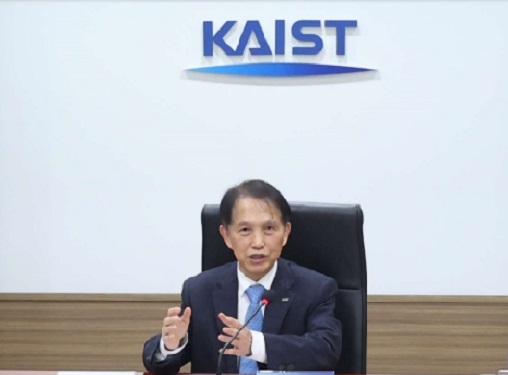 President Lee Presents Plans to Nurture Next-Generation Talents
President Lee stressed that nurturing medical scientists, semiconductor R&D personnel, startup entrepreneurs, and global innovators are key missions he will continue to pursue during a news conference
KAIST President Kwang Hyung Lee said that nurturing medical scientists, semiconductor R&D personnel, startup entrepreneurs, and global innovators are key missions he will continue to pursue during an online news conference marking the 1st anniversary of him becoming the president on February 15.
He said that nurturing physician-scientists is the most critical mission for KAIST to help the nation create a new growth engine. He said KAIST will help the nation drive the bio-industry and provide medical science resources for the nation’s health sector. To this end, he said that KAIST will open its Medical Science and Technology School by 2026.
“We plan to expand the current Graduate School of Medical Science and Engineering into a new Medical Science and Technology School that will focus entirely on a condensed MD-PhD course converging the fields of AI, bio, and physics,” he said.
The school aims to foster medical scientists whose research results will eventually be commercialized. He said that the university is now discussing revisions to related laws and regulations with the government and other universities.
To supply human resources to the semiconductor industry, President Lee said the university will add a campus in Pyongtaek City that will serve as an advanced convergence research hub in the field of next generation semiconductors in collaboration with Samsung Electronics and the city of Pyongtaek. The three-stage opening plan projected the final opening of the campus by 2036. During the first stage, which will be completed by 2026, it will construct the campus infrastructure in Pyongtaek city where Samsung Semiconductors runs two massive semiconductor complexes. By 2031, it plans to launch the open research platform including a future cities research center and future vehicles research center. The campus will open the global industrial collaboration cluster hub by 2036.
In the global arena, President Lee said he is working to open the New York campus with stakeholders in the United States. He announced the plan last December that was endorsed by New York-based entrepreneur Hee-Nam Bae, the chairman of Big Continent Inc. President Lee and Chairman Lee signed an MOU for the funding to open the campus in New York.
“We are discussing how to facilitate the plan and best accommodate the interests and potential of our students. Many ideas and plans are on the table and we think it will take longer than expected to finalize the plan,” explained President Lee.
However, he added that the basic idea is to offer art tech and health technology programs as well as an AI-based finance MBA at the New York campus, in addition to it serving as the startup accelerator of KAIST.
President Lee stressed the importance of technology commercialization when successfully launching KAIST Holdings last month to help spinoffs of KAIST labs accelerate their end results. He said that KAIST Holdings will build a virtuous supporting system to commercialize the technology startups coming from KAIST.
“We plan to list at least 10 KAIST startups on the KOSDAQ and two on the NASDAQ by 2031. KAIST Holdings also aims to nurture companies valued at a total of one billion KRW and earn 100 billion KRW in technology fees by 2031.
2022.02.17 View 12460
President Lee Presents Plans to Nurture Next-Generation Talents
President Lee stressed that nurturing medical scientists, semiconductor R&D personnel, startup entrepreneurs, and global innovators are key missions he will continue to pursue during a news conference
KAIST President Kwang Hyung Lee said that nurturing medical scientists, semiconductor R&D personnel, startup entrepreneurs, and global innovators are key missions he will continue to pursue during an online news conference marking the 1st anniversary of him becoming the president on February 15.
He said that nurturing physician-scientists is the most critical mission for KAIST to help the nation create a new growth engine. He said KAIST will help the nation drive the bio-industry and provide medical science resources for the nation’s health sector. To this end, he said that KAIST will open its Medical Science and Technology School by 2026.
“We plan to expand the current Graduate School of Medical Science and Engineering into a new Medical Science and Technology School that will focus entirely on a condensed MD-PhD course converging the fields of AI, bio, and physics,” he said.
The school aims to foster medical scientists whose research results will eventually be commercialized. He said that the university is now discussing revisions to related laws and regulations with the government and other universities.
To supply human resources to the semiconductor industry, President Lee said the university will add a campus in Pyongtaek City that will serve as an advanced convergence research hub in the field of next generation semiconductors in collaboration with Samsung Electronics and the city of Pyongtaek. The three-stage opening plan projected the final opening of the campus by 2036. During the first stage, which will be completed by 2026, it will construct the campus infrastructure in Pyongtaek city where Samsung Semiconductors runs two massive semiconductor complexes. By 2031, it plans to launch the open research platform including a future cities research center and future vehicles research center. The campus will open the global industrial collaboration cluster hub by 2036.
In the global arena, President Lee said he is working to open the New York campus with stakeholders in the United States. He announced the plan last December that was endorsed by New York-based entrepreneur Hee-Nam Bae, the chairman of Big Continent Inc. President Lee and Chairman Lee signed an MOU for the funding to open the campus in New York.
“We are discussing how to facilitate the plan and best accommodate the interests and potential of our students. Many ideas and plans are on the table and we think it will take longer than expected to finalize the plan,” explained President Lee.
However, he added that the basic idea is to offer art tech and health technology programs as well as an AI-based finance MBA at the New York campus, in addition to it serving as the startup accelerator of KAIST.
President Lee stressed the importance of technology commercialization when successfully launching KAIST Holdings last month to help spinoffs of KAIST labs accelerate their end results. He said that KAIST Holdings will build a virtuous supporting system to commercialize the technology startups coming from KAIST.
“We plan to list at least 10 KAIST startups on the KOSDAQ and two on the NASDAQ by 2031. KAIST Holdings also aims to nurture companies valued at a total of one billion KRW and earn 100 billion KRW in technology fees by 2031.
2022.02.17 View 12460 -
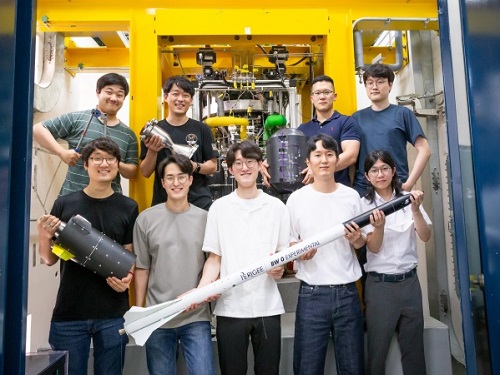 Perigee-KAIST Rocket Research Center Launches Scientific Rocket
Undergraduate startup Perigree Aerospace develops suborbital rocket called Blue Whale 0.1
On December 29, Perigee Aerospace, an undergraduate startup, launched a test rocket with a length of 3.2 m, a diameter of 19 cm, and a weight of 51 kg, using ethanol and liquid oxygen as fuel. The launch took place off Jeju Island. It was aimed at building experience and checking the combustion of a liquid propulsion engine and the performance of pre-set flight and trajectory, communication, and navigation devices. It was also one of the projects marking the 50th anniversary of KAIST in 2021.
However, after flying for several seconds, the rocket lost its track due to a gust of wind that activated the rocket’s automatic flight suspension system. "At the moment the rocket took off, there was a much stronger gust than expected," Dong-Yoon Shin, CEO of Perigee said. "The wind sent it flying off course and the automatic flight suspension system stopped its engine." However, Shin was not disappointed, saying the launch, which was conducted in collaboration with Perigee-KAIST Rocket Research Center provided a good experience.
"Some people say that Blue Whale 0.1 is like a toy because of its small size. Of course, it's much smaller than the rockets I’ve dreamed of, but like other rockets, it has all the technology needed for launch," said Shin, who established his company in 2018 as a KAIST aerospace engineering student to develop small liquid-propellant orbital rockets. Perigee Aerospace aims to develop the world’s lightest launch vehicle using high-powered engines, with a goal of leading the global market for small launch vehicles in the new space generation.
Perigee-KAIST Rocket Research Center was founded in 2019 for the research and development of rocket propellants and has been testing the combustion of rocket engines of various sizes in their liquid propellant rocket combustion lab located on the KAIST Munji Campus.
The research center initiated the 50th anniversary rocket launch project in late April of last year, finished the examination of their preliminary design in late May, and secured a tentative launching site through the KAIST-Jejudo agreement in early July.
The ethanol engine combustion was tested in late July, and an examination meeting regarding the detailed design that took place in late August was followed by two months of static firing tests of the assembled rocket in October and November.
This was a very meaningful trial in which a domestic private enterprise founded by a college student collaborated with a university to successfully develop and launch a technically challenging liquid propellant rocket.
Shin's near-term goal is to launch a two-stage orbital rocket that uses liquid methane as fuel and weighs 1.8 tons. To secure competitiveness in the small projectile market, KAIST and Perigee Aerospace have set up a joint research center to test various rocket engine sizes and develop the world's lightest projectile using a high-performance engine.
Professor Jae-Hung Han, head of the Department of Aerospace Engineering, said, “The scientific rocket system secured through the launch of the celebratory rocket will be utilized for design and system-oriented education, and for carrying out various scientific missions.” He added, “It is very rare both domestically and globally that a scientific rocket designed by the initiatives of a department should be incorporated as part of a regular aerospace system design curriculum. This will be an exemplary case we can boast about to the rest of the world.”
Perigee Aerospace will improve the technology they have developed through the course of this project to develop subminiature vehicles they may use to launch small satellites into the low Earth orbit.
Shin said, “I am happy just with the fact that we have participated in a rocket project to celebrate the 50th anniversary of KAIST, and I would like to thank the engineers at my company and members of the KAIST Department of Aerospace Engineering.” He added, “I’m looking forward to the day that we develop a space launch vehicle that can deliver satellites even higher.”
2022.01.14 View 10067
Perigee-KAIST Rocket Research Center Launches Scientific Rocket
Undergraduate startup Perigree Aerospace develops suborbital rocket called Blue Whale 0.1
On December 29, Perigee Aerospace, an undergraduate startup, launched a test rocket with a length of 3.2 m, a diameter of 19 cm, and a weight of 51 kg, using ethanol and liquid oxygen as fuel. The launch took place off Jeju Island. It was aimed at building experience and checking the combustion of a liquid propulsion engine and the performance of pre-set flight and trajectory, communication, and navigation devices. It was also one of the projects marking the 50th anniversary of KAIST in 2021.
However, after flying for several seconds, the rocket lost its track due to a gust of wind that activated the rocket’s automatic flight suspension system. "At the moment the rocket took off, there was a much stronger gust than expected," Dong-Yoon Shin, CEO of Perigee said. "The wind sent it flying off course and the automatic flight suspension system stopped its engine." However, Shin was not disappointed, saying the launch, which was conducted in collaboration with Perigee-KAIST Rocket Research Center provided a good experience.
"Some people say that Blue Whale 0.1 is like a toy because of its small size. Of course, it's much smaller than the rockets I’ve dreamed of, but like other rockets, it has all the technology needed for launch," said Shin, who established his company in 2018 as a KAIST aerospace engineering student to develop small liquid-propellant orbital rockets. Perigee Aerospace aims to develop the world’s lightest launch vehicle using high-powered engines, with a goal of leading the global market for small launch vehicles in the new space generation.
Perigee-KAIST Rocket Research Center was founded in 2019 for the research and development of rocket propellants and has been testing the combustion of rocket engines of various sizes in their liquid propellant rocket combustion lab located on the KAIST Munji Campus.
The research center initiated the 50th anniversary rocket launch project in late April of last year, finished the examination of their preliminary design in late May, and secured a tentative launching site through the KAIST-Jejudo agreement in early July.
The ethanol engine combustion was tested in late July, and an examination meeting regarding the detailed design that took place in late August was followed by two months of static firing tests of the assembled rocket in October and November.
This was a very meaningful trial in which a domestic private enterprise founded by a college student collaborated with a university to successfully develop and launch a technically challenging liquid propellant rocket.
Shin's near-term goal is to launch a two-stage orbital rocket that uses liquid methane as fuel and weighs 1.8 tons. To secure competitiveness in the small projectile market, KAIST and Perigee Aerospace have set up a joint research center to test various rocket engine sizes and develop the world's lightest projectile using a high-performance engine.
Professor Jae-Hung Han, head of the Department of Aerospace Engineering, said, “The scientific rocket system secured through the launch of the celebratory rocket will be utilized for design and system-oriented education, and for carrying out various scientific missions.” He added, “It is very rare both domestically and globally that a scientific rocket designed by the initiatives of a department should be incorporated as part of a regular aerospace system design curriculum. This will be an exemplary case we can boast about to the rest of the world.”
Perigee Aerospace will improve the technology they have developed through the course of this project to develop subminiature vehicles they may use to launch small satellites into the low Earth orbit.
Shin said, “I am happy just with the fact that we have participated in a rocket project to celebrate the 50th anniversary of KAIST, and I would like to thank the engineers at my company and members of the KAIST Department of Aerospace Engineering.” He added, “I’m looking forward to the day that we develop a space launch vehicle that can deliver satellites even higher.”
2022.01.14 View 10067 -
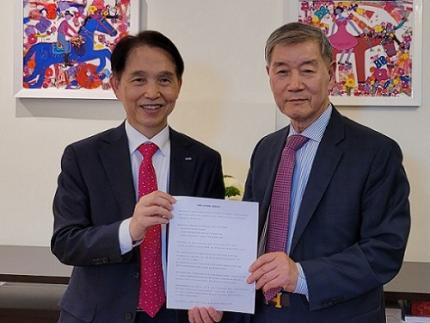 KAIST Plans to Open a New York Campus
President Lee signs an MOU with New York-based Big Continent Inc. Chairman Hee-Nam Bae on funding the New York campus
President Kwang Hyung Lee announced a plan to open a KAIST campus in New York with funding from New York-based entrepreneur Hee-Nam Bae. President Lee and Big Continent Inc. Chairman Hee-Nam Bae signed the MOU last week for the funding to open the campus in New York.
President Lee said it will take years to open up a campus in New York in order to conform with both Korean and US legal procedures. However, during a news conference in New York following the signing of the MOU with Chairman Bae, President Lee said this is the first step toward realizing KAIST’s new vision of a ‘Global Twin Strategy’ by making New York KAIST’s newest stronghold to target both domestic and global markets.
“New York is the center of the world’s commerce, culture, and new technologies. If we want to grow big, we should go to one of the biggest cities in the world and New York is the place. I highly encourage our students and faculty go into the world and never be satisfied enjoying the top position in Korea. The next place to investigate will be Silicon Valley,” said President Lee.
“We still have many issues to resolve domestically. We need to discuss more details first with the Board of Trustees and the Korean government,” he added.
The New York campus will aim to become an enterprise-type university to help KAIST create global value. "Our goal is to make sure that Korean businesses gain competitiveness in the global market and can become listed on the NASDAQ. We plan to open majors related to AI, financial engineering, and cultural technologies. We will recruit students from both the US and KAIST to study at our New York campus.” President Lee said.
Chairman Bae, a self-made entrepreneur who immigrated to the US in 1981, also leads the Global Leadership Foundation in the US. “President Lee and I have already toured several candidate sites for the campus in the New York region and we will make a final decision on the best site to purchase,” said Chairman Bae.
Chairman Bae added that he has always dreamed of fostering young global talents who will take on global challenges with pioneering minds. He believes KAIST shares this global vision.
The New York campus will be the first KAIST campus for global students funded by someone from the private sector. This is also a major step forward for KAIST, which was founded by a six million dollar USAID loan in 1971. KAIST announced its plans to establish Kenya KAIST in 2018 with funding from the Korea Eximbank’s 95 million USD development cooperation fund loan to the Kenyan government. KAIST will provide turn-key-based education consultancy featuring curriculum design and the construction of facilities for Kenya’s first advanced science and technology institute. The campus will be located in the Konza Techno City near Nairobi and plans to open in 2023.
2021.12.13 View 9709
KAIST Plans to Open a New York Campus
President Lee signs an MOU with New York-based Big Continent Inc. Chairman Hee-Nam Bae on funding the New York campus
President Kwang Hyung Lee announced a plan to open a KAIST campus in New York with funding from New York-based entrepreneur Hee-Nam Bae. President Lee and Big Continent Inc. Chairman Hee-Nam Bae signed the MOU last week for the funding to open the campus in New York.
President Lee said it will take years to open up a campus in New York in order to conform with both Korean and US legal procedures. However, during a news conference in New York following the signing of the MOU with Chairman Bae, President Lee said this is the first step toward realizing KAIST’s new vision of a ‘Global Twin Strategy’ by making New York KAIST’s newest stronghold to target both domestic and global markets.
“New York is the center of the world’s commerce, culture, and new technologies. If we want to grow big, we should go to one of the biggest cities in the world and New York is the place. I highly encourage our students and faculty go into the world and never be satisfied enjoying the top position in Korea. The next place to investigate will be Silicon Valley,” said President Lee.
“We still have many issues to resolve domestically. We need to discuss more details first with the Board of Trustees and the Korean government,” he added.
The New York campus will aim to become an enterprise-type university to help KAIST create global value. "Our goal is to make sure that Korean businesses gain competitiveness in the global market and can become listed on the NASDAQ. We plan to open majors related to AI, financial engineering, and cultural technologies. We will recruit students from both the US and KAIST to study at our New York campus.” President Lee said.
Chairman Bae, a self-made entrepreneur who immigrated to the US in 1981, also leads the Global Leadership Foundation in the US. “President Lee and I have already toured several candidate sites for the campus in the New York region and we will make a final decision on the best site to purchase,” said Chairman Bae.
Chairman Bae added that he has always dreamed of fostering young global talents who will take on global challenges with pioneering minds. He believes KAIST shares this global vision.
The New York campus will be the first KAIST campus for global students funded by someone from the private sector. This is also a major step forward for KAIST, which was founded by a six million dollar USAID loan in 1971. KAIST announced its plans to establish Kenya KAIST in 2018 with funding from the Korea Eximbank’s 95 million USD development cooperation fund loan to the Kenyan government. KAIST will provide turn-key-based education consultancy featuring curriculum design and the construction of facilities for Kenya’s first advanced science and technology institute. The campus will be located in the Konza Techno City near Nairobi and plans to open in 2023.
2021.12.13 View 9709