%47%45
-
 “Entrepreneurial Mutual Growth Fair 2026” to be Held... KAIST Super Star Companies Gather for AI Solopreneurship, Tech Commercialization, Investment, and Youth Job Fair
KAIST announced that it will host the ‘AI Agent-Based Solopreneurship Program Information Session’ and the ‘Entrepreneurial Mutual Growth Fair 2026’ for two days from May 18th to 19th.
In this event, KAIST’s new AI-based solopreneurship model, which utilizes AI not merely as an operational tool but as a ‘Co-founder,’ will be introduced in depth. The university will hold an information session for the ‘AI Solopreneur Support Project,’ which enables a single individual to carry out the entire entrepreneurial process—including planning, development, marketing, and fundraising—using AI agents prepared by the university.
In this program, 100 prospective entrepreneurs will be selected nationwide, and faculty from the KAIST Institute for Entrepreneurship and the KAIST Graduate School of AI will provide eight weeks of intensive training. Additionally, a network of top-tier domestic and global mentors will be established to support business optimization and linkage with overseas investments.
In particular, outstanding teams will be provided with seed investment of up to 100 million KRW, prototype production support, and infrastructure for GPU and AI services. By fostering world-class AI utilization skills in prospective entrepreneurs with diverse domain knowledge, KAIST plans to accelerate the introduction of AI into various domestic industries while nurturing AI business models with global competitiveness.
This event is organized as a venue to introduce the KAIST-style full-cycle entrepreneurial ecosystem, encompassing artificial intelligence (AI)-based entrepreneurship, technology commercialization, industry-academic cooperation, investment linkage, and youth job creation. In particular, it will showcase the competitiveness of the deep-tech (advanced technology-based) startup ecosystem from multiple perspectives, focusing on the technological prowess and industrial application cases of KAIST startup companies.
Global big tech companies' choice of AI solution providers will also participate to reveal various technologies reflecting the AX (AI Transformation) trend across industries. Actual application cases that supported the digital transformation of major domestic corporations through factory and office automation solutions will also be announced.
In the field of robotics, Lion Robotics will introduce field-application technologies based on quadruped robots and leading R&D cases for humanoid robots. In addition, next-generation AI semiconductor startups such as Panmnesia and HyperAccel will present next-generation chip design technologies for implementing On-Device AI. These companies will showcase technologies and business models that can run Large Language Model (LLM)-based AI services faster while reducing dependence on GPUs (Graphics Processing Units). In the deep-tech bio and healthcare AI field, Barreleye will introduce an innovative solution that complements the limitations of traditional MRI (Magnetic Resonance Imaging)-centered diagnosis through AI-based quantitative ultrasound analysis technology. In the bio and medical robot field, Roen Surgical will present next-generation medical innovation cases based on precision surgical robot technology.
On the first day of the event, May 18th, the ‘Entrepreneurial Mutual Growth Fair’ will be held in the main hall on the 1st floor of the KI Building along with the ‘AI Agent-Based Solopreneurship Program Information Session.’ Representative startup companies that have led KAIST’s technology commercialization success will participate in this session to share successful technology commercialization models that connected R&D achievements to actual market results.
Through this, they plan to present a virtuous cycle for the KAIST startup ecosystem leading from ‘Research → Startup → Investment → Growth.’ Furthermore, KAIST startup companies will operate recruitment sessions alongside technology exhibitions. Participating companies will conduct direct recruitment consultations and talent discovery on-site, providing youth with high-quality, technology-based job opportunities. Through this event, the university plans to support scientific and technological talents so they can advance into startups and industrial fields rather than staying in research, and to lead technology-based entrepreneurship and employment creation. On the second day, May 19th, an ‘Open Innovation Information Session’ will be held to connect KAIST’s research capabilities with industrial demand.
At the event, the ‘1 Lab N Startup’ model, which connects KAIST faculty’s technology with corporate R&D needs to promote joint research and commercialization, will be introduced. Industry-academic cooperation strategies that expand beyond technology transfer to joint entrepreneurship and new business creation will also be announced. Following this, in the ‘KAIST Startup Investment Linkage IR Pitching Session,’ the investment attraction program ‘Tech Plaza’ will be operated, featuring five Korean deep-tech bio companies. Companies selected based on the KAIST Startup Platform (KSTP) will present their business models and technological prowess to investors, and tangible investment results are expected through linkage with venture capital (VC) and accelerators. Bae Hyeon-min, Dean of the KAIST Institute for Entrepreneurship, said, “This Entrepreneurial Mutual Growth Fair is an integrated startup platform that connects the entire process from AI-based individual entrepreneurship to technology commercialization, industry-academic cooperation, investment, and job creation.
We expect it to serve as an opportunity to present a new direction for the domestic deep-tech startup ecosystem through the success stories of KAIST’s representative startups.” This event is open to students, the general public, corporations, and investment institutions interested in entrepreneurship, and is prepared as a place to directly confirm the innovative achievements and expansion possibilities of the KAIST startup ecosystem. Information regarding the KAIST AI Solopreneurship Program information session and participation applications can be found on the website (https://www.kaist-overedge.com/).
By accessing the website, people can watch the information session on YouTube and apply for participation.
2026.05.13 View 924
“Entrepreneurial Mutual Growth Fair 2026” to be Held... KAIST Super Star Companies Gather for AI Solopreneurship, Tech Commercialization, Investment, and Youth Job Fair
KAIST announced that it will host the ‘AI Agent-Based Solopreneurship Program Information Session’ and the ‘Entrepreneurial Mutual Growth Fair 2026’ for two days from May 18th to 19th.
In this event, KAIST’s new AI-based solopreneurship model, which utilizes AI not merely as an operational tool but as a ‘Co-founder,’ will be introduced in depth. The university will hold an information session for the ‘AI Solopreneur Support Project,’ which enables a single individual to carry out the entire entrepreneurial process—including planning, development, marketing, and fundraising—using AI agents prepared by the university.
In this program, 100 prospective entrepreneurs will be selected nationwide, and faculty from the KAIST Institute for Entrepreneurship and the KAIST Graduate School of AI will provide eight weeks of intensive training. Additionally, a network of top-tier domestic and global mentors will be established to support business optimization and linkage with overseas investments.
In particular, outstanding teams will be provided with seed investment of up to 100 million KRW, prototype production support, and infrastructure for GPU and AI services. By fostering world-class AI utilization skills in prospective entrepreneurs with diverse domain knowledge, KAIST plans to accelerate the introduction of AI into various domestic industries while nurturing AI business models with global competitiveness.
This event is organized as a venue to introduce the KAIST-style full-cycle entrepreneurial ecosystem, encompassing artificial intelligence (AI)-based entrepreneurship, technology commercialization, industry-academic cooperation, investment linkage, and youth job creation. In particular, it will showcase the competitiveness of the deep-tech (advanced technology-based) startup ecosystem from multiple perspectives, focusing on the technological prowess and industrial application cases of KAIST startup companies.
Global big tech companies' choice of AI solution providers will also participate to reveal various technologies reflecting the AX (AI Transformation) trend across industries. Actual application cases that supported the digital transformation of major domestic corporations through factory and office automation solutions will also be announced.
In the field of robotics, Lion Robotics will introduce field-application technologies based on quadruped robots and leading R&D cases for humanoid robots. In addition, next-generation AI semiconductor startups such as Panmnesia and HyperAccel will present next-generation chip design technologies for implementing On-Device AI. These companies will showcase technologies and business models that can run Large Language Model (LLM)-based AI services faster while reducing dependence on GPUs (Graphics Processing Units). In the deep-tech bio and healthcare AI field, Barreleye will introduce an innovative solution that complements the limitations of traditional MRI (Magnetic Resonance Imaging)-centered diagnosis through AI-based quantitative ultrasound analysis technology. In the bio and medical robot field, Roen Surgical will present next-generation medical innovation cases based on precision surgical robot technology.
On the first day of the event, May 18th, the ‘Entrepreneurial Mutual Growth Fair’ will be held in the main hall on the 1st floor of the KI Building along with the ‘AI Agent-Based Solopreneurship Program Information Session.’ Representative startup companies that have led KAIST’s technology commercialization success will participate in this session to share successful technology commercialization models that connected R&D achievements to actual market results.
Through this, they plan to present a virtuous cycle for the KAIST startup ecosystem leading from ‘Research → Startup → Investment → Growth.’ Furthermore, KAIST startup companies will operate recruitment sessions alongside technology exhibitions. Participating companies will conduct direct recruitment consultations and talent discovery on-site, providing youth with high-quality, technology-based job opportunities. Through this event, the university plans to support scientific and technological talents so they can advance into startups and industrial fields rather than staying in research, and to lead technology-based entrepreneurship and employment creation. On the second day, May 19th, an ‘Open Innovation Information Session’ will be held to connect KAIST’s research capabilities with industrial demand.
At the event, the ‘1 Lab N Startup’ model, which connects KAIST faculty’s technology with corporate R&D needs to promote joint research and commercialization, will be introduced. Industry-academic cooperation strategies that expand beyond technology transfer to joint entrepreneurship and new business creation will also be announced. Following this, in the ‘KAIST Startup Investment Linkage IR Pitching Session,’ the investment attraction program ‘Tech Plaza’ will be operated, featuring five Korean deep-tech bio companies. Companies selected based on the KAIST Startup Platform (KSTP) will present their business models and technological prowess to investors, and tangible investment results are expected through linkage with venture capital (VC) and accelerators. Bae Hyeon-min, Dean of the KAIST Institute for Entrepreneurship, said, “This Entrepreneurial Mutual Growth Fair is an integrated startup platform that connects the entire process from AI-based individual entrepreneurship to technology commercialization, industry-academic cooperation, investment, and job creation.
We expect it to serve as an opportunity to present a new direction for the domestic deep-tech startup ecosystem through the success stories of KAIST’s representative startups.” This event is open to students, the general public, corporations, and investment institutions interested in entrepreneurship, and is prepared as a place to directly confirm the innovative achievements and expansion possibilities of the KAIST startup ecosystem. Information regarding the KAIST AI Solopreneurship Program information session and participation applications can be found on the website (https://www.kaist-overedge.com/).
By accessing the website, people can watch the information session on YouTube and apply for participation.
2026.05.13 View 924 -
 Zero-Crease Foldable Technology to Shift the Paradigm of Next-Generation Displays
< Professor Phil-Seung Lee (center), Master’s graduate Jun-han Bae (top left) >
The "crease," long considered the biggest weakness of foldable smartphones, has been pointed out as a major obstacle to market expansion, causing screen distortion and reduced durability over repeated use. A research team at KAIST has presented a solution to this problem, marking a turning point for foldables to leap forward as the standard for next-generation smartphones. Furthermore, the technology is expected to establish itself as a core component of the future mobile industry, expanding into various devices such as laptops.
KAIST announced on April 20th that a research team led by Professor Phil-Seung Lee of the Department of Mechanical Engineering has developed an original technology capable of fundamentally solving the crease issue that occurs at the folding area of foldable smartphone displays and has registered a patent for it. The team has secured global technological competitiveness by filing patent applications in the United States, China, and the European Union (EU), in addition to South Korea.
While global smartphone companies have attempted to solve this issue through massive R&D investments for years, they have yet to achieve the complete removal of the crease. Consequently, the industry has identified the crease problem as the single greatest barrier to the widespread adoption of the foldable smartphone market.
The research team began their study to resolve the inconveniences they personally experienced while using mobile foldable phones. After disassembling dozens of used foldable phones and repeating various experiments, they derived a solution by innovatively redesigning the "adhesive area" between the display and the supporting plate. The core of the design is ensuring that deformation is not concentrated in a specific folding area but is instead distributed to the surrounding sections. Through this, they perfectly demonstrated the feasibility of a "crease-free foldable" while maintaining normal smartphone functionality.
To verify performance, the team shone a straight-line LED light onto the screen. Unlike commercial products where the light refracts and the straight line appears curved at the fold, the prototype maintained a sharp, straight reflection without any distortion. Notably, no visual distortion appeared even under conditions sensitive enough to detect minute curves with a crease depth of less than 0.1mm.
< Display surface reflecting a straight-line LED lamp >
This technology presents a new design paradigm that surpasses the limitations faced by the current industry. It not only fundamentally suppresses the formation of creases but also ensures superior durability by minimizing deformation even after tens of thousands of folding cycles.
Furthermore, because the structure is intuitive and simple, it can be easily integrated into existing manufacturing processes. It is expected to have high industrial utility, as it can be expanded beyond smartphones to various foldable display devices, including tablets and laptops.
< Core idea of the invention: (a) Adhesive and non-adhesive areas of a conventional foldable smartphone, (b) Adhesive and non-adhesive areas in this invention, (c) Stress distribution in a conventional foldable smartphone display, (d) Stress distribution in a foldable smartphone display applying this technology >
Industry experts anticipate that the commercialization of this technology will encourage global companies—which have been hesitant to enter the market due to crease issues—to participate. This is projected to significantly improve consumer satisfaction and accelerate the growth of the stagnating foldable market.
Professor Phil-Seung Lee stated, "We have solved a challenge that global giants could not resolve, using a relatively simple and clear method. We expect this technology to spread across next-generation displays, including laptops and tablets, further strengthening Korea's technological competitiveness."
Meanwhile, this research was conducted with support from the "2022 Daedeok Innopolis Campus Project," and the patent for the related original technology was registered on September 9, 2025.
2026.04.21 View 999
Zero-Crease Foldable Technology to Shift the Paradigm of Next-Generation Displays
< Professor Phil-Seung Lee (center), Master’s graduate Jun-han Bae (top left) >
The "crease," long considered the biggest weakness of foldable smartphones, has been pointed out as a major obstacle to market expansion, causing screen distortion and reduced durability over repeated use. A research team at KAIST has presented a solution to this problem, marking a turning point for foldables to leap forward as the standard for next-generation smartphones. Furthermore, the technology is expected to establish itself as a core component of the future mobile industry, expanding into various devices such as laptops.
KAIST announced on April 20th that a research team led by Professor Phil-Seung Lee of the Department of Mechanical Engineering has developed an original technology capable of fundamentally solving the crease issue that occurs at the folding area of foldable smartphone displays and has registered a patent for it. The team has secured global technological competitiveness by filing patent applications in the United States, China, and the European Union (EU), in addition to South Korea.
While global smartphone companies have attempted to solve this issue through massive R&D investments for years, they have yet to achieve the complete removal of the crease. Consequently, the industry has identified the crease problem as the single greatest barrier to the widespread adoption of the foldable smartphone market.
The research team began their study to resolve the inconveniences they personally experienced while using mobile foldable phones. After disassembling dozens of used foldable phones and repeating various experiments, they derived a solution by innovatively redesigning the "adhesive area" between the display and the supporting plate. The core of the design is ensuring that deformation is not concentrated in a specific folding area but is instead distributed to the surrounding sections. Through this, they perfectly demonstrated the feasibility of a "crease-free foldable" while maintaining normal smartphone functionality.
To verify performance, the team shone a straight-line LED light onto the screen. Unlike commercial products where the light refracts and the straight line appears curved at the fold, the prototype maintained a sharp, straight reflection without any distortion. Notably, no visual distortion appeared even under conditions sensitive enough to detect minute curves with a crease depth of less than 0.1mm.
< Display surface reflecting a straight-line LED lamp >
This technology presents a new design paradigm that surpasses the limitations faced by the current industry. It not only fundamentally suppresses the formation of creases but also ensures superior durability by minimizing deformation even after tens of thousands of folding cycles.
Furthermore, because the structure is intuitive and simple, it can be easily integrated into existing manufacturing processes. It is expected to have high industrial utility, as it can be expanded beyond smartphones to various foldable display devices, including tablets and laptops.
< Core idea of the invention: (a) Adhesive and non-adhesive areas of a conventional foldable smartphone, (b) Adhesive and non-adhesive areas in this invention, (c) Stress distribution in a conventional foldable smartphone display, (d) Stress distribution in a foldable smartphone display applying this technology >
Industry experts anticipate that the commercialization of this technology will encourage global companies—which have been hesitant to enter the market due to crease issues—to participate. This is projected to significantly improve consumer satisfaction and accelerate the growth of the stagnating foldable market.
Professor Phil-Seung Lee stated, "We have solved a challenge that global giants could not resolve, using a relatively simple and clear method. We expect this technology to spread across next-generation displays, including laptops and tablets, further strengthening Korea's technological competitiveness."
Meanwhile, this research was conducted with support from the "2022 Daedeok Innopolis Campus Project," and the patent for the related original technology was registered on September 9, 2025.
2026.04.21 View 999 -
 Professor Yiyun Kang Selected as TED 2026 Main Stage Speaker
< Professor Yiyun Kang (Photo Credit: Ryan Lash / TED) >
KAIST announced on April 17th that Professor Yiyun Kang of the Department of Industrial Design has been selected as a speaker for the Main Stage at TED 2026, the world-renowned knowledge conference.
Founded in 1984 under the motto "Ideas Worth Spreading," TED is an American non-profit knowledge platform where scholars, innovators, and artists from around the globe gather annually to lead global discourse. Previous Korean speakers on the Main Stage include novelist Young-ha Kim (2012) and violinist Ji-hae Park (2013). In 2011, roboticist Professor Dennis Hong stood on the main conference stage as the first Korean-American speaker.
< TED Lecture Photo (Photo Credit: Ryan Lash / TED) >
Professor Kang’s selection is particularly significant as it marks the first time since TED moved its venue to Vancouver, Canada, in 2014 that a Korean national—an artist and scholar actively based in South Korea, rather than an overseas resident or defector—has been invited to the Main Stage. Furthermore, it marks the return of a Korean speaker to the main stage after a 12-year hiatus, serving as a symbolic milestone.
The TED 2026 annual conference is being held from April 13 to 17 at the Vancouver Convention Centre in Canada, under the theme "ALL OF US." Professor Kang took the Main Stage on April 15, the third day of the conference, to present visual insights and philosophical solutions for a future where Artificial Intelligence (AI), humans, and nature must coexist. The lecture video will be edited and released globally via the official TED website and YouTube channel this coming July.
In this talk, Professor Kang defines AI and the climate crisis as "problems we understand intellectually but fail to feel physically," noting that data- and information-centric communication methods often lower our sense of reality. She proposes the potential of art as a means to bridge this gap. Specifically, Professor Kang will demonstrate on stage how to transform complex challenges into visual and sensory experiences through cases from her own projects.
Notably, this presentation transcends traditional lecture formats, structured as an "Immersive Talk" that transforms the entire stage into an artistic space. Rather than just listening, the audience participates by experiencing the content with their entire bodies.
Professor Yiyun Kang is a world-class media artist and researcher who crosses the boundaries between sensation and technology, and materiality (physical forms) and immateriality (elements like light, video, and data). She leads the Experience Design Lab (XD Lab) at KAIST and has consistently explored the convergence of technology and art through collaborations with NASA, Google Arts & Culture, and the Victoria and Albert Museum (V&A).
"Humanity is currently at a critical turning point that will determine the coexistence of technology and nature," Professor Kang stated. "Through this TED stage, I aim to ensure that AI and the climate crisis are perceived not just as mere information, but as realities of our lives. I hope to create a practical opportunity to expand fragmented individual perceptions into collective human solidarity through the creative energy of art."
< TED 2026 Professor Yiyun Kang (Source: TED Website) >
2026.04.18 View 1023
Professor Yiyun Kang Selected as TED 2026 Main Stage Speaker
< Professor Yiyun Kang (Photo Credit: Ryan Lash / TED) >
KAIST announced on April 17th that Professor Yiyun Kang of the Department of Industrial Design has been selected as a speaker for the Main Stage at TED 2026, the world-renowned knowledge conference.
Founded in 1984 under the motto "Ideas Worth Spreading," TED is an American non-profit knowledge platform where scholars, innovators, and artists from around the globe gather annually to lead global discourse. Previous Korean speakers on the Main Stage include novelist Young-ha Kim (2012) and violinist Ji-hae Park (2013). In 2011, roboticist Professor Dennis Hong stood on the main conference stage as the first Korean-American speaker.
< TED Lecture Photo (Photo Credit: Ryan Lash / TED) >
Professor Kang’s selection is particularly significant as it marks the first time since TED moved its venue to Vancouver, Canada, in 2014 that a Korean national—an artist and scholar actively based in South Korea, rather than an overseas resident or defector—has been invited to the Main Stage. Furthermore, it marks the return of a Korean speaker to the main stage after a 12-year hiatus, serving as a symbolic milestone.
The TED 2026 annual conference is being held from April 13 to 17 at the Vancouver Convention Centre in Canada, under the theme "ALL OF US." Professor Kang took the Main Stage on April 15, the third day of the conference, to present visual insights and philosophical solutions for a future where Artificial Intelligence (AI), humans, and nature must coexist. The lecture video will be edited and released globally via the official TED website and YouTube channel this coming July.
In this talk, Professor Kang defines AI and the climate crisis as "problems we understand intellectually but fail to feel physically," noting that data- and information-centric communication methods often lower our sense of reality. She proposes the potential of art as a means to bridge this gap. Specifically, Professor Kang will demonstrate on stage how to transform complex challenges into visual and sensory experiences through cases from her own projects.
Notably, this presentation transcends traditional lecture formats, structured as an "Immersive Talk" that transforms the entire stage into an artistic space. Rather than just listening, the audience participates by experiencing the content with their entire bodies.
Professor Yiyun Kang is a world-class media artist and researcher who crosses the boundaries between sensation and technology, and materiality (physical forms) and immateriality (elements like light, video, and data). She leads the Experience Design Lab (XD Lab) at KAIST and has consistently explored the convergence of technology and art through collaborations with NASA, Google Arts & Culture, and the Victoria and Albert Museum (V&A).
"Humanity is currently at a critical turning point that will determine the coexistence of technology and nature," Professor Kang stated. "Through this TED stage, I aim to ensure that AI and the climate crisis are perceived not just as mere information, but as realities of our lives. I hope to create a practical opportunity to expand fragmented individual perceptions into collective human solidarity through the creative energy of art."
< TED 2026 Professor Yiyun Kang (Source: TED Website) >
2026.04.18 View 1023 -
 KAIST Explores Solutions for African Youth Employment with World Bank and African Union
< Group photo of meeting participants >
KAIST announced on the 6th that the 'Jobs for Youth in Africa Knowledge Exchange' platform was held in Nairobi, Kenya, from March 3 to 5 (local time). The event was hosted by the Kenyan government and co-organized by the World Bank Group, the African Union, and the KAIST Global Center for Development and Strategy (G-CODEs).
As a high-level policy implementation platform dedicated to addressing youth employment challenges in Africa, the event drew approximately 200 participants, including government officials from over 20 African nations, international organizations, the private sector, academia, and development cooperation partners. KAIST participated as a key global partner linking technology and policy, presenting innovation models for employment systems based on digital and Artificial Intelligence (AI) technologies.
< Scene from the meeting hosted by the Kenyan government >
With Africa’s youth population projected to double by 2050, the continent faces significant hurdles such as high unemployment rates and informal employment. This event marked the second face-to-face meeting of the 'Jobs for Youth in Africa Community of Practice (CoP),' which was launched in Kigali, Rwanda, in 2025. The meeting aimed to share policy experiences among member states and materialize scalable implementation models. Salim Mvurya, Kenya's Cabinet Secretary for Youth Affairs, Creative Economy, and Sports, attended the opening ceremony and emphasized that youth job creation is a critical priority at both national and continental levels.
The program focused on several key themes:
Evidence-based youth employment strategies
Innovation in employment systems through digital and AI technologies
Improving labor market outcomes through Recognition of Prior Learning (RPL)
Business environment reforms and strengthening value chain linkages
Notably, in the session titled "Digital and AI-based Employment System Innovation," Professor Kyung Ryul Park of KAIST shared Korea’s digital transformation experiences and AI application cases, proposing directions for data-driven policy design and the development of technology-based employment platforms. Additionally, KAIST Professor Ga-young Park facilitated mutual learning and connected cases of scalable youth employment projects across countries during the "Global Cafe Session."
< Professor Kyung Ryul Park of KAIST delivering a presentation >
Participants visited the project site of "National Youth Opportunities Towards Advancement (NYOTA)," an initiative pursued by the Kenyan government and the World Bank. There, they observed a comprehensive youth employment model that integrates vocational training, job matching, and entrepreneurship support. The site visit served as a practical learning opportunity to share the processes of policy design and execution.
Since last year, KAIST has been involved in digital innovation projects for youth employment in East Africa through the Korea-World Bank Partnership Facility (KWPF). Through this event, the university reaffirmed its status as a global cooperation hub leading technology-based policy innovation.
"The issue of youth employment is a structural challenge that combines digital transformation, industrial strategy, and educational reform," stated Professor Kyung Ryul Park. "KAIST will continue to present actionable policy models based on data and technology while strengthening international cooperation."
This Knowledge Exchange platform is evaluated as a significant milestone that reaffirmed the African youth employment agenda as a core priority of international cooperation and solidified the foundation for enhancing policy implementation capabilities. A follow-up workshop is scheduled to be held early next year at the Kenya Advanced Institute of Science and Technology (Kenya-AIST) campus in Konza, Nairobi, which is modeled after KAIST.
2026.03.10 View 1254
KAIST Explores Solutions for African Youth Employment with World Bank and African Union
< Group photo of meeting participants >
KAIST announced on the 6th that the 'Jobs for Youth in Africa Knowledge Exchange' platform was held in Nairobi, Kenya, from March 3 to 5 (local time). The event was hosted by the Kenyan government and co-organized by the World Bank Group, the African Union, and the KAIST Global Center for Development and Strategy (G-CODEs).
As a high-level policy implementation platform dedicated to addressing youth employment challenges in Africa, the event drew approximately 200 participants, including government officials from over 20 African nations, international organizations, the private sector, academia, and development cooperation partners. KAIST participated as a key global partner linking technology and policy, presenting innovation models for employment systems based on digital and Artificial Intelligence (AI) technologies.
< Scene from the meeting hosted by the Kenyan government >
With Africa’s youth population projected to double by 2050, the continent faces significant hurdles such as high unemployment rates and informal employment. This event marked the second face-to-face meeting of the 'Jobs for Youth in Africa Community of Practice (CoP),' which was launched in Kigali, Rwanda, in 2025. The meeting aimed to share policy experiences among member states and materialize scalable implementation models. Salim Mvurya, Kenya's Cabinet Secretary for Youth Affairs, Creative Economy, and Sports, attended the opening ceremony and emphasized that youth job creation is a critical priority at both national and continental levels.
The program focused on several key themes:
Evidence-based youth employment strategies
Innovation in employment systems through digital and AI technologies
Improving labor market outcomes through Recognition of Prior Learning (RPL)
Business environment reforms and strengthening value chain linkages
Notably, in the session titled "Digital and AI-based Employment System Innovation," Professor Kyung Ryul Park of KAIST shared Korea’s digital transformation experiences and AI application cases, proposing directions for data-driven policy design and the development of technology-based employment platforms. Additionally, KAIST Professor Ga-young Park facilitated mutual learning and connected cases of scalable youth employment projects across countries during the "Global Cafe Session."
< Professor Kyung Ryul Park of KAIST delivering a presentation >
Participants visited the project site of "National Youth Opportunities Towards Advancement (NYOTA)," an initiative pursued by the Kenyan government and the World Bank. There, they observed a comprehensive youth employment model that integrates vocational training, job matching, and entrepreneurship support. The site visit served as a practical learning opportunity to share the processes of policy design and execution.
Since last year, KAIST has been involved in digital innovation projects for youth employment in East Africa through the Korea-World Bank Partnership Facility (KWPF). Through this event, the university reaffirmed its status as a global cooperation hub leading technology-based policy innovation.
"The issue of youth employment is a structural challenge that combines digital transformation, industrial strategy, and educational reform," stated Professor Kyung Ryul Park. "KAIST will continue to present actionable policy models based on data and technology while strengthening international cooperation."
This Knowledge Exchange platform is evaluated as a significant milestone that reaffirmed the African youth employment agenda as a core priority of international cooperation and solidified the foundation for enhancing policy implementation capabilities. A follow-up workshop is scheduled to be held early next year at the Kenya Advanced Institute of Science and Technology (Kenya-AIST) campus in Konza, Nairobi, which is modeled after KAIST.
2026.03.10 View 1254 -
 Simultaneous Decoding of Genetic Maps Inside Cells... A Game Changer for Understanding Complex Human Diseases
< (Clockwise from top left) Professor Inkyung Jung (KAIST), Dr. Dongchan Yang (KAIST), Dr. Kyukwang Kim (KAIST), Dr. Yueyuan Xu (Duke University), Dr. Xiaolin Wei (Duke University), Professor Yarui Diao (Duke University) >
The origin of many diseases begins at the cellular level and involves multiple molecular interactions. However, previous methods have struggled to accurately observe changes in individual cells. Analyzing average values across thousands of cells made it challenging to detect the early signals of disease.
Our university's research team has pioneered groundbreaking technology that decodes the genetic blueprint within a cell in 3D, akin to zooming in on Earth using Google Earth. This innovation is poised to transform research into complex diseases such as cancer, dementia, and Parkinson's disease.
KAIST announced on March 4th that Professor Inkyung Jung's research team from the Department of Biological Sciences, in collaboration with Professor Yarui Diao's team at Duke University, has developed scHiCAR (single-cell Hi-C with assay for transposase-accessible chromatin and RNA sequencing). This is the world’s first ultra-high throughput & precise molecular map decoding technology that simultaneously analyzes gene expression (transcriptome), the epigenome, and the 3D genome structure within a single cell.
The key to determining a cell's state lies in how its genes operate. Genes are not simply switches that turn on and off. The destiny of a cell is determined by which genes are actually active (transcriptome), why they are active (epigenome), and within what spatial structure they operate (3D genome structure). Existing technologies required obtaining this information from different cells separately and then matching them afterward, which could lead to the distortion or omission of subtle changes.
The research team introduced ‘Trimodal Multi-omics’ technology, an integrated precision analysis method that concurrently examines these three types of genetic information within a single cell. By incorporating Artificial Intelligence (AI) analysis, they significantly enhanced accuracy and reproducibility, culminating in a unified platform that reads internal cellular genetic information akin to a ‘single 3D map.’
<Ultra-precision Single-cell Molecular Map>
Notably, the team succeeded in lowering the analysis cost to approximately $0.04 (approx. 50 KRW) per cell. Using this, they constructed a high-resolution molecular map of 1.6 million cells in mouse brain tissue. This means it is now possible to precisely identify when, where, and within what structure disease genes are turned on or off at the cellular level.
The research team applied this technology to brain tissue and the muscle regeneration process, revealing distinct gene operation principles across 22 major cell types. Notably, they successfully tracked in real-time how the 3D structure of genes dynamically changes to influence cell fate during muscle stem cell regeneration. This advancement is expected to lay a crucial foundation for developing treatment strategies for aging and incurable diseases.
<Research Result Image (AI-generated)>
Professor Inkyung Jung remarked, ‘This research transcends mere observation of cells; it opens the door to precisely reading and controlling the genomic blueprints within them. It represents a significant turning point in elucidating the developmental mechanisms of complex diseases like Parkinson's and cancer, as well as identifying target points for patient-specific new drugs.’
The study was published on February 19th in the international academic journal Nature Biotechnology (IF=46.9).
Paper Title: Trimodal single-cell profiling of transcriptome, epigenome and 3D genome in complex tissues with scHiCAR
DOI: 10.1038/s41587-026-03013-7
Meanwhile, this research was conducted with support from the Suh Kyungbae Foundation, the Samsung Science and Technology Foundation, and the Basic Research Program and Bio-Medical Technology Development Program of the National Research Foundation of Korea (Ministry of Science and ICT).
2026.03.06 View 1061
Simultaneous Decoding of Genetic Maps Inside Cells... A Game Changer for Understanding Complex Human Diseases
< (Clockwise from top left) Professor Inkyung Jung (KAIST), Dr. Dongchan Yang (KAIST), Dr. Kyukwang Kim (KAIST), Dr. Yueyuan Xu (Duke University), Dr. Xiaolin Wei (Duke University), Professor Yarui Diao (Duke University) >
The origin of many diseases begins at the cellular level and involves multiple molecular interactions. However, previous methods have struggled to accurately observe changes in individual cells. Analyzing average values across thousands of cells made it challenging to detect the early signals of disease.
Our university's research team has pioneered groundbreaking technology that decodes the genetic blueprint within a cell in 3D, akin to zooming in on Earth using Google Earth. This innovation is poised to transform research into complex diseases such as cancer, dementia, and Parkinson's disease.
KAIST announced on March 4th that Professor Inkyung Jung's research team from the Department of Biological Sciences, in collaboration with Professor Yarui Diao's team at Duke University, has developed scHiCAR (single-cell Hi-C with assay for transposase-accessible chromatin and RNA sequencing). This is the world’s first ultra-high throughput & precise molecular map decoding technology that simultaneously analyzes gene expression (transcriptome), the epigenome, and the 3D genome structure within a single cell.
The key to determining a cell's state lies in how its genes operate. Genes are not simply switches that turn on and off. The destiny of a cell is determined by which genes are actually active (transcriptome), why they are active (epigenome), and within what spatial structure they operate (3D genome structure). Existing technologies required obtaining this information from different cells separately and then matching them afterward, which could lead to the distortion or omission of subtle changes.
The research team introduced ‘Trimodal Multi-omics’ technology, an integrated precision analysis method that concurrently examines these three types of genetic information within a single cell. By incorporating Artificial Intelligence (AI) analysis, they significantly enhanced accuracy and reproducibility, culminating in a unified platform that reads internal cellular genetic information akin to a ‘single 3D map.’
<Ultra-precision Single-cell Molecular Map>
Notably, the team succeeded in lowering the analysis cost to approximately $0.04 (approx. 50 KRW) per cell. Using this, they constructed a high-resolution molecular map of 1.6 million cells in mouse brain tissue. This means it is now possible to precisely identify when, where, and within what structure disease genes are turned on or off at the cellular level.
The research team applied this technology to brain tissue and the muscle regeneration process, revealing distinct gene operation principles across 22 major cell types. Notably, they successfully tracked in real-time how the 3D structure of genes dynamically changes to influence cell fate during muscle stem cell regeneration. This advancement is expected to lay a crucial foundation for developing treatment strategies for aging and incurable diseases.
<Research Result Image (AI-generated)>
Professor Inkyung Jung remarked, ‘This research transcends mere observation of cells; it opens the door to precisely reading and controlling the genomic blueprints within them. It represents a significant turning point in elucidating the developmental mechanisms of complex diseases like Parkinson's and cancer, as well as identifying target points for patient-specific new drugs.’
The study was published on February 19th in the international academic journal Nature Biotechnology (IF=46.9).
Paper Title: Trimodal single-cell profiling of transcriptome, epigenome and 3D genome in complex tissues with scHiCAR
DOI: 10.1038/s41587-026-03013-7
Meanwhile, this research was conducted with support from the Suh Kyungbae Foundation, the Samsung Science and Technology Foundation, and the Basic Research Program and Bio-Medical Technology Development Program of the National Research Foundation of Korea (Ministry of Science and ICT).
2026.03.06 View 1061 -
 Designing the Heart of Hydrogen Cars with AI... Development of Next-Generation Super Catalyst
<(From left) KAIST Ph.D. Candidate HyunWoo Chang, Professor EunAe Cho. (Top, from left) Seoul National University Professor Won Bo Lee, Dr. Jae Hyun Ryu.>
In the era of climate crisis, hydrogen vehicles are emerging as an alternative for eco-friendly mobility. However, the fuel cell, known as the ‘heart of the hydrogen car,’ still faces limitations of high cost and short lifespan. The core cause is the platinum catalyst. While it is a decisive material for generating electricity, the reaction is slow, performance degrades over time, and manufacturing costs are high. Korean researchers have presented a clue to solving this difficult problem.
KAIST announced on February 26th that the research team led by Professor EunAe Cho of the Department of Materials Science and Engineering, together with the team of Professor Won Bo Lee of the School of Chemical and Biological Engineering at Seoul National University, has developed a technology that predicts the ‘atomic arrangement’ tendency of catalysts using artificial intelligence (AI).
This technology is akin to calculating beforehand which combination is advantageous for completing a puzzle before putting it together. By having AI calculate the arrangement speed of metal atoms first, it has become possible to efficiently design catalysts with better performance. The core of this research is that ‘AI revealed the fact that zinc plays a decisive role in the platinum-cobalt atomic arrangement.’
<Schematic diagram of AI-based atomic alignment prediction>
Despite the high performance of existing platinum-cobalt (Pt-Co) alloy catalysts, very high-temperature heat treatment was required to create the ‘intermetallic (L1₀)’ structure, where atoms are regularly arranged. In this process, particles would clump together, or the structure would become unstable, posing limitations for actual fuel cell application.
To solve this problem, the research team introduced machine learning-based quantum chemistry simulations. Through AI, they precisely predicted how atoms move and arrange themselves inside the catalyst.
As a result, they discovered that zinc (Zn) acts as a mediating element that promotes atomic arrangement. The principle is that when zinc is introduced, atoms find their places more easily, forming a more sophisticated and stable structure. In other words, AI has found the ‘optimal path for atomic arrangement creation’ in advance.
< Synthesis process of Zinc-introduced Platinum-Cobalt catalyst>
The zinc-platinum-cobalt catalyst, synthesized based on AI predictions, secured both higher activity and superior long-term durability compared to commercial platinum catalysts. This is a case proving that the ‘virtual blueprint’ calculated by artificial intelligence can be implemented as a high-performance catalyst in an actual laboratory.
In particular, this technology is expected to contribute to extending catalyst lifespan and reducing manufacturing costs across core carbon-neutral industries, such as hydrogen passenger cars, hydrogen trucks requiring long-distance operation, hydrogen ships, and energy storage systems (ESS).
< Conceptual diagram of AI-based catalyst development (AI-generated image) >
Professor EunAe Cho stated, “This research is a case of utilizing machine learning to predict the atomic arrangement tendency of catalysts in advance and implementing this through actual synthesis,” and added, “AI-based material design will become a new paradigm for the development of next-generation fuel cell catalysts.”
Ph.D. Candidate HyunWoo Chang from KAIST’s Department of Materials Science and Engineering and Dr. Jae Hyun Ryu from Seoul National University’s School of Chemical and Biological Engineering participated as co-first authors in this research. The research results were published on January 15, 2026, in ‘Advanced Energy Materials,’ a world-renowned academic journal in the energy materials field. ※ Paper Title: Machine Learning-Guided Design of L1₀-PtCo Intermetallic Catalysts: Zn-Mediated Atomic Ordering, DOI: https://doi.org/10.1002/aenm.202505211
This research was conducted with the support of the National Research Foundation of Korea’s Nano & Material Technology Development Program and the Korea Institute of Energy Technology Evaluation and Planning’s Energy Innovation Research Center for Fuel Cell Technology.
2026.02.27 View 1768
Designing the Heart of Hydrogen Cars with AI... Development of Next-Generation Super Catalyst
<(From left) KAIST Ph.D. Candidate HyunWoo Chang, Professor EunAe Cho. (Top, from left) Seoul National University Professor Won Bo Lee, Dr. Jae Hyun Ryu.>
In the era of climate crisis, hydrogen vehicles are emerging as an alternative for eco-friendly mobility. However, the fuel cell, known as the ‘heart of the hydrogen car,’ still faces limitations of high cost and short lifespan. The core cause is the platinum catalyst. While it is a decisive material for generating electricity, the reaction is slow, performance degrades over time, and manufacturing costs are high. Korean researchers have presented a clue to solving this difficult problem.
KAIST announced on February 26th that the research team led by Professor EunAe Cho of the Department of Materials Science and Engineering, together with the team of Professor Won Bo Lee of the School of Chemical and Biological Engineering at Seoul National University, has developed a technology that predicts the ‘atomic arrangement’ tendency of catalysts using artificial intelligence (AI).
This technology is akin to calculating beforehand which combination is advantageous for completing a puzzle before putting it together. By having AI calculate the arrangement speed of metal atoms first, it has become possible to efficiently design catalysts with better performance. The core of this research is that ‘AI revealed the fact that zinc plays a decisive role in the platinum-cobalt atomic arrangement.’
<Schematic diagram of AI-based atomic alignment prediction>
Despite the high performance of existing platinum-cobalt (Pt-Co) alloy catalysts, very high-temperature heat treatment was required to create the ‘intermetallic (L1₀)’ structure, where atoms are regularly arranged. In this process, particles would clump together, or the structure would become unstable, posing limitations for actual fuel cell application.
To solve this problem, the research team introduced machine learning-based quantum chemistry simulations. Through AI, they precisely predicted how atoms move and arrange themselves inside the catalyst.
As a result, they discovered that zinc (Zn) acts as a mediating element that promotes atomic arrangement. The principle is that when zinc is introduced, atoms find their places more easily, forming a more sophisticated and stable structure. In other words, AI has found the ‘optimal path for atomic arrangement creation’ in advance.
< Synthesis process of Zinc-introduced Platinum-Cobalt catalyst>
The zinc-platinum-cobalt catalyst, synthesized based on AI predictions, secured both higher activity and superior long-term durability compared to commercial platinum catalysts. This is a case proving that the ‘virtual blueprint’ calculated by artificial intelligence can be implemented as a high-performance catalyst in an actual laboratory.
In particular, this technology is expected to contribute to extending catalyst lifespan and reducing manufacturing costs across core carbon-neutral industries, such as hydrogen passenger cars, hydrogen trucks requiring long-distance operation, hydrogen ships, and energy storage systems (ESS).
< Conceptual diagram of AI-based catalyst development (AI-generated image) >
Professor EunAe Cho stated, “This research is a case of utilizing machine learning to predict the atomic arrangement tendency of catalysts in advance and implementing this through actual synthesis,” and added, “AI-based material design will become a new paradigm for the development of next-generation fuel cell catalysts.”
Ph.D. Candidate HyunWoo Chang from KAIST’s Department of Materials Science and Engineering and Dr. Jae Hyun Ryu from Seoul National University’s School of Chemical and Biological Engineering participated as co-first authors in this research. The research results were published on January 15, 2026, in ‘Advanced Energy Materials,’ a world-renowned academic journal in the energy materials field. ※ Paper Title: Machine Learning-Guided Design of L1₀-PtCo Intermetallic Catalysts: Zn-Mediated Atomic Ordering, DOI: https://doi.org/10.1002/aenm.202505211
This research was conducted with the support of the National Research Foundation of Korea’s Nano & Material Technology Development Program and the Korea Institute of Energy Technology Evaluation and Planning’s Energy Innovation Research Center for Fuel Cell Technology.
2026.02.27 View 1768 -
 KAIST Overcomes Limitations of Existing Image Sensors… Clear Colors Even Under Oblique Light
<(From Left) Ph.D candidate Chanhyung Park from Electrical Engineering, Jaehyun Jeon from Department of Physics, Professor Min Seok Jang from Electrical Engineering>
Smartphone cameras are becoming smaller, yet photos are becoming sharper. Korean researchers have elevated the limits of next-generation smartphone cameras by developing a new image sensor technology that can accurately represent colors regardless of the angle at which light enters. The team achieved this by utilizing a “metamaterial” that designs the movement of light through structures too small to be seen with the naked eye.
KAIST (President Kwang Hyung Lee) announced on the 12th of February that a research team led by Professor Min Seok Jang of the School of Electrical Engineering, in collaboration with Professor Haejun Chung’s team at Hanyang, has developed a metamaterial-based technology for image sensors that can stably separate colors even when the angle of light incidence varies.
Conventional smartphone cameras capture images by concentrating light into a small lens. However, as camera pixels become extremely small, lenses alone struggle to gather sufficient light. To address this, the Nanophotonic Color Router was introduced. Instead of concentrating light through a lens, this technology uses microscopic structures invisible to the eye to precisely separate incoming light by color. By designing the pathways through which light travels, this metamaterial-based structure accurately divides light into red (R), green (G), and blue (B).
Samsung Electronics has already demonstrated the commercialization potential of this technology by applying it to actual image sensors under the name “Nano Prism.” Theoretically, stacking multiple layers of extremely fine nanostructures enables greater light collection and more accurate color separation.
<Nanophotonic color router technology that works reliably even under oblique incidence conditions (AI-generated image)>
However, existing Nanophotonic Color Routers had limitations. While they functioned well when light entered vertically, their performance deteriorated significantly—or colors mixed—when light entered at an angle, as is common in smartphone cameras. This issue, known as the “oblique incidence problem,” has been considered a critical challenge that must be resolved for real-world product applications.
The research team first investigated the root cause of this issue. They found that previous designs were overly optimized for vertically incident light, causing performance to drop sharply even with slight changes in the angle of incidence. Since smartphone cameras receive light from various angles, maintaining performance under angular variation is essential.
Instead of manually designing the structure, the team adopted an “inverse design” approach, which allows the computer to autonomously determine the optimal structure. Through this method, they derived a color router design capable of stable color separation even when the angle of incoming light changes.
As a result, whereas previous structures nearly failed when light was tilted by about 12 degrees, the newly designed structure maintained approximately 78% optical efficiency within a ±12-degree range, demonstrating stable color separation performance. In other words, the technology reaches a level suitable for practical smartphone usage environments.
<Nanophotonic color router robust to oblique incidence>
The team further analyzed performance variations by considering factors such as the number of metamaterial layers, design conditions, and potential fabrication errors. They also systematically defined the limits of robustness against changes in the angle of incidence. This study is particularly meaningful in that it presents design criteria for color routers that reflect realistic image sensor environments.
Professor Min Seok Jang of KAIST stated, “This research is significant in that it systematically analyzes the oblique incidence problem, which has hindered the commercialization of color router technology, and proposes a clear solution direction,” adding, “The proposed design methodology can be extended beyond color routers to a wide range of metamaterial-based nanophotonic devices.”
In this study, KAIST undergraduate student Jaehyun Jeon and doctoral candidate Chanhyung Park participated as co-first authors. The research findings were published on January 27 in the international journal Advanced Optical Materials.
※ Paper title: “Inverse Design of Nanophotonic Color Router Robust to Oblique Incidence”
DOI: https://doi.org/10.1002/adom.202501697※ Authors: Jaehyun Jeon (KAIST, first author), Chanhyung Park (KAIST, first author), Doyoung Heo (KAIST), Haejun Chung (Hanyang University), Min Seok Jang (KAIST, corresponding author)
This research was supported by the Ministry of Trade, Industry & Energy (Korea Institute for Advancement of Technology, Korea Semiconductor Research Consortium) under the project “Design Technology of Meta-Optical Structures for Next-Generation Sensors,” by the Ministry of Science and ICT (National Research Foundation of Korea) under the projects “Development of Full-Color Micro LED Devices and Panels Based on Beam-Steerable High-Color-Purity Meta Color Conversion Layers” and “Development of a Real-Time Zero-Energy Argos-Eye Metasurface Network Computing with All Properties of Light,” and by the Ministry of Culture, Sports and Tourism (Korea Creative Content Agency) under the project “International Joint Research for Next-Generation Copyright Protection and Secure Content Distribution Technologies.”
2026.02.19 View 1719
KAIST Overcomes Limitations of Existing Image Sensors… Clear Colors Even Under Oblique Light
<(From Left) Ph.D candidate Chanhyung Park from Electrical Engineering, Jaehyun Jeon from Department of Physics, Professor Min Seok Jang from Electrical Engineering>
Smartphone cameras are becoming smaller, yet photos are becoming sharper. Korean researchers have elevated the limits of next-generation smartphone cameras by developing a new image sensor technology that can accurately represent colors regardless of the angle at which light enters. The team achieved this by utilizing a “metamaterial” that designs the movement of light through structures too small to be seen with the naked eye.
KAIST (President Kwang Hyung Lee) announced on the 12th of February that a research team led by Professor Min Seok Jang of the School of Electrical Engineering, in collaboration with Professor Haejun Chung’s team at Hanyang, has developed a metamaterial-based technology for image sensors that can stably separate colors even when the angle of light incidence varies.
Conventional smartphone cameras capture images by concentrating light into a small lens. However, as camera pixels become extremely small, lenses alone struggle to gather sufficient light. To address this, the Nanophotonic Color Router was introduced. Instead of concentrating light through a lens, this technology uses microscopic structures invisible to the eye to precisely separate incoming light by color. By designing the pathways through which light travels, this metamaterial-based structure accurately divides light into red (R), green (G), and blue (B).
Samsung Electronics has already demonstrated the commercialization potential of this technology by applying it to actual image sensors under the name “Nano Prism.” Theoretically, stacking multiple layers of extremely fine nanostructures enables greater light collection and more accurate color separation.
<Nanophotonic color router technology that works reliably even under oblique incidence conditions (AI-generated image)>
However, existing Nanophotonic Color Routers had limitations. While they functioned well when light entered vertically, their performance deteriorated significantly—or colors mixed—when light entered at an angle, as is common in smartphone cameras. This issue, known as the “oblique incidence problem,” has been considered a critical challenge that must be resolved for real-world product applications.
The research team first investigated the root cause of this issue. They found that previous designs were overly optimized for vertically incident light, causing performance to drop sharply even with slight changes in the angle of incidence. Since smartphone cameras receive light from various angles, maintaining performance under angular variation is essential.
Instead of manually designing the structure, the team adopted an “inverse design” approach, which allows the computer to autonomously determine the optimal structure. Through this method, they derived a color router design capable of stable color separation even when the angle of incoming light changes.
As a result, whereas previous structures nearly failed when light was tilted by about 12 degrees, the newly designed structure maintained approximately 78% optical efficiency within a ±12-degree range, demonstrating stable color separation performance. In other words, the technology reaches a level suitable for practical smartphone usage environments.
<Nanophotonic color router robust to oblique incidence>
The team further analyzed performance variations by considering factors such as the number of metamaterial layers, design conditions, and potential fabrication errors. They also systematically defined the limits of robustness against changes in the angle of incidence. This study is particularly meaningful in that it presents design criteria for color routers that reflect realistic image sensor environments.
Professor Min Seok Jang of KAIST stated, “This research is significant in that it systematically analyzes the oblique incidence problem, which has hindered the commercialization of color router technology, and proposes a clear solution direction,” adding, “The proposed design methodology can be extended beyond color routers to a wide range of metamaterial-based nanophotonic devices.”
In this study, KAIST undergraduate student Jaehyun Jeon and doctoral candidate Chanhyung Park participated as co-first authors. The research findings were published on January 27 in the international journal Advanced Optical Materials.
※ Paper title: “Inverse Design of Nanophotonic Color Router Robust to Oblique Incidence”
DOI: https://doi.org/10.1002/adom.202501697※ Authors: Jaehyun Jeon (KAIST, first author), Chanhyung Park (KAIST, first author), Doyoung Heo (KAIST), Haejun Chung (Hanyang University), Min Seok Jang (KAIST, corresponding author)
This research was supported by the Ministry of Trade, Industry & Energy (Korea Institute for Advancement of Technology, Korea Semiconductor Research Consortium) under the project “Design Technology of Meta-Optical Structures for Next-Generation Sensors,” by the Ministry of Science and ICT (National Research Foundation of Korea) under the projects “Development of Full-Color Micro LED Devices and Panels Based on Beam-Steerable High-Color-Purity Meta Color Conversion Layers” and “Development of a Real-Time Zero-Energy Argos-Eye Metasurface Network Computing with All Properties of Light,” and by the Ministry of Culture, Sports and Tourism (Korea Creative Content Agency) under the project “International Joint Research for Next-Generation Copyright Protection and Secure Content Distribution Technologies.”
2026.02.19 View 1719 -
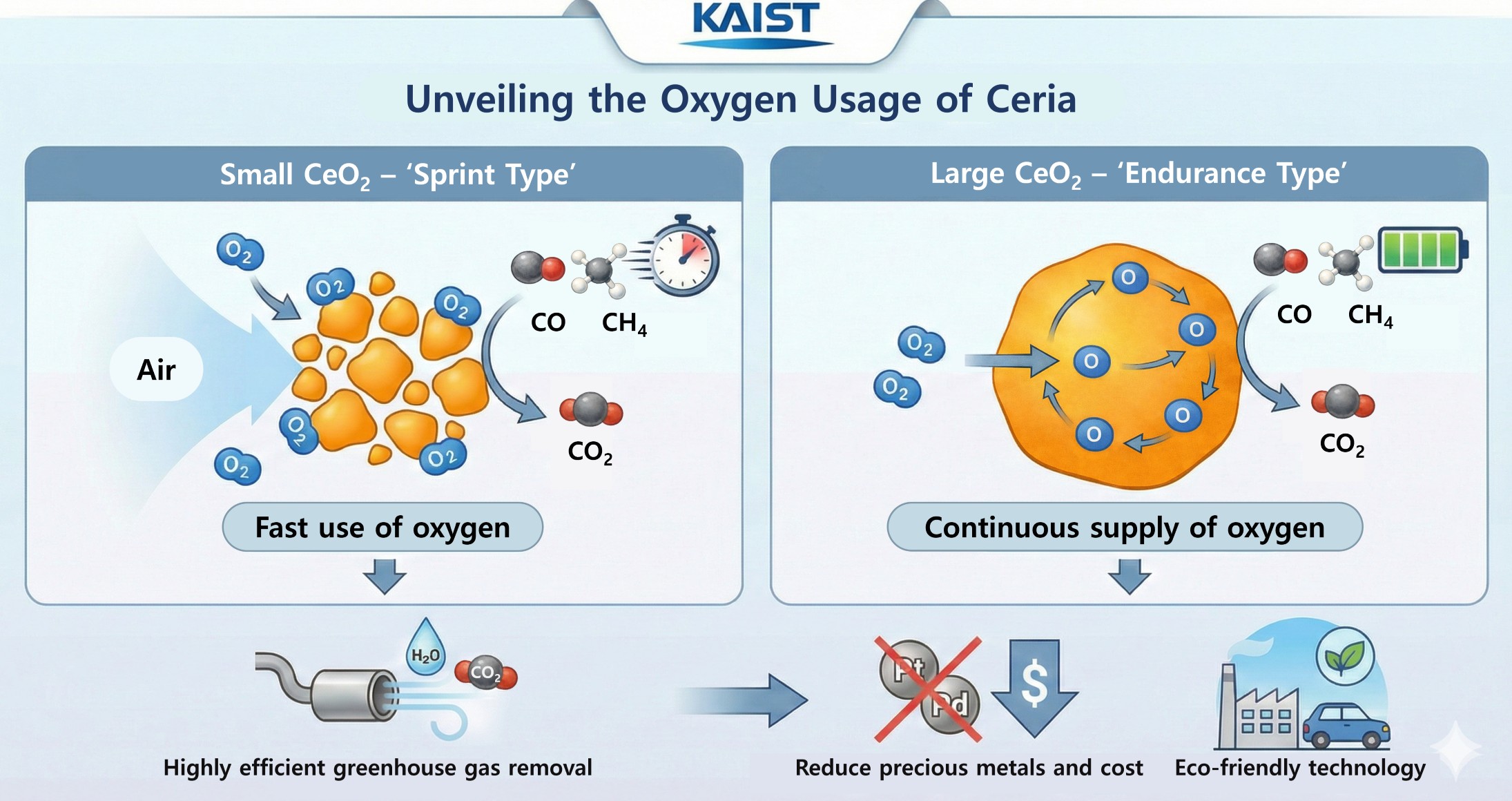 Unveiling the Oxygen Usage of Catalysts to Eliminate Greenhouse Gases Views
<(From Left) Professor Hyunjoo Lee, Ph. D candidate Yunji Choi, Ph. D candidate Jaebeom Han, Professor Jeong Young Park>
As the climate crisis becomes a part of daily life with unprecedented heatwaves and cold snaps, technology to effectively remove greenhouse gases is emerging as a critical global challenge. In particular, catalytic technology that decomposes harmful gases using oxygen is a key element of eco-friendly purification. South Korean researchers have identified the principle that catalysts—which were previously vaguely thought to simply ‘use oxygen well’—can selectively utilize different oxygen sources depending on the reaction environment, presenting a new standard for catalyst design.
A joint research team consisting of Professor Hyunjoo Lee from KAIST Department of Chemical and Biomolecular Engineering, Professor Jeong Woo Han from Seoul National University, and Professor Jeong Young Park from KAIST announced on February 4th that they have identified for the first time in the world that ceria (CeO₂), widely used as an eco-friendly catalyst, completely changes its method of using oxygen depending on its size. *Ceria (CeO₂): A compound formed by the combination of the metal cerium and oxygen.
Ceria is a metal oxide catalyst enables high catalytic performance while reducing the need for expensive precious metal catalysts. It is called an ‘oxygen tank’ in the field of catalysis because it can store oxygen and release it when needed. However, until now, it had not been clearly identified where the oxygen came from and under what conditions it was used in the reaction.
The research team focused on a new concept of a catalyst that ‘chooses and uses oxygen according to the situation,’ rather than just a catalyst that ‘uses oxygen well.’ To this end, they fabricated catalysts with precisely controlled ceria sizes, ranging from ultra-small nano-sizes to relatively large sizes, and systematically analyzed the oxygen movement and reaction processes.
<Schematic Diagram of the Oxygen Transport Mechanism According to Seria Size>
As a result, it was confirmed that small ceria catalysts operate as an ‘agility type’ that quickly takes in oxygen from the air and uses it immediately for reactions, while large ceria catalysts play an ‘endurance type’ role that pulls oxygen stored inside to the surface and supplies it continuously. In other words, the design principle was revealed for the first time that by simply adjusting the size of the catalyst, one can choose whether to use oxygen from the air or oxygen stored internally depending on the reaction conditions. The research team proved this mechanism simultaneously through advanced experimental analysis and artificial intelligence-based simulations.
The research team applied this principle to methane removal. Methane is a greenhouse gas with a global warming effect dozens of times stronger than carbon dioxide, and it is removed through a catalytic oxidation reaction that converts it into carbon dioxide and water using oxygen. The experimental results showed that the small ceria catalyst, by immediately utilizing oxygen from the air, demonstrated stable performance in removing methane even in low-temperature and high-humidity environments. This shows that it is possible to significantly reduce the use of expensive precious metals (platinum and palladium) while actually improving performance.
This achievement is expected to lead to the development of highly durable catalysts that maintain performance even in realistic industrial environments such as rain and moisture, as well as reducing the manufacturing cost of environmental purification equipment, thereby accelerating the commercialization of eco-friendly energy and environmental technologies.
<Schematic Illustration of Ceria Catalyst Applications>
Professor Hyunjoo Lee stated, “This research is an achievement that clearly distinguishes the two core mechanisms of how oxygen operates in catalysts for the first time,” and added, “It has opened a new path to custom-design high-efficiency catalysts required for responding to the climate crisis according to reaction conditions.”
Ph. D candidate Yunji Choi from KAIST, Dr. Seokhyun Choung from Seoul National University, and Ph. D candidate Jaebeom Han from KAIST participated as joint first authors of this study. The research results, also co-authored by Jae-eon Hwang, Hyeon Jin, Yunkyung Kim, and Jeongjin Kim, were published in the international academic journal 'Nature Communications' on January 9th.
This research was supported by the National Research Foundation of Korea (Global Leader Grant, Mid-Career Research Program) funded by the Ministry of Education, Science and Technology, Republic of Korea.
2026.02.09 View 5198
Unveiling the Oxygen Usage of Catalysts to Eliminate Greenhouse Gases Views
<(From Left) Professor Hyunjoo Lee, Ph. D candidate Yunji Choi, Ph. D candidate Jaebeom Han, Professor Jeong Young Park>
As the climate crisis becomes a part of daily life with unprecedented heatwaves and cold snaps, technology to effectively remove greenhouse gases is emerging as a critical global challenge. In particular, catalytic technology that decomposes harmful gases using oxygen is a key element of eco-friendly purification. South Korean researchers have identified the principle that catalysts—which were previously vaguely thought to simply ‘use oxygen well’—can selectively utilize different oxygen sources depending on the reaction environment, presenting a new standard for catalyst design.
A joint research team consisting of Professor Hyunjoo Lee from KAIST Department of Chemical and Biomolecular Engineering, Professor Jeong Woo Han from Seoul National University, and Professor Jeong Young Park from KAIST announced on February 4th that they have identified for the first time in the world that ceria (CeO₂), widely used as an eco-friendly catalyst, completely changes its method of using oxygen depending on its size. *Ceria (CeO₂): A compound formed by the combination of the metal cerium and oxygen.
Ceria is a metal oxide catalyst enables high catalytic performance while reducing the need for expensive precious metal catalysts. It is called an ‘oxygen tank’ in the field of catalysis because it can store oxygen and release it when needed. However, until now, it had not been clearly identified where the oxygen came from and under what conditions it was used in the reaction.
The research team focused on a new concept of a catalyst that ‘chooses and uses oxygen according to the situation,’ rather than just a catalyst that ‘uses oxygen well.’ To this end, they fabricated catalysts with precisely controlled ceria sizes, ranging from ultra-small nano-sizes to relatively large sizes, and systematically analyzed the oxygen movement and reaction processes.
<Schematic Diagram of the Oxygen Transport Mechanism According to Seria Size>
As a result, it was confirmed that small ceria catalysts operate as an ‘agility type’ that quickly takes in oxygen from the air and uses it immediately for reactions, while large ceria catalysts play an ‘endurance type’ role that pulls oxygen stored inside to the surface and supplies it continuously. In other words, the design principle was revealed for the first time that by simply adjusting the size of the catalyst, one can choose whether to use oxygen from the air or oxygen stored internally depending on the reaction conditions. The research team proved this mechanism simultaneously through advanced experimental analysis and artificial intelligence-based simulations.
The research team applied this principle to methane removal. Methane is a greenhouse gas with a global warming effect dozens of times stronger than carbon dioxide, and it is removed through a catalytic oxidation reaction that converts it into carbon dioxide and water using oxygen. The experimental results showed that the small ceria catalyst, by immediately utilizing oxygen from the air, demonstrated stable performance in removing methane even in low-temperature and high-humidity environments. This shows that it is possible to significantly reduce the use of expensive precious metals (platinum and palladium) while actually improving performance.
This achievement is expected to lead to the development of highly durable catalysts that maintain performance even in realistic industrial environments such as rain and moisture, as well as reducing the manufacturing cost of environmental purification equipment, thereby accelerating the commercialization of eco-friendly energy and environmental technologies.
<Schematic Illustration of Ceria Catalyst Applications>
Professor Hyunjoo Lee stated, “This research is an achievement that clearly distinguishes the two core mechanisms of how oxygen operates in catalysts for the first time,” and added, “It has opened a new path to custom-design high-efficiency catalysts required for responding to the climate crisis according to reaction conditions.”
Ph. D candidate Yunji Choi from KAIST, Dr. Seokhyun Choung from Seoul National University, and Ph. D candidate Jaebeom Han from KAIST participated as joint first authors of this study. The research results, also co-authored by Jae-eon Hwang, Hyeon Jin, Yunkyung Kim, and Jeongjin Kim, were published in the international academic journal 'Nature Communications' on January 9th.
This research was supported by the National Research Foundation of Korea (Global Leader Grant, Mid-Career Research Program) funded by the Ministry of Education, Science and Technology, Republic of Korea.
2026.02.09 View 5198 -
 Reading the Optical Fingerprint of Materials in Real-Time with AI
< (From Left) KAIST Dr. Jongchan Kim, Professor Sanghoo Park >
Just as every person has a unique fingerprint, every material has its own unique ‘optical fingerprint.’ Spectroscopy, which has identified materials without contact in fields ranging from semiconductor processes to environmental monitoring, disease diagnosis, and space research, has been called the ‘eyes of science.’ A KAIST research team has implemented spectroscopic analysis, which previously relied on the experience of experts, into AI-based automatic and real-time interpretation technology, greatly expanding its applicability in various industrial fields such as semiconductors, environment, and medicine.
The research team led by Professor Sanghoo Park of our university's Department of Nuclear and Quantum Engineering announced on the 3rd that they have developed ‘AI-based deep spectral interpretation technology’ that allows artificial intelligence to automatically interpret various spectral data in real-time, overcoming limitations such as noise, contamination, defects, and complex overlapping signals.
A spectrum is a graph that spreads out light emitted or absorbed by a material like a rainbow. Existing spectroscopic analysis had to manually analyze signals appearing as numbers in this spectrum by comparing them one by one with well-known reference data. Instead of this method, the research team enabled the artificial intelligence to recognize the entire spectrum as a single ‘image’ and learn its patterns.
< Deep learning-based spectrum technology >
As a result, even in situations where noise was mixed in the data or some parts were lost, the AI accurately identified material information as if it were recognizing an object in a photo. Furthermore, it equipped a function to self-check whether the prediction results are scientifically valid, significantly increasing the reliability of the analysis.
The research team verified this technology by applying it to absorption spectroscopy data widely used in atmospheric and plasma chemistry. As a result, they succeeded in predicting the concentrations of eight chemical substances, including ozone and nitrogen oxides, with very high accuracy even among complexly mixed signals. It was not only more accurate than existing manual analysis but also showed stable performance even in environments with poor data quality.
This research is expected to be a turning point in converting vast amounts of spectroscopic data, which were previously discarded due to the difficulty of analysis, into ‘immediately usable information.’ In particular, it has high potential for use in various high-tech industrial fields, such as improving yield in semiconductor plasma processes, stable control of nuclear fusion plasma, environmental monitoring in smart cities, and non-contact disease diagnosis.
< Research Image >
Professor Sanghoo Park said, “This technology is an achievement that significantly lowers the entry barrier for spectroscopic data analysis, which used to rely on the experience of experts,” and added, “It can be immediately applied to overall industries requiring spectral analysis, such as environmental monitoring, healthcare, and plasma diagnosis.”
In this study, doctoral students Jongchan Kim and Seong-Cheol Huh participated as co-first authors, and Jin Hee Bae and Su-Jin Shin also contributed to the research. The results were published online on January 12th in the prestigious international academic journal in the field of measurement and analytical chemistry, ‘Sensors and Actuators B: Chemical.’
※ Paper title: Deep spectral deconvolution for image-based broadband spectral data analysis DOI: https://doi.org/10.1016/j.snb.2025.139369
Meanwhile, this research was conducted with support from the Ministry of Science and ICT’s Global TOP Strategic Research Group Support Program, the KAIST Leap Research Project, and the Korea Institute of Materials Science (KIMS).
2026.02.03 View 1180
Reading the Optical Fingerprint of Materials in Real-Time with AI
< (From Left) KAIST Dr. Jongchan Kim, Professor Sanghoo Park >
Just as every person has a unique fingerprint, every material has its own unique ‘optical fingerprint.’ Spectroscopy, which has identified materials without contact in fields ranging from semiconductor processes to environmental monitoring, disease diagnosis, and space research, has been called the ‘eyes of science.’ A KAIST research team has implemented spectroscopic analysis, which previously relied on the experience of experts, into AI-based automatic and real-time interpretation technology, greatly expanding its applicability in various industrial fields such as semiconductors, environment, and medicine.
The research team led by Professor Sanghoo Park of our university's Department of Nuclear and Quantum Engineering announced on the 3rd that they have developed ‘AI-based deep spectral interpretation technology’ that allows artificial intelligence to automatically interpret various spectral data in real-time, overcoming limitations such as noise, contamination, defects, and complex overlapping signals.
A spectrum is a graph that spreads out light emitted or absorbed by a material like a rainbow. Existing spectroscopic analysis had to manually analyze signals appearing as numbers in this spectrum by comparing them one by one with well-known reference data. Instead of this method, the research team enabled the artificial intelligence to recognize the entire spectrum as a single ‘image’ and learn its patterns.
< Deep learning-based spectrum technology >
As a result, even in situations where noise was mixed in the data or some parts were lost, the AI accurately identified material information as if it were recognizing an object in a photo. Furthermore, it equipped a function to self-check whether the prediction results are scientifically valid, significantly increasing the reliability of the analysis.
The research team verified this technology by applying it to absorption spectroscopy data widely used in atmospheric and plasma chemistry. As a result, they succeeded in predicting the concentrations of eight chemical substances, including ozone and nitrogen oxides, with very high accuracy even among complexly mixed signals. It was not only more accurate than existing manual analysis but also showed stable performance even in environments with poor data quality.
This research is expected to be a turning point in converting vast amounts of spectroscopic data, which were previously discarded due to the difficulty of analysis, into ‘immediately usable information.’ In particular, it has high potential for use in various high-tech industrial fields, such as improving yield in semiconductor plasma processes, stable control of nuclear fusion plasma, environmental monitoring in smart cities, and non-contact disease diagnosis.
< Research Image >
Professor Sanghoo Park said, “This technology is an achievement that significantly lowers the entry barrier for spectroscopic data analysis, which used to rely on the experience of experts,” and added, “It can be immediately applied to overall industries requiring spectral analysis, such as environmental monitoring, healthcare, and plasma diagnosis.”
In this study, doctoral students Jongchan Kim and Seong-Cheol Huh participated as co-first authors, and Jin Hee Bae and Su-Jin Shin also contributed to the research. The results were published online on January 12th in the prestigious international academic journal in the field of measurement and analytical chemistry, ‘Sensors and Actuators B: Chemical.’
※ Paper title: Deep spectral deconvolution for image-based broadband spectral data analysis DOI: https://doi.org/10.1016/j.snb.2025.139369
Meanwhile, this research was conducted with support from the Ministry of Science and ICT’s Global TOP Strategic Research Group Support Program, the KAIST Leap Research Project, and the Korea Institute of Materials Science (KIMS).
2026.02.03 View 1180 -
 AI Enters the Experienced Hire Era... Teaching Learned Knowledge with Ease
< (From left) KAIST Professor Hyunwoo J. Kim, Postdoctoral Researcher Sanghyeok Lee, M.S candidate Taehoon Song, Korea University Ph.D candidate Jihwan Park >
How inconvenient would it be if you had to manually transfer every contact and photo from scratch every time you switched to a new smartphone? Current Artificial Intelligence (AI) models face a similar predicament. Whenever a superior new AI model—such as a new version of ChatGPT—emerges, it has to be retrained with massive amounts of data and at a high cost to acquire specialized knowledge in specific fields. A Korean research team has developed a "knowledge transplantation" technology between AI models that can resolve this inefficiency.
KAIST announced on January 27th that a research team led by Professor Hyunwoo J. Kim from the School of Computing, in collaboration with a research team from Korea University, has developed a new technology capable of effectively "transplanting" learned knowledge between different AI models.
Recently, Vision-Language Models (VLM), which understand both images and text simultaneously, have been evolving rapidly. These are easily understood as multimodal AIs, like ChatGPT, which can provide explanations when a user shows them a photo and asks a question. These models have the advantage of adapting relatively quickly to new fields using small amounts of data by pre-learning large-scale image and language data.
However, the need to repeat this "adaptation process" from scratch every time a new AI model is released has been pointed out as a major inefficiency. Existing adaptation techniques also faced limitations: they were difficult to use if the model structure changed even slightly, or they significantly increased memory and computational costs because multiple models had to be used simultaneously.
To solve these problems, the research team proposed "TransMiter," a transferable adaptation technique that allows learned knowledge to be reused regardless of the model's structure or size. The core of this technology is directly transferring the "adaptation experience" accumulated by one AI as it learns to another AI model.
< TransMiter: A transferable adaptation technique reusable regardless of model structure, size, etc. >
The researchers' technology does not overhaul the complex internal structure of the AI; instead, it adopts a method of passing on "know-how" learned by observing only the prediction results (output) to another AI. Even if the AI models have different architectures, if the know-how learned by one AI is organized based on the answers given to the same questions, another AI can utilize that knowledge immediately. Consequently, there is no need to undergo the complex and time-consuming retraining process, and there is almost no slowdown in speed.
This study is highly significant as it is the first to prove that AI adaptation knowledge—previously considered almost impossible to reuse if model structures or sizes differed—can be precisely transplanted regardless of the model type. This is expected to not only reduce repetitive learning costs but also be utilized as a so-called "knowledge patch" technology that updates Large Language Models (LLMs) in real-time according to specific needs.
Professor Hyunwoo J. Kim explained, "By extending this research, we can significantly reduce the cost of post-training that had to be performed repeatedly whenever a rapidly evolving hyper-scale language model appears. It will enable 'model patches' that easily add expertise in specific fields."
The study involved Taehoon Song (Master's student, KAIST School of Computing), Sanghyeok Lee (Postdoctoral researcher), and Jihwan Park (Doctoral student, Korea University) as co-authors, with Professor Hyunwoo J. Kim serving as the corresponding author. The research results were accepted for oral presentation (4.6% acceptance rate as of 2025) at AAAI 2026 (Association for the Advancement of Artificial Intelligence), the most prestigious international conference in the field of AI, and were presented on January 25th.
Paper Title: Transferable Model-agnostic Vision-Language Model Adaptation for Efficient Weak-to-Strong Generalization
DOI: https://doi.org/10.48550/arXiv.2508.08604
Meanwhile, Professor Hyunwoo J. Kim's laboratory presented a total of three papers at the conference, including this paper and "TabFlash," a technology developed in collaboration with Google Cloud AI to enhance the understanding of tables within documents.
2026.01.27 View 2225
AI Enters the Experienced Hire Era... Teaching Learned Knowledge with Ease
< (From left) KAIST Professor Hyunwoo J. Kim, Postdoctoral Researcher Sanghyeok Lee, M.S candidate Taehoon Song, Korea University Ph.D candidate Jihwan Park >
How inconvenient would it be if you had to manually transfer every contact and photo from scratch every time you switched to a new smartphone? Current Artificial Intelligence (AI) models face a similar predicament. Whenever a superior new AI model—such as a new version of ChatGPT—emerges, it has to be retrained with massive amounts of data and at a high cost to acquire specialized knowledge in specific fields. A Korean research team has developed a "knowledge transplantation" technology between AI models that can resolve this inefficiency.
KAIST announced on January 27th that a research team led by Professor Hyunwoo J. Kim from the School of Computing, in collaboration with a research team from Korea University, has developed a new technology capable of effectively "transplanting" learned knowledge between different AI models.
Recently, Vision-Language Models (VLM), which understand both images and text simultaneously, have been evolving rapidly. These are easily understood as multimodal AIs, like ChatGPT, which can provide explanations when a user shows them a photo and asks a question. These models have the advantage of adapting relatively quickly to new fields using small amounts of data by pre-learning large-scale image and language data.
However, the need to repeat this "adaptation process" from scratch every time a new AI model is released has been pointed out as a major inefficiency. Existing adaptation techniques also faced limitations: they were difficult to use if the model structure changed even slightly, or they significantly increased memory and computational costs because multiple models had to be used simultaneously.
To solve these problems, the research team proposed "TransMiter," a transferable adaptation technique that allows learned knowledge to be reused regardless of the model's structure or size. The core of this technology is directly transferring the "adaptation experience" accumulated by one AI as it learns to another AI model.
< TransMiter: A transferable adaptation technique reusable regardless of model structure, size, etc. >
The researchers' technology does not overhaul the complex internal structure of the AI; instead, it adopts a method of passing on "know-how" learned by observing only the prediction results (output) to another AI. Even if the AI models have different architectures, if the know-how learned by one AI is organized based on the answers given to the same questions, another AI can utilize that knowledge immediately. Consequently, there is no need to undergo the complex and time-consuming retraining process, and there is almost no slowdown in speed.
This study is highly significant as it is the first to prove that AI adaptation knowledge—previously considered almost impossible to reuse if model structures or sizes differed—can be precisely transplanted regardless of the model type. This is expected to not only reduce repetitive learning costs but also be utilized as a so-called "knowledge patch" technology that updates Large Language Models (LLMs) in real-time according to specific needs.
Professor Hyunwoo J. Kim explained, "By extending this research, we can significantly reduce the cost of post-training that had to be performed repeatedly whenever a rapidly evolving hyper-scale language model appears. It will enable 'model patches' that easily add expertise in specific fields."
The study involved Taehoon Song (Master's student, KAIST School of Computing), Sanghyeok Lee (Postdoctoral researcher), and Jihwan Park (Doctoral student, Korea University) as co-authors, with Professor Hyunwoo J. Kim serving as the corresponding author. The research results were accepted for oral presentation (4.6% acceptance rate as of 2025) at AAAI 2026 (Association for the Advancement of Artificial Intelligence), the most prestigious international conference in the field of AI, and were presented on January 25th.
Paper Title: Transferable Model-agnostic Vision-Language Model Adaptation for Efficient Weak-to-Strong Generalization
DOI: https://doi.org/10.48550/arXiv.2508.08604
Meanwhile, Professor Hyunwoo J. Kim's laboratory presented a total of three papers at the conference, including this paper and "TabFlash," a technology developed in collaboration with Google Cloud AI to enhance the understanding of tables within documents.
2026.01.27 View 2225 -
 Discovery of a Switch to Halt Adipocyte Generation
< (From left) Dr. Ju-Gyeong Kang, Ph.D candidate TaeJun Seol, Professor Dae-Sik Lim >
Metabolic diseases such as obesity, fatty liver, and insulin resistance are rapidly increasing worldwide, but fundamental methods to regulate the process of fat formation remain limited. In particular, once adipocytes (fat cells) are formed, they are difficult to reduce, making treatment challenging. Amidst this, a research team from our university has discovered the existence of a ‘switch’ that prevents fat formation. This discovery elucidates how an ‘epigenetic switch’—which regulates gene activity without altering the DNA sequence itself—functions during the process of adipogenesis, presenting new possibilities for the precise control of obesity and metabolic diseases in the future.
The research team, led by Professor Dae-Sik Lim and Professor Ju-Gyeong Kang from KAIST’s Department of Biological Sciences, announced on January 25th that they have identified ‘YAP/TAZ,’ key regulators of the Hippo signaling pathway*, as playing the role of an ‘epigenetic differentiation inhibition switch’ during the process of adipocyte differentiation**. The team proposed a new mechanism in which YAP/TAZ extensively inhibits the activation of genes responsible for adipocyte formation through its downstream target, ‘VGLL3.’ *Hippo signaling pathway: A cellular control system that regulates when cells grow, stop dividing, and differentiate. **Adipocyte differentiation: The process by which preadipocytes (or stem cells) transform into mature adipocytes.
Cell differentiation is not a simple matter of a single gene turning on or off; it is a complex, organic process involving multiple genes and DNA regulatory regions. The research team tracked the entire process of preadipocytes* differentiating into adipocytes using Next-Generation Sequencing (NGS), which allows for the simultaneous analysis of gene expression changes and epigenetic modifications. *Preadipocyte: A developing intermediate-stage cell whose direction as to which cell it will become has already been determined.
As a result, they confirmed that under conditions where YAP/TAZ is activated, the genetic program that establishes adipocyte identity fails to operate, and the overall adipocyte differentiation network—centered around PPARγ*—is suppressed. *PPARγ: The ‘metabolic master switch’ regulator that controls energy storage and utilization in the body.
Specifically, through single-cell analysis of adipose tissue, the research team identified VGLL3 as a novel target gene of YAP/TAZ. While it was previously known that YAP/TAZ directly binds to and inhibits PPARγ, this study revealed that VGLL3 indirectly controls the entire adipocyte differentiation program by suppressing ‘enhancers,’ which are the DNA regulatory regions of adipocyte genes. This signifies that the Hippo signaling pathway plays a crucial role in regulating the core timing that determines when and how robustly fat cells are created.
Dysfunction of adipose tissue is deeply linked to various metabolic diseases such as obesity, insulin resistance, and fatty liver. The research team expects that further studies on how the YAP/TAZ–VGLL3–PPARγ axis regulatory principle involves adipocyte formation and functional abnormalities will provide new clues for regulating or treating metabolic diseases.
< Schematic Diagram of Adipocyte Gene Regulation >
Professor Dae-Sik Lim stated, “This study is the first to establish that adipocyte differentiation is precisely controlled at the epigenetic level, beyond simple gene regulation. It has laid an important foundation for a more sophisticated understanding of the mechanisms behind adipocyte identity changes and, in the long term, for developing personalized treatment strategies for patients with metabolic diseases.”
This research, with Ph.D. student TaeJun Seol and Dr. Ju-Gyeong Kang as co-first authors, was published on January 14th in the world-renowned international academic journal, Science Advances. ※ Paper Title: YAP/TAZ-VGLL3 governs adipocyte fate via epigenetic reprogramming of PPARγ and its target enhancers, DOI: 10.1126/sciadv.aea7235
Meanwhile, this research was conducted with support from the Leader Researcher Support Program and the Overseas Excellent Scientist Recruitment Program of the National Research Foundation of Korea, funded by the Ministry of Science and ICT.
2026.01.26 View 1762
Discovery of a Switch to Halt Adipocyte Generation
< (From left) Dr. Ju-Gyeong Kang, Ph.D candidate TaeJun Seol, Professor Dae-Sik Lim >
Metabolic diseases such as obesity, fatty liver, and insulin resistance are rapidly increasing worldwide, but fundamental methods to regulate the process of fat formation remain limited. In particular, once adipocytes (fat cells) are formed, they are difficult to reduce, making treatment challenging. Amidst this, a research team from our university has discovered the existence of a ‘switch’ that prevents fat formation. This discovery elucidates how an ‘epigenetic switch’—which regulates gene activity without altering the DNA sequence itself—functions during the process of adipogenesis, presenting new possibilities for the precise control of obesity and metabolic diseases in the future.
The research team, led by Professor Dae-Sik Lim and Professor Ju-Gyeong Kang from KAIST’s Department of Biological Sciences, announced on January 25th that they have identified ‘YAP/TAZ,’ key regulators of the Hippo signaling pathway*, as playing the role of an ‘epigenetic differentiation inhibition switch’ during the process of adipocyte differentiation**. The team proposed a new mechanism in which YAP/TAZ extensively inhibits the activation of genes responsible for adipocyte formation through its downstream target, ‘VGLL3.’ *Hippo signaling pathway: A cellular control system that regulates when cells grow, stop dividing, and differentiate. **Adipocyte differentiation: The process by which preadipocytes (or stem cells) transform into mature adipocytes.
Cell differentiation is not a simple matter of a single gene turning on or off; it is a complex, organic process involving multiple genes and DNA regulatory regions. The research team tracked the entire process of preadipocytes* differentiating into adipocytes using Next-Generation Sequencing (NGS), which allows for the simultaneous analysis of gene expression changes and epigenetic modifications. *Preadipocyte: A developing intermediate-stage cell whose direction as to which cell it will become has already been determined.
As a result, they confirmed that under conditions where YAP/TAZ is activated, the genetic program that establishes adipocyte identity fails to operate, and the overall adipocyte differentiation network—centered around PPARγ*—is suppressed. *PPARγ: The ‘metabolic master switch’ regulator that controls energy storage and utilization in the body.
Specifically, through single-cell analysis of adipose tissue, the research team identified VGLL3 as a novel target gene of YAP/TAZ. While it was previously known that YAP/TAZ directly binds to and inhibits PPARγ, this study revealed that VGLL3 indirectly controls the entire adipocyte differentiation program by suppressing ‘enhancers,’ which are the DNA regulatory regions of adipocyte genes. This signifies that the Hippo signaling pathway plays a crucial role in regulating the core timing that determines when and how robustly fat cells are created.
Dysfunction of adipose tissue is deeply linked to various metabolic diseases such as obesity, insulin resistance, and fatty liver. The research team expects that further studies on how the YAP/TAZ–VGLL3–PPARγ axis regulatory principle involves adipocyte formation and functional abnormalities will provide new clues for regulating or treating metabolic diseases.
< Schematic Diagram of Adipocyte Gene Regulation >
Professor Dae-Sik Lim stated, “This study is the first to establish that adipocyte differentiation is precisely controlled at the epigenetic level, beyond simple gene regulation. It has laid an important foundation for a more sophisticated understanding of the mechanisms behind adipocyte identity changes and, in the long term, for developing personalized treatment strategies for patients with metabolic diseases.”
This research, with Ph.D. student TaeJun Seol and Dr. Ju-Gyeong Kang as co-first authors, was published on January 14th in the world-renowned international academic journal, Science Advances. ※ Paper Title: YAP/TAZ-VGLL3 governs adipocyte fate via epigenetic reprogramming of PPARγ and its target enhancers, DOI: 10.1126/sciadv.aea7235
Meanwhile, this research was conducted with support from the Leader Researcher Support Program and the Overseas Excellent Scientist Recruitment Program of the National Research Foundation of Korea, funded by the Ministry of Science and ICT.
2026.01.26 View 1762 -
 KAIST Transforms Hydrogen Energy by Flattening Granular Catalysts into Paper-Thin Sheets
<(From Left) Ph.D candidate HyunWoo J Yang, Ph.D candidate SangJae Lee, Professor EunAe Cho, Ph.D candidate DongWon Shin>
Catalysts are the “invisible engines” of hydrogen energy, governing both hydrogen production and electricity generation. Conventional catalysts are typically fabricated in granular particle form, which is easy to synthesize but suffers from inefficient use of precious metals and limited durability. KAIST researchers have introduced a paper-thin sheet architecture in place of granules, demonstrating that a structural innovation—rather than new materials—can simultaneously reduce precious-metal usage while enhancing both hydrogen production and fuel-cell performance.
KAIST (President Kwang Hyung Lee) announced on the 21st of January that a research team led by Professor EunAe Cho of the Department of Materials Science and Engineering has developed a new catalyst architecture that dramatically reduces the amount of expensive precious metals required while simultaneously improving hydrogen production and fuel-cell performance.
The core of this research lies in the application of ultrathin nanosheet structures, with thicknesses tens of thousands of times thinner than a human hair, enabling the team to overcome both efficiency and durability limitations of conventional catalysts.
Water electrolyzers and fuel cells are key technologies for hydrogen energy production and utilization. However, their commercialization has been severely constrained by the scarcity and high cost of iridium (Ir) and platinum (Pt), which are commonly used as catalysts. In conventional particle-based catalysts, only a limited surface area participates in reactions, and long-term operation inevitably leads to performance degradation.
To address this, the research team transformed agglomerated catalyst particles into paper-like, ultrathin and laterally extended sheets. For water electrolysis, they developed ultrathin iridium nanosheets with lateral size of 1–3 micrometers and thicknesses below 2 nanometers. This structure dramatically increased the active surface area participating in reactions, enabling significantly higher hydrogen production with the same amount of iridium.
< Ultrafine Iridium Nanosheet (AI-generated image) >
In addition, the team discovered that these ultrathin nanosheets naturally formed interconnected conductive pathways on titanium oxide (TiO2), a material previously considered unsuitable as a catalyst support due to its poor electrical conductivity. As a result, titanium oxide could be stably used as a catalyst support, further enhancing durability.
The resulting catalyst achieved a 38% higher hydrogen production rate than commercial catalysts and operated stably for over 1,000 hours under high-load, industry-relevant conditions (1 A/cm2*). Notably, even with approximately 65% less iridium, the catalyst delivered performance comparable to commercial benchmarks, demonstrating a major reduction in precious-metal usage.
*1 A/cm2: a high-current condition corresponding to intensive operation of practical hydrogen-production systems
The team further applied the ultrathin nanosheet design strategy to fuel-cell catalysts, producing platinum–copper nanosheets with thicknesses again tens of thousands of times thinner than a human hair.
In fuel-cell evaluations, this catalyst exhibited a 13-fold improvement in mass activity per unit platinum compared with commercial catalysts, and delivered approximately 2.3 times higher performance in full fuel-cell tests. Even after 50,000 accelerated durability cycles, the catalyst retained about 65% of its initial performance, significantly outperforming conventional catalysts. Importantly, the same performance was achieved while reducing platinum usage by approximately 60%.
Professor EunAe Cho emphasized, “This study presents a new catalyst architecture that simultaneously enhances hydrogen production and fuel-cell performance while using far less expensive precious metals,” adding, “It represents a critical turning point for lowering the cost of hydrogen energy and accelerating its commercialization.”
<Schematic illustration of ultrathin nanosheet synthesis and transmission electron microscopy (TEM) images of the fabricated catalyst>
<Fabrication process of an ultrathin nanosheet catalyst and transmission electron microscopy (TEM) images of the fabricated catalyst>
The results of this work were published in two separate papers, both based on the shared core technology of ultrathin nanosheet architectures—one focused on hydrogen-production catalysts and the other on fuel-cell catalysts.
The iridium nanosheet study, with doctoral candidate Dongwon Shin as first author, was published online on December 10, 2025, in ACS Nano (IF 16.0).
※ Paper title: “Ultrathin Iridium Nanosheets on Titanium Oxide for High-Efficiency and Durable Proton Exchange Membrane Water Electrolysis,” DOI: 10.1021/acsnano.5c15659
The platinum–copper nanosheet study, with SangJae Lee and doctoral candidate HyunWoo Yang as co–first authors, was published online on December 11, 2025, in Nano Letters (IF 9.6).
※ Paper title: “Ultrathin PtCu Nanosheets: A New Frontier in Highly Efficient and Durable Catalysts for the Oxygen Reduction Reaction,” DOI: 10.1021/acs.nanolett.5c04848
This research was supported by the Energy Human Resource Development Program of the Korea Institute of Energy Technology Evaluation and Planning (KETEP) under the Ministry of Trade, Industry and Energy, and by the Nano- and Materials-Technology Development Program of the National Research Foundation of Korea under the Ministry of Science and ICT.
2026.01.23 View 1439
KAIST Transforms Hydrogen Energy by Flattening Granular Catalysts into Paper-Thin Sheets
<(From Left) Ph.D candidate HyunWoo J Yang, Ph.D candidate SangJae Lee, Professor EunAe Cho, Ph.D candidate DongWon Shin>
Catalysts are the “invisible engines” of hydrogen energy, governing both hydrogen production and electricity generation. Conventional catalysts are typically fabricated in granular particle form, which is easy to synthesize but suffers from inefficient use of precious metals and limited durability. KAIST researchers have introduced a paper-thin sheet architecture in place of granules, demonstrating that a structural innovation—rather than new materials—can simultaneously reduce precious-metal usage while enhancing both hydrogen production and fuel-cell performance.
KAIST (President Kwang Hyung Lee) announced on the 21st of January that a research team led by Professor EunAe Cho of the Department of Materials Science and Engineering has developed a new catalyst architecture that dramatically reduces the amount of expensive precious metals required while simultaneously improving hydrogen production and fuel-cell performance.
The core of this research lies in the application of ultrathin nanosheet structures, with thicknesses tens of thousands of times thinner than a human hair, enabling the team to overcome both efficiency and durability limitations of conventional catalysts.
Water electrolyzers and fuel cells are key technologies for hydrogen energy production and utilization. However, their commercialization has been severely constrained by the scarcity and high cost of iridium (Ir) and platinum (Pt), which are commonly used as catalysts. In conventional particle-based catalysts, only a limited surface area participates in reactions, and long-term operation inevitably leads to performance degradation.
To address this, the research team transformed agglomerated catalyst particles into paper-like, ultrathin and laterally extended sheets. For water electrolysis, they developed ultrathin iridium nanosheets with lateral size of 1–3 micrometers and thicknesses below 2 nanometers. This structure dramatically increased the active surface area participating in reactions, enabling significantly higher hydrogen production with the same amount of iridium.
< Ultrafine Iridium Nanosheet (AI-generated image) >
In addition, the team discovered that these ultrathin nanosheets naturally formed interconnected conductive pathways on titanium oxide (TiO2), a material previously considered unsuitable as a catalyst support due to its poor electrical conductivity. As a result, titanium oxide could be stably used as a catalyst support, further enhancing durability.
The resulting catalyst achieved a 38% higher hydrogen production rate than commercial catalysts and operated stably for over 1,000 hours under high-load, industry-relevant conditions (1 A/cm2*). Notably, even with approximately 65% less iridium, the catalyst delivered performance comparable to commercial benchmarks, demonstrating a major reduction in precious-metal usage.
*1 A/cm2: a high-current condition corresponding to intensive operation of practical hydrogen-production systems
The team further applied the ultrathin nanosheet design strategy to fuel-cell catalysts, producing platinum–copper nanosheets with thicknesses again tens of thousands of times thinner than a human hair.
In fuel-cell evaluations, this catalyst exhibited a 13-fold improvement in mass activity per unit platinum compared with commercial catalysts, and delivered approximately 2.3 times higher performance in full fuel-cell tests. Even after 50,000 accelerated durability cycles, the catalyst retained about 65% of its initial performance, significantly outperforming conventional catalysts. Importantly, the same performance was achieved while reducing platinum usage by approximately 60%.
Professor EunAe Cho emphasized, “This study presents a new catalyst architecture that simultaneously enhances hydrogen production and fuel-cell performance while using far less expensive precious metals,” adding, “It represents a critical turning point for lowering the cost of hydrogen energy and accelerating its commercialization.”
<Schematic illustration of ultrathin nanosheet synthesis and transmission electron microscopy (TEM) images of the fabricated catalyst>
<Fabrication process of an ultrathin nanosheet catalyst and transmission electron microscopy (TEM) images of the fabricated catalyst>
The results of this work were published in two separate papers, both based on the shared core technology of ultrathin nanosheet architectures—one focused on hydrogen-production catalysts and the other on fuel-cell catalysts.
The iridium nanosheet study, with doctoral candidate Dongwon Shin as first author, was published online on December 10, 2025, in ACS Nano (IF 16.0).
※ Paper title: “Ultrathin Iridium Nanosheets on Titanium Oxide for High-Efficiency and Durable Proton Exchange Membrane Water Electrolysis,” DOI: 10.1021/acsnano.5c15659
The platinum–copper nanosheet study, with SangJae Lee and doctoral candidate HyunWoo Yang as co–first authors, was published online on December 11, 2025, in Nano Letters (IF 9.6).
※ Paper title: “Ultrathin PtCu Nanosheets: A New Frontier in Highly Efficient and Durable Catalysts for the Oxygen Reduction Reaction,” DOI: 10.1021/acs.nanolett.5c04848
This research was supported by the Energy Human Resource Development Program of the Korea Institute of Energy Technology Evaluation and Planning (KETEP) under the Ministry of Trade, Industry and Energy, and by the Nano- and Materials-Technology Development Program of the National Research Foundation of Korea under the Ministry of Science and ICT.
2026.01.23 View 1439