%6d%61%72%69%74%69%6d%65
-
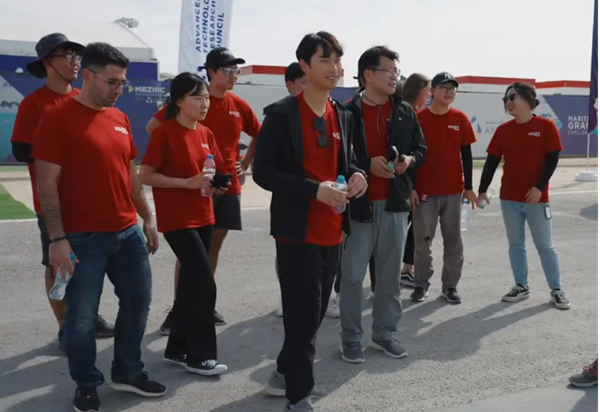 Team KAIST placed among top two at MBZIRC Maritime Grand Challenge
Representing Korean Robotics at Sea: KAIST’s 26-month strife rewarded
Team KAIST placed among top two at MBZIRC Maritime Grand Challenge
- Team KAIST, composed of students from the labs of Professor Jinwhan Kim of the Department of Mechanical Engineering and Professor Hyunchul Shim of the School of Electrical and Engineering, came through the challenge as the first runner-up winning the prize money totaling up to $650,000 (KRW 860 million).
- Successfully led the autonomous collaboration of unmanned aerial and maritime vehicles using cutting-edge robotics and AI technology through to the final round of the competition held in Abu Dhabi from January 10 to February 6, 2024.
KAIST (President Kwang-Hyung Lee), reported on the 8th that Team KAIST, led by students from the labs of Professor Jinwhan Kim of the Department of Mechanical Engineering and Professor Hyunchul Shim of the School of Electrical Engineering, with Pablo Aviation as a partner, won a total prize money of $650,000 (KRW 860 million) at the Maritime Grand Challenge by the Mohamed Bin Zayed International Robotics Challenge (MBZIRC), finishing first runner-up.
This competition, which is the largest ever robotics competition held over water, is sponsored by the government of the United Arab Emirates and organized by ASPIRE, an organization under the Abu Dhabi Ministry of Science, with a total prize money of $3 million.
In the competition, which started at the end of 2021, 52 teams from around the world participated and five teams were selected to go on to the finals in February 2023 after going through the first and second stages of screening. The final round was held from January 10 to February 6, 2024, using actual unmanned ships and drones in a secluded sea area of 10 km2 off the coast of Abu Dhabi, the capital of the United Arab Emirates. A total of 18 KAIST students and Professor Jinwhan Kim and Professor Hyunchul Shim took part in this competition at the location at Abu Dhabi.
Team KAIST will receive $500,000 in prize money for taking second place in the final, and the team’s prize money totals up to $650,000 including $150,000 that was as special midterm award for finalists.
The final mission scenario is to find the target vessel on the run carrying illegal cargoes among many ships moving within the GPS-disabled marine surface, and inspect the deck for two different types of stolen cargo to recover them using the aerial vehicle to bring the small cargo and the robot manipulator topped on an unmanned ship to retrieve the larger one. The true aim of the mission is to complete it through autonomous collaboration of the unmanned ship and the aerial vehicle without human intervention throughout the entire mission process. In particular, since GPS cannot be used in this competition due to regulations, Professor Jinwhan Kim's research team developed autonomous operation techniques for unmanned ships, including searching and navigating methods using maritime radar, and Professor Hyunchul Shim's research team developed video-based navigation and a technology to combine a small autonomous robot with a drone.
The final mission is to retrieve cargo on board a ship fleeing at sea through autonomous collaboration between unmanned ships and unmanned aerial vehicles without human intervention. The overall mission consists the first stage of conducting the inspection to find the target ship among several ships moving at sea and the second stage of conducting the intervention mission to retrieve the cargoes on the deck of the ship. Each team was given a total of three opportunities, and the team that completed the highest-level mission in the shortest time during the three attempts received the highest score.
In the first attempt, KAIST was the only team to succeed in the first stage search mission, but the competition began in earnest as the Croatian team also completed the first stage mission in the second attempt. As the competition schedule was delayed due to strong winds and high waves that continued for several days, the organizers decided to hold the finals with the three teams, including the Team KAIST and the team from Croatia’s the University of Zagreb, which completed the first stage of the mission, and Team Fly-Eagle, a team of researcher from China and UAE that partially completed the first stage. The three teams were given the chance to proceed to the finals and try for the third attempt, and in the final competition, the Croatian team won, KAIST took the second place, and the combined team of UAE-China combined team took the third place. The final prize to be given for the winning team is set at $2 million with $500,000 for the runner-up team, and $250,000 for the third-place.
Professor Jinwhan Kim of the Department of Mechanical Engineering, who served as the advisor for Team KAIST, said, “I would like to express my gratitude and congratulations to the students who put in a huge academic and physical efforts in preparing for the competition over the past two years. I feel rewarded because, regardless of the results, every bit of efforts put into this up to this point will become the base of their confidence and a valuable asset in their growth into a great researcher.” Sol Han, a doctoral student in mechanical engineering who served as the team leader, said, “I am disappointed of how narrowly we missed out on winning at the end, but I am satisfied with the significance of the output we’ve got and I am grateful to the team members who worked hard together for that.”
HD Hyundai, Rainbow Robotics, Avikus, and FIMS also participated as sponsors for Team KAIST's campaign.
2024.02.09 View 23984
Team KAIST placed among top two at MBZIRC Maritime Grand Challenge
Representing Korean Robotics at Sea: KAIST’s 26-month strife rewarded
Team KAIST placed among top two at MBZIRC Maritime Grand Challenge
- Team KAIST, composed of students from the labs of Professor Jinwhan Kim of the Department of Mechanical Engineering and Professor Hyunchul Shim of the School of Electrical and Engineering, came through the challenge as the first runner-up winning the prize money totaling up to $650,000 (KRW 860 million).
- Successfully led the autonomous collaboration of unmanned aerial and maritime vehicles using cutting-edge robotics and AI technology through to the final round of the competition held in Abu Dhabi from January 10 to February 6, 2024.
KAIST (President Kwang-Hyung Lee), reported on the 8th that Team KAIST, led by students from the labs of Professor Jinwhan Kim of the Department of Mechanical Engineering and Professor Hyunchul Shim of the School of Electrical Engineering, with Pablo Aviation as a partner, won a total prize money of $650,000 (KRW 860 million) at the Maritime Grand Challenge by the Mohamed Bin Zayed International Robotics Challenge (MBZIRC), finishing first runner-up.
This competition, which is the largest ever robotics competition held over water, is sponsored by the government of the United Arab Emirates and organized by ASPIRE, an organization under the Abu Dhabi Ministry of Science, with a total prize money of $3 million.
In the competition, which started at the end of 2021, 52 teams from around the world participated and five teams were selected to go on to the finals in February 2023 after going through the first and second stages of screening. The final round was held from January 10 to February 6, 2024, using actual unmanned ships and drones in a secluded sea area of 10 km2 off the coast of Abu Dhabi, the capital of the United Arab Emirates. A total of 18 KAIST students and Professor Jinwhan Kim and Professor Hyunchul Shim took part in this competition at the location at Abu Dhabi.
Team KAIST will receive $500,000 in prize money for taking second place in the final, and the team’s prize money totals up to $650,000 including $150,000 that was as special midterm award for finalists.
The final mission scenario is to find the target vessel on the run carrying illegal cargoes among many ships moving within the GPS-disabled marine surface, and inspect the deck for two different types of stolen cargo to recover them using the aerial vehicle to bring the small cargo and the robot manipulator topped on an unmanned ship to retrieve the larger one. The true aim of the mission is to complete it through autonomous collaboration of the unmanned ship and the aerial vehicle without human intervention throughout the entire mission process. In particular, since GPS cannot be used in this competition due to regulations, Professor Jinwhan Kim's research team developed autonomous operation techniques for unmanned ships, including searching and navigating methods using maritime radar, and Professor Hyunchul Shim's research team developed video-based navigation and a technology to combine a small autonomous robot with a drone.
The final mission is to retrieve cargo on board a ship fleeing at sea through autonomous collaboration between unmanned ships and unmanned aerial vehicles without human intervention. The overall mission consists the first stage of conducting the inspection to find the target ship among several ships moving at sea and the second stage of conducting the intervention mission to retrieve the cargoes on the deck of the ship. Each team was given a total of three opportunities, and the team that completed the highest-level mission in the shortest time during the three attempts received the highest score.
In the first attempt, KAIST was the only team to succeed in the first stage search mission, but the competition began in earnest as the Croatian team also completed the first stage mission in the second attempt. As the competition schedule was delayed due to strong winds and high waves that continued for several days, the organizers decided to hold the finals with the three teams, including the Team KAIST and the team from Croatia’s the University of Zagreb, which completed the first stage of the mission, and Team Fly-Eagle, a team of researcher from China and UAE that partially completed the first stage. The three teams were given the chance to proceed to the finals and try for the third attempt, and in the final competition, the Croatian team won, KAIST took the second place, and the combined team of UAE-China combined team took the third place. The final prize to be given for the winning team is set at $2 million with $500,000 for the runner-up team, and $250,000 for the third-place.
Professor Jinwhan Kim of the Department of Mechanical Engineering, who served as the advisor for Team KAIST, said, “I would like to express my gratitude and congratulations to the students who put in a huge academic and physical efforts in preparing for the competition over the past two years. I feel rewarded because, regardless of the results, every bit of efforts put into this up to this point will become the base of their confidence and a valuable asset in their growth into a great researcher.” Sol Han, a doctoral student in mechanical engineering who served as the team leader, said, “I am disappointed of how narrowly we missed out on winning at the end, but I am satisfied with the significance of the output we’ve got and I am grateful to the team members who worked hard together for that.”
HD Hyundai, Rainbow Robotics, Avikus, and FIMS also participated as sponsors for Team KAIST's campaign.
2024.02.09 View 23984 -
 Professor Sung Yong Kim Elected as the Chair of PICES MONITOR
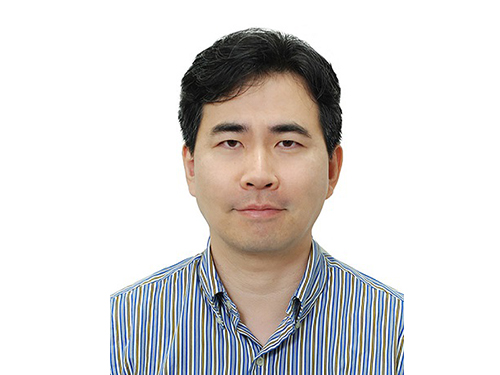
< Professor Sung Yong Kim >
Professor Sung Yong Kim from the Department of Mechanical Engineering was elected as the chair of the Technical Committee on Monitoring (MONITOR) of the North Pacific Marine Science Organization (PICES).
PICES is an intergovernmental marine science organization that was established in 1992 through a collaboration between six North Pacific nations including South Korea, Russia, the United States, Japan, China, and Canada to exchange and discuss research on the Pacific waters. Its headquarters is located in Canada and the organization consists of seven affiliated maritime science and marine technology committees.
Professor Kim was elected as the chair of the technical committee that focuses on monitoring and will be part of the Science Board as an ex-officio member. His term will last three years from November 2019.
Professor Kim was recognized for his academic excellence, expertise, and leadership among oceanographers both domestically and internationally.
Professor Kim will also participate as an academia civilian committee member of the Maritime and Fisheries Science and Technology Committee under the Korean Ministry of Oceans and Fisheries for two years from December 18, 2019.
He stated, “I will give my full efforts to broaden Korean oceanography research by participating in maritime leadership positions at home and abroad, and help South Korea become a maritime powerhouse.”
(END)
2019.12.22 View 16538
Professor Sung Yong Kim Elected as the Chair of PICES MONITOR
< Professor Sung Yong Kim >
Professor Sung Yong Kim from the Department of Mechanical Engineering was elected as the chair of the Technical Committee on Monitoring (MONITOR) of the North Pacific Marine Science Organization (PICES).
PICES is an intergovernmental marine science organization that was established in 1992 through a collaboration between six North Pacific nations including South Korea, Russia, the United States, Japan, China, and Canada to exchange and discuss research on the Pacific waters. Its headquarters is located in Canada and the organization consists of seven affiliated maritime science and marine technology committees.
Professor Kim was elected as the chair of the technical committee that focuses on monitoring and will be part of the Science Board as an ex-officio member. His term will last three years from November 2019.
Professor Kim was recognized for his academic excellence, expertise, and leadership among oceanographers both domestically and internationally.
Professor Kim will also participate as an academia civilian committee member of the Maritime and Fisheries Science and Technology Committee under the Korean Ministry of Oceans and Fisheries for two years from December 18, 2019.
He stated, “I will give my full efforts to broaden Korean oceanography research by participating in maritime leadership positions at home and abroad, and help South Korea become a maritime powerhouse.”
(END)
2019.12.22 View 16538 -
 Research Center for Smart Submerged Floating Tunnel Systems Opens
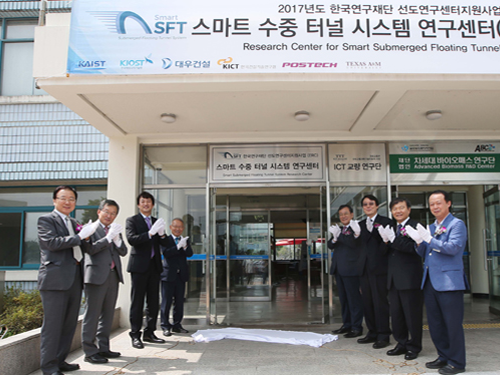
(Distinguished guests including President Shin (fourth from the right) and Director Lee (third from left) at the opening ceremony)
The Research Center for a Smart Submerged Floating Tunnel Systems was recently established at KAIST with the purpose of taking the lead in developing fundamental and applicable technology for submerged floating tunnels as well as fostering creative and talented people. Haeng-Ki Lee, a professor in the Department of Civil & Environmental Engineering at KAIST is heading the center.
KAIST held its opening ceremony on September 7, 2017 in the Applied Engineering Building located on the main campus.
Distinguished guests, including KAIST president Sung-Chul Shin, the President of the Korea Institute of Ocean Science and Technology Gi-Hoon Hong, the President of the Korean Society of Civil Engineering Young-Seok Park, and the Director in the Division of Engineering at the National Research Foundation of Korea Joong-Kon Park attended the ceremony.
The National Research Foundation of Korea provides Engineering Research Center (ERC) projects which find and foster groups with outstanding research performance in a field of engineering. The projects support these groups so that they can strengthen their global competitiveness while enhancing national competence in basic research.
The ‘Research Center for Smart Submerged Floating Tunnel Systems’ was selected as one of the ERC projects in 2017. For the next seven years, the research center will work to develop a submerged floating tunnel system resistant depths greater than 100 meters.
To achieve its goal, the center has defined crucial research topics including: i) a structural analysis program and integrated design technology specific for submerged floating tunnel systems, ii) high-durability marine construction materials and submerged construction integrated systems, and iii) safety and maintenance integrated technology for smart submerged floating tunnel systems.
The ‘Research Center for Smart Submerged Floating Tunnel Systems’ will devote itself to developing a variety of fundamental and applicable technology that will be leading global maritime construction. Moreover, it will concentrate on fostering professional research manpower in related areas.
The Director of the Center Lee said, “The center will cooperate with KAIST researchers who are experts in various fields, including structures, materials, construction, and maritime research. Based on this collaboration, the center will contribute to achieving autonomous technologies by developing fundamental and applicable technology related with submerged floating tunnel systems. It will also take the role of a leading global research hub in the field of submerged floating tunnels as well as construction technologies.”
2017.09.07 View 15103
Research Center for Smart Submerged Floating Tunnel Systems Opens
(Distinguished guests including President Shin (fourth from the right) and Director Lee (third from left) at the opening ceremony)
The Research Center for a Smart Submerged Floating Tunnel Systems was recently established at KAIST with the purpose of taking the lead in developing fundamental and applicable technology for submerged floating tunnels as well as fostering creative and talented people. Haeng-Ki Lee, a professor in the Department of Civil & Environmental Engineering at KAIST is heading the center.
KAIST held its opening ceremony on September 7, 2017 in the Applied Engineering Building located on the main campus.
Distinguished guests, including KAIST president Sung-Chul Shin, the President of the Korea Institute of Ocean Science and Technology Gi-Hoon Hong, the President of the Korean Society of Civil Engineering Young-Seok Park, and the Director in the Division of Engineering at the National Research Foundation of Korea Joong-Kon Park attended the ceremony.
The National Research Foundation of Korea provides Engineering Research Center (ERC) projects which find and foster groups with outstanding research performance in a field of engineering. The projects support these groups so that they can strengthen their global competitiveness while enhancing national competence in basic research.
The ‘Research Center for Smart Submerged Floating Tunnel Systems’ was selected as one of the ERC projects in 2017. For the next seven years, the research center will work to develop a submerged floating tunnel system resistant depths greater than 100 meters.
To achieve its goal, the center has defined crucial research topics including: i) a structural analysis program and integrated design technology specific for submerged floating tunnel systems, ii) high-durability marine construction materials and submerged construction integrated systems, and iii) safety and maintenance integrated technology for smart submerged floating tunnel systems.
The ‘Research Center for Smart Submerged Floating Tunnel Systems’ will devote itself to developing a variety of fundamental and applicable technology that will be leading global maritime construction. Moreover, it will concentrate on fostering professional research manpower in related areas.
The Director of the Center Lee said, “The center will cooperate with KAIST researchers who are experts in various fields, including structures, materials, construction, and maritime research. Based on this collaboration, the center will contribute to achieving autonomous technologies by developing fundamental and applicable technology related with submerged floating tunnel systems. It will also take the role of a leading global research hub in the field of submerged floating tunnels as well as construction technologies.”
2017.09.07 View 15103 -
 Professor Hyun Chung Claims the Elmer L. Hann Award 2016
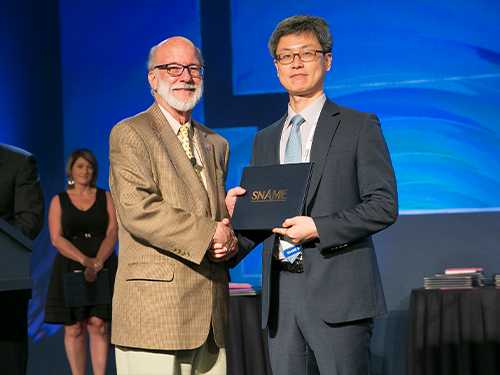
Professor Hyun Chung of KAIST’s Mechanical Engineering Department received the Elmer L. Hann Award 2016 at the SNAME Maritime Convention (SMC) that took place November 1-5 in Seattle, Washington, in the United States.
Held annually, the SMC is the largest academic gathering for researchers and professionals in maritime and ocean engineering, and it is hosted by the Society of Naval Architects and Marine Engineers (SNAME).
With more than 6,000 members around the world in 85 countries, SNAME is an internationally-recognized, non-profit, professional society of individual members serving the maritime and offshore industries and their suppliers. It strives to advance the art, science, and practice of naval architecture, marine engineering, ocean engineering, and other marine-related professions through the exchange of knowledge and ideas, as well as the promotion of R&D, and education.
Every year, SNAME selects three research papers that are either published in its academic journal or presented at its sponsored conferences and awards them, respectively. One of the three awards is the Elmer L. Hann Award.
This year, the Society announced Professor Chung’s paper as the Elmer L. Hann Award winner. His paper, entitled “Tolerance Analysis and Diagnosis Model of Compliant Block Assembly Considering Welding Deformation,” was presented at the World Maritime Technology Conference held November 3-7, 2015 in Providence, Rhode Island, USA.
Analysis, management, and diagnostics of tolerance are important factors in the production of ocean structures. In the paper, Professor Chung’s team proposed a simplified tolerance analysis and diagnosis model including the effects of welding distortion for accuracy control in ship block assembly, thereby improving the production process.
Professor Chung said, “This is indeed a wonderful award for our team. From early this year, with support from the U.S. Office of Naval Research, we have collaborated with the University of Michigan, the Massachusetts Institute of Technology, Ohio State University, and the Edison Welding Institute to study this topic more deeply. We will keep up the good work to make meaningful progress.”
2016.12.10 View 11971
Professor Hyun Chung Claims the Elmer L. Hann Award 2016
Professor Hyun Chung of KAIST’s Mechanical Engineering Department received the Elmer L. Hann Award 2016 at the SNAME Maritime Convention (SMC) that took place November 1-5 in Seattle, Washington, in the United States.
Held annually, the SMC is the largest academic gathering for researchers and professionals in maritime and ocean engineering, and it is hosted by the Society of Naval Architects and Marine Engineers (SNAME).
With more than 6,000 members around the world in 85 countries, SNAME is an internationally-recognized, non-profit, professional society of individual members serving the maritime and offshore industries and their suppliers. It strives to advance the art, science, and practice of naval architecture, marine engineering, ocean engineering, and other marine-related professions through the exchange of knowledge and ideas, as well as the promotion of R&D, and education.
Every year, SNAME selects three research papers that are either published in its academic journal or presented at its sponsored conferences and awards them, respectively. One of the three awards is the Elmer L. Hann Award.
This year, the Society announced Professor Chung’s paper as the Elmer L. Hann Award winner. His paper, entitled “Tolerance Analysis and Diagnosis Model of Compliant Block Assembly Considering Welding Deformation,” was presented at the World Maritime Technology Conference held November 3-7, 2015 in Providence, Rhode Island, USA.
Analysis, management, and diagnostics of tolerance are important factors in the production of ocean structures. In the paper, Professor Chung’s team proposed a simplified tolerance analysis and diagnosis model including the effects of welding distortion for accuracy control in ship block assembly, thereby improving the production process.
Professor Chung said, “This is indeed a wonderful award for our team. From early this year, with support from the U.S. Office of Naval Research, we have collaborated with the University of Michigan, the Massachusetts Institute of Technology, Ohio State University, and the Edison Welding Institute to study this topic more deeply. We will keep up the good work to make meaningful progress.”
2016.12.10 View 11971 -
 KAIST wins second place in unmanned boat competition
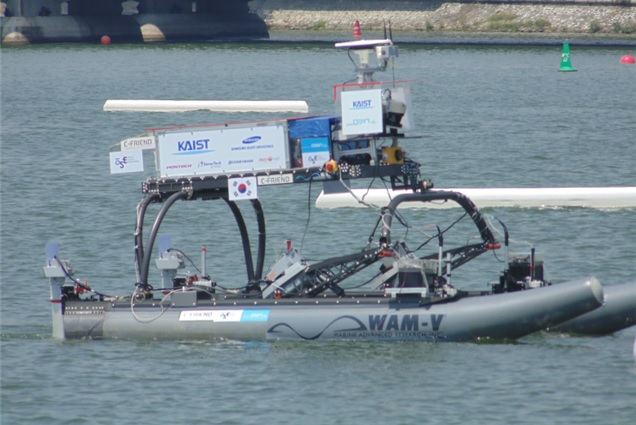
KAIST took second place in an international competition to promote technologies of the autonomous underwater vehicle (AUV).
Professor Jin-hwan Kim’s research team from KAIST’s Ocean Systems Engineering Department won the second place in Maritime RobotX Challenge which took place for the first time from October 20 - 26 in Marina Bay, Singapore.
Along with automobiles and drones, the necessity for unmanned boats has grown. To encourage and examine the development of these technologies, the U.S. Office of Naval Research decided to organize an unmanned boat competition which took place for the first time this year.
After three teams were selected from a domestic competition in each countries, a total of fifteen teams from five countries from the Pacific Rim including Korea, the United States, Australia, Japan, and Singapore competed. Teams from such universities as MIT, Tokyo University, Tokyo Institute of Technology, National University of Singapore, Nanyang Technological University, and Queensland University of Technology participated. In addition to KAIST, Seoul National University and Ulsan University participated.
Using a 4.5 meters long and 2.5 meters wide unmanned boat provided by the organizer, each team had to implement an integrated system that combined a propulsion system, hardware, and autonomous software. Each team’s vessel had to perform tasks without manual control, employing autonomous driving through recognition of the course, searching underwater for acoustic sources, automatically approaching piers, remote observation of buoy, and avoidance and detection of obstacles.
Although KAIST outpaced MIT in the semifinal which selected six out of fifteen teams, it won the second place in the final. As well as winning second prize, KAIST also won best website prize and a special prize from the competition sponsor, Northrop Grumman Corporation, an American defense technology company, totaling 16,500 U.S. dollars of prize money.
The Vice President for Planning and Budget, Professor Seungbin Park said, “It was a great opportunity to showcase the advanced unmanned robot technology of Korea.” He added that “this raised KAIST’s reputation as a global research oriented university.”
Professor Kim commented, “Along with automobiles and drones, the necessity for the development of unmanned ocean vehicles such as unmanned boats and submarines are recognized these days.” He added that “the use of unmanned boats will make the process of channel investigation, ocean exploration, surveillance over water territories safer and more effective.”
Professor Kim’s team was sponsored by the U.S. Office of Naval Research, Samsung Heavy Industries, Sonar Tech, Daeyang Electric, and Red-one Technology.
KAIST Team's Unmanned Boat
The Competition's Missions
2014.12.12 View 17061
KAIST wins second place in unmanned boat competition
KAIST took second place in an international competition to promote technologies of the autonomous underwater vehicle (AUV).
Professor Jin-hwan Kim’s research team from KAIST’s Ocean Systems Engineering Department won the second place in Maritime RobotX Challenge which took place for the first time from October 20 - 26 in Marina Bay, Singapore.
Along with automobiles and drones, the necessity for unmanned boats has grown. To encourage and examine the development of these technologies, the U.S. Office of Naval Research decided to organize an unmanned boat competition which took place for the first time this year.
After three teams were selected from a domestic competition in each countries, a total of fifteen teams from five countries from the Pacific Rim including Korea, the United States, Australia, Japan, and Singapore competed. Teams from such universities as MIT, Tokyo University, Tokyo Institute of Technology, National University of Singapore, Nanyang Technological University, and Queensland University of Technology participated. In addition to KAIST, Seoul National University and Ulsan University participated.
Using a 4.5 meters long and 2.5 meters wide unmanned boat provided by the organizer, each team had to implement an integrated system that combined a propulsion system, hardware, and autonomous software. Each team’s vessel had to perform tasks without manual control, employing autonomous driving through recognition of the course, searching underwater for acoustic sources, automatically approaching piers, remote observation of buoy, and avoidance and detection of obstacles.
Although KAIST outpaced MIT in the semifinal which selected six out of fifteen teams, it won the second place in the final. As well as winning second prize, KAIST also won best website prize and a special prize from the competition sponsor, Northrop Grumman Corporation, an American defense technology company, totaling 16,500 U.S. dollars of prize money.
The Vice President for Planning and Budget, Professor Seungbin Park said, “It was a great opportunity to showcase the advanced unmanned robot technology of Korea.” He added that “this raised KAIST’s reputation as a global research oriented university.”
Professor Kim commented, “Along with automobiles and drones, the necessity for the development of unmanned ocean vehicles such as unmanned boats and submarines are recognized these days.” He added that “the use of unmanned boats will make the process of channel investigation, ocean exploration, surveillance over water territories safer and more effective.”
Professor Kim’s team was sponsored by the U.S. Office of Naval Research, Samsung Heavy Industries, Sonar Tech, Daeyang Electric, and Red-one Technology.
KAIST Team's Unmanned Boat
The Competition's Missions
2014.12.12 View 17061 -
 International Forum on Electric Vehicles 2012
KAIST hosted the International Forum on Electric Vehicles 2012 was held on the 7th of November.
IFEV provided the opportunity for domestic and international front runners of future transportation technology research to come together and discuss the direction and possibility of commercialization of electric vehicles.
The keynote speaker of the forum was Hong Soon Man Director of Korea Railroad Research Institute. Lectures were given by distinguished speakers including Kim Gyung Chul Director of Korea Transportation Research Institute, Takashi Ohira Professor at Toyohashi University of Technology, Tomoyuki Shinkai Professor at Keio University, Christian Kobel Director of Development at Germany’s Bombardier, and Peter Burggraef Professor at Rheinisch University of Technology.
Four topics will be debated on: Future road vehicles and wireless power technology, future high speed railway system, future maritime transportation system, and strategy and policy for green transportation technology.
The IFEV is expected to yield a positive result by allowing government, academia, and industry to come together and discuss the direction of future transportation technology and its social implications.
Detailed information can be found at http://gt.kaist.ac.kr/ifev2012/
2012.11.29 View 10941
International Forum on Electric Vehicles 2012
KAIST hosted the International Forum on Electric Vehicles 2012 was held on the 7th of November.
IFEV provided the opportunity for domestic and international front runners of future transportation technology research to come together and discuss the direction and possibility of commercialization of electric vehicles.
The keynote speaker of the forum was Hong Soon Man Director of Korea Railroad Research Institute. Lectures were given by distinguished speakers including Kim Gyung Chul Director of Korea Transportation Research Institute, Takashi Ohira Professor at Toyohashi University of Technology, Tomoyuki Shinkai Professor at Keio University, Christian Kobel Director of Development at Germany’s Bombardier, and Peter Burggraef Professor at Rheinisch University of Technology.
Four topics will be debated on: Future road vehicles and wireless power technology, future high speed railway system, future maritime transportation system, and strategy and policy for green transportation technology.
The IFEV is expected to yield a positive result by allowing government, academia, and industry to come together and discuss the direction of future transportation technology and its social implications.
Detailed information can be found at http://gt.kaist.ac.kr/ifev2012/
2012.11.29 View 10941 -
 Wireless electric trams at Seoul Amusement Park begin full operations.
Photo by Hyung-Joon Jun
IMMEDIATE RELEASE
Wireless electric trams at Seoul Amusement Park begin full operations.
KAIST’s On-Line Electric Vehicle (OLEV) becomes an icon of green technology, particularly for young students who aspire to transform their nation into the “vanguard of sustainability.”
Seoul, South Korea, July 19, 2011—As young students wrap up their school work before summer vacation in late July, Seoul Grand Park, an amusement park located south of Seoul, is busily preparing to accommodate throngs of summer visitors. Among the park’s routine preparations, however, there is something new to introduce to guests this summer: three wireless electric trams have replaced the old diesel-powered carts used by passengers for transportation within the park.
The Korea Advanced Institute of Science and Technology (KAIST) and the city of Seoul held a ceremony this morning, July 19, 2011, to celebrate their joint efforts to adopt a green public transportation system and presented park visitors with the three On-Line Electric Vehicles (OLEVs), which will be operated immediately thereafter. Approximately one hundred people, including science high school students across the nation, attended the ceremony and had a chance to ride the trams.
KAIST unveiled the prototype of an electric tram to the public in March 2010, and since then it has developed three commercial trams. The Korean government and the institute have worked on legal issues to embark on the full-scale commercialization of OLEV, and the long awaited approval from the government on such issues as standardization of the OLEV technology and road infrastructure, regulation of electromagnetic fields and electricity safety, and license and permits for vehicle eligibility, finally came through.
The On-Line Electric Vehicle (OLEV) is no ordinary electric car in that it is remotely charged via electromagnetic fields created by electric cables buried beneath the road. Unlike other currently available electric cars, OLEV can travel unlimited distances without having to stop to recharge. OLEV also has a small battery onboard, which enables the vehicle to travel on roads that are not equipped with underground power cables. This battery, however, is only one-fifth of the size of a conventional electric vehicle battery, resulting in considerable savings in the cost, size, and weight of the vehicle.
The OLEV project was initiated in 2009 as a method of resolving the battery problems of electric cars in a creative and disruptive way. KAIST came up with the idea of supplying electricity directly to the cars instead of depending solely on the onboard battery for power. Since then, the university has developed core technologies related to OLEV such as the “Shaped Magnetic Field in Resonance (SMFIR),” which enables an electric car to collect the magnetic fields and convert them into electricity, and the “Segment Technology,” which controls the flow of electromagnetic waves through an automatic power-on/shut-down system, thereby eliminating accidental exposure of the electromagnetic waves to pedestrians or non-OLEV cars.
According to KAIST, three types of OLEV have been developed thus far: electric buses, trams, and sport utility vehicles (SUVs). The technical specifications of the most recently developed OLEV (an electric bus), the OLEV research team at the university said, are as follows:
· Power cables are buried 15cm beneath the road surface.
· On average, over 80% power transmission efficiency is achieved.
· The distance gap between the road surface and the underbody of the vehicle is 20cm.
· The OLEV bus has a maximum electricity pickup capacity of 100kW.
· The OLEV bus complies with international standards for electromagnetic fields (below 24.1 mG).
The eco-friendly electric trams at Seoul Grand Park consume no fossil fuels and do not require any overhead wires or cables. Out of the total circular driving route (2.2km), only 16% of the road, 372.5m, has the embedded power lines, indicating that OLEV does not require extensive reconstruction of the road infrastructure. The city government of Seoul signed a memorandum of understanding with KAIST in 2009 as part of its initiatives to curtail emissions from public transportation and provide cleaner air to its citizens. Both parties plan to expand such collaboration to other transportation systems including buses in the future.
KAIST expects the OLEV technology to be applied in industries ranging from transportation to electronics, aviation, maritime transportation, robotics, and leisure. There are several ongoing international collaborative projects to utilize the OLEV technology for a variety of transportation needs, such as inner city commute systems (bus and trolley) and airport shuttle buses, in nations including Malaysia, US, Germany, and Denmark.
# # #
More information about KAIST’s On-Line Electric Vehicle can be found at http://olev.co.kr/en/index.php. For any inquiries, please contact Lan Yoon at 82-42-350-2295 (cell: 82-10-2539-4303) or by email at hlyoon@kaist.ac.kr.
2011.07.22 View 20004
Wireless electric trams at Seoul Amusement Park begin full operations.
Photo by Hyung-Joon Jun
IMMEDIATE RELEASE
Wireless electric trams at Seoul Amusement Park begin full operations.
KAIST’s On-Line Electric Vehicle (OLEV) becomes an icon of green technology, particularly for young students who aspire to transform their nation into the “vanguard of sustainability.”
Seoul, South Korea, July 19, 2011—As young students wrap up their school work before summer vacation in late July, Seoul Grand Park, an amusement park located south of Seoul, is busily preparing to accommodate throngs of summer visitors. Among the park’s routine preparations, however, there is something new to introduce to guests this summer: three wireless electric trams have replaced the old diesel-powered carts used by passengers for transportation within the park.
The Korea Advanced Institute of Science and Technology (KAIST) and the city of Seoul held a ceremony this morning, July 19, 2011, to celebrate their joint efforts to adopt a green public transportation system and presented park visitors with the three On-Line Electric Vehicles (OLEVs), which will be operated immediately thereafter. Approximately one hundred people, including science high school students across the nation, attended the ceremony and had a chance to ride the trams.
KAIST unveiled the prototype of an electric tram to the public in March 2010, and since then it has developed three commercial trams. The Korean government and the institute have worked on legal issues to embark on the full-scale commercialization of OLEV, and the long awaited approval from the government on such issues as standardization of the OLEV technology and road infrastructure, regulation of electromagnetic fields and electricity safety, and license and permits for vehicle eligibility, finally came through.
The On-Line Electric Vehicle (OLEV) is no ordinary electric car in that it is remotely charged via electromagnetic fields created by electric cables buried beneath the road. Unlike other currently available electric cars, OLEV can travel unlimited distances without having to stop to recharge. OLEV also has a small battery onboard, which enables the vehicle to travel on roads that are not equipped with underground power cables. This battery, however, is only one-fifth of the size of a conventional electric vehicle battery, resulting in considerable savings in the cost, size, and weight of the vehicle.
The OLEV project was initiated in 2009 as a method of resolving the battery problems of electric cars in a creative and disruptive way. KAIST came up with the idea of supplying electricity directly to the cars instead of depending solely on the onboard battery for power. Since then, the university has developed core technologies related to OLEV such as the “Shaped Magnetic Field in Resonance (SMFIR),” which enables an electric car to collect the magnetic fields and convert them into electricity, and the “Segment Technology,” which controls the flow of electromagnetic waves through an automatic power-on/shut-down system, thereby eliminating accidental exposure of the electromagnetic waves to pedestrians or non-OLEV cars.
According to KAIST, three types of OLEV have been developed thus far: electric buses, trams, and sport utility vehicles (SUVs). The technical specifications of the most recently developed OLEV (an electric bus), the OLEV research team at the university said, are as follows:
· Power cables are buried 15cm beneath the road surface.
· On average, over 80% power transmission efficiency is achieved.
· The distance gap between the road surface and the underbody of the vehicle is 20cm.
· The OLEV bus has a maximum electricity pickup capacity of 100kW.
· The OLEV bus complies with international standards for electromagnetic fields (below 24.1 mG).
The eco-friendly electric trams at Seoul Grand Park consume no fossil fuels and do not require any overhead wires or cables. Out of the total circular driving route (2.2km), only 16% of the road, 372.5m, has the embedded power lines, indicating that OLEV does not require extensive reconstruction of the road infrastructure. The city government of Seoul signed a memorandum of understanding with KAIST in 2009 as part of its initiatives to curtail emissions from public transportation and provide cleaner air to its citizens. Both parties plan to expand such collaboration to other transportation systems including buses in the future.
KAIST expects the OLEV technology to be applied in industries ranging from transportation to electronics, aviation, maritime transportation, robotics, and leisure. There are several ongoing international collaborative projects to utilize the OLEV technology for a variety of transportation needs, such as inner city commute systems (bus and trolley) and airport shuttle buses, in nations including Malaysia, US, Germany, and Denmark.
# # #
More information about KAIST’s On-Line Electric Vehicle can be found at http://olev.co.kr/en/index.php. For any inquiries, please contact Lan Yoon at 82-42-350-2295 (cell: 82-10-2539-4303) or by email at hlyoon@kaist.ac.kr.
2011.07.22 View 20004 -
 KAIST Successfully Demonstrates Mobile Harbor in the Open Sea
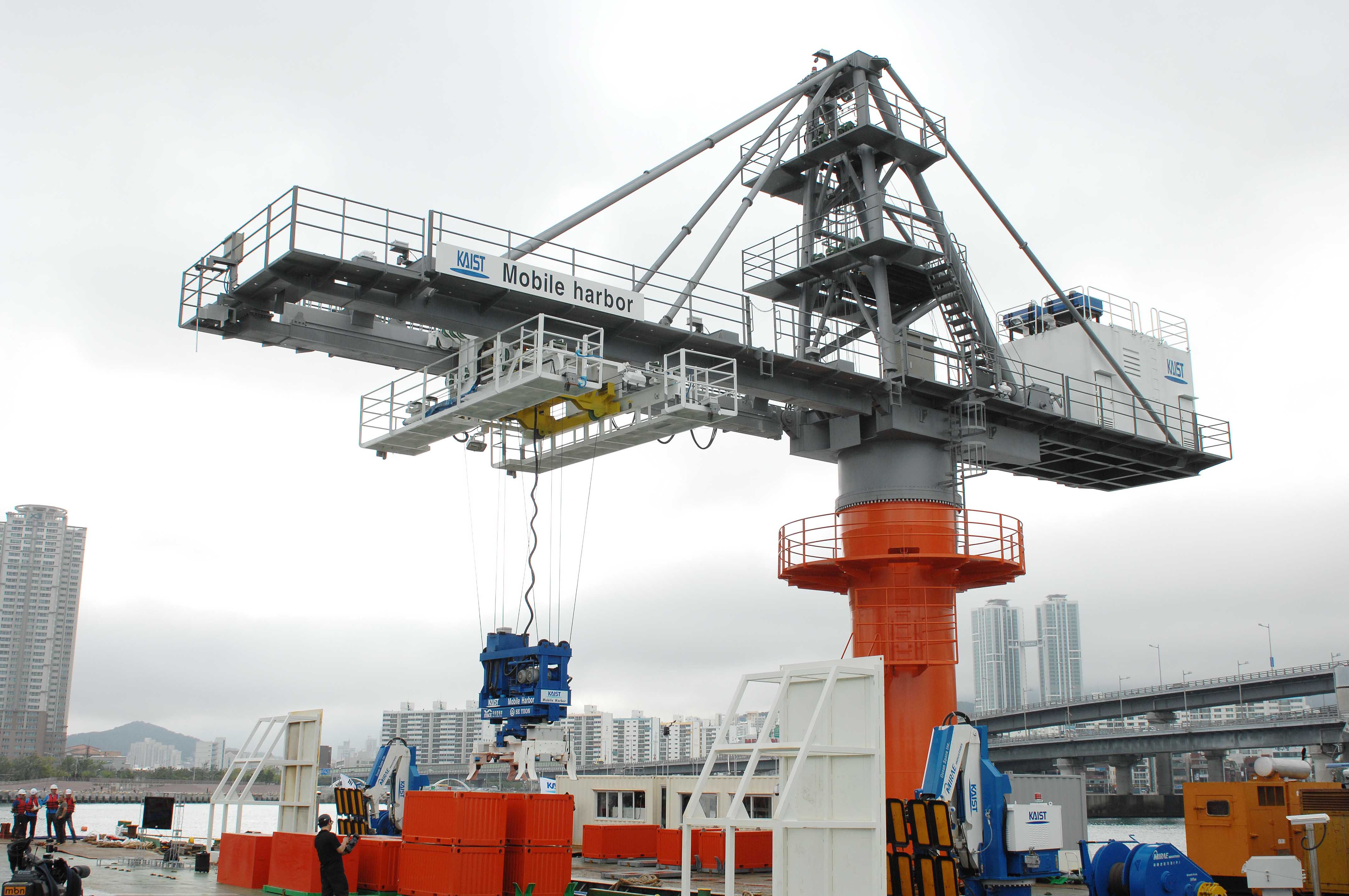
Busan, South Korea—Large container ships are no longer required to come into ports to transport cargo, as KAIST has developed an innovative technology that will transform the paradigm of today’s cargo handling operations. A Mobile Harbor is a vessel that carries a large stabilized crane with a smart spreader and multistage trolley system, enabling the loading and unloading of ship cargo on the wavy open sea. Following a successful docking of two vessels at sea in April of this year, KAIST conducted a full scope of Mobile Harbor operations in the inner sea of Busan, South Korea, on June 29, 2011.
Initiated in 2009, the Mobile Harbor (MH) is one of the university’s flagship research projects, which aims to provide a new growth engine that will lead the Korean economy to the next level of advancement, and to develop green technology through multidisciplinary and convergence research. The idea of MH came to light when thinking outside the box (why can’t a harbor go out to meet a ship on voyage and retrieve goods instead of ships coming into the harbor?) to improve problems relating to the current maritime transport system, such as port congestion, environmental issues caused by heavy sea transport, increased demand for supersized container ships, and the need for port construction and expansion.
The essential technology to establish a Mobile Harbor is a docking system and crane system that can overcome the obstacles imposed by the sea, i.e., waves and wind. Connecting two operating vessels of different sizes in the unpredictable and ever-changing environment of the sea was regarded as “impossible” and had never been tried before, but, on April 26, 2011, KAIST successfully demonstrated the technology to moor vessels safely and securely.
The Mobile Harbor has a unique way of mooring vessels that are anchored at sea: its flexibly designed robot arms with a square-shape vacuum suction pad at the tip reach out and attach to the hull of a container ship for docking. Each robot arm is connected to a cable and winch that further add stability to the Mobile Harbor. Foam-filled fenders are placed between the Mobile Harbor and the container ship, thereby maintaining a safe distance to prevent collisions.
The crane system consists of a multistage trolley, smart spreader, and tension controller, all of which provide the crane with functionality and stability to move around cargo containers in the sea. The crane system also has various sensors like cameras and laser scanners, and therefore, it can gauge the movement of the spreader and ships as well as trace a target container in real time. As a result, the spreader, a container grabbing device, is free from the swing motions when lifting and putting down cargo and grabs a target container safely in the wavy open sea.
During today’s at-sea demonstration in Busan, a research team from the KAIST Mobile Harbor Center docked a Mobile Harbor (a barge ship) right next to a container vessel (the other barge ship) and repeated freight transport operations between the two ships, presenting the great potential to commercialize the Mobile Harbor technology.
The project has been implemented in collaboration with industries, research institutes, and universities in such fields as mechanical engineering, robotics, automation engineering, and ocean systems engineering. The demonstration proceeded with a wide range of participants including researchers, engineers, government officials, and entrepreneurs from Korea and around the world.
Byung-Man Kwak, Director of the KAIST Mobile Harbor Center, explained his feelings on the successful demonstration:
“It’s been a remarkable journey to develop a Mobile Harbor from scratch, and I’m genuinely thrilled to showcase what we have accomplished so far. Today’s demonstration of Mobile Harbor’s core technologies will really change the face of our maritime transportation system. We will be able to deliver more goods to global markets and consumers via sea route, not necessarily building more ports or expanding the existing harbors. KAIST’s Mobile Harbor will also significantly cut down the high cost related to overland transportation of cargo and in return, contribute to the reduction of carbon emission.”
The Center has received much interest in possible market migration and broader application of the Mobile Harbor from businesses and organizations, e.g., US Office of Naval Research, King Fahd University of Petroleum and Minerals, Saudi Aramco, POSCO, and the Korean Navy.
2011.07.06 View 21821
KAIST Successfully Demonstrates Mobile Harbor in the Open Sea
Busan, South Korea—Large container ships are no longer required to come into ports to transport cargo, as KAIST has developed an innovative technology that will transform the paradigm of today’s cargo handling operations. A Mobile Harbor is a vessel that carries a large stabilized crane with a smart spreader and multistage trolley system, enabling the loading and unloading of ship cargo on the wavy open sea. Following a successful docking of two vessels at sea in April of this year, KAIST conducted a full scope of Mobile Harbor operations in the inner sea of Busan, South Korea, on June 29, 2011.
Initiated in 2009, the Mobile Harbor (MH) is one of the university’s flagship research projects, which aims to provide a new growth engine that will lead the Korean economy to the next level of advancement, and to develop green technology through multidisciplinary and convergence research. The idea of MH came to light when thinking outside the box (why can’t a harbor go out to meet a ship on voyage and retrieve goods instead of ships coming into the harbor?) to improve problems relating to the current maritime transport system, such as port congestion, environmental issues caused by heavy sea transport, increased demand for supersized container ships, and the need for port construction and expansion.
The essential technology to establish a Mobile Harbor is a docking system and crane system that can overcome the obstacles imposed by the sea, i.e., waves and wind. Connecting two operating vessels of different sizes in the unpredictable and ever-changing environment of the sea was regarded as “impossible” and had never been tried before, but, on April 26, 2011, KAIST successfully demonstrated the technology to moor vessels safely and securely.
The Mobile Harbor has a unique way of mooring vessels that are anchored at sea: its flexibly designed robot arms with a square-shape vacuum suction pad at the tip reach out and attach to the hull of a container ship for docking. Each robot arm is connected to a cable and winch that further add stability to the Mobile Harbor. Foam-filled fenders are placed between the Mobile Harbor and the container ship, thereby maintaining a safe distance to prevent collisions.
The crane system consists of a multistage trolley, smart spreader, and tension controller, all of which provide the crane with functionality and stability to move around cargo containers in the sea. The crane system also has various sensors like cameras and laser scanners, and therefore, it can gauge the movement of the spreader and ships as well as trace a target container in real time. As a result, the spreader, a container grabbing device, is free from the swing motions when lifting and putting down cargo and grabs a target container safely in the wavy open sea.
During today’s at-sea demonstration in Busan, a research team from the KAIST Mobile Harbor Center docked a Mobile Harbor (a barge ship) right next to a container vessel (the other barge ship) and repeated freight transport operations between the two ships, presenting the great potential to commercialize the Mobile Harbor technology.
The project has been implemented in collaboration with industries, research institutes, and universities in such fields as mechanical engineering, robotics, automation engineering, and ocean systems engineering. The demonstration proceeded with a wide range of participants including researchers, engineers, government officials, and entrepreneurs from Korea and around the world.
Byung-Man Kwak, Director of the KAIST Mobile Harbor Center, explained his feelings on the successful demonstration:
“It’s been a remarkable journey to develop a Mobile Harbor from scratch, and I’m genuinely thrilled to showcase what we have accomplished so far. Today’s demonstration of Mobile Harbor’s core technologies will really change the face of our maritime transportation system. We will be able to deliver more goods to global markets and consumers via sea route, not necessarily building more ports or expanding the existing harbors. KAIST’s Mobile Harbor will also significantly cut down the high cost related to overland transportation of cargo and in return, contribute to the reduction of carbon emission.”
The Center has received much interest in possible market migration and broader application of the Mobile Harbor from businesses and organizations, e.g., US Office of Naval Research, King Fahd University of Petroleum and Minerals, Saudi Aramco, POSCO, and the Korean Navy.
2011.07.06 View 21821 -
World?'s First Automated Maritime-Docking between Naval Vessels
KAIST demonstrated the technology that allows automated maritime docking between naval vessels on the 26th of April at Busan, Korea.
The docking technology is seen as one of the key components for the mobile harbor as it prevents collision between two naval vessels upon docking. It was recognized as an important technology worldwide, but its technological limitations made it hard to commercialize.
The demonstrated included approaching a barge next to a cargo vessel, performing automated docking, and maintaining the docking and solutions in the advent of an emergency.
The mobile harbor is, in essence, is a ‘moving port’ and the automated docking technology is imperative to commercialize the mobile harbor. In order for a large container ship to unload cargo, the mobile harbor needs to approach the container ship and dock onto the side of the ship.
The technology required to keep the two moving vessels docked, out at sea, in an efficient and safe manner, is daunting. The conventional method involved sailors tying the two vessels together with rope which made it time consuming and hard to react quickly in emergency situations.
The KAIST mobile harbor research team developed the docking technology with ‘Mirae Industrial Machine’ Maritime Corporation, and ‘Ocean Space’. The mobile harbor will allow two vessels to perform loading and unloading of cargo regardless of wind and current, using robotic arms, vacuum attachment pads, wench, and are a complex, integrated system.
KAIST is planning on having a demonstration that encompasses all the technology required for mobile harbor: from the docking technology to the stabilizing crane technology.
Advancements made by KAIST are expected to speed up the commercialization and the real life application of mobile harbor.
2011.05.11 View 15171
-
Cho Cheon Shik Graduate School of Green Transportation Initiated
KAIST established the Graduate School of Green Transportation in efforts to participate actively in the green transportation market and train experts in the field.
The opening ceremony was conducted in the KI building with President of KAIST Seo Nam Pyo and other dignitaries from Ministry of Land, Transport and Maritime Affairs, Korea Rail Network Authority, Korea Airports Corporation, Korea Railroad Research Institute, Land, Transport and Maritime Experts Training Institute, Seoul Development Institute, LG Innotech, Hyundai Rotem, and other major companies in the field of transportation attending.
The graduate school was founded with funding from donation made by Chairman Cho Cheon Shik. Developer of OLEV Professor Cho Dong Ho is the dean of the school and 16 other professors are a part of the school.
Courses offered include ‘Transportation Technology’ and ‘Transportation management’ and will focus mostly on allowing students to be a part of the graduate school with flexibility.
In terms of research there is the OLEV and mobile harbor and research will be done on electric and electronics, mechanics, materials, aeronautics, maritime, construction, environment, and etc. and will be an interdisciplinary research.
A memorandum of understanding was signed by the companies mentioned above which has now paved the way for experts to be trained and thus upgrade the level of technology in the field of green transportation.
Professor Seo of KAIST commented, ‘Korea is ranked top 10 in the world for greenhouse gas emissions and it has become hard to avoid global pressure. The results of researched performed at KAIST will allow Korea to form a green, sustainable society leading in the field of green transportation and dominate the market.
2011.02.23 View 25129
-
 KAIST's Mobile Harbor Program Attracts Two Corporate Investments
KAIST-developed Mobile Harbor Program has attracted investments from Korea"s two big-name industrial corporations, university authorities said on Monday (Oct. 19).
KAIST has recently signed an agreement with Hyundai Wia Corp., a machine parts supplier, to collaborate in the researches of the mobile harbor programs and commercialization. Under the agreement, Hyundai WIA will invest a total of 7.5 billion won in the program for two years starting from January 2010.
KAIST has also received a letter of intent from the Daewoo Shipbuilding & Marine Engineering Co. on investing 20 billion won in the commercialization of the project.
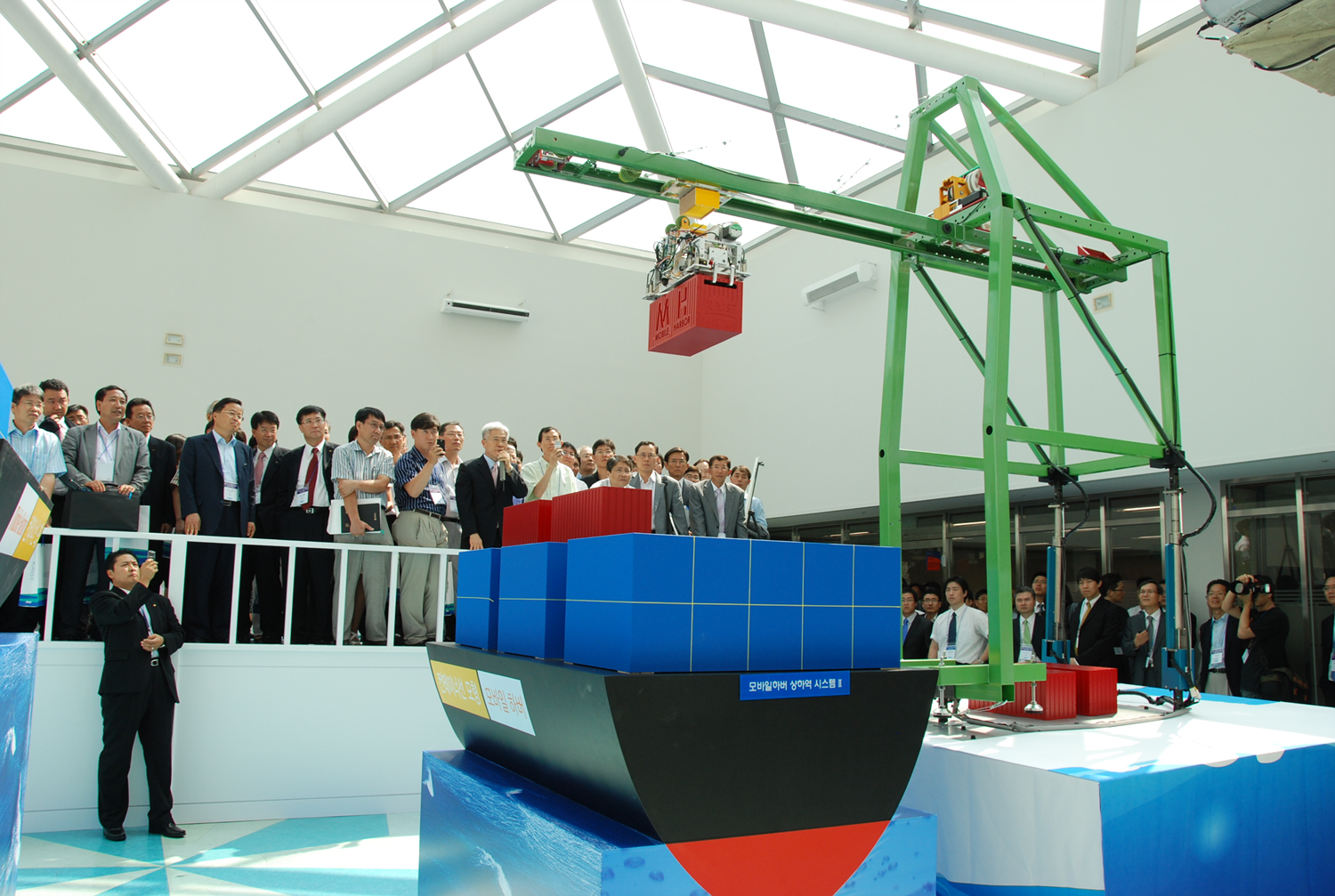
The Mobile Harbor Program is designed to create mobile units that can go out to the ship which are anchored off-shore and unload the cargo and take it to where it is needed. It is aimed at overcoming the shortcomings of the current maritime container transportation systems. Container ships are getting larger and larger, requiring deep waters, large and complex loading and unloading systems, and major investments in facilities.
Prof. Byung-Man Kwak, leader of the program"s R&D team, said: "With the investment from two global industrial companies, the program has gained a crucial momentum. The development of the program is expected to help Korea to become a global leader in marine transportation and maintain its supremacy in shipbuilding."
2009.10.20 View 24011
KAIST's Mobile Harbor Program Attracts Two Corporate Investments
KAIST-developed Mobile Harbor Program has attracted investments from Korea"s two big-name industrial corporations, university authorities said on Monday (Oct. 19).
KAIST has recently signed an agreement with Hyundai Wia Corp., a machine parts supplier, to collaborate in the researches of the mobile harbor programs and commercialization. Under the agreement, Hyundai WIA will invest a total of 7.5 billion won in the program for two years starting from January 2010.
KAIST has also received a letter of intent from the Daewoo Shipbuilding & Marine Engineering Co. on investing 20 billion won in the commercialization of the project.
The Mobile Harbor Program is designed to create mobile units that can go out to the ship which are anchored off-shore and unload the cargo and take it to where it is needed. It is aimed at overcoming the shortcomings of the current maritime container transportation systems. Container ships are getting larger and larger, requiring deep waters, large and complex loading and unloading systems, and major investments in facilities.
Prof. Byung-Man Kwak, leader of the program"s R&D team, said: "With the investment from two global industrial companies, the program has gained a crucial momentum. The development of the program is expected to help Korea to become a global leader in marine transportation and maintain its supremacy in shipbuilding."
2009.10.20 View 24011 -
 KAIST Appoints Two CEOs for Promotion of Innovative Projects
KAIST has appointed chief executive officers (CEO) for the two companies KAIST has recently established to carry out two innovative "low-carbon, green growth projects" supported by the Korean government, university authorities said on Monday (June 2).
Chung-Sung Ahn, a former executive of Hyundai Heavy Industries Co., a top shipbuilder of the world, was appointed as the CEO of the Mobile Harbor Co., and Chung-Koo Lee, a former president of Hyundai Motor Co., as CEO of the On-Line Electric Car Co.
The two companies have been newly established for the commercial operation of the mobile harbor and on-line electric car projects that KAIST has been working on.
KAIST has developed a plan to power electric cars through re-charging strips embedded in roadways. The university has built a prototype on its campus for electric-powered golf carts and worked on designs that would power cars and buses.
The mobile harbor system is motivated by a growing need for an innovative container transport service system to effectively meet continuing increase in global container shipping volume, KAIST has developed a system that can unload containers from a containership to a floating harbor in the sea and deliver them to a land terminal and load cargoes in a reverse way.
The 71-year-old Ahn of the Mobile Harbor Co. served as the president of the Offshore & Engineering Division and the Industrial Plant & Engineering Division of Hyundai Heavy Industries Co. from 2003 to 2005. He completed Advanced Management Program (AMP) from Harvard Business School in 1990. Ahn obtained Ph.D. in ocean engineering from MIT in 1972, M.S. in naval architecture from MIT in 1969, M.S. in meteorology/oceanography from MIT in 1967 and B.S. in Maritime Science from Korea Maritime University in 1959.
Chung-Koo Lee, 64, served as president of Hyundai Motor Co. from 1992 to 2002 and as a member of the Presidential Advisory Council on Science and Technology from 2001 to 2003.
2009.06.05 View 15885
KAIST Appoints Two CEOs for Promotion of Innovative Projects
KAIST has appointed chief executive officers (CEO) for the two companies KAIST has recently established to carry out two innovative "low-carbon, green growth projects" supported by the Korean government, university authorities said on Monday (June 2).
Chung-Sung Ahn, a former executive of Hyundai Heavy Industries Co., a top shipbuilder of the world, was appointed as the CEO of the Mobile Harbor Co., and Chung-Koo Lee, a former president of Hyundai Motor Co., as CEO of the On-Line Electric Car Co.
The two companies have been newly established for the commercial operation of the mobile harbor and on-line electric car projects that KAIST has been working on.
KAIST has developed a plan to power electric cars through re-charging strips embedded in roadways. The university has built a prototype on its campus for electric-powered golf carts and worked on designs that would power cars and buses.
The mobile harbor system is motivated by a growing need for an innovative container transport service system to effectively meet continuing increase in global container shipping volume, KAIST has developed a system that can unload containers from a containership to a floating harbor in the sea and deliver them to a land terminal and load cargoes in a reverse way.
The 71-year-old Ahn of the Mobile Harbor Co. served as the president of the Offshore & Engineering Division and the Industrial Plant & Engineering Division of Hyundai Heavy Industries Co. from 2003 to 2005. He completed Advanced Management Program (AMP) from Harvard Business School in 1990. Ahn obtained Ph.D. in ocean engineering from MIT in 1972, M.S. in naval architecture from MIT in 1969, M.S. in meteorology/oceanography from MIT in 1967 and B.S. in Maritime Science from Korea Maritime University in 1959.
Chung-Koo Lee, 64, served as president of Hyundai Motor Co. from 1992 to 2002 and as a member of the Presidential Advisory Council on Science and Technology from 2001 to 2003.
2009.06.05 View 15885