Campus/People
-
 KAIST launches "Junior KAIST" for future scientists who will change the world
KAIST (President Kwang Hyung Lee) announced on the 27th of August that it is relaunching its online gifted education program, KAIST Cyber Gifted Education, from the KAIST Center for Gifted Education, into "Junior KAIST," an open science and engineering exploration platform in which any elementary, middle, or high school student can participate.
This reorganization was carried out to respond to the declining school-age population, the tendency to avoid science and engineering fields, and the acceleration of digital transformation, with the aim of establishing a national talent development model that supports the early discovery and systematic growth of future science and technology talent. Through this, KAIST plans to expand the base of science and technology talent, reduce regional and social educational gaps, and realize inclusive science and technology education.
"Junior KAIST" is a step-by-step inquiry-based online curriculum designed to help students develop interest in science and technology fields and deepen their exploration of areas of interest. In the long term, it aims to discover outstanding science and engineering talent and strengthen connections to higher education and career pathways.
In particular, for students from the 4th grade of elementary school to the 2nd year of high school, it operates a grade-specific customized learning curriculum—Enjoy, Dive, Challenge, Boost, and ACE (Achieve Complete Exploration)—to support learning suited to individual levels and interests, while intensively strengthening core STEM (Science, Technology, Engineering, Mathematics) competencies such as mathematics, science, future technology, AI, and data-based problem solving.
In addition, the program will expand its Question-Based Learning (QBL) model, where students create and investigate their own questions. Outstanding students will also be given opportunities for real career experience, including mentoring with KAIST professors and university (graduate) students, participation in laboratory-based projects, and the presentation of research outcomes. KAIST plans to establish a virtuous cycle talent development system that will, in the long term, connect to admission into science high schools, gifted high schools, and KAIST itself.
In the second semester of the 2025 academic year, various courses such as "Enjoy Mathematics," "Enjoy Robots," and "Enjoy AI" will be offered, and registration is available until August 31 through the official website (junior.kaist.ac.kr).
Sijong Kwak, Director of the KAIST Center for Gifted Education Research, said, “Junior KAIST is not just gifted education, but a platform for fostering future science and technology talent that grows through curiosity, inquiry, and creativity. We will do our utmost to ensure that KAIST establishes itself as a representative model for national science and technology talent development.”
2025.08.28 View 4539
KAIST launches "Junior KAIST" for future scientists who will change the world
KAIST (President Kwang Hyung Lee) announced on the 27th of August that it is relaunching its online gifted education program, KAIST Cyber Gifted Education, from the KAIST Center for Gifted Education, into "Junior KAIST," an open science and engineering exploration platform in which any elementary, middle, or high school student can participate.
This reorganization was carried out to respond to the declining school-age population, the tendency to avoid science and engineering fields, and the acceleration of digital transformation, with the aim of establishing a national talent development model that supports the early discovery and systematic growth of future science and technology talent. Through this, KAIST plans to expand the base of science and technology talent, reduce regional and social educational gaps, and realize inclusive science and technology education.
"Junior KAIST" is a step-by-step inquiry-based online curriculum designed to help students develop interest in science and technology fields and deepen their exploration of areas of interest. In the long term, it aims to discover outstanding science and engineering talent and strengthen connections to higher education and career pathways.
In particular, for students from the 4th grade of elementary school to the 2nd year of high school, it operates a grade-specific customized learning curriculum—Enjoy, Dive, Challenge, Boost, and ACE (Achieve Complete Exploration)—to support learning suited to individual levels and interests, while intensively strengthening core STEM (Science, Technology, Engineering, Mathematics) competencies such as mathematics, science, future technology, AI, and data-based problem solving.
In addition, the program will expand its Question-Based Learning (QBL) model, where students create and investigate their own questions. Outstanding students will also be given opportunities for real career experience, including mentoring with KAIST professors and university (graduate) students, participation in laboratory-based projects, and the presentation of research outcomes. KAIST plans to establish a virtuous cycle talent development system that will, in the long term, connect to admission into science high schools, gifted high schools, and KAIST itself.
In the second semester of the 2025 academic year, various courses such as "Enjoy Mathematics," "Enjoy Robots," and "Enjoy AI" will be offered, and registration is available until August 31 through the official website (junior.kaist.ac.kr).
Sijong Kwak, Director of the KAIST Center for Gifted Education Research, said, “Junior KAIST is not just gifted education, but a platform for fostering future science and technology talent that grows through curiosity, inquiry, and creativity. We will do our utmost to ensure that KAIST establishes itself as a representative model for national science and technology talent development.”
2025.08.28 View 4539 -
 Professor Sung Yong Kim Publishes English Book, 'A Cup of Coffee and the Ocean'
<Professor Sung Yong Kim from Department of Mechanical Engineering>
Professor Sung Yong Kim of the Department of Mechanical Engineering announced the publication of his English book, ‘A Cup of Coffee and the Ocean: Basics of Ocean Dynamics for Everyone’, by the world-renowned academic publisher Springer Nature on August 22nd. The book was designed to easily explain the basics of the ocean, various physical phenomena, and safety common sense to high school students, university students, and the general public, using the familiar subject of coffee.
Professor Kim previously published 'Coffee and the Ocean,' Volume 34 of the 'Scholars Talk about Science and Technology' series, with support from the Korean Academy of Science and Technology in 2019. The new English edition is a rewrite based on that content, targeting an international readership.
The book explains the characteristics of fluids found in everyday coffee, expanding this to illustrate fluid phenomena in the ocean, and also includes various ocean-related safety tips. The goal is to help readers understand the principles of fluids and raise awareness of marine safety. Furthermore, it emphasizes that understanding the ocean is directly connected to national competence and includes a plea from the perspective of an oceanographer.
Professor Kim commented, "The ocean is a global shared space that is not limited by the boundaries of specific regions. This English book was published to broaden the understanding of the ocean not just domestically but among readers worldwide. Through this, I hope to see more oceanographers with a sense of mission who can see the bigger picture."
Book Cover Image
< Book Cover Image >
Related Book Links:
(Link for KAIST Insiders)
https://link-springer-com.libra.kaist.ac.kr/book/10.1007/978-981-96-6835-9
(Link for the General Public)
https://link.springer.com/book/10.1007/978-981-96-6835-9
< QR Code Linking to the Site >
This book was introduced on the UN Ocean Decade official website, and its significance is further amplified by its subject matter being closely aligned with the UN Sustainable Development Goals (SDGs).Furthermore, Professor Nadia Pinardi, who specializes in Physical Oceanography at the University of Bologna (Università di Bologna) in Italy, has communicated that the university plans to translate the book into Italian and utilize it as a textbook for marine education across Italy starting in 2027.The search results include a video featuring Professor Nadia Pinardi discussing sea level rise and coastal adaptation.
https://oceandecade.org/publications/a-cup-of-coffee-and-the-ocean-the-basics-of-ocean-dynamics/
2025.08.27 View 918
Professor Sung Yong Kim Publishes English Book, 'A Cup of Coffee and the Ocean'
<Professor Sung Yong Kim from Department of Mechanical Engineering>
Professor Sung Yong Kim of the Department of Mechanical Engineering announced the publication of his English book, ‘A Cup of Coffee and the Ocean: Basics of Ocean Dynamics for Everyone’, by the world-renowned academic publisher Springer Nature on August 22nd. The book was designed to easily explain the basics of the ocean, various physical phenomena, and safety common sense to high school students, university students, and the general public, using the familiar subject of coffee.
Professor Kim previously published 'Coffee and the Ocean,' Volume 34 of the 'Scholars Talk about Science and Technology' series, with support from the Korean Academy of Science and Technology in 2019. The new English edition is a rewrite based on that content, targeting an international readership.
The book explains the characteristics of fluids found in everyday coffee, expanding this to illustrate fluid phenomena in the ocean, and also includes various ocean-related safety tips. The goal is to help readers understand the principles of fluids and raise awareness of marine safety. Furthermore, it emphasizes that understanding the ocean is directly connected to national competence and includes a plea from the perspective of an oceanographer.
Professor Kim commented, "The ocean is a global shared space that is not limited by the boundaries of specific regions. This English book was published to broaden the understanding of the ocean not just domestically but among readers worldwide. Through this, I hope to see more oceanographers with a sense of mission who can see the bigger picture."
Book Cover Image
< Book Cover Image >
Related Book Links:
(Link for KAIST Insiders)
https://link-springer-com.libra.kaist.ac.kr/book/10.1007/978-981-96-6835-9
(Link for the General Public)
https://link.springer.com/book/10.1007/978-981-96-6835-9
< QR Code Linking to the Site >
This book was introduced on the UN Ocean Decade official website, and its significance is further amplified by its subject matter being closely aligned with the UN Sustainable Development Goals (SDGs).Furthermore, Professor Nadia Pinardi, who specializes in Physical Oceanography at the University of Bologna (Università di Bologna) in Italy, has communicated that the university plans to translate the book into Italian and utilize it as a textbook for marine education across Italy starting in 2027.The search results include a video featuring Professor Nadia Pinardi discussing sea level rise and coastal adaptation.
https://oceandecade.org/publications/a-cup-of-coffee-and-the-ocean-the-basics-of-ocean-dynamics/
2025.08.27 View 918 -
 KAIST–National Intelligence Service Successfully Hold the 4th University Research Security Education Council Workshop
KAIST (President Kwang Hyung Lee) announced on the 22nd of August that, together with the National Intelligence Service, it held the “4th University Research Security Education Council Workshop” at the Academic Cultural Complex on KAIST’s main campus in Daejeon on the 21st.
This 4th workshop was held under the theme of “Global Research Security,” based on the recognition that technology leakage can have serious impacts not only on the national economy and security but on international exchanges in science and technology. Accordingly, national policies and outstanding cases from institutions to enhance the level of university research security management were shared, and practical security enhancement measures applicable in the field were discussed.
In the presentation sessions, △ the Ministry of Science and ICT presented the government’s policy direction for strengthening research security, △ the National Institute for International Education and Training (KIRD) gave a presentation on settlement and career support programs for foreign researchers in science and engineering, △ the Korea Strategic Trade Institute (KOSTI) introduced the Authorized Economic Operator (AEO/CP) system for universities’ dual-use items and technology export control measures, and △ the Korea Institute of S&T Evaluation and Planning (KISTEP) conducted a special lecture on research security field manuals.
In the university case presentations, KAIST shared achievements in promoting global research security, while Yong In University introduced its newly launched program this year for fostering security professionals.
This event was attended by more than 130 participants from approximately 70 universities nationwide, including Seoul National University and Ewha Womans University, as well as officials from the Ministry of Science and ICT, the National Intelligence Service, KIRD, KISTEP, and KOSTI.
An NIS official stated, “With the rapid changes in the university research environment due to the expansion of international joint research and the increase in international students, the establishment of a research security culture has become more important than ever. Based on the excellent cases shared at the workshop, we will actively reflect the opinions of host institutions to spread security awareness and continue preparing effective countermeasures.”
Cheol Seong Jang, President of the National University Council of Research & Industry Cooperation and Research Directors (Professor at Kangwon National University), emphasized, “If the ideas and cases discussed at the workshop are applied in university settings, they will greatly contribute to Korea leading the establishment of a trusted global research ecosystem.”
Byung-Kwan Cho, Director of Research at KAIST, said, “KAIST will not hesitate to introduce and spread leading research security systems so that our efforts to strengthen research security become a benchmark for other universities. By applying the principle of open science — ‘as open as possible, as closed as necessary’ — we will ensure that research security and global exchanges achieve harmony.”
The University Research Security Education Council was launched in June 2022 with joint supervision by KAIST and the National Intelligence Service and cooperation from KIRD. This year’s workshop was co-hosted by KAIST, the National Intelligence Service, and Kangwon National University.
2025.08.22 View 2543
KAIST–National Intelligence Service Successfully Hold the 4th University Research Security Education Council Workshop
KAIST (President Kwang Hyung Lee) announced on the 22nd of August that, together with the National Intelligence Service, it held the “4th University Research Security Education Council Workshop” at the Academic Cultural Complex on KAIST’s main campus in Daejeon on the 21st.
This 4th workshop was held under the theme of “Global Research Security,” based on the recognition that technology leakage can have serious impacts not only on the national economy and security but on international exchanges in science and technology. Accordingly, national policies and outstanding cases from institutions to enhance the level of university research security management were shared, and practical security enhancement measures applicable in the field were discussed.
In the presentation sessions, △ the Ministry of Science and ICT presented the government’s policy direction for strengthening research security, △ the National Institute for International Education and Training (KIRD) gave a presentation on settlement and career support programs for foreign researchers in science and engineering, △ the Korea Strategic Trade Institute (KOSTI) introduced the Authorized Economic Operator (AEO/CP) system for universities’ dual-use items and technology export control measures, and △ the Korea Institute of S&T Evaluation and Planning (KISTEP) conducted a special lecture on research security field manuals.
In the university case presentations, KAIST shared achievements in promoting global research security, while Yong In University introduced its newly launched program this year for fostering security professionals.
This event was attended by more than 130 participants from approximately 70 universities nationwide, including Seoul National University and Ewha Womans University, as well as officials from the Ministry of Science and ICT, the National Intelligence Service, KIRD, KISTEP, and KOSTI.
An NIS official stated, “With the rapid changes in the university research environment due to the expansion of international joint research and the increase in international students, the establishment of a research security culture has become more important than ever. Based on the excellent cases shared at the workshop, we will actively reflect the opinions of host institutions to spread security awareness and continue preparing effective countermeasures.”
Cheol Seong Jang, President of the National University Council of Research & Industry Cooperation and Research Directors (Professor at Kangwon National University), emphasized, “If the ideas and cases discussed at the workshop are applied in university settings, they will greatly contribute to Korea leading the establishment of a trusted global research ecosystem.”
Byung-Kwan Cho, Director of Research at KAIST, said, “KAIST will not hesitate to introduce and spread leading research security systems so that our efforts to strengthen research security become a benchmark for other universities. By applying the principle of open science — ‘as open as possible, as closed as necessary’ — we will ensure that research security and global exchanges achieve harmony.”
The University Research Security Education Council was launched in June 2022 with joint supervision by KAIST and the National Intelligence Service and cooperation from KIRD. This year’s workshop was co-hosted by KAIST, the National Intelligence Service, and Kangwon National University.
2025.08.22 View 2543 -
 KAIST to Host the ‘6th Emerging Materials Symposium’
KAIST (President Kwang Hyung Lee) announced on the 22nd of August that it will host the 6th KAIST Emerging Materials Symposium on the 26th in the Meta Convergence Hall (W13) on its main Daejeon campus, to explore the latest research trends in next-generation promising nanomaterials and discuss future visions.
Launched in 2020, this symposium marks its sixth year and has established itself as KAIST’s flagship academic event by inviting world-renowned scholars on next-generation materials to share groundbreaking achievements.
The event will feature six speakers from four prestigious overseas universities—the Massachusetts Institute of Technology (MIT), Yale University, UCLA, and Drexel University—providing an overview of cutting-edge global research trends in emerging materials, while also showcasing KAIST’s representative achievements.
Notably, Professor Yury Gogotsi of Drexel University, who gained global recognition for the pioneering development of MXene—an emerging material attracting attention for its high electrical conductivity and electromagnetic shielding capability—will deliver a lecture titled “The Future of MXene.”
In the session “Global Frontier in MIT,” three MIT professors will present the institute’s leading research: ▴Professor Ju Li, an authority on AI-robotics-based materials synthesis, ▴Professor Martin Z. Bazant, an expert in the fields of electrochemistry and electronic transport dynamics, and ▴Professor Jeehwan Kim, a leading researcher tackling the limitations of silicon wafer-based semiconductor manufacturing.
In the session “Emerging Materials and New Possibilities,” ▴Professor Yury Gogotsi of Drexel University, ▴Professor Liangbing Hu of Yale University, a pioneer in nanoparticle synthesis through rapid high-temperature thermal processing, and ▴Professor Jun Chen of UCLA, a key researcher in bioelectronic materials using multifunctional flexible materials, will present the development of core emerging materials and future directions.
Additionally, six professors from KAIST’s Department of Materials Science and Engineering will lead the session “KAIST’s MSE Entrepreneurial Spirit” where they will share the process of founding startups based on KAIST’s advanced materials technologies and how nanomaterials have taken root as foundational industries.
The session will include: ▴Professor Il-Doo Kim, founder of the nanofiber and colorimetric gas sensor company IDKLAB; ▴Professor Kibeom Kang, CEO of TDS Innovation, a company specializing in precursors and equipment for 2D material synthesis; ▴Professor Yeonsik Jeong, co-founder of Pico Foundry, a company producing SERS chips; ▴Professor Sang Wook Kim, founder of Materials Creation, which develops products based on high-quality graphene oxide; ▴Professor Jaebeom Jang, founder of Flashomic Inc., a leader in the commercialization of high-speed multiplexed protein imaging technology; and ▴Professor Steve Park, co-CEO of Aldaver, a company developing artificial cadavers (practice organs) that fully replicate the human body. They will each share their entrepreneurial cases, offering vivid lectures on the journey of scientific technologies into the marketplace.
The symposium will also feature a tour of the automated research lab at the Top-Tier KAIST-MIT Future Energy Initiative Research Center, jointly established by KAIST and MIT. The center, designed to build an AI-robotics-based autonomous research laboratory for the rapid development and application of advanced energy materials to help solve the global climate crisis, will operate for ten years. Overseas scholars will also be given an inside look at research and development using automated infrastructure, with discussions to follow on upcoming international collaborations.
Professor Il-Doo Kim of KAIST’s Department of Materials Science and Engineering, who organized the event, emphasized, “This symposium, featuring six global scholars and six KAIST entrepreneurial professors, will be a valuable opportunity to instill an international perspective and entrepreneurial mindset in students. It will also mark a turning point in KAIST’s innovative materials research and international collaborative research network.”
As part of the program, on Wednesday the 27th, KAIST will hold academic exchange sessions with overseas scholars. These will include discussions on international joint research, as well as sessions where KAIST students and early-career researchers can present their work and interact, opening opportunities for future collaborations.
The 6th KAIST Emerging Materials Symposium is open free of charge to all researchers interested in the latest research trends in chemistry, physics, biology, and materials science-related engineering fields.
Participation on the 26th will be available through on-site registration without prior application. Further details are available on the KAIST Department of Materials Science and Engineering EMS website (https://mse.kaist.ac.kr/index.php?mid=MSE_EMS).
2025.08.22 View 3867
KAIST to Host the ‘6th Emerging Materials Symposium’
KAIST (President Kwang Hyung Lee) announced on the 22nd of August that it will host the 6th KAIST Emerging Materials Symposium on the 26th in the Meta Convergence Hall (W13) on its main Daejeon campus, to explore the latest research trends in next-generation promising nanomaterials and discuss future visions.
Launched in 2020, this symposium marks its sixth year and has established itself as KAIST’s flagship academic event by inviting world-renowned scholars on next-generation materials to share groundbreaking achievements.
The event will feature six speakers from four prestigious overseas universities—the Massachusetts Institute of Technology (MIT), Yale University, UCLA, and Drexel University—providing an overview of cutting-edge global research trends in emerging materials, while also showcasing KAIST’s representative achievements.
Notably, Professor Yury Gogotsi of Drexel University, who gained global recognition for the pioneering development of MXene—an emerging material attracting attention for its high electrical conductivity and electromagnetic shielding capability—will deliver a lecture titled “The Future of MXene.”
In the session “Global Frontier in MIT,” three MIT professors will present the institute’s leading research: ▴Professor Ju Li, an authority on AI-robotics-based materials synthesis, ▴Professor Martin Z. Bazant, an expert in the fields of electrochemistry and electronic transport dynamics, and ▴Professor Jeehwan Kim, a leading researcher tackling the limitations of silicon wafer-based semiconductor manufacturing.
In the session “Emerging Materials and New Possibilities,” ▴Professor Yury Gogotsi of Drexel University, ▴Professor Liangbing Hu of Yale University, a pioneer in nanoparticle synthesis through rapid high-temperature thermal processing, and ▴Professor Jun Chen of UCLA, a key researcher in bioelectronic materials using multifunctional flexible materials, will present the development of core emerging materials and future directions.
Additionally, six professors from KAIST’s Department of Materials Science and Engineering will lead the session “KAIST’s MSE Entrepreneurial Spirit” where they will share the process of founding startups based on KAIST’s advanced materials technologies and how nanomaterials have taken root as foundational industries.
The session will include: ▴Professor Il-Doo Kim, founder of the nanofiber and colorimetric gas sensor company IDKLAB; ▴Professor Kibeom Kang, CEO of TDS Innovation, a company specializing in precursors and equipment for 2D material synthesis; ▴Professor Yeonsik Jeong, co-founder of Pico Foundry, a company producing SERS chips; ▴Professor Sang Wook Kim, founder of Materials Creation, which develops products based on high-quality graphene oxide; ▴Professor Jaebeom Jang, founder of Flashomic Inc., a leader in the commercialization of high-speed multiplexed protein imaging technology; and ▴Professor Steve Park, co-CEO of Aldaver, a company developing artificial cadavers (practice organs) that fully replicate the human body. They will each share their entrepreneurial cases, offering vivid lectures on the journey of scientific technologies into the marketplace.
The symposium will also feature a tour of the automated research lab at the Top-Tier KAIST-MIT Future Energy Initiative Research Center, jointly established by KAIST and MIT. The center, designed to build an AI-robotics-based autonomous research laboratory for the rapid development and application of advanced energy materials to help solve the global climate crisis, will operate for ten years. Overseas scholars will also be given an inside look at research and development using automated infrastructure, with discussions to follow on upcoming international collaborations.
Professor Il-Doo Kim of KAIST’s Department of Materials Science and Engineering, who organized the event, emphasized, “This symposium, featuring six global scholars and six KAIST entrepreneurial professors, will be a valuable opportunity to instill an international perspective and entrepreneurial mindset in students. It will also mark a turning point in KAIST’s innovative materials research and international collaborative research network.”
As part of the program, on Wednesday the 27th, KAIST will hold academic exchange sessions with overseas scholars. These will include discussions on international joint research, as well as sessions where KAIST students and early-career researchers can present their work and interact, opening opportunities for future collaborations.
The 6th KAIST Emerging Materials Symposium is open free of charge to all researchers interested in the latest research trends in chemistry, physics, biology, and materials science-related engineering fields.
Participation on the 26th will be available through on-site registration without prior application. Further details are available on the KAIST Department of Materials Science and Engineering EMS website (https://mse.kaist.ac.kr/index.php?mid=MSE_EMS).
2025.08.22 View 3867 -
 KAIST Takes the Lead in Developing Core Technologies for Generative AI National R&D Project
KAIST announced on the 15th of August that Professor Sanghoo Park of the Department of Nuclear and Quantum Engineering has won two consecutive awards for early-career researchers at two of the world's most prestigious plasma academic conferences.
Professor Park was selected as a recipient of the Early Career Award (ECA) at the Gaseous Electronics Conference (GEC), hosted by the American Physical Society, on August 4. He was also honored with the Young Investigator Award, presented by the International Plasma Chemistry Society (IPCS), on June 19.
The American Physical Society's GEC Early Career Award is given to only one person worldwide every two years, based on a comprehensive evaluation of research excellence, academic influence, and contributions to the field of plasma. The award will be presented at GEC 2025, which will be held at COEX in Seoul from October 13 to 17.
Established in 1948, the GEC is a leading academic conference in the plasma field with a 77-year history of showcasing key research achievements in all areas of plasma, including physics, chemistry, diagnostics, and application technologies. Recently, advanced application research such as eco-friendly chemical processes, next-generation semiconductors, and atomic layer and ultra-low-temperature etching technology for HBM processes have been gaining attention.
To commemorate the award, Professor Park will give an invited lecture at GEC 2025 on the topic of "Deep-Learning-Based Spectroscopic Data Analysis for Advancing Plasma Spectroscopy." In his lecture, he will use case studies to demonstrate a method that allows even non-specialists to easily and quickly perform spectroscopic data analysis—which is essential for spectroscopy, a key analytical method in modern science including plasma diagnostics—by using deep learning technology.
Professor Park also won the Young Investigator Award from the IPCS at the 26th International Symposium on Plasma Chemistry (ISPC 26), which was held in Minneapolis, USA, from June 15 to 20.
First held in 1973, the ISPC (International Symposium on Plasma Chemistry) is a representative international conference in the field of plasma chemistry, held biennially. It covers a wide range of topics, from basic plasma chemical reaction principles to applications in semiconductor processes, green energy, environmental science, and biotechnology. Researchers from industry, academia, and research institutions worldwide share their latest findings at each event. The Young Investigator Award is given to a scientist who has obtained their doctorate within the last 10 years and has demonstrated outstanding achievements in the field.
Professor Park was recognized for his leading research achievements in using plasma-liquid interactions and real-time optical diagnostic technology to environmentally fix nitrogen from the air and precisely control the quantity and types of reactive chemical species that are beneficial to the human body and the environment.
Professor Sanghoo Park stated, "It is very meaningful to receive the Young Investigator Award representing Korea at the GEC event, which is being held in Korea for the first time in its history." He added, "I am happy that my consistent interest in and achievements in fundamental plasma science have been recognized, and it is even more significant that the efforts of the KAIST research team have been acknowledged by the world's top conferences."
2025.08.16 View 3960
KAIST Takes the Lead in Developing Core Technologies for Generative AI National R&D Project
KAIST announced on the 15th of August that Professor Sanghoo Park of the Department of Nuclear and Quantum Engineering has won two consecutive awards for early-career researchers at two of the world's most prestigious plasma academic conferences.
Professor Park was selected as a recipient of the Early Career Award (ECA) at the Gaseous Electronics Conference (GEC), hosted by the American Physical Society, on August 4. He was also honored with the Young Investigator Award, presented by the International Plasma Chemistry Society (IPCS), on June 19.
The American Physical Society's GEC Early Career Award is given to only one person worldwide every two years, based on a comprehensive evaluation of research excellence, academic influence, and contributions to the field of plasma. The award will be presented at GEC 2025, which will be held at COEX in Seoul from October 13 to 17.
Established in 1948, the GEC is a leading academic conference in the plasma field with a 77-year history of showcasing key research achievements in all areas of plasma, including physics, chemistry, diagnostics, and application technologies. Recently, advanced application research such as eco-friendly chemical processes, next-generation semiconductors, and atomic layer and ultra-low-temperature etching technology for HBM processes have been gaining attention.
To commemorate the award, Professor Park will give an invited lecture at GEC 2025 on the topic of "Deep-Learning-Based Spectroscopic Data Analysis for Advancing Plasma Spectroscopy." In his lecture, he will use case studies to demonstrate a method that allows even non-specialists to easily and quickly perform spectroscopic data analysis—which is essential for spectroscopy, a key analytical method in modern science including plasma diagnostics—by using deep learning technology.
Professor Park also won the Young Investigator Award from the IPCS at the 26th International Symposium on Plasma Chemistry (ISPC 26), which was held in Minneapolis, USA, from June 15 to 20.
First held in 1973, the ISPC (International Symposium on Plasma Chemistry) is a representative international conference in the field of plasma chemistry, held biennially. It covers a wide range of topics, from basic plasma chemical reaction principles to applications in semiconductor processes, green energy, environmental science, and biotechnology. Researchers from industry, academia, and research institutions worldwide share their latest findings at each event. The Young Investigator Award is given to a scientist who has obtained their doctorate within the last 10 years and has demonstrated outstanding achievements in the field.
Professor Park was recognized for his leading research achievements in using plasma-liquid interactions and real-time optical diagnostic technology to environmentally fix nitrogen from the air and precisely control the quantity and types of reactive chemical species that are beneficial to the human body and the environment.
Professor Sanghoo Park stated, "It is very meaningful to receive the Young Investigator Award representing Korea at the GEC event, which is being held in Korea for the first time in its history." He added, "I am happy that my consistent interest in and achievements in fundamental plasma science have been recognized, and it is even more significant that the efforts of the KAIST research team have been acknowledged by the world's top conferences."
2025.08.16 View 3960 -
 Professor Mikyoung Lim from Mathematical Sciences to Deliver Keynote at International Conference on Applied Inverse Problems
Professor Mikyoung Lim from KAIST Department of Mathematical Sciences gave a plenary talk on "Research on Inverse Problems based on Geometric Function Theory" at AIP 2025 (12th Applied Inverse Problems Conference). AIP is one of the leading international conferences in applied mathematics, organized biennially by the Inverse Problems International Association (IPIA). This year's conference was held from July 28 to August 1 in Rio de Janeiro, Brazil, and consisted of plenary talks, over 40 mini-symposia, and poster sessions. The IPIA began in 2007 and was re-established in 2022 as a non-profit international academic organization officially registered in Germany. At that time, Professor Lim served as an executive committee member for the re-establishment.
During the lecture, Professor Lim's research team introduced a new geometric solution and its applications to boundary value problems for electric/elastic equations, which they have been working on for the past 10 years. In particular, they presented a method for reconstructing partial differential equation boundary value problems into matrix equations and applying them to inverse problems using geometric function theory, a classical theory of complex analysis. A representative achievement was the formalization of the relationship between conformal mappings for simply connected domains in a plane and the measured values of solutions to equations of inhomogeneous conductors into a closed-form expression.
This research led to the plenary talk, as it was recognized for pioneering a new methodology for inverse problem research by connecting geometric function theory and layer potential theory.
2025.08.14 View 4008
Professor Mikyoung Lim from Mathematical Sciences to Deliver Keynote at International Conference on Applied Inverse Problems
Professor Mikyoung Lim from KAIST Department of Mathematical Sciences gave a plenary talk on "Research on Inverse Problems based on Geometric Function Theory" at AIP 2025 (12th Applied Inverse Problems Conference). AIP is one of the leading international conferences in applied mathematics, organized biennially by the Inverse Problems International Association (IPIA). This year's conference was held from July 28 to August 1 in Rio de Janeiro, Brazil, and consisted of plenary talks, over 40 mini-symposia, and poster sessions. The IPIA began in 2007 and was re-established in 2022 as a non-profit international academic organization officially registered in Germany. At that time, Professor Lim served as an executive committee member for the re-establishment.
During the lecture, Professor Lim's research team introduced a new geometric solution and its applications to boundary value problems for electric/elastic equations, which they have been working on for the past 10 years. In particular, they presented a method for reconstructing partial differential equation boundary value problems into matrix equations and applying them to inverse problems using geometric function theory, a classical theory of complex analysis. A representative achievement was the formalization of the relationship between conformal mappings for simply connected domains in a plane and the measured values of solutions to equations of inhomogeneous conductors into a closed-form expression.
This research led to the plenary talk, as it was recognized for pioneering a new methodology for inverse problem research by connecting geometric function theory and layer potential theory.
2025.08.14 View 4008 -
 KAIST Takes the Lead in Developing Core Technologies for Generative AI National R&D Project
KAIST (President Kwang Hyung Lee) is leading the transition to AI Transformation (AX) by advancing research topics based on the practical technological demands of industries, fostering AI talent, and demonstrating research outcomes in industrial settings. In this context, KAIST announced on the 13th of August that it is at the forefront of strengthening the nation's AI technology competitiveness by developing core AI technologies via national R&D projects for generative AI led by the Ministry of Science and ICT.
In the 'Generative AI Leading Talent Cultivation Project,' KAIST was selected as a joint research institution for all three projects—two led by industry partners and one by a research institution—and will thus be tasked with the dual challenge of developing core generative AI technologies and cultivating practical, core talent through industry-academia collaborations.
Moreover, in the 'Development of a Proprietary AI Foundation Model' project, KAIST faculty members are participating as key researchers in four out of five consortia, establishing the university as a central hub for domestic generative AI research.
Each project in the Generative AI Leading Talent Cultivation Project will receive 6.7 billion won, while each consortium in the proprietary AI foundation model development project will receive a total of 200 billion won in government support, including GPU infrastructure.
As part of the 'Generative AI Leading Talent Cultivation Project,' which runs until the end of 2028, KAIST is collaborating with LG AI Research. Professor Noseong Park from the School of Computing will participate as the principal investigator for KAIST, conducting research in the field of physics-based generative AI (Physical AI). This project focuses on developing image and video generation technologies based on physical laws and developing a 'World Model.'
In particular, research being conducted by Professor Noseong Park's team and Professor Sung-Eui Yoon's team proposes a model structure designed to help AI learn the real-world rules of the physical world more precisely. This is considered a core technology for Physical AI.
Professors Noseong Park, Jae-gil Lee, Jiyoung Hwang, Sung-Eui Yoon, and Hyun-Woo Kim from the School of Computing, who have been globally recognized for their achievements in the AI field, are jointly participating in this project. This year, they have presented work at top AI conferences such as ICLR, ICRA, ICCV, and ICML, including: ▲ Research on physics-based Ollivier Ricci-flow (ICLR 2025, Prof. Noseong Park) ▲ Technology to improve the navigation efficiency of quadruped robots (ICRA 2025, Prof. Sung-Eui Yoon) ▲ A multimodal large language model for text-video retrieval (ICCV 2025, Prof. Hyun-Woo Kim) ▲ Structured representation learning for knowledge generation (ICML 2025, Prof. Jiyoung Whang).
In the collaboration with NC AI, Professor Tae-Kyun Kim from the School of Computing is participating as the principal investigator to develop multimodal AI agent technology. The research will explore technologies applicable to the entire gaming industry, such as 3D modeling, animation, avatar expression generation, and character AI. It is expected to contribute to training practical AI talents by giving them hands-on experience in the industrial field and making the game production pipeline more efficient.
As the principal investigator, Professor Tae-Kyun Kim, a renowned scholar in 3D computer vision and generative AI, is developing key technologies for creating immersive avatars in the virtual and gaming industries. He will apply a first-person full-body motion diffusion model, which he developed through a joint research project with Meta, to VR and AR environments.
Professor Tae-Kyun Kim, Minhyeok Seong, and Tae-Hyun Oh from the School of Computing, and Professors Sung-Hee Lee, Woon-Tack Woo, Jun-Yong Noh, and Kyung-Tae Lim from the Graduate School of Culture Technology, are participating in the NC AI project. They have presented globally recognized work at CVPR 2025 and ICLR 2025, including: ▲ A first-person full-body motion diffusion model (CVPR 2025, Prof. Tae-Kyun Kim) ▲ Stochastic diffusion synchronization technology for image generation (ICLR 2025, Prof. Minhyeok Seong) ▲ The creation of a large-scale 3D facial mesh video dataset (ICLR 2025, Prof. Tae-Hyun Oh) ▲ Object-adaptive agent motion generation technology, InterFaceRays (Eurographics 2025, Prof. Sung-Hee Lee) ▲ 3D neural face editing technology (CVPR 2025, Prof. Jun-Yong Noh) ▲ Research on selective search augmentation for multilingual vision-language models (COLING 2025, Prof. Kyung-Tae Lim).
In the project led by the Korea Electronics Technology Institute (KETI), Professor Seungryong Kim from the Kim Jae-chul Graduate School of AI is participating in generative AI technology development. His team recently developed new technology for extracting robust point-tracking information from video data in collaboration with Adobe Research and Google DeepMind, proposing a key technology for clearly understanding and generating videos.
Each industry partner will open joint courses with KAIST and provide their generative AI foundation models for education and research. Selected outstanding students will be dispatched to these companies to conduct practical research, and KAIST faculty will also serve as adjunct professors at the in-house AI graduate school established by LG AI Research.
Meanwhile, KAIST showed an unrivaled presence by participating in four consortia for the Ministry of Science and ICT's 'Proprietary AI Foundation Model Development' project.
In the NC AI Consortium, Professors Tae-Kyun Kim, Sung-Eui Yoon, Noseong Park, Jiyoung Hwang, and Minhyeok Seong from the School of Computing are participating, focusing on the development of multimodal foundation models (LMMs) and robot-based models. They are particularly concentrating on developing LMMs that learn common sense about space, physics, and time. They have formed a research team optimized for developing next-generation, multimodal AI models that can understand and interact with the physical world, equipped with an 'all-purpose AI brain' capable of simultaneously understanding and processing diverse information such as text, images, video, and sound.
In the Upstage Consortium, Professors Jae-gil Lee and Hyeon-eon Oh from the School of Computing, both renowned scholars in data AI and NLP (natural language processing), along with Professor Kyung-Tae Lim from the Graduate School of Culture Technology, an LLM expert, are responsible for developing vertical models for industries such as finance, law, and manufacturing. The KAIST researchers will concentrate on developing practical AI models that are directly applicable to industrial settings and tailored to each specific industry.
The Naver Consortium includes Professor Tae-Hyun Oh from the School of Computing, who has developed key technology for multimodal learning and compositional language-vision models, Professor Hyun-Woo Kim, who has proposed video reasoning and generation methods using language models, and faculty from the Kim Jae-chul Graduate School of AI and the Department of Electrical Engineering.
In the SKT Consortium, Professor Ki-min Lee from the Kim Jae-chul Graduate School of AI, who has achieved outstanding results in text-to-image generation, human preference modeling, and visual robotic manipulation technology development, is participating. This technology is expected to play a key role in developing personalized services and customized AI solutions for telecommunications companies.
This outcome is considered a successful culmination of KAIST's strategy for developing AI technology based on industry demand and centered on on-site demonstrations.
KAIST President Kwang Hyung Lee said, "For AI technology to go beyond academic achievements and be connected to and practical for industry, continuous government support, research, and education centered on industry-academia collaboration are essential. KAIST will continue to strive to solve problems in industrial settings and make a real contribution to enhancing the competitiveness of the AI ecosystem."
He added that while the project led by Professor Sung-Ju Hwang from the Kim Jae-chul Graduate School of AI, which had applied as a lead institution for the proprietary foundation model development project, was unfortunately not selected, it was a meaningful challenge that stood out for its original approach and bold attempts. President Lee further commented, "Regardless of whether it was selected or not, such attempts will accumulate and make the Korean AI ecosystem even richer."
2025.08.13 View 4908
KAIST Takes the Lead in Developing Core Technologies for Generative AI National R&D Project
KAIST (President Kwang Hyung Lee) is leading the transition to AI Transformation (AX) by advancing research topics based on the practical technological demands of industries, fostering AI talent, and demonstrating research outcomes in industrial settings. In this context, KAIST announced on the 13th of August that it is at the forefront of strengthening the nation's AI technology competitiveness by developing core AI technologies via national R&D projects for generative AI led by the Ministry of Science and ICT.
In the 'Generative AI Leading Talent Cultivation Project,' KAIST was selected as a joint research institution for all three projects—two led by industry partners and one by a research institution—and will thus be tasked with the dual challenge of developing core generative AI technologies and cultivating practical, core talent through industry-academia collaborations.
Moreover, in the 'Development of a Proprietary AI Foundation Model' project, KAIST faculty members are participating as key researchers in four out of five consortia, establishing the university as a central hub for domestic generative AI research.
Each project in the Generative AI Leading Talent Cultivation Project will receive 6.7 billion won, while each consortium in the proprietary AI foundation model development project will receive a total of 200 billion won in government support, including GPU infrastructure.
As part of the 'Generative AI Leading Talent Cultivation Project,' which runs until the end of 2028, KAIST is collaborating with LG AI Research. Professor Noseong Park from the School of Computing will participate as the principal investigator for KAIST, conducting research in the field of physics-based generative AI (Physical AI). This project focuses on developing image and video generation technologies based on physical laws and developing a 'World Model.'
In particular, research being conducted by Professor Noseong Park's team and Professor Sung-Eui Yoon's team proposes a model structure designed to help AI learn the real-world rules of the physical world more precisely. This is considered a core technology for Physical AI.
Professors Noseong Park, Jae-gil Lee, Jiyoung Hwang, Sung-Eui Yoon, and Hyun-Woo Kim from the School of Computing, who have been globally recognized for their achievements in the AI field, are jointly participating in this project. This year, they have presented work at top AI conferences such as ICLR, ICRA, ICCV, and ICML, including: ▲ Research on physics-based Ollivier Ricci-flow (ICLR 2025, Prof. Noseong Park) ▲ Technology to improve the navigation efficiency of quadruped robots (ICRA 2025, Prof. Sung-Eui Yoon) ▲ A multimodal large language model for text-video retrieval (ICCV 2025, Prof. Hyun-Woo Kim) ▲ Structured representation learning for knowledge generation (ICML 2025, Prof. Jiyoung Whang).
In the collaboration with NC AI, Professor Tae-Kyun Kim from the School of Computing is participating as the principal investigator to develop multimodal AI agent technology. The research will explore technologies applicable to the entire gaming industry, such as 3D modeling, animation, avatar expression generation, and character AI. It is expected to contribute to training practical AI talents by giving them hands-on experience in the industrial field and making the game production pipeline more efficient.
As the principal investigator, Professor Tae-Kyun Kim, a renowned scholar in 3D computer vision and generative AI, is developing key technologies for creating immersive avatars in the virtual and gaming industries. He will apply a first-person full-body motion diffusion model, which he developed through a joint research project with Meta, to VR and AR environments.
Professor Tae-Kyun Kim, Minhyeok Seong, and Tae-Hyun Oh from the School of Computing, and Professors Sung-Hee Lee, Woon-Tack Woo, Jun-Yong Noh, and Kyung-Tae Lim from the Graduate School of Culture Technology, are participating in the NC AI project. They have presented globally recognized work at CVPR 2025 and ICLR 2025, including: ▲ A first-person full-body motion diffusion model (CVPR 2025, Prof. Tae-Kyun Kim) ▲ Stochastic diffusion synchronization technology for image generation (ICLR 2025, Prof. Minhyeok Seong) ▲ The creation of a large-scale 3D facial mesh video dataset (ICLR 2025, Prof. Tae-Hyun Oh) ▲ Object-adaptive agent motion generation technology, InterFaceRays (Eurographics 2025, Prof. Sung-Hee Lee) ▲ 3D neural face editing technology (CVPR 2025, Prof. Jun-Yong Noh) ▲ Research on selective search augmentation for multilingual vision-language models (COLING 2025, Prof. Kyung-Tae Lim).
In the project led by the Korea Electronics Technology Institute (KETI), Professor Seungryong Kim from the Kim Jae-chul Graduate School of AI is participating in generative AI technology development. His team recently developed new technology for extracting robust point-tracking information from video data in collaboration with Adobe Research and Google DeepMind, proposing a key technology for clearly understanding and generating videos.
Each industry partner will open joint courses with KAIST and provide their generative AI foundation models for education and research. Selected outstanding students will be dispatched to these companies to conduct practical research, and KAIST faculty will also serve as adjunct professors at the in-house AI graduate school established by LG AI Research.
Meanwhile, KAIST showed an unrivaled presence by participating in four consortia for the Ministry of Science and ICT's 'Proprietary AI Foundation Model Development' project.
In the NC AI Consortium, Professors Tae-Kyun Kim, Sung-Eui Yoon, Noseong Park, Jiyoung Hwang, and Minhyeok Seong from the School of Computing are participating, focusing on the development of multimodal foundation models (LMMs) and robot-based models. They are particularly concentrating on developing LMMs that learn common sense about space, physics, and time. They have formed a research team optimized for developing next-generation, multimodal AI models that can understand and interact with the physical world, equipped with an 'all-purpose AI brain' capable of simultaneously understanding and processing diverse information such as text, images, video, and sound.
In the Upstage Consortium, Professors Jae-gil Lee and Hyeon-eon Oh from the School of Computing, both renowned scholars in data AI and NLP (natural language processing), along with Professor Kyung-Tae Lim from the Graduate School of Culture Technology, an LLM expert, are responsible for developing vertical models for industries such as finance, law, and manufacturing. The KAIST researchers will concentrate on developing practical AI models that are directly applicable to industrial settings and tailored to each specific industry.
The Naver Consortium includes Professor Tae-Hyun Oh from the School of Computing, who has developed key technology for multimodal learning and compositional language-vision models, Professor Hyun-Woo Kim, who has proposed video reasoning and generation methods using language models, and faculty from the Kim Jae-chul Graduate School of AI and the Department of Electrical Engineering.
In the SKT Consortium, Professor Ki-min Lee from the Kim Jae-chul Graduate School of AI, who has achieved outstanding results in text-to-image generation, human preference modeling, and visual robotic manipulation technology development, is participating. This technology is expected to play a key role in developing personalized services and customized AI solutions for telecommunications companies.
This outcome is considered a successful culmination of KAIST's strategy for developing AI technology based on industry demand and centered on on-site demonstrations.
KAIST President Kwang Hyung Lee said, "For AI technology to go beyond academic achievements and be connected to and practical for industry, continuous government support, research, and education centered on industry-academia collaboration are essential. KAIST will continue to strive to solve problems in industrial settings and make a real contribution to enhancing the competitiveness of the AI ecosystem."
He added that while the project led by Professor Sung-Ju Hwang from the Kim Jae-chul Graduate School of AI, which had applied as a lead institution for the proprietary foundation model development project, was unfortunately not selected, it was a meaningful challenge that stood out for its original approach and bold attempts. President Lee further commented, "Regardless of whether it was selected or not, such attempts will accumulate and make the Korean AI ecosystem even richer."
2025.08.13 View 4908 -
 2025 APEC Youth STEM Science Exchange Program Successfully Completed
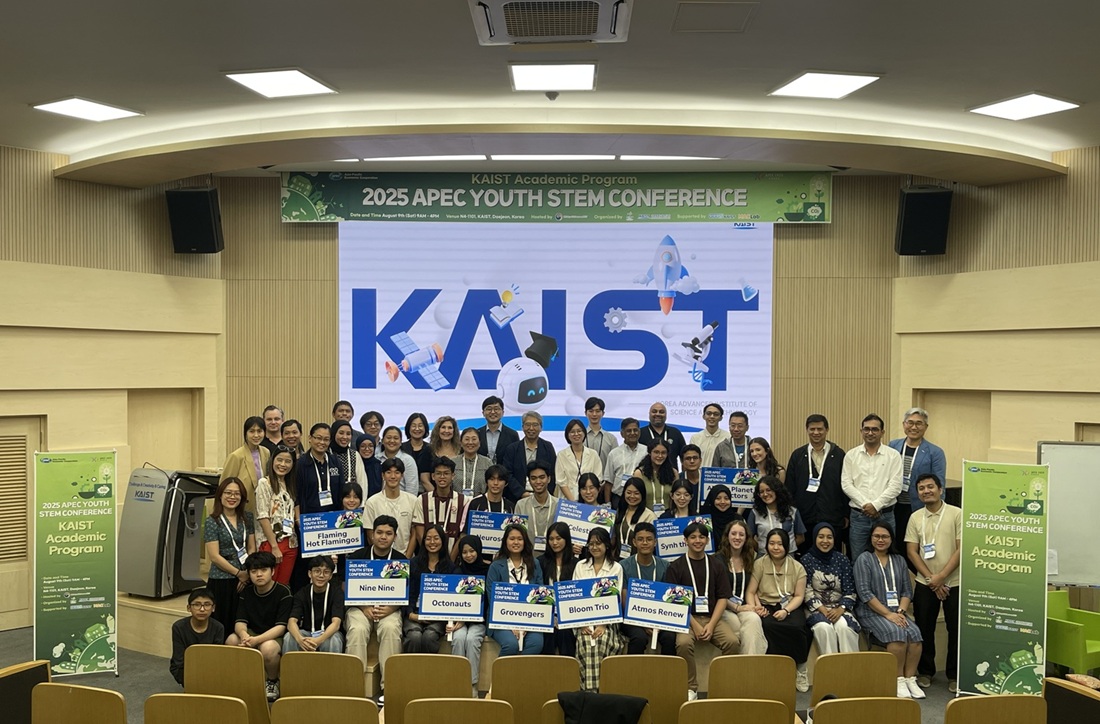
<Photo1. Group photo at the end of the program>
KAIST (President Kwang Hyung Lee) announced on the 11thof August that it successfully hosted the 'APEC Youth STEM Conference KAIST Academic Program,' a global science exchange program for 28 youth researchers from 10 countries and over 30 experts who participated in the '2025 APEC Youth STEM* Collaborative Research and Competition.' The event was held at the main campus in Daejeon on Saturday, August 9.
STEM (Science, Technology, Engineering, Math) refers to the fields of science and engineering.
The competition was hosted by the Ministry of Science and ICT and organized by the APEC Science Gifted Mentoring Center. It took place from Wednesday, August 6, to Saturday, August 9, 2025, at KAIST in Daejeon and the Korea Science Academy of KAIST in Busan. The KAIST program was organized by the APEC Science Gifted Mentoring Center and supported by the KAIST Institute for the Gifted and Talented in Science Education.
Participants had the opportunity to experience Korea's cutting-edge research infrastructure firsthand, broaden their horizons in science and technology, and collaborate and exchange ideas with future science talents from the APEC region.
As the 2025 APEC chair, Korea is promoting various international collaborations to discover and nurture the next generation of talent in the STEM fields. The KAIST academic exchange program was particularly meaningful as it was designed with the international goal of revitalizing science gifted exchanges and expanding the basis for cooperation among APEC member countries. It moved beyond the traditional online-centric research collaboration model to focus on hands-on, on-site, and convergence research experiences.
The global science exchange program at KAIST introduced participants to KAIST's world-class educational and research environment and provided various academic content to allow them to experience real-world examples of convergence technology-based research.
<Photo2. Program Activities>
First, the KAIST Admissions Office participated, introducing KAIST's admissions system and its educational and research environment to outstanding international students, providing an opportunity to attract global talent. Following this, Dr. Tae-kyun Kwon of the Music and Audio Computing Lab at the Graduate School of Culture Technology presented a convergence art project based on musical artificial intelligence data, including a research demonstration in an anechoic chamber.
<Photo3. Participation in a music AI research demonstration>
Furthermore, a Climate Talk Concert program was organized under the leadership of the Graduate School of Green Growth and Sustainability, in connection with the theme of the APEC Youth STEM Collaborative Research: 'Youth-led STEM Solutions: Enhancing Climate Resilience.'
The program was planned and hosted by Dean Jiyong Eom. It provided a platform for young people to explore creative and practical STEM-based solutions to the climate crisis and seek opportunities for international cooperation.
<Photo4. Participation in Music AI Research Demonstration >
The program was a meaningful time for APEC youth researchers, offering practical support for their research through special lectures and Q&A sessions on:
Interdisciplinary Research and Education in the Era of Climate Crisis (Dean Jiyong Eom)
Energy Transition Technology in the Carbon Neutral Era (Professor Jeongrak Son)
Policies for Energy System Change (Professor Jihyo Kim)
Carbon Neutral Bio-technology (Professor Gyeongrok Choi)
After the afternoon talk concert, Lee Jing Jing, a student from Brunei, shared her thoughts, saying, "The lectures by the four professors were very meaningful and insightful. I was able to think about energy transition plans to solve climate change from various perspectives."
Si-jong Kwak, Director of the KAIST Global Institute for Talented Education, stated, "I hope that young people from all over the world will directly experience KAIST's research areas and environment, expand their interest in KAIST, and continue to grow as outstanding talents in the fields of science and engineering."
KAIST President Kwang Hyung Lee said, "KAIST will be at the center of science and technology-based international cooperation and will spare no effort to support future talents in developing creative and practical problem-solving skills. I hope this event served as an opportunity for young people to understand the value of global cooperation and grow into future science leaders."
2025.08.11 View 5513
2025 APEC Youth STEM Science Exchange Program Successfully Completed
<Photo1. Group photo at the end of the program>
KAIST (President Kwang Hyung Lee) announced on the 11thof August that it successfully hosted the 'APEC Youth STEM Conference KAIST Academic Program,' a global science exchange program for 28 youth researchers from 10 countries and over 30 experts who participated in the '2025 APEC Youth STEM* Collaborative Research and Competition.' The event was held at the main campus in Daejeon on Saturday, August 9.
STEM (Science, Technology, Engineering, Math) refers to the fields of science and engineering.
The competition was hosted by the Ministry of Science and ICT and organized by the APEC Science Gifted Mentoring Center. It took place from Wednesday, August 6, to Saturday, August 9, 2025, at KAIST in Daejeon and the Korea Science Academy of KAIST in Busan. The KAIST program was organized by the APEC Science Gifted Mentoring Center and supported by the KAIST Institute for the Gifted and Talented in Science Education.
Participants had the opportunity to experience Korea's cutting-edge research infrastructure firsthand, broaden their horizons in science and technology, and collaborate and exchange ideas with future science talents from the APEC region.
As the 2025 APEC chair, Korea is promoting various international collaborations to discover and nurture the next generation of talent in the STEM fields. The KAIST academic exchange program was particularly meaningful as it was designed with the international goal of revitalizing science gifted exchanges and expanding the basis for cooperation among APEC member countries. It moved beyond the traditional online-centric research collaboration model to focus on hands-on, on-site, and convergence research experiences.
The global science exchange program at KAIST introduced participants to KAIST's world-class educational and research environment and provided various academic content to allow them to experience real-world examples of convergence technology-based research.
<Photo2. Program Activities>
First, the KAIST Admissions Office participated, introducing KAIST's admissions system and its educational and research environment to outstanding international students, providing an opportunity to attract global talent. Following this, Dr. Tae-kyun Kwon of the Music and Audio Computing Lab at the Graduate School of Culture Technology presented a convergence art project based on musical artificial intelligence data, including a research demonstration in an anechoic chamber.
<Photo3. Participation in a music AI research demonstration>
Furthermore, a Climate Talk Concert program was organized under the leadership of the Graduate School of Green Growth and Sustainability, in connection with the theme of the APEC Youth STEM Collaborative Research: 'Youth-led STEM Solutions: Enhancing Climate Resilience.'
The program was planned and hosted by Dean Jiyong Eom. It provided a platform for young people to explore creative and practical STEM-based solutions to the climate crisis and seek opportunities for international cooperation.
<Photo4. Participation in Music AI Research Demonstration >
The program was a meaningful time for APEC youth researchers, offering practical support for their research through special lectures and Q&A sessions on:
Interdisciplinary Research and Education in the Era of Climate Crisis (Dean Jiyong Eom)
Energy Transition Technology in the Carbon Neutral Era (Professor Jeongrak Son)
Policies for Energy System Change (Professor Jihyo Kim)
Carbon Neutral Bio-technology (Professor Gyeongrok Choi)
After the afternoon talk concert, Lee Jing Jing, a student from Brunei, shared her thoughts, saying, "The lectures by the four professors were very meaningful and insightful. I was able to think about energy transition plans to solve climate change from various perspectives."
Si-jong Kwak, Director of the KAIST Global Institute for Talented Education, stated, "I hope that young people from all over the world will directly experience KAIST's research areas and environment, expand their interest in KAIST, and continue to grow as outstanding talents in the fields of science and engineering."
KAIST President Kwang Hyung Lee said, "KAIST will be at the center of science and technology-based international cooperation and will spare no effort to support future talents in developing creative and practical problem-solving skills. I hope this event served as an opportunity for young people to understand the value of global cooperation and grow into future science leaders."
2025.08.11 View 5513 -
 'Team Atlanta', in which KAIST Professor Insu Yun research team participated, won the DARPA AI Cyber Challenge in the US, with a prize of 5.5 billion KRW
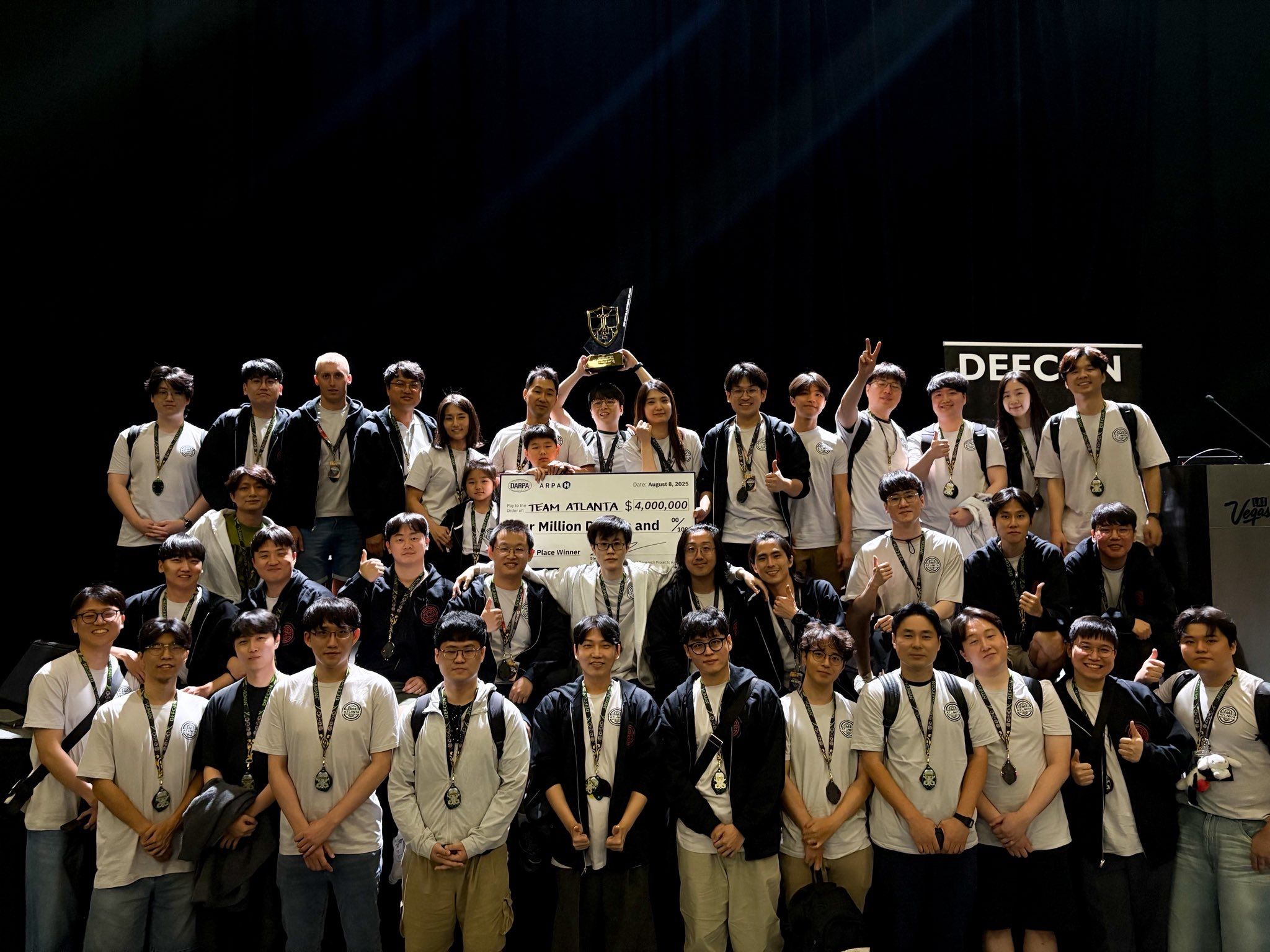
<Photo1. Group Photo of Team Atlanta>
Team Atlanta, led by Professor Insu Yun of the Department of Electrical and Electronic Engineering at KAIST and Tae-soo Kim, an executive from Samsung Research, along with researchers from POSTECH and Georgia Tech, won the final championship at the AI Cyber Challenge (AIxCC) hosted by the Defense Advanced Research Projects Agency (DARPA). The final was held at the world's largest hacking conference, DEF CON 33, in Las Vegas on August 8 (local time).
With this achievement, the team won a prize of $4 million (approximately 5.5 billion KRW), demonstrating the excellence of their AI-based autonomous cyber defense technology on the global stage.
<Photo2.Championship Commemorative:On the left and right are tournament officials. From the second person, Professor Tae-soo Kim(Samsung Research / Georgia Tech), Researcher Hyeong-seok Han (Samsung Research America), and Professor Insu Yun (KAIST)>
The AI Cyber Challenge is a two-year global competition co-hosted by DARPA and the Advanced Research Projects Agency for Health (ARPA-H). It challenges contestants to automatically analyze, detect, and fix software vulnerabilities using AI-based Cyber Reasoning Systems (CRS). The total prize money for the competition is $29.5 million, with the winning team receiving $4 million.
In the final, Team Atlanta scored a total of 392.76 points, a difference of over 170 points from the second-place team, Trail of Bits, securing a dominant victory. The CRS developed by Team Atlanta successfully and automatically detected various types of vulnerabilities and patched a significant number of them in real time.
Among the 7 finalist teams, an average of 77% of the 70 intentionally injected vulnerabilities were found, and 61% of them were patched. The teams also found 18 additional unknown vulnerabilities in real software, proving the potential of AI security technology.
All CRS technologies, including those of the winning team, will be provided as open-source and are expected to be used to strengthen the security of core infrastructure such as hospitals, water, and power systems.
<Photo3. Final Scoreboard: An overwhelming victory with over 170 points>
Professor Insu Yun of KAIST, a member of Team Atlanta, stated, "I am very happy to have achieved such a great result. This is a remarkable achievement that shows Korea's cyber security research has reached the highest level in the world, and it was meaningful to show the capabilities of Korean researchers on the world stage. I will continue to conduct research to protect the digital safety of the nation and global society through the fusion of AI and security technology."
KAIST President Kwang-hyung Lee stated, "This victory is another example that proves KAIST is a world-leading institution in the field of future cyber security and AI convergence. We will continue to provide full support to our researchers so they can compete and produce results on the world stage."
<Photo4. Results Announcement>
2025.08.10 View 5374
'Team Atlanta', in which KAIST Professor Insu Yun research team participated, won the DARPA AI Cyber Challenge in the US, with a prize of 5.5 billion KRW
<Photo1. Group Photo of Team Atlanta>
Team Atlanta, led by Professor Insu Yun of the Department of Electrical and Electronic Engineering at KAIST and Tae-soo Kim, an executive from Samsung Research, along with researchers from POSTECH and Georgia Tech, won the final championship at the AI Cyber Challenge (AIxCC) hosted by the Defense Advanced Research Projects Agency (DARPA). The final was held at the world's largest hacking conference, DEF CON 33, in Las Vegas on August 8 (local time).
With this achievement, the team won a prize of $4 million (approximately 5.5 billion KRW), demonstrating the excellence of their AI-based autonomous cyber defense technology on the global stage.
<Photo2.Championship Commemorative:On the left and right are tournament officials. From the second person, Professor Tae-soo Kim(Samsung Research / Georgia Tech), Researcher Hyeong-seok Han (Samsung Research America), and Professor Insu Yun (KAIST)>
The AI Cyber Challenge is a two-year global competition co-hosted by DARPA and the Advanced Research Projects Agency for Health (ARPA-H). It challenges contestants to automatically analyze, detect, and fix software vulnerabilities using AI-based Cyber Reasoning Systems (CRS). The total prize money for the competition is $29.5 million, with the winning team receiving $4 million.
In the final, Team Atlanta scored a total of 392.76 points, a difference of over 170 points from the second-place team, Trail of Bits, securing a dominant victory. The CRS developed by Team Atlanta successfully and automatically detected various types of vulnerabilities and patched a significant number of them in real time.
Among the 7 finalist teams, an average of 77% of the 70 intentionally injected vulnerabilities were found, and 61% of them were patched. The teams also found 18 additional unknown vulnerabilities in real software, proving the potential of AI security technology.
All CRS technologies, including those of the winning team, will be provided as open-source and are expected to be used to strengthen the security of core infrastructure such as hospitals, water, and power systems.
<Photo3. Final Scoreboard: An overwhelming victory with over 170 points>
Professor Insu Yun of KAIST, a member of Team Atlanta, stated, "I am very happy to have achieved such a great result. This is a remarkable achievement that shows Korea's cyber security research has reached the highest level in the world, and it was meaningful to show the capabilities of Korean researchers on the world stage. I will continue to conduct research to protect the digital safety of the nation and global society through the fusion of AI and security technology."
KAIST President Kwang-hyung Lee stated, "This victory is another example that proves KAIST is a world-leading institution in the field of future cyber security and AI convergence. We will continue to provide full support to our researchers so they can compete and produce results on the world stage."
<Photo4. Results Announcement>
2025.08.10 View 5374 -
 Prof. Seungbum Koo’s Team Receives Clinical Biomechanics Award at the 30th International Society of Biomechanics Conference
<(From Left) Ph.D candidate Jeongseok Oh from KAIST, Dr. Seungwoo Yoon from KAIST, Prof.Joon-Ho Wang from Samsung Medical Center, Prof.Seungbum Koo from KAIST>
Professor Seungbum Koo’s research team received the Clinical Biomechanics Award at the 30th International Society of Biomechanics (ISB) Conference, held in July 2025 in Stockholm, Sweden. The Plenary Lecture was delivered by first author and Ph.D. candidate Jeongseok Oh. This research was conducted in collaboration with Professor Joon-Ho Wang’s team at Samsung Medical Center.
Residual Translational and Rotational Kinematics After Combined ACL and Anterolateral Ligament Reconstruction During Walking
Jeongseok Oh, Seungwoo Yoon, Joon-Ho Wang, Seungbum Koo
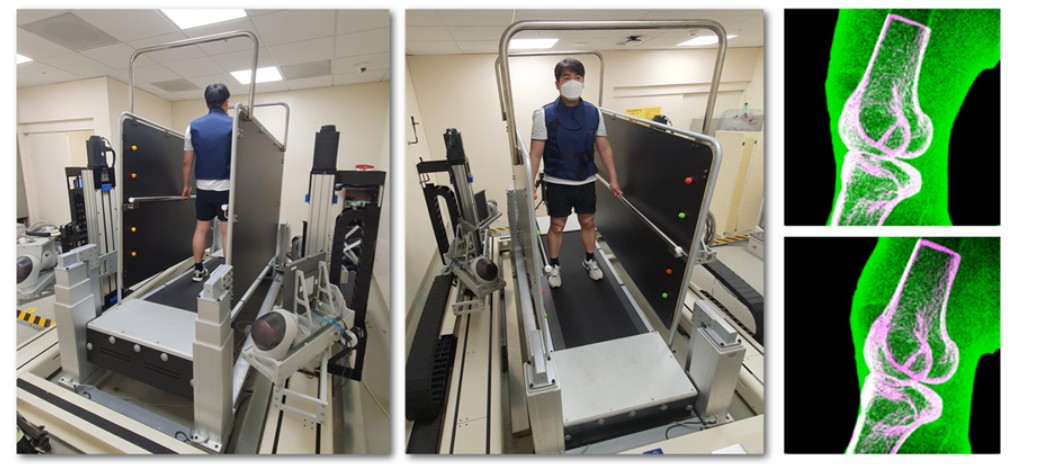
The study analyzed gait-related knee joint motion using high-speed biplane X-ray imaging and three-dimensional kinematic reconstruction in 10 healthy individuals and 10 patients who underwent ACL reconstruction with ALL augmentation. The patient group showed excessive anterior translation and internal rotation, suggesting incomplete restoration of normal joint kinematics post-surgery. These findings provide mechanistic insight into the early onset of knee osteoarthritis often reported in this population.'
The ISB conference, held biennially for over 60 years, is the largest international biomechanics meeting. This year, it hosted 1,600 researchers from 46 countries and featured over 1,400 presentations. The Clinical Biomechanics Award is given to one outstanding study selected from five top-rated abstracts invited for full manuscript review. The winning paper is published in Clinical Biomechanics, and the award includes a monetary prize and a Plenary Lecture opportunity.
From 2019 to 2023, Koo and Wang’s teams developed a system with support from the Samsung Future Technology Development Program to track knee motion in real time during treadmill walking, using high-speed biplane X-rays and custom three-dimensional reconstruction software. This system, along with proprietary software that precisely reconstructs the three-dimensional motion of joints, was approved for clinical trials by the Ministry of Food and Drug Safety and installed at Samsung Medical Center. It is being used to quantitatively analyze abnormal joint motion patterns in patients with knee ligament injuries and those who have undergone knee surgery.
Additionally, Jeongseok Oh was named one of five finalists for the David Winter Young Investigator Award, presenting his work during the award session. This award recognizes promising young researchers in biomechanics worldwide.
2025.08.10 View 3612
Prof. Seungbum Koo’s Team Receives Clinical Biomechanics Award at the 30th International Society of Biomechanics Conference
<(From Left) Ph.D candidate Jeongseok Oh from KAIST, Dr. Seungwoo Yoon from KAIST, Prof.Joon-Ho Wang from Samsung Medical Center, Prof.Seungbum Koo from KAIST>
Professor Seungbum Koo’s research team received the Clinical Biomechanics Award at the 30th International Society of Biomechanics (ISB) Conference, held in July 2025 in Stockholm, Sweden. The Plenary Lecture was delivered by first author and Ph.D. candidate Jeongseok Oh. This research was conducted in collaboration with Professor Joon-Ho Wang’s team at Samsung Medical Center.
Residual Translational and Rotational Kinematics After Combined ACL and Anterolateral Ligament Reconstruction During Walking
Jeongseok Oh, Seungwoo Yoon, Joon-Ho Wang, Seungbum Koo
The study analyzed gait-related knee joint motion using high-speed biplane X-ray imaging and three-dimensional kinematic reconstruction in 10 healthy individuals and 10 patients who underwent ACL reconstruction with ALL augmentation. The patient group showed excessive anterior translation and internal rotation, suggesting incomplete restoration of normal joint kinematics post-surgery. These findings provide mechanistic insight into the early onset of knee osteoarthritis often reported in this population.'
The ISB conference, held biennially for over 60 years, is the largest international biomechanics meeting. This year, it hosted 1,600 researchers from 46 countries and featured over 1,400 presentations. The Clinical Biomechanics Award is given to one outstanding study selected from five top-rated abstracts invited for full manuscript review. The winning paper is published in Clinical Biomechanics, and the award includes a monetary prize and a Plenary Lecture opportunity.
From 2019 to 2023, Koo and Wang’s teams developed a system with support from the Samsung Future Technology Development Program to track knee motion in real time during treadmill walking, using high-speed biplane X-rays and custom three-dimensional reconstruction software. This system, along with proprietary software that precisely reconstructs the three-dimensional motion of joints, was approved for clinical trials by the Ministry of Food and Drug Safety and installed at Samsung Medical Center. It is being used to quantitatively analyze abnormal joint motion patterns in patients with knee ligament injuries and those who have undergone knee surgery.
Additionally, Jeongseok Oh was named one of five finalists for the David Winter Young Investigator Award, presenting his work during the award session. This award recognizes promising young researchers in biomechanics worldwide.
2025.08.10 View 3612 -
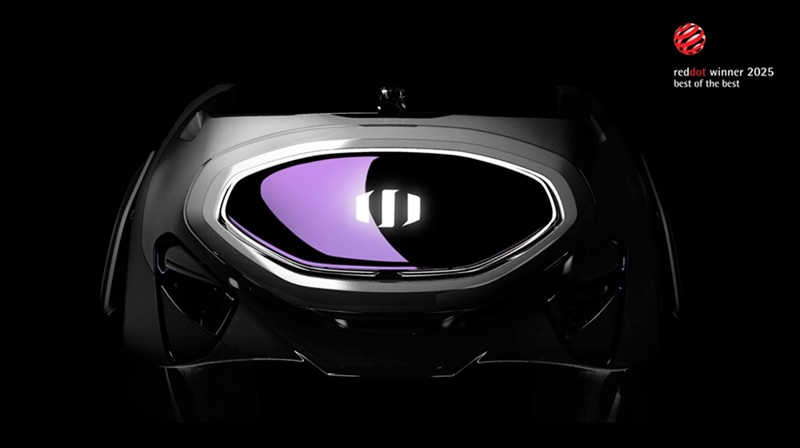 KAIST’s Wearable Robot Design Wins ‘2025 Red Dot Award Best of the Best’
<Professor Hyunjoon Park, M.S candidate Eun-ju Kang, Prospective M.S candidate Jae-seong Kim, undergraduate student Min-su Kim>
A team led by Professor Hyunjoon Park from the Department of Industrial Design won the ‘Best of the Best’ award at the 2025 Red Dot Design Awards, one of the world's top three design awards, for their 'Angel Robotics WSF1 VISION Concept.'
The design for the next-generation wearable robot for people with paraplegia successfully implements functionality, aesthetics, and social inclusion. This latest achievement follows the team's iF Design Award win for the WalkON Suit F1 prototype, which also won a gold medal at the Cybathlon last year. This marks consecutive wins at top-tier international design awards.
KAIST (President Kwang-hyung Lee) announced on the 8th of August that Move Lab, a research team led by Professor Hyunjoon Park from the Department of Industrial Design, won the 'Best of the Best' award in the Design Concept-Professional category at the prestigious '2025 Red Dot Design Awards' for their next-generation wearable robot design, the ‘Angel Robotics WSF1 VISION Concept.’
The German 'Red Dot Design Awards' is one of the world's most well-known design competitions. It is considered one of the world's top three design awards along with Germany’s iF Design Awards and America’s IDEA. The ‘Best of the Best’ award is given to the best design in a category and is awarded only to a very select few of the top designs (within the top 1%) among all Red Dot Award winners.
Professor Hyunjoon Park’s team was honored with the ‘Best of the Best’ award for a user-friendly follow-up development of the ‘WalkON Suit F1 prototype,’ which won a gold medal at the 2024 Cybathlon and an iF Design Award in 2025.
<Figure 1. WSF1 Vision Concept Main Image>
This award-winning design is the result of industry-academic cooperation with Angel Robotics Inc., founded by Professor Kyoungchul Kong from the KAIST Department of Mechanical Engineering. It is a concept design that proposes a next-generation wearable robot (an ultra-personal mobility device) that can be used by people with paraplegia in their daily lives.
The research team focused on transforming Angel Robotics Inc.'s advanced engineering platform into an intuitive and emotional, user-centric experience, implementing a design solution that simultaneously possesses functionality, aesthetics, and social inclusion.
<Figure 2. WSF1 Vision Concept Full Exterior (Front View)>
The WSF1 VISION Concept includes innovative features implemented in Professor Kyoungchul Kong’s Exo Lab, such as:
An autonomous access function where the robot finds the user on its own.
A front-loading mechanism designed for the user to put it on alone while seated.
Multi-directional walking functionality realized through 12 powerful torque actuators and the latest control algorithms.
AI vision technology, along with a multi-visual display system that provides navigation and omnidirectional vision.
This provides users with a safer and more convenient mobility experience.
The strong yet elegant silhouette was achieved through a design process that pursued perfection in proportion, surfaces, and details not seen in existing wearable robots. In particular, the fabric cover that wraps around the entire thigh from the robot's hip joint is a stylish element that respects the wearer's self-esteem and individuality, like fashionable athletic wear. It also acts as a device for the wearer to psychologically feel safe in interacting with the robot and blending in with the general public. This presents a new aesthetic for wearable robots where function and form are harmonized.
<Figure 3. WSF1 Vision Concept's Operating Principle. It walks autonomously and is worn from the front while the user is seated.>
KAIST Professor Hyunjoon Park said of the award, "We are focusing on using technology, aesthetics, and human-centered innovation to present advanced technical solutions as easy, enjoyable, and cool experiences for users. Based on Angel Robotics Inc.'s vision of 'recreating human ability with technology,' the WSF1 VISION Concept aimed to break away from the traditional framework of wearable robots and deliver a design experience that adds dignity, independence, and new style to the user's life."
<Figure 4. WSF1 Vision Concept Detail Image>
A physical model of the WSF1 VISION Concept is scheduled to be unveiled in the Future Hall of the 2025 Gwangju Design Biennale from August 30 to November 2. The theme is 'Po-yong-ji-deok' (the virtue of inclusion), and it will showcase the role of design language in creating an inclusive future society.
<Figure 5. WSF1 Vision Concept: Image of a Person Wearing and Walking>
2025.08.09 View 5352
KAIST’s Wearable Robot Design Wins ‘2025 Red Dot Award Best of the Best’
<Professor Hyunjoon Park, M.S candidate Eun-ju Kang, Prospective M.S candidate Jae-seong Kim, undergraduate student Min-su Kim>
A team led by Professor Hyunjoon Park from the Department of Industrial Design won the ‘Best of the Best’ award at the 2025 Red Dot Design Awards, one of the world's top three design awards, for their 'Angel Robotics WSF1 VISION Concept.'
The design for the next-generation wearable robot for people with paraplegia successfully implements functionality, aesthetics, and social inclusion. This latest achievement follows the team's iF Design Award win for the WalkON Suit F1 prototype, which also won a gold medal at the Cybathlon last year. This marks consecutive wins at top-tier international design awards.
KAIST (President Kwang-hyung Lee) announced on the 8th of August that Move Lab, a research team led by Professor Hyunjoon Park from the Department of Industrial Design, won the 'Best of the Best' award in the Design Concept-Professional category at the prestigious '2025 Red Dot Design Awards' for their next-generation wearable robot design, the ‘Angel Robotics WSF1 VISION Concept.’
The German 'Red Dot Design Awards' is one of the world's most well-known design competitions. It is considered one of the world's top three design awards along with Germany’s iF Design Awards and America’s IDEA. The ‘Best of the Best’ award is given to the best design in a category and is awarded only to a very select few of the top designs (within the top 1%) among all Red Dot Award winners.
Professor Hyunjoon Park’s team was honored with the ‘Best of the Best’ award for a user-friendly follow-up development of the ‘WalkON Suit F1 prototype,’ which won a gold medal at the 2024 Cybathlon and an iF Design Award in 2025.
<Figure 1. WSF1 Vision Concept Main Image>
This award-winning design is the result of industry-academic cooperation with Angel Robotics Inc., founded by Professor Kyoungchul Kong from the KAIST Department of Mechanical Engineering. It is a concept design that proposes a next-generation wearable robot (an ultra-personal mobility device) that can be used by people with paraplegia in their daily lives.
The research team focused on transforming Angel Robotics Inc.'s advanced engineering platform into an intuitive and emotional, user-centric experience, implementing a design solution that simultaneously possesses functionality, aesthetics, and social inclusion.
<Figure 2. WSF1 Vision Concept Full Exterior (Front View)>
The WSF1 VISION Concept includes innovative features implemented in Professor Kyoungchul Kong’s Exo Lab, such as:
An autonomous access function where the robot finds the user on its own.
A front-loading mechanism designed for the user to put it on alone while seated.
Multi-directional walking functionality realized through 12 powerful torque actuators and the latest control algorithms.
AI vision technology, along with a multi-visual display system that provides navigation and omnidirectional vision.
This provides users with a safer and more convenient mobility experience.
The strong yet elegant silhouette was achieved through a design process that pursued perfection in proportion, surfaces, and details not seen in existing wearable robots. In particular, the fabric cover that wraps around the entire thigh from the robot's hip joint is a stylish element that respects the wearer's self-esteem and individuality, like fashionable athletic wear. It also acts as a device for the wearer to psychologically feel safe in interacting with the robot and blending in with the general public. This presents a new aesthetic for wearable robots where function and form are harmonized.
<Figure 3. WSF1 Vision Concept's Operating Principle. It walks autonomously and is worn from the front while the user is seated.>
KAIST Professor Hyunjoon Park said of the award, "We are focusing on using technology, aesthetics, and human-centered innovation to present advanced technical solutions as easy, enjoyable, and cool experiences for users. Based on Angel Robotics Inc.'s vision of 'recreating human ability with technology,' the WSF1 VISION Concept aimed to break away from the traditional framework of wearable robots and deliver a design experience that adds dignity, independence, and new style to the user's life."
<Figure 4. WSF1 Vision Concept Detail Image>
A physical model of the WSF1 VISION Concept is scheduled to be unveiled in the Future Hall of the 2025 Gwangju Design Biennale from August 30 to November 2. The theme is 'Po-yong-ji-deok' (the virtue of inclusion), and it will showcase the role of design language in creating an inclusive future society.
<Figure 5. WSF1 Vision Concept: Image of a Person Wearing and Walking>
2025.08.09 View 5352 -
 Key Figures in the Establishment of KAIST, Specially Invited to the Presidential Office’s National Appointment Ceremony
KAIST announced on August 6 that Professor Emeritus Jung-Woong Ra from the Department of Electrical Engineering and Won-ki Kwon, former Vice Minister of the Ministry of Science and Technology, who played pivotal roles in the establishment of KAIST, were selected as special guests for the 'National Appointment Ceremony' hosted by the Presidential Office on August 15th.
The Presidential Office selected special invitees across eight categories for the ceremony. These include individuals born in 1945 (referred to as 'Liberation Babies'), those involved in the founding of KAIST in 1971, independence activists and national patriots, overseas workers in Germany and the Middle East, AI industry professionals, residents from regions facing depopulation, leading figures in K-culture, military personnel, firefighters, police officers, families of fallen public servants and victims of social disasters, as well as promising talents in economics, science, culture, and the arts.
Considering the historical significance of its establishment and its symbolic meaning for the development of national science and technology, KAIST Professor Emeritus Jung-Woong Ra, who was a key figure in the establishment of the Department of Electrical Engineering after being appointed as a professor in 1971, and former Vice Minister Kwon Won-ki, who was the first practical leader of the establishment project. Both were officially included on the special invitation list.
Briefing from the Presidential Office regarding the 'National Appointment Ceremony' (2025.07.28) https://www.president.go.kr/newsroom/briefing/grehGMuP
2025.08.06 View 3831
Key Figures in the Establishment of KAIST, Specially Invited to the Presidential Office’s National Appointment Ceremony
KAIST announced on August 6 that Professor Emeritus Jung-Woong Ra from the Department of Electrical Engineering and Won-ki Kwon, former Vice Minister of the Ministry of Science and Technology, who played pivotal roles in the establishment of KAIST, were selected as special guests for the 'National Appointment Ceremony' hosted by the Presidential Office on August 15th.
The Presidential Office selected special invitees across eight categories for the ceremony. These include individuals born in 1945 (referred to as 'Liberation Babies'), those involved in the founding of KAIST in 1971, independence activists and national patriots, overseas workers in Germany and the Middle East, AI industry professionals, residents from regions facing depopulation, leading figures in K-culture, military personnel, firefighters, police officers, families of fallen public servants and victims of social disasters, as well as promising talents in economics, science, culture, and the arts.
Considering the historical significance of its establishment and its symbolic meaning for the development of national science and technology, KAIST Professor Emeritus Jung-Woong Ra, who was a key figure in the establishment of the Department of Electrical Engineering after being appointed as a professor in 1971, and former Vice Minister Kwon Won-ki, who was the first practical leader of the establishment project. Both were officially included on the special invitation list.
Briefing from the Presidential Office regarding the 'National Appointment Ceremony' (2025.07.28) https://www.president.go.kr/newsroom/briefing/grehGMuP
2025.08.06 View 3831