%53
-
 KAIST K HERO Rides Nuri Rocket, Next Generation Micro Hall Thruster Technology Verified in Space
< (From left) Ph.D candidate Jaehong Park, COSMOVY researcher Yoonsoo Kim, Professor Wonho Choe, Ph.D candidate Dongha Park, M.S candidate Seungbeom Heo >
KAIST announced on the November 26th that the CubeSat 'K-HERO (KAIST Hall Effect Rocket Orbiter)', developed by the research team of Professor Wonho Choe from the Department of Nuclear and Quantum Engineering, is scheduled to launch into space aboard the 4th Nuri rocket launch vehicle on November 27th from the Naro Space Center in Goheung, Jeollanam-do.
This 4th Nuri launch is the first to be managed by the private company Hanwha Aerospace, which received technology transfer from the Korea Aerospace Research Institute (KARI), marking a significant milestone in the transformation of the domestic space industry. Along with the main payload, the Next-Generation Medium Satellite 3, twelve CubeSats developed by industry, academia, and research institutions will be onboard, with K-HERO being one of them.
The development of K-HERO was officially initiated when Professor Wonho Choe's research team was selected as the basic satellite development team in the '2022 CubeSat Competition' organized by KARI.
The basic satellite is a technology verification satellite designed to confirm whether the design and core components operate normally in the space environment before proceeding with the flight model (FM) production. K-HERO is a 3U standard CubeSat with dimensions of $10\text{ cm}$ (width) $\times$ $10\text{ cm}$ (length) $\times$ $30\text{ cm}$ (height) and a weight of $3.9\text{ kg}$. It was designed to satisfy all stability, electrical specifications, and interface conditions with the launch vehicle.
The core mission of K-HERO is to directly verify the in-space operation of the 150 W class micro-satellite Hall thruster developed by the research team.
The Hall thruster can be simply described as a 'space engine powered by electricity'. It is an electric propulsion engine that moves the satellite slowly but very efficiently using electricity.
Instead of burning a lot of fuel to generate instantaneous thrust, like a rocket, it works by using electricity to turn gas (Xenon) into a plasma state and rapidly accelerating it backward to push the satellite forward. Hall thrusters are considered a core technology for the era of small and constellation satellites due to their high fuel efficiency.
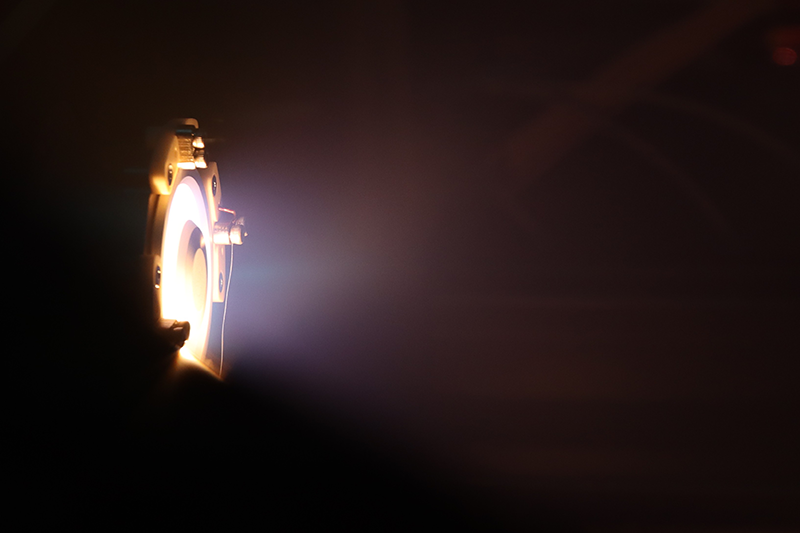
< Image of plasma generation in the micro-satellite Hall thruster mounted on the K-HERO CubeSat >
Hall thrusters are already a proven technology, having been used in large satellites and deep-space probes for over 20-30 years. However, their size and power requirements were large, so in the past, they were mainly operated on large geostationary (GEO) communication/broadcasting satellites and used by NASA and ESA deep-space probes for long-distance flights.
Recently, the emergence of the SpaceX Starlink satellite constellation has led to a surge in demand for small and micro electric thrusters. As the global space industry shifts towards satellite constellations, 'small and efficient thrusters' have become essential technology.
K-HERO is the first case of direct in-space demonstration of a micro Hall thruster made with domestic technology, and it is expected to be an important milestone in enhancing domestic technological competitiveness.
Professor Wonho Choe's research team began research on Hall thrusters in Korea in 2003, securing original technology based on plasma physics. In 2013, they successfully mounted a 200 W class Hall thruster on the 'KAIST Science and Technology Satellite 3,' proving its practical utility. This time, they have improved the design to operate even at a lower power of 30 W, developing a next-generation model aimed at micro-satellites.
COSMOVY Inc, a laboratory startup founded by Professor Wonho Choe's research team, also participated in the development of K-HERO, further strengthening the foundation for technology commercialization.
< K-HERO CubeSat being loaded into the Nuri rocket's CubeSat dispenser (Photo source: Korea Aerospace Research Institute) >
Professor Wonho Choe stated, "Starting with K-HERO, the number of small satellites equipped with electric thrusters will increase significantly in Korea. The Hall thruster being verified this time can be utilized for various missions, including low-Earth orbit constellation surveillance and reconnaissance satellites, 6G communication satellites, very-low-Earth orbit high-resolution satellites, and asteroid probes."
President Kwang Hyung Lee stated, "The launch of K-HERO is a significant opportunity to directly verify KAIST's electric propulsion technology on a micro-satellite platform once again in space, and it will be an important turning point that will further enhance the technological competitiveness of small satellites in Korea. KAIST will continue to contribute to the development of our country's space technology.
2025.11.26 View 2963
KAIST K HERO Rides Nuri Rocket, Next Generation Micro Hall Thruster Technology Verified in Space
< (From left) Ph.D candidate Jaehong Park, COSMOVY researcher Yoonsoo Kim, Professor Wonho Choe, Ph.D candidate Dongha Park, M.S candidate Seungbeom Heo >
KAIST announced on the November 26th that the CubeSat 'K-HERO (KAIST Hall Effect Rocket Orbiter)', developed by the research team of Professor Wonho Choe from the Department of Nuclear and Quantum Engineering, is scheduled to launch into space aboard the 4th Nuri rocket launch vehicle on November 27th from the Naro Space Center in Goheung, Jeollanam-do.
This 4th Nuri launch is the first to be managed by the private company Hanwha Aerospace, which received technology transfer from the Korea Aerospace Research Institute (KARI), marking a significant milestone in the transformation of the domestic space industry. Along with the main payload, the Next-Generation Medium Satellite 3, twelve CubeSats developed by industry, academia, and research institutions will be onboard, with K-HERO being one of them.
The development of K-HERO was officially initiated when Professor Wonho Choe's research team was selected as the basic satellite development team in the '2022 CubeSat Competition' organized by KARI.
The basic satellite is a technology verification satellite designed to confirm whether the design and core components operate normally in the space environment before proceeding with the flight model (FM) production. K-HERO is a 3U standard CubeSat with dimensions of $10\text{ cm}$ (width) $\times$ $10\text{ cm}$ (length) $\times$ $30\text{ cm}$ (height) and a weight of $3.9\text{ kg}$. It was designed to satisfy all stability, electrical specifications, and interface conditions with the launch vehicle.
The core mission of K-HERO is to directly verify the in-space operation of the 150 W class micro-satellite Hall thruster developed by the research team.
The Hall thruster can be simply described as a 'space engine powered by electricity'. It is an electric propulsion engine that moves the satellite slowly but very efficiently using electricity.
Instead of burning a lot of fuel to generate instantaneous thrust, like a rocket, it works by using electricity to turn gas (Xenon) into a plasma state and rapidly accelerating it backward to push the satellite forward. Hall thrusters are considered a core technology for the era of small and constellation satellites due to their high fuel efficiency.
< Image of plasma generation in the micro-satellite Hall thruster mounted on the K-HERO CubeSat >
Hall thrusters are already a proven technology, having been used in large satellites and deep-space probes for over 20-30 years. However, their size and power requirements were large, so in the past, they were mainly operated on large geostationary (GEO) communication/broadcasting satellites and used by NASA and ESA deep-space probes for long-distance flights.
Recently, the emergence of the SpaceX Starlink satellite constellation has led to a surge in demand for small and micro electric thrusters. As the global space industry shifts towards satellite constellations, 'small and efficient thrusters' have become essential technology.
K-HERO is the first case of direct in-space demonstration of a micro Hall thruster made with domestic technology, and it is expected to be an important milestone in enhancing domestic technological competitiveness.
Professor Wonho Choe's research team began research on Hall thrusters in Korea in 2003, securing original technology based on plasma physics. In 2013, they successfully mounted a 200 W class Hall thruster on the 'KAIST Science and Technology Satellite 3,' proving its practical utility. This time, they have improved the design to operate even at a lower power of 30 W, developing a next-generation model aimed at micro-satellites.
COSMOVY Inc, a laboratory startup founded by Professor Wonho Choe's research team, also participated in the development of K-HERO, further strengthening the foundation for technology commercialization.
< K-HERO CubeSat being loaded into the Nuri rocket's CubeSat dispenser (Photo source: Korea Aerospace Research Institute) >
Professor Wonho Choe stated, "Starting with K-HERO, the number of small satellites equipped with electric thrusters will increase significantly in Korea. The Hall thruster being verified this time can be utilized for various missions, including low-Earth orbit constellation surveillance and reconnaissance satellites, 6G communication satellites, very-low-Earth orbit high-resolution satellites, and asteroid probes."
President Kwang Hyung Lee stated, "The launch of K-HERO is a significant opportunity to directly verify KAIST's electric propulsion technology on a micro-satellite platform once again in space, and it will be an important turning point that will further enhance the technological competitiveness of small satellites in Korea. KAIST will continue to contribute to the development of our country's space technology.
2025.11.26 View 2963 -
 KAIST to Usher in an Era of Nationwide Science Culture: KSOP, OPEN KAIST, and AI Academy
< 2025 OPEN KAIST (Demonstration of the cluster systems and AI drone program conducted in Prof. Il-Chul Moon’s Lab, Department of Industrial & Systems Engineering)>
KAIST announced on November 25th that it is operating the 'Science Education Sharing (KSOP),' 'OPEN KAIST,' and 'KAIST-style IT/AI Academy for the General Public, social contribution programs based on science popularization,in line with the government's policy to spread science culture. Through these initiatives, KAIST is nurturing future science and technology talent and contributing to the popularization of science culture.
KAIST President Kwang Hyung Lee stated, “Under the mission of 'a university that contributes to humanity and society through science and technology,' KAIST is creating a ladder of opportunity through education sharing,” adding, “KSOP and OPEN KAIST are core KAIST programs that help all children dream of becoming scientists, regardless of their economic or regional circumstances. KAIST will continue to actively communicate with the general public and contribute to strengthening national competitiveness in science and technology by pursuing warm science, inclusive education, and a sustainable science culture ecosystem that goes beyond cutting-edge science and technology.”
■ KSOP for Science-Gifted Students from Underprivileged Backgrounds: 8,000 Beneficiaries in 10 Years, 70% Enrollment in STEM Fields
KSOP, operated by the Science Gifted Education Research Institute, is a representative science-sharing program. It selects students with potential in mathematics and science from socially disadvantaged youth and provides direct mentoring by current KAIST undergraduate and graduate students.
Starting with 250 students in 2015, the program expanded to approximately 1,000 participants annually starting in 2022, with a cumulative total of about 8,000 participants by 2025. It has achieved tangible results, with over 70% of graduates advancing into STEM fields, and a knowledge circulation structure has become established where graduates return as mentors.
Creative science education volunteer work has been conducted in underserved areas such as Jeju, Mokpo, and Andong, in addition to Daejeon, Sejong, and Hwaseong, contributing to the alleviation of educational disparities between regions. In particular, the program where mentees teach elementary school students has been cited as a prime example of KAIST's science culture diffusion.
One KSOP graduate who advanced to KAIST and is now been a mentor for five years shared, “Through mentoring, I feel the true value of sharing and service, as well as an inexpressible sense of pride and accomplishment.”
Furthermore, family-unit programs, including parent information sessions, family camps, and counseling support, have strengthened students' emotional and career support. In 2025, the fifth family camp was held, further broadening participation.
'KSOP FRIENDS,' centered on graduates and mentors, has established a virtuous cycle ecosystem connecting scholarships, mentoring, and donations. This initiative has expanded and developed into the 'Daddy-Long-Legs Project,' a representative small-sum regular donation program in which the public can participate.
< KSOP Jeju Island Educational Volunteer Group Photo >
< KSOP Scholarship Award >
■ ‘OPEN KAIST 2025’ to Meet KAIST Laboratories: Record-Breaking Number of Visitors
OPEN KAIST, KAIST's flagship science culture event that opens laboratories and the campus to the public every two years, recorded its highest ever attendance in 2025, with the number of visitors increasing more than fourfold compared to 2023. In particular, the lab tours garnered high interest, with long waiting lists for pre-registration. An elementary school participant commented, “The earthquake research lab tour was so fascinating and very helpful for answering my questions.” Recognizing that some participation was difficult due to the larger-than-expected number of visitors, KAIST announced plans to expand participation opportunities and improve operations in the future.
■ Cultivating Digital Talent through Short-Term Non-Degree IT/Semiconductor Courses for the General Public
The 'KAIST IT Academy' for military personnel is a non-degree program that provides practical, basic training in AI, computer science, and programming, involving KAIST graduate students as instructors. Operated both online and offline, approximately 1,000 trainees participate annually.
The 'SW Academy (Jungle),' a KAIST non-degree software education course, has become a successful model for nurturing young SW talent, with a cumulative 308 people completing the course between 2021 and 2024. Major employers include Naver, Krafton, Team Sparta, Nearthlab, and Woowa Brothers. Jungle trains developers who can be immediately deployed in practical work through hands-on programming education, mentoring by active developers, and planning/design feedback.
Based on the excellence of the Jungle program, Krafton launched and has been operating 'Krafton Jungle' since 2022. This is a social contribution activity by a company founded by KAIST alumnus Chairman Byung-Gyu Jang and is regarded as a prime example of KAIST's talent nurturing model spreading to the private sector.
Furthermore, the KAIST IDEC (IC Design Education Center) trains 240 young people annually as semiconductor design experts through the nurturing of semiconductor design talent, facilitating their entry into the industry.
■ Strengthening National Competitiveness by Building a Future Talent Ecosystem
KSOP received international recognition for its excellence in 2024 by winning the Best Program Award and Best Researcher Award at the Asia-Pacific Conference on Giftedness (APCG).
KAIST is further expanding its future talent platform by launching 'Junior KAIST' in 2025, a science, mathematics, and AI exploration program for youth. KAIST plans to continue strengthening its role as a public research university that grows with the nation through science and technology-based social contribution and the nurturing of future talent.
2025.11.25 View 2572
KAIST to Usher in an Era of Nationwide Science Culture: KSOP, OPEN KAIST, and AI Academy
< 2025 OPEN KAIST (Demonstration of the cluster systems and AI drone program conducted in Prof. Il-Chul Moon’s Lab, Department of Industrial & Systems Engineering)>
KAIST announced on November 25th that it is operating the 'Science Education Sharing (KSOP),' 'OPEN KAIST,' and 'KAIST-style IT/AI Academy for the General Public, social contribution programs based on science popularization,in line with the government's policy to spread science culture. Through these initiatives, KAIST is nurturing future science and technology talent and contributing to the popularization of science culture.
KAIST President Kwang Hyung Lee stated, “Under the mission of 'a university that contributes to humanity and society through science and technology,' KAIST is creating a ladder of opportunity through education sharing,” adding, “KSOP and OPEN KAIST are core KAIST programs that help all children dream of becoming scientists, regardless of their economic or regional circumstances. KAIST will continue to actively communicate with the general public and contribute to strengthening national competitiveness in science and technology by pursuing warm science, inclusive education, and a sustainable science culture ecosystem that goes beyond cutting-edge science and technology.”
■ KSOP for Science-Gifted Students from Underprivileged Backgrounds: 8,000 Beneficiaries in 10 Years, 70% Enrollment in STEM Fields
KSOP, operated by the Science Gifted Education Research Institute, is a representative science-sharing program. It selects students with potential in mathematics and science from socially disadvantaged youth and provides direct mentoring by current KAIST undergraduate and graduate students.
Starting with 250 students in 2015, the program expanded to approximately 1,000 participants annually starting in 2022, with a cumulative total of about 8,000 participants by 2025. It has achieved tangible results, with over 70% of graduates advancing into STEM fields, and a knowledge circulation structure has become established where graduates return as mentors.
Creative science education volunteer work has been conducted in underserved areas such as Jeju, Mokpo, and Andong, in addition to Daejeon, Sejong, and Hwaseong, contributing to the alleviation of educational disparities between regions. In particular, the program where mentees teach elementary school students has been cited as a prime example of KAIST's science culture diffusion.
One KSOP graduate who advanced to KAIST and is now been a mentor for five years shared, “Through mentoring, I feel the true value of sharing and service, as well as an inexpressible sense of pride and accomplishment.”
Furthermore, family-unit programs, including parent information sessions, family camps, and counseling support, have strengthened students' emotional and career support. In 2025, the fifth family camp was held, further broadening participation.
'KSOP FRIENDS,' centered on graduates and mentors, has established a virtuous cycle ecosystem connecting scholarships, mentoring, and donations. This initiative has expanded and developed into the 'Daddy-Long-Legs Project,' a representative small-sum regular donation program in which the public can participate.
< KSOP Jeju Island Educational Volunteer Group Photo >
< KSOP Scholarship Award >
■ ‘OPEN KAIST 2025’ to Meet KAIST Laboratories: Record-Breaking Number of Visitors
OPEN KAIST, KAIST's flagship science culture event that opens laboratories and the campus to the public every two years, recorded its highest ever attendance in 2025, with the number of visitors increasing more than fourfold compared to 2023. In particular, the lab tours garnered high interest, with long waiting lists for pre-registration. An elementary school participant commented, “The earthquake research lab tour was so fascinating and very helpful for answering my questions.” Recognizing that some participation was difficult due to the larger-than-expected number of visitors, KAIST announced plans to expand participation opportunities and improve operations in the future.
■ Cultivating Digital Talent through Short-Term Non-Degree IT/Semiconductor Courses for the General Public
The 'KAIST IT Academy' for military personnel is a non-degree program that provides practical, basic training in AI, computer science, and programming, involving KAIST graduate students as instructors. Operated both online and offline, approximately 1,000 trainees participate annually.
The 'SW Academy (Jungle),' a KAIST non-degree software education course, has become a successful model for nurturing young SW talent, with a cumulative 308 people completing the course between 2021 and 2024. Major employers include Naver, Krafton, Team Sparta, Nearthlab, and Woowa Brothers. Jungle trains developers who can be immediately deployed in practical work through hands-on programming education, mentoring by active developers, and planning/design feedback.
Based on the excellence of the Jungle program, Krafton launched and has been operating 'Krafton Jungle' since 2022. This is a social contribution activity by a company founded by KAIST alumnus Chairman Byung-Gyu Jang and is regarded as a prime example of KAIST's talent nurturing model spreading to the private sector.
Furthermore, the KAIST IDEC (IC Design Education Center) trains 240 young people annually as semiconductor design experts through the nurturing of semiconductor design talent, facilitating their entry into the industry.
■ Strengthening National Competitiveness by Building a Future Talent Ecosystem
KSOP received international recognition for its excellence in 2024 by winning the Best Program Award and Best Researcher Award at the Asia-Pacific Conference on Giftedness (APCG).
KAIST is further expanding its future talent platform by launching 'Junior KAIST' in 2025, a science, mathematics, and AI exploration program for youth. KAIST plans to continue strengthening its role as a public research university that grows with the nation through science and technology-based social contribution and the nurturing of future talent.
2025.11.25 View 2572 -
 Imdang Scholarship and Culture Foundation Donates 500 Million Won to Modernize KAIST's Space Research Infrastructure
< Photo of the Chung Mong-Hun Uri-Star Research Building at the Satellite Research Center >
KAIST announced on the Novemnber 21st that it received a donation of 500 million won from the Imdang Scholarship and Culture Foundation and will proceed with an environmental improvement project for the 'Chung Mong-Hun Uri-Star Research Building' at the Satellite Research Center on the main campus in Daejeon.
The Imdang Scholarship and Culture Foundation is a non-profit scholarship foundation established in 2005 by Chairwoman Moon-Hee Kim, the mother of Hyundai Group Chairwoman Jeong-Eun Hyun. Currently, Executive Director Ji-Yi Chung of Hyundai Movex, Chairwoman Hyun's eldest daughter, serves as the Chairwoman of the Foundation. The foundation has been carrying out various projects over three generations to promote education, culture, arts, sports, and nurture talent.
This donation from the Imdang Scholarship and Culture Foundation once again brings the special and long-standing relationship between KAIST and the Hyundai Group into the spotlight.
The 'Chung Mong-Hun Uri-Star Research Building,' located on the main KAIST campus in Daejeon, was established with a donation from the late Mong-Hun Chung, former Chairman of the Hyundai Group and husband of Chairwoman Hyun, to foster the development of domestic space research. This enabled the launch of the nation's first dedicated university-affiliated space research organization. Following this, Chairwoman Hyun also continued to show special interest and affection for research support projects. The research building was named its current name in 2008 to commemorate the 5th anniversary of the passing of the late Chairman Mong-Hun Chung. In this way, the partnership between Hyundai and KAIST is regarded as a healthy example of corporate social contribution, where a company participates in the development of the knowledge ecosystem and the nurturing of talent.
The KAIST Satellite Research Center, housed in the 'Chung Mong-Hun Uri-Star Research Building,' was established in 1989 as the nation's first dedicated university-affiliated space research organization. Starting with 'Uribyol-1,' which signaled the start of South Korea's space development, it has led the development of various satellites, including next-generation small satellites and ultra-small satellite constellations, based on independent domestic technology, growing into a world-class small satellite research institution.
Currently, about 80 researchers are stationed at the research building, dedicated to developing cutting-edge small satellite technology. However, the inconvenience of transporting research equipment due to the absence of an elevator and the lack of accessibility for mobility-impaired individuals have been persistent issues.
KAIST plans to use this donation to install an elevator connecting the basement floor to the 4th floor above ground. This will increase the efficiency of transporting research equipment while providing a convenient movement environment for both visitors and researchers.
Furthermore, the public relations hall, which has been operating since 2008, will be renovated into an experiential exhibition space, applying the latest digital display techniques to allow visitors to see KAIST's space research achievements and history at a glance. Visited by over 1,000 people annually, including domestic and international students, the general public, research institutions, businesses, and government officials, this space is expected to become a place for experiencing and sharing KAIST's space technology development process and future vision.
To commemorate this project and express gratitude for the sponsorship, our university will hold a plaque of appreciation ceremony at the KAIST Seoul Campus President's Office on Friday, November 21st, at 3:00 PM. Chairwoman Jeong-Eun Hyun of the Hyundai Group, President Kwang Hyung Lee of KAIST, and Director Jaeheung Han of the KAIST Space Science Research Institute attended the event to exchange expressions of mutual cooperation and gratitude.
Hyundai Group Chairwoman Jeong-Eun Hyun stated, "The late Chairman Mong-Hun Chung supported the development of the KAIST Satellite Research Center with his deep passion for science and space," and "I hope this environmental improvement project will carry on his legacy, contribute to the development of Korean space technology, and serve as an opportunity for more young talents to foster their dreams."
KAIST President Kwang Hyung Lee stated, "The Chung Mong-Hun Uri-Star Research Building is a symbolic space for the development of South Korea's space technology, and this environmental improvement project will serve as an opportunity to enhance both research efficiency and the value of public experience," adding, "The meaningful sponsorship from the Imdang Scholarship and Culture Foundation will be a great source of strength for KAIST's future space research development."
2025.11.21 View 2119
Imdang Scholarship and Culture Foundation Donates 500 Million Won to Modernize KAIST's Space Research Infrastructure
< Photo of the Chung Mong-Hun Uri-Star Research Building at the Satellite Research Center >
KAIST announced on the Novemnber 21st that it received a donation of 500 million won from the Imdang Scholarship and Culture Foundation and will proceed with an environmental improvement project for the 'Chung Mong-Hun Uri-Star Research Building' at the Satellite Research Center on the main campus in Daejeon.
The Imdang Scholarship and Culture Foundation is a non-profit scholarship foundation established in 2005 by Chairwoman Moon-Hee Kim, the mother of Hyundai Group Chairwoman Jeong-Eun Hyun. Currently, Executive Director Ji-Yi Chung of Hyundai Movex, Chairwoman Hyun's eldest daughter, serves as the Chairwoman of the Foundation. The foundation has been carrying out various projects over three generations to promote education, culture, arts, sports, and nurture talent.
This donation from the Imdang Scholarship and Culture Foundation once again brings the special and long-standing relationship between KAIST and the Hyundai Group into the spotlight.
The 'Chung Mong-Hun Uri-Star Research Building,' located on the main KAIST campus in Daejeon, was established with a donation from the late Mong-Hun Chung, former Chairman of the Hyundai Group and husband of Chairwoman Hyun, to foster the development of domestic space research. This enabled the launch of the nation's first dedicated university-affiliated space research organization. Following this, Chairwoman Hyun also continued to show special interest and affection for research support projects. The research building was named its current name in 2008 to commemorate the 5th anniversary of the passing of the late Chairman Mong-Hun Chung. In this way, the partnership between Hyundai and KAIST is regarded as a healthy example of corporate social contribution, where a company participates in the development of the knowledge ecosystem and the nurturing of talent.
The KAIST Satellite Research Center, housed in the 'Chung Mong-Hun Uri-Star Research Building,' was established in 1989 as the nation's first dedicated university-affiliated space research organization. Starting with 'Uribyol-1,' which signaled the start of South Korea's space development, it has led the development of various satellites, including next-generation small satellites and ultra-small satellite constellations, based on independent domestic technology, growing into a world-class small satellite research institution.
Currently, about 80 researchers are stationed at the research building, dedicated to developing cutting-edge small satellite technology. However, the inconvenience of transporting research equipment due to the absence of an elevator and the lack of accessibility for mobility-impaired individuals have been persistent issues.
KAIST plans to use this donation to install an elevator connecting the basement floor to the 4th floor above ground. This will increase the efficiency of transporting research equipment while providing a convenient movement environment for both visitors and researchers.
Furthermore, the public relations hall, which has been operating since 2008, will be renovated into an experiential exhibition space, applying the latest digital display techniques to allow visitors to see KAIST's space research achievements and history at a glance. Visited by over 1,000 people annually, including domestic and international students, the general public, research institutions, businesses, and government officials, this space is expected to become a place for experiencing and sharing KAIST's space technology development process and future vision.
To commemorate this project and express gratitude for the sponsorship, our university will hold a plaque of appreciation ceremony at the KAIST Seoul Campus President's Office on Friday, November 21st, at 3:00 PM. Chairwoman Jeong-Eun Hyun of the Hyundai Group, President Kwang Hyung Lee of KAIST, and Director Jaeheung Han of the KAIST Space Science Research Institute attended the event to exchange expressions of mutual cooperation and gratitude.
Hyundai Group Chairwoman Jeong-Eun Hyun stated, "The late Chairman Mong-Hun Chung supported the development of the KAIST Satellite Research Center with his deep passion for science and space," and "I hope this environmental improvement project will carry on his legacy, contribute to the development of Korean space technology, and serve as an opportunity for more young talents to foster their dreams."
KAIST President Kwang Hyung Lee stated, "The Chung Mong-Hun Uri-Star Research Building is a symbolic space for the development of South Korea's space technology, and this environmental improvement project will serve as an opportunity to enhance both research efficiency and the value of public experience," adding, "The meaningful sponsorship from the Imdang Scholarship and Culture Foundation will be a great source of strength for KAIST's future space research development."
2025.11.21 View 2119 -
 Professor Youngjin Kwon's Team Wins Google Award 'Catches Bugs Without a Real CPU
< Professor Youngjin Kwon >
Modern CPUs have complex structures, and in the process of handling multiple tasks simultaneously, an order-scrambling error known as a 'concurrency bug' can occur. Although this can lead to security issues, these bugs were extremely difficult to detect using conventional methods. Our university's research team has developed a world-first-level technology to automatically detect these bugs by precisely reproducing the internal operation of the CPU in a virtual environment without needing a physical chip. Through this, they successfully found and fixed 11 new bugs in the latest Linux kernel.
Our university announced on the 21st that the research team led by Professor Youngjin Kwon of the School of Computing has won the 'Research Scholar Award' (Systems category) presented by Google.
The Google Research Scholar Award is a global research support program, implemented since 2020, to support Early-Career Professors conducting innovative research in various fields such as AI, Systems, Security, and Data Management.
It is known as a highly competitive program, with the selection process conducted directly by Google Research scientists, and only a tiny fraction of the hundreds of applicants worldwide are chosen. In particular, this award is recognized as one of the most prestigious industry research support programs globally in the field of AI and Computer Systems, and domestic recipients are rare.
■ Technology Developed to Detect Concurrency Bugs in the Latest Apple M3 and ARM Servers
Professor Kwon's team developed a technology that automatically detects concurrency bugs in the latest ARM (a CPU design method that uses less power and is highly efficient) based servers, such as the Apple M3 (Apple's latest-generation computer processor chip).
A concurrency bug is an error that occurs when the order of operations gets mixed up while the CPU handles multiple tasks simultaneously. This is a severe security vulnerability that can cause the computer to suddenly freeze or become a pathway for hackers to attack the system. However, these errors were extremely difficult to find with existing testing methods alone.
■ Automatically Detects Bugs by Reproducing CPU Internal Operations Without a Real CPU
The core achievement of Professor Kwon's team is the 'technology to reproduce the internal operation of the CPU exactly in a virtual environment without a physical chip.' Using this technology, it is possible to precisely analyze the order in which instructions are executed and where problems occur using only software, without having to disassemble the CPU or use the actual chip.
By running the Linux operating system based on this system to automatically detect bugs, the research team discovered 11 new bugs in the latest Linux kernel* and reported them to the developer community, where they were all fixed.
*Linux kernel: The core operating system engine that forms the basis of servers, supercomputers, and smartphones (Android) worldwide. It acts as the 'heart' of the system, managing the CPU, memory, and storage devices.
Google recognized this technology as 'very important for its own infrastructure' and conferred the Award.
< Google Scholar Award Recipient Page >
This technology is evaluated to have general applicability, not only to Linux but also to various operating systems such as Android and Windows. The research team has released the software as open-source (GitHub) so that anyone in academia or industry can utilize it.
Professor Youngjin Kwon stated, "This award validates the international competitiveness of KAIST's systems research," and "We will continue our research to establish a safe and highly reliable computing environment."
※ Google Scholar Award Recipient Page: https://research.google/programs-and-events/research-scholar-program/recipients/ GitHub (Technology Open-Source): https://github.com/casys-kaist/ozz
2025.11.21 View 2392
Professor Youngjin Kwon's Team Wins Google Award 'Catches Bugs Without a Real CPU
< Professor Youngjin Kwon >
Modern CPUs have complex structures, and in the process of handling multiple tasks simultaneously, an order-scrambling error known as a 'concurrency bug' can occur. Although this can lead to security issues, these bugs were extremely difficult to detect using conventional methods. Our university's research team has developed a world-first-level technology to automatically detect these bugs by precisely reproducing the internal operation of the CPU in a virtual environment without needing a physical chip. Through this, they successfully found and fixed 11 new bugs in the latest Linux kernel.
Our university announced on the 21st that the research team led by Professor Youngjin Kwon of the School of Computing has won the 'Research Scholar Award' (Systems category) presented by Google.
The Google Research Scholar Award is a global research support program, implemented since 2020, to support Early-Career Professors conducting innovative research in various fields such as AI, Systems, Security, and Data Management.
It is known as a highly competitive program, with the selection process conducted directly by Google Research scientists, and only a tiny fraction of the hundreds of applicants worldwide are chosen. In particular, this award is recognized as one of the most prestigious industry research support programs globally in the field of AI and Computer Systems, and domestic recipients are rare.
■ Technology Developed to Detect Concurrency Bugs in the Latest Apple M3 and ARM Servers
Professor Kwon's team developed a technology that automatically detects concurrency bugs in the latest ARM (a CPU design method that uses less power and is highly efficient) based servers, such as the Apple M3 (Apple's latest-generation computer processor chip).
A concurrency bug is an error that occurs when the order of operations gets mixed up while the CPU handles multiple tasks simultaneously. This is a severe security vulnerability that can cause the computer to suddenly freeze or become a pathway for hackers to attack the system. However, these errors were extremely difficult to find with existing testing methods alone.
■ Automatically Detects Bugs by Reproducing CPU Internal Operations Without a Real CPU
The core achievement of Professor Kwon's team is the 'technology to reproduce the internal operation of the CPU exactly in a virtual environment without a physical chip.' Using this technology, it is possible to precisely analyze the order in which instructions are executed and where problems occur using only software, without having to disassemble the CPU or use the actual chip.
By running the Linux operating system based on this system to automatically detect bugs, the research team discovered 11 new bugs in the latest Linux kernel* and reported them to the developer community, where they were all fixed.
*Linux kernel: The core operating system engine that forms the basis of servers, supercomputers, and smartphones (Android) worldwide. It acts as the 'heart' of the system, managing the CPU, memory, and storage devices.
Google recognized this technology as 'very important for its own infrastructure' and conferred the Award.
< Google Scholar Award Recipient Page >
This technology is evaluated to have general applicability, not only to Linux but also to various operating systems such as Android and Windows. The research team has released the software as open-source (GitHub) so that anyone in academia or industry can utilize it.
Professor Youngjin Kwon stated, "This award validates the international competitiveness of KAIST's systems research," and "We will continue our research to establish a safe and highly reliable computing environment."
※ Google Scholar Award Recipient Page: https://research.google/programs-and-events/research-scholar-program/recipients/ GitHub (Technology Open-Source): https://github.com/casys-kaist/ozz
2025.11.21 View 2392 -
 Depression is Not Only a Disease of the Mind. KAIST Discovers the Immune-Brain Connection
<(From Left) Ph.D candidate Insook Ahn from KAIST, Professor Jinju Han from KAIST, (Upper Left) Yangsik Kim from Inhan University School of Medicine, Ph.D candidate Soyeon Chang(psychiatrist)>
Major depressive disorder (MDD) is characterized by a lowered mood and loss of interest, contributing not only to difficulties in academic and professional life but also as a major cause of suicide in South Korea. However, there are currently no objective biological markers that can be used for diagnosis or treatment. Amidst this, a research team from KAIST has revealed that depression is not merely a problem of the mind or brain, but is deeply connected to abnormalities in the body's overall immune response. They found that this immune abnormality affects brain function, and the 'Immune Neural Axis' imbalance is the core mechanism of depression, opening up the possibility for the discovery of new biomarkers and the development of new drugs for depression treatment.
KAIST announced on the November 20th that Professor Jinju Han's research team from the Graduate School of Medical Science and Engineering (GSMSE) at KAIST, in collaboration with Professor Yangsik Kim's research team (Ph.D., KAIST GSMSE) from Inha University School of Medicine, performed a multi-omics analysis combining plasma proteomic analysis, WBC single-cell analysis, and patient-derived brain organoids (mini-brains). This study focused on female patients with MDD who exhibited 'Atypical Features' (such as hypersomnia and overeating) and 'Psychotic Symptoms'(such as auditory hallucinations and idea of reference), which are different from typical depression symptoms, and who also had impaired reality judgment.
Sduio
■ "Immune Cells and Brain Function are Altered Together" A New Biological Clue for Depression
The research team simultaneously examined genetic changes in immune cells in the blood and changes in nervous-system-related proteins. The results confirmed a breakdown in the balance of immune-neural interaction in patients with depression.
MDD, especially in young women, often presents with atypical symptoms (hypersomnia, overeating, mood reactivity, etc.), which increases the risk of a later diagnosis of bipolar disorder. Furthermore, about 40% of patients are classified as treatment-resistant depression, showing no response to various antidepressants.
Consequently, there has been a continuous call for the development of new therapeutic strategies and the discovery of biomarkers based on immunity and metabolism, moving beyond the traditional drug-centric approach.
■ World's First Integration of "Leukocyte Single-Cell Analysis + Brain Organoid" A New Paradigm for Psychiatric Research
The research team presented the world's first precision medicine approach by integrating plasma proteomics, leukocyte single-cell transcriptome analysis, and analysis of brain organoids created from patient-derived induced pluripotent stem cells (iPSCs).
The results showed that patients with atypical depression exhibited high levels of stress, anxiety, and depression. Furthermore, proteins crucial for inter-neuronal signaling (DCLK3 and CALY) were significantly elevated compared to normal levels, and Complement Protein C5, which strongly enhances the body's immune response, was also increased. This indicates that both 'brain function' and 'immune function' are excessively activated and out of balance within the body.
This finding confirms a clue that depression is not merely a mood issue but is connected to biological changes occurring throughout the entire body. Upon examining the immune cells of depression patients, genetic changes were found that make inflammatory responses in the body occur more easily and strongly than usual. This implies that the entire bodily immune system is in a state of excessive activation, and this immune/inflammatory abnormality may influence the development of depression.
The patient-derived brain organoids showed accompanying growth retardation and abnormal neural development, supporting the possibility that immune abnormalities interact with changes in brain function to exacerbate the disease.
■ "Immune-Neural Axis Imbalance is the Core Mechanism of Atypical Depression"
This study integrated clinical data, single-cell omics, proteomics, and brain organoids to demonstrate that the 'Imbalance of the Immune-Neural Axis' is the core mechanism of MDD accompanied by atypical and psychotic symptoms.
<Integration of clinical symptoms, blood analysis, and patient-derived brain organoid analysis in women with major depressive disorder>
Professor Jinju Han stated, "This achievement presents a new precision medicine model for psychiatric research," adding, "We anticipate that this will actively lead to biomarker discovery and new drug development."
This accomplishment was published online in the world-renowned international scientific journal, Advanced Science, on October 31st.
※ Paper Title: Exploration of Novel Biomarkers through a Precision Medicine Approach Using Multi-omics and Brain Organoids in Patients with Atypical Depression and Psychotic Symptoms DOI: https://doi.org/10.1002/advs.202508383
※ Author Information: Soyeon Chang (Inha University, Co-First Author), Seok-Ho Choi, Jiyoung Lee, Yangsik Kim (Inha University, Corresponding Author), Insook Ahn (KAIST, Co-First Author), and Jinju Han (KAIST, Corresponding Author)
This research was supported by the National Research Foundation of Korea and the Korea Health Industry Development Institute.
2025.11.20 View 19315
Depression is Not Only a Disease of the Mind. KAIST Discovers the Immune-Brain Connection
<(From Left) Ph.D candidate Insook Ahn from KAIST, Professor Jinju Han from KAIST, (Upper Left) Yangsik Kim from Inhan University School of Medicine, Ph.D candidate Soyeon Chang(psychiatrist)>
Major depressive disorder (MDD) is characterized by a lowered mood and loss of interest, contributing not only to difficulties in academic and professional life but also as a major cause of suicide in South Korea. However, there are currently no objective biological markers that can be used for diagnosis or treatment. Amidst this, a research team from KAIST has revealed that depression is not merely a problem of the mind or brain, but is deeply connected to abnormalities in the body's overall immune response. They found that this immune abnormality affects brain function, and the 'Immune Neural Axis' imbalance is the core mechanism of depression, opening up the possibility for the discovery of new biomarkers and the development of new drugs for depression treatment.
KAIST announced on the November 20th that Professor Jinju Han's research team from the Graduate School of Medical Science and Engineering (GSMSE) at KAIST, in collaboration with Professor Yangsik Kim's research team (Ph.D., KAIST GSMSE) from Inha University School of Medicine, performed a multi-omics analysis combining plasma proteomic analysis, WBC single-cell analysis, and patient-derived brain organoids (mini-brains). This study focused on female patients with MDD who exhibited 'Atypical Features' (such as hypersomnia and overeating) and 'Psychotic Symptoms'(such as auditory hallucinations and idea of reference), which are different from typical depression symptoms, and who also had impaired reality judgment.
Sduio
■ "Immune Cells and Brain Function are Altered Together" A New Biological Clue for Depression
The research team simultaneously examined genetic changes in immune cells in the blood and changes in nervous-system-related proteins. The results confirmed a breakdown in the balance of immune-neural interaction in patients with depression.
MDD, especially in young women, often presents with atypical symptoms (hypersomnia, overeating, mood reactivity, etc.), which increases the risk of a later diagnosis of bipolar disorder. Furthermore, about 40% of patients are classified as treatment-resistant depression, showing no response to various antidepressants.
Consequently, there has been a continuous call for the development of new therapeutic strategies and the discovery of biomarkers based on immunity and metabolism, moving beyond the traditional drug-centric approach.
■ World's First Integration of "Leukocyte Single-Cell Analysis + Brain Organoid" A New Paradigm for Psychiatric Research
The research team presented the world's first precision medicine approach by integrating plasma proteomics, leukocyte single-cell transcriptome analysis, and analysis of brain organoids created from patient-derived induced pluripotent stem cells (iPSCs).
The results showed that patients with atypical depression exhibited high levels of stress, anxiety, and depression. Furthermore, proteins crucial for inter-neuronal signaling (DCLK3 and CALY) were significantly elevated compared to normal levels, and Complement Protein C5, which strongly enhances the body's immune response, was also increased. This indicates that both 'brain function' and 'immune function' are excessively activated and out of balance within the body.
This finding confirms a clue that depression is not merely a mood issue but is connected to biological changes occurring throughout the entire body. Upon examining the immune cells of depression patients, genetic changes were found that make inflammatory responses in the body occur more easily and strongly than usual. This implies that the entire bodily immune system is in a state of excessive activation, and this immune/inflammatory abnormality may influence the development of depression.
The patient-derived brain organoids showed accompanying growth retardation and abnormal neural development, supporting the possibility that immune abnormalities interact with changes in brain function to exacerbate the disease.
■ "Immune-Neural Axis Imbalance is the Core Mechanism of Atypical Depression"
This study integrated clinical data, single-cell omics, proteomics, and brain organoids to demonstrate that the 'Imbalance of the Immune-Neural Axis' is the core mechanism of MDD accompanied by atypical and psychotic symptoms.
<Integration of clinical symptoms, blood analysis, and patient-derived brain organoid analysis in women with major depressive disorder>
Professor Jinju Han stated, "This achievement presents a new precision medicine model for psychiatric research," adding, "We anticipate that this will actively lead to biomarker discovery and new drug development."
This accomplishment was published online in the world-renowned international scientific journal, Advanced Science, on October 31st.
※ Paper Title: Exploration of Novel Biomarkers through a Precision Medicine Approach Using Multi-omics and Brain Organoids in Patients with Atypical Depression and Psychotic Symptoms DOI: https://doi.org/10.1002/advs.202508383
※ Author Information: Soyeon Chang (Inha University, Co-First Author), Seok-Ho Choi, Jiyoung Lee, Yangsik Kim (Inha University, Corresponding Author), Insook Ahn (KAIST, Co-First Author), and Jinju Han (KAIST, Corresponding Author)
This research was supported by the National Research Foundation of Korea and the Korea Health Industry Development Institute.
2025.11.20 View 19315 -
 A KAIST team develops the world's first modular co-culture platform for the one-pot production of rainbow-colored bacterial cellulose.
<(From Left) Distinguished Professor Sang Yup Lee, Ph.D candidate Pingxin Lin, Ph.D candiate Zhou Hengrui>
The integration of systems metabolic engineering with co-culture strategies that couples bacterial cellulose production with natural colorant biosynthesis enabled the one-pot generation of rainbow-colored bacterial cellulose, establishing a sustainable biomanufacturing platform that can replace petroleum-based textiles and eliminate chemical dyeing processes.
A research group at KAIST has successfully developed a modular co-culture platform for the one-pot production of rainbow-colored bacterial cellulose. The team, led by Distinguished Professor Sang Yup Lee from the Department of Chemical and Biomolecular Engineering, engineered Komagataeibacter xylinus for bacterial cellulose synthesis and Escherichia coli for natural colorants overproduction. A co-culture of these engineered strains enabled the in situ coloration of bacterial cellulose. This research offers a versatile platform for producing living materials in multiple colors, and provides new opportunities for sustainable textiles, wearable biomaterials, and functional living materials that combine optical and structural properties beyond the reach of conventional textile technologies.
Bacterial cellulose is an attractive and biodegradable alternative to petroleum-derived fabrics due to its high purity, mechanical strength, and water-retention properties. However, the limited color range of bacterial cellulose, which is typically white, has limited its broader application in the textile industry, where more vibrant colored fabrics are increasingly desired. Conventional dyeing methods rely on petroleum-based colorants and toxic reagents, creating environmental and processing challenges. These challenges have driven the demand for alternative production methods.
To address these issues, KAIST researchers, including Ph.D. Candidate Hengrui Zhou, Ph.D. Candidate Pingxin Lin, Professor Ki Jun Jeong, and Distinguished Professor Sang Yup Lee, combined systems metabolic engineering with co-culture strategies to develop a bio-based route that integrates bacterial cellulose formation with natural pigment synthesis, enabling the production of colored living materials in a single step without additional chemical processing.
The team’s work, entitled “One-pot production of colored bacterial cellulose,” was published in Trends in Biotechnology on November 12,2025.
This research details the one-pot production of multicolored bacterial cellulose using a modular co-culture platform that integrates a bacterial cellulose-overproducing K. xylinus strain with natural colorant-producing E. coli strains. The team focused on addressing the limitations in bacterial cellulose coloration caused by environmental challenges and complex processing requirements. By employing vesicle engineering and optimizing co-culture parameters, the researchers achieved one-pot production of red, orange, yellow, green, blue, navy, and purple bacterial cellulose, eliminating the need for external dyes and toxic chemical treatments.
To enhance dyeing efficiency, E. coli strains were engineered for the overproduction and secretion of natural colorants. It was determined that the intracellular accumulation of these pigments disrupts cellular metabolism and physiology, thereby inhibiting their production. To overcome this limitation, vesicle engineering has emerged as a key strategy to mitigate these cytotoxic effects, including the induction of inner- and outer-membrane vesicles and the modulation of cell morphology, enabling the more efficient secretion of colorants and increased overall production. The engineered E. coli strains were optimized in fed-batch fermentation, achieving record-breaking production of 16.92 ± 0.10 g/L of deoxyviolacein, 8.09 ± 0.17 g/L of violacein, 1.82 ± 0.07 g/L of proviolacein, and 936.25 ± 9.70 mg/L of prodeoxyviolacein, the highest reported titers to date for all four violacein derivatives.
< Figure 1. Rainbow-colored bacterial cellulose (microbial fiber) with applied color >
A co-culture platform combining the K. xylinus with E. coli strains was further developed and optimized, enabling the in situ one-pot coloration of bacterial cellulose in vibrant green, blue, navy, and purple. Fed-batch fermentation further improved the performance of the platform, achieving the world-first one-pot production of multicolored bacterial cellulose on a larger scale. To expand the bacterial cellulose color palette, engineered carotenoid-producing E. coli strains were incorporated, enabling the successful synthesis of red, orange, and yellow bacterial cellulose. This milestone demonstrates the potential of microbial fermentation as a sustainable alternative to petroleum-based textile processes.
“We can anticipate that this microbial cell factory-based one-pot production of rainbow-colored bacterial cellulose has the potential to replace current petroleum-based textile processes,” said Ph.D. Candidate Hengrui Zhou. “The systems metabolic engineering strategies developed in this study could be broadly applied for the production of diverse sustainable textiles, wearable biomaterials, and functional living materials that combine optical and structural properties beyond the capabilities of conventional textile technologies.” He added, “This platform reduces the environmental impact while greatly expanding design possibilities. Beyond serving as a proof-of-concept, this technology offers a promising route toward scalable, eco-friendly fabrics with in situ coloration. Its modular design allows the incorporation of diverse natural colorant pathways, enabling the creation of living materials in multiple colors.”
< Figure 2. Schematic of a microbe-based platform for one-step production of rainbow-colored bacterial cellulose >
“As demand for sustainable textiles and living materials continues to grow, we expect that the integrated biomanufacturing platform developed here will play a pivotal role in producing diverse functional biomaterials with additional design possibilities in a single step, without additional chemical processing,” explained Distinguished Professor Sang Yup Lee.
This work was supported by the Development of Next-generation Biorefinery Platform Technologies for Leading Bio-based Chemicals Industry project (2022M3J5A1056072) and the Development of Platform Technologies of Microbial Cell Factories for the Next-generation Biorefineries project (2022M3J5A1056117) from the National Research Foundation supported by the Korean Ministry of Science and ICT.
Source:
Hengrui Zhou (1st), Pingxin Lin (2nd), Ki Jun Jeong (3rd), and Sang Yup Lee (Corresponding). “One-pot production of colored bacterial cellulose”. Trends in Biotechnology (Published) doi: 10.1016/j.tibtech.2025.09.019
2025.11.19 View 3325
A KAIST team develops the world's first modular co-culture platform for the one-pot production of rainbow-colored bacterial cellulose.
<(From Left) Distinguished Professor Sang Yup Lee, Ph.D candidate Pingxin Lin, Ph.D candiate Zhou Hengrui>
The integration of systems metabolic engineering with co-culture strategies that couples bacterial cellulose production with natural colorant biosynthesis enabled the one-pot generation of rainbow-colored bacterial cellulose, establishing a sustainable biomanufacturing platform that can replace petroleum-based textiles and eliminate chemical dyeing processes.
A research group at KAIST has successfully developed a modular co-culture platform for the one-pot production of rainbow-colored bacterial cellulose. The team, led by Distinguished Professor Sang Yup Lee from the Department of Chemical and Biomolecular Engineering, engineered Komagataeibacter xylinus for bacterial cellulose synthesis and Escherichia coli for natural colorants overproduction. A co-culture of these engineered strains enabled the in situ coloration of bacterial cellulose. This research offers a versatile platform for producing living materials in multiple colors, and provides new opportunities for sustainable textiles, wearable biomaterials, and functional living materials that combine optical and structural properties beyond the reach of conventional textile technologies.
Bacterial cellulose is an attractive and biodegradable alternative to petroleum-derived fabrics due to its high purity, mechanical strength, and water-retention properties. However, the limited color range of bacterial cellulose, which is typically white, has limited its broader application in the textile industry, where more vibrant colored fabrics are increasingly desired. Conventional dyeing methods rely on petroleum-based colorants and toxic reagents, creating environmental and processing challenges. These challenges have driven the demand for alternative production methods.
To address these issues, KAIST researchers, including Ph.D. Candidate Hengrui Zhou, Ph.D. Candidate Pingxin Lin, Professor Ki Jun Jeong, and Distinguished Professor Sang Yup Lee, combined systems metabolic engineering with co-culture strategies to develop a bio-based route that integrates bacterial cellulose formation with natural pigment synthesis, enabling the production of colored living materials in a single step without additional chemical processing.
The team’s work, entitled “One-pot production of colored bacterial cellulose,” was published in Trends in Biotechnology on November 12,2025.
This research details the one-pot production of multicolored bacterial cellulose using a modular co-culture platform that integrates a bacterial cellulose-overproducing K. xylinus strain with natural colorant-producing E. coli strains. The team focused on addressing the limitations in bacterial cellulose coloration caused by environmental challenges and complex processing requirements. By employing vesicle engineering and optimizing co-culture parameters, the researchers achieved one-pot production of red, orange, yellow, green, blue, navy, and purple bacterial cellulose, eliminating the need for external dyes and toxic chemical treatments.
To enhance dyeing efficiency, E. coli strains were engineered for the overproduction and secretion of natural colorants. It was determined that the intracellular accumulation of these pigments disrupts cellular metabolism and physiology, thereby inhibiting their production. To overcome this limitation, vesicle engineering has emerged as a key strategy to mitigate these cytotoxic effects, including the induction of inner- and outer-membrane vesicles and the modulation of cell morphology, enabling the more efficient secretion of colorants and increased overall production. The engineered E. coli strains were optimized in fed-batch fermentation, achieving record-breaking production of 16.92 ± 0.10 g/L of deoxyviolacein, 8.09 ± 0.17 g/L of violacein, 1.82 ± 0.07 g/L of proviolacein, and 936.25 ± 9.70 mg/L of prodeoxyviolacein, the highest reported titers to date for all four violacein derivatives.
< Figure 1. Rainbow-colored bacterial cellulose (microbial fiber) with applied color >
A co-culture platform combining the K. xylinus with E. coli strains was further developed and optimized, enabling the in situ one-pot coloration of bacterial cellulose in vibrant green, blue, navy, and purple. Fed-batch fermentation further improved the performance of the platform, achieving the world-first one-pot production of multicolored bacterial cellulose on a larger scale. To expand the bacterial cellulose color palette, engineered carotenoid-producing E. coli strains were incorporated, enabling the successful synthesis of red, orange, and yellow bacterial cellulose. This milestone demonstrates the potential of microbial fermentation as a sustainable alternative to petroleum-based textile processes.
“We can anticipate that this microbial cell factory-based one-pot production of rainbow-colored bacterial cellulose has the potential to replace current petroleum-based textile processes,” said Ph.D. Candidate Hengrui Zhou. “The systems metabolic engineering strategies developed in this study could be broadly applied for the production of diverse sustainable textiles, wearable biomaterials, and functional living materials that combine optical and structural properties beyond the capabilities of conventional textile technologies.” He added, “This platform reduces the environmental impact while greatly expanding design possibilities. Beyond serving as a proof-of-concept, this technology offers a promising route toward scalable, eco-friendly fabrics with in situ coloration. Its modular design allows the incorporation of diverse natural colorant pathways, enabling the creation of living materials in multiple colors.”
< Figure 2. Schematic of a microbe-based platform for one-step production of rainbow-colored bacterial cellulose >
“As demand for sustainable textiles and living materials continues to grow, we expect that the integrated biomanufacturing platform developed here will play a pivotal role in producing diverse functional biomaterials with additional design possibilities in a single step, without additional chemical processing,” explained Distinguished Professor Sang Yup Lee.
This work was supported by the Development of Next-generation Biorefinery Platform Technologies for Leading Bio-based Chemicals Industry project (2022M3J5A1056072) and the Development of Platform Technologies of Microbial Cell Factories for the Next-generation Biorefineries project (2022M3J5A1056117) from the National Research Foundation supported by the Korean Ministry of Science and ICT.
Source:
Hengrui Zhou (1st), Pingxin Lin (2nd), Ki Jun Jeong (3rd), and Sang Yup Lee (Corresponding). “One-pot production of colored bacterial cellulose”. Trends in Biotechnology (Published) doi: 10.1016/j.tibtech.2025.09.019
2025.11.19 View 3325 -
 Makes Summer Cooler and Winter Warmer Without Power
<(Front row from left)Professor Young Min Song, Ph.D candidate Hyung Rae Kim, M.S candidate Hyunkyu Kwak, (Back row from left)Ph.D candidate Hyo Eun Jeong, Dr. Sehui Chang, Ph.D candidate Do Hyeon Kim, (Circle from left) Professor Dae-Hyeong Kim, Dr. Yoonsoo Shin, Dr. Se-Yeon Heo>
The poplar (Populus alba) has a unique survival strategy: when exposed to hot and dry conditions, it curls its leaves to expose the ventral surface, reflecting sunlight, and at night, the moisture condensed on the leaf surface releases latent heat to prevent frost damage. Plants have evolved such intricate mechanisms in response to dynamic environmental fluctuations in diurnal and seasonal temperature cycles, light intensity, and humidity, but there have been few instances of realizing such a sophisticated thermal management system with artificial materials. Through this research, the KAIST research team has developed an artificial material that mimics the thermal management strategy of the poplar leaf, significantly increasing the applicability of power-free, self-regulating thermal management technology in applications such as building facades, roofs, and temporary shelters.
KAIST announced on November 18 that the research team led by Professor Young Min Song of the School of Electrical Engineering, in collaboration with Professor Dae-Hyeong Kim’s team at Seoul National University, has developed a flexible hydrogel-based ‘Latent-Radiative Thermostat (LRT)’ that mimics the natural heat regulation strategy of the poplar leaf.
The LRT developed by the research team is a bio-inspired thermal regulator that autonomously switches between cooling and heating modes. This technology is a new thermal management technique that can simultaneously realize latent heat regulation through the evaporation and condensation of water, and radiative heat regulation using light reflection and transmission, all within a single device.
The primary functional material is a composite that integrates lithium ions (Li+) and hydroxypropyl cellulose (HPC) within a polyacrylamide (PAAm) hydrogel. Li+ maintains warmth by condensing and absorbing moisture to regulate latent heat, and HPC changes between transparent and opaque states according to temperature changes, regulating the reflection and absorption of sunlight to switch between cooling and heating modes.
When the temperature rises, HPC molecules aggregate, causing the hydrogel to become opaque, which reflects sunlight and strengthens the natural cooling effect. The resulting LRT automatically switches among four thermal management modes based on the surrounding temperature, humidity, and sunlight.
<Figure 1. Schematic of a hydrogel-based self-regulating temperature controller inspired by the thermal management strategy of poplar leaves.>
▶ In night/cold environments below the dew point temperature, it maintains warmth by absorbing and condensing moisture in the air and releasing heat. ▶ On cold days with weak sunlight, it transmits sunlight and the absorbed moisture absorbs near-infrared radiation to produce a heating effect. ▶ In hot and dry conditions, internal moisture evaporates, resulting in powerful evaporative cooling. ▶ Under strong sunlight and high-temperature conditions, the HPC becomes opaque to reflect sunlight, and simultaneously, evaporative cooling operates to lower the temperature. That is, it is a bioinspired thermal management device that autonomously switches between cooling and heating modes according to the surrounding environment without requiring power.
Through this research, the LRT has demonstrated the performance to stay cooler in the summer and warmer in the winter. The research team confirmed that the thermal regulation properties can be finely tuned to various climate conditions by adjusting the concentrations of Li+ and HPC, and the durability and mechanical strength of the material were significantly improved by adding TiO2 nanoparticles. In outdoor experiments, the LRT maintained temperatures up to 3.7 °C lower in the summer and up to 3.5 °C higher in the winter compared to conventional cooling materials. Furthermore, a simulation covering 7 climate zones (ASHRAE standards) showed an annual energy saving of up to 153 MJ/m2 compared to existing roof coatings. This study is a case of the engineering implementation of the sophisticated thermal management strategies observed in nature. It is anticipated to serve as a next-generation thermal management platform for environments where power-based cooling and heating are difficult, such as building facades, roofs, and temporary shelters.
<Figure 2. Outdoor temperature measurement results and simulated energy savings.>
In a statement, Professor Young Min Song said, “This research is significant as it technically reproduced nature's intelligent thermal regulation strategy, presenting a thermal management device that self-adapts to seasonal and climate changes. It can be expanded into an intelligent thermal management platform applicable to various environments in the future.” This study was co-first authored by PhD candidate Hyung Rae Kim (School of Electrical Engineering, KAIST). Professor Young Min Song (School of Electrical Engineering, KAIST) participated as a corresponding author. The research was published online on November 4th in Advanced Materials (IF 26.8), a world-leading journal in the field of material science.
※ Paper Title: Hydrogel Thermostat Inspired by Photoprotective Foliage Using Latent and Radiative Heat Control, DOI: https://doi.org/10.1002/adma.202516537
This work was supported by the National Research Foundation of Korea(NRF) grant funded by the Korea government(MSIT) (RS-2025-16063568, RS-2025-16902996, RS-2023-NR077254, RS-2022-NR068140). This work was supported by the InnoCORE program of the Ministry of Science and ICT(GIST InnoCORE KH0830). This work also was supported by the Technology Innovation Program(or Industrial Strategic Technology Development Program-Bio-industry Technology Development Project)(RS-2024-00467230, Development of a Digital Healthcare Device for Non-invasive Continuous Monitoring of Myocardial Infarction Biomarkers Based on Mid-Infrared Nano-Optical Filters) funded By the Ministry of Trade Industry & Energy(MOTIE, Korea)
2025.11.18 View 1964
Makes Summer Cooler and Winter Warmer Without Power
<(Front row from left)Professor Young Min Song, Ph.D candidate Hyung Rae Kim, M.S candidate Hyunkyu Kwak, (Back row from left)Ph.D candidate Hyo Eun Jeong, Dr. Sehui Chang, Ph.D candidate Do Hyeon Kim, (Circle from left) Professor Dae-Hyeong Kim, Dr. Yoonsoo Shin, Dr. Se-Yeon Heo>
The poplar (Populus alba) has a unique survival strategy: when exposed to hot and dry conditions, it curls its leaves to expose the ventral surface, reflecting sunlight, and at night, the moisture condensed on the leaf surface releases latent heat to prevent frost damage. Plants have evolved such intricate mechanisms in response to dynamic environmental fluctuations in diurnal and seasonal temperature cycles, light intensity, and humidity, but there have been few instances of realizing such a sophisticated thermal management system with artificial materials. Through this research, the KAIST research team has developed an artificial material that mimics the thermal management strategy of the poplar leaf, significantly increasing the applicability of power-free, self-regulating thermal management technology in applications such as building facades, roofs, and temporary shelters.
KAIST announced on November 18 that the research team led by Professor Young Min Song of the School of Electrical Engineering, in collaboration with Professor Dae-Hyeong Kim’s team at Seoul National University, has developed a flexible hydrogel-based ‘Latent-Radiative Thermostat (LRT)’ that mimics the natural heat regulation strategy of the poplar leaf.
The LRT developed by the research team is a bio-inspired thermal regulator that autonomously switches between cooling and heating modes. This technology is a new thermal management technique that can simultaneously realize latent heat regulation through the evaporation and condensation of water, and radiative heat regulation using light reflection and transmission, all within a single device.
The primary functional material is a composite that integrates lithium ions (Li+) and hydroxypropyl cellulose (HPC) within a polyacrylamide (PAAm) hydrogel. Li+ maintains warmth by condensing and absorbing moisture to regulate latent heat, and HPC changes between transparent and opaque states according to temperature changes, regulating the reflection and absorption of sunlight to switch between cooling and heating modes.
When the temperature rises, HPC molecules aggregate, causing the hydrogel to become opaque, which reflects sunlight and strengthens the natural cooling effect. The resulting LRT automatically switches among four thermal management modes based on the surrounding temperature, humidity, and sunlight.
<Figure 1. Schematic of a hydrogel-based self-regulating temperature controller inspired by the thermal management strategy of poplar leaves.>
▶ In night/cold environments below the dew point temperature, it maintains warmth by absorbing and condensing moisture in the air and releasing heat. ▶ On cold days with weak sunlight, it transmits sunlight and the absorbed moisture absorbs near-infrared radiation to produce a heating effect. ▶ In hot and dry conditions, internal moisture evaporates, resulting in powerful evaporative cooling. ▶ Under strong sunlight and high-temperature conditions, the HPC becomes opaque to reflect sunlight, and simultaneously, evaporative cooling operates to lower the temperature. That is, it is a bioinspired thermal management device that autonomously switches between cooling and heating modes according to the surrounding environment without requiring power.
Through this research, the LRT has demonstrated the performance to stay cooler in the summer and warmer in the winter. The research team confirmed that the thermal regulation properties can be finely tuned to various climate conditions by adjusting the concentrations of Li+ and HPC, and the durability and mechanical strength of the material were significantly improved by adding TiO2 nanoparticles. In outdoor experiments, the LRT maintained temperatures up to 3.7 °C lower in the summer and up to 3.5 °C higher in the winter compared to conventional cooling materials. Furthermore, a simulation covering 7 climate zones (ASHRAE standards) showed an annual energy saving of up to 153 MJ/m2 compared to existing roof coatings. This study is a case of the engineering implementation of the sophisticated thermal management strategies observed in nature. It is anticipated to serve as a next-generation thermal management platform for environments where power-based cooling and heating are difficult, such as building facades, roofs, and temporary shelters.
<Figure 2. Outdoor temperature measurement results and simulated energy savings.>
In a statement, Professor Young Min Song said, “This research is significant as it technically reproduced nature's intelligent thermal regulation strategy, presenting a thermal management device that self-adapts to seasonal and climate changes. It can be expanded into an intelligent thermal management platform applicable to various environments in the future.” This study was co-first authored by PhD candidate Hyung Rae Kim (School of Electrical Engineering, KAIST). Professor Young Min Song (School of Electrical Engineering, KAIST) participated as a corresponding author. The research was published online on November 4th in Advanced Materials (IF 26.8), a world-leading journal in the field of material science.
※ Paper Title: Hydrogel Thermostat Inspired by Photoprotective Foliage Using Latent and Radiative Heat Control, DOI: https://doi.org/10.1002/adma.202516537
This work was supported by the National Research Foundation of Korea(NRF) grant funded by the Korea government(MSIT) (RS-2025-16063568, RS-2025-16902996, RS-2023-NR077254, RS-2022-NR068140). This work was supported by the InnoCORE program of the Ministry of Science and ICT(GIST InnoCORE KH0830). This work also was supported by the Technology Innovation Program(or Industrial Strategic Technology Development Program-Bio-industry Technology Development Project)(RS-2024-00467230, Development of a Digital Healthcare Device for Non-invasive Continuous Monitoring of Myocardial Infarction Biomarkers Based on Mid-Infrared Nano-Optical Filters) funded By the Ministry of Trade Industry & Energy(MOTIE, Korea)
2025.11.18 View 1964 -
 Efficient Quantum Process Tomography for Enabling Scalable Optical Quantum Computing
<(From Left) Ph.D candidate Geunhee Gwak, Professor Young-Sik Ra, Dr. Chan Roh, Ph.D candidate Young-Do Yoon from KAIST, (Top Left) Professor M.S Kim from Imperial College London>
Optical quantum computers are gaining attention as a next-generation computing technology with high speed and scalability. However, accurately characterizing complex optical processes, where multiple optical modes interact to generate quantum entanglement, has been considered an extremely challenging task. KAIST research team has overcome this limitation, developing a highly efficient technique that enables complete characterization of complex multimode quantum operations in experiment. This technology, which can analyze large-scale operations with less data, represents an important step toward scalable quantum computing and quantum communication technologies.
KAIST announced on November 17th that a research team led by Professor Young-Sik Ra from the Department of Physics has developed a Multimode Quantum Process Tomography technique capable of efficiently identifying the characteristics of second-order nonlinear optical quantum processes that are essential for optical quantum computing.
Efficient 'CT Scan' Technology for Quantum Computers
'Tomography' is a technique, similar to a medical CT scan, that reconstructs an invisible internal structure from diverse measurements. Similarly, quantum computing requires a method that reconstructs the internal workings of quantum operations using various measurement data. To outperform conventional computers, a quantum computer must be capable of manipulating a large number of quantum units (qubits or qumodes) at the same time. However, as the number of qubits or quantum optical modes (qumodes) increases, the resources required for tomography grows exponentially, making existing technologies unable to analyze systems with even five or more optical modes.
With the newly developed technique, the research team is now able to clearly determine what actually happens inside an optical quantum computer, as if taking a CT scan.
Introducing a New Mathematical Framework Based on Amplification and Noise Matrices
Inside a quantum computer, multiple optical modes interact in a highly complex and entangled way. The research team has introduced a new mathematical framework that precisely describes multimode second-order nonlinear optical quantum processes.
This method analyzes how input states change under a given operation using two key components: the 'Amplification matrix,' which describes how the mean fields of light are transformed, and the 'Noise matrix,' which captures the noise or loss introduced through environmental interactions.
Together, these components create a 'quantum state map' that enables accurate and simultaneous observation of both the ideal quantum evolution of light (unitary changes) and the unavoidable noise (non-unitary changes) present in real devices. This leads to a much more realistic characterization of how an optical quantum computer actually operates.
Reducing the Required Measurement Data and Expanding Analysis to 16 Modes
To determine how a quantum operation works, the research team input several types of quantum states and observed how the outputs changed. They then applied a statistical method known as Maximum Likelihood Estimation to reconstruct the internal operation that most accurately explains the collected data while satisfying the necessary physical conditions.
Using this approach, the research team dramatically reduced the amount of measurement data required. Whereas existing methods quickly become impractical—requiring enormous datasets even for systems with slightly more than a few modes and typically limiting analysis to about five modes—the new technique overcomes this bottleneck. The team successfully performed the world’s first experimental characterization of a large-scale optical quantum operation involving 16 modes, an unprecedented milestone in the field.
<Figure1.Experimental scheme. (Left) Various coherent states are used as input probes to determine the amplification matrix. (Right) A vacuum input state is used to additionally determine the noise matrix.>
<Figure2.Characterization results. (a) 16-mode second-order nonlinear optical quantum process. (b) Cluster state generation. (c) Mode-dependent loss with nonlinear interaction. (d) Quantum noise channel. Left and right columns show the amplification and noise matrices, respectively>
Professor Young-Sik Ra stated, "This research significantly increases the efficiency of Quantum Process Tomography, a foundational technology essential for quantum computing. The acquired technology will greatly contribute to enhancing the scalability and reliability of various quantum technologies, including quantum computing, quantum communication, and quantum sensing."
The study, in which Geunhee Gwak (Integrated M.S, Ph.D. Candidate, Department of Physics) participated as the first author, and Dr. Chan Roh (Postdoctoral Researcher), Young-Do Yoon (Integrated M.S./Ph.D. Candidate), and Professor Myungshik Kim (Imperial College London) participated as co-authors, was formally published online in the prominent international academic journal 'Nature Photonics' on November 11, 2025.
※ Article Title: Completely characterizing multimode second-order nonlinear optical quantum processes, DOI:10.1038/s41566-025-01787-x
This research was supported by the National Research Foundation of Korea (Quantum Computing Technology Development Project, Mid-career Researcher Support Project, Quantum Simulator Development for Material Innovation Project, Quantum Technology R&D Flagship Project, Basic Research Lab Support Project), the Institute of Information & Communications Technology Planning & Evaluation (Core Source Technology for Quantum Internet Project, University ICT Research Center Support Project), and the US Air Force Research Laboratory.
2025.11.18 View 2906
Efficient Quantum Process Tomography for Enabling Scalable Optical Quantum Computing
<(From Left) Ph.D candidate Geunhee Gwak, Professor Young-Sik Ra, Dr. Chan Roh, Ph.D candidate Young-Do Yoon from KAIST, (Top Left) Professor M.S Kim from Imperial College London>
Optical quantum computers are gaining attention as a next-generation computing technology with high speed and scalability. However, accurately characterizing complex optical processes, where multiple optical modes interact to generate quantum entanglement, has been considered an extremely challenging task. KAIST research team has overcome this limitation, developing a highly efficient technique that enables complete characterization of complex multimode quantum operations in experiment. This technology, which can analyze large-scale operations with less data, represents an important step toward scalable quantum computing and quantum communication technologies.
KAIST announced on November 17th that a research team led by Professor Young-Sik Ra from the Department of Physics has developed a Multimode Quantum Process Tomography technique capable of efficiently identifying the characteristics of second-order nonlinear optical quantum processes that are essential for optical quantum computing.
Efficient 'CT Scan' Technology for Quantum Computers
'Tomography' is a technique, similar to a medical CT scan, that reconstructs an invisible internal structure from diverse measurements. Similarly, quantum computing requires a method that reconstructs the internal workings of quantum operations using various measurement data. To outperform conventional computers, a quantum computer must be capable of manipulating a large number of quantum units (qubits or qumodes) at the same time. However, as the number of qubits or quantum optical modes (qumodes) increases, the resources required for tomography grows exponentially, making existing technologies unable to analyze systems with even five or more optical modes.
With the newly developed technique, the research team is now able to clearly determine what actually happens inside an optical quantum computer, as if taking a CT scan.
Introducing a New Mathematical Framework Based on Amplification and Noise Matrices
Inside a quantum computer, multiple optical modes interact in a highly complex and entangled way. The research team has introduced a new mathematical framework that precisely describes multimode second-order nonlinear optical quantum processes.
This method analyzes how input states change under a given operation using two key components: the 'Amplification matrix,' which describes how the mean fields of light are transformed, and the 'Noise matrix,' which captures the noise or loss introduced through environmental interactions.
Together, these components create a 'quantum state map' that enables accurate and simultaneous observation of both the ideal quantum evolution of light (unitary changes) and the unavoidable noise (non-unitary changes) present in real devices. This leads to a much more realistic characterization of how an optical quantum computer actually operates.
Reducing the Required Measurement Data and Expanding Analysis to 16 Modes
To determine how a quantum operation works, the research team input several types of quantum states and observed how the outputs changed. They then applied a statistical method known as Maximum Likelihood Estimation to reconstruct the internal operation that most accurately explains the collected data while satisfying the necessary physical conditions.
Using this approach, the research team dramatically reduced the amount of measurement data required. Whereas existing methods quickly become impractical—requiring enormous datasets even for systems with slightly more than a few modes and typically limiting analysis to about five modes—the new technique overcomes this bottleneck. The team successfully performed the world’s first experimental characterization of a large-scale optical quantum operation involving 16 modes, an unprecedented milestone in the field.
<Figure1.Experimental scheme. (Left) Various coherent states are used as input probes to determine the amplification matrix. (Right) A vacuum input state is used to additionally determine the noise matrix.>
<Figure2.Characterization results. (a) 16-mode second-order nonlinear optical quantum process. (b) Cluster state generation. (c) Mode-dependent loss with nonlinear interaction. (d) Quantum noise channel. Left and right columns show the amplification and noise matrices, respectively>
Professor Young-Sik Ra stated, "This research significantly increases the efficiency of Quantum Process Tomography, a foundational technology essential for quantum computing. The acquired technology will greatly contribute to enhancing the scalability and reliability of various quantum technologies, including quantum computing, quantum communication, and quantum sensing."
The study, in which Geunhee Gwak (Integrated M.S, Ph.D. Candidate, Department of Physics) participated as the first author, and Dr. Chan Roh (Postdoctoral Researcher), Young-Do Yoon (Integrated M.S./Ph.D. Candidate), and Professor Myungshik Kim (Imperial College London) participated as co-authors, was formally published online in the prominent international academic journal 'Nature Photonics' on November 11, 2025.
※ Article Title: Completely characterizing multimode second-order nonlinear optical quantum processes, DOI:10.1038/s41566-025-01787-x
This research was supported by the National Research Foundation of Korea (Quantum Computing Technology Development Project, Mid-career Researcher Support Project, Quantum Simulator Development for Material Innovation Project, Quantum Technology R&D Flagship Project, Basic Research Lab Support Project), the Institute of Information & Communications Technology Planning & Evaluation (Core Source Technology for Quantum Internet Project, University ICT Research Center Support Project), and the US Air Force Research Laboratory.
2025.11.18 View 2906 -
 Four KAIST Scholars Named to the 2025 Highly Cited Researchers List
Four members of KAIST including Distinguished Professor Sang Yup LEE, have been selected for the '2025 Highly Cited Researchers (HCR)' list announced by Clarivate Plc, a global academic information analysis company in the United States.
HCR is a program that identifies researchers who show top 1% influence in their respective fields based on the citation frequency of papers included in Web of Science, and it is utilized as an important indicator in the evaluation of world universities and research institutions. Clarivate announced the final list this year after verifying the excellence of research performance and academic influence through rigorous qualitative and quantitative reviews.
This year, the following professors from KAIST were selected: Distinguished Professor Sang Yup Lee from the Department of Chemical and Biomolecular Engineering and Professor Jin-Soo Kim* from the Graduate School of Engineering Biology in the field of Biology and Biochemistry; and Professor Bumjoon Kim and Professor Jangwon Seo from the Department of Chemical and Biomolecular Engineering in the Cross-Field category.
* Professor Jin-Soo Kim is currently listed under Edgene on the HCR list, and the affiliation is scheduled to be updated to KAIST at the end of December.
< KAIST Faculty List Selected as HCR (The total number of selected researchers is 6,868, but the total number of entries by field is 7,131, as the same researchers were selected simultaneously in multiple Cross-Field categories.) >
The Cross-Field category was established to recognize researchers who have demonstrated influence across multiple fields, going beyond a single academic area. Its importance is growing with the spread of convergence research, and it is evaluated as an indicator showing that a researcher has diverse academic impact.
This year, a total of 6,868 researchers from over 1,300 institutions in 60 countries worldwide were named HCR, and a total of 76 researchers from 12 fields were selected in South Korea. While several institutions in South Korea produced HCRs, KAIST produced its HCR selectees based on globally recognized research achievements in the fields of Bioengineering, Biotechnology, and Convergence.
2025.11.14 View 1941
Four KAIST Scholars Named to the 2025 Highly Cited Researchers List
Four members of KAIST including Distinguished Professor Sang Yup LEE, have been selected for the '2025 Highly Cited Researchers (HCR)' list announced by Clarivate Plc, a global academic information analysis company in the United States.
HCR is a program that identifies researchers who show top 1% influence in their respective fields based on the citation frequency of papers included in Web of Science, and it is utilized as an important indicator in the evaluation of world universities and research institutions. Clarivate announced the final list this year after verifying the excellence of research performance and academic influence through rigorous qualitative and quantitative reviews.
This year, the following professors from KAIST were selected: Distinguished Professor Sang Yup Lee from the Department of Chemical and Biomolecular Engineering and Professor Jin-Soo Kim* from the Graduate School of Engineering Biology in the field of Biology and Biochemistry; and Professor Bumjoon Kim and Professor Jangwon Seo from the Department of Chemical and Biomolecular Engineering in the Cross-Field category.
* Professor Jin-Soo Kim is currently listed under Edgene on the HCR list, and the affiliation is scheduled to be updated to KAIST at the end of December.
< KAIST Faculty List Selected as HCR (The total number of selected researchers is 6,868, but the total number of entries by field is 7,131, as the same researchers were selected simultaneously in multiple Cross-Field categories.) >
The Cross-Field category was established to recognize researchers who have demonstrated influence across multiple fields, going beyond a single academic area. Its importance is growing with the spread of convergence research, and it is evaluated as an indicator showing that a researcher has diverse academic impact.
This year, a total of 6,868 researchers from over 1,300 institutions in 60 countries worldwide were named HCR, and a total of 76 researchers from 12 fields were selected in South Korea. While several institutions in South Korea produced HCRs, KAIST produced its HCR selectees based on globally recognized research achievements in the fields of Bioengineering, Biotechnology, and Convergence.
2025.11.14 View 1941 -
 AI Opens a New Era in Medical Science and Bio
< (From left) KAIST Professors Yoonjae Choi, Tae-Kyun Kim, Jong Chul Ye, Hyunwoo Kim, Seunghoon Hong, Sang Yup Lee >
KAIST announced on the 14th of November that it has been selected as a major participating institution in the 'Lunit Consortium' for the 'AI Specialized Foundation Model Development Project' supervised by the Ministry of Science and ICT, and has officially started developing an AI foundation model for the medical science and bio fields. Through this project, KAIST plans to develop an 'AI Foundation Model Specialized for Medical Science' that encompasses the entire lifecycle of bio and medical data, and lead the creation of an AI based life science innovation ecosystem. The 'Lunit Consortium' includes 7 companies-Lunit, Trillion Labs, Kakao Healthcare, Igenscience, SK Biopharm, and Rebellion-along with 9 medical and research institutions, including KAIST, Seoul National University, NYU, National Health Insurance Service Ilsan Hospital, and Yonsei Severance Hospital. This consortium will be supported by 256 state of the art B200 GPUs to build and demonstrate a 'Chain of Evidence-Based Full-Cycle Medical Science AI Model', an AI system that connects and analyzes medical data from beginning to end, and a 'Multi-Agent Service', a system where multiple AIs collaborate to perform diagnosis and prediction. KAIST's participation in this project involves a joint research team formed by professors from the School of Computing and the Kim Jaechul Graduate School of AI. Professors Yoonjae Choi, Tae-Kyun Kim, Jong Chul Ye, Hyunwoo Kim, and Seunghoon Hong will serve as the research team, and Vice President for Research Sang Yup Lee will take on an advisory role. The research team is not merely collecting data but they are establishing a strategy (L1~L7 stages) to precisely process and systematically manage medical and life science data so that the AI can actually learn and utilize it. Through this, they plan to develop and verify an AI model that connects and analyzes diverse life science data, including medical information, gene/protein data, and new drug candidates. The data the research team aims to integrate includes a wide range from language to actual patient treatment information. Specifically, L1 represents language data, L2 is the structure of molecules, L3 is proteins and antibodies, L4 is omics data encompassing genetic and protein information, L5 is drug information, L6 is medical science research and clinical data, and L7 is real-world clinical data obtained from actual hospitals. In essence, the data handled by the AI connects everything from speech and text to molecules, proteins, drugs, clinical research, and actual patient treatment information.
< The process of training AI by viewing X ray images and doctor's interpretation (text) together (MedViLL from Professor Jae-Yoon Choi' s lab) >
Vice President Sang Yup Lee is a world-renowned scholar in the fields of synthetic biology and systems metabolic engineering, leading the establishment of a bio manufacturing platform and policy advice through the convergence of life science, engineering, and AI. He advises on the analysis of life information (omics) such as genes and proteins and designs a feedback system for verifying experimental results, supporting the Korean-developed medical AI model to secure international reliability and competitiveness. Vice President Lee stated, "AI technology is breaking down the boundaries of life science and engineering, creating a new paradigm for knowledge creation," adding, "KAIST will utilize full cycle medical science data to accelerate the era where AI uncovers the causes of diseases and predicts treatments." KAIST President Kwang Hyung Lee said, "KAIST will contribute to creating an AI-based life science innovation ecosystem, lead the innovation of national strategic industries through world-class AI-bio convergence research, and drive the progress of human health and science and technology." The model developed in the Lunit Consortium will be released as an Open License for commercial use, and is expected to expand into various medical and healthcare services such as national health chatbots. With this participation, KAIST plans to strengthen research on AI-based life science data infrastructure establishment, medical AI standardization, and AI ethics and policy advice, leading the AI transition of national bio and medical science research.
2025.11.14 View 2828
AI Opens a New Era in Medical Science and Bio
< (From left) KAIST Professors Yoonjae Choi, Tae-Kyun Kim, Jong Chul Ye, Hyunwoo Kim, Seunghoon Hong, Sang Yup Lee >
KAIST announced on the 14th of November that it has been selected as a major participating institution in the 'Lunit Consortium' for the 'AI Specialized Foundation Model Development Project' supervised by the Ministry of Science and ICT, and has officially started developing an AI foundation model for the medical science and bio fields. Through this project, KAIST plans to develop an 'AI Foundation Model Specialized for Medical Science' that encompasses the entire lifecycle of bio and medical data, and lead the creation of an AI based life science innovation ecosystem. The 'Lunit Consortium' includes 7 companies-Lunit, Trillion Labs, Kakao Healthcare, Igenscience, SK Biopharm, and Rebellion-along with 9 medical and research institutions, including KAIST, Seoul National University, NYU, National Health Insurance Service Ilsan Hospital, and Yonsei Severance Hospital. This consortium will be supported by 256 state of the art B200 GPUs to build and demonstrate a 'Chain of Evidence-Based Full-Cycle Medical Science AI Model', an AI system that connects and analyzes medical data from beginning to end, and a 'Multi-Agent Service', a system where multiple AIs collaborate to perform diagnosis and prediction. KAIST's participation in this project involves a joint research team formed by professors from the School of Computing and the Kim Jaechul Graduate School of AI. Professors Yoonjae Choi, Tae-Kyun Kim, Jong Chul Ye, Hyunwoo Kim, and Seunghoon Hong will serve as the research team, and Vice President for Research Sang Yup Lee will take on an advisory role. The research team is not merely collecting data but they are establishing a strategy (L1~L7 stages) to precisely process and systematically manage medical and life science data so that the AI can actually learn and utilize it. Through this, they plan to develop and verify an AI model that connects and analyzes diverse life science data, including medical information, gene/protein data, and new drug candidates. The data the research team aims to integrate includes a wide range from language to actual patient treatment information. Specifically, L1 represents language data, L2 is the structure of molecules, L3 is proteins and antibodies, L4 is omics data encompassing genetic and protein information, L5 is drug information, L6 is medical science research and clinical data, and L7 is real-world clinical data obtained from actual hospitals. In essence, the data handled by the AI connects everything from speech and text to molecules, proteins, drugs, clinical research, and actual patient treatment information.
< The process of training AI by viewing X ray images and doctor's interpretation (text) together (MedViLL from Professor Jae-Yoon Choi' s lab) >
Vice President Sang Yup Lee is a world-renowned scholar in the fields of synthetic biology and systems metabolic engineering, leading the establishment of a bio manufacturing platform and policy advice through the convergence of life science, engineering, and AI. He advises on the analysis of life information (omics) such as genes and proteins and designs a feedback system for verifying experimental results, supporting the Korean-developed medical AI model to secure international reliability and competitiveness. Vice President Lee stated, "AI technology is breaking down the boundaries of life science and engineering, creating a new paradigm for knowledge creation," adding, "KAIST will utilize full cycle medical science data to accelerate the era where AI uncovers the causes of diseases and predicts treatments." KAIST President Kwang Hyung Lee said, "KAIST will contribute to creating an AI-based life science innovation ecosystem, lead the innovation of national strategic industries through world-class AI-bio convergence research, and drive the progress of human health and science and technology." The model developed in the Lunit Consortium will be released as an Open License for commercial use, and is expected to expand into various medical and healthcare services such as national health chatbots. With this participation, KAIST plans to strengthen research on AI-based life science data infrastructure establishment, medical AI standardization, and AI ethics and policy advice, leading the AI transition of national bio and medical science research.
2025.11.14 View 2828 -
 World-Renowned Conductor Han-Na Chang Appointed as Visiting Distinguished Professor
< (From Left) Professor Joo Han Nam, President Kwang Hyung Lee, President and Vice President Students of KAIST Orchestra, Professor Han-Na Chang, Professor Hyeon-Jeong Suk >
"It is very meaningful to be able to share the joy of music with future science and technology leaders at KAIST and to explore the possibilities of a new field of performing arts hand-in-hand with AI." – Han-Na Chang, KAIST Visiting Distinguished Professor
KAIST announced on the 13th of November that it has appointed Han-Na Chang, a world-renowned conductor and musician who was formerly a cellist, as a Visiting Distinguished Professor at the Graduate School of Culture Technology (GSCT).
This appointment was pursued to expand the base of culture and arts within KAIST by inviting a world-class artist, and to lay the foundation for students to grow into creative and converged talents. Furthermore, it is expected to serve as an opportunity to share Professor Chang's experiences of challenge and achievement on the world stage, thereby delivering dreams and inspiration to the members of KAIST. Professor Han-Na Chang will share her 31 years of research as a musician and her stage experience through the 'Orchestra Master Class' (an open practical class where the conductor directly guides student performers on musical interpretation and collaboration through live performance). She will also conduct leadership special lectures for undergraduate and graduate students, sharing her vision for music and her philosophy on a conductor's leadership.
In particular, Professor Chang will participate in advising on Artificial Intelligence (AI) technology necessary for orchestral performance through the Sumi Jo Center for Performing Arts Research at the Graduate School of Culture Technology, thereby suggesting a new research direction that explores the convergence of art and science and technology. The term of appointment is two years, starting from November 2025.
Professor Han-Na Chang stated, "It is very meaningful to be able to share the values of art, leadership, and collaboration with students at KAIST, the center of science and technology," adding, "It is a great joy and honor to contribute to the future science and technology leaders' development of artistic sensibility, creativity, and expressiveness through the joys and sorrows of music.
KAIST President Kwang Hyung Lee remarked, "The joining of Professor Han-Na Chang, who possesses both artistic insight and leadership as a world-renowned conductor, will be a great stimulus to the members of KAIST," and "We expect her to breathe new creative inspiration into the convergence of science and art."
Meanwhile, Professor Han-Na Chang garnered global attention at the age of 11 by winning the First Prize at the Fifth International Rostropovich Cello Competition for the youngest ever. After her career as a cellist on the international stage, she transitioned to conducting in 2007. She is currently recognized for her musical leadership and artistic vision by conducting world-leading orchestras such as the Munich Philharmonic, Orchestre de Paris, Philharmonia Orchestra, and the Royal Concertgebouw Orchestra.
<Professor Han-Na Chang Conducting an Orchestra>
For the reference, KAIST has two orchestras: the 'KAIST Orchestra', which is centered on undergraduate students, and the 'KAIST Art Orchestra', composed of graduate students, faculty, staff, and alumni. The KAIST Orchestra was founded in 1992 and currently has about 90 members. It holds regular concerts every May and November and has established itself as a representative on-campus arts organization voluntarily planned and operated by students. The KAIST Art Orchestra, founded in 2024, is a project-based performance group with approximately 50 members who perform for specific events or projects.
2025.11.13 View 1715
World-Renowned Conductor Han-Na Chang Appointed as Visiting Distinguished Professor
< (From Left) Professor Joo Han Nam, President Kwang Hyung Lee, President and Vice President Students of KAIST Orchestra, Professor Han-Na Chang, Professor Hyeon-Jeong Suk >
"It is very meaningful to be able to share the joy of music with future science and technology leaders at KAIST and to explore the possibilities of a new field of performing arts hand-in-hand with AI." – Han-Na Chang, KAIST Visiting Distinguished Professor
KAIST announced on the 13th of November that it has appointed Han-Na Chang, a world-renowned conductor and musician who was formerly a cellist, as a Visiting Distinguished Professor at the Graduate School of Culture Technology (GSCT).
This appointment was pursued to expand the base of culture and arts within KAIST by inviting a world-class artist, and to lay the foundation for students to grow into creative and converged talents. Furthermore, it is expected to serve as an opportunity to share Professor Chang's experiences of challenge and achievement on the world stage, thereby delivering dreams and inspiration to the members of KAIST. Professor Han-Na Chang will share her 31 years of research as a musician and her stage experience through the 'Orchestra Master Class' (an open practical class where the conductor directly guides student performers on musical interpretation and collaboration through live performance). She will also conduct leadership special lectures for undergraduate and graduate students, sharing her vision for music and her philosophy on a conductor's leadership.
In particular, Professor Chang will participate in advising on Artificial Intelligence (AI) technology necessary for orchestral performance through the Sumi Jo Center for Performing Arts Research at the Graduate School of Culture Technology, thereby suggesting a new research direction that explores the convergence of art and science and technology. The term of appointment is two years, starting from November 2025.
Professor Han-Na Chang stated, "It is very meaningful to be able to share the values of art, leadership, and collaboration with students at KAIST, the center of science and technology," adding, "It is a great joy and honor to contribute to the future science and technology leaders' development of artistic sensibility, creativity, and expressiveness through the joys and sorrows of music.
KAIST President Kwang Hyung Lee remarked, "The joining of Professor Han-Na Chang, who possesses both artistic insight and leadership as a world-renowned conductor, will be a great stimulus to the members of KAIST," and "We expect her to breathe new creative inspiration into the convergence of science and art."
Meanwhile, Professor Han-Na Chang garnered global attention at the age of 11 by winning the First Prize at the Fifth International Rostropovich Cello Competition for the youngest ever. After her career as a cellist on the international stage, she transitioned to conducting in 2007. She is currently recognized for her musical leadership and artistic vision by conducting world-leading orchestras such as the Munich Philharmonic, Orchestre de Paris, Philharmonia Orchestra, and the Royal Concertgebouw Orchestra.
<Professor Han-Na Chang Conducting an Orchestra>
For the reference, KAIST has two orchestras: the 'KAIST Orchestra', which is centered on undergraduate students, and the 'KAIST Art Orchestra', composed of graduate students, faculty, staff, and alumni. The KAIST Orchestra was founded in 1992 and currently has about 90 members. It holds regular concerts every May and November and has established itself as a representative on-campus arts organization voluntarily planned and operated by students. The KAIST Art Orchestra, founded in 2024, is a project-based performance group with approximately 50 members who perform for specific events or projects.
2025.11.13 View 1715 -
 KAIST Develops Wearable Ultrasound Sensor Enabling Noninvasive Treatment Without Surgery
<(From Left) Professor Hyunjoo Jenny Lee, Dr.Sang-Mok Lee, Ph.D candidate Xiaojia Liang>
Conventional wearable ultrasound sensors have been limited by low power output and poor structural stability, making them unsuitable for high-resolution imaging or therapeutic applications. A KAIST research team has now overcome these challenges by developing a flexible ultrasound sensor with statically adjustable curvature. This breakthrough opens new possibilities for wearable medical devices that can capture precise, body-conforming images and perform noninvasive treatments using ultrasound energy.
KAIST (President Kwang Hyung Lee) announced on November 12 that a research team led by Professor Hyunjoo Jenny Lee from the School of Electrical Engineering developed a “flex-to-rigid (FTR)” capacitive micromachined ultrasonic transducer (CMUT) capable of transitioning freely between flexibility and rigidity using a semiconductor wafer process (MEMS).
The team incorporated a low-melting-point alloy (LMPA) inside the device. When an electric current is applied, the metal melts, allowing the structure to deform freely; upon cooling, it solidifies again, fixing the sensor into the desired curved shape.
Conventional polymer-membrane-based CMUTs have suffered from a low elastic modulus, resulting in insufficient acoustic power and blurred focal points during vibration. They have also lacked curvature control, limiting precise focusing on target regions.
Professor Lee’s team designed an FTR structure that combines a rigid silicon substrate with a flexible elastomer bridge, achieving both high output performance and mechanical flexibility. The embedded LMPA enables dynamic adjustment and fixation of the transducer’s shape by toggling between solid and liquid states through electrical control.
As a result, the new sensor can automatically focus ultrasound on a specific region according to its curvature—without requiring separate beamforming electronics—and maintains stable electrical and acoustic performance even after repeated bending.
The device’s acoustic output reaches the level of low-intensity focused ultrasound (LIFU), which can gently stimulate tissues to induce therapeutic effects without causing damage. Experiments on animal models demonstrated that noninvasive spleen stimulation reduced inflammation and improved mobility in arthritis models.
In the future, the team plans to extend this technology to a two-dimensional (2D) array structure—arranging multiple sensors in a grid—to enable simultaneous high-resolution ultrasound imaging and therapeutic applications, paving the way for a new generation of smart medical systems.
Because the technology is compatible with semiconductor fabrication processes, it can be mass-produced and adapted for wearable and home-use ultrasound systems.
This study was conducted by Sang-Mok Lee, Xiaojia Liang (co–first authors), and their collaborators under the supervision of Professor Hyunjoo Jenny Lee. The results were published online on October 23 in npj Flexible Electronics (Impact Factor: 15.5).
Paper title: “Flexible ultrasound transducer array with statically adjustable curvature for anti-inflammatory treatment”DOI: [10.1038/s41528-025-00484-7]
The research was supported by the Bio & Medical Technology Development Program (Brain Science Convergence Research Program) of the Ministry of Science and ICT (MSIT) and the Korea Medical Device Development Fund, a multi-ministerial R&D initiative.
2025.11.12 View 3484
KAIST Develops Wearable Ultrasound Sensor Enabling Noninvasive Treatment Without Surgery
<(From Left) Professor Hyunjoo Jenny Lee, Dr.Sang-Mok Lee, Ph.D candidate Xiaojia Liang>
Conventional wearable ultrasound sensors have been limited by low power output and poor structural stability, making them unsuitable for high-resolution imaging or therapeutic applications. A KAIST research team has now overcome these challenges by developing a flexible ultrasound sensor with statically adjustable curvature. This breakthrough opens new possibilities for wearable medical devices that can capture precise, body-conforming images and perform noninvasive treatments using ultrasound energy.
KAIST (President Kwang Hyung Lee) announced on November 12 that a research team led by Professor Hyunjoo Jenny Lee from the School of Electrical Engineering developed a “flex-to-rigid (FTR)” capacitive micromachined ultrasonic transducer (CMUT) capable of transitioning freely between flexibility and rigidity using a semiconductor wafer process (MEMS).
The team incorporated a low-melting-point alloy (LMPA) inside the device. When an electric current is applied, the metal melts, allowing the structure to deform freely; upon cooling, it solidifies again, fixing the sensor into the desired curved shape.
Conventional polymer-membrane-based CMUTs have suffered from a low elastic modulus, resulting in insufficient acoustic power and blurred focal points during vibration. They have also lacked curvature control, limiting precise focusing on target regions.
Professor Lee’s team designed an FTR structure that combines a rigid silicon substrate with a flexible elastomer bridge, achieving both high output performance and mechanical flexibility. The embedded LMPA enables dynamic adjustment and fixation of the transducer’s shape by toggling between solid and liquid states through electrical control.
As a result, the new sensor can automatically focus ultrasound on a specific region according to its curvature—without requiring separate beamforming electronics—and maintains stable electrical and acoustic performance even after repeated bending.
The device’s acoustic output reaches the level of low-intensity focused ultrasound (LIFU), which can gently stimulate tissues to induce therapeutic effects without causing damage. Experiments on animal models demonstrated that noninvasive spleen stimulation reduced inflammation and improved mobility in arthritis models.
In the future, the team plans to extend this technology to a two-dimensional (2D) array structure—arranging multiple sensors in a grid—to enable simultaneous high-resolution ultrasound imaging and therapeutic applications, paving the way for a new generation of smart medical systems.
Because the technology is compatible with semiconductor fabrication processes, it can be mass-produced and adapted for wearable and home-use ultrasound systems.
This study was conducted by Sang-Mok Lee, Xiaojia Liang (co–first authors), and their collaborators under the supervision of Professor Hyunjoo Jenny Lee. The results were published online on October 23 in npj Flexible Electronics (Impact Factor: 15.5).
Paper title: “Flexible ultrasound transducer array with statically adjustable curvature for anti-inflammatory treatment”DOI: [10.1038/s41528-025-00484-7]
The research was supported by the Bio & Medical Technology Development Program (Brain Science Convergence Research Program) of the Ministry of Science and ICT (MSIT) and the Korea Medical Device Development Fund, a multi-ministerial R&D initiative.
2025.11.12 View 3484