policy
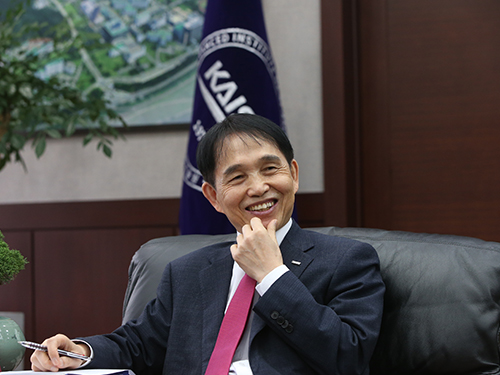
< KAIST President Kwang Hyung Lee >
The universities best equipped with digital infrastructure and savvy human resources will emerge as the new leaders − no matter where they are, says Kwang Hyung Lee
It goes without saying that the Covid-19 pandemic has taken a heavy toll on the education sector. Approximately 1.6 billion students from 192 countries, or 91 per cent of the world’s student population, have experienced educational disruptions.
As we all know, this disruption led to online education hastily emerging as an important new platform. However, approximately 29 percent of young people worldwide, about 364 million individuals, are not online. In many ways, the digital divide is now wider than ever.
We do, however, have an opportunity to ensure that the integration of emerging technologies is further accelerated and that online delivery becomes an integral component of education. This should, in theory, lead to more inclusive and creative pedagogical solutions.
The entire world has effectively taken part in an educational experiment, and at KAIST we were able to confirm that blended education worked effectively for our students. It made up for the long-standing pedagogical shortfalls of the one-way delivery of knowledge and made it possible to shift to a learner-centric model, giving us a great opportunity to unlock the creativity and collaborative minds of our students. Education tailored to students’ individual levels will not only help them accumulate knowledge but improve their ability to use it.
A recent survey in South Korea found that 96 per cent of Seoul citizens believed that the pandemic widened the existing learning gap, but 74 per cent said that schools should carry out a blended form of education using both remote and in-person classes. The feedback from KAIST students on our online classes gives us a glimpse into the new paths we need to take.
From last March, we offered 60 per cent real-time classes via Zoom and 40 per cent through our pre-recorded learning management system. Our students were satisfied with the real-time classes in which they could interact face to face with professors. The blended class format combining real-time and pre-recorded content received very satisfactory evaluations. The problem, however, came with lab classes via Zoom. Students expressed their dissatisfaction with the passive and indirect learning experiences.
Developing online tools or technologies that can enable scientific experiments, engineering prototyping and other hands-on activities remains a challenge. However, we can begin to address these issues using complementary technologies such as virtual reality, augmented reality, image recognition and eye-tracking technologies.
The barriers to access to these new experiences are both complex and pervasive, yet there are ways we can pull together to disrupt these barriers at a global level in the hope of fostering inclusive growth.
For instance, the virtual campus will become a reality at the Kenya-KAIST campus, which will open by September 2023 in the Konza Technopolis, 60km outside Nairobi.
There, we aim to go beyond online education by creating a “metaverse” that provides assistance for running classes and creates an immersive learning experience that runs the gamut of campus activities while utilising the latest digital technologies.
Following a feasibility study of the Kenya campus that took place five years ago, we planned to utilise Mooc courses created by KAIST professors. Using online content there will help mitigate the educational gap between the two institutions, plus it will reduce the need for many students and faculty to make the long commute from the capital to the campus. Although students are expected to live on campus, they will probably engage in other activities in Nairobi and want to take classes wherever they are.
Since it will take some time to select and recruit an excellent group of faculty members, we feel it will be more effective to use online lecture platforms to deliver standardised and qualified content.
It has been posited that the fast adoption of online education will affect international students’ enrolment in universities, which will lead to reductions in revenue. However, we expect that students will choose a university that offers more diverse and interactive metaverse experiences on top of academic and global experiences. The time has come to rebuild the curriculum and infrastructure for the world of the metaverse. We can’t go back to the way things were before.
Universities around the world are now on the same starting line. They need to innovate and pioneer new approaches and tools that can enable all sorts of campus activities online. They should carve out their own distinct metaverse that is viable for human interaction and diverse technological experiences that promote students’ creativity and collaborative minds.
The universities best equipped with digital infrastructure and savvy human resources will emerge as the new leaders − no matter where they are.
Successful education needs the full support of communities and equal access to opportunities. Technological breakthroughs must be used to benefit everyone. To this end, the private and public sectors need to collaborate to bring about inclusive learning opportunities and help shore up global resilience against this and any future pandemics. The hope is that such disruption will bring about new technology and knowledge that we can leverage to reshape the future of education.
ⓒ Source: Times Higher Education (THE)
-
research KAIST Reads “Stress” from Smartphone Chatting, Searching, and Payment Habits
Clues to stress can be hidden in everyday habits such as chatting, searching, and making payments on a smartphone. KAIST researchers have developed a technology that analyzes several routine behaviors repeatedly performed within apps to identify a person’s daily stress state. KAIST (President Choongsik Bae) announced on October 15 that a research team led by Professor Uichin Lee from the Department of AI Computing developed “SHIRBT-MMF,” a technology that automatically ident
2026-10-15 -
research KAIST Develops Transistor-Based Encryption That Controls When Information Can Be Read
Some information, such as exam questions or bid prices, must remain unreadable until an agreed time, even if it has already been delivered. KAIST researchers have used changes in the electric current inside a semiconductor to develop encryption in which information is revealed only after a set amount of time has passed, or can be read correctly only at a specific time. In addition to the key needed to restore the original information, the technology adds a second condition: when the informatio
2026-10-14 -
research KAIST Controls Where 2D Semiconductor Crystals Begin to Grow, Addressing a Key Challenge in Stacking AI Chips
Two-dimensional (2D) semiconductors, only a few atomic layers thick, are a promising material for making AI chips faster and more energy efficient by stacking additional semiconductor layers on top of existing computing circuits. However, when crystals form at multiple random locations during growth, it is difficult to produce high-quality semiconductors at the desired positions. A KAIST joint research team has developed a technology that sets in advance where a crystal begins to grow and allo
2026-10-13 -
research KAIST Develops a Beetle-Inspired Soft Robot That Operates with Artificial Muscles and Sensory Feedback
Researchers have developed a technology that lets a user move a small robot by bending and straightening a finger. The user can also pick up and move objects while checking the images and contact information that the robot sends back. The system combines artificial muscles, a camera, and tactile sensors in a small soft robot modeled on a beetle. It is expected to be used in remote tasks, such as inspecting narrow spaces that are difficult for people to reach and retrieving small objects. KAIS
2026-10-13 -
event KAIST to Chart a Platform-FirstCourse for “Physical AI” Beyond Humanoids
KAIST hosted “Physical AI KOREA 2026” at its Daejeon campus on October 13. At the event, KAIST presented physical AI platform technologies that can be applied not only to manufacturing but also to healthcare, defense, logistics, and everyday life, as well as strategies for research, education, and entrepreneurship that can be utilized by a wide range of companies. Humanoid robots are beginning to surpass human records in robotic competitions modeled after Olympic events such as tr
2026-10-12