event
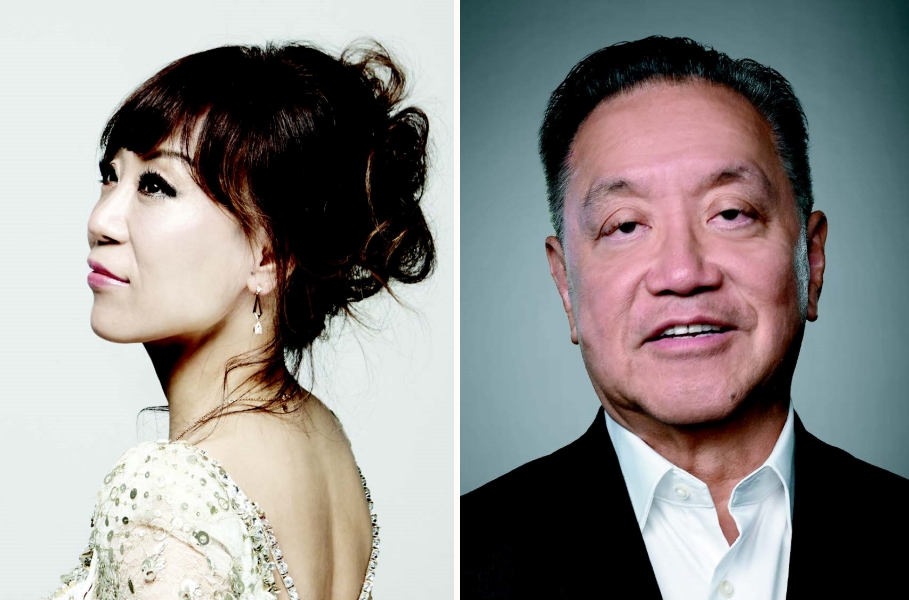
< (From left) Sumi Jo, Distinguished Visiting Professor at the Graduate School of Culture and Technology, and Broadcom President and CEO Hock Tan >
KAIST (President Kwang-Hyung Lee) announced that it awarded honorary doctorates to world-renowned soprano Sumi Jo, a distinguished visiting professor at the Graduate School of Culture and Technology, and the President and Chief Executive Officer of Broadcom Inc., Hock Tan, at the graduation ceremony held on the 16th of February, 2024.
Professor Sumi Jo, who received an honorary doctorate in science and technology, was appointed as a visiting professor at KAIST Graduate School of Culture and Technology in 2021 and established the "Sumi Jo Performing Arts Research Center" and have been involved in research providing valuable feedback on projects to put on stage performances utilizing AI-orchestrated musical ensemble technology and research on virtual voices using vocal synthesis technology, as well as participating in the demonstration of the technological performance showcased at KAIST. Also, she held a special lecture and a talk concert for KAIST students, sharing her experience as a celebrated soprano on the world stage and having honest conversations with students.
KAIST said, “The doctorate is being awarded in recognition of her contributions that is broadening the spectrum of research in the field of science and technology to lead the digital era by suggesting a direction for future
science and technology to take led by culture. Also, her significant contribution to promoting necessary internationalization capabilities helps KAIST as it is growing into a world-class university through new academic challenges.”
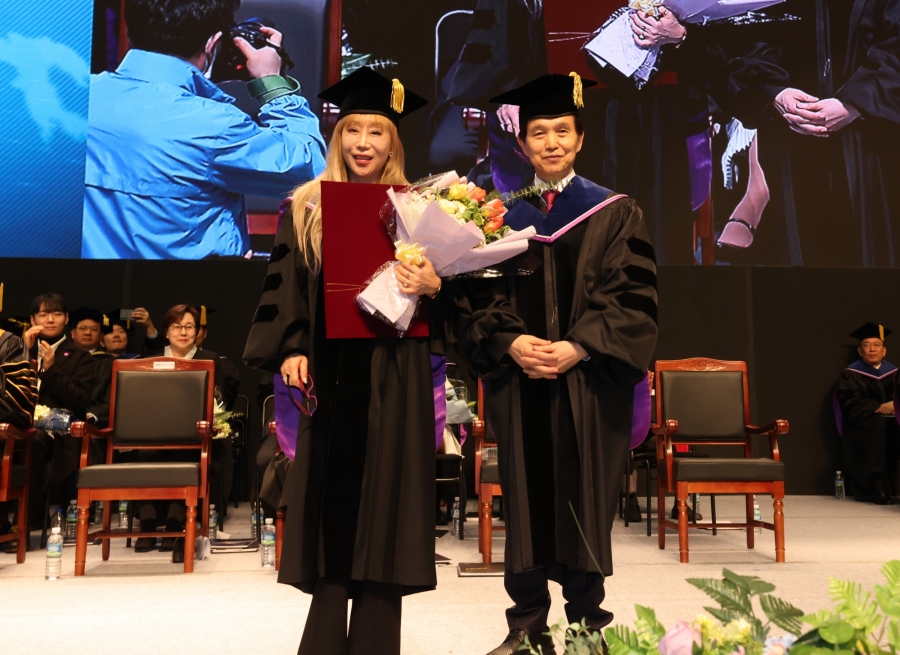
< Professor Sumi Jo (left), who received an honorary doctorate in science and technology, and President Kwang-Hyung Lee >
Professor Sumi Jo, who debuted as Gilda in the opera
Professor Sumi Jo said, “When I received a proposal from President Kwang-Hyung Lee of KAIST to convey what I experienced and felt on the world stage to students of science at KAIST under the topic of ‘Music and My Life,’ questions started to swirl inside of me.”
She continued, “Singing on stage is about ‘expressing,’ and it is a comprehensive artistic process that unfolding the artist’s inner self (expression) and showing it (presentation) in a way that the audience can best feel it through
methods such as sound, lighting, and directing. And I realized that, I was singing all my life in an environment where science and technology coexisted with culture and art.”
“When I worked with the students here at KAIST, I came to realize that when scientific and technologically talented people are set free to really enjoy their ideas and explore them on their own terms, their insight become sharper and their creativity become richer,” she said. She went on to add, “I am proud to be able to join the graduates at the ceremony and would like to express my gratitude for awarding me the honorary doctorate.”
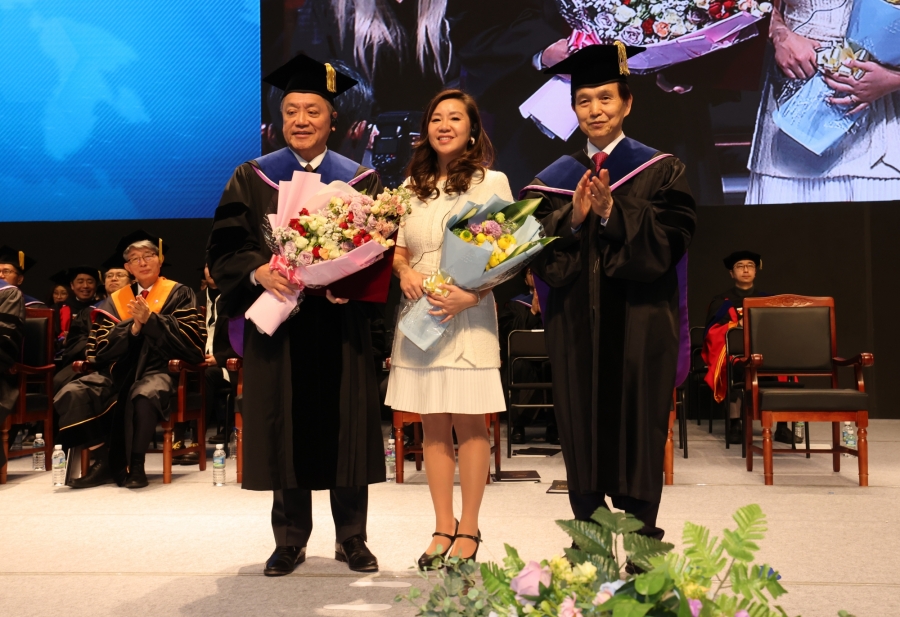
< (From left) President Hock Tan, who received the honorary doctorate in engineering, Mrs. Lya Trung Tan, and President Kwang-Hyung Lee >
Hock Tan received an honorary doctorate in engineering. He is a highly successful businessman who demonstrated entrepreneurship based on a profound understanding of science and technology, which transformed Broadcom into a global enterprise in technology that provides semiconductor and software solutions.
Broadcom has achieved advancement and technological innovation in the semiconductor industry tailored to computer and telecommunication networks, and is evaluated as having played a major role in bringing about the digital transformation movement that is now encompassing the global communities.
Tan attributes the secret to his success to ‘the considerate decision made by the university to award him the scholarship which enabled him to pursue his degree’ and ‘the great team members working with him’..’ Also, he is well-known as a person who considers giving back to society his most important mission.
To support effective medical treatment and identification of the cause of autism, Tan has made large donations to MIT and Harvard University since 2017 several times, and during the COVID-19 pandemic, he reinforced his support to improve the treatment of workers at community medical institutions and non-profit organizations. He also founded the Broadcom Foundation, which supports science, technology, engineering, and mathematics (STEM) education programs for students in and outside the United States.
KAIST said, “We are awarding CEO Hock Tan the honorary doctorate in recognition of his contribution to KAIST’s emergence as a world-class university, as he emphasized the importance of convergence research and
internationalization of KAIST during his time serving as an overseas member of the KAIST President's Advisory Council from 2006 to 2013, while providing policy advices built on his experiences of innovations from various parts around the world.”
Tan emphasized, “KAIST has been vital to Korea’s advancement in the global economy. (KAIST) remains a source of technological innovation,” and that, “It is truly an honor to be recognized by an institution with such a distinguished record of excellence in science, engineering and research.”
President Kwang-Hyung Lee said, “Professor Sumi Jo’s exploration into the future of performing arts through science and technology helps to expand KAIST’s scope and enhance our creative capabilities, while the dedication and humane efforts Hock Tan demonstrates as he contributes to digital innovation through corporate management and engages in various social contribution activities serves as a superb example to all members of KAIST.”
He continued, “These two have lived out the values of challenge and innovation and became examples for many, and we are very pleased to welcome them as the newest members of the KAIST family. On behalf of all members of KAIST, I deliver our sincere congratulations.”
-
research KAIST Develops Core Technology to Reverse Biological Changes Once Thought Irreversible, Opening New Possibilities for Aging and Cancer Research
Once a cell has locked into an abnormal state — the way cancer cells do — can it ever be restored back to normal? A KAIST research team has identified the ‘molecular lock’ that keeps cells trapped in an altered state, opening a new path toward releasing that lock and reversing a cell’s fate. KAIST (President Choongsik Bae) announced on the 21st of August that a research team led by Professor Kwang-Hyun Cho of the Department of Bio and Brain Engineering has, for t
2026-08-21 -
people Former KAIST President Kwang Hyung Lee, Known as the “Science Commander,” Received Honorary Doctorate in Military Science from KNDU
Kwang Hyung Lee, KAIST's 17th president, received an honorary doctorate in military science from Korea National Defense University (KNDU). Lee earned the nickname “Science Commander” for pioneering efforts to bring science and technology into national defense and for his extensive collaboration with the Army, Navy, and Air Force. KAIST (President Choongsik Bae) announced that former President Lee received the honorary degree at KNDU's 71st Founding Anniversary Ceremony. The ceremo
2026-08-13 -
research KAIST Develops High-Efficiency, Eco-Friendly Hydrogen Separation Membrane That Filters Hydrogen Through a Molecular “Network”
For hydrogen to be widely used as a clean energy source in everyday life, technologies that can extract only hydrogen with high purity from mixed gases are essential. KAIST researchers have presented a new strategy for developing high-performance separation membranes that can selectively filter hydrogen for clean hydrogen energy production. KAIST (President Choongsik Bae) announced on the 13th of August that a research team led by Professor Tae-Hyun Bae of the Department of Chemical and Biomo
2026-08-13 -
research KAIST Finds Algal Blooms Make Plastic More Prone to Breaking Apart, Revealing a Mechanism of Microplastic Formation
Every summer, algal blooms turn rivers and lakes green. Although they are widely known as a major form of water pollution that makes the water murky, a KAIST research team has now shown for the first time that algal bloom conditions can make discarded plastics, such as plastic bags, more prone to breaking apart, potentially accelerating the formation of microplastics. The study points to a new direction for the era of climate change: water pollution and plastic pollution need to be managed tog
2026-07-29 -
research KAIST Develops Low-Temperature Technique for Growing Crystal-Aligned Semiconductor Films
Building next-generation semiconductors and low-power electronic devices requires precisely stacking materials with different functions. In this process, it is essential to preserve each material's intrinsic properties, as well as the interface where the two materials meet, without damage. Layered van der Waals materials, including transition metal dichalcogenides (TMDs), have attracted considerable attention as next-generation semiconductor platforms because their layers interact through weak
2026-07-27