%4b%41%49%53%54
-
 KAIST-KakaoBank Speeds Up 'Explainable AI' by 11 Times: "Boosts Financial AI Reliability
< (From left) Professor Jaesik Choi of the Kim Jaechul Graduate School of AI, Ph.D candidate Chanwoo Lee, Ph.D candidate Youngjin Park >
The research team led by Professor Jaesik Choi of KAIST's Kim Jaechul Graduate School of AI, in collaboration with KakaoBank Corp, announced that they have developed an accelerated explanation technology that can explain the basis of an Artificial Intelligence (AI) model's judgment in real-time. This research achievement significantly increases the practical applicability of Explainable Artificial Intelligence (hereinafter XAI) technology in fields requiring real-time decision-making, such as financial services, by achieving an average processing speed 8.5 times faster, and up to 11 times faster, than existing explanation algorithms for AI model predictions.
In the financial sector, a clear explanation for decisions made by AI systems is essential. Especially in services directly related to customer rights, such as loan screening and anomaly detection, regulatory demands to transparently present the basis for the AI model's judgment are increasingly stringent. However, conventional Explainable Artificial Intelligence (XAI) technologies required the repeated calculation of hundreds to thousands of baselines to generate accurate explanations, resulting in massive computational costs. This was a major factor limiting the application of XAI technology in real-time service environments.
To address this issue, Professor Choi's research team developed the 'ABSQR (Amortized Baseline Selection via Rank-Revealing QR)' framework for accelerating explanation algorithms. ABSQR noticed that the value function matrix generated during the AI model explanation process has a low-rank structure. It introduced a method to select only a critical few baselines from the hundreds available. This drastically reduced the computation complexity, which was previously proportional to the number of baselines, to be proportional only to the number of selected critical baselines, thereby maximizing computational efficiency while maintaining explanatory accuracy.
Specifically, ABSQR operates in two stages. The first stage systematically selects important baselines using Singular Value Decomposition (SVD) and Rank-Revealing QR decomposition techniques. Unlike existing random sampling methods, this is a deterministic selection method aimed at preserving information recovery, which guarantees the accuracy of the explanation while significantly reducing computation. The second stage introduces an amortized inference mechanism, which reuses the pre-calculated weights of the baselines through cluster-based search, allowing the system to provide an explanation for the model's prediction result in real-time service environments without repeatedly evaluating the model. The research team verified the superiority of ABSQR through experiments on various real-world datasets. Tests on standard datasets across five sectors—finance, marketing, and demographics—showed that ABSQR achieved an average processing speed 8.5 times faster than existing explanation algorithms that use all baselines, with a maximum speed improvement of over 11 times. Furthermore, the degradation of explanatory accuracy due to speed acceleration was minimized, maintaining up to 93.5% of the explanation accuracy compared to the baseline algorithm. This level is sufficient to meet the explanation quality required in real-world applications.
< ABSQR Framework Overview. (1) The baseline selection stage utilizes the low-rank structure of the value function matrix to select only a small number of key baselines, and (2) the accelerated search stage reuses the pre-calculated baseline weight coefficients based on clusters. This dramatically reduces the computation complexity, which was proportional to the number of baselines, to be proportional only to the number of selected key baselines. >
A KakaoBank official stated, "We will continue relentless research and development to enhance the reliability and convenience of financial services and introduce innovative financial technologies that customers can experience." Chanwoo Lee and Youngjin Park, co-first authors from KAIST, explained the significance of the research: "This methodology solves the crucial acceleration problem for real-time application in the financial sector, proving that it is possible to provide users with the reasons behind a learning model's decision in real-time." They added, "This research provides new insights into what constitutes unnecessary computation and the selection of important baselines in explanation algorithms, practically contributing to the improvement of explanation technology efficiency." This research, co-authored by PhD candidates Chanwoo Lee and Youngjin Park from the KAIST Kim Jaechul Graduate School of AI, and researchers Hyeongeun Lee and Yeeun Yoo from the KakaoBank Financial Technology Research Institute, was presented on November 12 at the 'CIKM 2025 (ACM International Conference on Information and Knowledge Management)', the world's highest-authority academic conference in the field of information and knowledge management. ※ Paper Title: Amortized Baseline Selection via Rank-Revealing QR for Efficient Model Explanation
※ Author Information:
※ Author Information: DOI: https://doi.org/10.1145/3746252.3761036
Co-First Authors: Chanwoo Lee (KAIST Kim Jaechul Graduate School of AI), Youngjin Park (KAIST Kim Jaechul Graduate School of AI), Hyeogeun Lee (KakaoBank), Yeeun Yoo (KakaoBank)
Co-Authors: Daehee Han (KakaoBank), Junho Choi (KAIST Kim Jaechul Graduate School of AI), Kunhyung Kim (KAIST Kim Jaechul Graduate School of AI)
Corresponding Authors: Nari Kim (KAIST Kim Jaechul Graduate School of AI), Jaesik Choi (KAIST Kim Jaechul Graduate School of AI)
Meanwhile, this research achievement was conducted through KakaoBank's industry-academia research project 'Advanced Research on Explainable Artificial Intelligence Algorithms in the Financial Sector' and the Ministry of Science and ICT/Institute for Information & Communications Technology Planning and Evaluation (IITP) supported project 'Development of Explainable Artificial Intelligence Technology Providing Explainability in a Plug-and-Play Manner and Verification of Explanation Provision for AI Systems.'
2025.12.12 View 2591
KAIST-KakaoBank Speeds Up 'Explainable AI' by 11 Times: "Boosts Financial AI Reliability
< (From left) Professor Jaesik Choi of the Kim Jaechul Graduate School of AI, Ph.D candidate Chanwoo Lee, Ph.D candidate Youngjin Park >
The research team led by Professor Jaesik Choi of KAIST's Kim Jaechul Graduate School of AI, in collaboration with KakaoBank Corp, announced that they have developed an accelerated explanation technology that can explain the basis of an Artificial Intelligence (AI) model's judgment in real-time. This research achievement significantly increases the practical applicability of Explainable Artificial Intelligence (hereinafter XAI) technology in fields requiring real-time decision-making, such as financial services, by achieving an average processing speed 8.5 times faster, and up to 11 times faster, than existing explanation algorithms for AI model predictions.
In the financial sector, a clear explanation for decisions made by AI systems is essential. Especially in services directly related to customer rights, such as loan screening and anomaly detection, regulatory demands to transparently present the basis for the AI model's judgment are increasingly stringent. However, conventional Explainable Artificial Intelligence (XAI) technologies required the repeated calculation of hundreds to thousands of baselines to generate accurate explanations, resulting in massive computational costs. This was a major factor limiting the application of XAI technology in real-time service environments.
To address this issue, Professor Choi's research team developed the 'ABSQR (Amortized Baseline Selection via Rank-Revealing QR)' framework for accelerating explanation algorithms. ABSQR noticed that the value function matrix generated during the AI model explanation process has a low-rank structure. It introduced a method to select only a critical few baselines from the hundreds available. This drastically reduced the computation complexity, which was previously proportional to the number of baselines, to be proportional only to the number of selected critical baselines, thereby maximizing computational efficiency while maintaining explanatory accuracy.
Specifically, ABSQR operates in two stages. The first stage systematically selects important baselines using Singular Value Decomposition (SVD) and Rank-Revealing QR decomposition techniques. Unlike existing random sampling methods, this is a deterministic selection method aimed at preserving information recovery, which guarantees the accuracy of the explanation while significantly reducing computation. The second stage introduces an amortized inference mechanism, which reuses the pre-calculated weights of the baselines through cluster-based search, allowing the system to provide an explanation for the model's prediction result in real-time service environments without repeatedly evaluating the model. The research team verified the superiority of ABSQR through experiments on various real-world datasets. Tests on standard datasets across five sectors—finance, marketing, and demographics—showed that ABSQR achieved an average processing speed 8.5 times faster than existing explanation algorithms that use all baselines, with a maximum speed improvement of over 11 times. Furthermore, the degradation of explanatory accuracy due to speed acceleration was minimized, maintaining up to 93.5% of the explanation accuracy compared to the baseline algorithm. This level is sufficient to meet the explanation quality required in real-world applications.
< ABSQR Framework Overview. (1) The baseline selection stage utilizes the low-rank structure of the value function matrix to select only a small number of key baselines, and (2) the accelerated search stage reuses the pre-calculated baseline weight coefficients based on clusters. This dramatically reduces the computation complexity, which was proportional to the number of baselines, to be proportional only to the number of selected key baselines. >
A KakaoBank official stated, "We will continue relentless research and development to enhance the reliability and convenience of financial services and introduce innovative financial technologies that customers can experience." Chanwoo Lee and Youngjin Park, co-first authors from KAIST, explained the significance of the research: "This methodology solves the crucial acceleration problem for real-time application in the financial sector, proving that it is possible to provide users with the reasons behind a learning model's decision in real-time." They added, "This research provides new insights into what constitutes unnecessary computation and the selection of important baselines in explanation algorithms, practically contributing to the improvement of explanation technology efficiency." This research, co-authored by PhD candidates Chanwoo Lee and Youngjin Park from the KAIST Kim Jaechul Graduate School of AI, and researchers Hyeongeun Lee and Yeeun Yoo from the KakaoBank Financial Technology Research Institute, was presented on November 12 at the 'CIKM 2025 (ACM International Conference on Information and Knowledge Management)', the world's highest-authority academic conference in the field of information and knowledge management. ※ Paper Title: Amortized Baseline Selection via Rank-Revealing QR for Efficient Model Explanation
※ Author Information:
※ Author Information: DOI: https://doi.org/10.1145/3746252.3761036
Co-First Authors: Chanwoo Lee (KAIST Kim Jaechul Graduate School of AI), Youngjin Park (KAIST Kim Jaechul Graduate School of AI), Hyeogeun Lee (KakaoBank), Yeeun Yoo (KakaoBank)
Co-Authors: Daehee Han (KakaoBank), Junho Choi (KAIST Kim Jaechul Graduate School of AI), Kunhyung Kim (KAIST Kim Jaechul Graduate School of AI)
Corresponding Authors: Nari Kim (KAIST Kim Jaechul Graduate School of AI), Jaesik Choi (KAIST Kim Jaechul Graduate School of AI)
Meanwhile, this research achievement was conducted through KakaoBank's industry-academia research project 'Advanced Research on Explainable Artificial Intelligence Algorithms in the Financial Sector' and the Ministry of Science and ICT/Institute for Information & Communications Technology Planning and Evaluation (IITP) supported project 'Development of Explainable Artificial Intelligence Technology Providing Explainability in a Plug-and-Play Manner and Verification of Explanation Provision for AI Systems.'
2025.12.12 View 2591 -
 Failure in the AI Era? The 3rd Failure Conference Held
< 2025 Failure Conference Poster >
KAIST announced on the 31st of October that it will be holding the '3rd Failure Conference' from Wednesday, November 5th to Friday, November 14th. The event is organized by the KAIST Center for Ambitious Failure (Director Sungho Jo), and, under the theme 'AI times Failure,' it will re-examine the value of humaneness through the sensibility of 'failure' in this era of great transformation led by AI technology.
Composed of lectures, competitions, exhibitions, and networking programs, this conference provides a venue for new introspection on the relationship between humanity, society, and technology through the lens of 'failure.'
Failure Seminar 'AI Era, Asking the Way of Humanity' will be held on November 6th at the Jeong Geun-mo Conference Hall in the Academic and Cultural Complex
Professor Juho Kim of the KAIST School of Computing will discuss the human sensibility and resilience needed in the AI era through the paradox that "AI learns how to fail less, but humans are losing the opportunity to fail. Following this, Professor Sang Wook Lee of the Hanyang University Department of Philosophy will present philosophical and ethical challenges and practical directions for the advancement of AI technology to lead to universal welfare for humanity. The 'AI times Failure Idea Contest' Finals will take place on November 7th at the John Hanner Hall in the Academic and Cultural Complex. 12 teams, selected from preliminaries that included 111 teams from universities and graduate schools nationwide, will demonstrate their ideas in booth form on the theme of 'The Future where AI and Humans Coexist.' Participants will explore AI errors, human limitations, and the possibility of trust and recovery, presenting attempts to convert technological failure into human introspection, and human failure into technological possibility. On the day of the finals, the Grand Prize (KAIST President’s Award), First Prize, and Second Prize will be selected through judging.
The Photography Exhibition '404: Perfection Not Found' will be held on the 1st floor of the Creative Learning Building from November 5th to 14th. This exhibition showcases 'Scenes of Imperfection' captured by KAIST members through the PhotoVoice program and the AI times Failure Snapshot Challenge. It is divided into three sections: ▲ Brain that Mimics Perfection: Failure of AI ▲ Incomplete Connection: Portrait of the Digital Generation ▲ Aesthetics of Imperfection: Warmth of Humanity, providing a space for introspection that illuminates human responsibility and potential through technological failure. The 'Show Off Your Failed Project Contest,' which has garnered great response from KAIST students every year, will be expanded to include general public participation on the 5th at the John Hanner Hall in the Academic and Cultural Complex. Co-planned by the KAIST Center for Ambitious Failure and the student club ICISTS, participants will decorate their own booths with photos and videos to share their failures and the process of overcoming them. Awards such as ▲ Best (Most Votes) ▲ Shining Debris Award (Highly Relatable Failure Story) ▲ Flower of Ash Award (Overcoming Story) ▲ Aesthetics of Failure Award (Creative Expression) ▲ Beautiful Afterimage Award (Sincere Lingering Impression) will be selected through audience voting.
< 2025 Show Off Your Failed Project Contest Poster >
Sungho Jo, KAIST Center for Ambitious Failure (Professor, School of Computing), stated, "As AI technology rapidly evolves and changes the order of the world, humans need to look back at themselves beyond that speed. I hope this Failure Conference will be an opportunity to rediscover the meaning of humaneness amid technological innovation and to imagine a better future." Kwang Hyung Lee, President of KAIST, said, "Failure is another name for challenge, and a seed of innovation. KAIST will lead the AI era and human-centered technological development through a creative spirit of challenge that is not afraid of failure."
All programs for the 2025 Failure Conference are open to anyone interested, and detailed schedules and content can be checked on the webstie of KAIST Center for Ambitious Failure (caf.kaist.ac.kr).
2025.10.29 View 2076
Failure in the AI Era? The 3rd Failure Conference Held
< 2025 Failure Conference Poster >
KAIST announced on the 31st of October that it will be holding the '3rd Failure Conference' from Wednesday, November 5th to Friday, November 14th. The event is organized by the KAIST Center for Ambitious Failure (Director Sungho Jo), and, under the theme 'AI times Failure,' it will re-examine the value of humaneness through the sensibility of 'failure' in this era of great transformation led by AI technology.
Composed of lectures, competitions, exhibitions, and networking programs, this conference provides a venue for new introspection on the relationship between humanity, society, and technology through the lens of 'failure.'
Failure Seminar 'AI Era, Asking the Way of Humanity' will be held on November 6th at the Jeong Geun-mo Conference Hall in the Academic and Cultural Complex
Professor Juho Kim of the KAIST School of Computing will discuss the human sensibility and resilience needed in the AI era through the paradox that "AI learns how to fail less, but humans are losing the opportunity to fail. Following this, Professor Sang Wook Lee of the Hanyang University Department of Philosophy will present philosophical and ethical challenges and practical directions for the advancement of AI technology to lead to universal welfare for humanity. The 'AI times Failure Idea Contest' Finals will take place on November 7th at the John Hanner Hall in the Academic and Cultural Complex. 12 teams, selected from preliminaries that included 111 teams from universities and graduate schools nationwide, will demonstrate their ideas in booth form on the theme of 'The Future where AI and Humans Coexist.' Participants will explore AI errors, human limitations, and the possibility of trust and recovery, presenting attempts to convert technological failure into human introspection, and human failure into technological possibility. On the day of the finals, the Grand Prize (KAIST President’s Award), First Prize, and Second Prize will be selected through judging.
The Photography Exhibition '404: Perfection Not Found' will be held on the 1st floor of the Creative Learning Building from November 5th to 14th. This exhibition showcases 'Scenes of Imperfection' captured by KAIST members through the PhotoVoice program and the AI times Failure Snapshot Challenge. It is divided into three sections: ▲ Brain that Mimics Perfection: Failure of AI ▲ Incomplete Connection: Portrait of the Digital Generation ▲ Aesthetics of Imperfection: Warmth of Humanity, providing a space for introspection that illuminates human responsibility and potential through technological failure. The 'Show Off Your Failed Project Contest,' which has garnered great response from KAIST students every year, will be expanded to include general public participation on the 5th at the John Hanner Hall in the Academic and Cultural Complex. Co-planned by the KAIST Center for Ambitious Failure and the student club ICISTS, participants will decorate their own booths with photos and videos to share their failures and the process of overcoming them. Awards such as ▲ Best (Most Votes) ▲ Shining Debris Award (Highly Relatable Failure Story) ▲ Flower of Ash Award (Overcoming Story) ▲ Aesthetics of Failure Award (Creative Expression) ▲ Beautiful Afterimage Award (Sincere Lingering Impression) will be selected through audience voting.
< 2025 Show Off Your Failed Project Contest Poster >
Sungho Jo, KAIST Center for Ambitious Failure (Professor, School of Computing), stated, "As AI technology rapidly evolves and changes the order of the world, humans need to look back at themselves beyond that speed. I hope this Failure Conference will be an opportunity to rediscover the meaning of humaneness amid technological innovation and to imagine a better future." Kwang Hyung Lee, President of KAIST, said, "Failure is another name for challenge, and a seed of innovation. KAIST will lead the AI era and human-centered technological development through a creative spirit of challenge that is not afraid of failure."
All programs for the 2025 Failure Conference are open to anyone interested, and detailed schedules and content can be checked on the webstie of KAIST Center for Ambitious Failure (caf.kaist.ac.kr).
2025.10.29 View 2076 -
 Robot-Operated Space Station Construction Goal... 'In-space Servicing and Manufacturing Research Center' Launched
<Plaque Handover Ceremony. (From left) Jae-Hung Han, Director of the Space Research Institute, Ju-won Kang, Head of Engineering Group at the National Research Foundation of Korea Basic Research Headquarters>
KAIST's Space Research Institute announced on the 24th of October that it officially launched the 'Innovative Research Center for the Development of Core Technologies in In-space Servicing and Manufacturing (ISMRC)' at the KAIST Academic Cultural Center on Friday, October 24. About 150 officials from major organizations, including the Korea Aerospace Administration, the National Research Foundation of Korea, and Daejeon Metropolitan City, as well as domestic and foreign space experts, attended the opening ceremony to discuss future cooperation measures. The 'KAIST In-space Servicing and Manufacturing Research Center (ISMRC)' is a large-scale research hub selected for the Ministry of Science and ICT's 2025 Basic Research Project, with a total of 71.2 billion KRW long-term project planned over the next 10 years, including 50 billion KRW in national funding. Daejeon City will also provide a total of 3.6 billion KRW, with 400 million KRW annually starting from 2026. The research goals are to secure core technologies for next-generation space exploration, including: ▲ Construction of Unmanned Space Stations, ▲ Robotics-based In-space Manufacturing, and ▲ Resource Recovery Technology. A team of 14 KAIST professors, led by Director Jae-Hung Han, will spearhead the research, with major domestic and foreign space companies and research institutions participating in joint research. As the 'New Space' era fully commences globally, the In-space Servicing and Manufacturing industry is projected to grow to tens of trillions of Korean won by 2030, driven by the reduction of launch costs and the expansion of private sector participation. This field is evaluated as a core area that will fundamentally change the way humanity engages in space activities, including extending satellite lifespan, on-orbit maintenance and operation, and securing and manufacturing resources in space. Meanwhile, an international symposium was held for two days on October 23-24 at the KAIST Academic Cultural Center and KI Building, coinciding with the opening ceremony.
<Director Jae-Hung Han of the Space Research Institute presenting>
The symposium was composed of a total of six sessions, including: ▲ Exchange Meeting on Additive Manufacturing Tecnology for Aerospace, ▲ International Workshop on Aerospace Composites, ▲ Workshop on Swarm Satellite Development, and ▲ Workshop on In-space Servicing and Manufacturing Robotics. Major domestic and foreign institutions and experts, including the Korea Aerospace Research Institute, Japan Advanced Institute of Science and Technology, and California Institute of Technology (Caltech), attended to discuss the future direction of next-generation space technology development and international cooperation measures. Cheol-woong Son, Director-General of Future Strategy Industry Office at Daejeon City, said, "We will develop the Innovative Research Center into a Daejeon-type space industry innovation platform with KAIST," and "Daejeon City will concentrate its capabilities to help local businesses grow and establish Daejeon as the central city for the Republic of Korea's space industry." Jae-Hung Han, Director of the KAIST Space Research Institute, said, "We will lead the core technologies for in-space servicing and manufacturing through cooperation between industry, academia, research institutes, and government, and contribute to the establishment of a private sector-focused industrial ecosystem," adding, "KAIST will grow into a comprehensive research hub that encompasses R&D, talent nurturing, and technology commercialization."
<Group Photo of Participants at the Opening Ceremony of the In-space Servicing and Manufacturing Research Center>
Kwang Hyung Lee, President of KAIST, said, "The field of in-space servicing and manufacturing is a core area that will change the paradigm of the future space industry," and "KAIST will lead the Republic of Korea to become the center for opening a new era of the space industry through innovative technology development and global cooperation." KAIST plans to perform the role of breaking down the boundaries between academia and industry, focusing on these technologies, and laying the foundation for next-generation space activities.
2025.10.24 View 4029
Robot-Operated Space Station Construction Goal... 'In-space Servicing and Manufacturing Research Center' Launched
<Plaque Handover Ceremony. (From left) Jae-Hung Han, Director of the Space Research Institute, Ju-won Kang, Head of Engineering Group at the National Research Foundation of Korea Basic Research Headquarters>
KAIST's Space Research Institute announced on the 24th of October that it officially launched the 'Innovative Research Center for the Development of Core Technologies in In-space Servicing and Manufacturing (ISMRC)' at the KAIST Academic Cultural Center on Friday, October 24. About 150 officials from major organizations, including the Korea Aerospace Administration, the National Research Foundation of Korea, and Daejeon Metropolitan City, as well as domestic and foreign space experts, attended the opening ceremony to discuss future cooperation measures. The 'KAIST In-space Servicing and Manufacturing Research Center (ISMRC)' is a large-scale research hub selected for the Ministry of Science and ICT's 2025 Basic Research Project, with a total of 71.2 billion KRW long-term project planned over the next 10 years, including 50 billion KRW in national funding. Daejeon City will also provide a total of 3.6 billion KRW, with 400 million KRW annually starting from 2026. The research goals are to secure core technologies for next-generation space exploration, including: ▲ Construction of Unmanned Space Stations, ▲ Robotics-based In-space Manufacturing, and ▲ Resource Recovery Technology. A team of 14 KAIST professors, led by Director Jae-Hung Han, will spearhead the research, with major domestic and foreign space companies and research institutions participating in joint research. As the 'New Space' era fully commences globally, the In-space Servicing and Manufacturing industry is projected to grow to tens of trillions of Korean won by 2030, driven by the reduction of launch costs and the expansion of private sector participation. This field is evaluated as a core area that will fundamentally change the way humanity engages in space activities, including extending satellite lifespan, on-orbit maintenance and operation, and securing and manufacturing resources in space. Meanwhile, an international symposium was held for two days on October 23-24 at the KAIST Academic Cultural Center and KI Building, coinciding with the opening ceremony.
<Director Jae-Hung Han of the Space Research Institute presenting>
The symposium was composed of a total of six sessions, including: ▲ Exchange Meeting on Additive Manufacturing Tecnology for Aerospace, ▲ International Workshop on Aerospace Composites, ▲ Workshop on Swarm Satellite Development, and ▲ Workshop on In-space Servicing and Manufacturing Robotics. Major domestic and foreign institutions and experts, including the Korea Aerospace Research Institute, Japan Advanced Institute of Science and Technology, and California Institute of Technology (Caltech), attended to discuss the future direction of next-generation space technology development and international cooperation measures. Cheol-woong Son, Director-General of Future Strategy Industry Office at Daejeon City, said, "We will develop the Innovative Research Center into a Daejeon-type space industry innovation platform with KAIST," and "Daejeon City will concentrate its capabilities to help local businesses grow and establish Daejeon as the central city for the Republic of Korea's space industry." Jae-Hung Han, Director of the KAIST Space Research Institute, said, "We will lead the core technologies for in-space servicing and manufacturing through cooperation between industry, academia, research institutes, and government, and contribute to the establishment of a private sector-focused industrial ecosystem," adding, "KAIST will grow into a comprehensive research hub that encompasses R&D, talent nurturing, and technology commercialization."
<Group Photo of Participants at the Opening Ceremony of the In-space Servicing and Manufacturing Research Center>
Kwang Hyung Lee, President of KAIST, said, "The field of in-space servicing and manufacturing is a core area that will change the paradigm of the future space industry," and "KAIST will lead the Republic of Korea to become the center for opening a new era of the space industry through innovative technology development and global cooperation." KAIST plans to perform the role of breaking down the boundaries between academia and industry, focusing on these technologies, and laying the foundation for next-generation space activities.
2025.10.24 View 4029 -
 The 4th Korea AI System Forum Breakfast Lecture Successfully Concluded
A special event was held to explore the trend of "Physical AI," where artificial intelligence directly connects with the physical world and rapidly permeates industrial sites. On the morning of Monday, September 8, KAIST's Graduate School of AI Semiconductor held the "4th Korea AI System Forum (KAISF)" breakfast lecture at the Onoma Hotel in Daejeon.
At the lecture, Yoon-seok Pyu, a director at ROBOTIS, Inc., gave a special presentation on the topic, "Physical AI Research Trends and the Development History of Task-Oriented Humanoid AI Workers." Director Pyu introduced the current state of global Physical AI research and specifically explained ROBOTIS's strategy for developing humanoid robots tailored to industrial sites.
<Group photo of attendees at the 4th Korea AI System Forum>
In particular, the participants were shown the potential of a robot platform that can be applied in real industrial settings, thanks to technical advances in core components like the robot's ability to learn tasks through imitation learning, and the company's small, high-power actuators and self-developed reducers. He shared examples of the company's "AI Worker" development, which is specialized for the manufacturing, logistics, and service sectors, based on ROBOTIS's vision of "Freedom from Work."
Beyond simple technological concepts, attendees actively exchanged opinions and deeply agreed on the need for Physical AI robots that can be used stably and efficiently in the field.
Hoe-jun Yoo, chairman of the Korea AI System Forum (a KAIST professor), stated, "Physical AI is a field where countries around the world are fiercely competing to secure a leading position. KAISF will support our
companies to lead in the global market by building a Korean-style industrial ecosystem."
Going forward, KAISF plans to focus on ensuring that Korean Physical AI technology gains a competitive edge on the global stage by closely connecting industry, academia, and research institutions. Through this effort, it will promote the creation of a differentiated industrial ecosystem that encompasses AI semiconductors, robotics, and system integration.
2025.09.09 View 3080
The 4th Korea AI System Forum Breakfast Lecture Successfully Concluded
A special event was held to explore the trend of "Physical AI," where artificial intelligence directly connects with the physical world and rapidly permeates industrial sites. On the morning of Monday, September 8, KAIST's Graduate School of AI Semiconductor held the "4th Korea AI System Forum (KAISF)" breakfast lecture at the Onoma Hotel in Daejeon.
At the lecture, Yoon-seok Pyu, a director at ROBOTIS, Inc., gave a special presentation on the topic, "Physical AI Research Trends and the Development History of Task-Oriented Humanoid AI Workers." Director Pyu introduced the current state of global Physical AI research and specifically explained ROBOTIS's strategy for developing humanoid robots tailored to industrial sites.
<Group photo of attendees at the 4th Korea AI System Forum>
In particular, the participants were shown the potential of a robot platform that can be applied in real industrial settings, thanks to technical advances in core components like the robot's ability to learn tasks through imitation learning, and the company's small, high-power actuators and self-developed reducers. He shared examples of the company's "AI Worker" development, which is specialized for the manufacturing, logistics, and service sectors, based on ROBOTIS's vision of "Freedom from Work."
Beyond simple technological concepts, attendees actively exchanged opinions and deeply agreed on the need for Physical AI robots that can be used stably and efficiently in the field.
Hoe-jun Yoo, chairman of the Korea AI System Forum (a KAIST professor), stated, "Physical AI is a field where countries around the world are fiercely competing to secure a leading position. KAISF will support our
companies to lead in the global market by building a Korean-style industrial ecosystem."
Going forward, KAISF plans to focus on ensuring that Korean Physical AI technology gains a competitive edge on the global stage by closely connecting industry, academia, and research institutions. Through this effort, it will promote the creation of a differentiated industrial ecosystem that encompasses AI semiconductors, robotics, and system integration.
2025.09.09 View 3080 -
 Development of Core NPU Technology to Improve ChatGPT Inference Performance by Over 60%
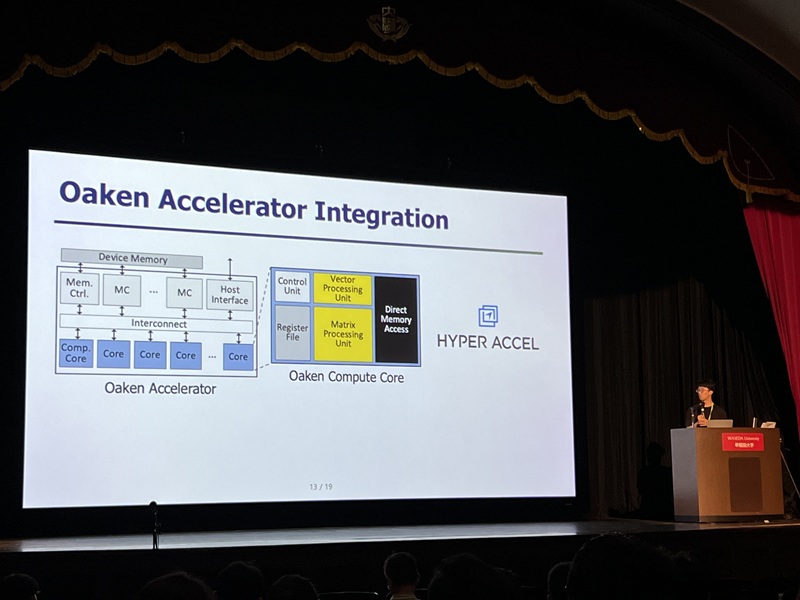
Latest generative AI models such as OpenAI's ChatGPT-4 and Google's Gemini 2.5 require not only high memory bandwidth but also large memory capacity. This is why generative AI cloud operating companies like Microsoft and Google purchase hundreds of thousands of NVIDIA GPUs. As a solution to address the core challenges of building such high-performance AI infrastructure, Korean researchers have succeeded in developing an NPU (Neural Processing Unit)* core technology that improves the inference performance of generative AI models by an average of over 60% while consuming approximately 44% less power compared to the latest GPUs.
*NPU (Neural Processing Unit): An AI-specific semiconductor chip designed to rapidly process artificial neural networks.
On the 4th, Professor Jongse Park's research team from KAIST School of Computing, in collaboration with HyperAccel Inc. (a startup founded by Professor Joo-Young Kim from the School of Electrical Engineering), announced that they have developed a high-performance, low-power NPU (Neural Processing Unit) core technology specialized for generative AI clouds like ChatGPT.
The technology proposed by the research team has been accepted by the '2025 International Symposium on Computer Architecture (ISCA 2025)', a top-tier international conference in the field of computer architecture.
The key objective of this research is to improve the performance of large-scale generative AI services by lightweighting the inference process, while minimizing accuracy loss and solving memory bottleneck issues. This research is highly recognized for its integrated design of AI semiconductors and AI system software, which are key components of AI infrastructure.
While existing GPU-based AI infrastructure requires multiple GPU devices to meet high bandwidth and capacity demands, this technology enables the configuration of the same level of AI infrastructure using fewer NPU devices through KV cache quantization*. KV cache accounts for most of the memory usage, thereby its quantization significantly reduces the cost of building generative AI clouds.
*KV Cache (Key-Value Cache) Quantization: Refers to reducing the data size in a type of temporary storage space used to improve performance when operating generative AI models (e.g., converting a 16-bit number to a 4-bit number reduces data size by 1/4).
The research team designed it to be integrated with memory interfaces without changing the operational logic of existing NPU architectures. This hardware architecture not only implements the proposed quantization algorithm but also adopts page-level memory management techniques* for efficient utilization of limited memory bandwidth and capacity, and introduces new encoding technique optimized for quantized KV cache.
*Page-level memory management technique: Virtualizes memory addresses, as the CPU does, to allow consistent access within the NPU.
Furthermore, when building an NPU-based AI cloud with superior cost and power efficiency compared to the latest GPUs, the high-performance, low-power nature of NPUs is expected to significantly reduce operating costs.
Professor Jongse Park stated, "This research, through joint work with HyperAccel Inc., found a solution in generative AI inference lightweighting algorithms and succeeded in developing a core NPU technology that can solve the 'memory problem.' Through this technology, we implemented an NPU with over 60% improved performance compared to the latest GPUs by combining quantization techniques that reduce memory requirements while maintaining inference accuracy, and hardware designs optimized for this".
He further emphasized, "This technology has demonstrated the possibility of implementing high-performance, low-power infrastructure specialized for generative AI, and is expected to play a key role not only in AI cloud data centers but also in the AI transformation (AX) environment represented by dynamic, executable AI such as 'Agentic AI'."
This research was presented by Ph.D. student Minsu Kim and Dr. Seongmin Hong from HyperAccel Inc. as co-first authors at the '2025 International Symposium on Computer Architecture (ISCA)' held in Tokyo, Japan, from June 21 to June 25. ISCA, a globally renowned academic conference, received 570 paper submissions this year, with only 127 papers accepted (an acceptance rate of 22.7%).
※Paper Title: Oaken: Fast and Efficient LLM Serving with Online-Offline Hybrid KV Cache Quantization
※DOI: https://doi.org/10.1145/3695053.3731019
Meanwhile, this research was supported by the National Research Foundation of Korea's Excellent Young Researcher Program, the Institute for Information & Communications Technology Planning & Evaluation (IITP), and the AI Semiconductor Graduate School Support Project.
2025.07.07 View 7846
Development of Core NPU Technology to Improve ChatGPT Inference Performance by Over 60%
Latest generative AI models such as OpenAI's ChatGPT-4 and Google's Gemini 2.5 require not only high memory bandwidth but also large memory capacity. This is why generative AI cloud operating companies like Microsoft and Google purchase hundreds of thousands of NVIDIA GPUs. As a solution to address the core challenges of building such high-performance AI infrastructure, Korean researchers have succeeded in developing an NPU (Neural Processing Unit)* core technology that improves the inference performance of generative AI models by an average of over 60% while consuming approximately 44% less power compared to the latest GPUs.
*NPU (Neural Processing Unit): An AI-specific semiconductor chip designed to rapidly process artificial neural networks.
On the 4th, Professor Jongse Park's research team from KAIST School of Computing, in collaboration with HyperAccel Inc. (a startup founded by Professor Joo-Young Kim from the School of Electrical Engineering), announced that they have developed a high-performance, low-power NPU (Neural Processing Unit) core technology specialized for generative AI clouds like ChatGPT.
The technology proposed by the research team has been accepted by the '2025 International Symposium on Computer Architecture (ISCA 2025)', a top-tier international conference in the field of computer architecture.
The key objective of this research is to improve the performance of large-scale generative AI services by lightweighting the inference process, while minimizing accuracy loss and solving memory bottleneck issues. This research is highly recognized for its integrated design of AI semiconductors and AI system software, which are key components of AI infrastructure.
While existing GPU-based AI infrastructure requires multiple GPU devices to meet high bandwidth and capacity demands, this technology enables the configuration of the same level of AI infrastructure using fewer NPU devices through KV cache quantization*. KV cache accounts for most of the memory usage, thereby its quantization significantly reduces the cost of building generative AI clouds.
*KV Cache (Key-Value Cache) Quantization: Refers to reducing the data size in a type of temporary storage space used to improve performance when operating generative AI models (e.g., converting a 16-bit number to a 4-bit number reduces data size by 1/4).
The research team designed it to be integrated with memory interfaces without changing the operational logic of existing NPU architectures. This hardware architecture not only implements the proposed quantization algorithm but also adopts page-level memory management techniques* for efficient utilization of limited memory bandwidth and capacity, and introduces new encoding technique optimized for quantized KV cache.
*Page-level memory management technique: Virtualizes memory addresses, as the CPU does, to allow consistent access within the NPU.
Furthermore, when building an NPU-based AI cloud with superior cost and power efficiency compared to the latest GPUs, the high-performance, low-power nature of NPUs is expected to significantly reduce operating costs.
Professor Jongse Park stated, "This research, through joint work with HyperAccel Inc., found a solution in generative AI inference lightweighting algorithms and succeeded in developing a core NPU technology that can solve the 'memory problem.' Through this technology, we implemented an NPU with over 60% improved performance compared to the latest GPUs by combining quantization techniques that reduce memory requirements while maintaining inference accuracy, and hardware designs optimized for this".
He further emphasized, "This technology has demonstrated the possibility of implementing high-performance, low-power infrastructure specialized for generative AI, and is expected to play a key role not only in AI cloud data centers but also in the AI transformation (AX) environment represented by dynamic, executable AI such as 'Agentic AI'."
This research was presented by Ph.D. student Minsu Kim and Dr. Seongmin Hong from HyperAccel Inc. as co-first authors at the '2025 International Symposium on Computer Architecture (ISCA)' held in Tokyo, Japan, from June 21 to June 25. ISCA, a globally renowned academic conference, received 570 paper submissions this year, with only 127 papers accepted (an acceptance rate of 22.7%).
※Paper Title: Oaken: Fast and Efficient LLM Serving with Online-Offline Hybrid KV Cache Quantization
※DOI: https://doi.org/10.1145/3695053.3731019
Meanwhile, this research was supported by the National Research Foundation of Korea's Excellent Young Researcher Program, the Institute for Information & Communications Technology Planning & Evaluation (IITP), and the AI Semiconductor Graduate School Support Project.
2025.07.07 View 7846 -
 2025 KAIST Global Entrepreneurship Summer School Concludes Successfully in Silicon Valley
< A group photo taken at the 2025 GESS Special Lecture.Vice President So Young Kim from the International Office, VC Jay Eum from GFT Ventures, Professor Byungchae Jin from the Impact MBA Program at the Business School, and Research Assistant Professor Sooa Lee from the Office of Global Initiative>
The “2025 KAIST Global Entrepreneurship Summer School (2025 KAIST GESS),” organized by the Office of Global Initiative of the KAIST International Office (Vice President So Young Kim), successfully concluded. Now in its fourth year, the program was designed to provide KAIST students with firsthand experience of the world’s leading startup ecosystem in Silicon Valley, USA, and to strengthen their practical capabilities to take on challenges on the global stage.
This year’s 2025 KAIST GESS welcomed approximately 40 participants, including 24 undergraduate and graduate students selected through document screening, interviews, team presentations, mentoring, and peer evaluations, as well as 16 Impact MBA students from the College of Business. The selected undergraduate and graduate participants underwent two months of pre-program training and received mentoring from experienced entrepreneurs to refine their business models and elevate their project ideas. Meanwhile, Impact MBA students joined the Silicon Valley program onsite, attending key lectures and networking sessions to broaden their understanding of the global startup ecosystem.
From June 22nd, participants spent seven days in Silicon Valley completing the global entrepreneurship curriculum. The program was operated in cooperation with major organizations including the KOTRA Silicon Valley IT Center, Korea-US AI Semiconductor Innovation Center (K-ASIC), and Plug and Play Tech Center. Local experts delivered lectures on topics such as “Startup Culture,” “Learning from Failures” and “Networks and Capital.”
Participants also had the opportunity to visit startups led by KAIST alumni and local entrepreneurs, gaining valuable insights from firsthand stories about global entrepreneurship. Companies visited included Medic Life Sciences (CEO Kyuho Han) and ImpriMed (CEO Sungwon Lim). Through these visits, participants received practical advice on market entry strategies and overcoming challenges in the global arena.
As part of their first onsite schedule, KAIST students attended an interactive fireside chat titled “Global Entrepreneurship and AI,” where they engaged in in-depth discussions on the future of AI-driven global startups. The session featured three distinguished speakers: Jay Kim, Head of US Business Development at Hyper Accel; Chandra Shekhar Dhir, AI/ML Director at JPMorgan Chase’s Machine Learning Center of Excellence; and Taesu Kim, co-founder of AI voice synthesis startup Neosapience and KAIST alumnus. Taesu Kim shared, “Facing serious health issues made me reflect on my life, and after recovering, I wanted to pursue something that could create a real impact on society, which led me to start my own company.” He also advised students to “take time at important turning points in life to deeply think about what you truly want to do and how you can contribute to society.
In line with the core value of ‘paying it forward’—a fundamental principle of global entrepreneurship learned in Silicon Valley—GESS participants engaged in a community service project titled “Let’s Play with AI+Tech,” organized in collaboration with the Sunnyvale community and Foothill College. Leveraging their strong foundation in AI, KAIST students designed and led a hands-on ‘Doodle AI’ educational program to make foundational AI concepts accessible and engaging for underrepresented local elementary school children and their parents, fostering meaningful community interaction.
On the final day of the 2025 KAIST GESS, a pitch competition was held with participation from Silicon Valley venture capitalists and accelerators. Participants presented their business models, developed over the two-month program, to a panel of judges. The winning team was eaureco, and Si Li Sara Aow (Civil and Environmental Engineering) shared, “GESS was a valuable opportunity to test and hone practical entrepreneurship skills beyond mere networking.” She added, “At first, I lacked confidence, but challenging myself to pitch in the final presentation gave me the courage to take one step closer to global entrepreneurship. Pitching in Silicon Valley, the heart of global startups, was an invaluable experience that will shape my path as a global entrepreneur.”
The program concluded with a special lecture by Jay Eum, a seasoned Silicon Valley venture capitalist and a judging panel member for GESS over the past three years. He shared key insights on startup success from an investor’s perspective, advising, “The journey of entrepreneurship is never easy, but the sooner you start, the better.” He further encouraged participants to “focus on solving problems in local markets, but do not fear challenging global markets,” inspiring them with courage and actionable advice.
So Young Kim, Director of the KAIST Office of Global Initiative, said, “We hope the 2025 KAIST GESS serves as a stepping stone for KAIST students to grow into influential entrepreneurs on the global stage,” adding, “This program is also expected to further enhance KAIST’s international reputation.”
Byungchae Jin, Faculty Chair of the KAIST Impact MBA, College of Business, highlighted the program's educational benefits, stating, “Engaging directly with local entrepreneurs and gaining practical experience in Silicon Valley's startup environment provide students with hands-on learning and significant inspiration.”
The 2025 KAIST GESS was jointly hosted by the KAIST Office of Global Initiative, Impact MBA, and Startup KAIST. Moving forward, KAIST plans to continue expanding its field-based global entrepreneurship education by linking with key global hubs like Silicon Valley, fostering next-generation global leaders who will lead innovation and challenge the status quo.
2025.07.01 View 6570
2025 KAIST Global Entrepreneurship Summer School Concludes Successfully in Silicon Valley
< A group photo taken at the 2025 GESS Special Lecture.Vice President So Young Kim from the International Office, VC Jay Eum from GFT Ventures, Professor Byungchae Jin from the Impact MBA Program at the Business School, and Research Assistant Professor Sooa Lee from the Office of Global Initiative>
The “2025 KAIST Global Entrepreneurship Summer School (2025 KAIST GESS),” organized by the Office of Global Initiative of the KAIST International Office (Vice President So Young Kim), successfully concluded. Now in its fourth year, the program was designed to provide KAIST students with firsthand experience of the world’s leading startup ecosystem in Silicon Valley, USA, and to strengthen their practical capabilities to take on challenges on the global stage.
This year’s 2025 KAIST GESS welcomed approximately 40 participants, including 24 undergraduate and graduate students selected through document screening, interviews, team presentations, mentoring, and peer evaluations, as well as 16 Impact MBA students from the College of Business. The selected undergraduate and graduate participants underwent two months of pre-program training and received mentoring from experienced entrepreneurs to refine their business models and elevate their project ideas. Meanwhile, Impact MBA students joined the Silicon Valley program onsite, attending key lectures and networking sessions to broaden their understanding of the global startup ecosystem.
From June 22nd, participants spent seven days in Silicon Valley completing the global entrepreneurship curriculum. The program was operated in cooperation with major organizations including the KOTRA Silicon Valley IT Center, Korea-US AI Semiconductor Innovation Center (K-ASIC), and Plug and Play Tech Center. Local experts delivered lectures on topics such as “Startup Culture,” “Learning from Failures” and “Networks and Capital.”
Participants also had the opportunity to visit startups led by KAIST alumni and local entrepreneurs, gaining valuable insights from firsthand stories about global entrepreneurship. Companies visited included Medic Life Sciences (CEO Kyuho Han) and ImpriMed (CEO Sungwon Lim). Through these visits, participants received practical advice on market entry strategies and overcoming challenges in the global arena.
As part of their first onsite schedule, KAIST students attended an interactive fireside chat titled “Global Entrepreneurship and AI,” where they engaged in in-depth discussions on the future of AI-driven global startups. The session featured three distinguished speakers: Jay Kim, Head of US Business Development at Hyper Accel; Chandra Shekhar Dhir, AI/ML Director at JPMorgan Chase’s Machine Learning Center of Excellence; and Taesu Kim, co-founder of AI voice synthesis startup Neosapience and KAIST alumnus. Taesu Kim shared, “Facing serious health issues made me reflect on my life, and after recovering, I wanted to pursue something that could create a real impact on society, which led me to start my own company.” He also advised students to “take time at important turning points in life to deeply think about what you truly want to do and how you can contribute to society.
In line with the core value of ‘paying it forward’—a fundamental principle of global entrepreneurship learned in Silicon Valley—GESS participants engaged in a community service project titled “Let’s Play with AI+Tech,” organized in collaboration with the Sunnyvale community and Foothill College. Leveraging their strong foundation in AI, KAIST students designed and led a hands-on ‘Doodle AI’ educational program to make foundational AI concepts accessible and engaging for underrepresented local elementary school children and their parents, fostering meaningful community interaction.
On the final day of the 2025 KAIST GESS, a pitch competition was held with participation from Silicon Valley venture capitalists and accelerators. Participants presented their business models, developed over the two-month program, to a panel of judges. The winning team was eaureco, and Si Li Sara Aow (Civil and Environmental Engineering) shared, “GESS was a valuable opportunity to test and hone practical entrepreneurship skills beyond mere networking.” She added, “At first, I lacked confidence, but challenging myself to pitch in the final presentation gave me the courage to take one step closer to global entrepreneurship. Pitching in Silicon Valley, the heart of global startups, was an invaluable experience that will shape my path as a global entrepreneur.”
The program concluded with a special lecture by Jay Eum, a seasoned Silicon Valley venture capitalist and a judging panel member for GESS over the past three years. He shared key insights on startup success from an investor’s perspective, advising, “The journey of entrepreneurship is never easy, but the sooner you start, the better.” He further encouraged participants to “focus on solving problems in local markets, but do not fear challenging global markets,” inspiring them with courage and actionable advice.
So Young Kim, Director of the KAIST Office of Global Initiative, said, “We hope the 2025 KAIST GESS serves as a stepping stone for KAIST students to grow into influential entrepreneurs on the global stage,” adding, “This program is also expected to further enhance KAIST’s international reputation.”
Byungchae Jin, Faculty Chair of the KAIST Impact MBA, College of Business, highlighted the program's educational benefits, stating, “Engaging directly with local entrepreneurs and gaining practical experience in Silicon Valley's startup environment provide students with hands-on learning and significant inspiration.”
The 2025 KAIST GESS was jointly hosted by the KAIST Office of Global Initiative, Impact MBA, and Startup KAIST. Moving forward, KAIST plans to continue expanding its field-based global entrepreneurship education by linking with key global hubs like Silicon Valley, fostering next-generation global leaders who will lead innovation and challenge the status quo.
2025.07.01 View 6570 -
 ‘Realizing the Dream Beyond Limits’… KAIST Space Institute opens
“KAIST Space Institute will present a new paradigm for space research and education, foster creative talents, and become a space research center to lead the advancement of national space initiatives” (KAIST President Kwang-Hyung Lee)
< Vision Declaration Ceremony Photo during Space Research Institute Opening Ceremony >
KAIST (President Kwang-Hyung Lee) opened the ‘Space Institute’, which brings together all of KAIST’s space technology capabilities to realize the dream of mankind leaping higher toward space, and held the opening ceremony on September 30th in the main auditorium of Daejeon. The opening ceremony included a vision declaration ceremony and a special lecture for KAIST Space Institute.
KAIST Space Institute is a newly established organization for space missions and convergence/core technology research that can lead the new space era. In September 2022, a promotion team was established to plan the specifics, and it was officially established as an organization within the school in April of this year to lead to this opening ceremony.
< Group Commemorative Photo during Space Research Institute Opening Ceremony >
Under the slogan of ‘Realizing the dreams beyond limits,’ the organization is to carry out projects to realize the vision of ▴ conducting space research that aims to be the first and expand the horizons of human life, ▴ presenting a new paradigm for space research and education as a global leading university space research cluster, ▴ contributing to domestic space technology innovation and space industry ecosystem establishment through verification and development of challenging space missions, and ▴ supporting sustainable national space development by fostering creative talents to lead space convergence.
To this end, the space research organizations that have been operated independently by various departments have been integrated and reorganized under the name of the Space Institute, and the following subordinate organizations will be established in the future: ▴ Artificial Satellite Research Institute, ▴ Space Technology Innovation Talent Training Center, ▴ Space Core Technology Research Institute, and ▴ Space Convergence Technology Research Institute.
At the same time, ▴ Hanwha Space Hub-KAIST Space Research Center, ▴ Perigee-KAIST Rocket Research Center, and ▴ Future Space Education Center will be reorganized under the Space Institute to pool their capabilities.
< President Kwang-Hyung Lee giving a welcoming speech at Space Research Institute Opening Ceremony >
The Satellite Research Institute, a subordinate organization, successfully developed and launched Korea’s first mass-produced ‘ultra-small cluster satellite 1’ in April of this year. It is currently conducting active research with the goal of launching a satellite in 2027 to verify active control technology for space objects.
The first special lecture was given by Professor Se-jin Kwon of the Department of Aerospace Engineering on the topic of ‘KAIST Space Exploration Journey and Vision.’ The institute looked back on its space development history and present future research and development directions and operational plans.
Next, Professor Daniel J. Scheeres, who was appointed as Co-director of the Space Institute and a Visiting Professor of KAIST Department of Aerospace Engineering, delivered a message on the topic of ‘The Future of Asteroid Exploration.’ He talked about preventing asteroid collisions, and lectured on the spirit of challenge for continuous exploration and future research issues.
Co-director Scheeres is a leading scholar in the fields of space engineering and celestial dynamics who was invited to lead the KAIST Space Institute’s leading international cooperation activities. He is well known as a key researcher who led asteroid research, including the ‘DART’ mission, in which the National Aeronautics and Space Administration (NASA) experimented with changing the trajectory an asteroid by colliding it with a spacecraft.
After its full-fledged opening, the Space Institute will be operated as an open organization where domestic and foreign experts as well as KAIST students can freely participate in research and education.
< Director Jae-heung Han introducing the organization at Space Research Institute Opening Ceremony >
KAIST Space Institute Director Jae-heung Han said, “On the 10th anniversary of the death of the late Dr. Soon-dal Choi, who helped establish space technology in Korea, we have established KAIST Space Institute to inherit the spirit of ‘Uri-Byul’, our first satellite, and develop subsequent achievements.”
He also said, “With a sense of mission to challenge limitations and venture into the greater unknown, we will strive to strengthen our space research and development capabilities and our global status as a leading aerospace country.”
2024.09.30 View 6448
‘Realizing the Dream Beyond Limits’… KAIST Space Institute opens
“KAIST Space Institute will present a new paradigm for space research and education, foster creative talents, and become a space research center to lead the advancement of national space initiatives” (KAIST President Kwang-Hyung Lee)
< Vision Declaration Ceremony Photo during Space Research Institute Opening Ceremony >
KAIST (President Kwang-Hyung Lee) opened the ‘Space Institute’, which brings together all of KAIST’s space technology capabilities to realize the dream of mankind leaping higher toward space, and held the opening ceremony on September 30th in the main auditorium of Daejeon. The opening ceremony included a vision declaration ceremony and a special lecture for KAIST Space Institute.
KAIST Space Institute is a newly established organization for space missions and convergence/core technology research that can lead the new space era. In September 2022, a promotion team was established to plan the specifics, and it was officially established as an organization within the school in April of this year to lead to this opening ceremony.
< Group Commemorative Photo during Space Research Institute Opening Ceremony >
Under the slogan of ‘Realizing the dreams beyond limits,’ the organization is to carry out projects to realize the vision of ▴ conducting space research that aims to be the first and expand the horizons of human life, ▴ presenting a new paradigm for space research and education as a global leading university space research cluster, ▴ contributing to domestic space technology innovation and space industry ecosystem establishment through verification and development of challenging space missions, and ▴ supporting sustainable national space development by fostering creative talents to lead space convergence.
To this end, the space research organizations that have been operated independently by various departments have been integrated and reorganized under the name of the Space Institute, and the following subordinate organizations will be established in the future: ▴ Artificial Satellite Research Institute, ▴ Space Technology Innovation Talent Training Center, ▴ Space Core Technology Research Institute, and ▴ Space Convergence Technology Research Institute.
At the same time, ▴ Hanwha Space Hub-KAIST Space Research Center, ▴ Perigee-KAIST Rocket Research Center, and ▴ Future Space Education Center will be reorganized under the Space Institute to pool their capabilities.
< President Kwang-Hyung Lee giving a welcoming speech at Space Research Institute Opening Ceremony >
The Satellite Research Institute, a subordinate organization, successfully developed and launched Korea’s first mass-produced ‘ultra-small cluster satellite 1’ in April of this year. It is currently conducting active research with the goal of launching a satellite in 2027 to verify active control technology for space objects.
The first special lecture was given by Professor Se-jin Kwon of the Department of Aerospace Engineering on the topic of ‘KAIST Space Exploration Journey and Vision.’ The institute looked back on its space development history and present future research and development directions and operational plans.
Next, Professor Daniel J. Scheeres, who was appointed as Co-director of the Space Institute and a Visiting Professor of KAIST Department of Aerospace Engineering, delivered a message on the topic of ‘The Future of Asteroid Exploration.’ He talked about preventing asteroid collisions, and lectured on the spirit of challenge for continuous exploration and future research issues.
Co-director Scheeres is a leading scholar in the fields of space engineering and celestial dynamics who was invited to lead the KAIST Space Institute’s leading international cooperation activities. He is well known as a key researcher who led asteroid research, including the ‘DART’ mission, in which the National Aeronautics and Space Administration (NASA) experimented with changing the trajectory an asteroid by colliding it with a spacecraft.
After its full-fledged opening, the Space Institute will be operated as an open organization where domestic and foreign experts as well as KAIST students can freely participate in research and education.
< Director Jae-heung Han introducing the organization at Space Research Institute Opening Ceremony >
KAIST Space Institute Director Jae-heung Han said, “On the 10th anniversary of the death of the late Dr. Soon-dal Choi, who helped establish space technology in Korea, we have established KAIST Space Institute to inherit the spirit of ‘Uri-Byul’, our first satellite, and develop subsequent achievements.”
He also said, “With a sense of mission to challenge limitations and venture into the greater unknown, we will strive to strengthen our space research and development capabilities and our global status as a leading aerospace country.”
2024.09.30 View 6448 -
 UAE Space Program Leaders named to be the 1st of the honorees of KAIST Alumni Association's special recognition for graduates of foreign nationality
The KAIST Alumni Association (Chairman, Chil-Hee Chung) announced on the 12th that the winners of the 2023 KAIST Distinguished Alumni Award and International Alumni Award has been selected.
The KAIST Distinguished Alumni Award, which produced the first recipient in 1992, is an award given to alumni who have contributed to the development of the nation and society, or who have glorified the honor of their alma mater with outstanding academic achievements and social and/or communal contributions.
On a special note, this year, there has been an addition to the honors, “the KAIST Distinguished International Alumni Award” to honor and encourage overseas alumni who are making their marks in the international community that will boost positive recognition of KAIST in the global setting and will later become a bridge that will expedite Korea's international efforts in the future.
As of 2022, the number of international students who succeeded in earning KAIST degrees has exceeded 1,700, and they are actively doing their part back in their home countries as leaders in various fields in which they belong, spanning from science and technology, to politics, industry and other corners of the society.
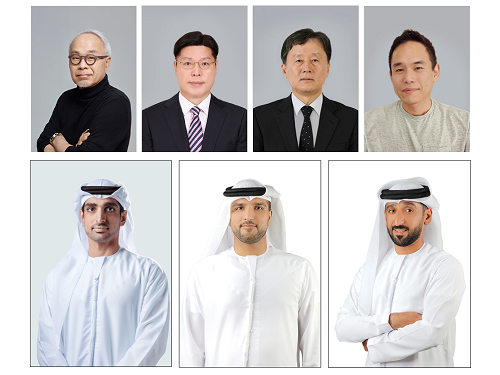
(From left) Omran Sharaf, the Assistant Minister of UAE Foreign Affairs and International Cooperation for Advanced Science and Technology, Amer Al Sayegh the Director General of Space Project at MBRSC, and Mohammed Al Harmi the Director General of Administration at MBRSC (Photos provided by the courtesy of MBRSC)
To celebrate and honor their outstanding achievements, the KAIST Alumni Association selected a team of three alumni of the United Arab Emirates (UAE) to receive the Distinguished International Alumni Award for the first time. The named honorees are Omran Sharaf, a master’s graduate from the Graduate School of Science and Technology Policy, and Amer Al Sayegh and Mohammed Al Harmi, master’s graduates of the Department of Aerospace Engineering - all three of the class of 2013 in leading positions in the UAE space program to lead the advancement of the science and technology of the country.
Currently, the three alums are in directorship of the Mohammed Bin Rashid Space Centre (MBRSC) with Mr. Omran Sharaf, who has recently been appointed as the Assistant Minister in charge of Advanced Science and Technology at the UAE Ministry of Foreign Affairs and International Cooperation, being the Project Director of the Emirates Mars Mission of MBRSC and Mr. Amer Al Sayegh in the Director General position in charge of Space Project and Mr. Mohammed Al Harmi, the Director General of Administration, at MBRSC.
They received technology transfer from “SatRec I”, Korea's first satellite system exporter and KAIST alumni company, for about 10 years from 2006, while carrying out their master’s studies at the same time.
Afterwards, they returned to UAE to lead the Emirates Mars Mission, which is already showing tangible progress including the successful launch of the Mars probe "Amal" (ال امل, meaning ‘Hope’ in Arabic), which was the first in the Arab world and the fifth in the world to successfully enter into orbit around Mars, and the UAE’s first independently developed Earth observation satellite "KhalifaSat".
An official from the KAIST Alumni Association said, "We selected the Distinguished International Alumni after evaluating their industrious leadership in promoting various space industry strategies, ranging from the development of Mars probes and Earth observation satellites, as well as lunar exploration, asteroid exploration, and Mars residence plans."
(From left) Joo-Sun Choi, President & CEO of Samsung Display Co. Ltd., Jung Goo Cho, the CEO of Green Power Co. Ltd., Jong Seung Park, the President of Agency for Defense Development (ADD), Kyunghyun Cho, Professor of New York University (NYU)
Also, four of the Korean graduates, Joo-Sun Choi, the CEO of Samsung Display, Jung Goo Cho, the CEO of Green Power Co. Ltd., Jong Seung Park, the President of Agency for Defense Development (ADD), and Kyunghyun Cho, a Professor of New York University (NYU), were selected as the winners of the “Distinguished Alumni Award”.
Mr. Joo-Sun Choi (Electrical and Electronic Engineering, M.S. in 1989, Ph.D. in 1995), the CEO of Samsung Display, led the successful development and mass-production of the world's first ultra-high-definition QD-OLED Displays, and preemptively transformed the structure of business of the industry and has been leading the way in technological innovation.
Mr. Jung Goo Cho (Electrical and Electronic Engineering, M.S. in 1988, Ph.D. in 1992), the CEO of Green Power Co. Ltd., developed wireless power technology for the first time in Korea in the early 2000s and applied it to semiconductor/display lines and led the wireless power charging technology in various fields, such as developing KAIST On-Line Electric Vehicles (OLEV) and commercializing the world's first wireless charger for 11kW electric vehicles.
Mr. Jong Seung Park (Mechanical Engineering, M.S. in 1988, Ph.D., in 1991), The President of ADD is an expert with abundant science and technology knowledge and organizational management capabilities. He is contributing greatly to national defense and security through science and technology.
Mr. Kyunghyun Cho (Computer Science, B.S., in 2009), the Professor of Computer Science and Data Science at NYU, is a world-renowned expert in Artificial Intelligence (AI), advancing the concept of 'Neural Machine Translation' in the field of natural language processing, to make great contributions to AI translation technology and related industries.
Chairman Chil-Hee Chung, the 26th Chair of KAIST Alumni Association “As each year goes by, I feel that the influence of KAIST alumni goes beyond science and technology to affect our society as a whole.” He went on to say, “This year, as it was more meaningful to extend the award to honor the international members of our Alums, we look forward to seeing more of our alumni continuing their social and academic endeavors to play an active role in the global stage in taking on the global challenges.”
The Ceremony for KAIST Distinguished Alumni and International Alumni Award Honorees will be conducted at the Annual New Year’s Event of KAIST Alumni Association for 2023 to be held on Friday, January 13th, at the Grand InterContinental Seoul Parnas.
2023.01.12 View 26534
UAE Space Program Leaders named to be the 1st of the honorees of KAIST Alumni Association's special recognition for graduates of foreign nationality
The KAIST Alumni Association (Chairman, Chil-Hee Chung) announced on the 12th that the winners of the 2023 KAIST Distinguished Alumni Award and International Alumni Award has been selected.
The KAIST Distinguished Alumni Award, which produced the first recipient in 1992, is an award given to alumni who have contributed to the development of the nation and society, or who have glorified the honor of their alma mater with outstanding academic achievements and social and/or communal contributions.
On a special note, this year, there has been an addition to the honors, “the KAIST Distinguished International Alumni Award” to honor and encourage overseas alumni who are making their marks in the international community that will boost positive recognition of KAIST in the global setting and will later become a bridge that will expedite Korea's international efforts in the future.
As of 2022, the number of international students who succeeded in earning KAIST degrees has exceeded 1,700, and they are actively doing their part back in their home countries as leaders in various fields in which they belong, spanning from science and technology, to politics, industry and other corners of the society.
(From left) Omran Sharaf, the Assistant Minister of UAE Foreign Affairs and International Cooperation for Advanced Science and Technology, Amer Al Sayegh the Director General of Space Project at MBRSC, and Mohammed Al Harmi the Director General of Administration at MBRSC (Photos provided by the courtesy of MBRSC)
To celebrate and honor their outstanding achievements, the KAIST Alumni Association selected a team of three alumni of the United Arab Emirates (UAE) to receive the Distinguished International Alumni Award for the first time. The named honorees are Omran Sharaf, a master’s graduate from the Graduate School of Science and Technology Policy, and Amer Al Sayegh and Mohammed Al Harmi, master’s graduates of the Department of Aerospace Engineering - all three of the class of 2013 in leading positions in the UAE space program to lead the advancement of the science and technology of the country.
Currently, the three alums are in directorship of the Mohammed Bin Rashid Space Centre (MBRSC) with Mr. Omran Sharaf, who has recently been appointed as the Assistant Minister in charge of Advanced Science and Technology at the UAE Ministry of Foreign Affairs and International Cooperation, being the Project Director of the Emirates Mars Mission of MBRSC and Mr. Amer Al Sayegh in the Director General position in charge of Space Project and Mr. Mohammed Al Harmi, the Director General of Administration, at MBRSC.
They received technology transfer from “SatRec I”, Korea's first satellite system exporter and KAIST alumni company, for about 10 years from 2006, while carrying out their master’s studies at the same time.
Afterwards, they returned to UAE to lead the Emirates Mars Mission, which is already showing tangible progress including the successful launch of the Mars probe "Amal" (ال امل, meaning ‘Hope’ in Arabic), which was the first in the Arab world and the fifth in the world to successfully enter into orbit around Mars, and the UAE’s first independently developed Earth observation satellite "KhalifaSat".
An official from the KAIST Alumni Association said, "We selected the Distinguished International Alumni after evaluating their industrious leadership in promoting various space industry strategies, ranging from the development of Mars probes and Earth observation satellites, as well as lunar exploration, asteroid exploration, and Mars residence plans."
(From left) Joo-Sun Choi, President & CEO of Samsung Display Co. Ltd., Jung Goo Cho, the CEO of Green Power Co. Ltd., Jong Seung Park, the President of Agency for Defense Development (ADD), Kyunghyun Cho, Professor of New York University (NYU)
Also, four of the Korean graduates, Joo-Sun Choi, the CEO of Samsung Display, Jung Goo Cho, the CEO of Green Power Co. Ltd., Jong Seung Park, the President of Agency for Defense Development (ADD), and Kyunghyun Cho, a Professor of New York University (NYU), were selected as the winners of the “Distinguished Alumni Award”.
Mr. Joo-Sun Choi (Electrical and Electronic Engineering, M.S. in 1989, Ph.D. in 1995), the CEO of Samsung Display, led the successful development and mass-production of the world's first ultra-high-definition QD-OLED Displays, and preemptively transformed the structure of business of the industry and has been leading the way in technological innovation.
Mr. Jung Goo Cho (Electrical and Electronic Engineering, M.S. in 1988, Ph.D. in 1992), the CEO of Green Power Co. Ltd., developed wireless power technology for the first time in Korea in the early 2000s and applied it to semiconductor/display lines and led the wireless power charging technology in various fields, such as developing KAIST On-Line Electric Vehicles (OLEV) and commercializing the world's first wireless charger for 11kW electric vehicles.
Mr. Jong Seung Park (Mechanical Engineering, M.S. in 1988, Ph.D., in 1991), The President of ADD is an expert with abundant science and technology knowledge and organizational management capabilities. He is contributing greatly to national defense and security through science and technology.
Mr. Kyunghyun Cho (Computer Science, B.S., in 2009), the Professor of Computer Science and Data Science at NYU, is a world-renowned expert in Artificial Intelligence (AI), advancing the concept of 'Neural Machine Translation' in the field of natural language processing, to make great contributions to AI translation technology and related industries.
Chairman Chil-Hee Chung, the 26th Chair of KAIST Alumni Association “As each year goes by, I feel that the influence of KAIST alumni goes beyond science and technology to affect our society as a whole.” He went on to say, “This year, as it was more meaningful to extend the award to honor the international members of our Alums, we look forward to seeing more of our alumni continuing their social and academic endeavors to play an active role in the global stage in taking on the global challenges.”
The Ceremony for KAIST Distinguished Alumni and International Alumni Award Honorees will be conducted at the Annual New Year’s Event of KAIST Alumni Association for 2023 to be held on Friday, January 13th, at the Grand InterContinental Seoul Parnas.
2023.01.12 View 26534 -
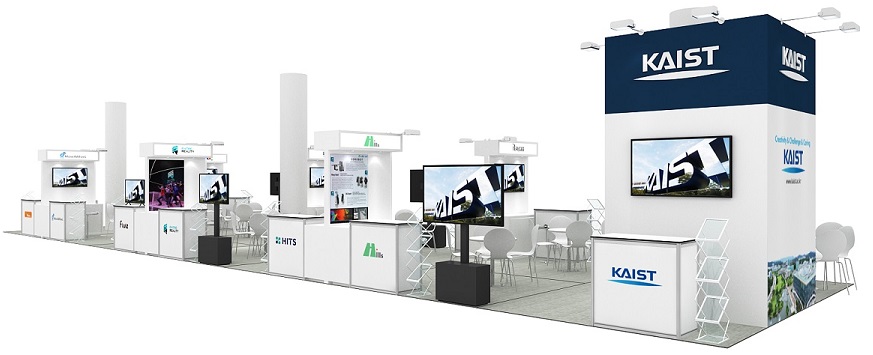 KAIST to showcase a pack of KAIST Start-ups at CES 2023
- KAIST is to run an Exclusive Booth at the Venetian Expo (Hall G) in Eureka Park, at CES 2023, to be held in Las Vegas from Thursday, January 5th through Sunday, the 8th.
- Twelve businesses recently put together by KAIST faculty, alumni, and the start-ups given legal usage of KAIST technologies will be showcased.
- Out of the participating start-ups, the products by Fluiz and Hills Robotics were selected as the “CES Innovation Award 2023 Honoree”, scoring top in their respective categories.
On January 3, KAIST announced that there will be a KAIST booth at Consumer Electronics Show (CES) 2023, the most influential tech event in the world, to be held in Las Vegas from January 3 to 8.
At this exclusive corner, KAIST will introduce the technologies of KAIST start-ups over the exhibition period.
KAIST first started holding its exclusive booth in CES 2019 with five start-up businesses, following up at CES 2020 with 12 start-ups and at CES 2022 with 10 start-ups. At CES 2023, which would be KAIST’s fourth conference, KAIST will be accompanying 12 businesses including start-ups by the faculty members, alumni, and technology transfer companies that just began their businesses with technologies from their research findings that stands a head above others.
To maximize the publicity opportunity, KAIST will support each company’s marketing strategies through cooperation with the Korea International Trade Association (KITA), and provide an opportunity for the school and each startup to create global identity and exhibit the excellence of their technologies at the convention.
The following companies will be at the KAIST Booth in Eureka Park:
The twelve startups mentioned above aim to achieve global technology commecialization in their respective fields of expertise spanning from eXtended Reality (XR) and gaming, to AI and robotics, vehicle and transport, mobile platform, smart city, autonomous driving, healthcare, internet of thing (IoT), through joint research and development, technology transfer and investment attraction from world’s leading institutions and enterprises.
In particular, Fluiz and Hills Robotics won the CES Innovation Award as 2023 Honorees and is expected to attain greater achievements in the future.
A staff member from the KAIST Institute of Technology Value Creation said, “The KAIST Showcase for CES 2023 has prepared a new pitching space for each of the companies for their own IR efforts, and we hope that KAIST startups will actively and effectively market their products and technologies while they are at the convention. We hope it will help them utilize their time here to establish their name in presence here which will eventually serve as a good foothold for them and their predecessors to further global commercialization goals.”
2023.01.04 View 29295
KAIST to showcase a pack of KAIST Start-ups at CES 2023
- KAIST is to run an Exclusive Booth at the Venetian Expo (Hall G) in Eureka Park, at CES 2023, to be held in Las Vegas from Thursday, January 5th through Sunday, the 8th.
- Twelve businesses recently put together by KAIST faculty, alumni, and the start-ups given legal usage of KAIST technologies will be showcased.
- Out of the participating start-ups, the products by Fluiz and Hills Robotics were selected as the “CES Innovation Award 2023 Honoree”, scoring top in their respective categories.
On January 3, KAIST announced that there will be a KAIST booth at Consumer Electronics Show (CES) 2023, the most influential tech event in the world, to be held in Las Vegas from January 3 to 8.
At this exclusive corner, KAIST will introduce the technologies of KAIST start-ups over the exhibition period.
KAIST first started holding its exclusive booth in CES 2019 with five start-up businesses, following up at CES 2020 with 12 start-ups and at CES 2022 with 10 start-ups. At CES 2023, which would be KAIST’s fourth conference, KAIST will be accompanying 12 businesses including start-ups by the faculty members, alumni, and technology transfer companies that just began their businesses with technologies from their research findings that stands a head above others.
To maximize the publicity opportunity, KAIST will support each company’s marketing strategies through cooperation with the Korea International Trade Association (KITA), and provide an opportunity for the school and each startup to create global identity and exhibit the excellence of their technologies at the convention.
The following companies will be at the KAIST Booth in Eureka Park:
The twelve startups mentioned above aim to achieve global technology commecialization in their respective fields of expertise spanning from eXtended Reality (XR) and gaming, to AI and robotics, vehicle and transport, mobile platform, smart city, autonomous driving, healthcare, internet of thing (IoT), through joint research and development, technology transfer and investment attraction from world’s leading institutions and enterprises.
In particular, Fluiz and Hills Robotics won the CES Innovation Award as 2023 Honorees and is expected to attain greater achievements in the future.
A staff member from the KAIST Institute of Technology Value Creation said, “The KAIST Showcase for CES 2023 has prepared a new pitching space for each of the companies for their own IR efforts, and we hope that KAIST startups will actively and effectively market their products and technologies while they are at the convention. We hope it will help them utilize their time here to establish their name in presence here which will eventually serve as a good foothold for them and their predecessors to further global commercialization goals.”
2023.01.04 View 29295 -
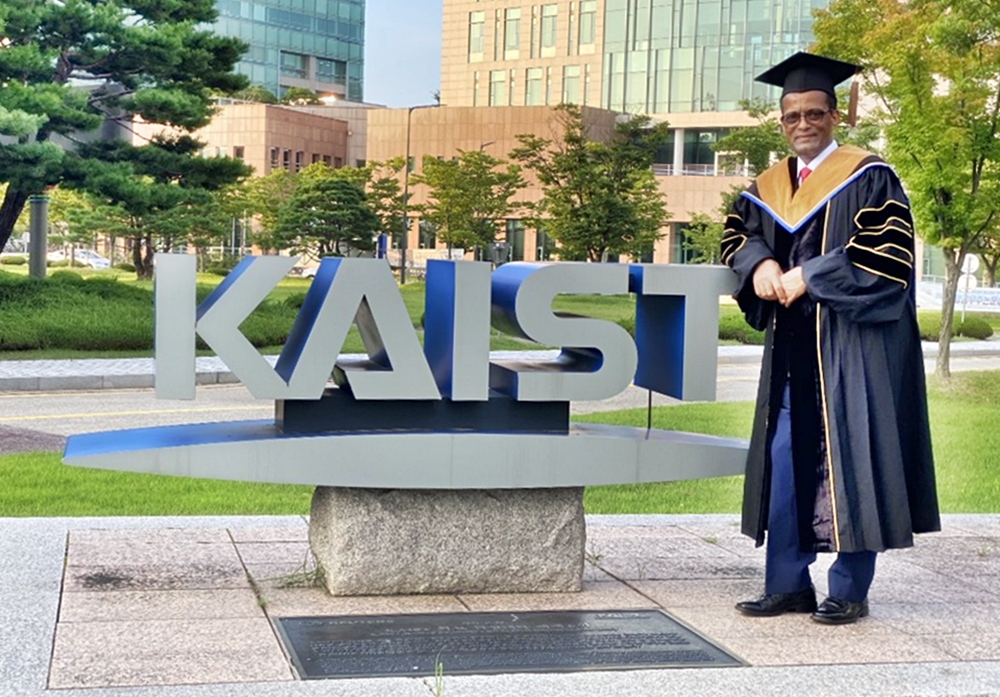 PhD Graduate Mekuria Teklemariam Inspired to Better Serve Ethiopia
Ethiopia’s Former Minister of Urban Development and Housing Mekuria Teklemariam became a KAIST alumnus, earning his PhD in the Global IT Technology Program (ITTP) last month. Dr. Telkemariam completed his degree summa cum laude in business administration in four years. He is the highest-ranking official among the ITTP Program recipients.
Dr. Teklemarian cited the ‘Saemaul Undong,’ also known as the New Community Movement as well as the strong infrastructure of IT industry as part of the driving forces behind Korea’s rapid economic success and this inspired him to choose KAIST as his academic destination.
The Global ITTP was launched in 2006 to educate elite public officials from diverse countries on information and communication technology. This program has played a vital role in transferring Korea’s advanced information and communications technology to many countries whose industries are in the budding stages.
Approximately 200 officials from over 50 countries have enrolled in the ITTP program, and the program has expanded to cover diverse areas of ICT and grown into a global network of ICT leaders abroad. The 2020 Class graduated five PhDs and five master’s degree holders.
Dr. Teklemariam plans to benchmark Korea to aid the development of Ethiopia when he returns home. “Korea is a country that has made remarkable progress in all areas including politics and economics in the last few decades, emerged from one of the poorest countries in the 1960s to be among the largest economies in the world today,” Dr. Telkemariam said.
“So I wanted to study what transformed Korea to make such a miraculous transformation academically for my country’s own development too,” he added, explaining his motivation to study in Korea. He also cited diverse IT education programs for the elderly as a Korean policy he would like to see applied in his country.
The 50-year-old former minister and incumbent urban affairs advisor to the prime minister of Ethiopia was elected to the country's parliament a decade ago, becoming the youngest member in Ethiopian history. He has led the economic development of Ethiopia in the areas of smart city development, land management, and housing development policies.
While studying at KAIST, Dr. Telkemariam became the two-time winner of the Outstanding Collaborative Research Award presented by the KAIST Institute for IT Convergence through collaborative research with the National IT Industry Promotion Agency (NIPA) and the Science and Technology Policy Institute (STEPI).
In addition, his graduation thesis, "Differentiating mobile broadband policies across diffusion stages: A panel data analysis" was published in Telecommunications Policy.
President Sung-Chul Shin met with him during a luncheon meeting before he returned to home. During the meeting Dr. Telkemariam said, “I was impressed by the Korean people, who not only work hard to do their part wherever they are, but also put whatever they say into practice. I will apply and practice what I have learned from Korea and KAIST to Ethiopia.” President Shin responded, “We shall seek to find ways to cooperate that can be practically used to expand exchanges between the two countries.”
2020.09.21 View 10089
PhD Graduate Mekuria Teklemariam Inspired to Better Serve Ethiopia
Ethiopia’s Former Minister of Urban Development and Housing Mekuria Teklemariam became a KAIST alumnus, earning his PhD in the Global IT Technology Program (ITTP) last month. Dr. Telkemariam completed his degree summa cum laude in business administration in four years. He is the highest-ranking official among the ITTP Program recipients.
Dr. Teklemarian cited the ‘Saemaul Undong,’ also known as the New Community Movement as well as the strong infrastructure of IT industry as part of the driving forces behind Korea’s rapid economic success and this inspired him to choose KAIST as his academic destination.
The Global ITTP was launched in 2006 to educate elite public officials from diverse countries on information and communication technology. This program has played a vital role in transferring Korea’s advanced information and communications technology to many countries whose industries are in the budding stages.
Approximately 200 officials from over 50 countries have enrolled in the ITTP program, and the program has expanded to cover diverse areas of ICT and grown into a global network of ICT leaders abroad. The 2020 Class graduated five PhDs and five master’s degree holders.
Dr. Teklemariam plans to benchmark Korea to aid the development of Ethiopia when he returns home. “Korea is a country that has made remarkable progress in all areas including politics and economics in the last few decades, emerged from one of the poorest countries in the 1960s to be among the largest economies in the world today,” Dr. Telkemariam said.
“So I wanted to study what transformed Korea to make such a miraculous transformation academically for my country’s own development too,” he added, explaining his motivation to study in Korea. He also cited diverse IT education programs for the elderly as a Korean policy he would like to see applied in his country.
The 50-year-old former minister and incumbent urban affairs advisor to the prime minister of Ethiopia was elected to the country's parliament a decade ago, becoming the youngest member in Ethiopian history. He has led the economic development of Ethiopia in the areas of smart city development, land management, and housing development policies.
While studying at KAIST, Dr. Telkemariam became the two-time winner of the Outstanding Collaborative Research Award presented by the KAIST Institute for IT Convergence through collaborative research with the National IT Industry Promotion Agency (NIPA) and the Science and Technology Policy Institute (STEPI).
In addition, his graduation thesis, "Differentiating mobile broadband policies across diffusion stages: A panel data analysis" was published in Telecommunications Policy.
President Sung-Chul Shin met with him during a luncheon meeting before he returned to home. During the meeting Dr. Telkemariam said, “I was impressed by the Korean people, who not only work hard to do their part wherever they are, but also put whatever they say into practice. I will apply and practice what I have learned from Korea and KAIST to Ethiopia.” President Shin responded, “We shall seek to find ways to cooperate that can be practically used to expand exchanges between the two countries.”
2020.09.21 View 10089 -
 Biomarker Predicts Who Will Have Severe COVID-19
- Airway cell analyses showing an activated immune axis could pinpoint the COVID-19 patients who will most benefit from targeted therapies.-
KAIST researchers have identified key markers that could help pinpoint patients who are bound to get a severe reaction to COVID-19 infection. This would help doctors provide the right treatments at the right time, potentially saving lives. The findings were published in the journal Frontiers in Immunology on August 28.
People’s immune systems react differently to infection with SARS-CoV-2, the virus that causes COVID-19, ranging from mild to severe, life-threatening responses.
To understand the differences in responses, Professor Heung Kyu Lee and PhD candidate Jang Hyun Park from the Graduate School of Medical Science and Engineering at KAIST analysed ribonucleic acid (RNA) sequencing data extracted from individual airway cells of healthy controls and of mildly and severely ill patients with COVID-19. The data was available in a public database previously published by a group of Chinese researchers.
“Our analyses identified an association between immune cells called neutrophils and special cell receptors that bind to the steroid hormone glucocorticoid,” Professor Lee explained. “This finding could be used as a biomarker for predicting disease severity in patients and thus selecting a targeted therapy that can help treat them at an appropriate time,” he added.
Severe illness in COVID-19 is associated with an exaggerated immune response that leads to excessive airway-damaging inflammation. This condition, known as acute respiratory distress syndrome (ARDS), accounts for 70% of deaths in fatal COVID-19 infections.
Scientists already know that this excessive inflammation involves heightened neutrophil recruitment to the airways, but the detailed mechanisms of this reaction are still unclear.
Lee and Park’s analyses found that a group of immune cells called myeloid cells produced excess amounts of neutrophil-recruiting chemicals in severely ill patients, including a cytokine called tumour necrosis factor (TNF) and a chemokine called CXCL8.
Further RNA analyses of neutrophils in severely ill patients showed they were less able to recruit very important T cells needed for attacking the virus. At the same time, the neutrophils produced too many extracellular molecules that normally trap pathogens, but damage airway cells when produced in excess.
The researchers additionally found that the airway cells in severely ill patients were not expressing enough glucocorticoid receptors. This was correlated with increased CXCL8 expression and neutrophil recruitment.
Glucocorticoids, like the well-known drug dexamethasone, are anti-inflammatory agents that could play a role in treating COVID-19. However, using them in early or mild forms of the infection could suppress the necessary immune reactions to combat the virus. But if airway damage has already happened in more severe cases, glucocorticoid treatment would be ineffective.
Knowing who to give this treatment to and when is really important. COVID-19 patients showing reduced glucocorticoid receptor expression, increased CXCL8 expression, and excess neutrophil recruitment to the airways could benefit from treatment with glucocorticoids to prevent airway damage. Further research is needed, however, to confirm the relationship between glucocorticoids and neutrophil inflammation at the protein level.
“Our study could serve as a springboard towards more accurate and reliable COVID-19 treatments,” Professor Lee said.
This work was supported by the National Research Foundation of Korea, and Mobile Clinic Module Project funded by KAIST.
Figure. Low glucocorticoid receptor (GR) expression led to excessive inflammation and lung damage by neutrophils through enhancing the expression of CXCL8 and other cytokines.
Image credit: Professor Heung Kyu Lee, KAIST. Created with Biorender.com.
Image usage restrictions: News organizations may use or redistribute these figures and image, with proper attribution, as part of news coverage of this paper only.
-Publication:
Jang Hyun Park, and Heung Kyu Lee. (2020). Re-analysis of Single Cell Transcriptome Reveals That the NR3C1-CXCL8-Neutrophil Axis Determines the Severity of COVID-19. Frontiers in Immunology, Available online at https://doi.org/10.3389/fimmu.2020.02145
-Profile: Heung Kyu Lee
Associate Professor
heungkyu.lee@kaist.ac.kr
https://www.heungkyulee.kaist.ac.kr/
Laboratory of Host Defenses
Graduate School of Medical Science and Engineering (GSMSE)
The Center for Epidemic Preparedness at KAIST Institute
http://kaist.ac.kr
Korea Advanced Institute of Science and Technology (KAIST)
Daejeon, Republic of Korea
Profile: Jang Hyun Park
PhD Candidate
janghyun.park@kaist.ac.kr
GSMSE, KAIST
2020.09.17 View 24617
Biomarker Predicts Who Will Have Severe COVID-19
- Airway cell analyses showing an activated immune axis could pinpoint the COVID-19 patients who will most benefit from targeted therapies.-
KAIST researchers have identified key markers that could help pinpoint patients who are bound to get a severe reaction to COVID-19 infection. This would help doctors provide the right treatments at the right time, potentially saving lives. The findings were published in the journal Frontiers in Immunology on August 28.
People’s immune systems react differently to infection with SARS-CoV-2, the virus that causes COVID-19, ranging from mild to severe, life-threatening responses.
To understand the differences in responses, Professor Heung Kyu Lee and PhD candidate Jang Hyun Park from the Graduate School of Medical Science and Engineering at KAIST analysed ribonucleic acid (RNA) sequencing data extracted from individual airway cells of healthy controls and of mildly and severely ill patients with COVID-19. The data was available in a public database previously published by a group of Chinese researchers.
“Our analyses identified an association between immune cells called neutrophils and special cell receptors that bind to the steroid hormone glucocorticoid,” Professor Lee explained. “This finding could be used as a biomarker for predicting disease severity in patients and thus selecting a targeted therapy that can help treat them at an appropriate time,” he added.
Severe illness in COVID-19 is associated with an exaggerated immune response that leads to excessive airway-damaging inflammation. This condition, known as acute respiratory distress syndrome (ARDS), accounts for 70% of deaths in fatal COVID-19 infections.
Scientists already know that this excessive inflammation involves heightened neutrophil recruitment to the airways, but the detailed mechanisms of this reaction are still unclear.
Lee and Park’s analyses found that a group of immune cells called myeloid cells produced excess amounts of neutrophil-recruiting chemicals in severely ill patients, including a cytokine called tumour necrosis factor (TNF) and a chemokine called CXCL8.
Further RNA analyses of neutrophils in severely ill patients showed they were less able to recruit very important T cells needed for attacking the virus. At the same time, the neutrophils produced too many extracellular molecules that normally trap pathogens, but damage airway cells when produced in excess.
The researchers additionally found that the airway cells in severely ill patients were not expressing enough glucocorticoid receptors. This was correlated with increased CXCL8 expression and neutrophil recruitment.
Glucocorticoids, like the well-known drug dexamethasone, are anti-inflammatory agents that could play a role in treating COVID-19. However, using them in early or mild forms of the infection could suppress the necessary immune reactions to combat the virus. But if airway damage has already happened in more severe cases, glucocorticoid treatment would be ineffective.
Knowing who to give this treatment to and when is really important. COVID-19 patients showing reduced glucocorticoid receptor expression, increased CXCL8 expression, and excess neutrophil recruitment to the airways could benefit from treatment with glucocorticoids to prevent airway damage. Further research is needed, however, to confirm the relationship between glucocorticoids and neutrophil inflammation at the protein level.
“Our study could serve as a springboard towards more accurate and reliable COVID-19 treatments,” Professor Lee said.
This work was supported by the National Research Foundation of Korea, and Mobile Clinic Module Project funded by KAIST.
Figure. Low glucocorticoid receptor (GR) expression led to excessive inflammation and lung damage by neutrophils through enhancing the expression of CXCL8 and other cytokines.
Image credit: Professor Heung Kyu Lee, KAIST. Created with Biorender.com.
Image usage restrictions: News organizations may use or redistribute these figures and image, with proper attribution, as part of news coverage of this paper only.
-Publication:
Jang Hyun Park, and Heung Kyu Lee. (2020). Re-analysis of Single Cell Transcriptome Reveals That the NR3C1-CXCL8-Neutrophil Axis Determines the Severity of COVID-19. Frontiers in Immunology, Available online at https://doi.org/10.3389/fimmu.2020.02145
-Profile: Heung Kyu Lee
Associate Professor
heungkyu.lee@kaist.ac.kr
https://www.heungkyulee.kaist.ac.kr/
Laboratory of Host Defenses
Graduate School of Medical Science and Engineering (GSMSE)
The Center for Epidemic Preparedness at KAIST Institute
http://kaist.ac.kr
Korea Advanced Institute of Science and Technology (KAIST)
Daejeon, Republic of Korea
Profile: Jang Hyun Park
PhD Candidate
janghyun.park@kaist.ac.kr
GSMSE, KAIST
2020.09.17 View 24617 -
 KAIST Technology Value Tops in Commercialization Market
KAIST became the first Korean university to achieve 10.183 billion KRW in annual technology royalties, and was also selected as an ‘Institution of Outstanding Patent Quality Management’ and an ‘Institution of Outstanding Public Patent Technology Transfer’ for 2020.
KAIST earns its technology royalties through 56 technology transfer contracts. Following KAIST in the rankings were Seoul National University (SNU) in second place with 8.8 billion KRW from 87 contracts and Korea University (KU) in the third with 5.4 billion KRW from 133 contracts. The data shows the high value of KAIST-created technology in the market.
The Korean Intellectual Property Office (KIPO) started to recognize the Institution of Outstanding Patent Quality Management this year to encourage profit-driven patent management at universities and public research institutes, and KAIST was selected as one of the four first recipients of this distinction.
In addition, KAIST was selected as an Institution of Outstanding Public Patent Technology Transfer, a title given by KIPO to three universities and public research institutes this year with outstanding achievements in technology transfers and commercialization to encourage patent utilization.
Director of the KAIST Institute of Technology Value Creation (ITVC) Professor Kyung-cheol Choi said that KAIST’s achievement in annual technology royalties and technology transfers and commercialization were prime examples of accelerating competitiveness in intellectual property through innovative R&D investment.
In April, KAIST expanded and reorganized its Industry-Academia Collaboration Team into the ITVC to support technology transfers and commercialization. Specialized organizations such as the Intellectual Property and Technology Transfer Center and Industrial Liaison Center have been established under the ITVC, and industry experts have been recruited as special professors focusing on industry-academia collaborations to enhance its specialized functions.
KAIST also operates an enterprise membership system and technology consulting system, aimed at sharing its outstanding intellectual property within domestic industries. In 2019, it secured a technology transfer commercialization fund of 1.2 billion KRW available for three years under KIPO’s Intellectual Property Profit Reinvestment Support Program (formerly the Korean Patent Gap Fund Creation Project).
This program was introduced to bridge the gap between the technology developed in universities and the level of technology required by industry. Under the program, bold investments are made in early-stage technologies at the research paper or experiment phase.
The program encourages enterprises to take active steps for the transfer of technologies by demonstrating their commercial potential through prototype production, testing and certification, and standard patent filing. KAIST is currently funding approximately 20 new technologies under this program as of July 2020.
KAIST’s outstanding intellectual property management has also received international recognition, with its selection as Asia’s leading institution in university R&D intellectual property at the Intellectual Property Business Congress (IPBC) Asia 2019 held in Tokyo, Japan last October.
(END)
2020.08.18 View 17423
KAIST Technology Value Tops in Commercialization Market
KAIST became the first Korean university to achieve 10.183 billion KRW in annual technology royalties, and was also selected as an ‘Institution of Outstanding Patent Quality Management’ and an ‘Institution of Outstanding Public Patent Technology Transfer’ for 2020.
KAIST earns its technology royalties through 56 technology transfer contracts. Following KAIST in the rankings were Seoul National University (SNU) in second place with 8.8 billion KRW from 87 contracts and Korea University (KU) in the third with 5.4 billion KRW from 133 contracts. The data shows the high value of KAIST-created technology in the market.
The Korean Intellectual Property Office (KIPO) started to recognize the Institution of Outstanding Patent Quality Management this year to encourage profit-driven patent management at universities and public research institutes, and KAIST was selected as one of the four first recipients of this distinction.
In addition, KAIST was selected as an Institution of Outstanding Public Patent Technology Transfer, a title given by KIPO to three universities and public research institutes this year with outstanding achievements in technology transfers and commercialization to encourage patent utilization.
Director of the KAIST Institute of Technology Value Creation (ITVC) Professor Kyung-cheol Choi said that KAIST’s achievement in annual technology royalties and technology transfers and commercialization were prime examples of accelerating competitiveness in intellectual property through innovative R&D investment.
In April, KAIST expanded and reorganized its Industry-Academia Collaboration Team into the ITVC to support technology transfers and commercialization. Specialized organizations such as the Intellectual Property and Technology Transfer Center and Industrial Liaison Center have been established under the ITVC, and industry experts have been recruited as special professors focusing on industry-academia collaborations to enhance its specialized functions.
KAIST also operates an enterprise membership system and technology consulting system, aimed at sharing its outstanding intellectual property within domestic industries. In 2019, it secured a technology transfer commercialization fund of 1.2 billion KRW available for three years under KIPO’s Intellectual Property Profit Reinvestment Support Program (formerly the Korean Patent Gap Fund Creation Project).
This program was introduced to bridge the gap between the technology developed in universities and the level of technology required by industry. Under the program, bold investments are made in early-stage technologies at the research paper or experiment phase.
The program encourages enterprises to take active steps for the transfer of technologies by demonstrating their commercial potential through prototype production, testing and certification, and standard patent filing. KAIST is currently funding approximately 20 new technologies under this program as of July 2020.
KAIST’s outstanding intellectual property management has also received international recognition, with its selection as Asia’s leading institution in university R&D intellectual property at the Intellectual Property Business Congress (IPBC) Asia 2019 held in Tokyo, Japan last October.
(END)
2020.08.18 View 17423