KAIST Enables DNA Synthesis Using Only Temperature Instead of Chemical Reagents
"Complex chemical processes are essential for making DNA." This long-held assumption in the field of biotechnology has been overturned by a Korean research team. A KAIST research team has developed the world's first foundational technology that enables the synthesis of desired DNA using only temperature. Using this technology, the team also demonstrated a "DNA temperature black box" that records temperature changes during shipping without electricity.
KAIST announced on the 7th of July that a research team led by Professor Yeongjae Choi of the Graduate School of Engineering Biology, in collaboration with ATG Lifetech Inc. (CEO Taehoon Ryu) and a research team led by Professor Hansol Choi from the Department of Life Science at Ewha Womans University, has developed this platform technology that synthesizes desired DNA sequences by controlling only temperature.
DNA is the "blueprint" that contains the genetic information of humans and all other living organisms. Scientists use custom-made DNA in various biotechnology applications, such as diagnosing diseases, developing new drugs, and creating microorganisms with new functions. Until now, however, each time one of the four bases that make up DNA—A, T, G, and C—was connected, chemical reagents had to be added and washed out repeatedly. As a result, costly automated DNA synthesis equipment and specialized research facilities were essential.
To overcome these limitations, the research team developed "hairpin DNA that reacts only at specific temperatures." This hairpin DNA is a special DNA structure that remains folded like a hairpin and unfolds only at a certain temperature. The team placed multiple types of hairpin DNA that operate at different temperatures into a single test tube and succeeded in synthesizing desired DNA step by step by changing only the temperature in the sequence.
This opens the way for synthesizing DNA with only a general temperature control device, without the need for complex reagent replacement or large-scale equipment.
As the technology advances, it is expected to greatly reduce the cost and time required to make DNA, lowering the entry barriers not only for synthetic biology and genetic research, but also for various bioindustries such as drug development and precision medicine.
To demonstrate the practical applicability of the technology, the research team also implemented a power-free "DNA temperature black box." This device is normally stored in a freeze-dried state and begins operating when a single drop of water is added just before use. It then automatically records—directly into a DNA sequence—when, how long, and in what order the temperature changes during shipping. In addition, when exposed to temperatures above a certain level, the device changes color, allowing abnormalities to be checked visually on the spot. It is expected to be used for the quality control of products for which cold-chain distribution is important, such as vaccines, biopharmaceuticals, cell therapies, and fresh foods.
KAIST researcher Jangho Choi and GIST doctoral student Jinho Kim participated in this research as co-first authors, and the research results were published in the international journal Nature Communications on July 2.
※ Paper title: Programmable one-pot polymerase-mediated DNA synthesis via temperature control
※ DOI: https://doi.org/10.1038/s41467-026-74890-4
※ Related Video: https://drive.google.com/file/d/1bUtzC83qIm1k-hNFKTb09yFPhfsD4iU-/view?usp=drive_lin
※ Authors: Jangho Choi (KAIST, co-first author), Jinho Kim (GIST, co-first author), Hansol Choi (Ewha Womans University, corresponding author), Yeongjae Choi (KAIST, corresponding author)
This research was supported by the Ministry of Science and ICT through the Future Promising Convergence Technology Pioneer Program, the Biofoundry-Based Technology Development Program, the Young Researcher Program, and the Global Basic Research Laboratory Program.
Energy-Efficient AI Hardware Technology Via a Brain-Inspired Stashing System
Researchers demonstrate neuromodulation-inspired stashing system for the energy-efficient learning of a spiking neural network using a self-rectifying memristor array
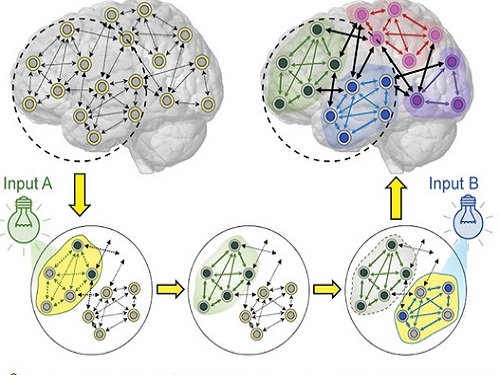
Researchers have proposed a novel system inspired by the neuromodulation of the brain, referred to as a ‘stashing system,’ that requires less energy consumption. The research group led by Professor Kyung Min Kim from the Department of Materials Science and Engineering has developed a technology that can efficiently handle mathematical operations for artificial intelligence by imitating the continuous changes in the topology of the neural network according to the situation. The human brain changes its neural topology in real time, learning to store or recall memories as needed. The research group presented a new artificial intelligence learning method that directly implements these neural coordination circuit configurations.
Research on artificial intelligence is becoming very active, and the development of artificial intelligence-based electronic devices and product releases are accelerating, especially in the Fourth Industrial Revolution age. To implement artificial intelligence in electronic devices, customized hardware development should also be supported. However most electronic devices for artificial intelligence require high power consumption and highly integrated memory arrays for large-scale tasks. It has been challenging to solve these power consumption and integration limitations, and efforts have been made to find out how the human brain solves problems.
To prove the efficiency of the developed technology, the research group created artificial neural network hardware equipped with a self-rectifying synaptic array and algorithm called a ‘stashing system’ that was developed to conduct artificial intelligence learning. As a result, it was able to reduce energy by 37% within the stashing system without any accuracy degradation. This result proves that emulating the neuromodulation in humans is possible.
Professor Kim said, "In this study, we implemented the learning method of the human brain with only a simple circuit composition and through this we were able to reduce the energy needed by nearly 40 percent.”
This neuromodulation-inspired stashing system that mimics the brain’s neural activity is compatible with existing electronic devices and commercialized semiconductor hardware. It is expected to be used in the design of next-generation semiconductor chips for artificial intelligence.
This study was published in Advanced Functional Materials in March 2022 and supported by KAIST, the National Research Foundation of Korea, the National NanoFab Center, and SK Hynix.
-Publication:
Woon Hyung Cheong, Jae Bum Jeon†, Jae Hyun In, Geunyoung Kim, Hanchan Song, Janho An, Juseong Park, Young Seok Kim, Cheol Seong Hwang, and Kyung Min Kim (2022)
“Demonstration of Neuromodulation-inspired Stashing System for Energy-efficient Learning of Spiking Neural Network using a Self-Rectifying Memristor Array,” Advanced FunctionalMaterials March 31, 2022 (DOI: 10.1002/adfm.202200337)
-Profile:
Professor Kyung Min Kimhttp://semi.kaist.ac.kr https://scholar.google.com/citations?user=BGw8yDYAAAAJ&hl=ko
Department of Materials Science and EngineeringKAIST