%49%6e%74%65%72%6e%61%74%69%6f%6e%61%6c%20%43%6f%6f%70%65%72%61%74%69%6f%6e
-
 UAE Space Program Leaders named to be the 1st of the honorees of KAIST Alumni Association's special recognition for graduates of foreign nationality
The KAIST Alumni Association (Chairman, Chil-Hee Chung) announced on the 12th that the winners of the 2023 KAIST Distinguished Alumni Award and International Alumni Award has been selected.
The KAIST Distinguished Alumni Award, which produced the first recipient in 1992, is an award given to alumni who have contributed to the development of the nation and society, or who have glorified the honor of their alma mater with outstanding academic achievements and social and/or communal contributions.
On a special note, this year, there has been an addition to the honors, “the KAIST Distinguished International Alumni Award” to honor and encourage overseas alumni who are making their marks in the international community that will boost positive recognition of KAIST in the global setting and will later become a bridge that will expedite Korea's international efforts in the future.
As of 2022, the number of international students who succeeded in earning KAIST degrees has exceeded 1,700, and they are actively doing their part back in their home countries as leaders in various fields in which they belong, spanning from science and technology, to politics, industry and other corners of the society.
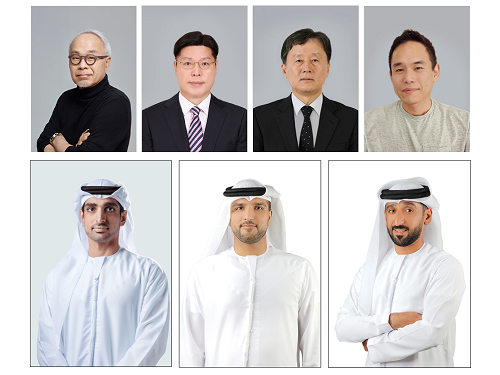
(From left) Omran Sharaf, the Assistant Minister of UAE Foreign Affairs and International Cooperation for Advanced Science and Technology, Amer Al Sayegh the Director General of Space Project at MBRSC, and Mohammed Al Harmi the Director General of Administration at MBRSC (Photos provided by the courtesy of MBRSC)
To celebrate and honor their outstanding achievements, the KAIST Alumni Association selected a team of three alumni of the United Arab Emirates (UAE) to receive the Distinguished International Alumni Award for the first time. The named honorees are Omran Sharaf, a master’s graduate from the Graduate School of Science and Technology Policy, and Amer Al Sayegh and Mohammed Al Harmi, master’s graduates of the Department of Aerospace Engineering - all three of the class of 2013 in leading positions in the UAE space program to lead the advancement of the science and technology of the country.
Currently, the three alums are in directorship of the Mohammed Bin Rashid Space Centre (MBRSC) with Mr. Omran Sharaf, who has recently been appointed as the Assistant Minister in charge of Advanced Science and Technology at the UAE Ministry of Foreign Affairs and International Cooperation, being the Project Director of the Emirates Mars Mission of MBRSC and Mr. Amer Al Sayegh in the Director General position in charge of Space Project and Mr. Mohammed Al Harmi, the Director General of Administration, at MBRSC.
They received technology transfer from “SatRec I”, Korea's first satellite system exporter and KAIST alumni company, for about 10 years from 2006, while carrying out their master’s studies at the same time.
Afterwards, they returned to UAE to lead the Emirates Mars Mission, which is already showing tangible progress including the successful launch of the Mars probe "Amal" (ال امل, meaning ‘Hope’ in Arabic), which was the first in the Arab world and the fifth in the world to successfully enter into orbit around Mars, and the UAE’s first independently developed Earth observation satellite "KhalifaSat".
An official from the KAIST Alumni Association said, "We selected the Distinguished International Alumni after evaluating their industrious leadership in promoting various space industry strategies, ranging from the development of Mars probes and Earth observation satellites, as well as lunar exploration, asteroid exploration, and Mars residence plans."
(From left) Joo-Sun Choi, President & CEO of Samsung Display Co. Ltd., Jung Goo Cho, the CEO of Green Power Co. Ltd., Jong Seung Park, the President of Agency for Defense Development (ADD), Kyunghyun Cho, Professor of New York University (NYU)
Also, four of the Korean graduates, Joo-Sun Choi, the CEO of Samsung Display, Jung Goo Cho, the CEO of Green Power Co. Ltd., Jong Seung Park, the President of Agency for Defense Development (ADD), and Kyunghyun Cho, a Professor of New York University (NYU), were selected as the winners of the “Distinguished Alumni Award”.
Mr. Joo-Sun Choi (Electrical and Electronic Engineering, M.S. in 1989, Ph.D. in 1995), the CEO of Samsung Display, led the successful development and mass-production of the world's first ultra-high-definition QD-OLED Displays, and preemptively transformed the structure of business of the industry and has been leading the way in technological innovation.
Mr. Jung Goo Cho (Electrical and Electronic Engineering, M.S. in 1988, Ph.D. in 1992), the CEO of Green Power Co. Ltd., developed wireless power technology for the first time in Korea in the early 2000s and applied it to semiconductor/display lines and led the wireless power charging technology in various fields, such as developing KAIST On-Line Electric Vehicles (OLEV) and commercializing the world's first wireless charger for 11kW electric vehicles.
Mr. Jong Seung Park (Mechanical Engineering, M.S. in 1988, Ph.D., in 1991), The President of ADD is an expert with abundant science and technology knowledge and organizational management capabilities. He is contributing greatly to national defense and security through science and technology.
Mr. Kyunghyun Cho (Computer Science, B.S., in 2009), the Professor of Computer Science and Data Science at NYU, is a world-renowned expert in Artificial Intelligence (AI), advancing the concept of 'Neural Machine Translation' in the field of natural language processing, to make great contributions to AI translation technology and related industries.
Chairman Chil-Hee Chung, the 26th Chair of KAIST Alumni Association “As each year goes by, I feel that the influence of KAIST alumni goes beyond science and technology to affect our society as a whole.” He went on to say, “This year, as it was more meaningful to extend the award to honor the international members of our Alums, we look forward to seeing more of our alumni continuing their social and academic endeavors to play an active role in the global stage in taking on the global challenges.”
The Ceremony for KAIST Distinguished Alumni and International Alumni Award Honorees will be conducted at the Annual New Year’s Event of KAIST Alumni Association for 2023 to be held on Friday, January 13th, at the Grand InterContinental Seoul Parnas.
2023.01.12 View 26608
UAE Space Program Leaders named to be the 1st of the honorees of KAIST Alumni Association's special recognition for graduates of foreign nationality
The KAIST Alumni Association (Chairman, Chil-Hee Chung) announced on the 12th that the winners of the 2023 KAIST Distinguished Alumni Award and International Alumni Award has been selected.
The KAIST Distinguished Alumni Award, which produced the first recipient in 1992, is an award given to alumni who have contributed to the development of the nation and society, or who have glorified the honor of their alma mater with outstanding academic achievements and social and/or communal contributions.
On a special note, this year, there has been an addition to the honors, “the KAIST Distinguished International Alumni Award” to honor and encourage overseas alumni who are making their marks in the international community that will boost positive recognition of KAIST in the global setting and will later become a bridge that will expedite Korea's international efforts in the future.
As of 2022, the number of international students who succeeded in earning KAIST degrees has exceeded 1,700, and they are actively doing their part back in their home countries as leaders in various fields in which they belong, spanning from science and technology, to politics, industry and other corners of the society.
(From left) Omran Sharaf, the Assistant Minister of UAE Foreign Affairs and International Cooperation for Advanced Science and Technology, Amer Al Sayegh the Director General of Space Project at MBRSC, and Mohammed Al Harmi the Director General of Administration at MBRSC (Photos provided by the courtesy of MBRSC)
To celebrate and honor their outstanding achievements, the KAIST Alumni Association selected a team of three alumni of the United Arab Emirates (UAE) to receive the Distinguished International Alumni Award for the first time. The named honorees are Omran Sharaf, a master’s graduate from the Graduate School of Science and Technology Policy, and Amer Al Sayegh and Mohammed Al Harmi, master’s graduates of the Department of Aerospace Engineering - all three of the class of 2013 in leading positions in the UAE space program to lead the advancement of the science and technology of the country.
Currently, the three alums are in directorship of the Mohammed Bin Rashid Space Centre (MBRSC) with Mr. Omran Sharaf, who has recently been appointed as the Assistant Minister in charge of Advanced Science and Technology at the UAE Ministry of Foreign Affairs and International Cooperation, being the Project Director of the Emirates Mars Mission of MBRSC and Mr. Amer Al Sayegh in the Director General position in charge of Space Project and Mr. Mohammed Al Harmi, the Director General of Administration, at MBRSC.
They received technology transfer from “SatRec I”, Korea's first satellite system exporter and KAIST alumni company, for about 10 years from 2006, while carrying out their master’s studies at the same time.
Afterwards, they returned to UAE to lead the Emirates Mars Mission, which is already showing tangible progress including the successful launch of the Mars probe "Amal" (ال امل, meaning ‘Hope’ in Arabic), which was the first in the Arab world and the fifth in the world to successfully enter into orbit around Mars, and the UAE’s first independently developed Earth observation satellite "KhalifaSat".
An official from the KAIST Alumni Association said, "We selected the Distinguished International Alumni after evaluating their industrious leadership in promoting various space industry strategies, ranging from the development of Mars probes and Earth observation satellites, as well as lunar exploration, asteroid exploration, and Mars residence plans."
(From left) Joo-Sun Choi, President & CEO of Samsung Display Co. Ltd., Jung Goo Cho, the CEO of Green Power Co. Ltd., Jong Seung Park, the President of Agency for Defense Development (ADD), Kyunghyun Cho, Professor of New York University (NYU)
Also, four of the Korean graduates, Joo-Sun Choi, the CEO of Samsung Display, Jung Goo Cho, the CEO of Green Power Co. Ltd., Jong Seung Park, the President of Agency for Defense Development (ADD), and Kyunghyun Cho, a Professor of New York University (NYU), were selected as the winners of the “Distinguished Alumni Award”.
Mr. Joo-Sun Choi (Electrical and Electronic Engineering, M.S. in 1989, Ph.D. in 1995), the CEO of Samsung Display, led the successful development and mass-production of the world's first ultra-high-definition QD-OLED Displays, and preemptively transformed the structure of business of the industry and has been leading the way in technological innovation.
Mr. Jung Goo Cho (Electrical and Electronic Engineering, M.S. in 1988, Ph.D. in 1992), the CEO of Green Power Co. Ltd., developed wireless power technology for the first time in Korea in the early 2000s and applied it to semiconductor/display lines and led the wireless power charging technology in various fields, such as developing KAIST On-Line Electric Vehicles (OLEV) and commercializing the world's first wireless charger for 11kW electric vehicles.
Mr. Jong Seung Park (Mechanical Engineering, M.S. in 1988, Ph.D., in 1991), The President of ADD is an expert with abundant science and technology knowledge and organizational management capabilities. He is contributing greatly to national defense and security through science and technology.
Mr. Kyunghyun Cho (Computer Science, B.S., in 2009), the Professor of Computer Science and Data Science at NYU, is a world-renowned expert in Artificial Intelligence (AI), advancing the concept of 'Neural Machine Translation' in the field of natural language processing, to make great contributions to AI translation technology and related industries.
Chairman Chil-Hee Chung, the 26th Chair of KAIST Alumni Association “As each year goes by, I feel that the influence of KAIST alumni goes beyond science and technology to affect our society as a whole.” He went on to say, “This year, as it was more meaningful to extend the award to honor the international members of our Alums, we look forward to seeing more of our alumni continuing their social and academic endeavors to play an active role in the global stage in taking on the global challenges.”
The Ceremony for KAIST Distinguished Alumni and International Alumni Award Honorees will be conducted at the Annual New Year’s Event of KAIST Alumni Association for 2023 to be held on Friday, January 13th, at the Grand InterContinental Seoul Parnas.
2023.01.12 View 26608 -
 The 40th Anniversary of the Establishment of KAIST Commemoration Held
KAIST, aspiring to become the best Science and Technology University, has turned 40.
KAIST held the commemoration ceremony for the 40th Anniversary of the Establishment of KAIST in the auditorium.
Five awards (Scholar, Creative Lecture, Excellence in Lecture, International Cooperation, Experiment) were given to Professors Kim Eun Jun and Walton Jones (department of Biology), Professor Abigail Shin (department of Humanities and Social Sciences), Professor Shin Seong Chul (department of Physics), and Professor Lee Sang Yeop (department of Biological Chemical Engineering). Each recipient received a prize of five million won.
Professor Song Joon Hwa (department of Computer Sciences) received the ‘New Knowledge Award’ in recognition of his development of the Orchestrator Mobile platform. The new platform is different from Android or the IOS platform in that it allows a fluid relationship to be formed between the smartphone and the user.
KAIST also showed off its new emblem.
The emblem consists of a star which represents the KAIST’s goals of becoming the world leader, of training leaders, the center point, and hope. The main keywords are: ‘Leadership’, ‘Premium’, ‘Scientific’, and ‘Humanity’.
KAIST plans on having various events from May 9th when there will be the Vision Declaration.
2011.02.21 View 23195
The 40th Anniversary of the Establishment of KAIST Commemoration Held
KAIST, aspiring to become the best Science and Technology University, has turned 40.
KAIST held the commemoration ceremony for the 40th Anniversary of the Establishment of KAIST in the auditorium.
Five awards (Scholar, Creative Lecture, Excellence in Lecture, International Cooperation, Experiment) were given to Professors Kim Eun Jun and Walton Jones (department of Biology), Professor Abigail Shin (department of Humanities and Social Sciences), Professor Shin Seong Chul (department of Physics), and Professor Lee Sang Yeop (department of Biological Chemical Engineering). Each recipient received a prize of five million won.
Professor Song Joon Hwa (department of Computer Sciences) received the ‘New Knowledge Award’ in recognition of his development of the Orchestrator Mobile platform. The new platform is different from Android or the IOS platform in that it allows a fluid relationship to be formed between the smartphone and the user.
KAIST also showed off its new emblem.
The emblem consists of a star which represents the KAIST’s goals of becoming the world leader, of training leaders, the center point, and hope. The main keywords are: ‘Leadership’, ‘Premium’, ‘Scientific’, and ‘Humanity’.
KAIST plans on having various events from May 9th when there will be the Vision Declaration.
2011.02.21 View 23195 -
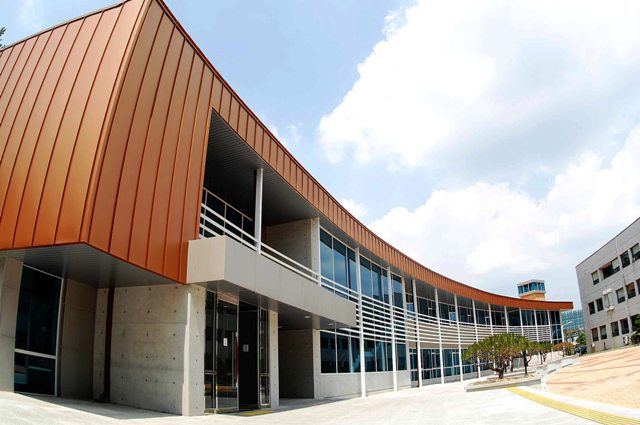 International Center was built to promote greater exchanges and collaborations between the international community and KAIST.
On July 9, 2010, KAIST held an opening ceremony for the construction of International Center. The Center will serve as an internal and external liaison for the university, providing a source of assistance to faculty, administrators, and students on matters related to international activities and initiatives. It will also pursue greater exchanges and collaborations between the international community and KAIST.
The facility accommodates various meetings, exhibitions, library, language services, and other amenities. The International Cooperation Team of KAIST will be moved into this building and provide a variety of services, such as immigration regulations, cultural adjustment, employment, to assist international students, scholars, faculty, and staff at KAIST, as well as Korean students seeking opportunities to study, work, or travel abroad. An international nursery school will also be inside the building so that foreign faculty and students with children can have convenience and quality child care while they are teaching or studying.
At the center will be held many different kinds of international event—one among them is KAIST-ONE, a festival held twice a year in spring and fall to introduce and share culture, education, and food of the global community at KAIST.
2010.07.19 View 17556
International Center was built to promote greater exchanges and collaborations between the international community and KAIST.
On July 9, 2010, KAIST held an opening ceremony for the construction of International Center. The Center will serve as an internal and external liaison for the university, providing a source of assistance to faculty, administrators, and students on matters related to international activities and initiatives. It will also pursue greater exchanges and collaborations between the international community and KAIST.
The facility accommodates various meetings, exhibitions, library, language services, and other amenities. The International Cooperation Team of KAIST will be moved into this building and provide a variety of services, such as immigration regulations, cultural adjustment, employment, to assist international students, scholars, faculty, and staff at KAIST, as well as Korean students seeking opportunities to study, work, or travel abroad. An international nursery school will also be inside the building so that foreign faculty and students with children can have convenience and quality child care while they are teaching or studying.
At the center will be held many different kinds of international event—one among them is KAIST-ONE, a festival held twice a year in spring and fall to introduce and share culture, education, and food of the global community at KAIST.
2010.07.19 View 17556 -
Research University Presidents Discuss Global Network to Increase Cooperation
Presidents and leaders of research universities participating in the 2008 International Presidential Forum on Global Research Universities (IPFGRU) held at the Westin Chosun Hotel in Seoul, Korea on Sept. 8, 2008 exchanged views and ideas on how to build and effectively utilize a global research network in order to increase cooperation and exchanges among institutions of science and technology across the world.
The participants agreed on the need to promote the sharing of expertise and facilities, conduct joint researches and positively implement dual degree, roaming professorship and other programs that help institutions in societies at different stages of scientific and technological development maximize the fruits of their research activities.
As a major goal, the participants agreed to create alliances for research and education that can become a new paradigm for global cooperation, with the outcome of discussions at the 2008 IPFGRU providing the guidelines for future endeavors in this direction.
Through the day-long symposium, participants reached general agreements on the following points:
--The concept of sharing faculty or roaming professorship should be actively promoted in order to accelerate global dissemination of academic expertise with the institutions and state authorities concerned easing existing restrictions to such arrangements and ensuring maximum academic freedom of professors involved.
--Dual degree programs especially those involving institutions of different countries need to be further encouraged in view of their benefits of resources sharing, expansion of knowledge and cultural exchanges and that educational authorities should try to remove various forms of limitations.
--As competitions over university ranking would grow intensive as institutions seek to attract better students and more donations, there is need to institutionalize a fairer, globally recognized national, regional and international assessment systems.
--In view of rapid expansion of interdisciplinary researches which calls for the sharing of facilities and expertise among different institutions, it is necessary to establish national or regional hubs to make state-of-the-art facilities and equipment available for researchers and research programs experiencing limitations in financial and material resources.
--National governments and political leaders should better recognize the importance of science and technology for societal and global prosperity and the science and technology community needs to make more communicative approaches to politicians so that greater trust may be built between them.
--Arrangements to conduct joint research involving international industries, academia and government should be accelerated with a view to addressing the common problems facing the mankind in the 21st century, including energy, environment, water, food and sustainability. The United Nations and other international organizations need to provide stronger support for research universities’ efforts in this direction.
--Research universities across the world should make concerted efforts to establish a global cooperative network that can facilitate the flow of information, resources and research personnel to realize universal advancement of science and technology and, ultimately, enhance the quality of human life.
Keynote speakers and panelists and the subjects of their presentations were:
Participants" List
Topic
Name of University
Speaker
Position
1. Roaming Professorships: To Whose Benefit?
Illinois Institute of Technology
John L. Anderson
President
Improving the Competitiveness of Global University Education
National University of Sciences and Technology
Muhammad Mushtaq
Pro-Rector
Improving the Competitiveness of Global University Education
Tianjin University
Fuling Yang
Director of International Cooperation Office
Sharing Differences in Culture and Environment for Sustainable Education for the Future Generation
Kumamoto University
Tatsuro Sakimoto
President
Sharing Differences in Culture and Environment for Sustainable Education for the Future Generation
Odessa National I. I. Mechnikov University
Sergiy Skorokhod
Vice Rector for International Cooperation
Promoting Science and Engineering Education among Secondary Students
Czech Technical University of Prague
Miroslav Vlcek
Vice Rector
Promoting Science and Engineering Education among Secondary Students
South China University of Technology
Xueqing Qiu
Vice President
Preserving and Utilizing Expert Knowledge for Better Education
Eotvos Loran University
Jösef Nemes-Nagy
Vice Dean
2. Dual Degree Programs: Future Potential & Challenges
University of Queensland
Paul Greenfield
President and Vice Chancellor
Benefits of Dual Degree Program
Institut National des Sciences Appliquées de Lyon
Martin Raynaud
Director, International Relations
Benefits and Limitations of Dual Degree Program
National Institute of Development Administration
Pradit Wanarat
Vice President for Academic Affairs
The Role of Dual Degree Program Easing Brain Drain
Nanyang Technological University
Lam Khin Yong
Associate Provost, Graduate Education & Special Projects
International Dual Degree Programs and Strategies
Georgia Institute of Technology
Steven W. McLaughlin
Vice Provost, International Initiatives
Dual Degree Program and Global Learning Networks
City University of Hong Kong
Richard Yan-Ki Ho
Special Advisor to the President
Raising International IQs of Scientists and Engineers for Global Enterprise
Technion, Israel Institute of Technology
Moshe Shpitalni
Dean,
Graduate Studies
Luncheon Speech
“Beneficial Relationships between Academia and Companies”
Medical Information Technology
A. Neil Pappalardo
Chairman and CEO
3. Sharing Facilities and Expertise
KAIST
Nam Pyo Suh
President
Promoting International Sharing of Research Facilities and Expertise to Strengthen Research Outcomes
Griffith University
Ian O"Connor
President
Economic Benefits of Sharing Research Facilities and Expertise
POSTECH
Sunggi Baik
President
Economic Benefits of Sharing Facilities and Expertise: National NanoFab Center
National NanoFab Center
Hee Chul Lee
President
Communicating Science and Technology to Political Leaders
Office of the President of KOREA
Chan Mo Park
Special Advisor to the President for Science and Technology
Filling the Gap of University Resources
Bandung Institute of Technology
Djoko Santoso
Rector
4. An Approach to Joint Research Ventures with NASA
NASA
Yvonne Pendleton
Deputy Associate Center Director
Benefits of International Joint Venture Research Projects
University of Adelaide
Martyn J. Evans
Director, Community Engagement
Benefits of International Joint Projects
Mahidol University
Sansanee Chaiyaroj
Vice President
International Joint Research Projects
University of Iowa
P. Barry Butler
Dean, College of Engineering
Joint Research: University of Technology Malaysia’s Experience at National and International Level
University Technology of Malaysia
Tan Sri Mohd Ghazali
Vice-Chancellor
Sharing Intellectual Property Rights
Paris Institute of Technology
Cyrille van Effenterre
President
Global Economic and Social Contribution of International Joint Project Cooperation
Kyushu University
Wataru Koterayama
Vice President
5. Globalization through Interfacing with Existing Networking
Technical University of Denmark
Lars Pallesen
Rector
Establishing Global Science and Technology Networking
National Cheng Kung University
Da Hsuan Feng
Senior Executive Vice President
Establishing Global Science and Technology Networking
University of Technology of Troyes
Christian Lerminiaux
President
The Role of Global Science and Technology Network for Higher Education in the 21st Century
Iowa State University
Tom I-P. Shih
Department Chair
Regionalized or Globalized Science and Technology Networking
Babes-Bolyai University
Calin Baciu
Dean, Faculty of Environmental Sciences
Globalized Science and Technology Networking
Harbin Institute of Technology
Shuguo Wang
President
Connecting Regional Science and Technology Networks for the Global Networking
Ritsumeikan University
Sadao
Kawamura
Special Aide
to the Chancellor
How Can a Publisher Strengthen the Global Network of Universities?
Elsevier
Youngsuk Chi
Vice Chairman
2008.09.18 View 30484
-
Foreign R&D Centers Cropping Up Here
Korea Times / 2004. 03. 26 By Kim Tae-gyu
Staff ReporterThe world"s top companies and research institutes are rushing to Korea to set up research and development (R&D) centers.
The Ministry of Science and Technology (MOST) on Thursday said it isunder negotiation with several world-renowned firms or foundations,including University of Cambridge Cavendish Laboratory, Novartis, DuPont and EMC.The Ministry of Information and Communication (MIC) is also lookingto attract five to six multinational companies to establish R&D centers here this year.
Korea has already become a home for R&D institutes from top-tier foreign outfits like the world"s No.1 computer-chip maker Intel Corp. and Paris-based medical foundation Institut Pasteur as well as Germany"s Fraunhofer-Gesellschaft.
The MOST said Cavendish will exchange a memorandum of understandingto set up a joint research center here together with the Korea Advanced Institute of Science and Technology (KAIST) as early as this May.
The two entities will join hands to accelerate knowledge in the fields of nanotechnology, optical technology and physics to name a few,a MOST official said.It also seeks to invite Swiss-based pharmaceutical group Norvatis toestablish an R&D center here on occasion of the medical symposium that will take place here from March 31.
The Fortune 500 company is expected to dispatch dozens of high-ranking staff to the two-day neuroscience convention.
The Korea Foundation for International Cooperation of Science and Technology (KICOS), an affiliate of MOST, expects a few American companies, including DuPont, to open shop here.``DuPont is likely to make a decision, and we are currently under negotiations with several big companies like EMC,"" KICOS official KimKey-hyup said.
EMC is the world"s third-largest maker of data-storage devices.Seoul seeks to host six high-tech information-technology (IT) research centers this year.
Up to now, Intel and Fraunhofer committed themselves to setting up research centers here, and IBM will likely open an R&D center as soonas its affiliate IBM Korea"s bribe scandal regarding a government contract is settled.
Such high-profile companies as Microsoft, Hewlett Packard and Qualcomm are welcome to open R&D centers in Korea, an MIC official said. The government is willing to provide financial incentives to foreignR&D centers.
2004.03.26 View 27851