6G
-
 KAIST & LG U+ Team Up for Quantum Computing Solution for Ultra-Space 6G Satellite Networking
KAIST quantum computer scientists have optimized ultra-space 6G Low-Earth Orbit (LEO) satellite networking, finding the shortest path to transfer data from a city to another place via multi-satellite hops.
The research team led by Professor June-Koo Kevin Rhee and Professor Dongsu Han in partnership with LG U+ verified the possibility of ultra-performance and precision communication with satellite networks using D-Wave, the first commercialized quantum computer.
Satellite network optimization has remained challenging since the network needs to be reconfigured whenever satellites approach other satellites within the connection range in a three-dimensional space. Moreover, LEO satellites orbiting at 200~2000 km above the Earth change their positions dynamically, whereas Geo-Stationary Orbit (GSO) satellites do not change their positions. Thus, LEO satellite network optimization needs to be solved in real time.
The research groups formulated the problem as a Quadratic Unconstrained Binary Optimization (QUBO) problem and managed to solve the problem, incorporating the connectivity and link distance limits as the constraints.
The proposed optimization algorithm is reported to be much more efficient in terms of hop counts and path length than previously reported studies using classical solutions. These results verify that a satellite network can provide ultra-performance (over 1Gbps user-perceived speed), and ultra-precision (less than 5ms end-to-end latency) network services, which are comparable to terrestrial communication.
Once QUBO is applied, “ultra-space networking” is expected to be realized with 6G. Researchers said that an ultra-space network provides communication services for an object moving at up to 10 km altitude with an extreme speed (~ 1000 km/h). Optimized LEO satellite networks can provide 6G communication services to currently unavailable areas such as air flights and deserts.
Professor Rhee, who is also the CEO of Qunova Computing, noted, “Collaboration with LG U+ was meaningful as we were able to find an industrial application for a quantum computer. We look forward to more quantum application research on real problems such as in communications, drug and material discovery, logistics, and fintech industries.”
2022.06.17 View 9536
KAIST & LG U+ Team Up for Quantum Computing Solution for Ultra-Space 6G Satellite Networking
KAIST quantum computer scientists have optimized ultra-space 6G Low-Earth Orbit (LEO) satellite networking, finding the shortest path to transfer data from a city to another place via multi-satellite hops.
The research team led by Professor June-Koo Kevin Rhee and Professor Dongsu Han in partnership with LG U+ verified the possibility of ultra-performance and precision communication with satellite networks using D-Wave, the first commercialized quantum computer.
Satellite network optimization has remained challenging since the network needs to be reconfigured whenever satellites approach other satellites within the connection range in a three-dimensional space. Moreover, LEO satellites orbiting at 200~2000 km above the Earth change their positions dynamically, whereas Geo-Stationary Orbit (GSO) satellites do not change their positions. Thus, LEO satellite network optimization needs to be solved in real time.
The research groups formulated the problem as a Quadratic Unconstrained Binary Optimization (QUBO) problem and managed to solve the problem, incorporating the connectivity and link distance limits as the constraints.
The proposed optimization algorithm is reported to be much more efficient in terms of hop counts and path length than previously reported studies using classical solutions. These results verify that a satellite network can provide ultra-performance (over 1Gbps user-perceived speed), and ultra-precision (less than 5ms end-to-end latency) network services, which are comparable to terrestrial communication.
Once QUBO is applied, “ultra-space networking” is expected to be realized with 6G. Researchers said that an ultra-space network provides communication services for an object moving at up to 10 km altitude with an extreme speed (~ 1000 km/h). Optimized LEO satellite networks can provide 6G communication services to currently unavailable areas such as air flights and deserts.
Professor Rhee, who is also the CEO of Qunova Computing, noted, “Collaboration with LG U+ was meaningful as we were able to find an industrial application for a quantum computer. We look forward to more quantum application research on real problems such as in communications, drug and material discovery, logistics, and fintech industries.”
2022.06.17 View 9536 -
 A Team of Three PhD Candidates Wins the Korea Semiconductor Design Contest
“We felt a sense of responsibility to help the nation advance its semiconductor design technology”
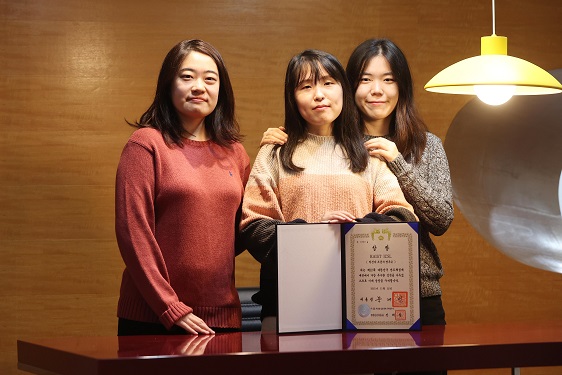
A CMOS (complementary metal-oxide semiconductor)-based “ultra-low noise signal chip” for 6G communications designed by three PhD candidates at the KAIST School of Electrical Engineering won the Presidential Award at the 22nd Korea Semiconductor Design Contest.
The winners are PhD candidates Sun-Eui Park, Yoon-Seo Cho, and Ju-Eun Bang from the Integrated Circuits and System Lab run by Professor Jaehyouk Choi. The contest, which is hosted by the Ministry of Trade, Industry and Energy and the Korea Semiconductors Industry Association, is one of the top national semiconductor design contests for college students.
Park said the team felt a sense of responsibility to help advance semiconductor design technology in Korea when deciding to participate the contest. The team expressed deep gratitude to Professor Choi for guiding their research on 6G communications.
“Our colleagues from other labs and seniors who already graduated helped us a great deal, so we owe them a lot,” explained Park. Cho added that their hard work finally got recognized and that acknowledgement pushes her to move forward with her research. Meanwhile, Bang said she is delighted to see that many people seem to be interested in her research topic.
Research for 6G is attempting to reach 1 tera bps (Tbps), 50 times faster than 5G communications with transmission speeds of up to 20 gigabytes. In general, the wider the communication frequency band, the higher the data transmission speed. Thus, the use of frequency bands above 100 gigahertz is essential for delivering high data transmission speeds for 6G communications.
However, it remains a big challenge to make a precise benchmark signal that can be used as a carrier wave in a high frequency band. Despite the advantages of CMOS’s ultra-small and low-power design, it still has limitations at high frequency bands and its operating frequency. Thus, it was difficult to achieve a frequency band above 100 gigahertz.
To overcome these challenges, the three students introduced ultra-low noise signal generation technology that can support high-order modulation technologies. This technology is expected to contribute to increasing the price competitiveness and density of 6G communication chips that will be used in the future.
5G just got started in 2020 and still has long way to go for full commercialization. Nevertheless, many researchers have started preparing for 6G technology, targeting 2030 since a new cellular communication appears in every other decade.
Professor Choi said, “Generating ultra-high frequency signals in bands above 100 GHz with highly accurate timing is one of the key technologies for implementing 6G communication hardware. Our research is significant for the development of the world’s first semiconductor chip that will use the CMOS process to achieve noise performance of less than 80fs in a frequency band above 100 GHz.”
The team members plan to work as circuit designers in Korean semiconductor companies after graduation. “We will continue to research the development of signal generators on the topic of award-winning 6G. We would like to continue our research on high-speed circuit designs such as ultra-fast analog-to-digital converters,” Park added.
2021.11.30 View 9816
A Team of Three PhD Candidates Wins the Korea Semiconductor Design Contest
“We felt a sense of responsibility to help the nation advance its semiconductor design technology”
A CMOS (complementary metal-oxide semiconductor)-based “ultra-low noise signal chip” for 6G communications designed by three PhD candidates at the KAIST School of Electrical Engineering won the Presidential Award at the 22nd Korea Semiconductor Design Contest.
The winners are PhD candidates Sun-Eui Park, Yoon-Seo Cho, and Ju-Eun Bang from the Integrated Circuits and System Lab run by Professor Jaehyouk Choi. The contest, which is hosted by the Ministry of Trade, Industry and Energy and the Korea Semiconductors Industry Association, is one of the top national semiconductor design contests for college students.
Park said the team felt a sense of responsibility to help advance semiconductor design technology in Korea when deciding to participate the contest. The team expressed deep gratitude to Professor Choi for guiding their research on 6G communications.
“Our colleagues from other labs and seniors who already graduated helped us a great deal, so we owe them a lot,” explained Park. Cho added that their hard work finally got recognized and that acknowledgement pushes her to move forward with her research. Meanwhile, Bang said she is delighted to see that many people seem to be interested in her research topic.
Research for 6G is attempting to reach 1 tera bps (Tbps), 50 times faster than 5G communications with transmission speeds of up to 20 gigabytes. In general, the wider the communication frequency band, the higher the data transmission speed. Thus, the use of frequency bands above 100 gigahertz is essential for delivering high data transmission speeds for 6G communications.
However, it remains a big challenge to make a precise benchmark signal that can be used as a carrier wave in a high frequency band. Despite the advantages of CMOS’s ultra-small and low-power design, it still has limitations at high frequency bands and its operating frequency. Thus, it was difficult to achieve a frequency band above 100 gigahertz.
To overcome these challenges, the three students introduced ultra-low noise signal generation technology that can support high-order modulation technologies. This technology is expected to contribute to increasing the price competitiveness and density of 6G communication chips that will be used in the future.
5G just got started in 2020 and still has long way to go for full commercialization. Nevertheless, many researchers have started preparing for 6G technology, targeting 2030 since a new cellular communication appears in every other decade.
Professor Choi said, “Generating ultra-high frequency signals in bands above 100 GHz with highly accurate timing is one of the key technologies for implementing 6G communication hardware. Our research is significant for the development of the world’s first semiconductor chip that will use the CMOS process to achieve noise performance of less than 80fs in a frequency band above 100 GHz.”
The team members plan to work as circuit designers in Korean semiconductor companies after graduation. “We will continue to research the development of signal generators on the topic of award-winning 6G. We would like to continue our research on high-speed circuit designs such as ultra-fast analog-to-digital converters,” Park added.
2021.11.30 View 9816