%41%4e%47
-
 KAIST Explores Solutions for African Youth Employment with World Bank and African Union
< Group photo of meeting participants >
KAIST announced on the 6th that the 'Jobs for Youth in Africa Knowledge Exchange' platform was held in Nairobi, Kenya, from March 3 to 5 (local time). The event was hosted by the Kenyan government and co-organized by the World Bank Group, the African Union, and the KAIST Global Center for Development and Strategy (G-CODEs).
As a high-level policy implementation platform dedicated to addressing youth employment challenges in Africa, the event drew approximately 200 participants, including government officials from over 20 African nations, international organizations, the private sector, academia, and development cooperation partners. KAIST participated as a key global partner linking technology and policy, presenting innovation models for employment systems based on digital and Artificial Intelligence (AI) technologies.
< Scene from the meeting hosted by the Kenyan government >
With Africa’s youth population projected to double by 2050, the continent faces significant hurdles such as high unemployment rates and informal employment. This event marked the second face-to-face meeting of the 'Jobs for Youth in Africa Community of Practice (CoP),' which was launched in Kigali, Rwanda, in 2025. The meeting aimed to share policy experiences among member states and materialize scalable implementation models. Salim Mvurya, Kenya's Cabinet Secretary for Youth Affairs, Creative Economy, and Sports, attended the opening ceremony and emphasized that youth job creation is a critical priority at both national and continental levels.
The program focused on several key themes:
Evidence-based youth employment strategies
Innovation in employment systems through digital and AI technologies
Improving labor market outcomes through Recognition of Prior Learning (RPL)
Business environment reforms and strengthening value chain linkages
Notably, in the session titled "Digital and AI-based Employment System Innovation," Professor Kyung Ryul Park of KAIST shared Korea’s digital transformation experiences and AI application cases, proposing directions for data-driven policy design and the development of technology-based employment platforms. Additionally, KAIST Professor Ga-young Park facilitated mutual learning and connected cases of scalable youth employment projects across countries during the "Global Cafe Session."
< Professor Kyung Ryul Park of KAIST delivering a presentation >
Participants visited the project site of "National Youth Opportunities Towards Advancement (NYOTA)," an initiative pursued by the Kenyan government and the World Bank. There, they observed a comprehensive youth employment model that integrates vocational training, job matching, and entrepreneurship support. The site visit served as a practical learning opportunity to share the processes of policy design and execution.
Since last year, KAIST has been involved in digital innovation projects for youth employment in East Africa through the Korea-World Bank Partnership Facility (KWPF). Through this event, the university reaffirmed its status as a global cooperation hub leading technology-based policy innovation.
"The issue of youth employment is a structural challenge that combines digital transformation, industrial strategy, and educational reform," stated Professor Kyung Ryul Park. "KAIST will continue to present actionable policy models based on data and technology while strengthening international cooperation."
This Knowledge Exchange platform is evaluated as a significant milestone that reaffirmed the African youth employment agenda as a core priority of international cooperation and solidified the foundation for enhancing policy implementation capabilities. A follow-up workshop is scheduled to be held early next year at the Kenya Advanced Institute of Science and Technology (Kenya-AIST) campus in Konza, Nairobi, which is modeled after KAIST.
2026.03.10 View 1147
KAIST Explores Solutions for African Youth Employment with World Bank and African Union
< Group photo of meeting participants >
KAIST announced on the 6th that the 'Jobs for Youth in Africa Knowledge Exchange' platform was held in Nairobi, Kenya, from March 3 to 5 (local time). The event was hosted by the Kenyan government and co-organized by the World Bank Group, the African Union, and the KAIST Global Center for Development and Strategy (G-CODEs).
As a high-level policy implementation platform dedicated to addressing youth employment challenges in Africa, the event drew approximately 200 participants, including government officials from over 20 African nations, international organizations, the private sector, academia, and development cooperation partners. KAIST participated as a key global partner linking technology and policy, presenting innovation models for employment systems based on digital and Artificial Intelligence (AI) technologies.
< Scene from the meeting hosted by the Kenyan government >
With Africa’s youth population projected to double by 2050, the continent faces significant hurdles such as high unemployment rates and informal employment. This event marked the second face-to-face meeting of the 'Jobs for Youth in Africa Community of Practice (CoP),' which was launched in Kigali, Rwanda, in 2025. The meeting aimed to share policy experiences among member states and materialize scalable implementation models. Salim Mvurya, Kenya's Cabinet Secretary for Youth Affairs, Creative Economy, and Sports, attended the opening ceremony and emphasized that youth job creation is a critical priority at both national and continental levels.
The program focused on several key themes:
Evidence-based youth employment strategies
Innovation in employment systems through digital and AI technologies
Improving labor market outcomes through Recognition of Prior Learning (RPL)
Business environment reforms and strengthening value chain linkages
Notably, in the session titled "Digital and AI-based Employment System Innovation," Professor Kyung Ryul Park of KAIST shared Korea’s digital transformation experiences and AI application cases, proposing directions for data-driven policy design and the development of technology-based employment platforms. Additionally, KAIST Professor Ga-young Park facilitated mutual learning and connected cases of scalable youth employment projects across countries during the "Global Cafe Session."
< Professor Kyung Ryul Park of KAIST delivering a presentation >
Participants visited the project site of "National Youth Opportunities Towards Advancement (NYOTA)," an initiative pursued by the Kenyan government and the World Bank. There, they observed a comprehensive youth employment model that integrates vocational training, job matching, and entrepreneurship support. The site visit served as a practical learning opportunity to share the processes of policy design and execution.
Since last year, KAIST has been involved in digital innovation projects for youth employment in East Africa through the Korea-World Bank Partnership Facility (KWPF). Through this event, the university reaffirmed its status as a global cooperation hub leading technology-based policy innovation.
"The issue of youth employment is a structural challenge that combines digital transformation, industrial strategy, and educational reform," stated Professor Kyung Ryul Park. "KAIST will continue to present actionable policy models based on data and technology while strengthening international cooperation."
This Knowledge Exchange platform is evaluated as a significant milestone that reaffirmed the African youth employment agenda as a core priority of international cooperation and solidified the foundation for enhancing policy implementation capabilities. A follow-up workshop is scheduled to be held early next year at the Kenya Advanced Institute of Science and Technology (Kenya-AIST) campus in Konza, Nairobi, which is modeled after KAIST.
2026.03.10 View 1147 -
 Formosa Group Chairman Ruey-Yu Wang Awarded Honorary Doctorate
KAIST (President Kwang Hyung Lee) announced that it conferred an Honorary Doctorate in Business Administration upon Ruey-Yu Wang, Executive Management Committee Member of Formosa Group and Chairman of Formosa Biomedical Technology Corporation, at its 2026 Commencement Ceremony held on February 20th.
As the recipient of the honorary degree, Chairman Wang has carried forward the management philosophy of the late Formosa Group founder Yung-Ching Wang, placing corporate sustainability and social responsibility at the core of her leadership while guiding the group’s strategic transformation and growth. Moving beyond its traditional petrochemical manufacturing base, she has expanded the group’s business portfolio into future-oriented industries such as biotechnology, clean energy, energy storage systems (ESS), and resource recycling, practicing long-term, forward-looking management.
KAIST stated, “Chairman Wang has presented a sustainable corporate growth model in which science and technology, industry, and talent cultivation are organically integrated, based on the belief that industrial growth and social responsibility cannot be separated.” KAIST added, “In particular, we are honored to recognize her contributions toward establishing a mid-to-long-term foundation for collaboration centered on biomedical research through strategic partnerships with KAIST, as well as toward expanding research infrastructure in life science and technology and fostering international joint research platforms.”
As part of this collaboration, Chairman Wang played a key role in building a joint research framework between major medical institutions and universities affiliated with Formosa Group and KAIST’s College of Life Science and Bioengineering. The resulting “KAIST–Formosa Biomedical Research Center” serves as a hub for multidisciplinary and international collaborative research, supporting mid- to long-term biomedical research initiatives and enhancing KAIST’s research competitiveness and global standing.
She also institutionalized mechanisms to reinvest corporate achievements into society and has made sustained, long-term investments in research and talent development, thereby fostering a virtuous cycle in which scientific and technological achievements translate into industrial and societal impact. These efforts have been widely recognized as exemplary contributions that go beyond the traditional scope of corporate management, advancing human welfare and promoting a sustainable society through science and technology.
Chairman Wang remarked, “I am deeply honored to receive an Honorary Doctorate in Business Administration from KAIST. I strongly resonate with KAIST’s values and philosophy of contributing to humanity and building a sustainable future through science, technology, and research.”
She added, “I hope that the young talents at KAIST will lead sustainable development for humanity through science and technology. I will continue to support research and talent development over the long term to help create a virtuous cycle in which scientific and technological innovations are translated into industry and society.”
President Kwang Hyung Lee stated, “Chairman Wang has exemplified socially responsible leadership through industry strategies centered on science and technology. We deeply appreciate her substantive support for expanding research infrastructure and strengthening international collaboration through a strategic partnership with KAIST, and we are honored to welcome her as a member of the KAIST family.”
2026.02.21 View 1599
Formosa Group Chairman Ruey-Yu Wang Awarded Honorary Doctorate
KAIST (President Kwang Hyung Lee) announced that it conferred an Honorary Doctorate in Business Administration upon Ruey-Yu Wang, Executive Management Committee Member of Formosa Group and Chairman of Formosa Biomedical Technology Corporation, at its 2026 Commencement Ceremony held on February 20th.
As the recipient of the honorary degree, Chairman Wang has carried forward the management philosophy of the late Formosa Group founder Yung-Ching Wang, placing corporate sustainability and social responsibility at the core of her leadership while guiding the group’s strategic transformation and growth. Moving beyond its traditional petrochemical manufacturing base, she has expanded the group’s business portfolio into future-oriented industries such as biotechnology, clean energy, energy storage systems (ESS), and resource recycling, practicing long-term, forward-looking management.
KAIST stated, “Chairman Wang has presented a sustainable corporate growth model in which science and technology, industry, and talent cultivation are organically integrated, based on the belief that industrial growth and social responsibility cannot be separated.” KAIST added, “In particular, we are honored to recognize her contributions toward establishing a mid-to-long-term foundation for collaboration centered on biomedical research through strategic partnerships with KAIST, as well as toward expanding research infrastructure in life science and technology and fostering international joint research platforms.”
As part of this collaboration, Chairman Wang played a key role in building a joint research framework between major medical institutions and universities affiliated with Formosa Group and KAIST’s College of Life Science and Bioengineering. The resulting “KAIST–Formosa Biomedical Research Center” serves as a hub for multidisciplinary and international collaborative research, supporting mid- to long-term biomedical research initiatives and enhancing KAIST’s research competitiveness and global standing.
She also institutionalized mechanisms to reinvest corporate achievements into society and has made sustained, long-term investments in research and talent development, thereby fostering a virtuous cycle in which scientific and technological achievements translate into industrial and societal impact. These efforts have been widely recognized as exemplary contributions that go beyond the traditional scope of corporate management, advancing human welfare and promoting a sustainable society through science and technology.
Chairman Wang remarked, “I am deeply honored to receive an Honorary Doctorate in Business Administration from KAIST. I strongly resonate with KAIST’s values and philosophy of contributing to humanity and building a sustainable future through science, technology, and research.”
She added, “I hope that the young talents at KAIST will lead sustainable development for humanity through science and technology. I will continue to support research and talent development over the long term to help create a virtuous cycle in which scientific and technological innovations are translated into industry and society.”
President Kwang Hyung Lee stated, “Chairman Wang has exemplified socially responsible leadership through industry strategies centered on science and technology. We deeply appreciate her substantive support for expanding research infrastructure and strengthening international collaboration through a strategic partnership with KAIST, and we are honored to welcome her as a member of the KAIST family.”
2026.02.21 View 1599 -
 KAIST Extends Its Deepest Condolences on the Passing of the Late Chairman Chang Sun Jung, Founder of Jungheung Group
KAIST extends its deepest condolences on the passing of the late Chairman Chang Sun Jung, founder of Jungheung Group.
Chairman Jung made significant contributions to the development of Korea’s construction industry and regional economy, and was a visionary leader who deeply recognized and actively supported the importance of nurturing science and technology talent. In particular, through his generous contribution to the KAIST Development Fund, he left a meaningful legacy in fostering future scientific talent and advancing research environments that will shape the nation’s future.
KAIST honors Chairman Jung’s noble spirit of giving and dedication, and will continue to strive to ensure that his vision lives on through the advancement of science and technology in Korea.
We extend our sincere condolences to the bereaved family and to the executives and employees of Jungheung Group, and pray for the eternal rest of the deceased.
2026.02.03 View 958
KAIST Extends Its Deepest Condolences on the Passing of the Late Chairman Chang Sun Jung, Founder of Jungheung Group
KAIST extends its deepest condolences on the passing of the late Chairman Chang Sun Jung, founder of Jungheung Group.
Chairman Jung made significant contributions to the development of Korea’s construction industry and regional economy, and was a visionary leader who deeply recognized and actively supported the importance of nurturing science and technology talent. In particular, through his generous contribution to the KAIST Development Fund, he left a meaningful legacy in fostering future scientific talent and advancing research environments that will shape the nation’s future.
KAIST honors Chairman Jung’s noble spirit of giving and dedication, and will continue to strive to ensure that his vision lives on through the advancement of science and technology in Korea.
We extend our sincere condolences to the bereaved family and to the executives and employees of Jungheung Group, and pray for the eternal rest of the deceased.
2026.02.03 View 958 -
 AI Enters the Experienced Hire Era... Teaching Learned Knowledge with Ease
< (From left) KAIST Professor Hyunwoo J. Kim, Postdoctoral Researcher Sanghyeok Lee, M.S candidate Taehoon Song, Korea University Ph.D candidate Jihwan Park >
How inconvenient would it be if you had to manually transfer every contact and photo from scratch every time you switched to a new smartphone? Current Artificial Intelligence (AI) models face a similar predicament. Whenever a superior new AI model—such as a new version of ChatGPT—emerges, it has to be retrained with massive amounts of data and at a high cost to acquire specialized knowledge in specific fields. A Korean research team has developed a "knowledge transplantation" technology between AI models that can resolve this inefficiency.
KAIST announced on January 27th that a research team led by Professor Hyunwoo J. Kim from the School of Computing, in collaboration with a research team from Korea University, has developed a new technology capable of effectively "transplanting" learned knowledge between different AI models.
Recently, Vision-Language Models (VLM), which understand both images and text simultaneously, have been evolving rapidly. These are easily understood as multimodal AIs, like ChatGPT, which can provide explanations when a user shows them a photo and asks a question. These models have the advantage of adapting relatively quickly to new fields using small amounts of data by pre-learning large-scale image and language data.
However, the need to repeat this "adaptation process" from scratch every time a new AI model is released has been pointed out as a major inefficiency. Existing adaptation techniques also faced limitations: they were difficult to use if the model structure changed even slightly, or they significantly increased memory and computational costs because multiple models had to be used simultaneously.
To solve these problems, the research team proposed "TransMiter," a transferable adaptation technique that allows learned knowledge to be reused regardless of the model's structure or size. The core of this technology is directly transferring the "adaptation experience" accumulated by one AI as it learns to another AI model.
< TransMiter: A transferable adaptation technique reusable regardless of model structure, size, etc. >
The researchers' technology does not overhaul the complex internal structure of the AI; instead, it adopts a method of passing on "know-how" learned by observing only the prediction results (output) to another AI. Even if the AI models have different architectures, if the know-how learned by one AI is organized based on the answers given to the same questions, another AI can utilize that knowledge immediately. Consequently, there is no need to undergo the complex and time-consuming retraining process, and there is almost no slowdown in speed.
This study is highly significant as it is the first to prove that AI adaptation knowledge—previously considered almost impossible to reuse if model structures or sizes differed—can be precisely transplanted regardless of the model type. This is expected to not only reduce repetitive learning costs but also be utilized as a so-called "knowledge patch" technology that updates Large Language Models (LLMs) in real-time according to specific needs.
Professor Hyunwoo J. Kim explained, "By extending this research, we can significantly reduce the cost of post-training that had to be performed repeatedly whenever a rapidly evolving hyper-scale language model appears. It will enable 'model patches' that easily add expertise in specific fields."
The study involved Taehoon Song (Master's student, KAIST School of Computing), Sanghyeok Lee (Postdoctoral researcher), and Jihwan Park (Doctoral student, Korea University) as co-authors, with Professor Hyunwoo J. Kim serving as the corresponding author. The research results were accepted for oral presentation (4.6% acceptance rate as of 2025) at AAAI 2026 (Association for the Advancement of Artificial Intelligence), the most prestigious international conference in the field of AI, and were presented on January 25th.
Paper Title: Transferable Model-agnostic Vision-Language Model Adaptation for Efficient Weak-to-Strong Generalization
DOI: https://doi.org/10.48550/arXiv.2508.08604
Meanwhile, Professor Hyunwoo J. Kim's laboratory presented a total of three papers at the conference, including this paper and "TabFlash," a technology developed in collaboration with Google Cloud AI to enhance the understanding of tables within documents.
2026.01.27 View 2071
AI Enters the Experienced Hire Era... Teaching Learned Knowledge with Ease
< (From left) KAIST Professor Hyunwoo J. Kim, Postdoctoral Researcher Sanghyeok Lee, M.S candidate Taehoon Song, Korea University Ph.D candidate Jihwan Park >
How inconvenient would it be if you had to manually transfer every contact and photo from scratch every time you switched to a new smartphone? Current Artificial Intelligence (AI) models face a similar predicament. Whenever a superior new AI model—such as a new version of ChatGPT—emerges, it has to be retrained with massive amounts of data and at a high cost to acquire specialized knowledge in specific fields. A Korean research team has developed a "knowledge transplantation" technology between AI models that can resolve this inefficiency.
KAIST announced on January 27th that a research team led by Professor Hyunwoo J. Kim from the School of Computing, in collaboration with a research team from Korea University, has developed a new technology capable of effectively "transplanting" learned knowledge between different AI models.
Recently, Vision-Language Models (VLM), which understand both images and text simultaneously, have been evolving rapidly. These are easily understood as multimodal AIs, like ChatGPT, which can provide explanations when a user shows them a photo and asks a question. These models have the advantage of adapting relatively quickly to new fields using small amounts of data by pre-learning large-scale image and language data.
However, the need to repeat this "adaptation process" from scratch every time a new AI model is released has been pointed out as a major inefficiency. Existing adaptation techniques also faced limitations: they were difficult to use if the model structure changed even slightly, or they significantly increased memory and computational costs because multiple models had to be used simultaneously.
To solve these problems, the research team proposed "TransMiter," a transferable adaptation technique that allows learned knowledge to be reused regardless of the model's structure or size. The core of this technology is directly transferring the "adaptation experience" accumulated by one AI as it learns to another AI model.
< TransMiter: A transferable adaptation technique reusable regardless of model structure, size, etc. >
The researchers' technology does not overhaul the complex internal structure of the AI; instead, it adopts a method of passing on "know-how" learned by observing only the prediction results (output) to another AI. Even if the AI models have different architectures, if the know-how learned by one AI is organized based on the answers given to the same questions, another AI can utilize that knowledge immediately. Consequently, there is no need to undergo the complex and time-consuming retraining process, and there is almost no slowdown in speed.
This study is highly significant as it is the first to prove that AI adaptation knowledge—previously considered almost impossible to reuse if model structures or sizes differed—can be precisely transplanted regardless of the model type. This is expected to not only reduce repetitive learning costs but also be utilized as a so-called "knowledge patch" technology that updates Large Language Models (LLMs) in real-time according to specific needs.
Professor Hyunwoo J. Kim explained, "By extending this research, we can significantly reduce the cost of post-training that had to be performed repeatedly whenever a rapidly evolving hyper-scale language model appears. It will enable 'model patches' that easily add expertise in specific fields."
The study involved Taehoon Song (Master's student, KAIST School of Computing), Sanghyeok Lee (Postdoctoral researcher), and Jihwan Park (Doctoral student, Korea University) as co-authors, with Professor Hyunwoo J. Kim serving as the corresponding author. The research results were accepted for oral presentation (4.6% acceptance rate as of 2025) at AAAI 2026 (Association for the Advancement of Artificial Intelligence), the most prestigious international conference in the field of AI, and were presented on January 25th.
Paper Title: Transferable Model-agnostic Vision-Language Model Adaptation for Efficient Weak-to-Strong Generalization
DOI: https://doi.org/10.48550/arXiv.2508.08604
Meanwhile, Professor Hyunwoo J. Kim's laboratory presented a total of three papers at the conference, including this paper and "TabFlash," a technology developed in collaboration with Google Cloud AI to enhance the understanding of tables within documents.
2026.01.27 View 2071 -
 “AI,” the New Language of Materials Science and Engineering Spoken at KAIST
<(From Left) M.S candidate Chaeyul Kang, Professor Seumgbum Hong, Ph. D candidate Benediktus Madika, Ph.D candidate Batzorig Buyantogtokh, Ph.D candiate Aditi Saha, >
Collaborating authors include Professor Joshua Agar (Drexel University), Professors Chris Wolverton and Peter Voorhees (Northwestern University), Professor Peter Littlewood (University of St Andrews), and Professor Sergei Kalinin (University of Tennessee).
Paper Title: Artificial Intelligence for Materials Discovery, Development, and Optimization
The era has arrived in which artificial intelligence (AI) autonomously imagines and predicts the structures and properties of new materials. Today, AI functions as a researcher’s “second brain,” actively participating in every stage of research, from idea generation to experimental validation.
KAIST (President Kwang Hyung Lee) announced on October 26 that a comprehensive review paper analyzing the impact of AI, Machine Learning (ML), and Deep Learning (DL) technologies across materials science and engineering has been published in ACS Nano (Impact Factor = 18.7). The paper was co-authored by Professor Seungbum Hong and his team from the Department of Materials Science and Engineering at KAIST, in collaboration with researchers from Drexel University, Northwestern University, the University of St Andrews, and the University of Tennessee in the United States.
The research team proposed a full-cycle utilization strategy for materials innovation through an AI-based catalyst search platform, which embodies the concept of a Self-Driving Lab—a system in which robots autonomously perform materials synthesis and optimization experiments.
Professor Hong’s team categorized materials research into three major stages—Discovery, Development, and Optimization—and detailed the distinctive role of AI in each phase:
In the Discovery Stage, AI designs new structures, predicts properties, and rapidly identifies the most promising materials among vast candidate pools.
In the Development Stage, AI analyzes experimental data and autonomously adjusts experimental processes through Self-Driving Lab systems, significantly shortening research timelines.
In the Optimization Stage, AI employs Reinforcement Learning, which identifies optimal conditions through Bayesian Optimization, which efficiently finds superior results with minimal experimentation, to fine-tune designs and process conditions for maximum performance.
In essence, AI serves as a “smart assistant” that narrows down the most promising materials, reduces experimental trial and error, and autonomously optimizes experimental conditions to achieve the best-performing outcomes.
The paper further highlights how cutting-edge technologies such as Generative AI, Graph Neural Networks (GNNs), and Transformer models are transforming AI from a computational tool into a “thinking researcher.” Nonetheless, the team cautions that AI’s predictions are not error-proof and that key challenges persist, such as imbalanced data quality, limited interpretability of AI predictions, and integration of heterogeneous datasets.
To address these limitations, the authors emphasize the importance of developing AI systems capable of autonomously understanding physical principles and ensuring transparent, verifiable decision-making processes for researchers.
The review also explores the concept of the Self-Driving Lab, where AI autonomously designs experimental plans, analyzes results, and determines the next experimental steps—without manual operation by researchers. The AI-Based Catalyst Search Platform exemplifies this concept, enabling robots to automatically design, execute, and optimize catalyst synthesis experiments.
In particular, the study presents cases in which AI-driven experimentation has dramatically accelerated catalyst development, suggesting that similar approaches could revolutionize research in battery and energy materials.
<AI Driving Innovation Across the Entire Cycle of New Material Discovery, Development, and Optimization>
“This review demonstrates that artificial intelligence is emerging as the new language of materials science and engineering, transcending its role as a mere tool,” said Professor Seungbum Hong. “The roadmap presented by the KAIST team will serve as a valuable guide for researchers in Korea’s national core industries including batteries, semiconductors, and energy materials.”
Benediktus Madika (Ph.D. candidate), Aditi Saha (Ph.D. candidate), Chaeyul Kang (M.S. candidate), and Batzorig Buyantogtokh (Ph.D. candidate) from KAIST’s Department of Materials Science and Engineering contributed as co-first authors.
Collaborating authors include Professor Joshua Agar (Drexel University), Professors Chris Wolverton and Peter Voorhees (Northwestern University), Professor Peter Littlewood (University of St Andrews), and Professor Sergei Kalinin (University of Tennessee).
Paper Title: Artificial Intelligence for Materials Discovery, Development, and Optimization
DOI: 10.1021/acsnano.5c04200
This work was supported by the National Research Foundation of Korea (NRF) with funding from the Ministry of Science and ICT (RS-2023-00247245).
2025.10.27 View 3009
“AI,” the New Language of Materials Science and Engineering Spoken at KAIST
<(From Left) M.S candidate Chaeyul Kang, Professor Seumgbum Hong, Ph. D candidate Benediktus Madika, Ph.D candidate Batzorig Buyantogtokh, Ph.D candiate Aditi Saha, >
Collaborating authors include Professor Joshua Agar (Drexel University), Professors Chris Wolverton and Peter Voorhees (Northwestern University), Professor Peter Littlewood (University of St Andrews), and Professor Sergei Kalinin (University of Tennessee).
Paper Title: Artificial Intelligence for Materials Discovery, Development, and Optimization
The era has arrived in which artificial intelligence (AI) autonomously imagines and predicts the structures and properties of new materials. Today, AI functions as a researcher’s “second brain,” actively participating in every stage of research, from idea generation to experimental validation.
KAIST (President Kwang Hyung Lee) announced on October 26 that a comprehensive review paper analyzing the impact of AI, Machine Learning (ML), and Deep Learning (DL) technologies across materials science and engineering has been published in ACS Nano (Impact Factor = 18.7). The paper was co-authored by Professor Seungbum Hong and his team from the Department of Materials Science and Engineering at KAIST, in collaboration with researchers from Drexel University, Northwestern University, the University of St Andrews, and the University of Tennessee in the United States.
The research team proposed a full-cycle utilization strategy for materials innovation through an AI-based catalyst search platform, which embodies the concept of a Self-Driving Lab—a system in which robots autonomously perform materials synthesis and optimization experiments.
Professor Hong’s team categorized materials research into three major stages—Discovery, Development, and Optimization—and detailed the distinctive role of AI in each phase:
In the Discovery Stage, AI designs new structures, predicts properties, and rapidly identifies the most promising materials among vast candidate pools.
In the Development Stage, AI analyzes experimental data and autonomously adjusts experimental processes through Self-Driving Lab systems, significantly shortening research timelines.
In the Optimization Stage, AI employs Reinforcement Learning, which identifies optimal conditions through Bayesian Optimization, which efficiently finds superior results with minimal experimentation, to fine-tune designs and process conditions for maximum performance.
In essence, AI serves as a “smart assistant” that narrows down the most promising materials, reduces experimental trial and error, and autonomously optimizes experimental conditions to achieve the best-performing outcomes.
The paper further highlights how cutting-edge technologies such as Generative AI, Graph Neural Networks (GNNs), and Transformer models are transforming AI from a computational tool into a “thinking researcher.” Nonetheless, the team cautions that AI’s predictions are not error-proof and that key challenges persist, such as imbalanced data quality, limited interpretability of AI predictions, and integration of heterogeneous datasets.
To address these limitations, the authors emphasize the importance of developing AI systems capable of autonomously understanding physical principles and ensuring transparent, verifiable decision-making processes for researchers.
The review also explores the concept of the Self-Driving Lab, where AI autonomously designs experimental plans, analyzes results, and determines the next experimental steps—without manual operation by researchers. The AI-Based Catalyst Search Platform exemplifies this concept, enabling robots to automatically design, execute, and optimize catalyst synthesis experiments.
In particular, the study presents cases in which AI-driven experimentation has dramatically accelerated catalyst development, suggesting that similar approaches could revolutionize research in battery and energy materials.
<AI Driving Innovation Across the Entire Cycle of New Material Discovery, Development, and Optimization>
“This review demonstrates that artificial intelligence is emerging as the new language of materials science and engineering, transcending its role as a mere tool,” said Professor Seungbum Hong. “The roadmap presented by the KAIST team will serve as a valuable guide for researchers in Korea’s national core industries including batteries, semiconductors, and energy materials.”
Benediktus Madika (Ph.D. candidate), Aditi Saha (Ph.D. candidate), Chaeyul Kang (M.S. candidate), and Batzorig Buyantogtokh (Ph.D. candidate) from KAIST’s Department of Materials Science and Engineering contributed as co-first authors.
Collaborating authors include Professor Joshua Agar (Drexel University), Professors Chris Wolverton and Peter Voorhees (Northwestern University), Professor Peter Littlewood (University of St Andrews), and Professor Sergei Kalinin (University of Tennessee).
Paper Title: Artificial Intelligence for Materials Discovery, Development, and Optimization
DOI: 10.1021/acsnano.5c04200
This work was supported by the National Research Foundation of Korea (NRF) with funding from the Ministry of Science and ICT (RS-2023-00247245).
2025.10.27 View 3009 -
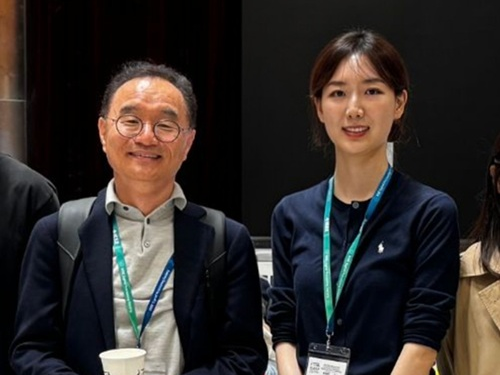 KAIST researcher Se Jin Park develops 'SpeechSSM,' opening up possibilities for a 24-hour AI voice assistant.
<(From Left)Prof. Yong Man Ro and Ph.D. candidate Sejin Park>
Se Jin Park, a researcher from Professor Yong Man Ro’s team at KAIST, has announced 'SpeechSSM', a spoken language model capable of generating long-duration speech that sounds natural and remains consistent.
An efficient processing technique based on linear sequence modeling overcomes the limitations of existing spoken language models, enabling high-quality speech generation without time constraints.
It is expected to be widely used in podcasts, audiobooks, and voice assistants due to its ability to generate natural, long-duration speech like humans.
Recently, Spoken Language Models (SLMs) have been spotlighted as next-generation technology that surpasses the limitations of text-based language models by learning human speech without text to understand and generate linguistic and non-linguistic information. However, existing models showed significant limitations in generating long-duration content required for podcasts, audiobooks, and voice assistants. Now, KAIST researcher has succeeded in overcoming these limitations by developing 'SpeechSSM,' which enables consistent and natural speech generation without time constraints.
KAIST(President Kwang Hyung Lee) announced on the 3rd of July that Ph.D. candidate Sejin Park from Professor Yong Man Ro's research team in the School of Electrical Engineering has developed 'SpeechSSM,' a spoken. a spoken language model capable of generating long-duration speech.
This research is set to be presented as an oral paper at ICML (International Conference on Machine Learning) 2025, one of the top machine learning conferences, selected among approximately 1% of all submitted papers. This not only proves outstanding research ability but also serves as an opportunity to once again demonstrate KAIST's world-leading AI research capabilities.
A major advantage of Spoken Language Models (SLMs) is their ability to directly process speech without intermediate text conversion, leveraging the unique acoustic characteristics of human speakers, allowing for the rapid generation of high-quality speech even in large-scale models.
However, existing models faced difficulties in maintaining semantic and speaker consistency for long-duration speech due to increased 'speech token resolution' and memory consumption when capturing very detailed information by breaking down speech into fine fragments.
To solve this problem, Se Jin Park developed 'SpeechSSM,' a spoken language model using a Hybrid State-Space Model, designed to efficiently process and generate long speech sequences.
This model employs a 'hybrid structure' that alternately places 'attention layers' focusing on recent information and 'recurrent layers' that remember the overall narrative flow (long-term context). This allows the story to flow smoothly without losing coherence even when generating speech for a long time. Furthermore, memory usage and computational load do not increase sharply with input length, enabling stable and efficient learning and the generation of long-duration speech.
SpeechSSM effectively processes unbounded speech sequences by dividing speech data into short, fixed units (windows), processing each unit independently, and then combining them to create long speech.
Additionally, in the speech generation phase, it uses a 'Non-Autoregressive' audio synthesis model (SoundStorm), which rapidly generates multiple parts at once instead of slowly creating one character or one word at a time, enabling the fast generation of high-quality speech.
While existing models typically evaluated short speech models of about 10 seconds, Se Jin Park created new evaluation tasks for speech generation based on their self-built benchmark dataset, 'LibriSpeech-Long,' capable of generating up to 16 minutes of speech.
Compared to PPL (Perplexity), an existing speech model evaluation metric that only indicates grammatical correctness, she proposed new evaluation metrics such as 'SC-L (semantic coherence over time)' to assess content coherence over time, and 'N-MOS-T (naturalness mean opinion score over time)' to evaluate naturalness over time, enabling more effective and precise evaluation.
Through these new evaluations, it was confirmed that speech generated by the SpeechSSM spoken language model consistently featured specific individuals mentioned in the initial prompt, and new characters and events unfolded naturally and contextually consistently, despite long-duration generation. This contrasts sharply with existing models, which tended to easily lose their topic and exhibit repetition during long-duration generation.
PhD candidate Sejin Park explained, "Existing spoken language models had limitations in long-duration generation, so our goal was to develop a spoken language model capable of generating long-duration speech for actual human use." She added, "This research achievement is expected to greatly contribute to various types of voice content creation and voice AI fields like voice assistants, by maintaining consistent content in long contexts and responding more efficiently and quickly in real time than existing methods."
This research, with Se Jin Park as the first author, was conducted in collaboration with Google DeepMind and is scheduled to be presented as an oral presentation at ICML (International Conference on Machine Learning) 2025 on July 16th.
Paper Title: Long-Form Speech Generation with Spoken Language Models
DOI: 10.48550/arXiv.2412.18603
Ph.D. candidate Se Jin Park has demonstrated outstanding research capabilities as a member of Professor Yong Man Ro's MLLM (multimodal large language model) research team, through her work integrating vision, speech, and language. Her achievements include a spotlight paper presentation at 2024 CVPR (Computer Vision and Pattern Recognition) and an Outstanding Paper Award at 2024 ACL (Association for Computational Linguistics).
For more information, you can refer to the publication and accompanying demo: SpeechSSM Publications.
2025.07.04 View 4751
KAIST researcher Se Jin Park develops 'SpeechSSM,' opening up possibilities for a 24-hour AI voice assistant.
<(From Left)Prof. Yong Man Ro and Ph.D. candidate Sejin Park>
Se Jin Park, a researcher from Professor Yong Man Ro’s team at KAIST, has announced 'SpeechSSM', a spoken language model capable of generating long-duration speech that sounds natural and remains consistent.
An efficient processing technique based on linear sequence modeling overcomes the limitations of existing spoken language models, enabling high-quality speech generation without time constraints.
It is expected to be widely used in podcasts, audiobooks, and voice assistants due to its ability to generate natural, long-duration speech like humans.
Recently, Spoken Language Models (SLMs) have been spotlighted as next-generation technology that surpasses the limitations of text-based language models by learning human speech without text to understand and generate linguistic and non-linguistic information. However, existing models showed significant limitations in generating long-duration content required for podcasts, audiobooks, and voice assistants. Now, KAIST researcher has succeeded in overcoming these limitations by developing 'SpeechSSM,' which enables consistent and natural speech generation without time constraints.
KAIST(President Kwang Hyung Lee) announced on the 3rd of July that Ph.D. candidate Sejin Park from Professor Yong Man Ro's research team in the School of Electrical Engineering has developed 'SpeechSSM,' a spoken. a spoken language model capable of generating long-duration speech.
This research is set to be presented as an oral paper at ICML (International Conference on Machine Learning) 2025, one of the top machine learning conferences, selected among approximately 1% of all submitted papers. This not only proves outstanding research ability but also serves as an opportunity to once again demonstrate KAIST's world-leading AI research capabilities.
A major advantage of Spoken Language Models (SLMs) is their ability to directly process speech without intermediate text conversion, leveraging the unique acoustic characteristics of human speakers, allowing for the rapid generation of high-quality speech even in large-scale models.
However, existing models faced difficulties in maintaining semantic and speaker consistency for long-duration speech due to increased 'speech token resolution' and memory consumption when capturing very detailed information by breaking down speech into fine fragments.
To solve this problem, Se Jin Park developed 'SpeechSSM,' a spoken language model using a Hybrid State-Space Model, designed to efficiently process and generate long speech sequences.
This model employs a 'hybrid structure' that alternately places 'attention layers' focusing on recent information and 'recurrent layers' that remember the overall narrative flow (long-term context). This allows the story to flow smoothly without losing coherence even when generating speech for a long time. Furthermore, memory usage and computational load do not increase sharply with input length, enabling stable and efficient learning and the generation of long-duration speech.
SpeechSSM effectively processes unbounded speech sequences by dividing speech data into short, fixed units (windows), processing each unit independently, and then combining them to create long speech.
Additionally, in the speech generation phase, it uses a 'Non-Autoregressive' audio synthesis model (SoundStorm), which rapidly generates multiple parts at once instead of slowly creating one character or one word at a time, enabling the fast generation of high-quality speech.
While existing models typically evaluated short speech models of about 10 seconds, Se Jin Park created new evaluation tasks for speech generation based on their self-built benchmark dataset, 'LibriSpeech-Long,' capable of generating up to 16 minutes of speech.
Compared to PPL (Perplexity), an existing speech model evaluation metric that only indicates grammatical correctness, she proposed new evaluation metrics such as 'SC-L (semantic coherence over time)' to assess content coherence over time, and 'N-MOS-T (naturalness mean opinion score over time)' to evaluate naturalness over time, enabling more effective and precise evaluation.
Through these new evaluations, it was confirmed that speech generated by the SpeechSSM spoken language model consistently featured specific individuals mentioned in the initial prompt, and new characters and events unfolded naturally and contextually consistently, despite long-duration generation. This contrasts sharply with existing models, which tended to easily lose their topic and exhibit repetition during long-duration generation.
PhD candidate Sejin Park explained, "Existing spoken language models had limitations in long-duration generation, so our goal was to develop a spoken language model capable of generating long-duration speech for actual human use." She added, "This research achievement is expected to greatly contribute to various types of voice content creation and voice AI fields like voice assistants, by maintaining consistent content in long contexts and responding more efficiently and quickly in real time than existing methods."
This research, with Se Jin Park as the first author, was conducted in collaboration with Google DeepMind and is scheduled to be presented as an oral presentation at ICML (International Conference on Machine Learning) 2025 on July 16th.
Paper Title: Long-Form Speech Generation with Spoken Language Models
DOI: 10.48550/arXiv.2412.18603
Ph.D. candidate Se Jin Park has demonstrated outstanding research capabilities as a member of Professor Yong Man Ro's MLLM (multimodal large language model) research team, through her work integrating vision, speech, and language. Her achievements include a spotlight paper presentation at 2024 CVPR (Computer Vision and Pattern Recognition) and an Outstanding Paper Award at 2024 ACL (Association for Computational Linguistics).
For more information, you can refer to the publication and accompanying demo: SpeechSSM Publications.
2025.07.04 View 4751 -
 KAIST Invites World-Renowned Scholars, Elevating Global Competitiveness
< Photo 1. (From left) Professor John Rogers, Professor Gregg Rothermel, Dr. Sang H. Choi >
KAIST announced on June 27th that it has appointed three world-renowned scholars, including Professor John A. Rogers of Northwestern University, USA, as Invited Distinguished Professors in key departments such as Materials Science and Engineering.
Professor John A. Rogers (Northwestern University, USA) will be working with the Department of Materials Science and Engineering from July 2025 to June 2028 with Professor Gregg Rothermel (North Carolina State University, USA) working with the School of Computing from August 2025 to July 2026, and Dr. Sang H. Choi (NASA Langley Research Center, USA) with the Department of Aerospace Engineering from May 2025 to April 2028.
Professor John A. Rogers, a person of global authority in the field of bio-integrated electronics, has been leading advanced convergence technologies such as flexible electronics, smart skin, and implantable sensors. His significant impact on academia and industry is evident through over 900 papers published in top-tier academic journals like Science, Nature, and Cell, and he comes in an H-index of 240*. His research group, the Rogers Research Group at Northwestern University, focuses on "Science that brings Solutions to Society," encompassing areas such as bio-integrated microsystems and unconventional nanofabrication techniques. He is the founding Director of the Querrey-Simpson Institute of Bioelectronics at Northwestern University.
* H-index 240: An H-index is a measurement used to assess the research productivity and impact of an individual authors. H-index 240 means that 240 or more papers have been cited at least 240 times each, indicating a significant impact and the presumable status as a world-class scholar.
The Department of Materials Science and Engineering plans to further enhance its research capabilities in next-generation bio-implantable materials and wearable devices and boost its global competitiveness through the invitation of Professor Rogers. In particular, it aims to create strong research synergies by linking with the development of bio-convergence interface materials, a core task of the Leading Research Center (ERC, total research budget of 13.5 billion KRW over 7 years) led by Professor Kun-Jae Lee.
Professor Gregg Rothermel, a world-renowned scholar in software engineering, was ranked second among the top 50 global researchers by Communications of the ACM. For over 30 years, he has conducted practical research to improve software reliability and quality. He has achieved influential research outcomes through collaborations with global companies such as Boeing, Microsoft, and Lockheed Martin. Dr. Rothermel's research at North Carolina State University focuses on software engineering and program analysis, with significant contributions through initiatives like the ESQuaReD Laboratory and the Software-Artifact Infrastructure Repository (SIR).
The School of Computing plans to strengthen its research capabilities in software engineering and conduct collaborative research on software design and testing to enhance the reliability and safety of AI-based software systems through the invitation of Professor Gregg Rothermel. In particular, he is expected to participate in the Big Data Edge-Cloud Service Research Center (ITRC, total research budget of 6.7 billion KRW over 8 years) led by Professor In-Young Ko of the School of Computing, and the Research on Improving Complex Mobility Safety (SafetyOps, Digital Columbus Project, total research budget of 3.5 billion KRW over 8 years), contributing to resolving uncertainties in machine learning-based AI software and advancing technology.
Dr. Sang H. Choi, a global expert in space exploration and energy harvesting, has worked at NASA Langley Research Center for over 40 years, authoring over 200 papers and reports, holding 45 patents, and receiving 71 awards from NASA. In 2022, he was inducted into the 'Inventors Hall of Fame' as part of NASA's Technology Transfer Program. This is a rare honor, recognizing researchers who have contributed to the private sector dissemination of space exploration technology, with only 35 individuals worldwide selected to date. Dr. Choi's extensive work at NASA includes research on advanced electronic and energetic materials, satellite sensors, and various nano-technologies.
Dr. Choi plans to collaborate with Associate Professor Hyun-Jung Kim (former NASA Research Scientist, 2009-2024), who joined the Department of Aerospace Engineering in September of 2024, to lead the development of core technologies for lunar exploration (energy sources, sensing, in-situ resource utilization ISRU).
KAIST President Kwang Hyung Lee stated, "It is very meaningful to be able to invite these world-class scholars. Through these appointments, KAIST will further strengthen its global competitiveness in research in the fields of advanced convergence technology such as bio-convergence electronics, AI software engineering, and space exploration, securing our position as the leader of global innovations."
2025.06.27 View 8093
KAIST Invites World-Renowned Scholars, Elevating Global Competitiveness
< Photo 1. (From left) Professor John Rogers, Professor Gregg Rothermel, Dr. Sang H. Choi >
KAIST announced on June 27th that it has appointed three world-renowned scholars, including Professor John A. Rogers of Northwestern University, USA, as Invited Distinguished Professors in key departments such as Materials Science and Engineering.
Professor John A. Rogers (Northwestern University, USA) will be working with the Department of Materials Science and Engineering from July 2025 to June 2028 with Professor Gregg Rothermel (North Carolina State University, USA) working with the School of Computing from August 2025 to July 2026, and Dr. Sang H. Choi (NASA Langley Research Center, USA) with the Department of Aerospace Engineering from May 2025 to April 2028.
Professor John A. Rogers, a person of global authority in the field of bio-integrated electronics, has been leading advanced convergence technologies such as flexible electronics, smart skin, and implantable sensors. His significant impact on academia and industry is evident through over 900 papers published in top-tier academic journals like Science, Nature, and Cell, and he comes in an H-index of 240*. His research group, the Rogers Research Group at Northwestern University, focuses on "Science that brings Solutions to Society," encompassing areas such as bio-integrated microsystems and unconventional nanofabrication techniques. He is the founding Director of the Querrey-Simpson Institute of Bioelectronics at Northwestern University.
* H-index 240: An H-index is a measurement used to assess the research productivity and impact of an individual authors. H-index 240 means that 240 or more papers have been cited at least 240 times each, indicating a significant impact and the presumable status as a world-class scholar.
The Department of Materials Science and Engineering plans to further enhance its research capabilities in next-generation bio-implantable materials and wearable devices and boost its global competitiveness through the invitation of Professor Rogers. In particular, it aims to create strong research synergies by linking with the development of bio-convergence interface materials, a core task of the Leading Research Center (ERC, total research budget of 13.5 billion KRW over 7 years) led by Professor Kun-Jae Lee.
Professor Gregg Rothermel, a world-renowned scholar in software engineering, was ranked second among the top 50 global researchers by Communications of the ACM. For over 30 years, he has conducted practical research to improve software reliability and quality. He has achieved influential research outcomes through collaborations with global companies such as Boeing, Microsoft, and Lockheed Martin. Dr. Rothermel's research at North Carolina State University focuses on software engineering and program analysis, with significant contributions through initiatives like the ESQuaReD Laboratory and the Software-Artifact Infrastructure Repository (SIR).
The School of Computing plans to strengthen its research capabilities in software engineering and conduct collaborative research on software design and testing to enhance the reliability and safety of AI-based software systems through the invitation of Professor Gregg Rothermel. In particular, he is expected to participate in the Big Data Edge-Cloud Service Research Center (ITRC, total research budget of 6.7 billion KRW over 8 years) led by Professor In-Young Ko of the School of Computing, and the Research on Improving Complex Mobility Safety (SafetyOps, Digital Columbus Project, total research budget of 3.5 billion KRW over 8 years), contributing to resolving uncertainties in machine learning-based AI software and advancing technology.
Dr. Sang H. Choi, a global expert in space exploration and energy harvesting, has worked at NASA Langley Research Center for over 40 years, authoring over 200 papers and reports, holding 45 patents, and receiving 71 awards from NASA. In 2022, he was inducted into the 'Inventors Hall of Fame' as part of NASA's Technology Transfer Program. This is a rare honor, recognizing researchers who have contributed to the private sector dissemination of space exploration technology, with only 35 individuals worldwide selected to date. Dr. Choi's extensive work at NASA includes research on advanced electronic and energetic materials, satellite sensors, and various nano-technologies.
Dr. Choi plans to collaborate with Associate Professor Hyun-Jung Kim (former NASA Research Scientist, 2009-2024), who joined the Department of Aerospace Engineering in September of 2024, to lead the development of core technologies for lunar exploration (energy sources, sensing, in-situ resource utilization ISRU).
KAIST President Kwang Hyung Lee stated, "It is very meaningful to be able to invite these world-class scholars. Through these appointments, KAIST will further strengthen its global competitiveness in research in the fields of advanced convergence technology such as bio-convergence electronics, AI software engineering, and space exploration, securing our position as the leader of global innovations."
2025.06.27 View 8093 -
 “One Experiment Is All It Takes”: KAIST Team Revolutionizes Drug Interaction Testing, Replacing 60,000 Studies
A groundbreaking new method developed by researchers at KAIST and Chungnam National University could drastically streamline drug interaction testing — replacing dozens of traditional experiments with just one.
The research, led by Professor Jae Kyoung Kim of KAIST Department of Mathematical Sciences & IBS Biomedical Mathematics Group and Professor Sang Kyum Kim of Chungnam National University's College of Pharmacy, introduces a novel analysis technique called 50-BOA, published in Nature Communications on June 5, 2025.
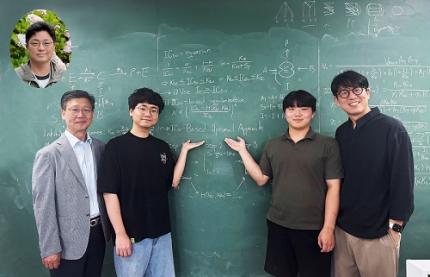
< Photo 1. (From left) Professor Sang Kyum Kim (Chungnam National University College of Pharmacy, co-corresponding author), Dr. Yun Min Song (IBS Biomedical Mathematics Group, formerly KAIST Department of Mathematical Sciences, co-first author), undergraduate student Hyeong Jun Jang (KAIST, co-first author), Professor Jae Kyoung Kim (KAIST and IBS Biomedical Mathematics Group, co-corresponding author) (Top left in the bubble) Professor Hwi-yeol Yun (Chungnam National University College of Pharmacy, co-author) >
For decades, scientists have had to repeat drug inhibition experiments across a wide range of concentrations to estimate inhibition constants — a process seen in over 60,000 scientific publications. But the KAIST-led team discovered that a single, well-chosen inhibitor concentration can yield even more accurate results.
< Figure 1. Graphical summary of 50-BOA. 50-BOA improves the accuracy and efficiency of inhibition constant estimation by using only a single inhibitor concentration instead of the traditionally used method of employing multiple inhibitor concentrations. >
“This approach challenges long-standing assumptions in experimental pharmacology,” says Prof. Kim. “It shows how mathematics can fundamentally redesign life science experiments.”
By mathematically analyzing the sources of error in conventional methods, the team found that over half the data typically collected adds no value or even skews results. Their new method not only cuts experimental effort by over 75%, but also enhances reproducibility and accuracy.
To help researchers adopt the method quickly, the team developed a user-friendly tool that takes simple Excel files as input, now freely available on GitHub:
☞ https://github.com/Mathbiomed/50-BOA
< Figure 2. The MATLAB and R package of 50-BOA at GitHub >
The work holds promise for faster and more reliable drug development, especially in assessing potential interactions in combination therapies. The U.S. FDA already emphasizes the importance of accurate enzyme inhibition assessment during early-stage drug evaluation — and this method could soon become a new gold standard.
2025.06.16 View 8812
“One Experiment Is All It Takes”: KAIST Team Revolutionizes Drug Interaction Testing, Replacing 60,000 Studies
A groundbreaking new method developed by researchers at KAIST and Chungnam National University could drastically streamline drug interaction testing — replacing dozens of traditional experiments with just one.
The research, led by Professor Jae Kyoung Kim of KAIST Department of Mathematical Sciences & IBS Biomedical Mathematics Group and Professor Sang Kyum Kim of Chungnam National University's College of Pharmacy, introduces a novel analysis technique called 50-BOA, published in Nature Communications on June 5, 2025.
< Photo 1. (From left) Professor Sang Kyum Kim (Chungnam National University College of Pharmacy, co-corresponding author), Dr. Yun Min Song (IBS Biomedical Mathematics Group, formerly KAIST Department of Mathematical Sciences, co-first author), undergraduate student Hyeong Jun Jang (KAIST, co-first author), Professor Jae Kyoung Kim (KAIST and IBS Biomedical Mathematics Group, co-corresponding author) (Top left in the bubble) Professor Hwi-yeol Yun (Chungnam National University College of Pharmacy, co-author) >
For decades, scientists have had to repeat drug inhibition experiments across a wide range of concentrations to estimate inhibition constants — a process seen in over 60,000 scientific publications. But the KAIST-led team discovered that a single, well-chosen inhibitor concentration can yield even more accurate results.
< Figure 1. Graphical summary of 50-BOA. 50-BOA improves the accuracy and efficiency of inhibition constant estimation by using only a single inhibitor concentration instead of the traditionally used method of employing multiple inhibitor concentrations. >
“This approach challenges long-standing assumptions in experimental pharmacology,” says Prof. Kim. “It shows how mathematics can fundamentally redesign life science experiments.”
By mathematically analyzing the sources of error in conventional methods, the team found that over half the data typically collected adds no value or even skews results. Their new method not only cuts experimental effort by over 75%, but also enhances reproducibility and accuracy.
To help researchers adopt the method quickly, the team developed a user-friendly tool that takes simple Excel files as input, now freely available on GitHub:
☞ https://github.com/Mathbiomed/50-BOA
< Figure 2. The MATLAB and R package of 50-BOA at GitHub >
The work holds promise for faster and more reliable drug development, especially in assessing potential interactions in combination therapies. The U.S. FDA already emphasizes the importance of accurate enzyme inhibition assessment during early-stage drug evaluation — and this method could soon become a new gold standard.
2025.06.16 View 8812 -
 KAIST Successfully Develops High-Performance Water Electrolysis Without Platinum, Bringing Hydrogen Economy Closer
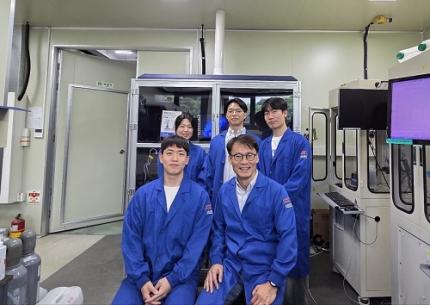
< Photo 1. (Front row, from left) Jeesoo Park (Ph.D. Candidate), Professor Hee-Tak Kim (Back row, from left) Kyunghwa Seok (Ph.D. Candidate), Dr. Gisu Doo, Euntaek Oh (Ph.D. Candidate) >
Hydrogen is gaining attention as a clean energy source that emits no carbon. Among various methods, water electrolysis, which splits water into hydrogen and oxygen using electricity, is recognized as an eco-friendly hydrogen production method. Specifically, proton exchange membrane water electrolysis (PEMWE) is considered a next-generation hydrogen production technology due to its ability to produce high-purity hydrogen at high pressure. However, existing PEMWE technology has faced limitations in commercialization due to its heavy reliance on expensive precious metal catalysts and coating materials. Korean researchers have now proposed a new solution to address these technical and economic bottlenecks.
KAIST (President Kwang Hyung Lee) announced on June 11th that a research team led by Professor Hee-Tak Kim of the Department of Chemical and Biomolecular Engineering, in a joint study with Dr. Gisu Doo of the Korea Institute of Energy Research (KIER, President Chang-keun Lee), has developed a next-generation water electrolysis technology that achieves high performance without the need for expensive platinum (Pt) coating.
The research team focused on the primary reason why 'iridium oxide (IrOx),' a highly active catalyst for water electrolysis electrodes, fails to perform optimally. They found that this is due to inefficient electron transfer and, for the first time in the world, demonstrated that performance can be maximized simply by controlling the catalyst particle size.
In this study, it was revealed that the reason iridium oxide catalysts do not exhibit excellent performance without platinum coating is due to 'electron transport resistance' that occurs at the interface between the catalyst, the ion conductor (hereinafter referred to as ionomer), and the Ti (titanium) substrate—core components inherently used together in water electrolysis electrodes.
Specifically, they identified that the 'pinch-off' phenomenon, where the electron pathway is blocked between the catalyst, ionomer, and titanium substrate, is the critical cause of reduced conductivity. The ionomer has properties close to an electron insulator, thereby hindering electron flow when it surrounds catalyst particles. Furthermore, when the ionomer comes into contact with the titanium substrate, an electron barrier forms on the surface oxide layer of the titanium substrate, significantly increasing resistance.
< Figure 1. Infographic related to electron transport resistance at the catalyst layer/diffusion layer interface >
To address this, the research team fabricated and compared catalysts of various particle sizes. Through single-cell evaluation and multiphysics simulations, they demonstrated, for the first time globally, that when iridium oxide catalyst particles with a size of 20 nanometers (nm) or larger are used, the ionomer mixed region decreases, ensuring an electron pathway and restoring conductivity.
Moreover, they successfully optimized the interfacial structure through precise design, simultaneously ensuring both reactivity and electron transport. This achievement demonstrated that the previously unavoidable trade-off between catalyst activity and conductivity can be overcome through meticulous interfacial design.
This breakthrough is expected to be a significant milestone not only for the development of high-performance catalyst materials but also for the future commercialization of proton exchange membrane water electrolysis systems that can achieve high efficiency while drastically reducing the amount of precious metals used.
Professor Hee-Tak Kim stated, "This research presents a new interface design strategy that can resolve the interfacial conductivity problem, which was a bottleneck in high-performance water electrolysis technology." He added, "By securing high performance even without expensive materials like platinum, it will be a stepping stone closer to realizing a hydrogen economy."
This research, with Jeesoo Park, a Ph.D. student from the Department of Chemical and Biomolecular Engineering at KAIST, as the first author, was published on June 7th in 'Energy & Environmental Science' (IF: 32.4, 2025), a leading international journal in the energy and environmental fields, and was recognized for its innovativeness and impact. (Paper title: On the interface electron transport problem of highly active IrOx catalysts, DOI: 10.1039/D4EE05816J).
This research was supported by the New and Renewable Energy Core Technology Development Project of the Ministry of Trade, Industry and Energy.
2025.06.11 View 9344
KAIST Successfully Develops High-Performance Water Electrolysis Without Platinum, Bringing Hydrogen Economy Closer
< Photo 1. (Front row, from left) Jeesoo Park (Ph.D. Candidate), Professor Hee-Tak Kim (Back row, from left) Kyunghwa Seok (Ph.D. Candidate), Dr. Gisu Doo, Euntaek Oh (Ph.D. Candidate) >
Hydrogen is gaining attention as a clean energy source that emits no carbon. Among various methods, water electrolysis, which splits water into hydrogen and oxygen using electricity, is recognized as an eco-friendly hydrogen production method. Specifically, proton exchange membrane water electrolysis (PEMWE) is considered a next-generation hydrogen production technology due to its ability to produce high-purity hydrogen at high pressure. However, existing PEMWE technology has faced limitations in commercialization due to its heavy reliance on expensive precious metal catalysts and coating materials. Korean researchers have now proposed a new solution to address these technical and economic bottlenecks.
KAIST (President Kwang Hyung Lee) announced on June 11th that a research team led by Professor Hee-Tak Kim of the Department of Chemical and Biomolecular Engineering, in a joint study with Dr. Gisu Doo of the Korea Institute of Energy Research (KIER, President Chang-keun Lee), has developed a next-generation water electrolysis technology that achieves high performance without the need for expensive platinum (Pt) coating.
The research team focused on the primary reason why 'iridium oxide (IrOx),' a highly active catalyst for water electrolysis electrodes, fails to perform optimally. They found that this is due to inefficient electron transfer and, for the first time in the world, demonstrated that performance can be maximized simply by controlling the catalyst particle size.
In this study, it was revealed that the reason iridium oxide catalysts do not exhibit excellent performance without platinum coating is due to 'electron transport resistance' that occurs at the interface between the catalyst, the ion conductor (hereinafter referred to as ionomer), and the Ti (titanium) substrate—core components inherently used together in water electrolysis electrodes.
Specifically, they identified that the 'pinch-off' phenomenon, where the electron pathway is blocked between the catalyst, ionomer, and titanium substrate, is the critical cause of reduced conductivity. The ionomer has properties close to an electron insulator, thereby hindering electron flow when it surrounds catalyst particles. Furthermore, when the ionomer comes into contact with the titanium substrate, an electron barrier forms on the surface oxide layer of the titanium substrate, significantly increasing resistance.
< Figure 1. Infographic related to electron transport resistance at the catalyst layer/diffusion layer interface >
To address this, the research team fabricated and compared catalysts of various particle sizes. Through single-cell evaluation and multiphysics simulations, they demonstrated, for the first time globally, that when iridium oxide catalyst particles with a size of 20 nanometers (nm) or larger are used, the ionomer mixed region decreases, ensuring an electron pathway and restoring conductivity.
Moreover, they successfully optimized the interfacial structure through precise design, simultaneously ensuring both reactivity and electron transport. This achievement demonstrated that the previously unavoidable trade-off between catalyst activity and conductivity can be overcome through meticulous interfacial design.
This breakthrough is expected to be a significant milestone not only for the development of high-performance catalyst materials but also for the future commercialization of proton exchange membrane water electrolysis systems that can achieve high efficiency while drastically reducing the amount of precious metals used.
Professor Hee-Tak Kim stated, "This research presents a new interface design strategy that can resolve the interfacial conductivity problem, which was a bottleneck in high-performance water electrolysis technology." He added, "By securing high performance even without expensive materials like platinum, it will be a stepping stone closer to realizing a hydrogen economy."
This research, with Jeesoo Park, a Ph.D. student from the Department of Chemical and Biomolecular Engineering at KAIST, as the first author, was published on June 7th in 'Energy & Environmental Science' (IF: 32.4, 2025), a leading international journal in the energy and environmental fields, and was recognized for its innovativeness and impact. (Paper title: On the interface electron transport problem of highly active IrOx catalysts, DOI: 10.1039/D4EE05816J).
This research was supported by the New and Renewable Energy Core Technology Development Project of the Ministry of Trade, Industry and Energy.
2025.06.11 View 9344 -
 A 10-Month Journey of Tiny Flaps Completed: A Special Family Returns to KAIST Duck Pond
On the morning of June 9, 2025, gentle activity stirred early around the KAIST campus duck pond. It was the day a special family of ducks—and two goslings—were to be released back into the pond after spending a month in a temporary shelter. One by one, the ducklings cautiously emerged from their box, waddling toward the water's edge and scanning their surroundings, followed closely by their mother.
< The landscape manager from the KAIST Facilities Team releases the ducks and goslings. >
The mother duck, once a rescued loner who couldn’t integrate with the flock, returned triumphantly as the head of a new family—caring for both ducklings and goslings. Students and faculty looked on quietly, welcoming them back and reflecting on their remarkable 10-month journey.
The story began in July 2024, as a student filed a report of spotting two ducklings wandering near the pond without a mother. Based on their soft down, flat beaks, and lack of fear around humans, it was presumed they had been abandoned. Professor Won Do Heo of the Department of Biological Sciences—affectionately known as the “Goose Dad”—and the KAIST Facilities Team quickly stepped in to rescue them. After about a month of care, the ducklings were released back into the pond.
< On June 9, the day of the release, KAIST President Kwang-Hyung Lee (left), the former “Goose Dad,” and Professor Won Do Heo (right), the current “Goose Dad,” watched the flock as they freely wobbled about. >
At first, the ducklings seemed to adapt, but they started distancing themselves from the established goose flock. One eventually disappeared, and the remaining duckling was found injured by the pond during winter. Although KAIST typically avoids making human interference in the natural ecosystem, an exception was made to save the young duck’s life. It was put under the care of Professor Heo and the Facilities Team to regain its health within a month.
In the spring, the healed duck began laying eggs. Professor Heo supported the process by adjusting its diet, avoiding further intervention. On Children’s Day, May 5, the duck’s eggs hatched. The once-isolated duck had become a mother. Ten days later, on May 15, four goslings also hatched from the resident goose flock. With new life flourishing, the pond was more vibrant than ever.
< Rescued baby goslings near the pond, alongside the duck family that took them in. The mother duck—once a vulnerable duckling herself—had grown strong enough to care for others in need. >
But just days later, the mother goose disappeared, and two goslings—still unable to swim—were found shivering by the pond. Dahyeon Byeon, a student from Seoul National University who came for a visit on that day, reported this upon sighting, prompting another rescue. The vulnerable goslings were brought to the shelter to stay with the duck family.
Initially, the interspecies cohabitation was uneasy. But the mother duck did not reject the goslings. Slowly, they began to eat and sleep together, forming a new kind of family. After a month, they were released together into the pond—and to everyone’s surprise, the existing goose flock accepted both the goslings and the duck family.
< A peaceful moment for the duck family. The baby goslings naturally followed the mother duck. >
It took ten months for this family to return. From abandonment and injury to healing, birth, and unexpected bonds, this was more than a story of survival. It was a journey of transformation. The duck family’s ten-month saga is a quiet miracle—written in small moments of crisis, care, and connection—and a lasting memory on the KAIST campus.
< The resident goose flock at KAIST’s pond naturally accepted the returning duck and goslings as part of their group. >
2025.06.10 View 6555
A 10-Month Journey of Tiny Flaps Completed: A Special Family Returns to KAIST Duck Pond
On the morning of June 9, 2025, gentle activity stirred early around the KAIST campus duck pond. It was the day a special family of ducks—and two goslings—were to be released back into the pond after spending a month in a temporary shelter. One by one, the ducklings cautiously emerged from their box, waddling toward the water's edge and scanning their surroundings, followed closely by their mother.
< The landscape manager from the KAIST Facilities Team releases the ducks and goslings. >
The mother duck, once a rescued loner who couldn’t integrate with the flock, returned triumphantly as the head of a new family—caring for both ducklings and goslings. Students and faculty looked on quietly, welcoming them back and reflecting on their remarkable 10-month journey.
The story began in July 2024, as a student filed a report of spotting two ducklings wandering near the pond without a mother. Based on their soft down, flat beaks, and lack of fear around humans, it was presumed they had been abandoned. Professor Won Do Heo of the Department of Biological Sciences—affectionately known as the “Goose Dad”—and the KAIST Facilities Team quickly stepped in to rescue them. After about a month of care, the ducklings were released back into the pond.
< On June 9, the day of the release, KAIST President Kwang-Hyung Lee (left), the former “Goose Dad,” and Professor Won Do Heo (right), the current “Goose Dad,” watched the flock as they freely wobbled about. >
At first, the ducklings seemed to adapt, but they started distancing themselves from the established goose flock. One eventually disappeared, and the remaining duckling was found injured by the pond during winter. Although KAIST typically avoids making human interference in the natural ecosystem, an exception was made to save the young duck’s life. It was put under the care of Professor Heo and the Facilities Team to regain its health within a month.
In the spring, the healed duck began laying eggs. Professor Heo supported the process by adjusting its diet, avoiding further intervention. On Children’s Day, May 5, the duck’s eggs hatched. The once-isolated duck had become a mother. Ten days later, on May 15, four goslings also hatched from the resident goose flock. With new life flourishing, the pond was more vibrant than ever.
< Rescued baby goslings near the pond, alongside the duck family that took them in. The mother duck—once a vulnerable duckling herself—had grown strong enough to care for others in need. >
But just days later, the mother goose disappeared, and two goslings—still unable to swim—were found shivering by the pond. Dahyeon Byeon, a student from Seoul National University who came for a visit on that day, reported this upon sighting, prompting another rescue. The vulnerable goslings were brought to the shelter to stay with the duck family.
Initially, the interspecies cohabitation was uneasy. But the mother duck did not reject the goslings. Slowly, they began to eat and sleep together, forming a new kind of family. After a month, they were released together into the pond—and to everyone’s surprise, the existing goose flock accepted both the goslings and the duck family.
< A peaceful moment for the duck family. The baby goslings naturally followed the mother duck. >
It took ten months for this family to return. From abandonment and injury to healing, birth, and unexpected bonds, this was more than a story of survival. It was a journey of transformation. The duck family’s ten-month saga is a quiet miracle—written in small moments of crisis, care, and connection—and a lasting memory on the KAIST campus.
< The resident goose flock at KAIST’s pond naturally accepted the returning duck and goslings as part of their group. >
2025.06.10 View 6555 -
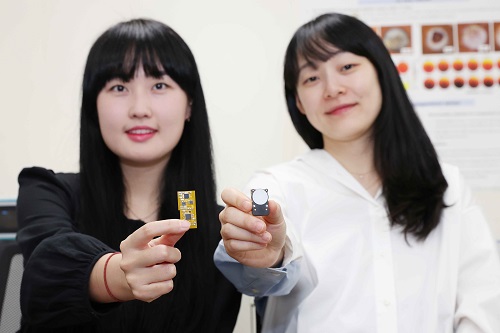 KAIST Succeeds in Real-Time Carbon Dioxide Monitoring Without Batteries or External Power
< (From left) Master's Student Gyurim Jang, Professor Kyeongha Kwon >
KAIST (President Kwang Hyung Lee) announced on June 9th that a research team led by Professor Kyeongha Kwon from the School of Electrical Engineering, in a joint study with Professor Hanjun Ryu's team at Chung-Ang University, has developed a self-powered wireless carbon dioxide (CO2) monitoring system. This innovative system harvests fine vibrational energy from its surroundings to periodically measure CO2 concentrations.
This breakthrough addresses a critical need in environmental monitoring: accurately understanding "how much" CO2 is being emitted to combat climate change and global warming. While CO2 monitoring technology is key to this, existing systems largely rely on batteries or wired power system, imposing limitations on installation and maintenance. The KAIST team tackled this by creating a self-powered wireless system that operates without external power.
The core of this new system is an "Inertia-driven Triboelectric Nanogenerator (TENG)" that converts vibrations (with amplitudes ranging from 20-4000 ㎛ and frequencies from 0-300 Hz) generated by industrial equipment or pipelines into electricity. This enables periodic CO2 concentration measurements and wireless transmission without the need for batteries.
< Figure 1. Concept and configuration of self-powered wireless CO2 monitoring system using fine vibration harvesting (a) System block diagram (b) Photo of fabricated system prototype >
The research team successfully amplified fine vibrations and induced resonance by combining spring-attached 4-stack TENGs. They achieved stable power production of 0.5 mW under conditions of 13 Hz and 0.56 g acceleration. The generated power was then used to operate a CO2 sensor and a Bluetooth Low Energy (BLE) system-on-a-chip (SoC).
Professor Kyeongha Kwon emphasized, "For efficient environmental monitoring, a system that can operate continuously without power limitations is essential." She explained, "In this research, we implemented a self-powered system that can periodically measure and wirelessly transmit CO2 concentrations based on the energy generated from an inertia-driven TENG." She added, "This technology can serve as a foundational technology for future self-powered environmental monitoring platforms integrating various sensors."
< Figure 2. TENG energy harvesting-based wireless CO2 sensing system operation results (c) Experimental setup (d) Measured CO2 concentration results powered by TENG and conventional DC power source >
This research was published on June 1st in the internationally renowned academic journal `Nano Energy (IF 16.8)`. Gyurim Jang, a master's student at KAIST, and Daniel Manaye Tiruneh, a master's student at Chung-Ang University, are the co-first authors of the paper.*Paper Title: Highly compact inertia-driven triboelectric nanogenerator for self-powered wireless CO2 monitoring via fine-vibration harvesting*DOI: 10.1016/j.nanoen.2025.110872
This research was supported by the Saudi Aramco-KAIST CO2 Management Center.
2025.06.09 View 56054
KAIST Succeeds in Real-Time Carbon Dioxide Monitoring Without Batteries or External Power
< (From left) Master's Student Gyurim Jang, Professor Kyeongha Kwon >
KAIST (President Kwang Hyung Lee) announced on June 9th that a research team led by Professor Kyeongha Kwon from the School of Electrical Engineering, in a joint study with Professor Hanjun Ryu's team at Chung-Ang University, has developed a self-powered wireless carbon dioxide (CO2) monitoring system. This innovative system harvests fine vibrational energy from its surroundings to periodically measure CO2 concentrations.
This breakthrough addresses a critical need in environmental monitoring: accurately understanding "how much" CO2 is being emitted to combat climate change and global warming. While CO2 monitoring technology is key to this, existing systems largely rely on batteries or wired power system, imposing limitations on installation and maintenance. The KAIST team tackled this by creating a self-powered wireless system that operates without external power.
The core of this new system is an "Inertia-driven Triboelectric Nanogenerator (TENG)" that converts vibrations (with amplitudes ranging from 20-4000 ㎛ and frequencies from 0-300 Hz) generated by industrial equipment or pipelines into electricity. This enables periodic CO2 concentration measurements and wireless transmission without the need for batteries.
< Figure 1. Concept and configuration of self-powered wireless CO2 monitoring system using fine vibration harvesting (a) System block diagram (b) Photo of fabricated system prototype >
The research team successfully amplified fine vibrations and induced resonance by combining spring-attached 4-stack TENGs. They achieved stable power production of 0.5 mW under conditions of 13 Hz and 0.56 g acceleration. The generated power was then used to operate a CO2 sensor and a Bluetooth Low Energy (BLE) system-on-a-chip (SoC).
Professor Kyeongha Kwon emphasized, "For efficient environmental monitoring, a system that can operate continuously without power limitations is essential." She explained, "In this research, we implemented a self-powered system that can periodically measure and wirelessly transmit CO2 concentrations based on the energy generated from an inertia-driven TENG." She added, "This technology can serve as a foundational technology for future self-powered environmental monitoring platforms integrating various sensors."
< Figure 2. TENG energy harvesting-based wireless CO2 sensing system operation results (c) Experimental setup (d) Measured CO2 concentration results powered by TENG and conventional DC power source >
This research was published on June 1st in the internationally renowned academic journal `Nano Energy (IF 16.8)`. Gyurim Jang, a master's student at KAIST, and Daniel Manaye Tiruneh, a master's student at Chung-Ang University, are the co-first authors of the paper.*Paper Title: Highly compact inertia-driven triboelectric nanogenerator for self-powered wireless CO2 monitoring via fine-vibration harvesting*DOI: 10.1016/j.nanoen.2025.110872
This research was supported by the Saudi Aramco-KAIST CO2 Management Center.
2025.06.09 View 56054 -
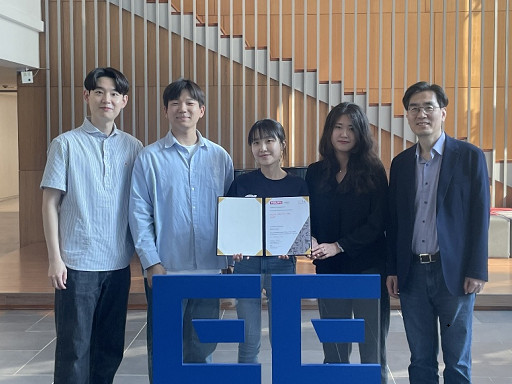 Professor Hyun Myung's Team Wins First Place in a Challenge at ICRA by IEEE
< Photo 1. (From left) Daebeom Kim (Team Leader, Ph.D. student), Seungjae Lee (Ph.D. student), Seoyeon Jang (Ph.D. student), Jei Kong (Master's student), Professor Hyun Myung >
A team of the Urban Robotics Lab, led by Professor Hyun Myung from the KAIST School of Electrical Engineering, achieved a remarkable first-place overall victory in the Nothing Stands Still Challenge (NSS Challenge) 2025, held at the 2025 IEEE International Conference on Robotics and Automation (ICRA), the world's most prestigious robotics conference, from May 19 to 23 in Atlanta, USA.
The NSS Challenge was co-hosted by HILTI, a global construction company based in Liechtenstein, and Stanford University's Gradient Spaces Group. It is an expanded version of the HILTI SLAM (Simultaneous Localization and Mapping)* Challenge, which has been held since 2021, and is considered one of the most prominent challenges at 2025 IEEE ICRA.*SLAM: Refers to Simultaneous Localization and Mapping, a technology where robots, drones, autonomous vehicles, etc., determine their own position and simultaneously create a map of their surroundings.
< Photo 2. A scene from the oral presentation on the winning team's technology (Speakers: Seungjae Lee and Seoyeon Jang, Ph.D. candidates of KAIST School of Electrical Engineering) >
This challenge primarily evaluates how accurately and robustly LiDAR scan data, collected at various times, can be registered in situations with frequent structural changes, such as construction and industrial environments. In particular, it is regarded as a highly technical competition because it deals with multi-session localization and mapping (Multi-session SLAM) technology that responds to structural changes occurring over multiple timeframes, rather than just single-point registration accuracy.
The Urban Robotics Lab team secured first place overall, surpassing National Taiwan University (3rd place) and Northwestern Polytechnical University of China (2nd place) by a significant margin, with their unique localization and mapping technology that solves the problem of registering LiDAR data collected across multiple times and spaces. The winning team will be awarded a prize of $4,000.
< Figure 1. Example of Multiway-Registration for Registering Multiple Scans >
The Urban Robotics Lab team independently developed a multiway-registration framework that can robustly register multiple scans even without prior connection information. This framework consists of an algorithm for summarizing feature points within scans and finding correspondences (CubicFeat), an algorithm for performing global registration based on the found correspondences (Quatro), and an algorithm for refining results based on change detection (Chamelion). This combination of technologies ensures stable registration performance based on fixed structures, even in highly dynamic industrial environments.
< Figure 2. Example of Change Detection Using the Chamelion Algorithm>
LiDAR scan registration technology is a core component of SLAM (Simultaneous Localization And Mapping) in various autonomous systems such as autonomous vehicles, autonomous robots, autonomous walking systems, and autonomous flying vehicles.
Professor Hyun Myung of the School of Electrical Engineering stated, "This award-winning technology is evaluated as a case that simultaneously proves both academic value and industrial applicability by maximizing the performance of precisely estimating the relative positions between different scans even in complex environments. I am grateful to the students who challenged themselves and never gave up, even when many teams abandoned due to the high difficulty."
< Figure 3. Competition Result Board, Lower RMSE (Root Mean Squared Error) Indicates Higher Score (Unit: meters)>
The Urban Robotics Lab team first participated in the SLAM Challenge in 2022, winning second place among academic teams, and in 2023, they secured first place overall in the LiDAR category and first place among academic teams in the vision category.
2025.05.30 View 13510
Professor Hyun Myung's Team Wins First Place in a Challenge at ICRA by IEEE
< Photo 1. (From left) Daebeom Kim (Team Leader, Ph.D. student), Seungjae Lee (Ph.D. student), Seoyeon Jang (Ph.D. student), Jei Kong (Master's student), Professor Hyun Myung >
A team of the Urban Robotics Lab, led by Professor Hyun Myung from the KAIST School of Electrical Engineering, achieved a remarkable first-place overall victory in the Nothing Stands Still Challenge (NSS Challenge) 2025, held at the 2025 IEEE International Conference on Robotics and Automation (ICRA), the world's most prestigious robotics conference, from May 19 to 23 in Atlanta, USA.
The NSS Challenge was co-hosted by HILTI, a global construction company based in Liechtenstein, and Stanford University's Gradient Spaces Group. It is an expanded version of the HILTI SLAM (Simultaneous Localization and Mapping)* Challenge, which has been held since 2021, and is considered one of the most prominent challenges at 2025 IEEE ICRA.*SLAM: Refers to Simultaneous Localization and Mapping, a technology where robots, drones, autonomous vehicles, etc., determine their own position and simultaneously create a map of their surroundings.
< Photo 2. A scene from the oral presentation on the winning team's technology (Speakers: Seungjae Lee and Seoyeon Jang, Ph.D. candidates of KAIST School of Electrical Engineering) >
This challenge primarily evaluates how accurately and robustly LiDAR scan data, collected at various times, can be registered in situations with frequent structural changes, such as construction and industrial environments. In particular, it is regarded as a highly technical competition because it deals with multi-session localization and mapping (Multi-session SLAM) technology that responds to structural changes occurring over multiple timeframes, rather than just single-point registration accuracy.
The Urban Robotics Lab team secured first place overall, surpassing National Taiwan University (3rd place) and Northwestern Polytechnical University of China (2nd place) by a significant margin, with their unique localization and mapping technology that solves the problem of registering LiDAR data collected across multiple times and spaces. The winning team will be awarded a prize of $4,000.
< Figure 1. Example of Multiway-Registration for Registering Multiple Scans >
The Urban Robotics Lab team independently developed a multiway-registration framework that can robustly register multiple scans even without prior connection information. This framework consists of an algorithm for summarizing feature points within scans and finding correspondences (CubicFeat), an algorithm for performing global registration based on the found correspondences (Quatro), and an algorithm for refining results based on change detection (Chamelion). This combination of technologies ensures stable registration performance based on fixed structures, even in highly dynamic industrial environments.
< Figure 2. Example of Change Detection Using the Chamelion Algorithm>
LiDAR scan registration technology is a core component of SLAM (Simultaneous Localization And Mapping) in various autonomous systems such as autonomous vehicles, autonomous robots, autonomous walking systems, and autonomous flying vehicles.
Professor Hyun Myung of the School of Electrical Engineering stated, "This award-winning technology is evaluated as a case that simultaneously proves both academic value and industrial applicability by maximizing the performance of precisely estimating the relative positions between different scans even in complex environments. I am grateful to the students who challenged themselves and never gave up, even when many teams abandoned due to the high difficulty."
< Figure 3. Competition Result Board, Lower RMSE (Root Mean Squared Error) Indicates Higher Score (Unit: meters)>
The Urban Robotics Lab team first participated in the SLAM Challenge in 2022, winning second place among academic teams, and in 2023, they secured first place overall in the LiDAR category and first place among academic teams in the vision category.
2025.05.30 View 13510