%4d%61%72%61%74%68%6f%6e
-
 KAIST’s World-First Full-Course Robot Marathon Completion Published in Nature
A quadruped robot ran 42.195 km, a distance that is not easy even for humans to complete, without replacing its battery. KAIST researchers have developed this world-first achievement into design principles for long-distance operation, published the results in Nature, and are now moving toward commercializing robots that can be used in real industrial environments.
KAIST (President Choongsik Bae) announced on the September 24 that the long-distance running technology of RAIBO2, a quadruped robot developed by a research team led by Professor Jemin Hwangbo from the Department of Mechanical Engineering, and the results of its actual marathon completion were published in the international journal Nature.
This is the first time that robotics research conducted in Korea has been published in the main journal of Nature. Even globally, it is extremely rare for robotics research to be published in Nature, making this achievement an important demonstration of both the technological capability and academic level of Korean robotics research.
RAIBO2 completed the full 42.195 km course of the Sangju Dried Persimmon Marathon held in November 2024 in 4 hours, 19 minutes, and 52 seconds without charging or replacing its battery. It was the world’s first case of a quadruped robot completing the full course of an actual marathon event.
The core significance of this paper does not lie simply in the record of a robot running 42.195 km. In the global robotics industry, competition has recently intensified over the running speeds and obstacle-negotiation capabilities of quadruped robots and humanoids. However, to operate robots for long periods in real industrial environments, it is necessary to secure not only momentary locomotion performance but also energy efficiency, thermal management, battery performance, and actuator stability.
The research team approached long-distance operation not as a performance issue involving individual components such as batteries or motors, but as a “whole-robot system problem” in which mechanical structure, electrical systems, and locomotion control are closely interconnected.
Quadruped robots lose energy in multiple areas – including actuators, electrical systems, and mechanical components – as they repeatedly move their legs. Improving the efficiency of only one component makes it difficult to achieve both fast and stable locomotion performance and long travel distances at the same time.
The research team systematically analyzed energy losses throughout the entire robot and jointly designed the mechanical, electrical, actuation, and control systems so that energy consumption could be reduced while maintaining high locomotion performance. Through this approach, the researchers presented specific design principles for which factors must be considered together to enable quadruped robots to move stably for extended periods.
In particular, the research team went beyond short-distance laboratory running tests or maximum travel distances estimated through calculations and validated the technology on an actual full marathon course.
During the marathon, the team recorded the robot’s internal voltage, current, temperature, and battery status in real time and synchronized the data with position, speed, and altitude information measured by GPS. RAIBO2 was officially registered as a participant, allowing formal split times to be recorded, while the researchers ran alongside the robot and filmed the entire journey, lasting more than four hours from the starting line to the finish.
While the 42.195 km completion record demonstrated RAIBO2’s performance, the data accumulated throughout the process provided scientific evidence showing how that performance was made possible and how it was maintained in a real-world environment. The research team developed a single impressive demonstration into research results based on system design principles and actual measurement data that can be analyzed and revalidated.
The research team’s next challenge is to transfer the performance achieved with a single research robot into a product that can be used repeatedly in industrial environments.
RAIBO2 is a research robot that was designed and built by hand by the researchers themselves. To develop it into a product that can be deployed in real industrial environments, the same performance must be achieved reliably across multiple robots while also reducing production costs. The product must also meet industrial reliability requirements, including water and dust resistance, operation across a wide temperature range, durability against shock and vibration, and electromagnetic interference and compatibility requirements (EMI/EMC).
Raion Robotics, a KAIST faculty startup that originated from Professor Hwang’s laboratory, is responsible for connecting the research results to actual products. During the development of RAIBO2, Raion Robotics’ manufacturing technology also contributed to maintaining the high energy efficiency and locomotion performance achieved in the laboratory for more than four hours during the actual marathon.
The research team and Raion Robotics developed not only the mechanical and electrical systems, software, and artificial intelligence but also the motor drivers that precisely control the robot’s motors, allowing them to optimize the entire system.
Currently, Raion Robotics is using this systems-design capability to develop commercialization and mass-production technologies for quadruped robots that can operate for extended periods in real environments, going beyond research prototypes. The goal is to reproduce the world-class performance demonstrated by a single laboratory robot across multiple products and enable stable operation in a wide variety of environments.
Professor Jemin Hwang said, “This study goes beyond demonstrating how far a quadruped robot can run. Using actual marathon data, we demonstrated how the entire robot must be designed to achieve both high locomotion performance and energy efficiency,” adding, “We will connect the world-class performance achieved in the laboratory to products that anyone can use reliably in industrial environments.”
Dr. Choongin Lee and students Donghoon Youm and Jeongsoo Park of the KAIST Department of Mechanical Engineering participated in the study as co-first authors, and the research results were published in the international journal Nature on September 23 (local time).
Paper title: A quadruped robot designed to complete a marathon on a single battery charge, DOI: 10.1038/s41586-026-11102-5
Related photos and videos:
Comprehensive photo/video collection on Google Drive: https://drive.google.com/drive/folders/1ye82tTr2dCK2Bt7Ih0hSgWqkgqlVXk6X?usp=sharing
Full video of the marathon completion on YouTube: https://www.youtube.com/watch?v=-HMFoa3g9nA
The entire process of RAIBO2 completing the marathon can be viewed in the YouTube video.
2026.09.28 View 4240
-
 KAIST’s RAIBO2 becomes the World’s First Robo-dog to Successfully Complete a Full-course Marathon
KAIST's quadrupedal walking robot "RAIBO", which can run seamlessly on sandy beaches, has now evolved into "RAIBO2"and achieved the groundbreaking milestone by becomeing the world's first quadrupedal robot to successfully complete a full-course marathon in an official event.
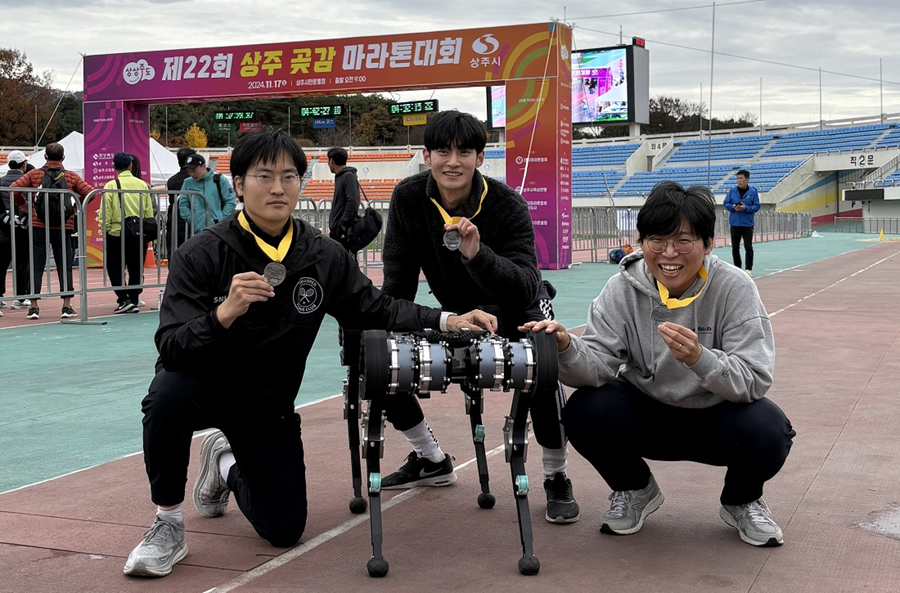
< Photo 1. A group photo of RAIBO2 and the team after completing the full-course marathon >
KAIST (President Kwang Hyung Lee) announced on the 17th of November that Professor Je Min Hwangbo's research team of the Department of Mechanical Engineering participated in the 22nd Sangju Dried-Persimmon Marathon and completed the full-course race (42.195 km) with a time of 4 hours 19 minutes and 52 seconds.
< Photo 2. RAIBO2 after completing the full-course marathon with its official record presented on the photo wall >
The Sangju Dried Persimmon Marathon is known for its challenging course featuring two 50 m elevation climbs, each at the 14 km and 28 km marks, making it defficult for amateur runners. This made it an especially demanding challenge for the walking robot, as unexpected losses in efficiency could occur.
< Photo 3. RAIBO2 with the completion medal around its neck >
To prepare RAIBO2, Professor Hwangbo's team developed a walking controller using reinforcement learning algorithms within their proprietary simulation environment "RaiSim". This simulator allowed the team to simlate diverse terrains such as slopes, stairs, and icy roads to ensure stable walking performance.
In particular, RAIBO2's high torque transparency joint mechanism enable the robot to efficiently harvest energy on the downhill slopes to regain some of the energy used in climbing up steep hill.
In addition, the stability of the robot was greatly improved through the collaboration with RAION ROBOTICS Inc., a company founded by the researchers from Professor Hwangbo’s lab.
< Figure 1. Conceptual diagram of power flow employed by the quadrupedal robot >
< Figure 2. The process of leg posture change of RAIBO2 walking at the most efficient walking speed of 3 m/s. By reducing the ground contact speed of the feet, the collision energy loss was reduced, and by minimizing the slipperiness of the foot upon contact, the body's kinetic energy was maintained towards the direction of the movement. >
Due to the nature of walking, pedal robots must employ highly complex systems that can withstand periodic vibrations from the frequent impacts that occur upon contact with the ground surface. Immediately after development, high efficiency was already recorded in short-distance experiments in the laboratory at the beginning of the year, but the manufacturing technology of RAION ROBOTICS significantly bolstered RAIBO's performance in running safely for a prolonged time of more than 4 hours among random pack of people in an actual marathon.
Compared to previous studies on improving walking efficiency, where external parts or software could not be changed and only limited improvements were made in some areas, Professor Hwangbo’s research team cited the fact that they were able to comprehensively solve problems by developing all steps and parts in-house, including mechanism design, electrical design, software, and artificial intelligence, as a key factor in improving efficiency.
Following the development of RAIBO1, the research team developed RAIBO2 and optimized all aspects of the robot. In particular, the team integrated the motor driver circuitry directly into the robot to minimize actuator losses and increase the control bandwidth, greatly improving walking efficiency and stability.
< Photo 4. RAIBO2 running the full-course marathon along human participants >
Choongin Lee, a Ph.D. Student that co-first author of the studies on RAIBO, said, “Through the marathon project, we demonstrated that RAIBO2 has the walking performance to stably execute services such as delivery and patrol in urban environments with many people and random objects,” and “In follow-up research, we will add autonomous navigation functions to RAIBO and strive to achieve the world’s best walking performance in mountainous and disaster environments.”
< Photo 5. RAIBO2 and co-first authors of the related research at the Ph.D. program of the Department of Mechanical Engineering at KAIST. (From left) Choongin Lee, Donghoon Youm, and Jeongsoo Park >
This research was conducted with the support of Samsung Electronics Future Technology Promotion Center and RAION ROBOTICS Inc.
2024.11.17 View 24178
-
 KAIST’s Beach-Roaming Quadrupedal Robot “RAIBO” to Run a Marathon!
“RAIBO”, KAIST’s four-legged robot featuring remarkable agility even on challenging terrains like sandy beaches, is now set to be the first in the world to complete a full marathon.
< Photo 1. A group photo of the research team of Professor Je Min Hwangbo (second from the right in the front row) of the Department of Mechanical Engineering who participated in the marathon event at 2024 Geumsan Insam Festival last September >
On the 17th of November, KAIST (represented by President Kwang Hyung Lee) announced that Professor Je Min Hwangbo’s team from the Department of Mechanical Engineering has developed an upgraded version, “RAIBO2,” which will take on the full 42.195-kilometer course at the "Sangju Dried-Persimmon Marathon".
This is over double the previous maximum distance achieved by quadruped robots, which was limited to around 20 kilometers. The KAIST team has successfully developed a robot that can walk continuously for 43 kilometers on a single charge, completing the course in 4 hours and 40 minutes by following a GPS-guided path on the university’s main athletic field. Through this marathon, the team aims to demonstrate RAIBO2’s walking performance in an actual urban environment.
Previously, most measurements of walking robots’ travel distances were confined to controlled laboratory conditions or theoretical data. This marathon challenge is thus significant in that the robot will run alongside the general public in a real urban setting, marking the first attempt to validate the practical potential of four-legged robots in real environments.
Quadruped robots have shown advantages in challenging terrains, such as ice, sand, and mountainous areas, where they can walk stably. However, limited travel distance and running time have long been obstacles to wider applications.
< Figure 1. Conceptual diagram of power flow employed by the quadruped robot >
Professor Hwangbo’s team designed every component of the robot, from its actuators to its mechanical structure, to overcome these limitations. Notably, they implemented an efficient walking control system based on reinforcement learning using their proprietary dynamic simulator “RaiSim”.
The team also collected and analyzed walking data from outdoor environments, creating a model to address walking losses. This model was then used to iteratively improve walking efficiency over one full year.
< Figure 2. The leg posture change process of RAIBO2 walking at the most efficient walking speed of 3 m/s. By reducing the ground contact speed of the feet, the collision energy loss was reduced, and by minimizing the slipperiness of the foot upon contact, the body's kinetic energy was maintained towards the direction of the movement. >
This is the team’s second attempt. Their first was during the marathon event at “Geumsan Insam Festival” in September when the robot’s battery ran out at the 37-kilometer mark, falling short of completion. The battery drained 10 kilometers earlier than expected due to frequent speed changes as the robot adjusted to the pacing of other runners on the course.
Following the initial attempt, the team focused on technical improvements for a successful finish. They enhanced control efficiency by implementing joint stiffness control directly onto the motor actuator and increased battery capacity by 33% by refining the internal structure. These improvements enabled the robot to cover a maximum distance of 67 kilometers on straight paths.
< Figure 3. Data from completing 43 km on a single charge at the main sports field on campus. Left) GPS data of the driving course used during autonomous running. Middle) Covered distance by the hour. Right) Energy consumption by module >
Choongin Lee, a Ph.D. student of RAI Lab who is one of the co-first author of this study, explained, “Our comprehensive analysis of walking losses in terms of mechanics, electrical systems, and walking methods was crucial to improving walking efficiency. This research marks an important milestone in extending the operating range of quadruped robots to urban environments.”
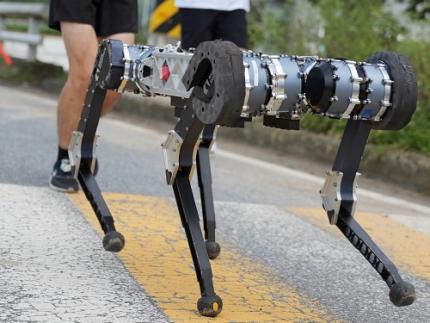
< Photo 2. A Photo from Practice Run>
This research was supported by the Samsung Electronics Future Technology Development Center and RAION ROBOTICS Co., Ltd.
< Photo 3. A Photo from Practice Run >
2024.11.15 View 18169