%4d%69%63%72%6f%6e%65%65%64%6c%65
-
 KAIST and KIOM Develop a Wearable Microneedle Electroceutical for Personalized Pain Management
A "wearable electroceutical" has been developed that could reduce the need to visit a hospital or rely on painkillers every time pain occurs. When attached to the skin, it modulates pain through electrical stimulation and can be remotely controlled via smartphone even across long distances, such as between Korea and the United States.
KAIST (President Choongsik Bae) announced on September 13 that a joint research team led by Professor Jae-Woong Jeong from the School of Electrical Engineering at KAIST and Dr. Sanghun Lee from the KIOM (Korea Institute of Oriental Medicine, President Sung-Kyu Kho) has developed a wearable electroceutical platform that combines a wireless microneedle (fine needles that adhere to the skin) electroceutical with Internet of Things (IoT)-based remote control technology.
The key feature of this research is that a single small skin-attached device integrates stable electrical stimulation, smartphone-based remote control, and automatic stimulation based on the body's physiological state. Once its efficacy and safety are validated with actual patients, the technology may be used for personalized pain management at home or in daily life.
The need for such an approach is particularly relevant for chronic pain management. Painkillers are widely used to treat chronic pain, but long-term medication use raises concerns about side effects and dependency. In particular, opioid analgesics used for conditions such as cancer pain carry an increasing risk of tolerance and misuse with prolonged use, which has spurred research into "electroceuticals", devices that modulate nerves through electrical stimulation as an alternative to drugs.
However, existing electroceuticals have limitations. Implantable devices require surgery, and skin-attached electrodes may fail to deliver electrical current properly depending on skin conditions such as sweat or dead skin cells. A concentrated current at specific sites can also raise skin temperature or pose a risk of burns.
To address these issues, the research team developed a temperature-responsive, conductive, and adhesive microneedle electrode (a fine needle electrode that conducts electricity well while adhering to the skin).
Because the microneedles penetrate the highly resistive stratum corneum, the device can deliver stable electrical stimulation while reducing the influence of sweat and dead skin cells. The team also coated the electrode with a conductive hydrogel (a gel-like material that retains a large amount of water) so that current spreads evenly rather than concentrating at the needle tips.
In addition to improving electrical performance, the electrode was designed with a built-in thermal safety mechanism. When skin temperature rises abnormally, the electrode's adhesion weakens and it detaches from the skin on its own, helping reduce the risk of skin burns that could occur during electrical stimulation.
Beyond the skin interface itself, the research team integrated the device with IoT-based remote management. Using a smartphone and cloud server, a healthcare provider can control the device's operating time and electrical stimulation in real time or on a scheduled basis, even when located far from the patient. The team confirmed that the device could be remotely controlled even across long international distances, such as between Korea and the United States.
Following future clinical validation, this could develop into a home-based or remote pain management approach in which patients use the electroceutical under medical supervision without needing to visit a hospital.
The platform further extends beyond remote control by enabling automatic operation based on the body's physiological state. Using a photoplethysmography (PPG) sensor (a technology that measures pulse and blood flow changes using light), the team detected pain-related stress states and, based on this, implemented a closed-loop (a method that automatically adjusts treatment while continuously checking the body's condition) therapy function that automatically triggers electrical stimulation.
The researchers evaluated the performance of the platform in both animal experiments and a small-scale human study. In animal experiments, current was delivered more effectively than with conventional gel electrodes, and pain-relieving effects were also confirmed. In a small-scale study involving healthy adults, changes in skin sensory pain thresholds (the level of stimulation at which pain begins to be felt) following electrical stimulation were observed to assess the potential for application in humans.
However, direct analgesic effects in this study were confirmed only through animal experiments. The research team noted that further clinical studies are needed to confirm therapeutic efficacy and the safety of long-term use in actual chronic pain patients.
Professor Jae-Woong Jeong from the KAIST School of Electrical Engineering said, "By combining a stable skin interface with IoT-based remote management, we have expanded the potential for wearable electroceuticals in daily life. We hope that, following future clinical validation, this approach can evolve into a personalized digital healthcare platform that enables pain management tailored to each patient's condition."
Dr. Sanghun Lee from the KIOM said, "We hope this research will be integrated with future wearable acupuncture technologies to contribute to the development of a new non-pharmacological pain management approach that stimulates acupoints through electrical stimulation."
The study, co-first-authored by Heesoo Kim, a PhD student at KAIST, and Dr. Se Kyun Bang from the KIOM, was published in the international journal Nature Communications on August 28th.
Paper title: Wireless IoT-Enabled Microneedle Electroceutical for Personalized and Connected Pain Management, DOI: 10.1038/s41467-026-76527-y
Author information: Heesoo Kim (KAIST, co-first author), Se Kyun Bang (KIOM/UST, co-first author), Sanghun Lee (KIOM, co-corresponding author), Jae-Woong Jeong (KAIST, corresponding author), and 10 others
Demonstration video: https://www.dropbox.com/scl/fo/zrglys1t1c49l5u1xo08e/AJsbboH3sQMFag-6aO6sSSs?rlkey=dnux0jj80bdczws22u0dq7ugx&e=1&dl=0
This work was supported by the National Research Foundation of Korea (RS-2022-NR067853, RS-2025-02218624, RS-2024-00335066), and by the Korea Institute of Oriental Medicine (KSN2511012 and KSN2511013).
2026.09.14 View 3216
-
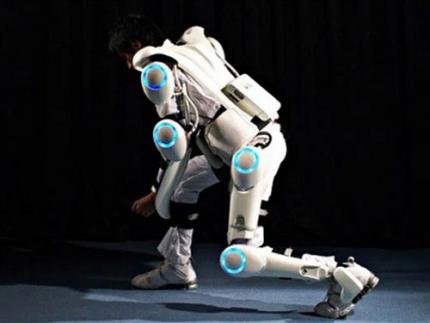 KAIST Research Team Develops Sweat-Resistant Wearable Robot Sensor
New electromyography (EMG) sensor technology that allows the long-term stable control of wearable robots and is not affected by the wearer’s sweat and dead skin has gained attention recently. Wearable robots are devices used across a variety of rehabilitation treatments for the elderly and patients recovering from stroke or trauma.
A joint research team led by Professor Jae-Woong Jung from the KAIST School of Electrical Engineering (EE) and Professor Jung Kim from the KAIST Department of Mechanical Engineering (ME) announced on January 23rd that they have successfully developed a stretchable and adhesive microneedle sensor that can electrically sense physiological signals at a high level without being affected by the state of the user’s skin.
For wearable robots to recognize the intentions behind human movement for their use in rehabilitation treatment, they require a wearable electrophysiological sensor that gives precise EMG measurements. However, existing sensors often show deteriorating signal quality over time and are greatly affected by the user’s skin conditions. Furthermore, the sensor’s higher mechanical hardness causes noise since the contact surface is unable to keep up with the deformation of the skin. These shortcomings limit the reliable, long-term control of wearable robots.
< Figure 1. Design and working concept of the Stretchable microNeedle Adhesive Patch (SNAP). (A) Schematic illustration showing the overall system configuration and application of SNAP. (B) Exploded view schematic diagram of a SNAP, consisting of stretchable serpentine interconnects, Au-coated Si microneedle, and ECA made of Ag flakes–silicone composite. (C) Optical images showing high mechanical compliance of SNAP. >
However, the recently developed technology is expected to allow long-term and high-quality EMG measurements as it uses a stretchable and adhesive conducting substrate integrated with microneedle arrays that can easily penetrate the stratum corneum without causing discomfort. Through its excellent performance, the sensor is anticipated to be able to stably control wearable robots over a long period of time regardless of the wearer’s changing skin conditions and without the need for a preparation step that removes sweat and dead cells from the surface of their skin.
The research team created a stretchable and adhesive microneedle sensor by integrating microneedles into a soft silicon polymer substrate. The hard microneedles penetrate through the stratum corneum, which has high electrical resistance. As a result, the sensor can effectively lower contact resistance with the skin and obtain high-quality electrophysiological signals regardless of contamination. At the same time, the soft and adhesive conducting substrate can adapt to the skin’s surface that stretches with the wearer’s movement, providing a comfortable fit and minimizing noise caused by movement.
< Figure 2. Demonstration of the wireless Stretchable microNeedle Adhesive Patch (SNAP) system as an Human-machine interfaces (HMI) for closed-loop control of an exoskeleton robot. (A) Illustration depicting the system architecture and control strategy of an exoskeleton robot. (B) The hardware configuration of the pneumatic back support exoskeleton system. (C) Comparison of root mean square (RMS) of electromyography (EMG) with and without robotic assistance of pretreated skin and non-pretreated skin. >
To verify the usability of the new patch, the research team conducted a motion assistance experiment using a wearable robot. They attached the microneedle patch on a user’s leg, where it could sense the electrical signals generated by the muscle. The sensor then sent the detected intention to a wearable robot, allowing the robot to help the wearer lift a heavy object more easily.
Professor Jae-Woong Jung, who led the research, said, “The developed stretchable and adhesive microneedle sensor can stability detect EMG signals without being affected by the state of a user’s skin. Through this, we will be able to control wearable robots with higher precision and stability, which will help the rehabilitation of patients who use robots.”
The results of this research, written by co-first authors Heesoo Kim and Juhyun Lee, who are both Ph.D. candidates in the KAIST School of EE, were published in Science Advances on January 17th under the title “Skin-preparation-free, stretchable microneedle adhesive patches for reliable electrophysiological sensing and exoskeleton robot control”.
This research was supported by the Bio-signal Sensor Integrated Technology Development Project by the National Research Foundation of Korea, the Electronic Medicinal Technology Development Project, and the Step 4 BK21 Project.
2024.01.30 View 19194