KAIST Develops AI to Detect ‘Foreign-Linked Opinion Manipulation’ in 110 Million News Comments
During election seasons or major national issues, online news comment sections often become heated spaces of conflict across gender, generation, and political lines. For years, there have been persistent concerns that behind some of these conflicts may lie “foreign winds,” or interventions by foreign actors seeking to manipulate public opinion and deepen social divisions. A KAIST research team has now developed a technology that uses big data on two decades worth of news comments and artificial intelligence (AI) to precisely detect traces of such hidden influence operations.
KAIST (President Choongsik Bae) announced on the 12th of August that a joint research team led by Professor Wonjae Lee of the Graduate School of Culture Technology, Professor Meeyoung Cha of the School of Computing (Scientific director at Max Planck Institute for Security and Privacy) and Professor Alice Oh of the School of Computing, in collaboration with Professor Thorsten Holz of the Max Planck Institute, has developed an explainable AI technology that automatically detects patterns suspected of foreign-linked influence operations in online news comments and provides specific evidence for its judgments.
The organized and repeated posting of comments or content by certain actors to shape public opinion in a desired direction is known as an “online influence operation.” Existing AI-based detection technologies have had a key limitation: even when they classify certain accounts as belonging to a “blacklist,” they often fail to provide clear evidence explaining why those accounts should be considered influence-operation accounts.
To overcome this limitation, the research team used 70 foreign-linked accounts previously identified by the Institute for National Security Strategy as starting points. They then tracked groups of accounts connected to them or repeatedly commenting on the same news articles, ultimately collecting and analyzing a large-scale dataset of 110 million comments posted on Naver News over a 20-year period from 2006 to 2025.
In particular, the AI developed by the research team examines accounts through a careful three-step process. First, it checks whether there are clues suggesting that the author may be linked to a foreign source. Second, it examines whether the comment contains emotionally polarizing expressions, such as moral condemnation or blind praise. Third, it identifies which country or target the emotional framing is directed toward.
The model does not stop at simply labeling an account as suspicious. It also highlights the specific phrases in the comments that served as the basis for its judgment. The team further combined this with multidimensional behavioral-pattern analysis, including account activity frequency, account lifespan, and activity links with other suspected accounts. As a result, among approximately 4 million Naver News users, the model ultimately identified 23,998 accounts exhibiting patterns consistent with suspected public-opinion manipulation.
The analysis also revealed the more subtle strategy of these suspected accounts. Their main target was not the victory of a particular political camp, but rather the maximization of division and confrontation within Korean society.
Among the top 10 targets that drew the highest public engagement, measured through likes and other reactions, seven were prominent domestic political figures. Notably, the attacks were not concentrated on a single party or ideology. Former and current presidents, presidential candidates, and political parties from both progressive and conservative camps were targeted across the spectrum. According to the research team, this suggests a sophisticated strategy aimed not so much at supporting a particular group, but at inflaming domestic political conflict and increasing social distrust and polarization.
This study is significant because it provides data-based evidence for influence-operation activity that had previously been discussed largely in terms of suspicion, while also offering a potential defense mechanism for protecting healthy online public discourse. In the future, portal platforms and related organizations could use this technology during elections or national crises to monitor the influx of suspicious accounts in real time and prioritize the review of coordinated attacks against domestic political figures. However, the research team emphasized that the AI should not be used to block accounts indiscriminately, but rather as an explainable content-moderation tool that supports the judgment of expert reviewers.
Professor Wonjae Lee said, “By analyzing 20 years of data, we found that suspected accounts tended to use messages criticizing Korea and domestic political figures rather than directly praising foreign countries, and that these messages gained higher visibility,” adding, “This research can provide empirical criteria for when and which messages platforms and monitoring organizations should prioritize for review, especially during socially sensitive periods such as elections.”
Professor Alice Oh said, “This is a meaningful achievement in which AI precisely identified not only the surface meaning of words in massive comment datasets, but also subtle emotional patterns and organized behavioral signals intended to provoke conflict,” adding, “It can become a powerful defense system against online influence operations, which are becoming increasingly sophisticated.”
Professor Meeyoung Cha said, “This study goes beyond simple blacklist-account analysis and represents the outcome of actionable data science that addresses real-world problems and drives practical change,” adding, “In an online environment where social conflict is deepening, we hope this technology will serve as a practical tool for protecting the transparency and trustworthiness of the digital public sphere.”
This research was led by KAIST Ph.D. candidate Jaehong Kim and master’s student Hyeonseung Kim as co-first authors. The paper is scheduled to be presented at the USENIX Security Symposium 2026, one of the most prestigious conferences in the field of computer security.
Paper title: Cross-National Information Attacks: A Two-Decade Analysis of Troll Behavior in Korea,
DOI: 10.48550/arXiv.2606.22785
This research was supported by the Hyundai Motor Chung Mong-Koo Foundation, the Institute of Information & Communications Technology Planning & Evaluation, and the National Research Foundation of Korea, funded by the Ministry of Science and ICT.
“Cross-Generation Collaborative Labs” for Semiconductor, Chemistry, and Computer Science Opened
< Photo of Professor Hoi-Jun Yoo (center) of the School of Electrical Engineering at the signboard unveiling ceremony >
KAIST held a ceremony to mark the opening of three additional ‘Cross-Generation Collaborative Labs’ on the morning of January 7th, 2025.
The “Next-Generation AI Semiconductor System Lab” by Professor Hoi-Jun Yoo of the School of Electrical Engineering, the “Molecular Spectroscopy and Chemical Dynamics Lab” by Professor Sang Kyu Kim of the Department of Chemistry, and the “Advanced Data Computing Lab” by Professor Sue Bok Moon of the School of Computer Science are the three new labs given the honored titled of the “Cross-Generation Collaborative Lab”.
The Cross-Generation Collaborative Lab is KAIST’s unique system that was set up to facilitate the collaboration between retiring professors and junior professors to continue the achievements and know-how the elders have accumulated over their academic career. Since its introduction in 2018, nine labs have been named to be the Cross-Generation Labs, and this year’s new addition brings the total up to twelve.
The ‘Next-Generation AI Semiconductor System Lab’ led by Professor Hoi-Jun Yoo will be operated by Professor Joo-Young Kim of the same school.
Professor Hoi-Jun Yoo is a world-renowned scholar with outstanding research achievements in the field of on-device AI semiconductor design. Professor Joo-Young Kim is an up-and-coming researcher studying large language models and design of AI semiconductors for server computers, and is currently researching technologies to design PIM (Processing-in-Memory), a core technology in the field of AI semiconductors.
Their research goal is to systematically collaborate and transfer next-generation AI semiconductor design technology, including brain-mimicking AI algorithms such as deep neural networks and generative AI, to integrate core technologies, and to maximize the usability of R&D outputs, thereby further solidifying the position of Korean AI semiconductor companies in the global market.
Professor Hoi-Jun Yoo said, “I believe that, we will be able to present a development direction of for the next-generation AI semiconductors industries at home and abroad through collaborative research and play a key role in transferring and expanding global leadership.”
< Professor Sang Kyu Kim of the Department of Chemistry (middle), at the signboard unveiling ceremony for his laboratory >
The “Molecular Spectroscopy and Chemical Dynamics Laboratory”, where Professor Sang Kyu Kim of the Department of Chemistry is in charge, will be operated by Professor Tae Kyu Kim of the same department, and another professor in the field of spectroscopy and dynamics will join in the future.
Professor Sang Kyu Kim has secured technologies for developing unique experimental equipment based on ultrashort lasers and supersonic molecular beams, and is a world leader who has been creatively pioneering new fields of experimental physical chemistry.
The research goal is to describe chemical reactions and verify from a quantum mechanical perspective and introduce new theories and technologies to pursue a complete understanding of the principles of chemical reactions. In addition, the accompanying basic scientific knowledge will be applied to the design of new materials.
Professor Sang Kyu Kim said, “I am very happy to be able to pass on the research infrastructure to the next generation through this system, and I will continue to nurture it to grow into a world-class research lab through trans-generational collaborative research.”
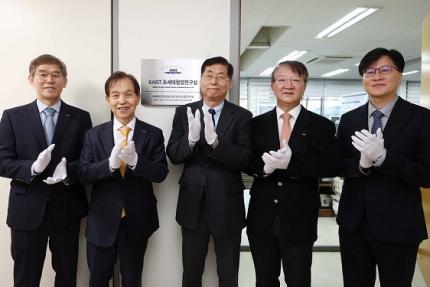
< Photo of Professor Sue Bok Moon (center) at the signboard unveiling ceremony by the School of Computing >
Lastly, the “Advanced Data Computing Lab” led by Professor Sue Bok Moon is joined by Professor Mee Young Cha of the same school and Professor Wonjae Lee of the Graduate School of Culture Technology.
Professor Sue Bok Moon showed the infinite possibilities of large-scale data-based social network research through Cyworld, YouTube, and Twitter, and had a great influence on related fields beyond the field of computer science.
Professor Mee Young Cha is a data scientist who analyzes difficult social issues such as misinformation, poverty, and disaster detection using big data-based AI. She is the first Korean to be recognized for her achievements as the director of the Max Planck Institute in Germany, a world-class basic science research institute. Therefore, there is high expectation for synergy effects from overseas collaborative research and technology transfer and sharing among the participating professors of the collaborative research lab. Professor Wonjae Lee is researching dynamic interaction analysis between science and technology using structural topic models.
They plan to conduct research aimed at improving the analysis and understanding of negative influences occurring online, and in particular, developing a hateful precursor detection model using emotions and morality to preemptively block hateful expressions.
Professor Sue Bok Moon said, “Through this collaborative research lab, we will play a key role in conducting in-depth collaborative research on unexpected negative influences in the AI era so that we can have a high level of competitiveness worldwide.”
The ceremonies for the unveiling of the new Cross-Generation Collaborative Lab signboard were held in front of each lab from 10:00 AM on the 7th, in the attendance of President Kwang Hyung Lee, Senior Vice President for Research Sang Yup Lee, and other key officials of KAIST and the new staff members to join the laboratories.