achievements
-
 2018 KAIST Research Day Honors Outstanding Research Achievements
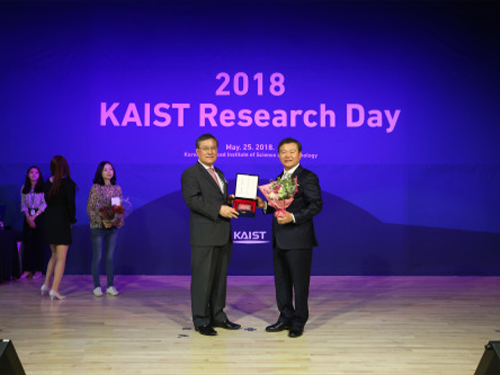
(KAIST President Sung-Chul Shin and Professor Jong-Hwan Kim) Professor Jong-Hwan Kim from the School of Electrical Engineering was recognized at the 2018 KAIST Research Day as the Research Grand Prize Awardee. The ten most distinguished research achievements of the past year were also recognized.
The Research Grand Prize recognizes the professor whose comprehensive research performance evaluation indicator was the highest over the past five years. The indicator combines the number of research contracts, IPR and royalty income.
During the May 25th ceremony, Professor Hyochoong Bang from the Department of Aerospace Engineering and Professor In so Kweon from the School of Electrical Engineering also won the Best Research Award prize.
This year, the Research Innovation Award went to Professor Dong Soo Han from the School of Computing. The Research Innovation Award combines scores in the categories of foreign patent registrations, contracts of technological transfer, and income from technology fees, technology consultations, and startups.
The Convergence Research Award was given to Professor Junmo Kim from the School of Electrical Engineering and Professor Hyun Myung from the Department of Civil & Environmental Engineering. The Convergence Research Award recognizes the most outstanding research team that created innovative research results over a one-year period.
President Sung-Chul Shin said, “KAIST has selected the ten most outstanding research achievements of 2017 conducted by our faculty and researchers. All of them demonstrated exceptional creativity, which opens new research paths in each field though their novelty, innovation, and impact.”
KAIST hosts Research Day every year to introduce major research performances at KAIST and share knowledge about the research and development.
During Research Day, KAIST also announced the ten most distinguished research achievements contributed by KAIST professors during the previous year. They are listed below.
▲ High-Speed Motion Core Technology for Magnetic Memory by Professor Kab-Jin Kim from the Department of Physics
▲ A Double Well Potential System by Professor Jaeyoung Byeon from the Department of Mathematical Sciences
▲ Cheap and Efficient Dehydrogenation of Alkanes by Professor Mu-Hyun Baik from the Department of Chemistry
▲ A Dynamic LPS Transfer Mechanism for Innate Immune Activation by Professor Ho Min Kim from the Graduate School of Medical Science and Engineering
▲ A Memristive Functional Device and Circuit on Fabric for Fibertronics by Professor Yang-Kyu Choi and Professor Sung-Yool Choi from the School of Electrical Engineering
▲ A Hippocampal Morphology Study Based on a Progressive Template Deformable Model by Professor Jinah Park from the School of Computing
▲ The Development of a 6-DOF Dynamic Response Measurement System for Civil Infrastructure Monitoring by Professor Hoon Sohn from the Department of Civil and Environmental Engineering
▲ Cooperative Tumour Cell Membrane Targeted Phototherapy by Professor Ji-Ho Park from the Department of Bio and Brain Engineering
▲ HUMICOTTA: A 3D-Printed Terracotta Humidifier by Professor Sangmin Bae from the Department of Industrial Design
▲ Ultrathin, Cross-Linked Ionic Polymer Thin Films by Professor Sung Gap Im from the Department of Chemical and Biomolecular Engineering
2018.05.28 View 12123
2018 KAIST Research Day Honors Outstanding Research Achievements
(KAIST President Sung-Chul Shin and Professor Jong-Hwan Kim) Professor Jong-Hwan Kim from the School of Electrical Engineering was recognized at the 2018 KAIST Research Day as the Research Grand Prize Awardee. The ten most distinguished research achievements of the past year were also recognized.
The Research Grand Prize recognizes the professor whose comprehensive research performance evaluation indicator was the highest over the past five years. The indicator combines the number of research contracts, IPR and royalty income.
During the May 25th ceremony, Professor Hyochoong Bang from the Department of Aerospace Engineering and Professor In so Kweon from the School of Electrical Engineering also won the Best Research Award prize.
This year, the Research Innovation Award went to Professor Dong Soo Han from the School of Computing. The Research Innovation Award combines scores in the categories of foreign patent registrations, contracts of technological transfer, and income from technology fees, technology consultations, and startups.
The Convergence Research Award was given to Professor Junmo Kim from the School of Electrical Engineering and Professor Hyun Myung from the Department of Civil & Environmental Engineering. The Convergence Research Award recognizes the most outstanding research team that created innovative research results over a one-year period.
President Sung-Chul Shin said, “KAIST has selected the ten most outstanding research achievements of 2017 conducted by our faculty and researchers. All of them demonstrated exceptional creativity, which opens new research paths in each field though their novelty, innovation, and impact.”
KAIST hosts Research Day every year to introduce major research performances at KAIST and share knowledge about the research and development.
During Research Day, KAIST also announced the ten most distinguished research achievements contributed by KAIST professors during the previous year. They are listed below.
▲ High-Speed Motion Core Technology for Magnetic Memory by Professor Kab-Jin Kim from the Department of Physics
▲ A Double Well Potential System by Professor Jaeyoung Byeon from the Department of Mathematical Sciences
▲ Cheap and Efficient Dehydrogenation of Alkanes by Professor Mu-Hyun Baik from the Department of Chemistry
▲ A Dynamic LPS Transfer Mechanism for Innate Immune Activation by Professor Ho Min Kim from the Graduate School of Medical Science and Engineering
▲ A Memristive Functional Device and Circuit on Fabric for Fibertronics by Professor Yang-Kyu Choi and Professor Sung-Yool Choi from the School of Electrical Engineering
▲ A Hippocampal Morphology Study Based on a Progressive Template Deformable Model by Professor Jinah Park from the School of Computing
▲ The Development of a 6-DOF Dynamic Response Measurement System for Civil Infrastructure Monitoring by Professor Hoon Sohn from the Department of Civil and Environmental Engineering
▲ Cooperative Tumour Cell Membrane Targeted Phototherapy by Professor Ji-Ho Park from the Department of Bio and Brain Engineering
▲ HUMICOTTA: A 3D-Printed Terracotta Humidifier by Professor Sangmin Bae from the Department of Industrial Design
▲ Ultrathin, Cross-Linked Ionic Polymer Thin Films by Professor Sung Gap Im from the Department of Chemical and Biomolecular Engineering
2018.05.28 View 12123 -
 Cross-Generation Collaborative Labs Open
KAIST opened two cross-generation collaborative labs last month. This novel approach will pair up senior and junior faculty members for sustaining research and academic achievements even after the senior researcher retires.
This is one of the Vision 2031 innovation initiatives established to extend the spectrum of knowledge and research competitiveness. The selected labs will be funded for five years and the funding will be extended if necessary. KAIST will continue to select new labs every year.
A five-member selection committee including the Nobel Laureates Professor Klaus Von Klitzing at the Max-Planck Institute for Solid State Research and Dr. Kurt Wüthrich from ETH Zürich selected the first two labs with senior-junior pairs in March.
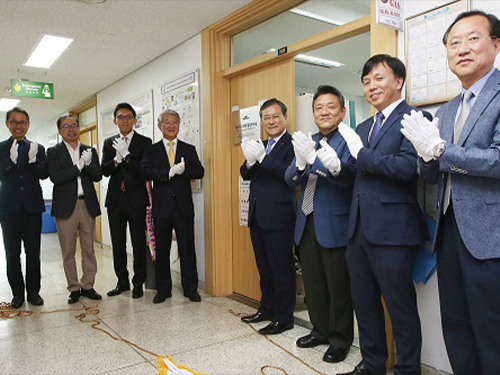
(Two renowned scholars' Cross-Generation Collaborative Labs which opened last month.
Distinguished Professor Lee's lab (above) andChair Professor Sung's lab)
Both labs are run by world-renowned scholars: the Systems Metabolic Engineering and Systems Healthcare Laboratory headed by Distinguished Professor Sang-Yup Lee in the Department of Chemical and Biomolecular Engineering and the Acousto-Microfluidics Research Center for Next-Generation Healthcare led by Chair Professor Hyung Jin Sung in the Department of Mechanical Engineering.
Distinguished Professor Lee will be teamed up with Professor Hyun Uk Kim, and their lab aims to mass produce new eco-friendly chemical materials as well as higher-value-added materials which will be used for medicine. The new platform technologies created in the lab are expected to provide information which will benefit human healthcare.
Meanwhile, the Acousto-Microfluidics Research Center for Next-Generation Healthcare will team up with Professors Hyoungsoo Kim and Yeunwoo Cho under Chair Professor Sung. The lab will conduct research on controlling fluids and objects exquisitely on a micro-nano scale by using high-frequency acoustic waves. The lab plans to develop a next-generation healthcare platform for customized diagnoses as well as disease treatment.
KAIST President Sung-Chul Shin, who introduced this novel idea in his research innovation initiative, said that he hopes the Cross-Generation Collaborative Labs will contribute to honoring senior scholars’ research legacies and passing knowledge down to junior researchers in order to further develop their academic achievements. He said, “I sincerely hope the labs will make numerous research breakthroughs in the very near future.”
2018.05.03 View 12795
Cross-Generation Collaborative Labs Open
KAIST opened two cross-generation collaborative labs last month. This novel approach will pair up senior and junior faculty members for sustaining research and academic achievements even after the senior researcher retires.
This is one of the Vision 2031 innovation initiatives established to extend the spectrum of knowledge and research competitiveness. The selected labs will be funded for five years and the funding will be extended if necessary. KAIST will continue to select new labs every year.
A five-member selection committee including the Nobel Laureates Professor Klaus Von Klitzing at the Max-Planck Institute for Solid State Research and Dr. Kurt Wüthrich from ETH Zürich selected the first two labs with senior-junior pairs in March.
(Two renowned scholars' Cross-Generation Collaborative Labs which opened last month.
Distinguished Professor Lee's lab (above) andChair Professor Sung's lab)
Both labs are run by world-renowned scholars: the Systems Metabolic Engineering and Systems Healthcare Laboratory headed by Distinguished Professor Sang-Yup Lee in the Department of Chemical and Biomolecular Engineering and the Acousto-Microfluidics Research Center for Next-Generation Healthcare led by Chair Professor Hyung Jin Sung in the Department of Mechanical Engineering.
Distinguished Professor Lee will be teamed up with Professor Hyun Uk Kim, and their lab aims to mass produce new eco-friendly chemical materials as well as higher-value-added materials which will be used for medicine. The new platform technologies created in the lab are expected to provide information which will benefit human healthcare.
Meanwhile, the Acousto-Microfluidics Research Center for Next-Generation Healthcare will team up with Professors Hyoungsoo Kim and Yeunwoo Cho under Chair Professor Sung. The lab will conduct research on controlling fluids and objects exquisitely on a micro-nano scale by using high-frequency acoustic waves. The lab plans to develop a next-generation healthcare platform for customized diagnoses as well as disease treatment.
KAIST President Sung-Chul Shin, who introduced this novel idea in his research innovation initiative, said that he hopes the Cross-Generation Collaborative Labs will contribute to honoring senior scholars’ research legacies and passing knowledge down to junior researchers in order to further develop their academic achievements. He said, “I sincerely hope the labs will make numerous research breakthroughs in the very near future.”
2018.05.03 View 12795 -
 LG's Woo Jong Lee Named the Alumnus of College of Engineering
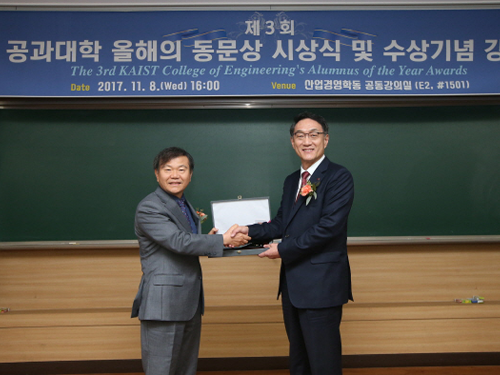
The College of Engineering at KAIST selected Woo Jong Lee, President and Head of the VC Business Division at LG Electronics Inc., as the 2017 Alumnus of the Year for the College of Engineering.
‘Alumnus of the Year’ is an award given to a distinguished alumnus who has contributed to the development of industrial technology or made outstanding academic achievements.
Lee graduated from KAIST with the master’s degrees in Industrial Engineering. He also worked at Daewoo Motors as an executive member in the development division. He has been a crucial human resource for LG since he joined the company in 2000.
While leading the VC business Division, which was established in 2013, Lee is recognized as a creative engineer as well as a leader in the automotive industry. Focusing on autonomous driving and eco-friendliness, he has been engaged in the production of major projects from the beginning to the end.
Since 2014, outstanding alumni whose achievements have represented KAIST at the highest level have received the award. The first recipient was Tae-Kyung Yoo, an executive at Lumens Co., Ltd., and the second recipient was Jung-Ju Kim, the founder of NXC. In 2016, the award was not given because an appropriate candidate could not be identified.
The award was held in the Industrial Engineering & Management Building (E2) on November 8. Faculty members including the dean of the College of Engineering Jong-Hwan Kim, the vice dean Hyochoong Bang, the head of Industrial & Systems Engineering Taesik Lee, and the dean of the KAIST Academy Tae-Eog Lee attended the ceremony.
After the ceremony, Lee delivered a lecture on ‘Auto-components Business of LG Electronics’ to KAIST students.
2017.11.09 View 9284
LG's Woo Jong Lee Named the Alumnus of College of Engineering
The College of Engineering at KAIST selected Woo Jong Lee, President and Head of the VC Business Division at LG Electronics Inc., as the 2017 Alumnus of the Year for the College of Engineering.
‘Alumnus of the Year’ is an award given to a distinguished alumnus who has contributed to the development of industrial technology or made outstanding academic achievements.
Lee graduated from KAIST with the master’s degrees in Industrial Engineering. He also worked at Daewoo Motors as an executive member in the development division. He has been a crucial human resource for LG since he joined the company in 2000.
While leading the VC business Division, which was established in 2013, Lee is recognized as a creative engineer as well as a leader in the automotive industry. Focusing on autonomous driving and eco-friendliness, he has been engaged in the production of major projects from the beginning to the end.
Since 2014, outstanding alumni whose achievements have represented KAIST at the highest level have received the award. The first recipient was Tae-Kyung Yoo, an executive at Lumens Co., Ltd., and the second recipient was Jung-Ju Kim, the founder of NXC. In 2016, the award was not given because an appropriate candidate could not be identified.
The award was held in the Industrial Engineering & Management Building (E2) on November 8. Faculty members including the dean of the College of Engineering Jong-Hwan Kim, the vice dean Hyochoong Bang, the head of Industrial & Systems Engineering Taesik Lee, and the dean of the KAIST Academy Tae-Eog Lee attended the ceremony.
After the ceremony, Lee delivered a lecture on ‘Auto-components Business of LG Electronics’ to KAIST students.
2017.11.09 View 9284 -
 Open KAIST 2015
KAIST’s research environment and its most recent achievements were open to the public.
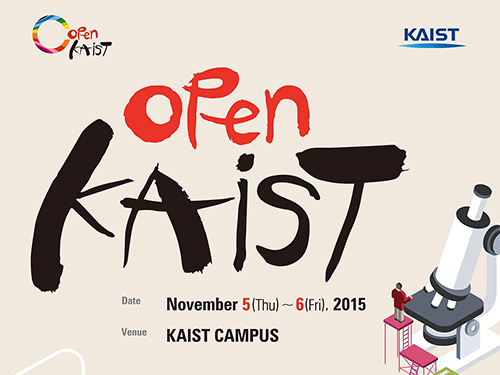
KAIST hosted “Open KAIST 2015” over two days from November 5-6, 2015 in which its 17 departments and three research centers were open to the public. The event is one of the largest events that KAIST holds, which permits such public viewings of its facilities. It is the eighth time it has taken place.
During this event, the departments and centers offered 64 programs including laboratory tours, research achievement exhibitions, department introductions, and special lectures.
The “Motion Capture System”of Professor Jun-Yong Noh’s lab (Graduate School of Culture Technology) drew particular attention.
The “Motion Capture System” expresses human and animal motion in three-dimensional (3D) space using infrared cameras and optic markers, which can then be applied to various industries such as movies, games, and animation. During the program, researchers themselves demonstrated the recording of the movement and its conversion into 3D characters.
Professor Yong-Hoon Cho’s laboratory introduced the scientific mechanism behind the Light Emitting Diode (LED) as well as its manufacturing process under the topic:“A to Z of LED Production.” The reserachers explained that how green LED is much more efficient compared to previous light sources and presented applications that how it is widely used in everyday life in smart phones, electronic displays, and other mobile gadgets.
Professor Jun-tani of the Department of Electronic and Electrical Engineering introduced “Humanoid Robot Nao’s Imitation of Human Motions.” Nao is an autonomous, programmable humanoid robot developed by a French robotics company based in Paris. Nao has an artificial neural circuit, which is the functional equivalent of a human brain, and can thus mimic the subject’s motions through learning.
In addition, Professor Hyo-Choong Bang (Department of Aerospace Engineering) in his lecture on “Unmanned Vehicle Research and Nano Satellites” and Professor Hyun Myung (Department of Civil and Environmental Engineering) on his lecture on “Future Civilization Robot System: the Jellyfish Elimination Robotic Swarm and the Wall-Climbing Drone” provided information on the progress of their respective research.
KAIST also displayed its most recent research achievements. A lecture on “Information Technology Convergence” offered a showroom for “Dr. M,” which is a mobile healthcare platform. Dr. M is a mobile healthcare system that collects and analyzes biosignals via a smart sensor attached to the human body that shows around 20 advanced technologies.
The Satellite Technology Research Center introduced the public to its “Get to Know Satellites” program on Korea’s first satellite “Our Star 1” in addition to showing the satellite assembly room and the satellite communication center.
Special lectures were also held for visitors. Professor Min-Hyuk Kim and Hye-Yeon Oh of the School of Computing talked about “Computer Graphics and Advanced Video Technology” and “Man and the Computer,” respectively, from the perspective of non-experts.
Another interesting feature was the “Wearable Computer Competition” in which college students held fashion shows with computers attached to their clothes.
Professor Jung Kwon Lee, the Dean of the College of Engineering, who led this event, said that “the Open KAIST, which is being held for the eighth time this year, is an excellent opportunity for the general public to experience KAIST’s research environment.” He hoped this could motivate young adults to widen their spectrum of scientific knowledge and raise affection for science.
2015.11.13 View 11891
Open KAIST 2015
KAIST’s research environment and its most recent achievements were open to the public.
KAIST hosted “Open KAIST 2015” over two days from November 5-6, 2015 in which its 17 departments and three research centers were open to the public. The event is one of the largest events that KAIST holds, which permits such public viewings of its facilities. It is the eighth time it has taken place.
During this event, the departments and centers offered 64 programs including laboratory tours, research achievement exhibitions, department introductions, and special lectures.
The “Motion Capture System”of Professor Jun-Yong Noh’s lab (Graduate School of Culture Technology) drew particular attention.
The “Motion Capture System” expresses human and animal motion in three-dimensional (3D) space using infrared cameras and optic markers, which can then be applied to various industries such as movies, games, and animation. During the program, researchers themselves demonstrated the recording of the movement and its conversion into 3D characters.
Professor Yong-Hoon Cho’s laboratory introduced the scientific mechanism behind the Light Emitting Diode (LED) as well as its manufacturing process under the topic:“A to Z of LED Production.” The reserachers explained that how green LED is much more efficient compared to previous light sources and presented applications that how it is widely used in everyday life in smart phones, electronic displays, and other mobile gadgets.
Professor Jun-tani of the Department of Electronic and Electrical Engineering introduced “Humanoid Robot Nao’s Imitation of Human Motions.” Nao is an autonomous, programmable humanoid robot developed by a French robotics company based in Paris. Nao has an artificial neural circuit, which is the functional equivalent of a human brain, and can thus mimic the subject’s motions through learning.
In addition, Professor Hyo-Choong Bang (Department of Aerospace Engineering) in his lecture on “Unmanned Vehicle Research and Nano Satellites” and Professor Hyun Myung (Department of Civil and Environmental Engineering) on his lecture on “Future Civilization Robot System: the Jellyfish Elimination Robotic Swarm and the Wall-Climbing Drone” provided information on the progress of their respective research.
KAIST also displayed its most recent research achievements. A lecture on “Information Technology Convergence” offered a showroom for “Dr. M,” which is a mobile healthcare platform. Dr. M is a mobile healthcare system that collects and analyzes biosignals via a smart sensor attached to the human body that shows around 20 advanced technologies.
The Satellite Technology Research Center introduced the public to its “Get to Know Satellites” program on Korea’s first satellite “Our Star 1” in addition to showing the satellite assembly room and the satellite communication center.
Special lectures were also held for visitors. Professor Min-Hyuk Kim and Hye-Yeon Oh of the School of Computing talked about “Computer Graphics and Advanced Video Technology” and “Man and the Computer,” respectively, from the perspective of non-experts.
Another interesting feature was the “Wearable Computer Competition” in which college students held fashion shows with computers attached to their clothes.
Professor Jung Kwon Lee, the Dean of the College of Engineering, who led this event, said that “the Open KAIST, which is being held for the eighth time this year, is an excellent opportunity for the general public to experience KAIST’s research environment.” He hoped this could motivate young adults to widen their spectrum of scientific knowledge and raise affection for science.
2015.11.13 View 11891 -
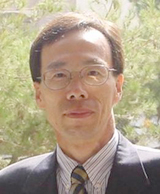 Professor Yang Named Recipient of Dupont Science & Technology Award
- Named as the recipient of Dupont Science & Technology Award of 2007- In recognition of his development of optical?bio-functional photonic crystal structures through Self-assembly of nanoparticles
Seung-Man Yang, a professor of Chemical and Biomolecular Engineering of KAIST (President Nam Pyo Suh) and the president of the National Creative Research Initiatives Center for Photon and Fluid Integrated Circuit by the Ministry of Science and Technology, has been named as the recipient of Dupont Science & Technology Award.
Dupont Korea, associate of Dupont, a world-class science firm, has established and conferred ‘Dupont Science & Technology Award’ since 2002 to promote basic sciences and industrial development of Korea. Dupont Science & Technology Awards are awarded to scientists of universities or state-run institutes who have made outstanding R&D achievements in the fields of Chemistry, Chemical Engineering, Material Science and Material Engineering within five years. Dupont Korea announced on May 2, 2007 that Professor Yang is the recipient of the award this year, following the strict examination by the Koran Academy of Science and Technology (KAST).
The reason for the award is Professor Yang’s development of prototype optical?bio-functional photonic crystal structures that can process a huge amount of data, resulting from a study that has discovered the principle of Self-assembly where multifunctional nanoparticles are manufactured and assembled for themselves.
Professor Yang’s recent research result about photon structures and nano patterns was published by Nature (February 2, 2006 edition); posted on Heart-Cut, the portal site of the American Chemistry Society (ACS), as highlight paper two times (November 4, 2002 and May 1, 2006); and introduced at Research/Researcher of MRS Bulletin by the U.S. Material Research Society (MRS) as main paper in December 2003. Professor Yang is very famous in Korea and abroad for the excellences of his research achievements and has made request seminars at Harvard University, University of Wisconsin, Caltech, University of California, etc. He is also invited speaker and session organizer of the MRS and the SPIE.
2007.05.08 View 20711
Professor Yang Named Recipient of Dupont Science & Technology Award
Professor Yang Named Recipient of Dupont Science & Technology Award
- Named as the recipient of Dupont Science & Technology Award of 2007- In recognition of his development of optical?bio-functional photonic crystal structures through Self-assembly of nanoparticles
Seung-Man Yang, a professor of Chemical and Biomolecular Engineering of KAIST (President Nam Pyo Suh) and the president of the National Creative Research Initiatives Center for Photon and Fluid Integrated Circuit by the Ministry of Science and Technology, has been named as the recipient of Dupont Science & Technology Award.
Dupont Korea, associate of Dupont, a world-class science firm, has established and conferred ‘Dupont Science & Technology Award’ since 2002 to promote basic sciences and industrial development of Korea. Dupont Science & Technology Awards are awarded to scientists of universities or state-run institutes who have made outstanding R&D achievements in the fields of Chemistry, Chemical Engineering, Material Science and Material Engineering within five years. Dupont Korea announced on May 2, 2007 that Professor Yang is the recipient of the award this year, following the strict examination by the Koran Academy of Science and Technology (KAST).
The reason for the award is Professor Yang’s development of prototype optical?bio-functional photonic crystal structures that can process a huge amount of data, resulting from a study that has discovered the principle of Self-assembly where multifunctional nanoparticles are manufactured and assembled for themselves.
Professor Yang’s recent research result about photon structures and nano patterns was published by Nature (February 2, 2006 edition); posted on Heart-Cut, the portal site of the American Chemistry Society (ACS), as highlight paper two times (November 4, 2002 and May 1, 2006); and introduced at Research/Researcher of MRS Bulletin by the U.S. Material Research Society (MRS) as main paper in December 2003. Professor Yang is very famous in Korea and abroad for the excellences of his research achievements and has made request seminars at Harvard University, University of Wisconsin, Caltech, University of California, etc. He is also invited speaker and session organizer of the MRS and the SPIE.
2007.05.08 View 20711