%61%72%74
-
 “Entrepreneurial Mutual Growth Fair 2026” to be Held... KAIST Super Star Companies Gather for AI Solopreneurship, Tech Commercialization, Investment, and Youth Job Fair
KAIST announced that it will host the ‘AI Agent-Based Solopreneurship Program Information Session’ and the ‘Entrepreneurial Mutual Growth Fair 2026’ for two days from May 18th to 19th.
In this event, KAIST’s new AI-based solopreneurship model, which utilizes AI not merely as an operational tool but as a ‘Co-founder,’ will be introduced in depth. The university will hold an information session for the ‘AI Solopreneur Support Project,’ which enables a single individual to carry out the entire entrepreneurial process—including planning, development, marketing, and fundraising—using AI agents prepared by the university.
In this program, 100 prospective entrepreneurs will be selected nationwide, and faculty from the KAIST Institute for Entrepreneurship and the KAIST Graduate School of AI will provide eight weeks of intensive training. Additionally, a network of top-tier domestic and global mentors will be established to support business optimization and linkage with overseas investments.
In particular, outstanding teams will be provided with seed investment of up to 100 million KRW, prototype production support, and infrastructure for GPU and AI services. By fostering world-class AI utilization skills in prospective entrepreneurs with diverse domain knowledge, KAIST plans to accelerate the introduction of AI into various domestic industries while nurturing AI business models with global competitiveness.
This event is organized as a venue to introduce the KAIST-style full-cycle entrepreneurial ecosystem, encompassing artificial intelligence (AI)-based entrepreneurship, technology commercialization, industry-academic cooperation, investment linkage, and youth job creation. In particular, it will showcase the competitiveness of the deep-tech (advanced technology-based) startup ecosystem from multiple perspectives, focusing on the technological prowess and industrial application cases of KAIST startup companies.
Global big tech companies' choice of AI solution providers will also participate to reveal various technologies reflecting the AX (AI Transformation) trend across industries. Actual application cases that supported the digital transformation of major domestic corporations through factory and office automation solutions will also be announced.
In the field of robotics, Lion Robotics will introduce field-application technologies based on quadruped robots and leading R&D cases for humanoid robots. In addition, next-generation AI semiconductor startups such as Panmnesia and HyperAccel will present next-generation chip design technologies for implementing On-Device AI. These companies will showcase technologies and business models that can run Large Language Model (LLM)-based AI services faster while reducing dependence on GPUs (Graphics Processing Units). In the deep-tech bio and healthcare AI field, Barreleye will introduce an innovative solution that complements the limitations of traditional MRI (Magnetic Resonance Imaging)-centered diagnosis through AI-based quantitative ultrasound analysis technology. In the bio and medical robot field, Roen Surgical will present next-generation medical innovation cases based on precision surgical robot technology.
On the first day of the event, May 18th, the ‘Entrepreneurial Mutual Growth Fair’ will be held in the main hall on the 1st floor of the KI Building along with the ‘AI Agent-Based Solopreneurship Program Information Session.’ Representative startup companies that have led KAIST’s technology commercialization success will participate in this session to share successful technology commercialization models that connected R&D achievements to actual market results.
Through this, they plan to present a virtuous cycle for the KAIST startup ecosystem leading from ‘Research → Startup → Investment → Growth.’ Furthermore, KAIST startup companies will operate recruitment sessions alongside technology exhibitions. Participating companies will conduct direct recruitment consultations and talent discovery on-site, providing youth with high-quality, technology-based job opportunities. Through this event, the university plans to support scientific and technological talents so they can advance into startups and industrial fields rather than staying in research, and to lead technology-based entrepreneurship and employment creation. On the second day, May 19th, an ‘Open Innovation Information Session’ will be held to connect KAIST’s research capabilities with industrial demand.
At the event, the ‘1 Lab N Startup’ model, which connects KAIST faculty’s technology with corporate R&D needs to promote joint research and commercialization, will be introduced. Industry-academic cooperation strategies that expand beyond technology transfer to joint entrepreneurship and new business creation will also be announced. Following this, in the ‘KAIST Startup Investment Linkage IR Pitching Session,’ the investment attraction program ‘Tech Plaza’ will be operated, featuring five Korean deep-tech bio companies. Companies selected based on the KAIST Startup Platform (KSTP) will present their business models and technological prowess to investors, and tangible investment results are expected through linkage with venture capital (VC) and accelerators. Bae Hyeon-min, Dean of the KAIST Institute for Entrepreneurship, said, “This Entrepreneurial Mutual Growth Fair is an integrated startup platform that connects the entire process from AI-based individual entrepreneurship to technology commercialization, industry-academic cooperation, investment, and job creation.
We expect it to serve as an opportunity to present a new direction for the domestic deep-tech startup ecosystem through the success stories of KAIST’s representative startups.” This event is open to students, the general public, corporations, and investment institutions interested in entrepreneurship, and is prepared as a place to directly confirm the innovative achievements and expansion possibilities of the KAIST startup ecosystem. Information regarding the KAIST AI Solopreneurship Program information session and participation applications can be found on the website (https://www.kaist-overedge.com/).
By accessing the website, people can watch the information session on YouTube and apply for participation.
2026.05.13 View 116
“Entrepreneurial Mutual Growth Fair 2026” to be Held... KAIST Super Star Companies Gather for AI Solopreneurship, Tech Commercialization, Investment, and Youth Job Fair
KAIST announced that it will host the ‘AI Agent-Based Solopreneurship Program Information Session’ and the ‘Entrepreneurial Mutual Growth Fair 2026’ for two days from May 18th to 19th.
In this event, KAIST’s new AI-based solopreneurship model, which utilizes AI not merely as an operational tool but as a ‘Co-founder,’ will be introduced in depth. The university will hold an information session for the ‘AI Solopreneur Support Project,’ which enables a single individual to carry out the entire entrepreneurial process—including planning, development, marketing, and fundraising—using AI agents prepared by the university.
In this program, 100 prospective entrepreneurs will be selected nationwide, and faculty from the KAIST Institute for Entrepreneurship and the KAIST Graduate School of AI will provide eight weeks of intensive training. Additionally, a network of top-tier domestic and global mentors will be established to support business optimization and linkage with overseas investments.
In particular, outstanding teams will be provided with seed investment of up to 100 million KRW, prototype production support, and infrastructure for GPU and AI services. By fostering world-class AI utilization skills in prospective entrepreneurs with diverse domain knowledge, KAIST plans to accelerate the introduction of AI into various domestic industries while nurturing AI business models with global competitiveness.
This event is organized as a venue to introduce the KAIST-style full-cycle entrepreneurial ecosystem, encompassing artificial intelligence (AI)-based entrepreneurship, technology commercialization, industry-academic cooperation, investment linkage, and youth job creation. In particular, it will showcase the competitiveness of the deep-tech (advanced technology-based) startup ecosystem from multiple perspectives, focusing on the technological prowess and industrial application cases of KAIST startup companies.
Global big tech companies' choice of AI solution providers will also participate to reveal various technologies reflecting the AX (AI Transformation) trend across industries. Actual application cases that supported the digital transformation of major domestic corporations through factory and office automation solutions will also be announced.
In the field of robotics, Lion Robotics will introduce field-application technologies based on quadruped robots and leading R&D cases for humanoid robots. In addition, next-generation AI semiconductor startups such as Panmnesia and HyperAccel will present next-generation chip design technologies for implementing On-Device AI. These companies will showcase technologies and business models that can run Large Language Model (LLM)-based AI services faster while reducing dependence on GPUs (Graphics Processing Units). In the deep-tech bio and healthcare AI field, Barreleye will introduce an innovative solution that complements the limitations of traditional MRI (Magnetic Resonance Imaging)-centered diagnosis through AI-based quantitative ultrasound analysis technology. In the bio and medical robot field, Roen Surgical will present next-generation medical innovation cases based on precision surgical robot technology.
On the first day of the event, May 18th, the ‘Entrepreneurial Mutual Growth Fair’ will be held in the main hall on the 1st floor of the KI Building along with the ‘AI Agent-Based Solopreneurship Program Information Session.’ Representative startup companies that have led KAIST’s technology commercialization success will participate in this session to share successful technology commercialization models that connected R&D achievements to actual market results.
Through this, they plan to present a virtuous cycle for the KAIST startup ecosystem leading from ‘Research → Startup → Investment → Growth.’ Furthermore, KAIST startup companies will operate recruitment sessions alongside technology exhibitions. Participating companies will conduct direct recruitment consultations and talent discovery on-site, providing youth with high-quality, technology-based job opportunities. Through this event, the university plans to support scientific and technological talents so they can advance into startups and industrial fields rather than staying in research, and to lead technology-based entrepreneurship and employment creation. On the second day, May 19th, an ‘Open Innovation Information Session’ will be held to connect KAIST’s research capabilities with industrial demand.
At the event, the ‘1 Lab N Startup’ model, which connects KAIST faculty’s technology with corporate R&D needs to promote joint research and commercialization, will be introduced. Industry-academic cooperation strategies that expand beyond technology transfer to joint entrepreneurship and new business creation will also be announced. Following this, in the ‘KAIST Startup Investment Linkage IR Pitching Session,’ the investment attraction program ‘Tech Plaza’ will be operated, featuring five Korean deep-tech bio companies. Companies selected based on the KAIST Startup Platform (KSTP) will present their business models and technological prowess to investors, and tangible investment results are expected through linkage with venture capital (VC) and accelerators. Bae Hyeon-min, Dean of the KAIST Institute for Entrepreneurship, said, “This Entrepreneurial Mutual Growth Fair is an integrated startup platform that connects the entire process from AI-based individual entrepreneurship to technology commercialization, industry-academic cooperation, investment, and job creation.
We expect it to serve as an opportunity to present a new direction for the domestic deep-tech startup ecosystem through the success stories of KAIST’s representative startups.” This event is open to students, the general public, corporations, and investment institutions interested in entrepreneurship, and is prepared as a place to directly confirm the innovative achievements and expansion possibilities of the KAIST startup ecosystem. Information regarding the KAIST AI Solopreneurship Program information session and participation applications can be found on the website (https://www.kaist-overedge.com/).
By accessing the website, people can watch the information session on YouTube and apply for participation.
2026.05.13 View 116 -
 KAIST Professor Jinjoon Lee’s 10-Meter Hanji Scroll PhD Thesis from Oxford Enters the Permanent Collection of the World’s Oldest Museum, First Work by a Contemporary Korean Artist
<A ten-metre scroll doctoral thesis reinterpreting the 15th-century Joseon landscape painting scroll tradition, Empty Garden, exhibited at the University Church of St Mary the Virgin, Oxford, founded in the 15th century. 2020>
- Media artist and KAIST professor Jinjoon Lee's doctoral thesis 'Empty Garden' officially acquired by the Ashmolean Museum, UK, for permanent collection
- Korean artistic and academic achievement recognized as public cultural heritage at a museum predating the Louvre by 110 years — the 'heart of Western intellectual history'
- Blending Eastern aesthetics of 'wandering' (거닐기) and 'emptiness' with data technology in the AI era — awarded Oxford's unanimous 'No Corrections' in just 2.5 years in 2020
- First work by a contemporary Korean artist to enter the Ashmolean's permanent collection — officially confirmed by the museum's curator
- Korean artistic and academic achievement officially recognised as intellectual cultural heritage — permanently preserved, researched, and exhibited within the Western public knowledge system
A doctoral thesis is often imagined as a dense, bound volume. Yet a 10-meter-long hanji scroll- traditional Korean mulberry paper prized for its durability across centuries- is now drawing global attention from the art world and academia alike.
KAIST (President Kwang Hyung Lee) announced on the 26th that Empty Garden – A Liminoid Journey to Nowhere in Somewhere (2020), a doctoral thesis by media artist and KAIST Graduate School of Culture Technology Professor Jinjoon Lee, has been officially acquired by the Ashmolean Museum, University of Oxford, for its permanent collection and exhibition — through formal purchase, not donation.
Founded in 1683, the Ashmolean Museum is the world's first university museum, operated by the University of Oxford with over 340 years of history. It predates the Louvre (1793) by 110 years and the British Museum (1759) by 76 years, and is regarded as the starting point of European Enlightenment scholarship. Its collections include masterworks by Raphael, Michelangelo, Leonardo da Vinci, and Turner, alongside ancient artefacts and East Asian ceramics and paintings — over one million objects in total.
The Ashmolean is not simply an exhibition venue but an academic institution integrating collection, research, and education. Unlike Tate Modern, which engages with the contemporary art market, or the British Museum, which displays national heritage, the Ashmolean's core mission is scholarly preservation and research. The acquisition of Professor Lee's doctoral thesis here signifies that Korean aesthetics and philosophical thought have entered the public record of European intellectual history.
Professor Lee's PhD thesis Empty Garden reinterprets the concept of uiwon (意園) — an imaginary garden cultivated in the mind by Joseon-era scholars — through contemporary data and media language, proposing 'data gardening' as a methodology for tending to the philosophy of emptiness. It is a work that continues to ask fundamental questions about human sensation, memory, and existence, even within an environment dominated by AI and data.
The 10-meter hanji scroll format is itself a central feature of the thesis. As readers engage with the text, they are naturally led to move through space — physically enacting the East Asian garden tradition of 'wandering' (거닐기). The work is designed not merely to be read but to be experienced through movement and contemplation. The thesis was produced as nine hanji scrolls in total; one of these has been acquired by the Ashmolean for its permanent collection.
This thesis received unanimous 'No Corrections' approval at its DPhil in Fine Art examination at the University of Oxford in 2020, recognising its academic rigour and originality — an achievement completed in just two and a half years, where the process typically takes over four. It is an extremely rare distinction even within Oxford's 900-year history, and drew significant attention at the time.
Oxford doctoral theses are typically archived at the Bodleian Library as academic records. This acquisition is entirely separate from that process: the museum conducted an independent five-year review following the award of the degree, assessed the work on its artistic and scholarly merits, and made a formal purchase. The inclusion of a living artist's doctoral thesis in the permanent collection of the world's oldest university museum through purchase — not donation — is exceptionally rare.
Professor Shelagh Vainker, Alice King Curator of Chinese and Korean Art at the Ashmolean Museum, University of Oxford, stated:
"I am delighted that the Ashmolean Museum has been able to acquire Dr Jinjoon Lee's Empty Garden for our permanent collection. The long, contemplative scroll breaks new ground in so many ways: in the materials and techniques employed, in the breadth and depth of cultural and intellectual knowledge embedded in it, and in the complexity of the presentation of different spaces — all providing the viewer with multiple perspectives and experiences. Empty Garden is the first piece by a contemporary Korean artist to enter the collection; when not on display it will be available for viewing by appointment."
— Shelagh Vainker, Alice King Curator of Chinese and Korean Art, Ashmolean Museum, University of Oxford
<Dr Shelagh Vainker, Professor at the University of Oxford and Alice King Curator of Chinese and Korean Art at the Ashmolean Museum, reviewing the doctoral thesis Empty Garden in the Eastern Art Study Room, Ashmolean Museum. 2026>
Professor Lee noted that during his doctoral research at Oxford, a serious leg injury left him using a wheelchair for an extended period, during which he reflected deeply on the relationship between movement, stillness, and thought. He stated: "In the age of AI, art cannot remain confined to immaterial images on screens. Data and images can only acquire depth through material forms capable of enduring time and preservation."
He further expressed his hope that Empty Garden, now housed within the public collection of Western intellectual history, would "serve as a continuing reference point connecting East Asian thought — including that of Korea — with new sensory frameworks for the age of artificial intelligence."
The first practicing artist to be appointed as a tenure-track professor at KAIST, Professor Lee currently holds concurrent positions as Visiting Fellow at Exeter College, University of Oxford, Visiting Senior Researcher at Tokyo University of the Arts, and Adjunct Professor at New York University, continuing interdisciplinary research across art, technology, and the humanities. Most recently, his work has drawn international attention from arts community, including Good Morning, Mr. G-Dragon, a space art project based on the iris data of K-pop artist G-Dragon, and Cine Forest: Awakening Bloom, an AI-based media symphony at Bundang Central Park in S. Korea.
<Jinjoon Lee, artist's studio, Seoul. 2025>
This acquisition is an exceptionally rare case of a doctoral thesis entering the permanent collection of the world's oldest university museum through formal purchase, and a historic event in which a work by a contemporary Korean artist has entered the Ashmolean's collection for the first time. Korean research that poses new questions about the role of art and the humanities in the post-AI era has now found a permanent place within the public record of Western intellectual history.
2026.03.26 View 1003
KAIST Professor Jinjoon Lee’s 10-Meter Hanji Scroll PhD Thesis from Oxford Enters the Permanent Collection of the World’s Oldest Museum, First Work by a Contemporary Korean Artist
<A ten-metre scroll doctoral thesis reinterpreting the 15th-century Joseon landscape painting scroll tradition, Empty Garden, exhibited at the University Church of St Mary the Virgin, Oxford, founded in the 15th century. 2020>
- Media artist and KAIST professor Jinjoon Lee's doctoral thesis 'Empty Garden' officially acquired by the Ashmolean Museum, UK, for permanent collection
- Korean artistic and academic achievement recognized as public cultural heritage at a museum predating the Louvre by 110 years — the 'heart of Western intellectual history'
- Blending Eastern aesthetics of 'wandering' (거닐기) and 'emptiness' with data technology in the AI era — awarded Oxford's unanimous 'No Corrections' in just 2.5 years in 2020
- First work by a contemporary Korean artist to enter the Ashmolean's permanent collection — officially confirmed by the museum's curator
- Korean artistic and academic achievement officially recognised as intellectual cultural heritage — permanently preserved, researched, and exhibited within the Western public knowledge system
A doctoral thesis is often imagined as a dense, bound volume. Yet a 10-meter-long hanji scroll- traditional Korean mulberry paper prized for its durability across centuries- is now drawing global attention from the art world and academia alike.
KAIST (President Kwang Hyung Lee) announced on the 26th that Empty Garden – A Liminoid Journey to Nowhere in Somewhere (2020), a doctoral thesis by media artist and KAIST Graduate School of Culture Technology Professor Jinjoon Lee, has been officially acquired by the Ashmolean Museum, University of Oxford, for its permanent collection and exhibition — through formal purchase, not donation.
Founded in 1683, the Ashmolean Museum is the world's first university museum, operated by the University of Oxford with over 340 years of history. It predates the Louvre (1793) by 110 years and the British Museum (1759) by 76 years, and is regarded as the starting point of European Enlightenment scholarship. Its collections include masterworks by Raphael, Michelangelo, Leonardo da Vinci, and Turner, alongside ancient artefacts and East Asian ceramics and paintings — over one million objects in total.
The Ashmolean is not simply an exhibition venue but an academic institution integrating collection, research, and education. Unlike Tate Modern, which engages with the contemporary art market, or the British Museum, which displays national heritage, the Ashmolean's core mission is scholarly preservation and research. The acquisition of Professor Lee's doctoral thesis here signifies that Korean aesthetics and philosophical thought have entered the public record of European intellectual history.
Professor Lee's PhD thesis Empty Garden reinterprets the concept of uiwon (意園) — an imaginary garden cultivated in the mind by Joseon-era scholars — through contemporary data and media language, proposing 'data gardening' as a methodology for tending to the philosophy of emptiness. It is a work that continues to ask fundamental questions about human sensation, memory, and existence, even within an environment dominated by AI and data.
The 10-meter hanji scroll format is itself a central feature of the thesis. As readers engage with the text, they are naturally led to move through space — physically enacting the East Asian garden tradition of 'wandering' (거닐기). The work is designed not merely to be read but to be experienced through movement and contemplation. The thesis was produced as nine hanji scrolls in total; one of these has been acquired by the Ashmolean for its permanent collection.
This thesis received unanimous 'No Corrections' approval at its DPhil in Fine Art examination at the University of Oxford in 2020, recognising its academic rigour and originality — an achievement completed in just two and a half years, where the process typically takes over four. It is an extremely rare distinction even within Oxford's 900-year history, and drew significant attention at the time.
Oxford doctoral theses are typically archived at the Bodleian Library as academic records. This acquisition is entirely separate from that process: the museum conducted an independent five-year review following the award of the degree, assessed the work on its artistic and scholarly merits, and made a formal purchase. The inclusion of a living artist's doctoral thesis in the permanent collection of the world's oldest university museum through purchase — not donation — is exceptionally rare.
Professor Shelagh Vainker, Alice King Curator of Chinese and Korean Art at the Ashmolean Museum, University of Oxford, stated:
"I am delighted that the Ashmolean Museum has been able to acquire Dr Jinjoon Lee's Empty Garden for our permanent collection. The long, contemplative scroll breaks new ground in so many ways: in the materials and techniques employed, in the breadth and depth of cultural and intellectual knowledge embedded in it, and in the complexity of the presentation of different spaces — all providing the viewer with multiple perspectives and experiences. Empty Garden is the first piece by a contemporary Korean artist to enter the collection; when not on display it will be available for viewing by appointment."
— Shelagh Vainker, Alice King Curator of Chinese and Korean Art, Ashmolean Museum, University of Oxford
<Dr Shelagh Vainker, Professor at the University of Oxford and Alice King Curator of Chinese and Korean Art at the Ashmolean Museum, reviewing the doctoral thesis Empty Garden in the Eastern Art Study Room, Ashmolean Museum. 2026>
Professor Lee noted that during his doctoral research at Oxford, a serious leg injury left him using a wheelchair for an extended period, during which he reflected deeply on the relationship between movement, stillness, and thought. He stated: "In the age of AI, art cannot remain confined to immaterial images on screens. Data and images can only acquire depth through material forms capable of enduring time and preservation."
He further expressed his hope that Empty Garden, now housed within the public collection of Western intellectual history, would "serve as a continuing reference point connecting East Asian thought — including that of Korea — with new sensory frameworks for the age of artificial intelligence."
The first practicing artist to be appointed as a tenure-track professor at KAIST, Professor Lee currently holds concurrent positions as Visiting Fellow at Exeter College, University of Oxford, Visiting Senior Researcher at Tokyo University of the Arts, and Adjunct Professor at New York University, continuing interdisciplinary research across art, technology, and the humanities. Most recently, his work has drawn international attention from arts community, including Good Morning, Mr. G-Dragon, a space art project based on the iris data of K-pop artist G-Dragon, and Cine Forest: Awakening Bloom, an AI-based media symphony at Bundang Central Park in S. Korea.
<Jinjoon Lee, artist's studio, Seoul. 2025>
This acquisition is an exceptionally rare case of a doctoral thesis entering the permanent collection of the world's oldest university museum through formal purchase, and a historic event in which a work by a contemporary Korean artist has entered the Ashmolean's collection for the first time. Korean research that poses new questions about the role of art and the humanities in the post-AI era has now found a permanent place within the public record of Western intellectual history.
2026.03.26 View 1003 -
 Campus in Spring: KAIST Art Museum Hosts ‘Oblique Time’ Exhibition
< (Left: Stair-shaped work) Divided Horizon, (Right: Circular mirror work) In-between >
KAIST invites visitors to go beyond simply 'looking' at art, offering a space to experience ‘Oblique Time’ while strolling through the venue. ‘Oblique Time’ refers to a different texture of time—stepping away from the linear flow of daily life to a place where senses and contemplation slowly intersect.
KAIST announced that it will host ‘Oblique Time,’ a special installation art exhibition by graphic designer Na Kim, at the KAIST Art Museum on the main Daejeon campus starting on the 3rd.
The exhibition takes place on the newly opened rooftop of the museum. The three installed works awaken a new sense of space through the media of wind, light, gaze, and movement. Upon entering the rooftop, soaring columns greet visitors; as one walks slowly between them, the traces of the wind brushing past can be felt by the body.
Ascending and descending the stairs reveals entirely different scenes within the same space, while circular mirrors on the floor simultaneously reflect the sky, the clouds, and the viewer standing before them. Visitors shift from being mere observers to becoming part of the landscape within the artwork. The space is no longer a fixed structure but transforms into a fluid field of time.
All three works are experiential installations that rely on the participation and movement of the audience. Rather than a fixed viewpoint, the artist uses a "wavering gaze" to twist our conventional senses of space and time. It is an exhibition that leaves behind experience over explanation, and contemplation over definitive answers.
Na Kim is a graphic designer and visual artist who graduated from the Department of Industrial Design at KAIST and studied at Hongik University and ArtEZ University of the Arts in the Netherlands. Based in design, she has built a unique artistic world that crosses into the realm of fine arts. By extracting and reconstructing memories and contexts tied to objects, images, and text, she encourages viewers to reflect on themselves and conjure their own self-portraits. She has received the Korea Institute of Design Promotion’s ‘Next Generation Design Leader’ award, the Doosan Yonkang Art Award, and the Ministry of Culture, Sports and Tourism’s ‘Today’s Young Artist Award.’ Currently represented by Kukje Gallery, she operates the project space ‘LOOM’ in Berlin, Germany.
"The creation of an art museum within the KAIST campus felt very meaningful to me," said Kim. "I am honored to participate in the first exhibition for this newly opened rooftop space. I hope this exhibition provides students with an opportunity to experience art and reflect on themselves."
Since its opening in December 2024, the KAIST Art Museum has operated three exhibition halls on the first and second floors. With the recent completion of interior work on the third floor, it has evolved into a full-scale museum with a total of seven galleries (five indoor, two outdoor). This exhibition, held in the rooftop area (Galleries 6 & 7) being revealed for the first time since the museum's opening, symbolizes the spatial expansion of the institution. This stage—extending from indoors to outdoors and from fixed galleries to the open sky—marks the starting point of a new experiment envisioned by the museum.
Hyeon-Jeong Suk, Director of the KAIST Art Museum (and Head of the Department of Industrial Design), stated, "I am delighted to introduce Na Kim, who is also a junior from our department, to KAIST. Her original artistic world, rooted in the language of design, will diversely expand the museum's exhibitions."
President Kwang Hyung Lee remarked, "I am proud that a KAIST graduate has grown into a world-class artist and returned to her alma mater. I look forward to this exhibition serving as a leap forward for both the KAIST Art Museum and the artist."
Starting with the museum construction fund and art donations from the late Chairman Moon-Soul Chung, KAIST has consistently received artworks from various social figures, artists, and bereaved families. Na Kim’s installation works will also belong to the KAIST Art Museum after the exhibition concludes, remaining as artistic assets for the campus.
The exhibition ‘Oblique Time’ opens at 3:00 PM on the 3rd and will be open to the public free of charge until August 28th. Viewing hours are weekdays from 10:00 AM to 5:00 PM.
< Vertical Texture (5m size)>
< Divided Horizon (8m size) >
< In-between (Circular diameters of 1.2m and 1.5m) >
2026.03.04 View 814
Campus in Spring: KAIST Art Museum Hosts ‘Oblique Time’ Exhibition
< (Left: Stair-shaped work) Divided Horizon, (Right: Circular mirror work) In-between >
KAIST invites visitors to go beyond simply 'looking' at art, offering a space to experience ‘Oblique Time’ while strolling through the venue. ‘Oblique Time’ refers to a different texture of time—stepping away from the linear flow of daily life to a place where senses and contemplation slowly intersect.
KAIST announced that it will host ‘Oblique Time,’ a special installation art exhibition by graphic designer Na Kim, at the KAIST Art Museum on the main Daejeon campus starting on the 3rd.
The exhibition takes place on the newly opened rooftop of the museum. The three installed works awaken a new sense of space through the media of wind, light, gaze, and movement. Upon entering the rooftop, soaring columns greet visitors; as one walks slowly between them, the traces of the wind brushing past can be felt by the body.
Ascending and descending the stairs reveals entirely different scenes within the same space, while circular mirrors on the floor simultaneously reflect the sky, the clouds, and the viewer standing before them. Visitors shift from being mere observers to becoming part of the landscape within the artwork. The space is no longer a fixed structure but transforms into a fluid field of time.
All three works are experiential installations that rely on the participation and movement of the audience. Rather than a fixed viewpoint, the artist uses a "wavering gaze" to twist our conventional senses of space and time. It is an exhibition that leaves behind experience over explanation, and contemplation over definitive answers.
Na Kim is a graphic designer and visual artist who graduated from the Department of Industrial Design at KAIST and studied at Hongik University and ArtEZ University of the Arts in the Netherlands. Based in design, she has built a unique artistic world that crosses into the realm of fine arts. By extracting and reconstructing memories and contexts tied to objects, images, and text, she encourages viewers to reflect on themselves and conjure their own self-portraits. She has received the Korea Institute of Design Promotion’s ‘Next Generation Design Leader’ award, the Doosan Yonkang Art Award, and the Ministry of Culture, Sports and Tourism’s ‘Today’s Young Artist Award.’ Currently represented by Kukje Gallery, she operates the project space ‘LOOM’ in Berlin, Germany.
"The creation of an art museum within the KAIST campus felt very meaningful to me," said Kim. "I am honored to participate in the first exhibition for this newly opened rooftop space. I hope this exhibition provides students with an opportunity to experience art and reflect on themselves."
Since its opening in December 2024, the KAIST Art Museum has operated three exhibition halls on the first and second floors. With the recent completion of interior work on the third floor, it has evolved into a full-scale museum with a total of seven galleries (five indoor, two outdoor). This exhibition, held in the rooftop area (Galleries 6 & 7) being revealed for the first time since the museum's opening, symbolizes the spatial expansion of the institution. This stage—extending from indoors to outdoors and from fixed galleries to the open sky—marks the starting point of a new experiment envisioned by the museum.
Hyeon-Jeong Suk, Director of the KAIST Art Museum (and Head of the Department of Industrial Design), stated, "I am delighted to introduce Na Kim, who is also a junior from our department, to KAIST. Her original artistic world, rooted in the language of design, will diversely expand the museum's exhibitions."
President Kwang Hyung Lee remarked, "I am proud that a KAIST graduate has grown into a world-class artist and returned to her alma mater. I look forward to this exhibition serving as a leap forward for both the KAIST Art Museum and the artist."
Starting with the museum construction fund and art donations from the late Chairman Moon-Soul Chung, KAIST has consistently received artworks from various social figures, artists, and bereaved families. Na Kim’s installation works will also belong to the KAIST Art Museum after the exhibition concludes, remaining as artistic assets for the campus.
The exhibition ‘Oblique Time’ opens at 3:00 PM on the 3rd and will be open to the public free of charge until August 28th. Viewing hours are weekdays from 10:00 AM to 5:00 PM.
< Vertical Texture (5m size)>
< Divided Horizon (8m size) >
< In-between (Circular diameters of 1.2m and 1.5m) >
2026.03.04 View 814 -
 Robot Valley Project Activation of the Korean style Robot and AI Startup Ecosystem Fully Underway
< From left: Top Excellence Award winner Robolight (Pre-startup Founder Han-seol Choi), Top Excellence Award winner Coils (CEO Seong-ryeol Heo), Professor Jung Kim of KAIST, Grand Prize winner Noman (CEO Jung-wook Moon), Professor Kyoungchul Kong of KAIST, CEO Dae-hee Park of Daejeon Creative Economy Innovation Center, Excellence Award winner Gigaflops (CEO Min-tae Kim), Excellence Award winner BLUE APEX (Pre-startup Founder Na-hyeon Kwon) >
KAIST announced on December 10th that KAIST Holdings (CEO Hyeonmin Bae), a specialized technology commercialization investment institution, successfully held the '2025 KAIST Hu-Robotics Startup Cup' on the 9th at the main building of Daejeon Startup Park. This was held as part of the Robot Valley Project, aiming to discover and foster promising startup teams in the robotics field and establish a robot scale-up ecosystem based on a technology platform.
This competition was conducted as a core program of the Robot Valley Project (Deep-Tech Scale-up Valley Fostering Project), which is promoted by the Ministry of Science and ICT and supported by Daejeon Metropolitan City. The competition proceeded through a meet-up day with KAIST Mechanical Engineering researchers, robotics companies like Angel Robotics and Twinny, and startup experts such as Bluepoint, leading to the final round. Throughout this process, a support system for the scale-up of robot startups was established, linking technology verification, strengthening entrepreneurial capabilities, and investment linkage.
KAIST Holdings and the Deep-Tech Valley Project Group (hereinafter referred to as the Project Group) stated that this competition marks the beginning of 'establishing a Korean-style Robot and AI startup ecosystem.' Their goal through the Robot Valley Project is to create a Korean-style robot scale-up ecosystem centered around Daejeon and KAIST, and furthermore, to build a technology circulation structure utilizing verified technology platforms.
KAIST has produced successful scale-up cases in the robotics field, such as Rainbow Robotics and Angel Robotics. However, the recent robotics industry has seen a rapid increase in technological difficulty due to the convergence of mechanical engineering, AI, and control software, creating structural limitations for early-stage founders to challenge alone.
To solve this, the Project Group proposed the 'Scale-up Valley Construction Strategy,' which opens up the verified technologies of established senior companies to junior founders. This strategy focuses on supporting startups to concentrate on developing market-ready robot services and applications on top of verified technology platforms, rather than consuming excessive time on developing basic hardware like motors and controllers.
The Angel Robotics technology platform, presented as the core underlying technology of this strategy, consists of actuators, control modules, and core software. KAIST plans to gradually open up these foundational technologies for use by early-stage startup teams.
The Project Group emphasized that enabling startup teams to utilize such technology platforms from the initial stage is the core infrastructure for accelerating the Korean-style robot startup ecosystem.
A total of 21 teams participated in this competition, including pre-startup founders (Track A) and early-stage startups established within 3 years (Track B), all possessing human-centered robotics technology and convergence business models.
After fierce preliminaries, 8 teams advanced to the final round, and a total of 5 teams were finally selected: one Grand Prize winner, two Choi Woo-sung (Top Excellence Award) winners, and two Excellence Award winners.
The Grand Prize was awarded to 'Noman' for proposing an integrated system for a strawberry farm work robot and a rotating vertical cultivation module.
The Woo-sung Choi (Top Excellence Award) went to 'Robolight' and 'Coils.'
The Excellence Award was awarded to BLUE APEX and Gigaflops.
Professor Jung Kim, Head of the KAIST Mechanical Engineering Department and General Manager of the Robot Valley Project, said, "This competition has become the starting point for discovering future robot unicorns. For the next three years, we will continue to provide practical support for the growth of robot startups, and KAIST will play a leading role in building and expanding the deep-tech robot ecosystem centered in Daejeon."
< Group Photo of Award Winners >
Meanwhile, this competition was jointly hosted and organized by the Ministry of Science and ICT, Daejeon Metropolitan City, and the Research and Business Development Special Zone Foundation, as well as startup support organizations including KAIST, KAIST Holdings, Daejeon Technopark, and Daejeon Creative Economy Innovation Center.
2025.12.10 View 2905
Robot Valley Project Activation of the Korean style Robot and AI Startup Ecosystem Fully Underway
< From left: Top Excellence Award winner Robolight (Pre-startup Founder Han-seol Choi), Top Excellence Award winner Coils (CEO Seong-ryeol Heo), Professor Jung Kim of KAIST, Grand Prize winner Noman (CEO Jung-wook Moon), Professor Kyoungchul Kong of KAIST, CEO Dae-hee Park of Daejeon Creative Economy Innovation Center, Excellence Award winner Gigaflops (CEO Min-tae Kim), Excellence Award winner BLUE APEX (Pre-startup Founder Na-hyeon Kwon) >
KAIST announced on December 10th that KAIST Holdings (CEO Hyeonmin Bae), a specialized technology commercialization investment institution, successfully held the '2025 KAIST Hu-Robotics Startup Cup' on the 9th at the main building of Daejeon Startup Park. This was held as part of the Robot Valley Project, aiming to discover and foster promising startup teams in the robotics field and establish a robot scale-up ecosystem based on a technology platform.
This competition was conducted as a core program of the Robot Valley Project (Deep-Tech Scale-up Valley Fostering Project), which is promoted by the Ministry of Science and ICT and supported by Daejeon Metropolitan City. The competition proceeded through a meet-up day with KAIST Mechanical Engineering researchers, robotics companies like Angel Robotics and Twinny, and startup experts such as Bluepoint, leading to the final round. Throughout this process, a support system for the scale-up of robot startups was established, linking technology verification, strengthening entrepreneurial capabilities, and investment linkage.
KAIST Holdings and the Deep-Tech Valley Project Group (hereinafter referred to as the Project Group) stated that this competition marks the beginning of 'establishing a Korean-style Robot and AI startup ecosystem.' Their goal through the Robot Valley Project is to create a Korean-style robot scale-up ecosystem centered around Daejeon and KAIST, and furthermore, to build a technology circulation structure utilizing verified technology platforms.
KAIST has produced successful scale-up cases in the robotics field, such as Rainbow Robotics and Angel Robotics. However, the recent robotics industry has seen a rapid increase in technological difficulty due to the convergence of mechanical engineering, AI, and control software, creating structural limitations for early-stage founders to challenge alone.
To solve this, the Project Group proposed the 'Scale-up Valley Construction Strategy,' which opens up the verified technologies of established senior companies to junior founders. This strategy focuses on supporting startups to concentrate on developing market-ready robot services and applications on top of verified technology platforms, rather than consuming excessive time on developing basic hardware like motors and controllers.
The Angel Robotics technology platform, presented as the core underlying technology of this strategy, consists of actuators, control modules, and core software. KAIST plans to gradually open up these foundational technologies for use by early-stage startup teams.
The Project Group emphasized that enabling startup teams to utilize such technology platforms from the initial stage is the core infrastructure for accelerating the Korean-style robot startup ecosystem.
A total of 21 teams participated in this competition, including pre-startup founders (Track A) and early-stage startups established within 3 years (Track B), all possessing human-centered robotics technology and convergence business models.
After fierce preliminaries, 8 teams advanced to the final round, and a total of 5 teams were finally selected: one Grand Prize winner, two Choi Woo-sung (Top Excellence Award) winners, and two Excellence Award winners.
The Grand Prize was awarded to 'Noman' for proposing an integrated system for a strawberry farm work robot and a rotating vertical cultivation module.
The Woo-sung Choi (Top Excellence Award) went to 'Robolight' and 'Coils.'
The Excellence Award was awarded to BLUE APEX and Gigaflops.
Professor Jung Kim, Head of the KAIST Mechanical Engineering Department and General Manager of the Robot Valley Project, said, "This competition has become the starting point for discovering future robot unicorns. For the next three years, we will continue to provide practical support for the growth of robot startups, and KAIST will play a leading role in building and expanding the deep-tech robot ecosystem centered in Daejeon."
< Group Photo of Award Winners >
Meanwhile, this competition was jointly hosted and organized by the Ministry of Science and ICT, Daejeon Metropolitan City, and the Research and Business Development Special Zone Foundation, as well as startup support organizations including KAIST, KAIST Holdings, Daejeon Technopark, and Daejeon Creative Economy Innovation Center.
2025.12.10 View 2905 -
 KAIST and the World Bank Launch Digital Innovation Initiative to Boost Youth Employment in East Africa
Daejeon, Republic of Korea — November 2025 — KAIST has joined forces with the World Bank to launch a new initiative aimed at advancing youth employment and social protection systems through digital innovation in East Africa. The project, titled “Enhancing Youth Employment Policies through Digital Technologies,” will be implemented in Rwanda, Kenya, and Tanzania over the next three years.
The initiative is jointly led by Professor Kyung Ryul Park of the KAIST Graduate School of Science and Technology Policy, John Van Dyck, Director of the World Bank’s Social Protection and Labor (SPL) Global Practice, and Yoon Young Cho, Senior Economist at the World Bank. Supported by the Korea–World Bank Partnership Facility (KWPF), the project is funded at approximately KRW 1.4 billion (USD 980,000) and will run through 2028.
The collaboration aims to strengthen youth employment and advance the digital transformation of social protection systems in East Africa. In many developing countries, such systems are still managed manually, resulting in inefficiencies and inaccuracies. To address these challenges, the project will establish AI- and big data–driven digital social registry systems that enhance transparency, accuracy, and efficiency in social service delivery.
Beyond technology transfer, the project will also explore broader social and policy challenges that arise in digital labor markets — including algorithmic bias, ethical considerations in AI, and new forms of inequality. Through this work, the partners aim to develop a new model for an “inclusive AI transition,” ensuring that technological innovation contributes to social inclusion and sustainable development. Findings from the project will be published in World Bank reports and policy briefs.
As a global leader in digital governance and data-driven policymaking, South Korea’s experience is expected to play a key role in helping East African governments design and implement resilient, inclusive, and data-based labor and social protection systems.
The KAIST Global Center for Development and Strategy (G-CODEs) will organize two international workshops in collaboration with the Korea Development Institute (KDI), the Ministry of Employment and Labor of Korea, and the Kenya Advanced Institute of Science and Technology (Kenya-AIST). These workshops will help local officials build capacity in applying digital technologies, while providing KAIST researchers and students with hands-on experience in global development cooperation.
A kickoff workshop was held during the World Bank Annual Meetings earlier this month, with participation from Professors Kyung-Ryul Park and Seok-Kyun Woo (Graduate School of Science and Technology Policy), Dean Ji-Yong Eom (Graduate School of Green Growth and Sustainability), Researcher Seung-Hyun Kim, and Consultant Ji-Su Sim (M.S. Class of 2025, STP).
“This collaboration is not merely a technical project but an innovative effort to digitally connect youth employment and social protection systems,” said John Van Dyck, Director of the World Bank SPL Global Practice. “It will help East African governments design sustainable and inclusive digital labor infrastructures.”
Yoon Young Cho, Senior Economist at the World Bank, added, “The project seeks to digitalize social protection systems in East Africa to promote youth employment and social inclusion, focusing on building sustainable, government-led public digital solutions.”
Professor Kyung-Ryul Park of KAIST stated, “Through this partnership with the World Bank, we hope to support inclusive development in East Africa while offering KAIST researchers and students valuable opportunities to learn and grow through real-world international cooperation.”
2025.11.05 View 3321
KAIST and the World Bank Launch Digital Innovation Initiative to Boost Youth Employment in East Africa
Daejeon, Republic of Korea — November 2025 — KAIST has joined forces with the World Bank to launch a new initiative aimed at advancing youth employment and social protection systems through digital innovation in East Africa. The project, titled “Enhancing Youth Employment Policies through Digital Technologies,” will be implemented in Rwanda, Kenya, and Tanzania over the next three years.
The initiative is jointly led by Professor Kyung Ryul Park of the KAIST Graduate School of Science and Technology Policy, John Van Dyck, Director of the World Bank’s Social Protection and Labor (SPL) Global Practice, and Yoon Young Cho, Senior Economist at the World Bank. Supported by the Korea–World Bank Partnership Facility (KWPF), the project is funded at approximately KRW 1.4 billion (USD 980,000) and will run through 2028.
The collaboration aims to strengthen youth employment and advance the digital transformation of social protection systems in East Africa. In many developing countries, such systems are still managed manually, resulting in inefficiencies and inaccuracies. To address these challenges, the project will establish AI- and big data–driven digital social registry systems that enhance transparency, accuracy, and efficiency in social service delivery.
Beyond technology transfer, the project will also explore broader social and policy challenges that arise in digital labor markets — including algorithmic bias, ethical considerations in AI, and new forms of inequality. Through this work, the partners aim to develop a new model for an “inclusive AI transition,” ensuring that technological innovation contributes to social inclusion and sustainable development. Findings from the project will be published in World Bank reports and policy briefs.
As a global leader in digital governance and data-driven policymaking, South Korea’s experience is expected to play a key role in helping East African governments design and implement resilient, inclusive, and data-based labor and social protection systems.
The KAIST Global Center for Development and Strategy (G-CODEs) will organize two international workshops in collaboration with the Korea Development Institute (KDI), the Ministry of Employment and Labor of Korea, and the Kenya Advanced Institute of Science and Technology (Kenya-AIST). These workshops will help local officials build capacity in applying digital technologies, while providing KAIST researchers and students with hands-on experience in global development cooperation.
A kickoff workshop was held during the World Bank Annual Meetings earlier this month, with participation from Professors Kyung-Ryul Park and Seok-Kyun Woo (Graduate School of Science and Technology Policy), Dean Ji-Yong Eom (Graduate School of Green Growth and Sustainability), Researcher Seung-Hyun Kim, and Consultant Ji-Su Sim (M.S. Class of 2025, STP).
“This collaboration is not merely a technical project but an innovative effort to digitally connect youth employment and social protection systems,” said John Van Dyck, Director of the World Bank SPL Global Practice. “It will help East African governments design sustainable and inclusive digital labor infrastructures.”
Yoon Young Cho, Senior Economist at the World Bank, added, “The project seeks to digitalize social protection systems in East Africa to promote youth employment and social inclusion, focusing on building sustainable, government-led public digital solutions.”
Professor Kyung-Ryul Park of KAIST stated, “Through this partnership with the World Bank, we hope to support inclusive development in East Africa while offering KAIST researchers and students valuable opportunities to learn and grow through real-world international cooperation.”
2025.11.05 View 3321 -
 KAIST Fabricates Green Hydrogen Cells in Just 10 Minutes Like Using a Microwave
<(From Left) Ph.D candidate Hyeongmin Yu, Ph.D candidate Seungsoo Jang, Ph.D candidate Donghun Lee, Ph.D candidate Gayoung Yoon, Professor Kang Taek Lee>
Solid oxide electrolysis cells (SOECs), a key technology for producing green hydrogen without carbon emissions, require a high-temperature “sintering” process to harden ceramic powders. Researchers at KAIST have successfully shortened this process from six hours to just ten minutes, while also reducing the required temperature from 1,400°C to 1,200°C. This innovation dramatically cuts both energy consumption and production time, marking a major step forward for the green hydrogen era.
KAIST (President Kwang Hyung Lee) announced on the 25th of October that a research team led by Professor Kang Taek Lee from the Department of Mechanical Engineering has developed an ultra-fast manufacturing method capable of producing high-performance green hydrogen electrolysis cells in only ten minutes.
The core of this technology lies in sintering—a process in which ceramic powders are baked at high temperatures to form a dense, tightly bonded structure. Proper sintering is critical: it ensures that gases do not leak (as hydrogen and oxygen mixing could cause explosions), oxygen ions move efficiently, and the electrodes adhere firmly to the electrolyte to allow smooth current flow. In short, the precision of the sintering process directly determines the cell’s performance and lifetime.
To address these challenges, the KAIST team applied a “volumetric heating” technique that uses microwaves to heat the material uniformly from the inside out. This approach shortened the sintering process by more than thirtyfold compared to conventional methods. Whereas traditional sintering requires prolonged heating above 1,400°C, the new process uses microwaves to heat the material internally and evenly, achieving stable electrolyte formation at just 1,200°C within 10 minutes.
In conventional fabrication, the essential materials—ceria (CeO₂) and zirconia (ZrO₂)—tend to intermix at excessively high temperatures, degrading material quality. KAIST’s new method allows these two materials to bond firmly at the right temperature without mixing, producing a dense, defect-free bilayer electrolyte.
The total “processing time” includes heating, holding, and cooling. The conventional sintering process required about 36.5 hours, whereas KAIST’s microwave-based technique completes the entire cycle in only 70 minutes—over 30 times faster.
<Figure 1. (a) Schematic illustration of the microwave-based ultrafast sintering process and the conventional sintering process (b) Cross-sectional SEM images of the bilayer ceramic electrolyte according to the sintering process>
The resulting electrochemical cells demonstrated remarkable performance: they produced 23.7 mL of hydrogen per minute at 750°C, maintained stable operation for over 250 hours, and exhibited excellent durability. Using 3D digital twin simulations, the team further revealed that ultra-fast microwave heating improves electrolyte density and suppresses abnormal grain growth of nickel oxide (NiO) particles within the fuel electrode, thereby enhancing hydrogen production efficiency.
<Figure 2. 3D reconstruction, contact area, and electrochemically active site images of the solid oxide electrochemical cell according to the sintering process>
Professor Kang Taek Lee stated, “This research introduces a new manufacturing paradigm that enables the rapid and efficient production of high-performance solid oxide electrolysis cells.” He added, “Compared to conventional processes, our approach drastically reduces both energy consumption and production time, offering strong potential for commercialization.”
This study was co-first-authored by Hyeongmin Yu and Seungsoo Jang, both Ph.D. candidates in Mechanical Engineering at KAIST, with Donghun Lee and Gayoung Youn as collaborators. The research was published online on October 2 in Advanced Materials (Impact Factor: 26.8) and was selected as the Inside Front Cover feature paper for its scientific significance.
※ Paper title: “Ultra-Fast Microwave-Assisted Volumetric Heating Engineered Defect-Free Ceria/Zirconia Bilayer Electrolytes for Solid Oxide Electrochemical Cells”, DOI: 10.1002/adma.202500183)
This work was supported by the Ministry of Science and ICT through the H2 Next Round Program, the Mid-Career Researcher Program, and the Global Research Laboratory (GRL) Program.
2025.10.29 View 2671
KAIST Fabricates Green Hydrogen Cells in Just 10 Minutes Like Using a Microwave
<(From Left) Ph.D candidate Hyeongmin Yu, Ph.D candidate Seungsoo Jang, Ph.D candidate Donghun Lee, Ph.D candidate Gayoung Yoon, Professor Kang Taek Lee>
Solid oxide electrolysis cells (SOECs), a key technology for producing green hydrogen without carbon emissions, require a high-temperature “sintering” process to harden ceramic powders. Researchers at KAIST have successfully shortened this process from six hours to just ten minutes, while also reducing the required temperature from 1,400°C to 1,200°C. This innovation dramatically cuts both energy consumption and production time, marking a major step forward for the green hydrogen era.
KAIST (President Kwang Hyung Lee) announced on the 25th of October that a research team led by Professor Kang Taek Lee from the Department of Mechanical Engineering has developed an ultra-fast manufacturing method capable of producing high-performance green hydrogen electrolysis cells in only ten minutes.
The core of this technology lies in sintering—a process in which ceramic powders are baked at high temperatures to form a dense, tightly bonded structure. Proper sintering is critical: it ensures that gases do not leak (as hydrogen and oxygen mixing could cause explosions), oxygen ions move efficiently, and the electrodes adhere firmly to the electrolyte to allow smooth current flow. In short, the precision of the sintering process directly determines the cell’s performance and lifetime.
To address these challenges, the KAIST team applied a “volumetric heating” technique that uses microwaves to heat the material uniformly from the inside out. This approach shortened the sintering process by more than thirtyfold compared to conventional methods. Whereas traditional sintering requires prolonged heating above 1,400°C, the new process uses microwaves to heat the material internally and evenly, achieving stable electrolyte formation at just 1,200°C within 10 minutes.
In conventional fabrication, the essential materials—ceria (CeO₂) and zirconia (ZrO₂)—tend to intermix at excessively high temperatures, degrading material quality. KAIST’s new method allows these two materials to bond firmly at the right temperature without mixing, producing a dense, defect-free bilayer electrolyte.
The total “processing time” includes heating, holding, and cooling. The conventional sintering process required about 36.5 hours, whereas KAIST’s microwave-based technique completes the entire cycle in only 70 minutes—over 30 times faster.
<Figure 1. (a) Schematic illustration of the microwave-based ultrafast sintering process and the conventional sintering process (b) Cross-sectional SEM images of the bilayer ceramic electrolyte according to the sintering process>
The resulting electrochemical cells demonstrated remarkable performance: they produced 23.7 mL of hydrogen per minute at 750°C, maintained stable operation for over 250 hours, and exhibited excellent durability. Using 3D digital twin simulations, the team further revealed that ultra-fast microwave heating improves electrolyte density and suppresses abnormal grain growth of nickel oxide (NiO) particles within the fuel electrode, thereby enhancing hydrogen production efficiency.
<Figure 2. 3D reconstruction, contact area, and electrochemically active site images of the solid oxide electrochemical cell according to the sintering process>
Professor Kang Taek Lee stated, “This research introduces a new manufacturing paradigm that enables the rapid and efficient production of high-performance solid oxide electrolysis cells.” He added, “Compared to conventional processes, our approach drastically reduces both energy consumption and production time, offering strong potential for commercialization.”
This study was co-first-authored by Hyeongmin Yu and Seungsoo Jang, both Ph.D. candidates in Mechanical Engineering at KAIST, with Donghun Lee and Gayoung Youn as collaborators. The research was published online on October 2 in Advanced Materials (Impact Factor: 26.8) and was selected as the Inside Front Cover feature paper for its scientific significance.
※ Paper title: “Ultra-Fast Microwave-Assisted Volumetric Heating Engineered Defect-Free Ceria/Zirconia Bilayer Electrolytes for Solid Oxide Electrochemical Cells”, DOI: 10.1002/adma.202500183)
This work was supported by the Ministry of Science and ICT through the H2 Next Round Program, the Mid-Career Researcher Program, and the Global Research Laboratory (GRL) Program.
2025.10.29 View 2671 -
 A Boom in Robot Startups: Global Ventures from the Legacy of HUBO's Creator
KAIST announced on September 16 that it is gaining attention as a "cradle of Korean robotics" as various robot startups founded on campus have recently succeeded in attracting investment.
Rainbow Robotics, founded by Professor Jun-Ho Oh of the Department of Mechanical Engineering, set a new milestone in the robotics industry by successfully going public with its world-class humanoid technology. Following this, Angel Robotics, a company specializing in rehabilitation and medical robots founded by Professor Kyung-chul Kong of the Department of Mechanical Engineering, also went public, making the achievements of KAIST-born robot startups more visible.
Following in their footsteps, a number of other startups are on a rapid growth trajectory after their founding in various technological fields, including quadrupedal, collaborative, and wearable robots, as well as autonomous walking. These include Pureun Robotics (2021, Hyunchul Ham, MS from Mechanical Engineering), Wero Robotics (2021, Yeonbaek Lee, MS from Mechanical Engineering), Raion Robotics (2023, Professor Jaemin Hwangbo, Mechanical Engineering), Triangle Robotics (2023, Jinhyuk Choi, PhD candidate in Computer Science), URobotics (2024, Byungho Yoo, PhD from Electrical Engineering), and Diden Robotics (2024, Junha Kim, PhD from Mechanical Engineering).
In particular, Raion Robotics, founded by Professor Jaemin Hwangbo of the Department of Mechanical Engineering, recently secured a Series A investment of 23 billion KRW from leading domestic investors, including SBVA, Company K Partners, FuturePlay, KDB Capital, IBK, and IBK Venture Capital.
< (Left) Raibo1, (Right) Raibo2 participating in a marathon >
Raion Robotics' flagship product, the quadrupedal robot 'Raibo,' is equipped with reinforcement learning-based AI, enabling stable walking on uneven terrain. It also boasts a distinctive performance with an 8-hour operating time. Recently, it successfully completed a full marathon (42.195 km) alongside a human, proving its durability in real-world conditions and attracting attention from the global robotics industry.
This trend is also evident in URobotics, a startup from Professor Hyun Myung's lab in the Department of Electrical Engineering. URobotics recently secured a 3.5 billion KRW seed investment and was selected for the 1.5 billion KRW Deep Tech TIPS program, accelerating its growth in the field of autonomous walking robots. The company is preparing to apply its technology to various industrial sites, including defense, construction, logistics, and smart cities, by internalizing its control and autonomous walking technologies and applying them to humanoids. The industry is already taking note of its high growth potential from the early stages.
< (Left) URobotics' general-purpose autonomous walking solution being tested on a quadrupedal robot, (Right) Developing core spatial intelligence technology >
< URobotics' autonomous walking solution >
Diden Robotics, a startup from Professor Haewon Park's lab in the Department of Mechanical Engineering, is leading the industrial application and commercialization of walking mobile robot technology. The company's key competitive advantages lie in its hardware design capabilities through the internalization of core components, advanced Physical AI technology based on reinforcement learning, and a special magnetic foot technology. Robots developed with this technology can move freely on vertical steel walls and ceilings to perform high-difficulty tasks like welding and non-destructive testing. Based on this technology, Diden Robotics attracted a 7 billion KRW investment in a Pre-A round and has signed supply contracts with major shipyards, proving its commercial viability.
< (Left) Diden Robotics' mobile robot DIDEN30 for shipbuilding sites (Right) Various work scenarios inside a ship block >
KAIST recently secured 10.5 billion KRW in government funding by participating as the lead institution in the Deep Tech Scale-up Valley project. With this funding, it plans to create a virtuous cycle among companies, technology, and talent in the robotics industry and emerge as a next-generation robotics hub. URobotics and Angel Robotics are also participating in this project.
Bae Hyun-min, head of the Startup Center, said, "Researchers from KAIST are entering the global stage through challenging startups. The Startup Center will actively support them to help KAIST establish itself as a 'hub for deep tech startups'."
KAIST President Kwang Hyung Lee emphasized, "KAIST is a cradle of innovation that creates social value through startups, beyond education and research. The achievements of these robot startups show that KAIST is at the center of leading the paradigm of the global robotics industry. This also aligns with KAIST's vision of preparing for the era of 'Physical AI,' which fuses artificial intelligence with the physical world. KAIST will continue to strengthen its global technological leadership through innovation that connects academia and industry.
2025.09.16 View 6791
A Boom in Robot Startups: Global Ventures from the Legacy of HUBO's Creator
KAIST announced on September 16 that it is gaining attention as a "cradle of Korean robotics" as various robot startups founded on campus have recently succeeded in attracting investment.
Rainbow Robotics, founded by Professor Jun-Ho Oh of the Department of Mechanical Engineering, set a new milestone in the robotics industry by successfully going public with its world-class humanoid technology. Following this, Angel Robotics, a company specializing in rehabilitation and medical robots founded by Professor Kyung-chul Kong of the Department of Mechanical Engineering, also went public, making the achievements of KAIST-born robot startups more visible.
Following in their footsteps, a number of other startups are on a rapid growth trajectory after their founding in various technological fields, including quadrupedal, collaborative, and wearable robots, as well as autonomous walking. These include Pureun Robotics (2021, Hyunchul Ham, MS from Mechanical Engineering), Wero Robotics (2021, Yeonbaek Lee, MS from Mechanical Engineering), Raion Robotics (2023, Professor Jaemin Hwangbo, Mechanical Engineering), Triangle Robotics (2023, Jinhyuk Choi, PhD candidate in Computer Science), URobotics (2024, Byungho Yoo, PhD from Electrical Engineering), and Diden Robotics (2024, Junha Kim, PhD from Mechanical Engineering).
In particular, Raion Robotics, founded by Professor Jaemin Hwangbo of the Department of Mechanical Engineering, recently secured a Series A investment of 23 billion KRW from leading domestic investors, including SBVA, Company K Partners, FuturePlay, KDB Capital, IBK, and IBK Venture Capital.
< (Left) Raibo1, (Right) Raibo2 participating in a marathon >
Raion Robotics' flagship product, the quadrupedal robot 'Raibo,' is equipped with reinforcement learning-based AI, enabling stable walking on uneven terrain. It also boasts a distinctive performance with an 8-hour operating time. Recently, it successfully completed a full marathon (42.195 km) alongside a human, proving its durability in real-world conditions and attracting attention from the global robotics industry.
This trend is also evident in URobotics, a startup from Professor Hyun Myung's lab in the Department of Electrical Engineering. URobotics recently secured a 3.5 billion KRW seed investment and was selected for the 1.5 billion KRW Deep Tech TIPS program, accelerating its growth in the field of autonomous walking robots. The company is preparing to apply its technology to various industrial sites, including defense, construction, logistics, and smart cities, by internalizing its control and autonomous walking technologies and applying them to humanoids. The industry is already taking note of its high growth potential from the early stages.
< (Left) URobotics' general-purpose autonomous walking solution being tested on a quadrupedal robot, (Right) Developing core spatial intelligence technology >
< URobotics' autonomous walking solution >
Diden Robotics, a startup from Professor Haewon Park's lab in the Department of Mechanical Engineering, is leading the industrial application and commercialization of walking mobile robot technology. The company's key competitive advantages lie in its hardware design capabilities through the internalization of core components, advanced Physical AI technology based on reinforcement learning, and a special magnetic foot technology. Robots developed with this technology can move freely on vertical steel walls and ceilings to perform high-difficulty tasks like welding and non-destructive testing. Based on this technology, Diden Robotics attracted a 7 billion KRW investment in a Pre-A round and has signed supply contracts with major shipyards, proving its commercial viability.
< (Left) Diden Robotics' mobile robot DIDEN30 for shipbuilding sites (Right) Various work scenarios inside a ship block >
KAIST recently secured 10.5 billion KRW in government funding by participating as the lead institution in the Deep Tech Scale-up Valley project. With this funding, it plans to create a virtuous cycle among companies, technology, and talent in the robotics industry and emerge as a next-generation robotics hub. URobotics and Angel Robotics are also participating in this project.
Bae Hyun-min, head of the Startup Center, said, "Researchers from KAIST are entering the global stage through challenging startups. The Startup Center will actively support them to help KAIST establish itself as a 'hub for deep tech startups'."
KAIST President Kwang Hyung Lee emphasized, "KAIST is a cradle of innovation that creates social value through startups, beyond education and research. The achievements of these robot startups show that KAIST is at the center of leading the paradigm of the global robotics industry. This also aligns with KAIST's vision of preparing for the era of 'Physical AI,' which fuses artificial intelligence with the physical world. KAIST will continue to strengthen its global technological leadership through innovation that connects academia and industry.
2025.09.16 View 6791 -
 Startup Nation Korea International Forum to be Held at KAIST
On September 9, KAIST announced that it will be co-hosting the 4th "2025 Startup Nation Korea International Forum" with JoongAng Ilbo and Seoul National University. The two-day event will be held from September 10 to 11 at the KI Building on the main KAIST campus in Daejeon. The forum aims to bring together various members of the startup ecosystem—including government officials, universities, research institutions, investors, entrepreneurs, media, and students—to find practical solutions to the "R&D paradox," where research and development achievements in the Korean science and technology sector don't lead to successful startups. First held at Seoul National University in 2022, this year's forum will take place at KAIST.
<KI Building, where the Startup Nation International Forum will be held>
This year's theme is "The Path to an Innovative Startup Cluster." The goal is to properly foster a startup cluster in Korea through industry-academia-research cooperation, which can serve as a new growth engine, similar to global innovation clusters like Boston in the United States, a hub for the biotech industry, and Zhongguancun, China's top innovation hub.
Day 1: Startup Nation Korea International Forum
On the morning of the first day, a pre-event will feature presentations on the future of innovation clusters centered in Hongneung, Seoul, and Daedeok, Daejeon, by Professor Lee Ji-hoon of Kangwon National University, Director Im Moon-taek, Chairman Park Han-oh of Bioneer, and Director Kim Hyun-woo of the Seoul Bio Hub Project. Separately from the main event, a "Corporate-Early Career Researcher Networking Day," hosted by the Ministry of Trade, Industry and Energy, is also scheduled.
The opening ceremony on the first day will begin with opening remarks by Hong Seok-hyun, Chairman of JoongAng Holdings, welcome addresses by KAIST President Lee Kwang-hyung and Seoul National University President Yoo Hong-lim, a congratulatory speech from President Lee Jae-myung (read on his behalf by Ha Jung-woo, Chief of AI Future Planning), and congratulatory remarks from the Ministry of Science and ICT, the Ministry of Trade, Industry and Energy, the Ministry of SMEs and Startups, the Korea Chamber of Commerce and Industry, and the Federation of Korean Industries.
Following the opening ceremony, keynote speeches will be delivered by Oh Sang-rok, President of the Korea Institute of Science and Technology (KIST); Johannes Fruehauf, President of LabCentral; and Liu De-ying, President of the Peking University Innovation and Entrepreneurship College. A panel discussion on fostering startups with a focus on clusters will also be held. The discussion will be moderated by Hyun-min Bae, Director of the KAIST Center for Entrepreneurship, and will include panelists such as Johannes Fruehauf, Liu De-ying, Moon-taek Im, Director of the Daedeok Innopolis Cluster Headquarters, Jong-tak Han, Director of the Daejeon City Corporate Support Policy Division, and Hyun-woo Kim, Director of the Seoul Bio Hub Project.
Innovation Startup Competition Awards Ceremony
The Innovation Startup Competition awards ceremony will be held on the afternoon of the first day. This year, the number of awards has been significantly expanded to 13 across three categories: the Grand Prize (9 awards), the Innovation Startup Challenge Award (3 awards), and the Innovation Startup Ecosystem Contribution Award (1 award).
Nine startups were selected for the Grand Prize: Rebellion (Minister of Science and ICT Award), Cureverse (Minister of Trade, Industry and Energy Award), Cryptolab (Minister of SMEs and Startups Award), SEMIFIVE (Chairman of the Korea Chamber of Commerce and Industry Award), Solivis (Chairman of the Federation of Korean Industries Award), Medical IP (KAIST President's Award), Selectstar (Seoul National University President's Award), Bluetile Labs (Chairman of the National Research Council of Science & Technology Award), and Naeil Technology (Chairman of the Innopolis Foundation Award).
Three startups were selected for the newly established Innovation Startup Challenge Award (for startups less than 3 years old): Panacia (Minister of Science and ICT Award), HyperAccel (Minister of Trade, Industry and Energy Award), and WatertreeNeZ (Minister of SMEs and Startups Award). Additionally, Korea Technology Finance Corporation was chosen for the first-ever Innovation Startup Ecosystem Contribution Award (Chairman of JoongAng Holdings Award).
Kim Kyung-hwan, Dean of the Sungkyunkwan University Graduate School of Global Entrepreneurship and head of the judging committee, said, "This year's competition featured a large number of deep-tech startups at a global level in AI, biotech, and semiconductors. A notable feature was the high number of companies with intellectual property rights, such as patents."
<Startup Nation Korea International Forum Poster>
Day 2: Startup Nation Korea International Forum
On the second day (September 11), Part 1 will feature IR pitching from eight startups recommended by KAIST, Seoul National University, and the Korea Technology Finance Corporation. A subsequent discussion on revitalizing the innovation startup ecosystem will be moderated by Professor Ahn Tae-wook of the KAIST Center for Entrepreneurship. The discussion will include experts from industry, academia, research, and investment, such as Park Dae-hee, Chairman of the Creative Economy Innovation Center Council; Cho Young-soo, Director of Planning and Coordination at the Korea Institute of Startup & Entrepreneurship Development; startup CEOs Kyu-nam Kim, Ji-min Park, and Kyung-jin Jung; and Ji-young Jang, CEO of Rising S Ventures. They will engage in an in-depth discussion on the current status and future direction of the startup ecosystem.
In the afternoon, a special session will be dedicated to showcasing cases of student startups from KAIST. CLASSUM, Smoore Talk, Innersia, and OINS will present their entrepreneurial journeys and achievements. These presentations are expected to highlight the competitiveness of university-based startup ecosystems.
Additionally, the "PEN Global Investment Forum (Investor's Reverse Pitch)" will be held with the participation of global investors. Venture capital experts from the United States, China, Hong Kong, and other regions will take the stage to share their investment strategies and outlook on the global market.
Following this, at the Innopolis Campus Lab Startup Seminar hosted by the KAIST Center for Entrepreneurship, Myung-soo Song, CEO of PEN Ventures, will give a presentation on overseas expansion for deep-tech companies through collaboration with global Corporate Venture Capital (CVCs), providing practical insights for startups looking to expand internationally. A networking session will also be held for participants to discover new collaboration opportunities. On the same morning, the Innopolis Foundation will hold a concurrent seminar to celebrate its 20th anniversary, focusing on "The Dissemination of AI and Deep-Tech Achievements."
Seok-hyun Hong, Chairman of JoongAng Holdings, said, "For Korea to leap forward as a startup nation, universities, research institutions, and industry must join forces. I hope this forum will serve as a starting point for presenting a vision for the Korean startup ecosystem and creating a startup cluster model that can compete on the world stage."
Hong-lim Yoo, President of Seoul National University, stated, "Seoul National University has been striving to connect research achievements to social value. I hope that through this forum with KAIST, we can create a cooperative model necessary for Korea to move toward becoming a global innovation startup nation."
Kwang-hyung Lee, President of KAIST, said, "KAIST is taking the lead in creating a Korean-style innovation model by connecting research and development achievements to actual startups and industries. I hope this international forum will be an opportunity to establish a Korean-style startup cluster model and strengthen our global competitiveness."
Innovation Startup Exhibition
An exhibition of innovative startups will also be held on the first floor of the KAIST building where the international forum is taking place. In addition to booths for the 13 startups selected in the Innovation Startup Competition, visitors can also meet 23 other innovative startups chosen by participating institutions like Seoul National University and KAIST.
The forum is sponsored by the Ministry of Science and ICT, the Ministry of Trade, Industry and Energy, the Ministry of SMEs and Startups, the Korea Chamber of Commerce and Industry, the Federation of Korean Industries, the National Research Council of Science & Technology, the Innopolis Foundation, the Korea Technology Finance Corporation, Chungcheongbuk-do Provincial Government, PEN Ventures, Korea Technology Finance Corporation, and DaedeokNet. The forum will be live-streamed on YouTube and the official websites (www.snkforum.co.kr, www.joongang.co.kr), where anyone can watch.
2025.09.09 View 6491
Startup Nation Korea International Forum to be Held at KAIST
On September 9, KAIST announced that it will be co-hosting the 4th "2025 Startup Nation Korea International Forum" with JoongAng Ilbo and Seoul National University. The two-day event will be held from September 10 to 11 at the KI Building on the main KAIST campus in Daejeon. The forum aims to bring together various members of the startup ecosystem—including government officials, universities, research institutions, investors, entrepreneurs, media, and students—to find practical solutions to the "R&D paradox," where research and development achievements in the Korean science and technology sector don't lead to successful startups. First held at Seoul National University in 2022, this year's forum will take place at KAIST.
<KI Building, where the Startup Nation International Forum will be held>
This year's theme is "The Path to an Innovative Startup Cluster." The goal is to properly foster a startup cluster in Korea through industry-academia-research cooperation, which can serve as a new growth engine, similar to global innovation clusters like Boston in the United States, a hub for the biotech industry, and Zhongguancun, China's top innovation hub.
Day 1: Startup Nation Korea International Forum
On the morning of the first day, a pre-event will feature presentations on the future of innovation clusters centered in Hongneung, Seoul, and Daedeok, Daejeon, by Professor Lee Ji-hoon of Kangwon National University, Director Im Moon-taek, Chairman Park Han-oh of Bioneer, and Director Kim Hyun-woo of the Seoul Bio Hub Project. Separately from the main event, a "Corporate-Early Career Researcher Networking Day," hosted by the Ministry of Trade, Industry and Energy, is also scheduled.
The opening ceremony on the first day will begin with opening remarks by Hong Seok-hyun, Chairman of JoongAng Holdings, welcome addresses by KAIST President Lee Kwang-hyung and Seoul National University President Yoo Hong-lim, a congratulatory speech from President Lee Jae-myung (read on his behalf by Ha Jung-woo, Chief of AI Future Planning), and congratulatory remarks from the Ministry of Science and ICT, the Ministry of Trade, Industry and Energy, the Ministry of SMEs and Startups, the Korea Chamber of Commerce and Industry, and the Federation of Korean Industries.
Following the opening ceremony, keynote speeches will be delivered by Oh Sang-rok, President of the Korea Institute of Science and Technology (KIST); Johannes Fruehauf, President of LabCentral; and Liu De-ying, President of the Peking University Innovation and Entrepreneurship College. A panel discussion on fostering startups with a focus on clusters will also be held. The discussion will be moderated by Hyun-min Bae, Director of the KAIST Center for Entrepreneurship, and will include panelists such as Johannes Fruehauf, Liu De-ying, Moon-taek Im, Director of the Daedeok Innopolis Cluster Headquarters, Jong-tak Han, Director of the Daejeon City Corporate Support Policy Division, and Hyun-woo Kim, Director of the Seoul Bio Hub Project.
Innovation Startup Competition Awards Ceremony
The Innovation Startup Competition awards ceremony will be held on the afternoon of the first day. This year, the number of awards has been significantly expanded to 13 across three categories: the Grand Prize (9 awards), the Innovation Startup Challenge Award (3 awards), and the Innovation Startup Ecosystem Contribution Award (1 award).
Nine startups were selected for the Grand Prize: Rebellion (Minister of Science and ICT Award), Cureverse (Minister of Trade, Industry and Energy Award), Cryptolab (Minister of SMEs and Startups Award), SEMIFIVE (Chairman of the Korea Chamber of Commerce and Industry Award), Solivis (Chairman of the Federation of Korean Industries Award), Medical IP (KAIST President's Award), Selectstar (Seoul National University President's Award), Bluetile Labs (Chairman of the National Research Council of Science & Technology Award), and Naeil Technology (Chairman of the Innopolis Foundation Award).
Three startups were selected for the newly established Innovation Startup Challenge Award (for startups less than 3 years old): Panacia (Minister of Science and ICT Award), HyperAccel (Minister of Trade, Industry and Energy Award), and WatertreeNeZ (Minister of SMEs and Startups Award). Additionally, Korea Technology Finance Corporation was chosen for the first-ever Innovation Startup Ecosystem Contribution Award (Chairman of JoongAng Holdings Award).
Kim Kyung-hwan, Dean of the Sungkyunkwan University Graduate School of Global Entrepreneurship and head of the judging committee, said, "This year's competition featured a large number of deep-tech startups at a global level in AI, biotech, and semiconductors. A notable feature was the high number of companies with intellectual property rights, such as patents."
<Startup Nation Korea International Forum Poster>
Day 2: Startup Nation Korea International Forum
On the second day (September 11), Part 1 will feature IR pitching from eight startups recommended by KAIST, Seoul National University, and the Korea Technology Finance Corporation. A subsequent discussion on revitalizing the innovation startup ecosystem will be moderated by Professor Ahn Tae-wook of the KAIST Center for Entrepreneurship. The discussion will include experts from industry, academia, research, and investment, such as Park Dae-hee, Chairman of the Creative Economy Innovation Center Council; Cho Young-soo, Director of Planning and Coordination at the Korea Institute of Startup & Entrepreneurship Development; startup CEOs Kyu-nam Kim, Ji-min Park, and Kyung-jin Jung; and Ji-young Jang, CEO of Rising S Ventures. They will engage in an in-depth discussion on the current status and future direction of the startup ecosystem.
In the afternoon, a special session will be dedicated to showcasing cases of student startups from KAIST. CLASSUM, Smoore Talk, Innersia, and OINS will present their entrepreneurial journeys and achievements. These presentations are expected to highlight the competitiveness of university-based startup ecosystems.
Additionally, the "PEN Global Investment Forum (Investor's Reverse Pitch)" will be held with the participation of global investors. Venture capital experts from the United States, China, Hong Kong, and other regions will take the stage to share their investment strategies and outlook on the global market.
Following this, at the Innopolis Campus Lab Startup Seminar hosted by the KAIST Center for Entrepreneurship, Myung-soo Song, CEO of PEN Ventures, will give a presentation on overseas expansion for deep-tech companies through collaboration with global Corporate Venture Capital (CVCs), providing practical insights for startups looking to expand internationally. A networking session will also be held for participants to discover new collaboration opportunities. On the same morning, the Innopolis Foundation will hold a concurrent seminar to celebrate its 20th anniversary, focusing on "The Dissemination of AI and Deep-Tech Achievements."
Seok-hyun Hong, Chairman of JoongAng Holdings, said, "For Korea to leap forward as a startup nation, universities, research institutions, and industry must join forces. I hope this forum will serve as a starting point for presenting a vision for the Korean startup ecosystem and creating a startup cluster model that can compete on the world stage."
Hong-lim Yoo, President of Seoul National University, stated, "Seoul National University has been striving to connect research achievements to social value. I hope that through this forum with KAIST, we can create a cooperative model necessary for Korea to move toward becoming a global innovation startup nation."
Kwang-hyung Lee, President of KAIST, said, "KAIST is taking the lead in creating a Korean-style innovation model by connecting research and development achievements to actual startups and industries. I hope this international forum will be an opportunity to establish a Korean-style startup cluster model and strengthen our global competitiveness."
Innovation Startup Exhibition
An exhibition of innovative startups will also be held on the first floor of the KAIST building where the international forum is taking place. In addition to booths for the 13 startups selected in the Innovation Startup Competition, visitors can also meet 23 other innovative startups chosen by participating institutions like Seoul National University and KAIST.
The forum is sponsored by the Ministry of Science and ICT, the Ministry of Trade, Industry and Energy, the Ministry of SMEs and Startups, the Korea Chamber of Commerce and Industry, the Federation of Korean Industries, the National Research Council of Science & Technology, the Innopolis Foundation, the Korea Technology Finance Corporation, Chungcheongbuk-do Provincial Government, PEN Ventures, Korea Technology Finance Corporation, and DaedeokNet. The forum will be live-streamed on YouTube and the official websites (www.snkforum.co.kr, www.joongang.co.kr), where anyone can watch.
2025.09.09 View 6491 -
 KAIST to Foster a 'Robot Valley' in Daejeon with $10 Million Initiative
<Group Photo of Kick-off Meeting>
On September 3, KAIST announced the official launch of the "2025 Deep Tech Scale-up Valley Nurturing Project" with a kick-off meeting at the KAIST Department of Mechanical Engineering.
KAIST was selected for this project by the Ministry of Science and ICT and the Research and Development Special District Foundation. With this selection, the university plans to create a "Robot Valley".
Over the next three and a half years, KAIST will receive a total of 13.65 billion won (approximately $10 million) in funding. The university's goal is to intensively nurture globally competitive, innovative robotics companies based on foundational technologies and to develop Daejeon into a global hub for the robotics industry.
The initiative will leverage Daejeon's exceptional research talent and its startup and investment ecosystem to create a model for regional revitalization and to cultivate the robotics industry as a next-generation strategic sector.
KAIST's vision for this project is to develop "Human-Friendly Robots (HFR)" that are more than just automated machines; they are collaborative partners that share space, roles, and emotions with people.
The project will implement a multi-stage strategy that includes promoting the commercialization of robotics technology, supporting the startup ecosystem, securing global technological competitiveness, and developing robot commercialization platforms. This will establish a virtuous cycle of technology development, startup and investment growth, and reinvestment.
Unlike traditional startup support and scale-up programs, this project aims for the simultaneous growth of the entire robotics industry, not just individual companies. A key element is an open innovation model where leading robotics firms like Angel Robotics Inc. and EuRoBotics Inc. (led by Professor Byung-ho Yu and Professor Hyun Myung) will share common core technologies related to actuators, circuits, AI, and standardized data. This will allow startups to focus on developing robot products that directly meet customer needs.
The project team includes key KAIST robotics researchers. The project leader is Professor Jung Kim (President of the Korea Robotics Society) from the Department of Mechanical Engineering. Other participating professors include Geon-Jae Lee from the Department of Materials Science and Engineering (human augmentation sensors), Hyun Myung from the School of Electrical Engineering (winner of the QRC 2023 quadruped robot autonomous walking competition at IEEE ICRA), Kyung-Chul Kong from the Department of Mechanical Engineering (two-time champion of the Cybathlon International Competition and founder of Angel Robotics), and Suk-Hyung Bae from the Department of Industrial Design (winner of the ACM SIGGRAPH robot sketching competition).
In addition, the KAIST Technology Commercialization Office, KAIST Holdings, Global Techno Valley Lab (GTLAB), and the Daejeon Center for Creative Economy and Innovation will manage technology commercialization and valley construction. The Daejeon Technopark will also participate to provide comprehensive commercialization support.
"The strategic cooperation between Daejeon City's robotics industry nurturing plan and KAIST was the driving force behind the selection for this project," said Geon-Jae Lee, Director of the KAIST Technology Commercialization Office. "We will create a robotics innovation ecosystem based in Daejeon and systematically foster global companies to rival the likes of ABB in Switzerland and KUKA in Germany, which are considered among the top three robotics companies in the world."
< Kick-off Meeting Scene>
Project leader Jung Kim stated, "We will spearhead efforts to discover and nurture over 15 future unicorn companies by promoting the commercialization of deep-tech robotics developed at KAIST. The entire KAIST robotics research team will dedicate its full efforts to ensure that our research and development achievements lead to real-world industries and startups."
KAIST President Kwang-Hyung Lee emphasized, "As Korea's leading research-oriented university, KAIST will actively support Daejeon's growth into a global robotics hub. This project is more than just research and development; it will be a turning point for KAIST to stand at the center of the global robotics ecosystem and create a new growth engine for the region and the nation."
In collaboration with Daejeon City, KAIST plans to form an "HFR Valley Innovation Council" to share and review project outcomes, ultimately building a self-sustaining ecosystem. This initiative aims to establish Daejeon as a world-class robotics industry hub.
2025.09.03 View 4868
KAIST to Foster a 'Robot Valley' in Daejeon with $10 Million Initiative
<Group Photo of Kick-off Meeting>
On September 3, KAIST announced the official launch of the "2025 Deep Tech Scale-up Valley Nurturing Project" with a kick-off meeting at the KAIST Department of Mechanical Engineering.
KAIST was selected for this project by the Ministry of Science and ICT and the Research and Development Special District Foundation. With this selection, the university plans to create a "Robot Valley".
Over the next three and a half years, KAIST will receive a total of 13.65 billion won (approximately $10 million) in funding. The university's goal is to intensively nurture globally competitive, innovative robotics companies based on foundational technologies and to develop Daejeon into a global hub for the robotics industry.
The initiative will leverage Daejeon's exceptional research talent and its startup and investment ecosystem to create a model for regional revitalization and to cultivate the robotics industry as a next-generation strategic sector.
KAIST's vision for this project is to develop "Human-Friendly Robots (HFR)" that are more than just automated machines; they are collaborative partners that share space, roles, and emotions with people.
The project will implement a multi-stage strategy that includes promoting the commercialization of robotics technology, supporting the startup ecosystem, securing global technological competitiveness, and developing robot commercialization platforms. This will establish a virtuous cycle of technology development, startup and investment growth, and reinvestment.
Unlike traditional startup support and scale-up programs, this project aims for the simultaneous growth of the entire robotics industry, not just individual companies. A key element is an open innovation model where leading robotics firms like Angel Robotics Inc. and EuRoBotics Inc. (led by Professor Byung-ho Yu and Professor Hyun Myung) will share common core technologies related to actuators, circuits, AI, and standardized data. This will allow startups to focus on developing robot products that directly meet customer needs.
The project team includes key KAIST robotics researchers. The project leader is Professor Jung Kim (President of the Korea Robotics Society) from the Department of Mechanical Engineering. Other participating professors include Geon-Jae Lee from the Department of Materials Science and Engineering (human augmentation sensors), Hyun Myung from the School of Electrical Engineering (winner of the QRC 2023 quadruped robot autonomous walking competition at IEEE ICRA), Kyung-Chul Kong from the Department of Mechanical Engineering (two-time champion of the Cybathlon International Competition and founder of Angel Robotics), and Suk-Hyung Bae from the Department of Industrial Design (winner of the ACM SIGGRAPH robot sketching competition).
In addition, the KAIST Technology Commercialization Office, KAIST Holdings, Global Techno Valley Lab (GTLAB), and the Daejeon Center for Creative Economy and Innovation will manage technology commercialization and valley construction. The Daejeon Technopark will also participate to provide comprehensive commercialization support.
"The strategic cooperation between Daejeon City's robotics industry nurturing plan and KAIST was the driving force behind the selection for this project," said Geon-Jae Lee, Director of the KAIST Technology Commercialization Office. "We will create a robotics innovation ecosystem based in Daejeon and systematically foster global companies to rival the likes of ABB in Switzerland and KUKA in Germany, which are considered among the top three robotics companies in the world."
< Kick-off Meeting Scene>
Project leader Jung Kim stated, "We will spearhead efforts to discover and nurture over 15 future unicorn companies by promoting the commercialization of deep-tech robotics developed at KAIST. The entire KAIST robotics research team will dedicate its full efforts to ensure that our research and development achievements lead to real-world industries and startups."
KAIST President Kwang-Hyung Lee emphasized, "As Korea's leading research-oriented university, KAIST will actively support Daejeon's growth into a global robotics hub. This project is more than just research and development; it will be a turning point for KAIST to stand at the center of the global robotics ecosystem and create a new growth engine for the region and the nation."
In collaboration with Daejeon City, KAIST plans to form an "HFR Valley Innovation Council" to share and review project outcomes, ultimately building a self-sustaining ecosystem. This initiative aims to establish Daejeon as a world-class robotics industry hub.
2025.09.03 View 4868 -
 KAIST Develops AI that Automatically Detects Defects in Smart Factory Manufacturing Processes Even When Conditions Change
Recently, defect detection systems using artificial intelligence (AI) sensor data have been installed in smart factory manufacturing sites. However, when the manufacturing process changes due to machine replacement or variations in temperature, pressure, or speed, existing AI models fail to properly understand the new situation and their performance drops sharply. KAIST researchers have developed AI technology that can accurately detect defects even in such situations without retraining, achieving performance improvements up to 9.42%. This achievement is expected to contribute to reducing AI operating costs and expanding applicability in various fields such as smart factories, healthcare devices, and smart cities.
KAIST (President Kwang Hyung Lee) announced on the 26th of August that a research team led by Professor Jae-Gil Lee from the School of Computing has developed a new “time-series domain adaptation” technology that allows existing AI models to be utilized without additional defect labeling, even when manufacturing processes or equipment change.
Time-series domain adaptation technology enables AI models that handle time-varying data (e.g., temperature changes, machine vibrations, power usage, sensor signals) to maintain stable performance without additional training, even when the training environment (domain) and the actual application environment differ.
Professor Lee’s team paid attention to the fact that the core problem of AI models becoming confused by environmental (domain) changes lies not only in differences in data distribution but also in changes in defect occurrence patterns (label distribution) themselves. For example, in semiconductor wafer processes, the ratio of ring-shaped defects and scratch defects may change due to equipment modifications.
The research team developed a method for decomposing new process sensor data into three components—trends, non-trends, and frequencies—to analyze their characteristics individually. Just as humans detect anomalies by combining pitch, vibration patterns, and periodic changes in machine sounds, AI was enabled to analyze data from multiple perspectives.
In other words, the team developed TA4LS (Time-series domain Adaptation for mitigating Label Shifts) technology, which applies a method of automatically correcting predictions by comparing the results predicted by the existing model with the clustering information of the new process data. Through this, predictions biased toward the defect occurrence patterns of the existing process can be precisely adjusted to match the new process.
In particular, this technology is highly practical because it can be easily combined like an additional plug-in module inserted into existing AI systems without requiring separate complex development. That is, regardless of the AI technology currently being used, it can be applied immediately with only simple additional procedures.
In experiments using four benchmark datasets of time-series domain adaptation (i.e., four types of sensor data in which changes had occurred), the research team achieved up to 9.42% improvement in accuracy compared to existing methods.[TT1]
Especially when process changes caused large differences in label distribution (e.g., defect occurrence patterns), the AI demonstrated remarkable performance improvement by autonomously correcting and distinguishing such differences. These results proved that the technology can be used more effectively without defects in environments that produce small batches of various products, one of the main advantages of smart factories.
Professor Jae-Gil Lee, who supervised the research, said, “This technology solves the retraining problem, which has been the biggest obstacle to the introduction of artificial intelligence in manufacturing. Once commercialized, it will greatly contribute to the spread of smart factories by reducing maintenance costs and improving defect detection rates.”
This research was carried out with Jihye Na, a Ph.D. student at KAIST, as the first author, with Youngeun Nam, a Ph.D. student, and Junhyeok Kang, a researcher at LG AI Research, as co-authors. The research results were presented in August 2025 at KDD (the ACM SIGKDD Conference on Knowledge Discovery and Data Mining), the world’s top academic conference in artificial intelligence and data.
※Paper Title: “Mitigating Source Label Dependency in Time-Series Domain Adaptation under Label Shifts”
※DOI: https://doi.org/10.1145/3711896.3737050
This technology was developed as part of the research outcome of the SW Computing Industry Original Technology Development Program’s SW StarLab project (RS-2020-II200862, DB4DL: Development of Highly Available and High-Performance Distributed In-Memory DBMS for Deep Learning), supported by the Ministry of Science and ICT and the Institute for Information & Communications Technology Planning & Evaluation (IITP).
2025.08.26 View 4324
KAIST Develops AI that Automatically Detects Defects in Smart Factory Manufacturing Processes Even When Conditions Change
Recently, defect detection systems using artificial intelligence (AI) sensor data have been installed in smart factory manufacturing sites. However, when the manufacturing process changes due to machine replacement or variations in temperature, pressure, or speed, existing AI models fail to properly understand the new situation and their performance drops sharply. KAIST researchers have developed AI technology that can accurately detect defects even in such situations without retraining, achieving performance improvements up to 9.42%. This achievement is expected to contribute to reducing AI operating costs and expanding applicability in various fields such as smart factories, healthcare devices, and smart cities.
KAIST (President Kwang Hyung Lee) announced on the 26th of August that a research team led by Professor Jae-Gil Lee from the School of Computing has developed a new “time-series domain adaptation” technology that allows existing AI models to be utilized without additional defect labeling, even when manufacturing processes or equipment change.
Time-series domain adaptation technology enables AI models that handle time-varying data (e.g., temperature changes, machine vibrations, power usage, sensor signals) to maintain stable performance without additional training, even when the training environment (domain) and the actual application environment differ.
Professor Lee’s team paid attention to the fact that the core problem of AI models becoming confused by environmental (domain) changes lies not only in differences in data distribution but also in changes in defect occurrence patterns (label distribution) themselves. For example, in semiconductor wafer processes, the ratio of ring-shaped defects and scratch defects may change due to equipment modifications.
The research team developed a method for decomposing new process sensor data into three components—trends, non-trends, and frequencies—to analyze their characteristics individually. Just as humans detect anomalies by combining pitch, vibration patterns, and periodic changes in machine sounds, AI was enabled to analyze data from multiple perspectives.
In other words, the team developed TA4LS (Time-series domain Adaptation for mitigating Label Shifts) technology, which applies a method of automatically correcting predictions by comparing the results predicted by the existing model with the clustering information of the new process data. Through this, predictions biased toward the defect occurrence patterns of the existing process can be precisely adjusted to match the new process.
In particular, this technology is highly practical because it can be easily combined like an additional plug-in module inserted into existing AI systems without requiring separate complex development. That is, regardless of the AI technology currently being used, it can be applied immediately with only simple additional procedures.
In experiments using four benchmark datasets of time-series domain adaptation (i.e., four types of sensor data in which changes had occurred), the research team achieved up to 9.42% improvement in accuracy compared to existing methods.[TT1]
Especially when process changes caused large differences in label distribution (e.g., defect occurrence patterns), the AI demonstrated remarkable performance improvement by autonomously correcting and distinguishing such differences. These results proved that the technology can be used more effectively without defects in environments that produce small batches of various products, one of the main advantages of smart factories.
Professor Jae-Gil Lee, who supervised the research, said, “This technology solves the retraining problem, which has been the biggest obstacle to the introduction of artificial intelligence in manufacturing. Once commercialized, it will greatly contribute to the spread of smart factories by reducing maintenance costs and improving defect detection rates.”
This research was carried out with Jihye Na, a Ph.D. student at KAIST, as the first author, with Youngeun Nam, a Ph.D. student, and Junhyeok Kang, a researcher at LG AI Research, as co-authors. The research results were presented in August 2025 at KDD (the ACM SIGKDD Conference on Knowledge Discovery and Data Mining), the world’s top academic conference in artificial intelligence and data.
※Paper Title: “Mitigating Source Label Dependency in Time-Series Domain Adaptation under Label Shifts”
※DOI: https://doi.org/10.1145/3711896.3737050
This technology was developed as part of the research outcome of the SW Computing Industry Original Technology Development Program’s SW StarLab project (RS-2020-II200862, DB4DL: Development of Highly Available and High-Performance Distributed In-Memory DBMS for Deep Learning), supported by the Ministry of Science and ICT and the Institute for Information & Communications Technology Planning & Evaluation (IITP).
2025.08.26 View 4324 -
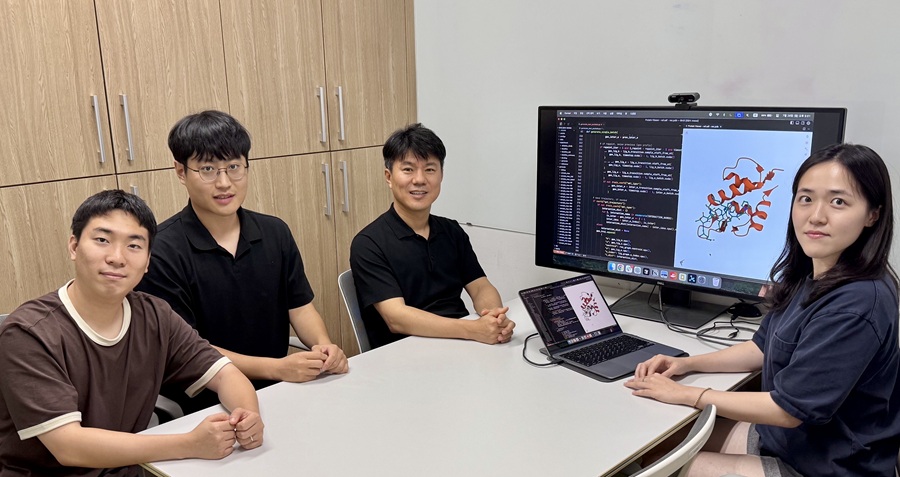 KAIST Develops AI That Automatically Designs Optimal Drug Candidates for Cancer-Targeting Mutations
< (From left) Ph.D candidate Wonho Zhung, Ph.D cadidate Joongwon Lee , Prof. Woo Young Kim , Ph.D candidate Jisu Seo >
Traditional drug development methods involve identifying a target protin (e.g., a cancer cell receptor) that causes disease, and then searching through countless molecular candidates (potential drugs) that could bind to that protein and block its function. This process is costly, time-consuming, and has a low success rate. KAIST researchers have developed an AI model that, using only information about the target protein, can design optimal drug candidates without any prior molecular data—opening up new possibilities for drug discovery.
KAIST (President Kwang Hyung Lee) announced on the 10th that a research team led by Professor Woo Youn Kim in the Department of Chemistry has developed an AI model named BInD (Bond and Interaction-generating Diffusion model), which can design and optimize drug candidate molecules tailored to a protein’s structure alone—without needing prior information about binding molecules. The model also predicts the binding mechanism (non-covalent interactions) between the drug and the target protein.
The core innovation of this technology lies in its “simultaneous design” approach. Previous AI models either focused on generating molecules or separately evaluating whether the generated molecule could bind to the target protein. In contrast, this new model considers the binding mechanism between the molecule and the protein during the generation process, enabling comprehensive design in one step. Since it pre-accounts for critical factors in protein-ligand binding, it has a much higher likelihood of generating effective and stable molecules. The generation process visually demonstrates how types and positions of atoms, covalent bonds, and interactions are created simultaneously to fit the protein’s binding site.
<Figure 1. Schematic of the diffusion model developed by the research team, which generates molecular structures and non-covalent interactions based on protein structures. Starting from a noise distribution, the model gradually removes noise (via reverse diffusion) to restore the atom positions, types, covalent bond types, and interaction types, thereby generating molecules. Interacting patterns are extracted from prior knowledge of known binding molecules or proteins, and through an inpainting technique, these patterns are kept fixed during the reverse diffusion process to guide the molecular generation.>
Moreover, this model is designed to meet multiple essential drug design criteria simultaneously—such as target binding affinity, drug-like properties, and structural stability. Traditional models often optimized for only one or two goals at the expense of others, but this new model balances various objectives, significantly enhancing its practical applicability.
The research team explained that the AI operates based on a “diffusion model”—a generative approach where a structure becomes increasingly refined from a random state. This is the same type of model used in AlphaFold 3, the 2024 Nobel Chemistry Prize-winning tool for protein-ligand structure generation, which has already demonstrated high efficiency.
Unlike AlphaFold 3, which provides spatial coordinates for atom positions, this study introduced a knowledge-based guide grounded in actual chemical laws—such as bond lengths and protein-ligand distances—enabling more chemically realistic structure generation.
<Figure 2. (Left) Target protein and the original bound molecule; (Right) Examples of molecules designed using the model developed in this study. The values for protein binding affinity (Vina), drug-likeness (QED), and synthetic accessibility (SA) are shown at the bottom.>
Additionally, the team applied an optimization strategy where outstanding binding patterns from prior results are reused. This allowed the model to generate even better drug candidates without additional training. Notably, the AI successfully produced molecules that selectively bind to the mutated residues of EGFR, a cancer-related target protein.
This study is also meaningful because it advances beyond the team’s previous research, which required prior input about the molecular conditions for the interaction pattern of protein binding.
Professor Woo Youn Kim commented that “the newly developed AI can learn and understand the key features required for strong binding to a target protein, and design optimal drug candidate molecules—even without any prior input. This could significantly shift the paradigm of drug development.” He added, “Since this technology generates molecular structures based on principles of chemical interactions, it is expected to enable faster and more reliable drug development.”
Joongwon Lee and Wonho Zhung, PhD students in the Department of Chemistry, participated as co-first authors of this study. The research results were published in the international journal Advanced Science (IF = 14.1) on July 11.
● Paper Title: BInD: Bond and Interaction-Generating Diffusion Model for Multi-Objective Structure-Based Drug Design
● DOI: 10.1002/advs.202502702
This research was supported by the National Research Foundation of Korea and the Ministry of Health and Welfare.
2025.08.12 View 5652
KAIST Develops AI That Automatically Designs Optimal Drug Candidates for Cancer-Targeting Mutations
< (From left) Ph.D candidate Wonho Zhung, Ph.D cadidate Joongwon Lee , Prof. Woo Young Kim , Ph.D candidate Jisu Seo >
Traditional drug development methods involve identifying a target protin (e.g., a cancer cell receptor) that causes disease, and then searching through countless molecular candidates (potential drugs) that could bind to that protein and block its function. This process is costly, time-consuming, and has a low success rate. KAIST researchers have developed an AI model that, using only information about the target protein, can design optimal drug candidates without any prior molecular data—opening up new possibilities for drug discovery.
KAIST (President Kwang Hyung Lee) announced on the 10th that a research team led by Professor Woo Youn Kim in the Department of Chemistry has developed an AI model named BInD (Bond and Interaction-generating Diffusion model), which can design and optimize drug candidate molecules tailored to a protein’s structure alone—without needing prior information about binding molecules. The model also predicts the binding mechanism (non-covalent interactions) between the drug and the target protein.
The core innovation of this technology lies in its “simultaneous design” approach. Previous AI models either focused on generating molecules or separately evaluating whether the generated molecule could bind to the target protein. In contrast, this new model considers the binding mechanism between the molecule and the protein during the generation process, enabling comprehensive design in one step. Since it pre-accounts for critical factors in protein-ligand binding, it has a much higher likelihood of generating effective and stable molecules. The generation process visually demonstrates how types and positions of atoms, covalent bonds, and interactions are created simultaneously to fit the protein’s binding site.
<Figure 1. Schematic of the diffusion model developed by the research team, which generates molecular structures and non-covalent interactions based on protein structures. Starting from a noise distribution, the model gradually removes noise (via reverse diffusion) to restore the atom positions, types, covalent bond types, and interaction types, thereby generating molecules. Interacting patterns are extracted from prior knowledge of known binding molecules or proteins, and through an inpainting technique, these patterns are kept fixed during the reverse diffusion process to guide the molecular generation.>
Moreover, this model is designed to meet multiple essential drug design criteria simultaneously—such as target binding affinity, drug-like properties, and structural stability. Traditional models often optimized for only one or two goals at the expense of others, but this new model balances various objectives, significantly enhancing its practical applicability.
The research team explained that the AI operates based on a “diffusion model”—a generative approach where a structure becomes increasingly refined from a random state. This is the same type of model used in AlphaFold 3, the 2024 Nobel Chemistry Prize-winning tool for protein-ligand structure generation, which has already demonstrated high efficiency.
Unlike AlphaFold 3, which provides spatial coordinates for atom positions, this study introduced a knowledge-based guide grounded in actual chemical laws—such as bond lengths and protein-ligand distances—enabling more chemically realistic structure generation.
<Figure 2. (Left) Target protein and the original bound molecule; (Right) Examples of molecules designed using the model developed in this study. The values for protein binding affinity (Vina), drug-likeness (QED), and synthetic accessibility (SA) are shown at the bottom.>
Additionally, the team applied an optimization strategy where outstanding binding patterns from prior results are reused. This allowed the model to generate even better drug candidates without additional training. Notably, the AI successfully produced molecules that selectively bind to the mutated residues of EGFR, a cancer-related target protein.
This study is also meaningful because it advances beyond the team’s previous research, which required prior input about the molecular conditions for the interaction pattern of protein binding.
Professor Woo Youn Kim commented that “the newly developed AI can learn and understand the key features required for strong binding to a target protein, and design optimal drug candidate molecules—even without any prior input. This could significantly shift the paradigm of drug development.” He added, “Since this technology generates molecular structures based on principles of chemical interactions, it is expected to enable faster and more reliable drug development.”
Joongwon Lee and Wonho Zhung, PhD students in the Department of Chemistry, participated as co-first authors of this study. The research results were published in the international journal Advanced Science (IF = 14.1) on July 11.
● Paper Title: BInD: Bond and Interaction-Generating Diffusion Model for Multi-Objective Structure-Based Drug Design
● DOI: 10.1002/advs.202502702
This research was supported by the National Research Foundation of Korea and the Ministry of Health and Welfare.
2025.08.12 View 5652 -
 KAIST’s Wearable Robot Design Wins ‘2025 Red Dot Award Best of the Best’
<Professor Hyunjoon Park, M.S candidate Eun-ju Kang, Prospective M.S candidate Jae-seong Kim, undergraduate student Min-su Kim>
A team led by Professor Hyunjoon Park from the Department of Industrial Design won the ‘Best of the Best’ award at the 2025 Red Dot Design Awards, one of the world's top three design awards, for their 'Angel Robotics WSF1 VISION Concept.'
The design for the next-generation wearable robot for people with paraplegia successfully implements functionality, aesthetics, and social inclusion. This latest achievement follows the team's iF Design Award win for the WalkON Suit F1 prototype, which also won a gold medal at the Cybathlon last year. This marks consecutive wins at top-tier international design awards.
KAIST (President Kwang-hyung Lee) announced on the 8th of August that Move Lab, a research team led by Professor Hyunjoon Park from the Department of Industrial Design, won the 'Best of the Best' award in the Design Concept-Professional category at the prestigious '2025 Red Dot Design Awards' for their next-generation wearable robot design, the ‘Angel Robotics WSF1 VISION Concept.’
The German 'Red Dot Design Awards' is one of the world's most well-known design competitions. It is considered one of the world's top three design awards along with Germany’s iF Design Awards and America’s IDEA. The ‘Best of the Best’ award is given to the best design in a category and is awarded only to a very select few of the top designs (within the top 1%) among all Red Dot Award winners.
Professor Hyunjoon Park’s team was honored with the ‘Best of the Best’ award for a user-friendly follow-up development of the ‘WalkON Suit F1 prototype,’ which won a gold medal at the 2024 Cybathlon and an iF Design Award in 2025.
<Figure 1. WSF1 Vision Concept Main Image>
This award-winning design is the result of industry-academic cooperation with Angel Robotics Inc., founded by Professor Kyoungchul Kong from the KAIST Department of Mechanical Engineering. It is a concept design that proposes a next-generation wearable robot (an ultra-personal mobility device) that can be used by people with paraplegia in their daily lives.
The research team focused on transforming Angel Robotics Inc.'s advanced engineering platform into an intuitive and emotional, user-centric experience, implementing a design solution that simultaneously possesses functionality, aesthetics, and social inclusion.
<Figure 2. WSF1 Vision Concept Full Exterior (Front View)>
The WSF1 VISION Concept includes innovative features implemented in Professor Kyoungchul Kong’s Exo Lab, such as:
An autonomous access function where the robot finds the user on its own.
A front-loading mechanism designed for the user to put it on alone while seated.
Multi-directional walking functionality realized through 12 powerful torque actuators and the latest control algorithms.
AI vision technology, along with a multi-visual display system that provides navigation and omnidirectional vision.
This provides users with a safer and more convenient mobility experience.
The strong yet elegant silhouette was achieved through a design process that pursued perfection in proportion, surfaces, and details not seen in existing wearable robots. In particular, the fabric cover that wraps around the entire thigh from the robot's hip joint is a stylish element that respects the wearer's self-esteem and individuality, like fashionable athletic wear. It also acts as a device for the wearer to psychologically feel safe in interacting with the robot and blending in with the general public. This presents a new aesthetic for wearable robots where function and form are harmonized.
<Figure 3. WSF1 Vision Concept's Operating Principle. It walks autonomously and is worn from the front while the user is seated.>
KAIST Professor Hyunjoon Park said of the award, "We are focusing on using technology, aesthetics, and human-centered innovation to present advanced technical solutions as easy, enjoyable, and cool experiences for users. Based on Angel Robotics Inc.'s vision of 'recreating human ability with technology,' the WSF1 VISION Concept aimed to break away from the traditional framework of wearable robots and deliver a design experience that adds dignity, independence, and new style to the user's life."
<Figure 4. WSF1 Vision Concept Detail Image>
A physical model of the WSF1 VISION Concept is scheduled to be unveiled in the Future Hall of the 2025 Gwangju Design Biennale from August 30 to November 2. The theme is 'Po-yong-ji-deok' (the virtue of inclusion), and it will showcase the role of design language in creating an inclusive future society.
<Figure 5. WSF1 Vision Concept: Image of a Person Wearing and Walking>
2025.08.09 View 5377
KAIST’s Wearable Robot Design Wins ‘2025 Red Dot Award Best of the Best’
<Professor Hyunjoon Park, M.S candidate Eun-ju Kang, Prospective M.S candidate Jae-seong Kim, undergraduate student Min-su Kim>
A team led by Professor Hyunjoon Park from the Department of Industrial Design won the ‘Best of the Best’ award at the 2025 Red Dot Design Awards, one of the world's top three design awards, for their 'Angel Robotics WSF1 VISION Concept.'
The design for the next-generation wearable robot for people with paraplegia successfully implements functionality, aesthetics, and social inclusion. This latest achievement follows the team's iF Design Award win for the WalkON Suit F1 prototype, which also won a gold medal at the Cybathlon last year. This marks consecutive wins at top-tier international design awards.
KAIST (President Kwang-hyung Lee) announced on the 8th of August that Move Lab, a research team led by Professor Hyunjoon Park from the Department of Industrial Design, won the 'Best of the Best' award in the Design Concept-Professional category at the prestigious '2025 Red Dot Design Awards' for their next-generation wearable robot design, the ‘Angel Robotics WSF1 VISION Concept.’
The German 'Red Dot Design Awards' is one of the world's most well-known design competitions. It is considered one of the world's top three design awards along with Germany’s iF Design Awards and America’s IDEA. The ‘Best of the Best’ award is given to the best design in a category and is awarded only to a very select few of the top designs (within the top 1%) among all Red Dot Award winners.
Professor Hyunjoon Park’s team was honored with the ‘Best of the Best’ award for a user-friendly follow-up development of the ‘WalkON Suit F1 prototype,’ which won a gold medal at the 2024 Cybathlon and an iF Design Award in 2025.
<Figure 1. WSF1 Vision Concept Main Image>
This award-winning design is the result of industry-academic cooperation with Angel Robotics Inc., founded by Professor Kyoungchul Kong from the KAIST Department of Mechanical Engineering. It is a concept design that proposes a next-generation wearable robot (an ultra-personal mobility device) that can be used by people with paraplegia in their daily lives.
The research team focused on transforming Angel Robotics Inc.'s advanced engineering platform into an intuitive and emotional, user-centric experience, implementing a design solution that simultaneously possesses functionality, aesthetics, and social inclusion.
<Figure 2. WSF1 Vision Concept Full Exterior (Front View)>
The WSF1 VISION Concept includes innovative features implemented in Professor Kyoungchul Kong’s Exo Lab, such as:
An autonomous access function where the robot finds the user on its own.
A front-loading mechanism designed for the user to put it on alone while seated.
Multi-directional walking functionality realized through 12 powerful torque actuators and the latest control algorithms.
AI vision technology, along with a multi-visual display system that provides navigation and omnidirectional vision.
This provides users with a safer and more convenient mobility experience.
The strong yet elegant silhouette was achieved through a design process that pursued perfection in proportion, surfaces, and details not seen in existing wearable robots. In particular, the fabric cover that wraps around the entire thigh from the robot's hip joint is a stylish element that respects the wearer's self-esteem and individuality, like fashionable athletic wear. It also acts as a device for the wearer to psychologically feel safe in interacting with the robot and blending in with the general public. This presents a new aesthetic for wearable robots where function and form are harmonized.
<Figure 3. WSF1 Vision Concept's Operating Principle. It walks autonomously and is worn from the front while the user is seated.>
KAIST Professor Hyunjoon Park said of the award, "We are focusing on using technology, aesthetics, and human-centered innovation to present advanced technical solutions as easy, enjoyable, and cool experiences for users. Based on Angel Robotics Inc.'s vision of 'recreating human ability with technology,' the WSF1 VISION Concept aimed to break away from the traditional framework of wearable robots and deliver a design experience that adds dignity, independence, and new style to the user's life."
<Figure 4. WSF1 Vision Concept Detail Image>
A physical model of the WSF1 VISION Concept is scheduled to be unveiled in the Future Hall of the 2025 Gwangju Design Biennale from August 30 to November 2. The theme is 'Po-yong-ji-deok' (the virtue of inclusion), and it will showcase the role of design language in creating an inclusive future society.
<Figure 5. WSF1 Vision Concept: Image of a Person Wearing and Walking>
2025.08.09 View 5377