%61%73%73%6f%63%69%61%74%69%6f%6e
-
 Distinguished Professor Sang Yup Lee, Senior Vice President for Research, to Lead Industry-Academic-Research Cooperation in Synthetic Biology
< Sang Yup Lee, Senior Vice President for Research at KAIST (Inaugural Chairman of the Korea Synthetic Biology Association) >
KAIST announced on February 27th that Sang Yup Lee, Distinguished Professor of the Department of Chemical and Biomolecular Engineering and Senior Vice President for Research, has been appointed as the inaugural chairman of the Korea Synthetic Biology Association (KSBA). This appointment was officially ratified during the association's 5th regular general meeting held on the 23rd.
The KSBA is a specialized consultative body established to promote cooperation in policy, industry, and research within the field of synthetic biology. Based on a network spanning industry, academia, research institutes, and government, the association supports the creation of a synthetic biology ecosystem as a national strategic technology and strengthens industrial competitiveness. It has contributed to the expansion of the domestic synthetic biology foundation through multifaceted activities such as policy proposals, international cooperation, human resource development, and industrial vitalization.
Through this appointment of the inaugural chairman, the association has established a unified leadership system and is set to formalize the operational foundation in line with the enforcement of the "Synthetic Biology Promotion Act."
At the general meeting, the 2025 business performance report was presented, and agendas for the ratification of the next chairman and the appointment of executives were resolved. Officials from the Ministry of Science and ICT also attended, expressing expectations for the association’s political role and future direction.
During the meeting, the ratification of Chairman Sang Yup Lee, who was elected by the Board of Directors in accordance with the articles of incorporation, was finally approved. Chairman Sang Yup Lee is a world-leading researcher who has pioneered the fields of synthetic biology and biotechnology. As the Senior Vice President for Research at KAIST, Head of the Metabolic Engineering National Research Laboratory, and Director of both the BioProcess Engineering Research Center and the Center for Synthetic Biology, he has led research innovation and the expansion of global cooperation. With this ratification, the KSBA has officially launched an integrated leadership system encompassing the establishment of mid-to-long-term strategies, strengthening industry-research links, and expanding global networks.
< Group photo of the Korea Synthetic Biology Association General Meeting (Chairman Sang Yup Lee, 5th from the bottom left) >
Chairman Sang Yup Lee stated, "Synthetic biology is a key strategic technology that will determine national competitiveness. We will ensure close cooperation between industry, academia, research, and government so that the purpose of laws and systems can lead to practical innovation in research and industrial fields."
Furthermore, the Board of Directors approved the appointment of directors and external auditors to enhance the accountability and transparency of organizational management, including Steering Committee Secretary Lee Seung-koo (Korea Research Institute of Bioscience and Biotechnology), as well as Park Han-oh (Bioneer), Kim장성 (Korea Research Institute of Bioscience and Biotechnology), Kim Dong-myung (Chungnam National University), Oh Min-kyu (Korea University), Cho Byung-kwan (KAIST), Yoon Hye-sun (Hanyang University), and Lee Do-heon (KAIST).
At this general meeting, the major contents of the "Synthetic Biology Promotion Act," scheduled for enforcement on April 23, and the corresponding legislative notice of the enforcement decree were shared. Prior to the enforcement of the law, the Ministry of Science and ICT prepared an enforcement decree specifying delegated matters and has been conducting a legislative notice for 40 days starting February 23. The enforcement decree includes: ▲Clarification of procedures for establishing the Basic Plan for Synthetic Biology Promotion and annual implementation plans ▲Establishment of standards for designating and operating research hubs and biofoundries ▲Materialization of safety management systems and inspection procedures.
The KSBA plans to actively pursue implementation strategies for each division so that the legislative intent of the enforcement decree can be practically realized in industrial and research fields.
The Policy and System Division will strengthen its policy advisory function to ensure that field opinions are reflected in the process of establishing basic and annual implementation plans. It will also continue to present directions for synthetic biology development and social infrastructure construction strategies through the ‘KSBA Policy Insight 2026’ report.
The Convergence Division aims to advance research systems based on data, AI, and automation to simultaneously secure research reliability and efficiency. It will also support the strengthening of technology standardization and safety management capabilities through the publication of convergence technology trend reports and the operation of workshops.
The Technology and Industry Division plans to specify industry-research linkage models that meet the standards for designating and operating research infrastructure such as biofoundries. It will also expand corporate cooperation networks to ensure that the implementation of the system leads to technology commercialization and manufacturing innovation.
The Education and Network Division will prepare a competition (IDEA-B) to discover next-generation talent and strengthen safety and ethics education to increase the accountability and expertise of synthetic biology research. Additionally, it plans to expand international cooperation to ensure that domestic systems harmonize with global norms.
The KSBA plans to further enhance the stability of organizational operations through this general meeting and expand its role as a hub institution connecting policy, industry, and research. In particular, under the unified leadership centered on Chairman Sang Yup Lee, it intends to serve as a bridge for private-public cooperation so that the intent of the "Synthetic Biology Promotion Act" can be practically implemented in the field.
< KSBA Policy Insight 2026 Report of the Korea Synthetic Biology Association >
2026.02.27 View 1563
Distinguished Professor Sang Yup Lee, Senior Vice President for Research, to Lead Industry-Academic-Research Cooperation in Synthetic Biology
< Sang Yup Lee, Senior Vice President for Research at KAIST (Inaugural Chairman of the Korea Synthetic Biology Association) >
KAIST announced on February 27th that Sang Yup Lee, Distinguished Professor of the Department of Chemical and Biomolecular Engineering and Senior Vice President for Research, has been appointed as the inaugural chairman of the Korea Synthetic Biology Association (KSBA). This appointment was officially ratified during the association's 5th regular general meeting held on the 23rd.
The KSBA is a specialized consultative body established to promote cooperation in policy, industry, and research within the field of synthetic biology. Based on a network spanning industry, academia, research institutes, and government, the association supports the creation of a synthetic biology ecosystem as a national strategic technology and strengthens industrial competitiveness. It has contributed to the expansion of the domestic synthetic biology foundation through multifaceted activities such as policy proposals, international cooperation, human resource development, and industrial vitalization.
Through this appointment of the inaugural chairman, the association has established a unified leadership system and is set to formalize the operational foundation in line with the enforcement of the "Synthetic Biology Promotion Act."
At the general meeting, the 2025 business performance report was presented, and agendas for the ratification of the next chairman and the appointment of executives were resolved. Officials from the Ministry of Science and ICT also attended, expressing expectations for the association’s political role and future direction.
During the meeting, the ratification of Chairman Sang Yup Lee, who was elected by the Board of Directors in accordance with the articles of incorporation, was finally approved. Chairman Sang Yup Lee is a world-leading researcher who has pioneered the fields of synthetic biology and biotechnology. As the Senior Vice President for Research at KAIST, Head of the Metabolic Engineering National Research Laboratory, and Director of both the BioProcess Engineering Research Center and the Center for Synthetic Biology, he has led research innovation and the expansion of global cooperation. With this ratification, the KSBA has officially launched an integrated leadership system encompassing the establishment of mid-to-long-term strategies, strengthening industry-research links, and expanding global networks.
< Group photo of the Korea Synthetic Biology Association General Meeting (Chairman Sang Yup Lee, 5th from the bottom left) >
Chairman Sang Yup Lee stated, "Synthetic biology is a key strategic technology that will determine national competitiveness. We will ensure close cooperation between industry, academia, research, and government so that the purpose of laws and systems can lead to practical innovation in research and industrial fields."
Furthermore, the Board of Directors approved the appointment of directors and external auditors to enhance the accountability and transparency of organizational management, including Steering Committee Secretary Lee Seung-koo (Korea Research Institute of Bioscience and Biotechnology), as well as Park Han-oh (Bioneer), Kim장성 (Korea Research Institute of Bioscience and Biotechnology), Kim Dong-myung (Chungnam National University), Oh Min-kyu (Korea University), Cho Byung-kwan (KAIST), Yoon Hye-sun (Hanyang University), and Lee Do-heon (KAIST).
At this general meeting, the major contents of the "Synthetic Biology Promotion Act," scheduled for enforcement on April 23, and the corresponding legislative notice of the enforcement decree were shared. Prior to the enforcement of the law, the Ministry of Science and ICT prepared an enforcement decree specifying delegated matters and has been conducting a legislative notice for 40 days starting February 23. The enforcement decree includes: ▲Clarification of procedures for establishing the Basic Plan for Synthetic Biology Promotion and annual implementation plans ▲Establishment of standards for designating and operating research hubs and biofoundries ▲Materialization of safety management systems and inspection procedures.
The KSBA plans to actively pursue implementation strategies for each division so that the legislative intent of the enforcement decree can be practically realized in industrial and research fields.
The Policy and System Division will strengthen its policy advisory function to ensure that field opinions are reflected in the process of establishing basic and annual implementation plans. It will also continue to present directions for synthetic biology development and social infrastructure construction strategies through the ‘KSBA Policy Insight 2026’ report.
The Convergence Division aims to advance research systems based on data, AI, and automation to simultaneously secure research reliability and efficiency. It will also support the strengthening of technology standardization and safety management capabilities through the publication of convergence technology trend reports and the operation of workshops.
The Technology and Industry Division plans to specify industry-research linkage models that meet the standards for designating and operating research infrastructure such as biofoundries. It will also expand corporate cooperation networks to ensure that the implementation of the system leads to technology commercialization and manufacturing innovation.
The Education and Network Division will prepare a competition (IDEA-B) to discover next-generation talent and strengthen safety and ethics education to increase the accountability and expertise of synthetic biology research. Additionally, it plans to expand international cooperation to ensure that domestic systems harmonize with global norms.
The KSBA plans to further enhance the stability of organizational operations through this general meeting and expand its role as a hub institution connecting policy, industry, and research. In particular, under the unified leadership centered on Chairman Sang Yup Lee, it intends to serve as a bridge for private-public cooperation so that the intent of the "Synthetic Biology Promotion Act" can be practically implemented in the field.
< KSBA Policy Insight 2026 Report of the Korea Synthetic Biology Association >
2026.02.27 View 1563 -
 Vieworks CEO Hu-sik Kim Appointed as 28th KAIST Alumni Association President
< Hu-sik Kim, 28th President of KAIST Alumni Association (CEO of Vieworks) >
KAIST announced on December 23rd that Hu-sik Kim, CEO of Vieworks—a company specializing in medical and industrial imaging solutions—has been appointed as the 28th President of the KAIST Alumni Association.
President-elect Hu-sik Kim, an alumnus with a Master’s degree in Physics (Class of ’95) from KAIST, is a technology-driven leader who has dedicated 26 years to the field of imaging solutions. He is recognized as a "field-oriented innovator" who has pioneered global niche markets with world-first technologies and driven long-term growth by prioritizing people and organizational culture as core competencies.
While working professionally, he enrolled in the KAIST Master’s program to strengthen his theoretical and practical expertise in optics. Later, he played a leading role in co-founding a venture company with fellow alumni, successfully growing Vieworks into a prominent global mid-sized enterprise.
In his inauguration remarks, President Kim stated, “I feel a profound sense of responsibility to give back to the nation and the community for the benefits I have received. I will do my best to ensure that the values of innovation and entrepreneurship are realized through our alumni network, and that the alumni association and our alma mater can prosper together.”
President Kim’s term will span two years starting from January 2026. The inauguration ceremony will be held during the "2026 New Year’s Greeting Ceremony" on January 16, 2026, at the El Tower in Seoul.
2025.12.23 View 1791
Vieworks CEO Hu-sik Kim Appointed as 28th KAIST Alumni Association President
< Hu-sik Kim, 28th President of KAIST Alumni Association (CEO of Vieworks) >
KAIST announced on December 23rd that Hu-sik Kim, CEO of Vieworks—a company specializing in medical and industrial imaging solutions—has been appointed as the 28th President of the KAIST Alumni Association.
President-elect Hu-sik Kim, an alumnus with a Master’s degree in Physics (Class of ’95) from KAIST, is a technology-driven leader who has dedicated 26 years to the field of imaging solutions. He is recognized as a "field-oriented innovator" who has pioneered global niche markets with world-first technologies and driven long-term growth by prioritizing people and organizational culture as core competencies.
While working professionally, he enrolled in the KAIST Master’s program to strengthen his theoretical and practical expertise in optics. Later, he played a leading role in co-founding a venture company with fellow alumni, successfully growing Vieworks into a prominent global mid-sized enterprise.
In his inauguration remarks, President Kim stated, “I feel a profound sense of responsibility to give back to the nation and the community for the benefits I have received. I will do my best to ensure that the values of innovation and entrepreneurship are realized through our alumni network, and that the alumni association and our alma mater can prosper together.”
President Kim’s term will span two years starting from January 2026. The inauguration ceremony will be held during the "2026 New Year’s Greeting Ceremony" on January 16, 2026, at the El Tower in Seoul.
2025.12.23 View 1791 -
 KAIST's Pioneering VR Precision Technology & Choreography Tool Receive Spotlights at CHI 2025
Accurate pointing in virtual spaces is essential for seamless interaction. If pointing is not precise, selecting the desired object becomes challenging, breaking user immersion and reducing overall experience quality. KAIST researchers have developed a technology that offers a vivid, lifelike experience in virtual space, alongside a new tool that assists choreographers throughout the creative process.
KAIST (President Kwang-Hyung Lee) announced on May 13th that a research team led by Professor Sang Ho Yoon of the Graduate School of Culture Technology, in collaboration with Professor Yang Zhang of the University of California, Los Angeles (UCLA), has developed the ‘T2IRay’ technology and the ‘ChoreoCraft’ platform, which enables choreographers to work more freely and creatively in virtual reality. These technologies received two Honorable Mention awards, recognizing the top 5% of papers, at CHI 2025*, the best international conference in the field of human-computer interaction, hosted by the Association for Computing Machinery (ACM) from April 25 to May 1.
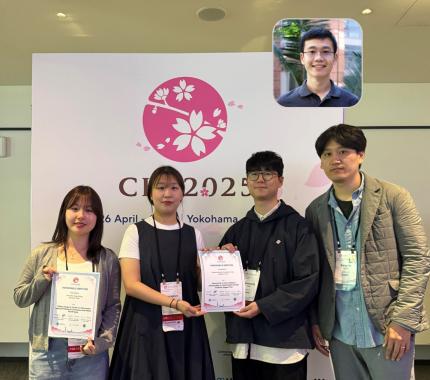
< (From left) PhD candidates Jina Kim and Kyungeun Jung along with Master's candidate, Hyunyoung Han and Professor Sang Ho Yoon of KAIST Graduate School of Culture Technology and Professor Yang Zhang (top) of UCLA >
T2IRay: Enabling Virtual Input with Precision
T2IRay introduces a novel input method that allows for precise object pointing in virtual environments by expanding traditional thumb-to-index gestures. This approach overcomes previous limitations, such as interruptions or reduced accuracy due to changes in hand position or orientation.
The technology uses a local coordinate system based on finger relationships, ensuring continuous input even as hand positions shift. It accurately captures subtle thumb movements within this coordinate system, integrating natural head movements to allow fluid, intuitive control across a wide range.
< Figure 1. T2IRay framework utilizing the delicate movements of the thumb and index fingers for AR/VR pointing >
Professor Sang Ho Yoon explained, “T2IRay can significantly enhance the user experience in AR/VR by enabling smooth, stable control even when the user’s hands are in motion.”
This study, led by first author Jina Kim, was supported by the Excellent New Researcher Support Project of the National Research Foundation of Korea under the Ministry of Science and ICT, as well as the University ICT Research Center (ITRC) Support Project of the Institute of Information and Communications Technology Planning and Evaluation (IITP).
▴ Paper title: T2IRay: Design of Thumb-to-Index Based Indirect Pointing for Continuous and Robust AR/VR Input▴ Paper link: https://doi.org/10.1145/3706598.3713442
▴ T2IRay demo video: https://youtu.be/ElJlcJbkJPY
ChoreoCraft: Creativity Support through VR for Choreographers
In addition, Professor Yoon’s team developed ‘ChoreoCraft,’ a virtual reality tool designed to support choreographers by addressing the unique challenges they face, such as memorizing complex movements, overcoming creative blocks, and managing subjective feedback.
ChoreoCraft reduces reliance on memory by allowing choreographers to save and refine movements directly within a VR space, using a motion-capture avatar for real-time interaction. It also enhances creativity by suggesting movements that naturally fit with prior choreography and musical elements. Furthermore, the system provides quantitative feedback by analyzing kinematic factors like motion stability and engagement, helping choreographers make data-driven creative decisions.
< Figure 2. ChoreoCraft's approaches to encourage creative process >
Professor Yoon noted, “ChoreoCraft is a tool designed to address the core challenges faced by choreographers, enhancing both creativity and efficiency. In user tests with professional choreographers, it received high marks for its ability to spark creative ideas and provide valuable quantitative feedback.”
This research was conducted in collaboration with doctoral candidate Kyungeun Jung and master’s candidate Hyunyoung Han, alongside the Electronics and Telecommunications Research Institute (ETRI) and One Million Co., Ltd. (CEO Hye-rang Kim), with support from the Cultural and Arts Immersive Service Development Project by the Ministry of Culture, Sports and Tourism.
▴ Paper title: ChoreoCraft: In-situ Crafting of Choreography in Virtual Reality through Creativity Support Tools▴ Paper link: https://doi.org/10.1145/3706598.3714220
▴ ChoreoCraft demo video: https://youtu.be/Ms1fwiSBjjw
*CHI (Conference on Human Factors in Computing Systems): The premier international conference on human-computer interaction, organized by the ACM, was held this year from April 25 to May 1, 2025.
2025.05.13 View 11837
KAIST's Pioneering VR Precision Technology & Choreography Tool Receive Spotlights at CHI 2025
Accurate pointing in virtual spaces is essential for seamless interaction. If pointing is not precise, selecting the desired object becomes challenging, breaking user immersion and reducing overall experience quality. KAIST researchers have developed a technology that offers a vivid, lifelike experience in virtual space, alongside a new tool that assists choreographers throughout the creative process.
KAIST (President Kwang-Hyung Lee) announced on May 13th that a research team led by Professor Sang Ho Yoon of the Graduate School of Culture Technology, in collaboration with Professor Yang Zhang of the University of California, Los Angeles (UCLA), has developed the ‘T2IRay’ technology and the ‘ChoreoCraft’ platform, which enables choreographers to work more freely and creatively in virtual reality. These technologies received two Honorable Mention awards, recognizing the top 5% of papers, at CHI 2025*, the best international conference in the field of human-computer interaction, hosted by the Association for Computing Machinery (ACM) from April 25 to May 1.
< (From left) PhD candidates Jina Kim and Kyungeun Jung along with Master's candidate, Hyunyoung Han and Professor Sang Ho Yoon of KAIST Graduate School of Culture Technology and Professor Yang Zhang (top) of UCLA >
T2IRay: Enabling Virtual Input with Precision
T2IRay introduces a novel input method that allows for precise object pointing in virtual environments by expanding traditional thumb-to-index gestures. This approach overcomes previous limitations, such as interruptions or reduced accuracy due to changes in hand position or orientation.
The technology uses a local coordinate system based on finger relationships, ensuring continuous input even as hand positions shift. It accurately captures subtle thumb movements within this coordinate system, integrating natural head movements to allow fluid, intuitive control across a wide range.
< Figure 1. T2IRay framework utilizing the delicate movements of the thumb and index fingers for AR/VR pointing >
Professor Sang Ho Yoon explained, “T2IRay can significantly enhance the user experience in AR/VR by enabling smooth, stable control even when the user’s hands are in motion.”
This study, led by first author Jina Kim, was supported by the Excellent New Researcher Support Project of the National Research Foundation of Korea under the Ministry of Science and ICT, as well as the University ICT Research Center (ITRC) Support Project of the Institute of Information and Communications Technology Planning and Evaluation (IITP).
▴ Paper title: T2IRay: Design of Thumb-to-Index Based Indirect Pointing for Continuous and Robust AR/VR Input▴ Paper link: https://doi.org/10.1145/3706598.3713442
▴ T2IRay demo video: https://youtu.be/ElJlcJbkJPY
ChoreoCraft: Creativity Support through VR for Choreographers
In addition, Professor Yoon’s team developed ‘ChoreoCraft,’ a virtual reality tool designed to support choreographers by addressing the unique challenges they face, such as memorizing complex movements, overcoming creative blocks, and managing subjective feedback.
ChoreoCraft reduces reliance on memory by allowing choreographers to save and refine movements directly within a VR space, using a motion-capture avatar for real-time interaction. It also enhances creativity by suggesting movements that naturally fit with prior choreography and musical elements. Furthermore, the system provides quantitative feedback by analyzing kinematic factors like motion stability and engagement, helping choreographers make data-driven creative decisions.
< Figure 2. ChoreoCraft's approaches to encourage creative process >
Professor Yoon noted, “ChoreoCraft is a tool designed to address the core challenges faced by choreographers, enhancing both creativity and efficiency. In user tests with professional choreographers, it received high marks for its ability to spark creative ideas and provide valuable quantitative feedback.”
This research was conducted in collaboration with doctoral candidate Kyungeun Jung and master’s candidate Hyunyoung Han, alongside the Electronics and Telecommunications Research Institute (ETRI) and One Million Co., Ltd. (CEO Hye-rang Kim), with support from the Cultural and Arts Immersive Service Development Project by the Ministry of Culture, Sports and Tourism.
▴ Paper title: ChoreoCraft: In-situ Crafting of Choreography in Virtual Reality through Creativity Support Tools▴ Paper link: https://doi.org/10.1145/3706598.3714220
▴ ChoreoCraft demo video: https://youtu.be/Ms1fwiSBjjw
*CHI (Conference on Human Factors in Computing Systems): The premier international conference on human-computer interaction, organized by the ACM, was held this year from April 25 to May 1, 2025.
2025.05.13 View 11837 -
 KAIST Alumni Association to Honor Alumni of the Year Award Winners
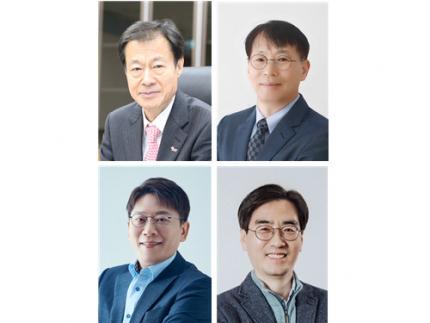
Photo 1. Photo of the KAIST Alumni of the Year Award Recipients
(From left) UST President Lee-whan Kim, CEO Han Chung of iThree Systems Co., Ltd., CEO Dong Myung Kim of LG Energy Solution Co., Ltd., and Professor Hyun Myung of the School of Electrical Engineering at KAIST
KAIST (President Kwang Hyung Lee) announced on Monday, the 13th of January that the Alumni Association (President Yun-Tae Lee) has selected its Alumni of the Year.
This year’s honorees are: ▴ President Lee-whan Kim of the Korea National University of Science and Technology (UST), ▴ CEO Han Chung of i3 Systems, ▴ CEO Dong Myung Kim of LG Energy Solution, and ▴ Professor Hyun Myung of the School of Electrical Engineering at KAIST.
The honorees were selected based on their achievements over the past year, and the award ceremony will be held at the 2025 KAIST Alumni Association New Year’s Gathering to be held at the L Tower in Seoul at 5 PM on Friday the 17th.
The KAIST Alumni of the Year Award is an award presented by the Alumni Association to alumni who have contributed to the development of the country and the society or have brought honor to their alma mater through outstanding academic achievements and community service. Since its establishment in 1992, 126 recipients have been awarded.
Lee-whan Kim (Master's graduate of Mechanical Engineering, 82), the President of the Korea National University of Science and Technology (UST), established a leading foundation for national science and technology policy and strategy, and played a leading role in innovating national science and technology capabilities through the advancement of the national research and development system and the advancement of science and technology personnel training. In particular, he played a pivotal role in the establishment of UST and the Korea Science Academy (KSA), and greatly contributed to establishing a foundation for the training and utilization of science and technology personnel.
Han Chung (Master's graduate of Electrical Engineering, 91, with Ph.D. degree in 96), the CEO of i3 Systems, is a first-generation researcher in the field of domestic infrared detectors. He developed military detectors for over 30 years and founded i3 Systems, a specialized infrared detector company, in 1998. Currently, he supplies more than 80% of the infrared detectors used by the Korean military, and has also achieved export results to over 20 countries.
Dong Myung Kim (Master's graduate of Materials Science and Engineering, 94, with Ph.D. degree in 98) the CEO of LG Energy Solution Co., Ltd. has led innovation in the battery field with his ceaseless exploration and challenging spirit, and is known as an authority in the secondary battery industry. He played a leading role in establishing K-Battery as a global leader, strengthened the country's future industrial competitiveness, and greatly contributed to the development of science and technology.
Hyun Myung (Bachelor's graduate of Electrical Engineering, 92, with Master's degree in 94, and Ph.D. degree in 98) a Professor of Electrical Engineering, KAIST, won first place in the world at the Quadruped Robot Challenge (QRC) hosted by the IEEE’s International Conference on Robotics and Automation (ICRA) 2023 with the 'DreamWaQ' system, an AI walking technology based on deep reinforcement learning that utilizes non-video sensory technologies. He contributed to enhancing the competitiveness of the domestic robot industry by developing his own fully autonomous walking technology that recognizes the environment around the robot and finds the optimal path.
Yun-Tae Lee, the 27th president of the KAIST Alumni Association, said, “KAIST alumni have been the driving force behind the growth of industries in all walks of life by continuously conducting research and development in the field of advanced science and technology for a long time,” and added, “I am very proud of the KAIST alumni award recipients who are leading science and technology on the world stage beyond Korea, and I sincerely thank them for their efforts and achievements.”
2025.01.15 View 13526
KAIST Alumni Association to Honor Alumni of the Year Award Winners
Photo 1. Photo of the KAIST Alumni of the Year Award Recipients
(From left) UST President Lee-whan Kim, CEO Han Chung of iThree Systems Co., Ltd., CEO Dong Myung Kim of LG Energy Solution Co., Ltd., and Professor Hyun Myung of the School of Electrical Engineering at KAIST
KAIST (President Kwang Hyung Lee) announced on Monday, the 13th of January that the Alumni Association (President Yun-Tae Lee) has selected its Alumni of the Year.
This year’s honorees are: ▴ President Lee-whan Kim of the Korea National University of Science and Technology (UST), ▴ CEO Han Chung of i3 Systems, ▴ CEO Dong Myung Kim of LG Energy Solution, and ▴ Professor Hyun Myung of the School of Electrical Engineering at KAIST.
The honorees were selected based on their achievements over the past year, and the award ceremony will be held at the 2025 KAIST Alumni Association New Year’s Gathering to be held at the L Tower in Seoul at 5 PM on Friday the 17th.
The KAIST Alumni of the Year Award is an award presented by the Alumni Association to alumni who have contributed to the development of the country and the society or have brought honor to their alma mater through outstanding academic achievements and community service. Since its establishment in 1992, 126 recipients have been awarded.
Lee-whan Kim (Master's graduate of Mechanical Engineering, 82), the President of the Korea National University of Science and Technology (UST), established a leading foundation for national science and technology policy and strategy, and played a leading role in innovating national science and technology capabilities through the advancement of the national research and development system and the advancement of science and technology personnel training. In particular, he played a pivotal role in the establishment of UST and the Korea Science Academy (KSA), and greatly contributed to establishing a foundation for the training and utilization of science and technology personnel.
Han Chung (Master's graduate of Electrical Engineering, 91, with Ph.D. degree in 96), the CEO of i3 Systems, is a first-generation researcher in the field of domestic infrared detectors. He developed military detectors for over 30 years and founded i3 Systems, a specialized infrared detector company, in 1998. Currently, he supplies more than 80% of the infrared detectors used by the Korean military, and has also achieved export results to over 20 countries.
Dong Myung Kim (Master's graduate of Materials Science and Engineering, 94, with Ph.D. degree in 98) the CEO of LG Energy Solution Co., Ltd. has led innovation in the battery field with his ceaseless exploration and challenging spirit, and is known as an authority in the secondary battery industry. He played a leading role in establishing K-Battery as a global leader, strengthened the country's future industrial competitiveness, and greatly contributed to the development of science and technology.
Hyun Myung (Bachelor's graduate of Electrical Engineering, 92, with Master's degree in 94, and Ph.D. degree in 98) a Professor of Electrical Engineering, KAIST, won first place in the world at the Quadruped Robot Challenge (QRC) hosted by the IEEE’s International Conference on Robotics and Automation (ICRA) 2023 with the 'DreamWaQ' system, an AI walking technology based on deep reinforcement learning that utilizes non-video sensory technologies. He contributed to enhancing the competitiveness of the domestic robot industry by developing his own fully autonomous walking technology that recognizes the environment around the robot and finds the optimal path.
Yun-Tae Lee, the 27th president of the KAIST Alumni Association, said, “KAIST alumni have been the driving force behind the growth of industries in all walks of life by continuously conducting research and development in the field of advanced science and technology for a long time,” and added, “I am very proud of the KAIST alumni award recipients who are leading science and technology on the world stage beyond Korea, and I sincerely thank them for their efforts and achievements.”
2025.01.15 View 13526 -
 KAIST Professor Uichin Lee Receives Distinguished Paper Award from ACM
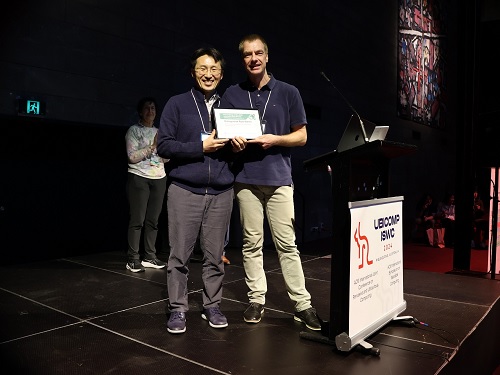
< Photo. Professor Uichin Lee (left) receiving the award >
KAIST (President Kwang Hyung Lee) announced on the 25th of October that Professor Uichin Lee’s research team from the School of Computing received the Distinguished Paper Award at the International Joint Conference on Pervasive and Ubiquitous Computing and International Symposium on Wearable Computing (Ubicomp / ISWC) hosted by the Association for Computing Machinery (ACM) in Melbourne, Australia on October 8.
The ACM Ubiquitous Computing Conference is the most prestigious international conference where leading universities and global companies from around the world present the latest research results on ubiquitous computing and wearable technologies in the field of human-computer interaction (HCI).
The main conference program is composed of invited papers published in the Proceedings of the ACM (PACM) on Interactive, Mobile, Wearable and Ubiquitous Technologies (IMWUT), which covers the latest research in the field of ubiquitous and wearable computing.
The Distinguished Paper Award Selection Committee selected eight papers among 205 papers published in Vol. 7 of the ACM Proceedings (PACM IMWUT) that made outstanding and exemplary contributions to the research community. The committee consists of 16 prominent experts who are current and former members of the journal's editorial board which made the selection after a rigorous review of all papers for a period that stretched over a month.
< Figure 1. BeActive mobile app to promote physical activity to form active lifestyle habits >
The research that won the Distinguished Paper Award was conducted by Dr. Junyoung Park, a graduate of the KAIST Graduate School of Data Science, as the 1st author, and was titled “Understanding Disengagement in Just-in-Time Mobile Health Interventions”
Professor Uichin Lee’s research team explored user engagement of ‘Just-in-Time Mobile Health Interventions’ that actively provide interventions in opportune situations by utilizing sensor data collected from health management apps, based on the premise that these apps are aptly in use to ensure effectiveness.
< Figure 2. Traditional user-requested digital behavior change intervention (DBCI) delivery (Pull) vs. Automatic transmission (Push) for Just-in-Time (JIT) mobile DBCI using smartphone sensing technologies >
The research team conducted a systematic analysis of user disengagement or the decline in user engagement in digital behavior change interventions. They developed the BeActive system, an app that promotes physical activities designed to help forming active lifestyle habits, and systematically analyzed the effects of users’ self-control ability and boredom-proneness on compliance with behavioral interventions over time.
The results of an 8-week field trial revealed that even if just-in-time interventions are provided according to the user’s situation, it is impossible to avoid a decline in participation. However, for users with high self-control and low boredom tendency, the compliance with just-in-time interventions delivered through the app was significantly higher than that of users in other groups.
In particular, users with high boredom proneness easily got tired of the repeated push interventions, and their compliance with the app decreased more quickly than in other groups.
< Figure 3. Just-in-time Mobile Health Intervention: a demonstrative case of the BeActive system: When a user is identified to be sitting for more than 50 mins, an automatic push notification is sent to recommend a short active break to complete for reward points. >
Professor Uichin Lee explained, “As the first study on user engagement in digital therapeutics and wellness services utilizing mobile just-in-time health interventions, this research provides a foundation for exploring ways to empower user engagement.” He further added, “By leveraging large language models (LLMs) and comprehensive context-aware technologies, it will be possible to develop user-centered AI technologies that can significantly boost engagement."
< Figure 4. A conceptual illustration of user engagement in digital health apps. Engagement in digital health apps consists of (1) engagement in using digital health apps and (2) engagement in behavioral interventions provided by digital health apps, i.e., compliance with behavioral interventions. Repeated adherences to behavioral interventions recommended by digital health apps can help achieve the distal health goals. >
This study was conducted with the support of the 2021 Biomedical Technology Development Program and the 2022 Basic Research and Development Program of the National Research Foundation of Korea funded by the Ministry of Science and ICT.
< Figure 5. A conceptual illustration of user disengagement and engagement of digital behavior change intervention (DBCI) apps. In general, user engagement of digital health intervention apps consists of two components: engagement in digital health apps and engagement in behavioral interventions recommended by such apps (known as behavioral compliance or intervention adherence). The distinctive stages of user can be divided into adoption, abandonment, and attrition. >
< Figure 6. Trends of changes in frequency of app usage and adherence to behavioral intervention over 8 weeks, ● SC: Self-Control Ability (High-SC: user group with high self-control, Low-SC: user group with low self-control) ● BD: Boredom-Proneness (High-BD: user group with high boredom-proneness, Low-BD: user group with low boredom-proneness). The app usage frequencies were declined over time, but the adherence rates of those participants with High-SC and Low-BD were significantly higher than other groups. >
2024.10.25 View 17913
KAIST Professor Uichin Lee Receives Distinguished Paper Award from ACM
< Photo. Professor Uichin Lee (left) receiving the award >
KAIST (President Kwang Hyung Lee) announced on the 25th of October that Professor Uichin Lee’s research team from the School of Computing received the Distinguished Paper Award at the International Joint Conference on Pervasive and Ubiquitous Computing and International Symposium on Wearable Computing (Ubicomp / ISWC) hosted by the Association for Computing Machinery (ACM) in Melbourne, Australia on October 8.
The ACM Ubiquitous Computing Conference is the most prestigious international conference where leading universities and global companies from around the world present the latest research results on ubiquitous computing and wearable technologies in the field of human-computer interaction (HCI).
The main conference program is composed of invited papers published in the Proceedings of the ACM (PACM) on Interactive, Mobile, Wearable and Ubiquitous Technologies (IMWUT), which covers the latest research in the field of ubiquitous and wearable computing.
The Distinguished Paper Award Selection Committee selected eight papers among 205 papers published in Vol. 7 of the ACM Proceedings (PACM IMWUT) that made outstanding and exemplary contributions to the research community. The committee consists of 16 prominent experts who are current and former members of the journal's editorial board which made the selection after a rigorous review of all papers for a period that stretched over a month.
< Figure 1. BeActive mobile app to promote physical activity to form active lifestyle habits >
The research that won the Distinguished Paper Award was conducted by Dr. Junyoung Park, a graduate of the KAIST Graduate School of Data Science, as the 1st author, and was titled “Understanding Disengagement in Just-in-Time Mobile Health Interventions”
Professor Uichin Lee’s research team explored user engagement of ‘Just-in-Time Mobile Health Interventions’ that actively provide interventions in opportune situations by utilizing sensor data collected from health management apps, based on the premise that these apps are aptly in use to ensure effectiveness.
< Figure 2. Traditional user-requested digital behavior change intervention (DBCI) delivery (Pull) vs. Automatic transmission (Push) for Just-in-Time (JIT) mobile DBCI using smartphone sensing technologies >
The research team conducted a systematic analysis of user disengagement or the decline in user engagement in digital behavior change interventions. They developed the BeActive system, an app that promotes physical activities designed to help forming active lifestyle habits, and systematically analyzed the effects of users’ self-control ability and boredom-proneness on compliance with behavioral interventions over time.
The results of an 8-week field trial revealed that even if just-in-time interventions are provided according to the user’s situation, it is impossible to avoid a decline in participation. However, for users with high self-control and low boredom tendency, the compliance with just-in-time interventions delivered through the app was significantly higher than that of users in other groups.
In particular, users with high boredom proneness easily got tired of the repeated push interventions, and their compliance with the app decreased more quickly than in other groups.
< Figure 3. Just-in-time Mobile Health Intervention: a demonstrative case of the BeActive system: When a user is identified to be sitting for more than 50 mins, an automatic push notification is sent to recommend a short active break to complete for reward points. >
Professor Uichin Lee explained, “As the first study on user engagement in digital therapeutics and wellness services utilizing mobile just-in-time health interventions, this research provides a foundation for exploring ways to empower user engagement.” He further added, “By leveraging large language models (LLMs) and comprehensive context-aware technologies, it will be possible to develop user-centered AI technologies that can significantly boost engagement."
< Figure 4. A conceptual illustration of user engagement in digital health apps. Engagement in digital health apps consists of (1) engagement in using digital health apps and (2) engagement in behavioral interventions provided by digital health apps, i.e., compliance with behavioral interventions. Repeated adherences to behavioral interventions recommended by digital health apps can help achieve the distal health goals. >
This study was conducted with the support of the 2021 Biomedical Technology Development Program and the 2022 Basic Research and Development Program of the National Research Foundation of Korea funded by the Ministry of Science and ICT.
< Figure 5. A conceptual illustration of user disengagement and engagement of digital behavior change intervention (DBCI) apps. In general, user engagement of digital health intervention apps consists of two components: engagement in digital health apps and engagement in behavioral interventions recommended by such apps (known as behavioral compliance or intervention adherence). The distinctive stages of user can be divided into adoption, abandonment, and attrition. >
< Figure 6. Trends of changes in frequency of app usage and adherence to behavioral intervention over 8 weeks, ● SC: Self-Control Ability (High-SC: user group with high self-control, Low-SC: user group with low self-control) ● BD: Boredom-Proneness (High-BD: user group with high boredom-proneness, Low-BD: user group with low boredom-proneness). The app usage frequencies were declined over time, but the adherence rates of those participants with High-SC and Low-BD were significantly higher than other groups. >
2024.10.25 View 17913 -
 Dr. Bong-Joon Jung Elected as Interim President of KAIST U.S. Alumni Association
On April 29th, 2024, the Office of Global Initiative at KAIST, led by Vice President Man-Sung Yim, successfully conducted the election for the interim president of the KAIST U.S. Alumni Association. The authority to organize and operate the election was delegated by the KAIST U.S. Alumni Interim President Selection Committee Foundation, consisting of Je Woo Kim, Director of KAIST U.S. Foundation; Terri Kim, Director of KAIST U.S. Foundation; and Myungjin Yim, President of the KAIST Silicon Valley Alumni Association.
The election was announced during the KAIST Online U.S. Alumni Event held on December 8th, 2023, with the aim of establishing interim executive principles for six months and ultimately forming the official executive body of the KAIST U.S. Alumni Association.
The election was conducted according to the requirements set by the KAIST U.S. Alumni Interim President Selection Committee Foundation, which stated that "if there is a single candidate, they will be elected if they receive more than half of the votes from participating voters." The voting period lasted from April 13th (Monday) to April 24th (Friday) and was specifically directed towards KAIST alumni living in the Americas.
All 50 eligible voters participated in the election, unanimously supporting Dr. Bong-Joon Jung (Ph.D., admitted in 1993, Department of Electrical Engineering) with a 100% approval rate as the interim president of the KAIST U.S. Alumni Association. Dr. Bong-Joon Jung currently serves as the Senior Technology Analyst and Partner at Ambex Venture Group and previously served as the President of the KAIST Silicon Valley Alumni Association. Dr. Jung expressed his intention to strengthen connections with KAIST alumni in the United States and contribute to the establishment of the U.S. alumni association as the interim president.
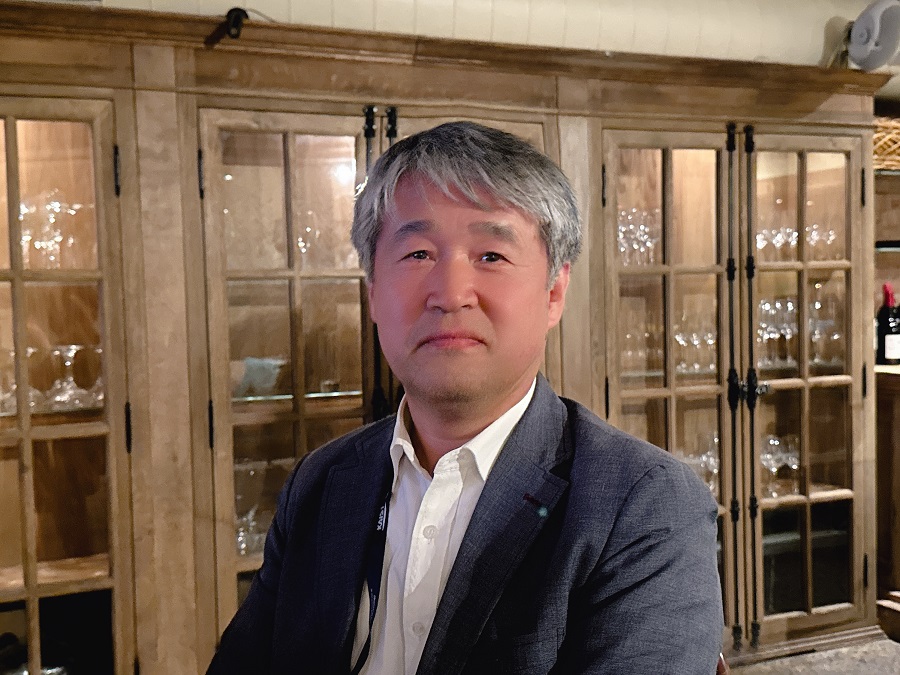
< Photo. Newly elected president of interim KAIST U.S. Alumni Association, Dr. Bong-Joon Jung. >
Man-Sung Yim, Vice President of the International Office, congratulated Dr. Bong-Joon Jung on his election and pledged continuous support for the activities of the interim KAIST U.S. Alumni Association, led by alumni. He stated, "The election of the interim president of the KAIST U.S. Alumni Association marks the beginning of active engagement not only from alumni associations in various regions but also from alumni across the Americas, reflecting sustained interest in their alma mater."
2024.04.29 View 10782
Dr. Bong-Joon Jung Elected as Interim President of KAIST U.S. Alumni Association
On April 29th, 2024, the Office of Global Initiative at KAIST, led by Vice President Man-Sung Yim, successfully conducted the election for the interim president of the KAIST U.S. Alumni Association. The authority to organize and operate the election was delegated by the KAIST U.S. Alumni Interim President Selection Committee Foundation, consisting of Je Woo Kim, Director of KAIST U.S. Foundation; Terri Kim, Director of KAIST U.S. Foundation; and Myungjin Yim, President of the KAIST Silicon Valley Alumni Association.
The election was announced during the KAIST Online U.S. Alumni Event held on December 8th, 2023, with the aim of establishing interim executive principles for six months and ultimately forming the official executive body of the KAIST U.S. Alumni Association.
The election was conducted according to the requirements set by the KAIST U.S. Alumni Interim President Selection Committee Foundation, which stated that "if there is a single candidate, they will be elected if they receive more than half of the votes from participating voters." The voting period lasted from April 13th (Monday) to April 24th (Friday) and was specifically directed towards KAIST alumni living in the Americas.
All 50 eligible voters participated in the election, unanimously supporting Dr. Bong-Joon Jung (Ph.D., admitted in 1993, Department of Electrical Engineering) with a 100% approval rate as the interim president of the KAIST U.S. Alumni Association. Dr. Bong-Joon Jung currently serves as the Senior Technology Analyst and Partner at Ambex Venture Group and previously served as the President of the KAIST Silicon Valley Alumni Association. Dr. Jung expressed his intention to strengthen connections with KAIST alumni in the United States and contribute to the establishment of the U.S. alumni association as the interim president.
< Photo. Newly elected president of interim KAIST U.S. Alumni Association, Dr. Bong-Joon Jung. >
Man-Sung Yim, Vice President of the International Office, congratulated Dr. Bong-Joon Jung on his election and pledged continuous support for the activities of the interim KAIST U.S. Alumni Association, led by alumni. He stated, "The election of the interim president of the KAIST U.S. Alumni Association marks the beginning of active engagement not only from alumni associations in various regions but also from alumni across the Americas, reflecting sustained interest in their alma mater."
2024.04.29 View 10782 -
 Center for Global Strategies and Planning Hosts Successful Virtual KAIST U.S. Alumni Connection Event
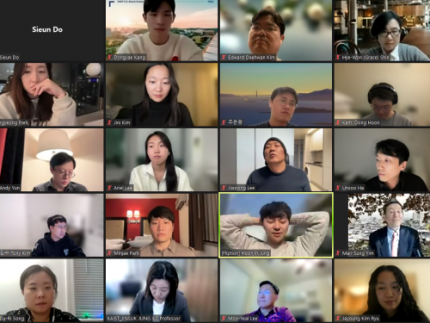
< Screen capture of the KAIST U.S. Alumni meeting held online on December 8 >
On December 8th, the Center for Global Strategies and Planning at KAIST, led by Vice President Man-Sung Yim of the International Office, conducted a virtual event to bring together KAIST alumni in the United States. The purpose of this event was to showcase KAIST's current initiatives in the U.S., facilitate information exchanges among U.S. alumni, and foster networking opportunities. Over 130 KAIST alumni based in the U.S. registered and attended the event.
The event began with a warm welcome from President Kwang-Hyung Lee, followed by a presentation from Vice President Man-Sung Yim on the current status and vision of KAIST's U.S. collaboration project as well as that of KAIST U.S. Foundation, Inc. Additionally, a distinguished KAIST alumnus, Seok-Hyun Yun, a professor from Harvard Medical School, delivered a keynote speech that highlighted the development of collaborative projects between KAIST and the United States. Alumni Hyun Gook Yoon, a manager at Ford Motor Company, and Eunkwang Joo, CEO of Wasder, also presented recent technological trends in the fields of batteries and blockchain, respectively.
President Kwang-Hyung Lee said, "This event serves as a crucial opportunity to enhance exchanges between KAIST and the U.S., playing a pivotal role in expanding KAIST's global presence." The event also featured small group discussions and networking sessions focusing on revitalizing collaborative efforts between KAIST and the United States.
After the small group discussions, a KAIST alumna and the current president of the Boston KAIST Alumni Association, Jiyoung Lee, shared her belief that the event will provide a meaningful opportunity for KAIST alumni from across the U.S. to come together and build a strong alumni community. Vice President Man-Sung Yim said, "Because collaboration with KAIST alumni in the U.S. is essential for the development of KAIST and innovative science and technology at the global level, we are committed to sustainably organizing meaningful events."
This virtual event for KAIST U.S. alumni has set a new milestone for global networking, marking the beginning of future collaborations and development.
2023.12.08 View 11182
Center for Global Strategies and Planning Hosts Successful Virtual KAIST U.S. Alumni Connection Event
< Screen capture of the KAIST U.S. Alumni meeting held online on December 8 >
On December 8th, the Center for Global Strategies and Planning at KAIST, led by Vice President Man-Sung Yim of the International Office, conducted a virtual event to bring together KAIST alumni in the United States. The purpose of this event was to showcase KAIST's current initiatives in the U.S., facilitate information exchanges among U.S. alumni, and foster networking opportunities. Over 130 KAIST alumni based in the U.S. registered and attended the event.
The event began with a warm welcome from President Kwang-Hyung Lee, followed by a presentation from Vice President Man-Sung Yim on the current status and vision of KAIST's U.S. collaboration project as well as that of KAIST U.S. Foundation, Inc. Additionally, a distinguished KAIST alumnus, Seok-Hyun Yun, a professor from Harvard Medical School, delivered a keynote speech that highlighted the development of collaborative projects between KAIST and the United States. Alumni Hyun Gook Yoon, a manager at Ford Motor Company, and Eunkwang Joo, CEO of Wasder, also presented recent technological trends in the fields of batteries and blockchain, respectively.
President Kwang-Hyung Lee said, "This event serves as a crucial opportunity to enhance exchanges between KAIST and the U.S., playing a pivotal role in expanding KAIST's global presence." The event also featured small group discussions and networking sessions focusing on revitalizing collaborative efforts between KAIST and the United States.
After the small group discussions, a KAIST alumna and the current president of the Boston KAIST Alumni Association, Jiyoung Lee, shared her belief that the event will provide a meaningful opportunity for KAIST alumni from across the U.S. to come together and build a strong alumni community. Vice President Man-Sung Yim said, "Because collaboration with KAIST alumni in the U.S. is essential for the development of KAIST and innovative science and technology at the global level, we are committed to sustainably organizing meaningful events."
This virtual event for KAIST U.S. alumni has set a new milestone for global networking, marking the beginning of future collaborations and development.
2023.12.08 View 11182 -
 KAIST holds its first ‘KAIST Tech Fair’ in New York, USA
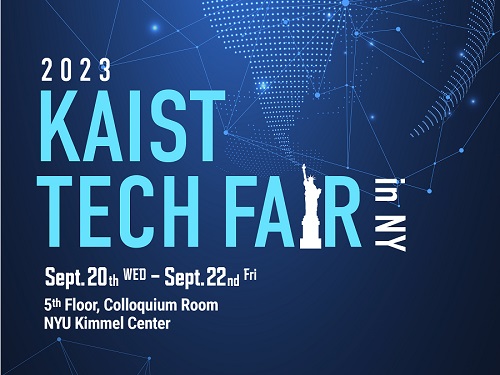
< Photo 1. 2023 KAIST Tech Fair in New York >
KAIST (President Kwang-Hyung Lee) announced on the 11th that it will hold the ‘2023 KAIST Tech Fair in New York’ at the Kimmel Center at New York University in Manhattan, USA, on the 22nd of this month. It is an event designed to be the starting point for KAIST to expand its startup ecosystem into the global stage, and it is to attract investments and secure global customers in New York by demonstrating the technological value of KAIST startup companies directly at location.
< Photo 2. President Kwang Hyung Lee at the 2023 KAIST Tech Fair in New York >
KAIST has been holding briefing sessions for technology transfer in Korea every year since 2018, and this year is the first time to hold a tech fair overseas for global companies.
KAIST Institute of Technology Value Creation (Director Sung-Yool Choi) has prepared for this event over the past six months with the Korea International Trade Association (hereinafter KITA, CEO Christopher Koo) to survey customer base and investment companies to conduct market analysis.
Among the companies founded with the technologies developed by the faculty and students of KAIST and their partners, 7 companies were selected to be matched with companies overseas that expressed interests in these technologies. Global multinational companies in the fields of IT, artificial intelligence, environment, logistics, distribution, and retail are participating as demand agencies and are testing the marketability of the start-up's technology as of September.
Daim Research, founded by Professor Young Jae Jang of the Department of Industrial and Systems Engineering, is a company specializing in smart factory automation solutions and is knocking on the door of the global market with a platform technology optimized for automated logistics systems.
< Photo 3. Presentation by Professor Young Jae Jang for DAIM Research >
It is a ‘collaborative intelligence’ solution that maximizes work productivity by having a number of robots used in industrial settings collaborate with one another. The strength of their solution is that logistics robots equipped with AI reinforced learning technology can respond to processes and environmental changes on their own, minimizing maintenance costs and the system can achieve excellent performance even with a small amount of data when it is combined with the digital twin technology the company has developed on its own.
A student startup, ‘Aniai’, is entering the US market, the home of hamburgers, with hamburger patty automation equipments and solutions. This is a robot kitchen startup founded by its CEO Gunpil Hwang, a graduate of KAIST’s School of Electrical Engineering which gathered together the experts in the fields of robot control, design, and artificial intelligence and cognitive technology to develop technology to automatically cook hamburger patties.
At the touch of a button, both sides of the patty are cooked simultaneously for consistent taste and quality according to the set condition. Since it can cook about 200 dishes in an hour, it is attracting attention as a technology that can not only solve manpower shortages but also accelerate the digital transformation of the restaurant industry.
Also, at the tech fair to be held at the Kimmel Center of New York University on the 22nd, the following startups who are currently under market verification in the U.S. will be participating: ▴'TheWaveTalk', which developed a water quality management system that can measure external substances and metal ions by transferring original technology from KAIST; ▴‘VIRNECT’, which helps workers improve their skills by remotely managing industrial sites using XR*; ▴‘Datumo’, a solution that helps process and analyze artificial intelligence big data, ▴‘VESSL AI’, the provider of a solution to eliminate the overhead** of machine learning systems; and ▴ ‘DolbomDream’, which developed an inflatable vest that helps the psychological stability of people with developmental disabilities.
* XR (eXtended Reality): Ultra-realistic technology that enhances immersion by utilizing augmented reality, virtual reality, and mixed reality technologies
** Overhead: Additional time required for stable processing of the program
In addition, two companies (Plasmapp and NotaAI) that are participating in the D-Unicorn program with the support of the Daejeon City and two companies (Enget and ILIAS Biologics) that are receiving support from the Scale Up Tips of the Ministry of SMEs and Startups, three companies (WiPowerOne, IDK Lab, and Artificial Photosynthesis Lab) that are continuing to realize the sustainable development goals for a total of 14 KAIST startups, will hold a corporate information session with about 100 invited guests from global companies and venture capital.
< Photo 4. Presentation for AP Lab >
Prior to this event, participating startups will be visiting the New York Economic Development Corporation and large law firms to receive advice on U.S. government support programs and on their attemps to enter the U.S. market. In addition, the participating companies plan to visit a startup support investment institution pursuing sustainable development goals and the Leslie eLab, New York University's one-stop startup support space, to lay the foundation for KAIST's leap forward in global technology commercialization.
< Photo 5. Sung-Yool Choi, the Director of KAIST Institute of Technology Value Creation (left) at the 2023 KAIST Tech Fair in New York with the key participants >
Sung-Yool Choi, the Director of KAIST Institute of Technology Value Creation, said, “KAIST prepared this event to realize its vision of being a leading university in creating global value.” He added, “We hope that our startups founded with KAIST technology would successfully completed market verification to be successful in securing global demands and in attracting investments for their endeavors.”
2023.09.11 View 31875
KAIST holds its first ‘KAIST Tech Fair’ in New York, USA
< Photo 1. 2023 KAIST Tech Fair in New York >
KAIST (President Kwang-Hyung Lee) announced on the 11th that it will hold the ‘2023 KAIST Tech Fair in New York’ at the Kimmel Center at New York University in Manhattan, USA, on the 22nd of this month. It is an event designed to be the starting point for KAIST to expand its startup ecosystem into the global stage, and it is to attract investments and secure global customers in New York by demonstrating the technological value of KAIST startup companies directly at location.
< Photo 2. President Kwang Hyung Lee at the 2023 KAIST Tech Fair in New York >
KAIST has been holding briefing sessions for technology transfer in Korea every year since 2018, and this year is the first time to hold a tech fair overseas for global companies.
KAIST Institute of Technology Value Creation (Director Sung-Yool Choi) has prepared for this event over the past six months with the Korea International Trade Association (hereinafter KITA, CEO Christopher Koo) to survey customer base and investment companies to conduct market analysis.
Among the companies founded with the technologies developed by the faculty and students of KAIST and their partners, 7 companies were selected to be matched with companies overseas that expressed interests in these technologies. Global multinational companies in the fields of IT, artificial intelligence, environment, logistics, distribution, and retail are participating as demand agencies and are testing the marketability of the start-up's technology as of September.
Daim Research, founded by Professor Young Jae Jang of the Department of Industrial and Systems Engineering, is a company specializing in smart factory automation solutions and is knocking on the door of the global market with a platform technology optimized for automated logistics systems.
< Photo 3. Presentation by Professor Young Jae Jang for DAIM Research >
It is a ‘collaborative intelligence’ solution that maximizes work productivity by having a number of robots used in industrial settings collaborate with one another. The strength of their solution is that logistics robots equipped with AI reinforced learning technology can respond to processes and environmental changes on their own, minimizing maintenance costs and the system can achieve excellent performance even with a small amount of data when it is combined with the digital twin technology the company has developed on its own.
A student startup, ‘Aniai’, is entering the US market, the home of hamburgers, with hamburger patty automation equipments and solutions. This is a robot kitchen startup founded by its CEO Gunpil Hwang, a graduate of KAIST’s School of Electrical Engineering which gathered together the experts in the fields of robot control, design, and artificial intelligence and cognitive technology to develop technology to automatically cook hamburger patties.
At the touch of a button, both sides of the patty are cooked simultaneously for consistent taste and quality according to the set condition. Since it can cook about 200 dishes in an hour, it is attracting attention as a technology that can not only solve manpower shortages but also accelerate the digital transformation of the restaurant industry.
Also, at the tech fair to be held at the Kimmel Center of New York University on the 22nd, the following startups who are currently under market verification in the U.S. will be participating: ▴'TheWaveTalk', which developed a water quality management system that can measure external substances and metal ions by transferring original technology from KAIST; ▴‘VIRNECT’, which helps workers improve their skills by remotely managing industrial sites using XR*; ▴‘Datumo’, a solution that helps process and analyze artificial intelligence big data, ▴‘VESSL AI’, the provider of a solution to eliminate the overhead** of machine learning systems; and ▴ ‘DolbomDream’, which developed an inflatable vest that helps the psychological stability of people with developmental disabilities.
* XR (eXtended Reality): Ultra-realistic technology that enhances immersion by utilizing augmented reality, virtual reality, and mixed reality technologies
** Overhead: Additional time required for stable processing of the program
In addition, two companies (Plasmapp and NotaAI) that are participating in the D-Unicorn program with the support of the Daejeon City and two companies (Enget and ILIAS Biologics) that are receiving support from the Scale Up Tips of the Ministry of SMEs and Startups, three companies (WiPowerOne, IDK Lab, and Artificial Photosynthesis Lab) that are continuing to realize the sustainable development goals for a total of 14 KAIST startups, will hold a corporate information session with about 100 invited guests from global companies and venture capital.
< Photo 4. Presentation for AP Lab >
Prior to this event, participating startups will be visiting the New York Economic Development Corporation and large law firms to receive advice on U.S. government support programs and on their attemps to enter the U.S. market. In addition, the participating companies plan to visit a startup support investment institution pursuing sustainable development goals and the Leslie eLab, New York University's one-stop startup support space, to lay the foundation for KAIST's leap forward in global technology commercialization.
< Photo 5. Sung-Yool Choi, the Director of KAIST Institute of Technology Value Creation (left) at the 2023 KAIST Tech Fair in New York with the key participants >
Sung-Yool Choi, the Director of KAIST Institute of Technology Value Creation, said, “KAIST prepared this event to realize its vision of being a leading university in creating global value.” He added, “We hope that our startups founded with KAIST technology would successfully completed market verification to be successful in securing global demands and in attracting investments for their endeavors.”
2023.09.11 View 31875 -
 KAIST Holds 2023 Commencement Ceremony
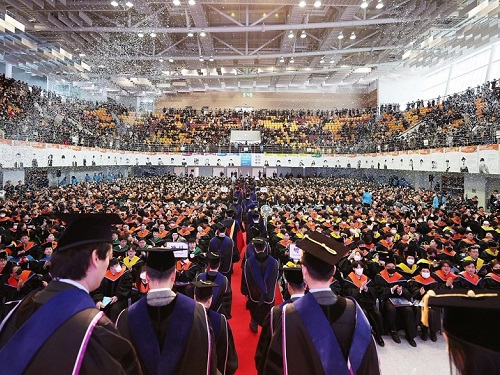
< Photo 1. On the 17th, KAIST held the 2023 Commencement Ceremony for a total of 2,870 students, including 691 doctors. >
KAIST held its 2023 commencement ceremony at the Sports Complex of its main campus in Daejeon at 2 p.m. on February 27. It was the first commencement ceremony to invite all its graduates since the start of COVID-19 quarantine measures.
KAIST awarded a total of 2,870 degrees including 691 PhD degrees, 1,464 master’s degrees, and 715 bachelor’s degrees, which adds to the total of 74,999 degrees KAIST has conferred since its foundation in 1971, which includes 15,772 PhD, 38,360 master’s and 20,867 bachelor’s degrees.
This year’s Cum Laude, Gabin Ryu, from the Department of Mechanical Engineering received the Minister of Science and ICT Award. Seung-ju Lee from the School of Computing received the Chairman of the KAIST Board of Trustees Award, while Jantakan Nedsaengtip, an international student from Thailand received the KAIST Presidential Award, and Jaeyong Hwang from the Department of Physics and Junmo Lee from the Department of Industrial and Systems Engineering each received the President of the Alumni Association Award and the Chairman of the KAIST Development Foundation Award, respectively.
Minister Jong-ho Lee of the Ministry of Science and ICT awarded the recipients of the academic awards and delivered a congratulatory speech.
Yujin Cha from the Department of Bio and Brain Engineering, who received a PhD degree after 19 years since his entrance to KAIST as an undergraduate student in 2004 gave a speech on behalf of the graduates to move and inspire the graduates and the guests.
After Cha received a bachelor’s degree from the Department of Nuclear and Quantum Engineering, he entered a medical graduate school and became a radiation oncology specialist. But after experiencing the death of a young patient who suffered from osteosarcoma, he returned to his alma mater to become a scientist. As he believes that science and technology is the ultimate solution to the limitations of modern medicine, he started as a PhD student at the Department of Bio and Brain Engineering in 2018, hoping to find such solutions.
During his course, he identified the characteristics of the decision-making process of doctors during diagnosis, and developed a brain-inspired AI algorithm. It is an original and challenging study that attempted to develop a fundamental machine learning theory from the data he collected from 200 doctors of different specialties.
Cha said, “Humans and AI can cooperate by humans utilizing the unique learning abilities of AI to develop our expertise, while AIs can mimic us humans’ learning abilities to improve.” He added, “My ultimate goal is to develop technology to a level at which humans and machines influence each other and ‘coevolve’, and applying it not only to medicine, but in all areas.”
Cha, who is currently an assistant professor at the KAIST Biomedical Research Center, has also written Artificial Intelligence for Doctors in 2017 to help medical personnel use AI in clinical fields, and the book was selected as one of the 2018 Sejong Books in the academic category.
During his speech at this year’s commencement ceremony, he shared that “there are so many things in the world that are difficult to solve and many things to solve them with, but I believe the things that can really broaden the horizons of the world and find fundamental solutions to the problems at hand are science and technology.”
Meanwhile, singer-songwriter Sae Byul Park who studied at the KAIST Graduate School of Culture Technology will also receive her PhD degree.
Natural language processing (NLP) is a field in AI that teaches a computer to understand and analyze human language that is actively being studied. An example of NLP is ChatGTP, which recently received a lot of attention. For her research, Park analyzed music rather than language using NLP technology.
To analyze music, which is in the form of sound, using the methods for NLP, it is necessary to rebuild notes and beats into a form of words or sentences as in a language. For this, Park designed an algorithm called Mel2Word and applied it to her research.
She also suggested that by converting melodies into texts for analysis, one would be able to quantitatively express music as sentences or words with meaning and context rather than as simple sounds representing a certain note.
Park said, “music has always been considered as a product of subjective emotion, but this research provides a framework that can calculate and analyze music.”
Park’s study can later be developed into a tool to measure the similarities between musical work, as well as a piece’s originality, artistry and popularity, and it can be used as a clue to explore the fundamental principles of how humans respond to music from a cognitive science perspective.
Park began her Ph.D. program in 2014, while carrying on with her musical activities as well as public and university lectures alongside, and dealing with personally major events including marriage and childbirth during the course of years. She already met the requirements to receive her degree in 2019, but delayed her graduation in order to improve the level of completion of her research, and finally graduated with her current achievements after nine years.
Professor Juhan Nam, who supervised Park’s research, said, “Park, who has a bachelor’s degree in psychology, later learned to code for graduate school, and has complete high-quality research in the field of artificial intelligence.” He added, “Though it took a long time, her attitude of not giving up until the end as a researcher is also excellent.”
Sae Byul Park is currently lecturing courses entitled Culture Technology and Music Information Retrieval at the Underwood International College of Yonsei University.
Park said, “the 10 or so years I’ve spent at KAIST as a graduate student was a time I could learn and prosper not only academically but from all angles of life.” She added, “having received a doctorate degree is not the end, but a ‘commencement’. Therefore, I will start to root deeper from the seeds I sowed and work harder as a both a scholar and an artist.”
< Photo 2. From left) Yujin Cha (Valedictorian, Medical-Scientist Program Ph.D. graduate), Saebyeol Park (a singer-songwriter, Ph.D. graduate from the Graduate School of Culture and Technology), Junseok Moon and Inah Seo (the two highlighted CEO graduates from the Department of Management Engineering's master’s program) >
Young entrepreneurs who dream of solving social problems will also be wearing their graduation caps. Two such graduates are Jun-seok Moon and Inah Seo, receiving their master’s degrees in social entrepreneurship MBA from the KAIST College of Business.
Before entrance, Moon ran a café helping African refugees stand on their own feet. Then, he entered KAIST to later expand his business and learn social entrepreneurship in order to sustainably help refugees in the blind spots of human rights and welfare.
During his master’s course, Moon realized that he could achieve active carbon reduction by changing the coffee alone, and switched his business field and founded Equal Table. The amount of carbon an individual can reduce by refraining from using a single paper cup is 10g, while changing the coffee itself can reduce it by 300g.
1kg of coffee emits 15kg of carbon over the course of its production, distribution, processing, and consumption, but Moon produces nearly carbon-neutral coffee beans by having innovated the entire process. In particular, the company-to-company ESG business solution is Moon’s new start-up area. It provides companies with carbon-reduced coffee made by roasting raw beans from carbon-neutral certified farms with 100% renewable energy, and shows how much carbon has been reduced in its making. Equal Table will launch the service this month in collaboration with SK Telecom, its first partner.
Inah Seo, who also graduated with Moon, founded Conscious Wear to start a fashion business reducing environmental pollution. In order to realize her mission, she felt the need to gain the appropriate expertise in management, and enrolled for the social entrepreneurship MBA.
Out of the various fashion industries, Seo focused on the leather market, which is worth 80 trillion won. Due to thickness or contamination issues, only about 60% of animal skin fabric is used, and the rest is discarded. Heavy metals are used during such processes, which also directly affects the environment.
During the social entrepreneurship MBA course, Seo collaborated with SK Chemicals, which had links through the program, and launched eco-friendly leather bags. The bags used discarded leather that was recycled by grinding and reprocessing into a biomaterial called PO3G. It was the first case in which PO3G that is over 90% biodegradable was applied to regenerated leather. In other words, it can reduce environmental pollution in the processing and disposal stages, while also reducing carbon emissions and water usage by one-tenth compared to existing cowhide products.
The social entrepreneurship MBA course, from which Moon and Seo graduated, will run in integration with the Graduate School of Green Growth as an Impact MBA program starting this year. KAIST plans to steadily foster entrepreneurs who will lead meaningful changes in the environment and society as well as economic values through innovative technologies and ideas.
< Photo 3. NYU President Emeritus John Sexton (left), who received this year's honorary doctorate of science, poses with President Kwang Hyung Lee >
Meanwhile, during this day’s commencement ceremony, KAIST also presented President Emeritus John Sexton of New York University with an honorary doctorate in science. He was recognized for laying the foundation for the cooperation between KAIST and New York University, such as promoting joint campuses.
< Photo 4. At the commencement ceremony of KAIST held on the 17th, President Kwang Hyung Lee is encouraging the graduates with his commencement address. >
President Kwang Hyung Lee emphasized in his commencement speech that, “if you can draw up the future and work hard toward your goal, the future can become a work of art that you create with your own hands,” and added, “Never stop on the journey toward your dreams, and do not give up even when you are met with failure. Failure happens to everyone, all the time. The important thing is to know 'why you failed', and to use those elements of failure as the driving force for the next try.”
2023.02.20 View 35530
KAIST Holds 2023 Commencement Ceremony
< Photo 1. On the 17th, KAIST held the 2023 Commencement Ceremony for a total of 2,870 students, including 691 doctors. >
KAIST held its 2023 commencement ceremony at the Sports Complex of its main campus in Daejeon at 2 p.m. on February 27. It was the first commencement ceremony to invite all its graduates since the start of COVID-19 quarantine measures.
KAIST awarded a total of 2,870 degrees including 691 PhD degrees, 1,464 master’s degrees, and 715 bachelor’s degrees, which adds to the total of 74,999 degrees KAIST has conferred since its foundation in 1971, which includes 15,772 PhD, 38,360 master’s and 20,867 bachelor’s degrees.
This year’s Cum Laude, Gabin Ryu, from the Department of Mechanical Engineering received the Minister of Science and ICT Award. Seung-ju Lee from the School of Computing received the Chairman of the KAIST Board of Trustees Award, while Jantakan Nedsaengtip, an international student from Thailand received the KAIST Presidential Award, and Jaeyong Hwang from the Department of Physics and Junmo Lee from the Department of Industrial and Systems Engineering each received the President of the Alumni Association Award and the Chairman of the KAIST Development Foundation Award, respectively.
Minister Jong-ho Lee of the Ministry of Science and ICT awarded the recipients of the academic awards and delivered a congratulatory speech.
Yujin Cha from the Department of Bio and Brain Engineering, who received a PhD degree after 19 years since his entrance to KAIST as an undergraduate student in 2004 gave a speech on behalf of the graduates to move and inspire the graduates and the guests.
After Cha received a bachelor’s degree from the Department of Nuclear and Quantum Engineering, he entered a medical graduate school and became a radiation oncology specialist. But after experiencing the death of a young patient who suffered from osteosarcoma, he returned to his alma mater to become a scientist. As he believes that science and technology is the ultimate solution to the limitations of modern medicine, he started as a PhD student at the Department of Bio and Brain Engineering in 2018, hoping to find such solutions.
During his course, he identified the characteristics of the decision-making process of doctors during diagnosis, and developed a brain-inspired AI algorithm. It is an original and challenging study that attempted to develop a fundamental machine learning theory from the data he collected from 200 doctors of different specialties.
Cha said, “Humans and AI can cooperate by humans utilizing the unique learning abilities of AI to develop our expertise, while AIs can mimic us humans’ learning abilities to improve.” He added, “My ultimate goal is to develop technology to a level at which humans and machines influence each other and ‘coevolve’, and applying it not only to medicine, but in all areas.”
Cha, who is currently an assistant professor at the KAIST Biomedical Research Center, has also written Artificial Intelligence for Doctors in 2017 to help medical personnel use AI in clinical fields, and the book was selected as one of the 2018 Sejong Books in the academic category.
During his speech at this year’s commencement ceremony, he shared that “there are so many things in the world that are difficult to solve and many things to solve them with, but I believe the things that can really broaden the horizons of the world and find fundamental solutions to the problems at hand are science and technology.”
Meanwhile, singer-songwriter Sae Byul Park who studied at the KAIST Graduate School of Culture Technology will also receive her PhD degree.
Natural language processing (NLP) is a field in AI that teaches a computer to understand and analyze human language that is actively being studied. An example of NLP is ChatGTP, which recently received a lot of attention. For her research, Park analyzed music rather than language using NLP technology.
To analyze music, which is in the form of sound, using the methods for NLP, it is necessary to rebuild notes and beats into a form of words or sentences as in a language. For this, Park designed an algorithm called Mel2Word and applied it to her research.
She also suggested that by converting melodies into texts for analysis, one would be able to quantitatively express music as sentences or words with meaning and context rather than as simple sounds representing a certain note.
Park said, “music has always been considered as a product of subjective emotion, but this research provides a framework that can calculate and analyze music.”
Park’s study can later be developed into a tool to measure the similarities between musical work, as well as a piece’s originality, artistry and popularity, and it can be used as a clue to explore the fundamental principles of how humans respond to music from a cognitive science perspective.
Park began her Ph.D. program in 2014, while carrying on with her musical activities as well as public and university lectures alongside, and dealing with personally major events including marriage and childbirth during the course of years. She already met the requirements to receive her degree in 2019, but delayed her graduation in order to improve the level of completion of her research, and finally graduated with her current achievements after nine years.
Professor Juhan Nam, who supervised Park’s research, said, “Park, who has a bachelor’s degree in psychology, later learned to code for graduate school, and has complete high-quality research in the field of artificial intelligence.” He added, “Though it took a long time, her attitude of not giving up until the end as a researcher is also excellent.”
Sae Byul Park is currently lecturing courses entitled Culture Technology and Music Information Retrieval at the Underwood International College of Yonsei University.
Park said, “the 10 or so years I’ve spent at KAIST as a graduate student was a time I could learn and prosper not only academically but from all angles of life.” She added, “having received a doctorate degree is not the end, but a ‘commencement’. Therefore, I will start to root deeper from the seeds I sowed and work harder as a both a scholar and an artist.”
< Photo 2. From left) Yujin Cha (Valedictorian, Medical-Scientist Program Ph.D. graduate), Saebyeol Park (a singer-songwriter, Ph.D. graduate from the Graduate School of Culture and Technology), Junseok Moon and Inah Seo (the two highlighted CEO graduates from the Department of Management Engineering's master’s program) >
Young entrepreneurs who dream of solving social problems will also be wearing their graduation caps. Two such graduates are Jun-seok Moon and Inah Seo, receiving their master’s degrees in social entrepreneurship MBA from the KAIST College of Business.
Before entrance, Moon ran a café helping African refugees stand on their own feet. Then, he entered KAIST to later expand his business and learn social entrepreneurship in order to sustainably help refugees in the blind spots of human rights and welfare.
During his master’s course, Moon realized that he could achieve active carbon reduction by changing the coffee alone, and switched his business field and founded Equal Table. The amount of carbon an individual can reduce by refraining from using a single paper cup is 10g, while changing the coffee itself can reduce it by 300g.
1kg of coffee emits 15kg of carbon over the course of its production, distribution, processing, and consumption, but Moon produces nearly carbon-neutral coffee beans by having innovated the entire process. In particular, the company-to-company ESG business solution is Moon’s new start-up area. It provides companies with carbon-reduced coffee made by roasting raw beans from carbon-neutral certified farms with 100% renewable energy, and shows how much carbon has been reduced in its making. Equal Table will launch the service this month in collaboration with SK Telecom, its first partner.
Inah Seo, who also graduated with Moon, founded Conscious Wear to start a fashion business reducing environmental pollution. In order to realize her mission, she felt the need to gain the appropriate expertise in management, and enrolled for the social entrepreneurship MBA.
Out of the various fashion industries, Seo focused on the leather market, which is worth 80 trillion won. Due to thickness or contamination issues, only about 60% of animal skin fabric is used, and the rest is discarded. Heavy metals are used during such processes, which also directly affects the environment.
During the social entrepreneurship MBA course, Seo collaborated with SK Chemicals, which had links through the program, and launched eco-friendly leather bags. The bags used discarded leather that was recycled by grinding and reprocessing into a biomaterial called PO3G. It was the first case in which PO3G that is over 90% biodegradable was applied to regenerated leather. In other words, it can reduce environmental pollution in the processing and disposal stages, while also reducing carbon emissions and water usage by one-tenth compared to existing cowhide products.
The social entrepreneurship MBA course, from which Moon and Seo graduated, will run in integration with the Graduate School of Green Growth as an Impact MBA program starting this year. KAIST plans to steadily foster entrepreneurs who will lead meaningful changes in the environment and society as well as economic values through innovative technologies and ideas.
< Photo 3. NYU President Emeritus John Sexton (left), who received this year's honorary doctorate of science, poses with President Kwang Hyung Lee >
Meanwhile, during this day’s commencement ceremony, KAIST also presented President Emeritus John Sexton of New York University with an honorary doctorate in science. He was recognized for laying the foundation for the cooperation between KAIST and New York University, such as promoting joint campuses.
< Photo 4. At the commencement ceremony of KAIST held on the 17th, President Kwang Hyung Lee is encouraging the graduates with his commencement address. >
President Kwang Hyung Lee emphasized in his commencement speech that, “if you can draw up the future and work hard toward your goal, the future can become a work of art that you create with your own hands,” and added, “Never stop on the journey toward your dreams, and do not give up even when you are met with failure. Failure happens to everyone, all the time. The important thing is to know 'why you failed', and to use those elements of failure as the driving force for the next try.”
2023.02.20 View 35530 -
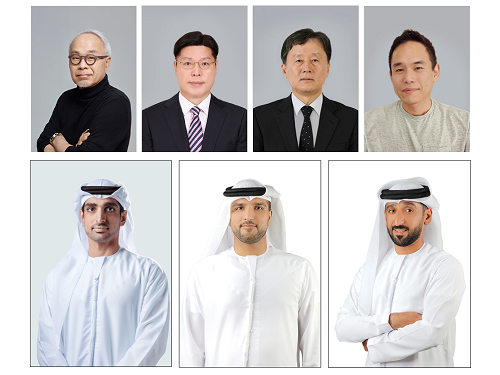 UAE Space Program Leaders named to be the 1st of the honorees of KAIST Alumni Association's special recognition for graduates of foreign nationality
The KAIST Alumni Association (Chairman, Chil-Hee Chung) announced on the 12th that the winners of the 2023 KAIST Distinguished Alumni Award and International Alumni Award has been selected.
The KAIST Distinguished Alumni Award, which produced the first recipient in 1992, is an award given to alumni who have contributed to the development of the nation and society, or who have glorified the honor of their alma mater with outstanding academic achievements and social and/or communal contributions.
On a special note, this year, there has been an addition to the honors, “the KAIST Distinguished International Alumni Award” to honor and encourage overseas alumni who are making their marks in the international community that will boost positive recognition of KAIST in the global setting and will later become a bridge that will expedite Korea's international efforts in the future.
As of 2022, the number of international students who succeeded in earning KAIST degrees has exceeded 1,700, and they are actively doing their part back in their home countries as leaders in various fields in which they belong, spanning from science and technology, to politics, industry and other corners of the society.
(From left) Omran Sharaf, the Assistant Minister of UAE Foreign Affairs and International Cooperation for Advanced Science and Technology, Amer Al Sayegh the Director General of Space Project at MBRSC, and Mohammed Al Harmi the Director General of Administration at MBRSC (Photos provided by the courtesy of MBRSC)
To celebrate and honor their outstanding achievements, the KAIST Alumni Association selected a team of three alumni of the United Arab Emirates (UAE) to receive the Distinguished International Alumni Award for the first time. The named honorees are Omran Sharaf, a master’s graduate from the Graduate School of Science and Technology Policy, and Amer Al Sayegh and Mohammed Al Harmi, master’s graduates of the Department of Aerospace Engineering - all three of the class of 2013 in leading positions in the UAE space program to lead the advancement of the science and technology of the country.
Currently, the three alums are in directorship of the Mohammed Bin Rashid Space Centre (MBRSC) with Mr. Omran Sharaf, who has recently been appointed as the Assistant Minister in charge of Advanced Science and Technology at the UAE Ministry of Foreign Affairs and International Cooperation, being the Project Director of the Emirates Mars Mission of MBRSC and Mr. Amer Al Sayegh in the Director General position in charge of Space Project and Mr. Mohammed Al Harmi, the Director General of Administration, at MBRSC.
They received technology transfer from “SatRec I”, Korea's first satellite system exporter and KAIST alumni company, for about 10 years from 2006, while carrying out their master’s studies at the same time.
Afterwards, they returned to UAE to lead the Emirates Mars Mission, which is already showing tangible progress including the successful launch of the Mars probe "Amal" (ال امل, meaning ‘Hope’ in Arabic), which was the first in the Arab world and the fifth in the world to successfully enter into orbit around Mars, and the UAE’s first independently developed Earth observation satellite "KhalifaSat".
An official from the KAIST Alumni Association said, "We selected the Distinguished International Alumni after evaluating their industrious leadership in promoting various space industry strategies, ranging from the development of Mars probes and Earth observation satellites, as well as lunar exploration, asteroid exploration, and Mars residence plans."
(From left) Joo-Sun Choi, President & CEO of Samsung Display Co. Ltd., Jung Goo Cho, the CEO of Green Power Co. Ltd., Jong Seung Park, the President of Agency for Defense Development (ADD), Kyunghyun Cho, Professor of New York University (NYU)
Also, four of the Korean graduates, Joo-Sun Choi, the CEO of Samsung Display, Jung Goo Cho, the CEO of Green Power Co. Ltd., Jong Seung Park, the President of Agency for Defense Development (ADD), and Kyunghyun Cho, a Professor of New York University (NYU), were selected as the winners of the “Distinguished Alumni Award”.
Mr. Joo-Sun Choi (Electrical and Electronic Engineering, M.S. in 1989, Ph.D. in 1995), the CEO of Samsung Display, led the successful development and mass-production of the world's first ultra-high-definition QD-OLED Displays, and preemptively transformed the structure of business of the industry and has been leading the way in technological innovation.
Mr. Jung Goo Cho (Electrical and Electronic Engineering, M.S. in 1988, Ph.D. in 1992), the CEO of Green Power Co. Ltd., developed wireless power technology for the first time in Korea in the early 2000s and applied it to semiconductor/display lines and led the wireless power charging technology in various fields, such as developing KAIST On-Line Electric Vehicles (OLEV) and commercializing the world's first wireless charger for 11kW electric vehicles.
Mr. Jong Seung Park (Mechanical Engineering, M.S. in 1988, Ph.D., in 1991), The President of ADD is an expert with abundant science and technology knowledge and organizational management capabilities. He is contributing greatly to national defense and security through science and technology.
Mr. Kyunghyun Cho (Computer Science, B.S., in 2009), the Professor of Computer Science and Data Science at NYU, is a world-renowned expert in Artificial Intelligence (AI), advancing the concept of 'Neural Machine Translation' in the field of natural language processing, to make great contributions to AI translation technology and related industries.
Chairman Chil-Hee Chung, the 26th Chair of KAIST Alumni Association “As each year goes by, I feel that the influence of KAIST alumni goes beyond science and technology to affect our society as a whole.” He went on to say, “This year, as it was more meaningful to extend the award to honor the international members of our Alums, we look forward to seeing more of our alumni continuing their social and academic endeavors to play an active role in the global stage in taking on the global challenges.”
The Ceremony for KAIST Distinguished Alumni and International Alumni Award Honorees will be conducted at the Annual New Year’s Event of KAIST Alumni Association for 2023 to be held on Friday, January 13th, at the Grand InterContinental Seoul Parnas.
2023.01.12 View 26535
UAE Space Program Leaders named to be the 1st of the honorees of KAIST Alumni Association's special recognition for graduates of foreign nationality
The KAIST Alumni Association (Chairman, Chil-Hee Chung) announced on the 12th that the winners of the 2023 KAIST Distinguished Alumni Award and International Alumni Award has been selected.
The KAIST Distinguished Alumni Award, which produced the first recipient in 1992, is an award given to alumni who have contributed to the development of the nation and society, or who have glorified the honor of their alma mater with outstanding academic achievements and social and/or communal contributions.
On a special note, this year, there has been an addition to the honors, “the KAIST Distinguished International Alumni Award” to honor and encourage overseas alumni who are making their marks in the international community that will boost positive recognition of KAIST in the global setting and will later become a bridge that will expedite Korea's international efforts in the future.
As of 2022, the number of international students who succeeded in earning KAIST degrees has exceeded 1,700, and they are actively doing their part back in their home countries as leaders in various fields in which they belong, spanning from science and technology, to politics, industry and other corners of the society.
(From left) Omran Sharaf, the Assistant Minister of UAE Foreign Affairs and International Cooperation for Advanced Science and Technology, Amer Al Sayegh the Director General of Space Project at MBRSC, and Mohammed Al Harmi the Director General of Administration at MBRSC (Photos provided by the courtesy of MBRSC)
To celebrate and honor their outstanding achievements, the KAIST Alumni Association selected a team of three alumni of the United Arab Emirates (UAE) to receive the Distinguished International Alumni Award for the first time. The named honorees are Omran Sharaf, a master’s graduate from the Graduate School of Science and Technology Policy, and Amer Al Sayegh and Mohammed Al Harmi, master’s graduates of the Department of Aerospace Engineering - all three of the class of 2013 in leading positions in the UAE space program to lead the advancement of the science and technology of the country.
Currently, the three alums are in directorship of the Mohammed Bin Rashid Space Centre (MBRSC) with Mr. Omran Sharaf, who has recently been appointed as the Assistant Minister in charge of Advanced Science and Technology at the UAE Ministry of Foreign Affairs and International Cooperation, being the Project Director of the Emirates Mars Mission of MBRSC and Mr. Amer Al Sayegh in the Director General position in charge of Space Project and Mr. Mohammed Al Harmi, the Director General of Administration, at MBRSC.
They received technology transfer from “SatRec I”, Korea's first satellite system exporter and KAIST alumni company, for about 10 years from 2006, while carrying out their master’s studies at the same time.
Afterwards, they returned to UAE to lead the Emirates Mars Mission, which is already showing tangible progress including the successful launch of the Mars probe "Amal" (ال امل, meaning ‘Hope’ in Arabic), which was the first in the Arab world and the fifth in the world to successfully enter into orbit around Mars, and the UAE’s first independently developed Earth observation satellite "KhalifaSat".
An official from the KAIST Alumni Association said, "We selected the Distinguished International Alumni after evaluating their industrious leadership in promoting various space industry strategies, ranging from the development of Mars probes and Earth observation satellites, as well as lunar exploration, asteroid exploration, and Mars residence plans."
(From left) Joo-Sun Choi, President & CEO of Samsung Display Co. Ltd., Jung Goo Cho, the CEO of Green Power Co. Ltd., Jong Seung Park, the President of Agency for Defense Development (ADD), Kyunghyun Cho, Professor of New York University (NYU)
Also, four of the Korean graduates, Joo-Sun Choi, the CEO of Samsung Display, Jung Goo Cho, the CEO of Green Power Co. Ltd., Jong Seung Park, the President of Agency for Defense Development (ADD), and Kyunghyun Cho, a Professor of New York University (NYU), were selected as the winners of the “Distinguished Alumni Award”.
Mr. Joo-Sun Choi (Electrical and Electronic Engineering, M.S. in 1989, Ph.D. in 1995), the CEO of Samsung Display, led the successful development and mass-production of the world's first ultra-high-definition QD-OLED Displays, and preemptively transformed the structure of business of the industry and has been leading the way in technological innovation.
Mr. Jung Goo Cho (Electrical and Electronic Engineering, M.S. in 1988, Ph.D. in 1992), the CEO of Green Power Co. Ltd., developed wireless power technology for the first time in Korea in the early 2000s and applied it to semiconductor/display lines and led the wireless power charging technology in various fields, such as developing KAIST On-Line Electric Vehicles (OLEV) and commercializing the world's first wireless charger for 11kW electric vehicles.
Mr. Jong Seung Park (Mechanical Engineering, M.S. in 1988, Ph.D., in 1991), The President of ADD is an expert with abundant science and technology knowledge and organizational management capabilities. He is contributing greatly to national defense and security through science and technology.
Mr. Kyunghyun Cho (Computer Science, B.S., in 2009), the Professor of Computer Science and Data Science at NYU, is a world-renowned expert in Artificial Intelligence (AI), advancing the concept of 'Neural Machine Translation' in the field of natural language processing, to make great contributions to AI translation technology and related industries.
Chairman Chil-Hee Chung, the 26th Chair of KAIST Alumni Association “As each year goes by, I feel that the influence of KAIST alumni goes beyond science and technology to affect our society as a whole.” He went on to say, “This year, as it was more meaningful to extend the award to honor the international members of our Alums, we look forward to seeing more of our alumni continuing their social and academic endeavors to play an active role in the global stage in taking on the global challenges.”
The Ceremony for KAIST Distinguished Alumni and International Alumni Award Honorees will be conducted at the Annual New Year’s Event of KAIST Alumni Association for 2023 to be held on Friday, January 13th, at the Grand InterContinental Seoul Parnas.
2023.01.12 View 26535 -
 “3D sketch” Your Ideas and Bring Them to Life, Instantly!
Professor Seok-Hyung Bae’s research team at the Department of Industrial Design developed a novel 3D sketching system that rapidly creates animated 3D concepts through simple user interactions like sketching on a piece of paper or playing a toy.
Foldable drones, transforming vehicles, and multi-legged robots from sci-fi movies are now becoming commonplace thanks to technological progress. However, designing them remains a difficult challenge even for skilled experts, because complex design decisions must be made regarding not only their form, but also the structure, poses, and motions, which are interdependent on one another.
Creating a 3D concept comprising of multiple moving parts connected by different types of joints using a traditional 3D CAD tool, which is more suited for processing precise and elaborate modeling, is a painstaking and time-consuming process. This presents a major bottleneck for the workflow during the early stage of design, in which it is preferred that as many ideas are tried and discarded out as quickly as possible in order to explore a wide range of possibilities in the shortest amount of time.
A research team led by Professor Bae has focused on designers’ freehand sketches drew up with a pen on a paper that serve as the starting point for virtually all design projects. This led them to develop their 3D sketching technology to generate desired 3D curves from the rough but expressive 2D strokes drawn with a digital stylus on a digital tablet.
Their latest research helps designers bring their 3D sketches to life almost instantly. Using the intuitive set of multi-touch gestures the team successfully designed and implemented, designers can handle the 3D sketches they are working on with their fingers as if they are playing with toys and put them into animation in no time.
< Figure 1. A novel 3D sketching system for rapidly designing articulated 3D concepts with a small set of coherent pen and multi-touch gestures. (a) Sketching: A 3D sketch curve is created by marking a pen stroke that is projected onto a sketch plane widget. (b) Segmenting: Entire or partial sketch curves are added to separate parts that serve as links in the kinematic chain. (c) Rigging: Repeatedly demonstrating the desired motion of a part leaves behind a trail, from which the system infers a joint. (d) Posing: Desired poses can be achieved through actuating joints via forward or inverse kinematics. (e) Filming: A sequence of keyframes specifying desired poses and viewpoints is connected as a smooth motion. >
< Figure 2. (a) Concept drawing of an autonomous excavator. It features (b, c) four caterpillars that swivel for high maneuverability, (d) an extendable boom and a bucket connected by multiple links, and (e) a rotating platform. The concept’s designer, who had 8 years of work experience, estimated that it would take 1-2 weeks to express and communicate such a complex articulated object with existing tools. With the proposed system, it took only 2 hours and 52 minutes. >
The major findings of their work were published under the title “Rapid Design of Articulated Objects” in ACM Transactions on Graphics (impact factor: 7.403), the top international journal in the field of computer graphics, and presented at ACM SIGGRAPH 2022 (h5-index: 103), the world’s largest international academic conference in the field, which was held back in August in Vancouver, Canada with Joon Hyub Lee, a Ph.D. student of the Department of Industrial Design as the first author.
The ACM SIGGRAPH 2022 conference was reportedly attended by over 10,000 participants including researchers, artists, and developers from world-renowned universities; film, animation, and game studies, such as Marvel, Pixar, and Blizzard; high-tech manufacturers, such as Lockheed Martin and Boston Dynamics; and metaverse platform companies, such as Meta and Roblox.
< Figure 3. The findings of Professor Bae’s research team were published in ACM Transactions on Graphics, the top international academic journal in the field of computer graphics, and presented at ACM SIGGRAPH 2022, the largest international academic conference held in conjunction early August in Vancouver, Canada. The team’s live demo at the Emerging Technologies program was highly praised by numerous academics and industry officials and received an Honorable Mention. >
The team was also invited to present their technical paper as a demo and a special talk at the Emerging Technologies program at ACM SIGGRAPH 2022 as one of the top-three impactful technologies. The live performance, in which Hanbit Kim, a Ph.D. student of the Department of Industrial Design at KAIST and a co-author, sketched and animated a sophisticated animal-shaped robot from scratch in a matter of a few minutes, wowed the audience and won the Honorable Mention Award from the jury.
Edwin Catmull, the co-founder of Pixar and a keynote speaker at the SIGGRAPH conference, praised the team’s research on 3D sketching as “really excellent work” and “a kind of tool that would be useful to Pixar's creative model designers.”
This technology, which became virally popular in Japan after featuring in an online IT media outlet and attracting more than 600K views, received a special award from the Digital Content Association of Japan (DCAJ) and was invited and exhibited for three days at Tokyo in November, as a part of Inter BEE 2022, the largest broadcasting and media expo in Japan.
“The more we come to understand how designers think and work, the more effective design tools can be built around that understanding,” said Professor Bae, explaining that “the key is to integrate different algorithms into a harmonious system as intuitive interactions.” He added that “this work wouldn’t have been possible if it weren’t for the convergent research environment cultivated by the Department of Industrial Design at KAIST, in which all students see themselves not only as aspiring creative designers, but also as practical engineers.”
By enabling designers to produce highly expressive animated 3D concepts far more quickly and easily in comparison to using existing methods, this new tool is expected to revolutionize design practices and processes in the content creation, manufacturing, and metaverse-related industries.
This research was funded by the Ministry of Science and ICT, and the National Research Foundation of Korea.
More info: https://sketch.kaist.ac.kr/publications/2022_siggraph_rapid_design
Video: https://www.youtube.com/watch?v=rsBl0QvSDqI
< Figure 4. From left to right: Ph.D. students Hanbit Kim, and Joon Hyub Lee and Professor Bae of the Department of Industrial Design, KAIST >
2022.11.23 View 17948
“3D sketch” Your Ideas and Bring Them to Life, Instantly!
Professor Seok-Hyung Bae’s research team at the Department of Industrial Design developed a novel 3D sketching system that rapidly creates animated 3D concepts through simple user interactions like sketching on a piece of paper or playing a toy.
Foldable drones, transforming vehicles, and multi-legged robots from sci-fi movies are now becoming commonplace thanks to technological progress. However, designing them remains a difficult challenge even for skilled experts, because complex design decisions must be made regarding not only their form, but also the structure, poses, and motions, which are interdependent on one another.
Creating a 3D concept comprising of multiple moving parts connected by different types of joints using a traditional 3D CAD tool, which is more suited for processing precise and elaborate modeling, is a painstaking and time-consuming process. This presents a major bottleneck for the workflow during the early stage of design, in which it is preferred that as many ideas are tried and discarded out as quickly as possible in order to explore a wide range of possibilities in the shortest amount of time.
A research team led by Professor Bae has focused on designers’ freehand sketches drew up with a pen on a paper that serve as the starting point for virtually all design projects. This led them to develop their 3D sketching technology to generate desired 3D curves from the rough but expressive 2D strokes drawn with a digital stylus on a digital tablet.
Their latest research helps designers bring their 3D sketches to life almost instantly. Using the intuitive set of multi-touch gestures the team successfully designed and implemented, designers can handle the 3D sketches they are working on with their fingers as if they are playing with toys and put them into animation in no time.
< Figure 1. A novel 3D sketching system for rapidly designing articulated 3D concepts with a small set of coherent pen and multi-touch gestures. (a) Sketching: A 3D sketch curve is created by marking a pen stroke that is projected onto a sketch plane widget. (b) Segmenting: Entire or partial sketch curves are added to separate parts that serve as links in the kinematic chain. (c) Rigging: Repeatedly demonstrating the desired motion of a part leaves behind a trail, from which the system infers a joint. (d) Posing: Desired poses can be achieved through actuating joints via forward or inverse kinematics. (e) Filming: A sequence of keyframes specifying desired poses and viewpoints is connected as a smooth motion. >
< Figure 2. (a) Concept drawing of an autonomous excavator. It features (b, c) four caterpillars that swivel for high maneuverability, (d) an extendable boom and a bucket connected by multiple links, and (e) a rotating platform. The concept’s designer, who had 8 years of work experience, estimated that it would take 1-2 weeks to express and communicate such a complex articulated object with existing tools. With the proposed system, it took only 2 hours and 52 minutes. >
The major findings of their work were published under the title “Rapid Design of Articulated Objects” in ACM Transactions on Graphics (impact factor: 7.403), the top international journal in the field of computer graphics, and presented at ACM SIGGRAPH 2022 (h5-index: 103), the world’s largest international academic conference in the field, which was held back in August in Vancouver, Canada with Joon Hyub Lee, a Ph.D. student of the Department of Industrial Design as the first author.
The ACM SIGGRAPH 2022 conference was reportedly attended by over 10,000 participants including researchers, artists, and developers from world-renowned universities; film, animation, and game studies, such as Marvel, Pixar, and Blizzard; high-tech manufacturers, such as Lockheed Martin and Boston Dynamics; and metaverse platform companies, such as Meta and Roblox.
< Figure 3. The findings of Professor Bae’s research team were published in ACM Transactions on Graphics, the top international academic journal in the field of computer graphics, and presented at ACM SIGGRAPH 2022, the largest international academic conference held in conjunction early August in Vancouver, Canada. The team’s live demo at the Emerging Technologies program was highly praised by numerous academics and industry officials and received an Honorable Mention. >
The team was also invited to present their technical paper as a demo and a special talk at the Emerging Technologies program at ACM SIGGRAPH 2022 as one of the top-three impactful technologies. The live performance, in which Hanbit Kim, a Ph.D. student of the Department of Industrial Design at KAIST and a co-author, sketched and animated a sophisticated animal-shaped robot from scratch in a matter of a few minutes, wowed the audience and won the Honorable Mention Award from the jury.
Edwin Catmull, the co-founder of Pixar and a keynote speaker at the SIGGRAPH conference, praised the team’s research on 3D sketching as “really excellent work” and “a kind of tool that would be useful to Pixar's creative model designers.”
This technology, which became virally popular in Japan after featuring in an online IT media outlet and attracting more than 600K views, received a special award from the Digital Content Association of Japan (DCAJ) and was invited and exhibited for three days at Tokyo in November, as a part of Inter BEE 2022, the largest broadcasting and media expo in Japan.
“The more we come to understand how designers think and work, the more effective design tools can be built around that understanding,” said Professor Bae, explaining that “the key is to integrate different algorithms into a harmonious system as intuitive interactions.” He added that “this work wouldn’t have been possible if it weren’t for the convergent research environment cultivated by the Department of Industrial Design at KAIST, in which all students see themselves not only as aspiring creative designers, but also as practical engineers.”
By enabling designers to produce highly expressive animated 3D concepts far more quickly and easily in comparison to using existing methods, this new tool is expected to revolutionize design practices and processes in the content creation, manufacturing, and metaverse-related industries.
This research was funded by the Ministry of Science and ICT, and the National Research Foundation of Korea.
More info: https://sketch.kaist.ac.kr/publications/2022_siggraph_rapid_design
Video: https://www.youtube.com/watch?v=rsBl0QvSDqI
< Figure 4. From left to right: Ph.D. students Hanbit Kim, and Joon Hyub Lee and Professor Bae of the Department of Industrial Design, KAIST >
2022.11.23 View 17948 -
 KPC4IR Helping to Create Global Standards for Virtual Transactions
KPC4IR will join the task force for the Global Implementation of Travel Rule Standards
The KAIST Policy Center for the Fourth Industrial Revolution (KPC4IR) will participate in a global initiative to create global standards for virtual asset transactions. As a member of the GI-TRUST (Global Implementation of Travel Rule Standards) task force, the KPC4IR will develop technical standards and relevant policies that support the global implementation of the travel rule for virtual assets in compliance with the recommendations of the Financial Action Task Force’s (FATF).
The FATF is an intergovernmental organization founded in 1989 by the G7 to develop policies to combat money laundering. In June 2019, the FATF extended its Recommendation 16, commonly known as the “travel rule,” to virtual asset services providers (VASPs), requiring both financial institutions and VASPs to aggregate information on the senders and recipients of wire transfers and exchange this information between parties to create a suitable audit trail.
According to the FATF’s recommendation and the G20’s support, jurisdictions, especially G20 member countries, have now applied the travel rule to their respective local laws. Korea also amended the Act on Reporting and Using Specified Financial Transaction Information in March 2020 to include virtual assets in their regulatory scope by March 2022.
The GI-TRUST task force will collaborate with global and local organizations developing travel rule technologies and offer a neutral assessment of proposed solutions. Their activities are aimed at standardizing related authentication protocols and security technologies that help VASPs comply with the travel rule.
The task force will also aid in the pilot testing of travel rule solutions for certain VASPs in Korea. Afterwards, the task force will report on the performance and reliability of the tested travel rule solutions for actual virtual asset transactions, in compliance with the FATF’s guidance.
Besides the KPC4IR, the GI-TRUST task force includes the Global Blockchain Business Council (GBBC), International Digital Asset Exchange Association (IDAXA), and Korea Blockchain Association (KBCA).
Director of the KPC4IR Professor So Young Kim will co-chair the task force. Professor Kim said their approach should be prudential in dealing with the regulations that rely on secure real-name data on top of the opposing governance style of pseudonymization, distribution, and recombination.
She explained, “KAIST has designed the co-evolution of technologies and institutions in conjunction with the global leaders’ groups such as the World Economic Forum and the EC Joint Research Center.”
She expects KAIST’s interdisciplinary, global cooperation to untie the entangled problem between regulations and technologies that obstruct future pathways.
2021.07.30 View 14395
KPC4IR Helping to Create Global Standards for Virtual Transactions
KPC4IR will join the task force for the Global Implementation of Travel Rule Standards
The KAIST Policy Center for the Fourth Industrial Revolution (KPC4IR) will participate in a global initiative to create global standards for virtual asset transactions. As a member of the GI-TRUST (Global Implementation of Travel Rule Standards) task force, the KPC4IR will develop technical standards and relevant policies that support the global implementation of the travel rule for virtual assets in compliance with the recommendations of the Financial Action Task Force’s (FATF).
The FATF is an intergovernmental organization founded in 1989 by the G7 to develop policies to combat money laundering. In June 2019, the FATF extended its Recommendation 16, commonly known as the “travel rule,” to virtual asset services providers (VASPs), requiring both financial institutions and VASPs to aggregate information on the senders and recipients of wire transfers and exchange this information between parties to create a suitable audit trail.
According to the FATF’s recommendation and the G20’s support, jurisdictions, especially G20 member countries, have now applied the travel rule to their respective local laws. Korea also amended the Act on Reporting and Using Specified Financial Transaction Information in March 2020 to include virtual assets in their regulatory scope by March 2022.
The GI-TRUST task force will collaborate with global and local organizations developing travel rule technologies and offer a neutral assessment of proposed solutions. Their activities are aimed at standardizing related authentication protocols and security technologies that help VASPs comply with the travel rule.
The task force will also aid in the pilot testing of travel rule solutions for certain VASPs in Korea. Afterwards, the task force will report on the performance and reliability of the tested travel rule solutions for actual virtual asset transactions, in compliance with the FATF’s guidance.
Besides the KPC4IR, the GI-TRUST task force includes the Global Blockchain Business Council (GBBC), International Digital Asset Exchange Association (IDAXA), and Korea Blockchain Association (KBCA).
Director of the KPC4IR Professor So Young Kim will co-chair the task force. Professor Kim said their approach should be prudential in dealing with the regulations that rely on secure real-name data on top of the opposing governance style of pseudonymization, distribution, and recombination.
She explained, “KAIST has designed the co-evolution of technologies and institutions in conjunction with the global leaders’ groups such as the World Economic Forum and the EC Joint Research Center.”
She expects KAIST’s interdisciplinary, global cooperation to untie the entangled problem between regulations and technologies that obstruct future pathways.
2021.07.30 View 14395