donation
-
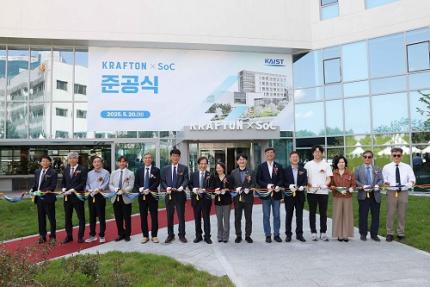 KAIST School of Computing Unveils 'KRAFTON Building,' A Symbol of Collective Generosity
< (From the fifth from the left) Provost and Executive Vice President Gyun Min Lee, Auditor Eun Woo Lee, President Kwang-Hyung Lee, Dean of the School of Computing Seok-Young Ryu, former Krafton member and donor Woong-Hee Cho, Krafton Chairman Byung-Gyu Chang >
KAIST announced on May 20th the completion of the expansion building for its School of Computing, the "KRAFTON Building." The project began in June 2021 with an ₩11 billion donation from KRAFTON and its employees, eventually growing to ₩11.7 billion with contributions from 204 donors.
Designed as a "Pay It Forward" space, the building aims to enable alumni to pass on the gratitude they received from the school to their juniors and foster connection. Byung-Gyu Chang, Chairman of KRAFTON and a KAIST alumnus, expressed his joy, stating, "I am very pleased that the first building created by alumni donations within KAIST is now complete, and I hope it will continue to be a space for communication, challenges, and growth that connects to the next generation."
The completion ceremony, held today at 3 PM in front of the KRAFTON SoC (School of Computing) Building at KAIST's main campus, was attended by over 100 people, including Chairman Byung-Gyu Chang, KAIST President Kwang-Hyung Lee, and Dean Seok-Young Ryu of the KAIST School of Computing.
The building's inception dates back to June 2021, with an ₩11 billion donation from the gaming company KRAFTON and its current and former members, dedicated to nurturing future software talent at KAIST. Four alumni, including KRAFTON Chairman Byung-Gyu Chang, who graduated from the KAIST School of Computing, were the first to pledge donations. This initial act inspired more participants, leading to ₩5.5 billion in individual donations from a total of 11 people. KRAFTON Inc. then matched this amount, bringing the total donation to ₩11 billion.
Since 2021, KRAFTON Inc. has operated a "Matching Grant" program, a donation culture initiative driven by its members. This system allows the company to match funds voluntarily raised by its employees, aiming to encourage active social participation and the creation of social value among its members.
Following this, another 11 KAIST alumni from Devsisters Inc., famous for the Cookie Run series, joined the donation effort. This wave of generosity expanded to include a total of 204 participants, comprising graduates, alumni professors, and current students, acting as a catalyst for the spread of a donation culture within the campus. To date, approximately ₩11.7 billion has been raised for the expansion of the School of Computing building. Furthermore, small donations, including those from alumni and the general public, have continuously grown, reaching over 50,000 instances from 2021 to May 2025.
The funds raised through donations were used to construct a 2,000-pyeong (approximately 6,600 square meters) building for individuals who, like Chairman Byung-Gyu Chang, will unleash their potential and become global leaders. The building was named "KRAFTON SoC (KRAFTON SoC)," and KRAFTON Inc. has further pledged additional donations for the building's maintenance over the next 10 years.
The newly completed KRAFTON Building is a six-story structure. From the second floor up, it features research labs for 20 professors and graduate students to freely pursue their research, along with large lecture halls. The first floor is designed as a meeting place for current students, alumni, and seniors, serving as a space to remember those who came before them.
The four lecture halls on the first floor are designated as "Immersion Camp Classrooms." During the summer and winter sessions, these rooms will be used for intensive month-long courses focused on improving coding and collaboration skills. During regular semesters, they will be utilized for other lectures.
Additionally, to support the physical and mental well-being of those weary from study and research, the building includes a small café on the first floor, a fitness center on the second floor, a Pilates studio on the fifth floor, and a soundproof band practice room in the basement.
Dean Seok-Young Ryu of the School of Computing explained, "The motivation for this wave of donations began with gratitude for the excellent professors and wonderful students, the free and open communication, the comfortable acceptance of diversity among various members, and the time when we could fearlessly dream. We cannot fully repay those who provided us with such precious time and space, but instead, this will be a 'Pay It Forward' space, a space of connection, where we share this gratitude with our juniors."
Alumnus Byung-Gyu Chang shared, "KAIST is more than just an academic foundation for me; it's a meaningful place that helped me set the direction for my life. I am very happy that this space, born from the desire of KRAFTON's members and myself to give back the opportunities and learning we received to the next generation, is completed today. I hope this space becomes a small but warm echo for KAIST members who freely communicate, challenge themselves, and grow."
< Congratulatory speech by alumnus Byung-Gyu Chang >
President Kwang-Hyung Lee stated, "The KRAFTON SoC, the expanded building for the School of Computing, is not just a space; it is the culmination of the KAIST community spirit created by alumni, current students, and faculty. I sincerely thank everyone who participated in this meaningful donation, which demonstrates the power of sharing and connection."
< Commemorative speech by President Kwang-Hyung Lee >
On a related note, the KAIST Development Foundation is actively promoting the "TeamKAIST" campaign for the general public and KAIST alumni to meet more "Daddy Long-Legs" (benefactors) for KAIST.
Website: https://giving.kaist.ac.kr/ko/sub01/sub0103_1.php
2025.05.21 View 1887
KAIST School of Computing Unveils 'KRAFTON Building,' A Symbol of Collective Generosity
< (From the fifth from the left) Provost and Executive Vice President Gyun Min Lee, Auditor Eun Woo Lee, President Kwang-Hyung Lee, Dean of the School of Computing Seok-Young Ryu, former Krafton member and donor Woong-Hee Cho, Krafton Chairman Byung-Gyu Chang >
KAIST announced on May 20th the completion of the expansion building for its School of Computing, the "KRAFTON Building." The project began in June 2021 with an ₩11 billion donation from KRAFTON and its employees, eventually growing to ₩11.7 billion with contributions from 204 donors.
Designed as a "Pay It Forward" space, the building aims to enable alumni to pass on the gratitude they received from the school to their juniors and foster connection. Byung-Gyu Chang, Chairman of KRAFTON and a KAIST alumnus, expressed his joy, stating, "I am very pleased that the first building created by alumni donations within KAIST is now complete, and I hope it will continue to be a space for communication, challenges, and growth that connects to the next generation."
The completion ceremony, held today at 3 PM in front of the KRAFTON SoC (School of Computing) Building at KAIST's main campus, was attended by over 100 people, including Chairman Byung-Gyu Chang, KAIST President Kwang-Hyung Lee, and Dean Seok-Young Ryu of the KAIST School of Computing.
The building's inception dates back to June 2021, with an ₩11 billion donation from the gaming company KRAFTON and its current and former members, dedicated to nurturing future software talent at KAIST. Four alumni, including KRAFTON Chairman Byung-Gyu Chang, who graduated from the KAIST School of Computing, were the first to pledge donations. This initial act inspired more participants, leading to ₩5.5 billion in individual donations from a total of 11 people. KRAFTON Inc. then matched this amount, bringing the total donation to ₩11 billion.
Since 2021, KRAFTON Inc. has operated a "Matching Grant" program, a donation culture initiative driven by its members. This system allows the company to match funds voluntarily raised by its employees, aiming to encourage active social participation and the creation of social value among its members.
Following this, another 11 KAIST alumni from Devsisters Inc., famous for the Cookie Run series, joined the donation effort. This wave of generosity expanded to include a total of 204 participants, comprising graduates, alumni professors, and current students, acting as a catalyst for the spread of a donation culture within the campus. To date, approximately ₩11.7 billion has been raised for the expansion of the School of Computing building. Furthermore, small donations, including those from alumni and the general public, have continuously grown, reaching over 50,000 instances from 2021 to May 2025.
The funds raised through donations were used to construct a 2,000-pyeong (approximately 6,600 square meters) building for individuals who, like Chairman Byung-Gyu Chang, will unleash their potential and become global leaders. The building was named "KRAFTON SoC (KRAFTON SoC)," and KRAFTON Inc. has further pledged additional donations for the building's maintenance over the next 10 years.
The newly completed KRAFTON Building is a six-story structure. From the second floor up, it features research labs for 20 professors and graduate students to freely pursue their research, along with large lecture halls. The first floor is designed as a meeting place for current students, alumni, and seniors, serving as a space to remember those who came before them.
The four lecture halls on the first floor are designated as "Immersion Camp Classrooms." During the summer and winter sessions, these rooms will be used for intensive month-long courses focused on improving coding and collaboration skills. During regular semesters, they will be utilized for other lectures.
Additionally, to support the physical and mental well-being of those weary from study and research, the building includes a small café on the first floor, a fitness center on the second floor, a Pilates studio on the fifth floor, and a soundproof band practice room in the basement.
Dean Seok-Young Ryu of the School of Computing explained, "The motivation for this wave of donations began with gratitude for the excellent professors and wonderful students, the free and open communication, the comfortable acceptance of diversity among various members, and the time when we could fearlessly dream. We cannot fully repay those who provided us with such precious time and space, but instead, this will be a 'Pay It Forward' space, a space of connection, where we share this gratitude with our juniors."
Alumnus Byung-Gyu Chang shared, "KAIST is more than just an academic foundation for me; it's a meaningful place that helped me set the direction for my life. I am very happy that this space, born from the desire of KRAFTON's members and myself to give back the opportunities and learning we received to the next generation, is completed today. I hope this space becomes a small but warm echo for KAIST members who freely communicate, challenge themselves, and grow."
< Congratulatory speech by alumnus Byung-Gyu Chang >
President Kwang-Hyung Lee stated, "The KRAFTON SoC, the expanded building for the School of Computing, is not just a space; it is the culmination of the KAIST community spirit created by alumni, current students, and faculty. I sincerely thank everyone who participated in this meaningful donation, which demonstrates the power of sharing and connection."
< Commemorative speech by President Kwang-Hyung Lee >
On a related note, the KAIST Development Foundation is actively promoting the "TeamKAIST" campaign for the general public and KAIST alumni to meet more "Daddy Long-Legs" (benefactors) for KAIST.
Website: https://giving.kaist.ac.kr/ko/sub01/sub0103_1.php
2025.05.21 View 1887 -
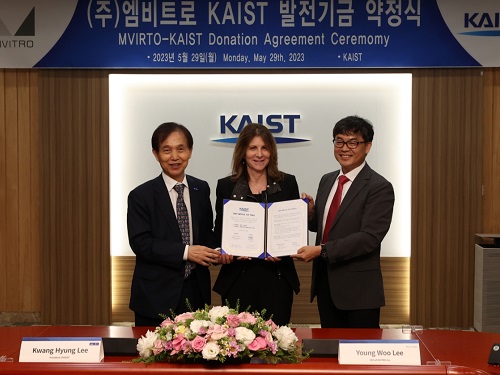 MVITRO Co., Ltd. Signs to Donate KRW 1 Billion as Development Fund toward KAIST-NYU Joint Campus
KAIST (President Kwang Hyung Lee) announced on the 29th that it has solicited a development fund of KRW 1 billion from MVITRO (CEO Young Woo Lee) for joint research at the KAIST-NYU Joint Campus, which is being pursued to be KAIST's first campus on the United States.
KAIST plans to use this development fund for research and development of various solutions in the field of 'Healthcare at Home' among several joint researches being conducted with New York University (hereinafter referred to as NYU).
Young Woo Lee, the CEO of MVITRO, said, "We decided to make the donation with the hope that the KAIST-NYU Joint Campus will become an ecosystem that would help with Korean companies’ advancement into the US."
After announcing its plans to enter New York in 2021, KAIST has formed partnerships with NYU and New York City last year. Currently, NYU and KAIST are devising plans for mid- to long-term joint research in nine fields of studies including AI and bio-medicine and technology, and are promoting cooperation in the field of education, including exchange students, minors, double majors, and joint degrees under the joint campus agreement,
The ceremony for the consigning of MVITRO Co., Ltd.’s donation was held at the main campus of KAIST in the afternoon of the 29th and was attended by KAIST officials such as President Kwang Hyung Lee and Jae-Hung Han, the executive director of KAIST Development Foundation, along with the NYU President-Designate Linda G. Mills, and the CEO of MVITRO, Young Woo Lee.
< Photo. (from left) Kwang Hyung Lee, the President of KAIST, Linda G. Mills, the President-Designate of NYU, and Young Woo Lee, the CEO of MVITRO, pose for the photo with the signed letter of donation on May 29, 2023 at KAIST >
Linda Mills, the nominee designated to be NYU president next term said, “I am proud to join our colleagues in celebrating this important gift from MVITRO, which will help support the partnership between KAIST and NYU. This global partnership leverages the distinctive strengths of both universities to drive advances in research poised to deliver profound impact, such as the intersections of healthcare, technology, and AI."
President Kwang Hyung Lee said, "The KAIST-NYU Joint Campus will be the first step in extending KAIST's excellent science and technology capabilities to the international stage and will serve as a bridgehead to help excellent technological advancements venture into the United States." Then, President Lee added, "I would like to express my gratitude to MVITRO for sympathizing with this vision. I will work with NYU to lead the creation of global values.”
On a different note, MVITRO Co., Ltd., is a home medical device maker that collaborated with Hyundai Futurenet Co., Ltd. to develop an IoT product that combined a painless laser lancet (blood collector) and a blood glucose meter into one for a convenient at-home health support, which received favorable reviews from overseas buyers at CES 2023.
2023.05.30 View 10373
MVITRO Co., Ltd. Signs to Donate KRW 1 Billion as Development Fund toward KAIST-NYU Joint Campus
KAIST (President Kwang Hyung Lee) announced on the 29th that it has solicited a development fund of KRW 1 billion from MVITRO (CEO Young Woo Lee) for joint research at the KAIST-NYU Joint Campus, which is being pursued to be KAIST's first campus on the United States.
KAIST plans to use this development fund for research and development of various solutions in the field of 'Healthcare at Home' among several joint researches being conducted with New York University (hereinafter referred to as NYU).
Young Woo Lee, the CEO of MVITRO, said, "We decided to make the donation with the hope that the KAIST-NYU Joint Campus will become an ecosystem that would help with Korean companies’ advancement into the US."
After announcing its plans to enter New York in 2021, KAIST has formed partnerships with NYU and New York City last year. Currently, NYU and KAIST are devising plans for mid- to long-term joint research in nine fields of studies including AI and bio-medicine and technology, and are promoting cooperation in the field of education, including exchange students, minors, double majors, and joint degrees under the joint campus agreement,
The ceremony for the consigning of MVITRO Co., Ltd.’s donation was held at the main campus of KAIST in the afternoon of the 29th and was attended by KAIST officials such as President Kwang Hyung Lee and Jae-Hung Han, the executive director of KAIST Development Foundation, along with the NYU President-Designate Linda G. Mills, and the CEO of MVITRO, Young Woo Lee.
< Photo. (from left) Kwang Hyung Lee, the President of KAIST, Linda G. Mills, the President-Designate of NYU, and Young Woo Lee, the CEO of MVITRO, pose for the photo with the signed letter of donation on May 29, 2023 at KAIST >
Linda Mills, the nominee designated to be NYU president next term said, “I am proud to join our colleagues in celebrating this important gift from MVITRO, which will help support the partnership between KAIST and NYU. This global partnership leverages the distinctive strengths of both universities to drive advances in research poised to deliver profound impact, such as the intersections of healthcare, technology, and AI."
President Kwang Hyung Lee said, "The KAIST-NYU Joint Campus will be the first step in extending KAIST's excellent science and technology capabilities to the international stage and will serve as a bridgehead to help excellent technological advancements venture into the United States." Then, President Lee added, "I would like to express my gratitude to MVITRO for sympathizing with this vision. I will work with NYU to lead the creation of global values.”
On a different note, MVITRO Co., Ltd., is a home medical device maker that collaborated with Hyundai Futurenet Co., Ltd. to develop an IoT product that combined a painless laser lancet (blood collector) and a blood glucose meter into one for a convenient at-home health support, which received favorable reviews from overseas buyers at CES 2023.
2023.05.30 View 10373 -
 Anonymous Donor Makes a Gift of Property Valued at 30 Billion KRW
The KAIST Development Foundation announced on May 9 that an anonymous donor in his 50s made a gift of real estate valued at 30 billion KRW. This is the first donation from an anonymous benefactor on such a grand scale. The benefactor expressed his wishes to fund scholarships for students in need and R&D for medical and bio sciences.
According to the Development Foundation official, the benefactor is reported to have said that he felt burdened that he earned much more than he needed and was looking for the right way to share his assets. The benefactor refused to hold an official donation ceremony and meeting with high-level university administrators.
The donor believes that KAIST is filled with young and dynamic energy, saying, “I would like to help KAIST move forward and create breakthroughs that will benefit the nation as well as all humanity.”
Before making up his mind to give his asset to KAIST, he had planned to establish his own social foundation but he changed his mind. “I decided that an investment in education would be the best investment,” he said. He explained that he was inspired by his KAIST graduate friend who is running a company. He was deeply motivated to help KAIST after witnessing the KAIST graduate’s passion for conducting his business.
After receiving the gift, KAIST President Kwang Hyung Lee was thankful for the full support and trust of the benefactor. “We will spare no effort to foster next-generation talents and advance science and technology in the field of biomedicine.”
2022.05.11 View 6156
Anonymous Donor Makes a Gift of Property Valued at 30 Billion KRW
The KAIST Development Foundation announced on May 9 that an anonymous donor in his 50s made a gift of real estate valued at 30 billion KRW. This is the first donation from an anonymous benefactor on such a grand scale. The benefactor expressed his wishes to fund scholarships for students in need and R&D for medical and bio sciences.
According to the Development Foundation official, the benefactor is reported to have said that he felt burdened that he earned much more than he needed and was looking for the right way to share his assets. The benefactor refused to hold an official donation ceremony and meeting with high-level university administrators.
The donor believes that KAIST is filled with young and dynamic energy, saying, “I would like to help KAIST move forward and create breakthroughs that will benefit the nation as well as all humanity.”
Before making up his mind to give his asset to KAIST, he had planned to establish his own social foundation but he changed his mind. “I decided that an investment in education would be the best investment,” he said. He explained that he was inspired by his KAIST graduate friend who is running a company. He was deeply motivated to help KAIST after witnessing the KAIST graduate’s passion for conducting his business.
After receiving the gift, KAIST President Kwang Hyung Lee was thankful for the full support and trust of the benefactor. “We will spare no effort to foster next-generation talents and advance science and technology in the field of biomedicine.”
2022.05.11 View 6156 -
 Baemin CEO Endows a Scholarship in Honor of the Late Professor Chwa
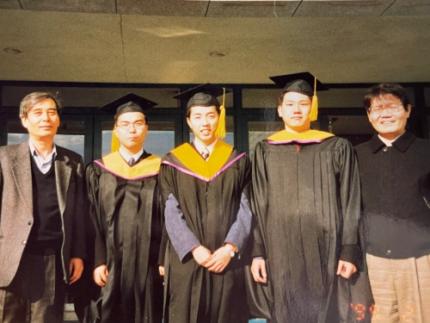
CEO Beom-Jun Kim of Woowa Brothers also known as ‘Baemin,’ a leading meal delivery app company, made a donation of 100 million KRW in honor of the late Professor Kyong-Yong Chwa from the School of Computing who passed away last year. The fund will be established for the “Kyong-Yong Chwa - Beom-Jun Kim Scholarship” to provide scholarships for four students over five years.
Kim finished his BS in 1997 and MS in 1999 at the School of Computing and Professor Chwa was his advisor. The late Professor Chwa was a pioneering scholar who brought the concept of computer algorithms to Korea. After graduating from Seoul National University in electric engineering, Professor Chwa earned his PhD at Northwestern University and began teaching at KAIST in 1980. Professor Chwa served as the President of the Korean Institute of Information Scientists and Engineers and a fellow emeritus at the Korean Academy of Science and Technology.
Professor Chwa encouraged younger students to participate in international computer programming contests. Under his wing, Team Korea, which was comprised of four high school students, including Kim, placed fourth in the International Olympiad Informatics (IOI). Kim, who participated in the contest as high school junior, won an individual gold medal in the fourth IOI competition in 1992. Since then, Korean students have actively participated in many competitions including the International Collegiate Programming Contest (ICPC) hosted by the Association for Computing Machinery.
Kim said, “I feel fortunate to have met so many good friends and distinguished professors. With them, I had opportunities to grow. I would like to provide such opportunities to my juniors at KAIST. Professor Chwa was a larger than life figure in the field of computer programming. He was always caring and supported us with a warm heart. I want this donation to help carry on his legacy for our students and for them to seek greater challenges and bigger dreams.”
2022.03.25 View 9266
Baemin CEO Endows a Scholarship in Honor of the Late Professor Chwa
CEO Beom-Jun Kim of Woowa Brothers also known as ‘Baemin,’ a leading meal delivery app company, made a donation of 100 million KRW in honor of the late Professor Kyong-Yong Chwa from the School of Computing who passed away last year. The fund will be established for the “Kyong-Yong Chwa - Beom-Jun Kim Scholarship” to provide scholarships for four students over five years.
Kim finished his BS in 1997 and MS in 1999 at the School of Computing and Professor Chwa was his advisor. The late Professor Chwa was a pioneering scholar who brought the concept of computer algorithms to Korea. After graduating from Seoul National University in electric engineering, Professor Chwa earned his PhD at Northwestern University and began teaching at KAIST in 1980. Professor Chwa served as the President of the Korean Institute of Information Scientists and Engineers and a fellow emeritus at the Korean Academy of Science and Technology.
Professor Chwa encouraged younger students to participate in international computer programming contests. Under his wing, Team Korea, which was comprised of four high school students, including Kim, placed fourth in the International Olympiad Informatics (IOI). Kim, who participated in the contest as high school junior, won an individual gold medal in the fourth IOI competition in 1992. Since then, Korean students have actively participated in many competitions including the International Collegiate Programming Contest (ICPC) hosted by the Association for Computing Machinery.
Kim said, “I feel fortunate to have met so many good friends and distinguished professors. With them, I had opportunities to grow. I would like to provide such opportunities to my juniors at KAIST. Professor Chwa was a larger than life figure in the field of computer programming. He was always caring and supported us with a warm heart. I want this donation to help carry on his legacy for our students and for them to seek greater challenges and bigger dreams.”
2022.03.25 View 9266 -
 KAIST Plans to Open a New York Campus
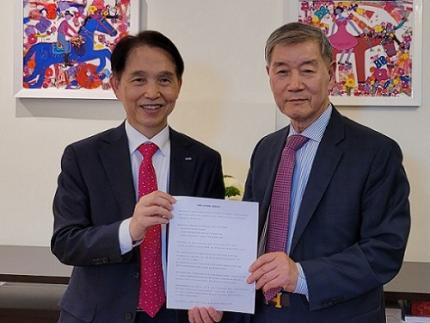
President Lee signs an MOU with New York-based Big Continent Inc. Chairman Hee-Nam Bae on funding the New York campus
President Kwang Hyung Lee announced a plan to open a KAIST campus in New York with funding from New York-based entrepreneur Hee-Nam Bae. President Lee and Big Continent Inc. Chairman Hee-Nam Bae signed the MOU last week for the funding to open the campus in New York.
President Lee said it will take years to open up a campus in New York in order to conform with both Korean and US legal procedures. However, during a news conference in New York following the signing of the MOU with Chairman Bae, President Lee said this is the first step toward realizing KAIST’s new vision of a ‘Global Twin Strategy’ by making New York KAIST’s newest stronghold to target both domestic and global markets.
“New York is the center of the world’s commerce, culture, and new technologies. If we want to grow big, we should go to one of the biggest cities in the world and New York is the place. I highly encourage our students and faculty go into the world and never be satisfied enjoying the top position in Korea. The next place to investigate will be Silicon Valley,” said President Lee.
“We still have many issues to resolve domestically. We need to discuss more details first with the Board of Trustees and the Korean government,” he added.
The New York campus will aim to become an enterprise-type university to help KAIST create global value. "Our goal is to make sure that Korean businesses gain competitiveness in the global market and can become listed on the NASDAQ. We plan to open majors related to AI, financial engineering, and cultural technologies. We will recruit students from both the US and KAIST to study at our New York campus.” President Lee said.
Chairman Bae, a self-made entrepreneur who immigrated to the US in 1981, also leads the Global Leadership Foundation in the US. “President Lee and I have already toured several candidate sites for the campus in the New York region and we will make a final decision on the best site to purchase,” said Chairman Bae.
Chairman Bae added that he has always dreamed of fostering young global talents who will take on global challenges with pioneering minds. He believes KAIST shares this global vision.
The New York campus will be the first KAIST campus for global students funded by someone from the private sector. This is also a major step forward for KAIST, which was founded by a six million dollar USAID loan in 1971. KAIST announced its plans to establish Kenya KAIST in 2018 with funding from the Korea Eximbank’s 95 million USD development cooperation fund loan to the Kenyan government. KAIST will provide turn-key-based education consultancy featuring curriculum design and the construction of facilities for Kenya’s first advanced science and technology institute. The campus will be located in the Konza Techno City near Nairobi and plans to open in 2023.
2021.12.13 View 9710
KAIST Plans to Open a New York Campus
President Lee signs an MOU with New York-based Big Continent Inc. Chairman Hee-Nam Bae on funding the New York campus
President Kwang Hyung Lee announced a plan to open a KAIST campus in New York with funding from New York-based entrepreneur Hee-Nam Bae. President Lee and Big Continent Inc. Chairman Hee-Nam Bae signed the MOU last week for the funding to open the campus in New York.
President Lee said it will take years to open up a campus in New York in order to conform with both Korean and US legal procedures. However, during a news conference in New York following the signing of the MOU with Chairman Bae, President Lee said this is the first step toward realizing KAIST’s new vision of a ‘Global Twin Strategy’ by making New York KAIST’s newest stronghold to target both domestic and global markets.
“New York is the center of the world’s commerce, culture, and new technologies. If we want to grow big, we should go to one of the biggest cities in the world and New York is the place. I highly encourage our students and faculty go into the world and never be satisfied enjoying the top position in Korea. The next place to investigate will be Silicon Valley,” said President Lee.
“We still have many issues to resolve domestically. We need to discuss more details first with the Board of Trustees and the Korean government,” he added.
The New York campus will aim to become an enterprise-type university to help KAIST create global value. "Our goal is to make sure that Korean businesses gain competitiveness in the global market and can become listed on the NASDAQ. We plan to open majors related to AI, financial engineering, and cultural technologies. We will recruit students from both the US and KAIST to study at our New York campus.” President Lee said.
Chairman Bae, a self-made entrepreneur who immigrated to the US in 1981, also leads the Global Leadership Foundation in the US. “President Lee and I have already toured several candidate sites for the campus in the New York region and we will make a final decision on the best site to purchase,” said Chairman Bae.
Chairman Bae added that he has always dreamed of fostering young global talents who will take on global challenges with pioneering minds. He believes KAIST shares this global vision.
The New York campus will be the first KAIST campus for global students funded by someone from the private sector. This is also a major step forward for KAIST, which was founded by a six million dollar USAID loan in 1971. KAIST announced its plans to establish Kenya KAIST in 2018 with funding from the Korea Eximbank’s 95 million USD development cooperation fund loan to the Kenyan government. KAIST will provide turn-key-based education consultancy featuring curriculum design and the construction of facilities for Kenya’s first advanced science and technology institute. The campus will be located in the Konza Techno City near Nairobi and plans to open in 2023.
2021.12.13 View 9710 -
 A Judicial Scrivener in His 90s Donates to AI Research
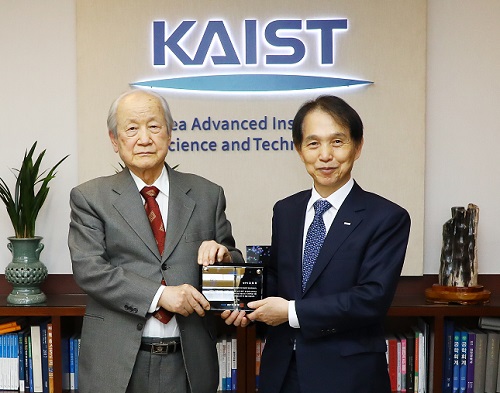
Dong-Myoung Kim donated 2 billion KRW to fund the Kim Jae-Chul AI Graduate School
Dong-Myong Kim, a 90-year-old resident living in Seongnam City in Kyonggido made a gift of 300 million KRW in cash and property valued at 1.7 billion KRW to fund the Kim Jae-Chul AI Graduate School. KAIST President Kwang Hyung Lee and a senior leadership team warmly received Kim during the donation ceremony on December 6 and delivered a plaque of appreciation.
Kim, a certified judicial scrivener, sent a letter regarding his intention to donate to the KAIST Development Foundation Office in October. Development foundation officers contacted him for a meeting and presented the major achievements of KAIST and new vision for the future during the meeting. After meeting with KAIST officials, Kim completed all the legal procedures for donating such as handing over the title of his property.
A Development Foundation official said that Kim was well aware of what KAIST has achieved and is doing now. “He had already searched KAIST’s website and scrutinized what we are doing now. He was clear about his intentions,” said the official.
Kim said that media news reports on the recent series of huge donations to KAIST inspired him. “I thought there was something special behind the donors’ intention to make such a decision.”
Kim said the studies on futurism he started in the 1980s led him to become interested in new technologies. “I firmly believe that KAIST will make huge contributions to the nation and our society through advances in science and technology. It is said that the joy of giving is much larger than that of receiving. I am now experiencing such immense joy. I will be even happier if KAIST can lead the nation through its AI research.”
President Kwang Hyung Lee said Kim’s letter of intention touched him deeply. He thanked Kim, saying that the entire KAIST community will make every effort to respond to Kim’s donation wishes.
2021.12.08 View 5875
A Judicial Scrivener in His 90s Donates to AI Research
Dong-Myoung Kim donated 2 billion KRW to fund the Kim Jae-Chul AI Graduate School
Dong-Myong Kim, a 90-year-old resident living in Seongnam City in Kyonggido made a gift of 300 million KRW in cash and property valued at 1.7 billion KRW to fund the Kim Jae-Chul AI Graduate School. KAIST President Kwang Hyung Lee and a senior leadership team warmly received Kim during the donation ceremony on December 6 and delivered a plaque of appreciation.
Kim, a certified judicial scrivener, sent a letter regarding his intention to donate to the KAIST Development Foundation Office in October. Development foundation officers contacted him for a meeting and presented the major achievements of KAIST and new vision for the future during the meeting. After meeting with KAIST officials, Kim completed all the legal procedures for donating such as handing over the title of his property.
A Development Foundation official said that Kim was well aware of what KAIST has achieved and is doing now. “He had already searched KAIST’s website and scrutinized what we are doing now. He was clear about his intentions,” said the official.
Kim said that media news reports on the recent series of huge donations to KAIST inspired him. “I thought there was something special behind the donors’ intention to make such a decision.”
Kim said the studies on futurism he started in the 1980s led him to become interested in new technologies. “I firmly believe that KAIST will make huge contributions to the nation and our society through advances in science and technology. It is said that the joy of giving is much larger than that of receiving. I am now experiencing such immense joy. I will be even happier if KAIST can lead the nation through its AI research.”
President Kwang Hyung Lee said Kim’s letter of intention touched him deeply. He thanked Kim, saying that the entire KAIST community will make every effort to respond to Kim’s donation wishes.
2021.12.08 View 5875 -
 Jungheung to Donate 30B KRW for Semiconductor Research and Education
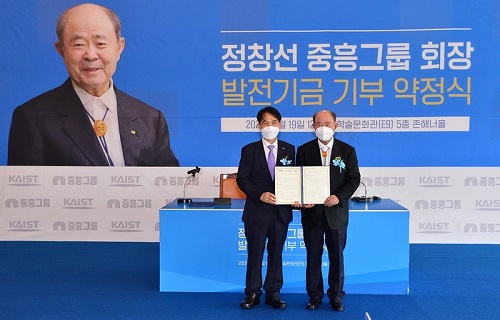
Jungheung Group, a construction company in Korea, made a pledge to donate 30 billion KRW for semiconductor research and education at KAIST. Junghueng will spend 20 billion KRW to construct the semiconductor education and research facilities that will be established in Pyeongtaek City in collaboration with Samsung Electronics, and 10 billion will go for supporting the educational training program. The pledge ceremony was held at the Daejeon campus with Jungheung Group Chairman Chang-Sun Jung, KAIST President Kwang Hyung Lee, and Pyeongtaek City Mayor Jang-Seon Jung in attendance.
Chairman said, “The only way to earn a competitive edge in this era of technology hegemony is to invest in young talents in the science and technology fields. They will grow up to be excellent experts who will feed tens of thousands of people.” He added, “Donating to nurture future talents is the most rewarding investment we can make for the future.”
President Lee said, “Jungheung’s donation is an investment in the semiconductor industry in Korea, which will be the growth engine for the nation. We will make every effort to foster the world’s best workforce in the semiconductor sector.”
Mayor Jung also expressed high hopes for the advancement of KAIST into ‘Brain City,’ a complex designated with Samsung Electronics for the semiconductor industry.
“The city government will fully support the semiconductor industry and KAIST. In doing so, we look forward to becoming the center of the semiconductor industry in the nation,” announced Mayor Jung.
2021.07.20 View 6489
Jungheung to Donate 30B KRW for Semiconductor Research and Education
Jungheung Group, a construction company in Korea, made a pledge to donate 30 billion KRW for semiconductor research and education at KAIST. Junghueng will spend 20 billion KRW to construct the semiconductor education and research facilities that will be established in Pyeongtaek City in collaboration with Samsung Electronics, and 10 billion will go for supporting the educational training program. The pledge ceremony was held at the Daejeon campus with Jungheung Group Chairman Chang-Sun Jung, KAIST President Kwang Hyung Lee, and Pyeongtaek City Mayor Jang-Seon Jung in attendance.
Chairman said, “The only way to earn a competitive edge in this era of technology hegemony is to invest in young talents in the science and technology fields. They will grow up to be excellent experts who will feed tens of thousands of people.” He added, “Donating to nurture future talents is the most rewarding investment we can make for the future.”
President Lee said, “Jungheung’s donation is an investment in the semiconductor industry in Korea, which will be the growth engine for the nation. We will make every effort to foster the world’s best workforce in the semiconductor sector.”
Mayor Jung also expressed high hopes for the advancement of KAIST into ‘Brain City,’ a complex designated with Samsung Electronics for the semiconductor industry.
“The city government will fully support the semiconductor industry and KAIST. In doing so, we look forward to becoming the center of the semiconductor industry in the nation,” announced Mayor Jung.
2021.07.20 View 6489 -
 Alumni Professor Cho at NYU Endows Scholarship for Female Computer Scientists
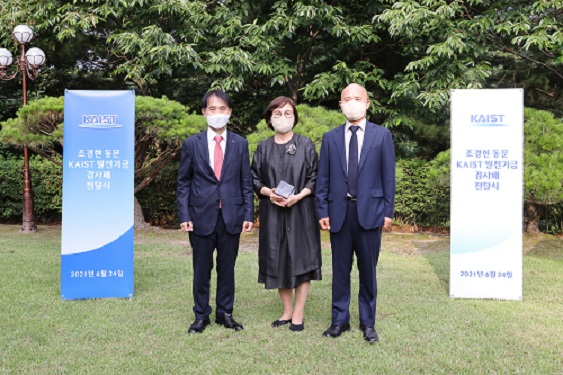
Alumni Professor Kyunghyun Cho at New York University endowed the “Lim Mi-Sook Scholarship” at KAIST for female computer scientists in honor of his mother.
Professor Cho, a graduate of the School of Computing in 2011 completed his master’s and PhD at Alto University in Finland in 2014. He has been teaching at NYU since 2015 and received the Samsung Ho-Am Prize for Engineering this year in recognition of his outstanding researches in the fields of machine learning and AI.
“I hope this will encourage young female students to continue their studies in computer science and encourage others to join the discipline in the future, thereby contributing to building a more diverse community of computer scientists,” he said in his written message. His parents and President Kwang Hyung Lee attended the donation ceremony held at the Daejeon campus on June 24.
Professor Cho has developed neural network machine learning translation algorithm that is widely being used in translation engines. His contributions to AI-powered translations and innovation in the industry led him to win one of the most prestigious prizes in Korea.
He decided to donate his 300 million KRW prize money to fund two 100 million KRW scholarships named after each of his parents: the Lim Mi-Sook Scholarship is for female computer scientists and the Bae-Gyu Scholarly Award for Classics is in honor of his father, who is a Korean literature professor at Soongsil University in Korea. He will also fund a scholarship at Alto University.
“I recall there were less than five female students out of 70 students in my cohort during my undergraduate studies at KAIST even in later 2000s. Back then, it just felt natural that boys majored computer science and girls in biology.”
He said he wanted to acknowledge his mother, who had to give up her teaching career in the 1980s to take care of her children. “It made all of us think more about the burden of raising children that is placed often disproportionately on mothers and how it should be better distributed among parents, relatives, and society in order to ensure and maximize equity in education as well as career development and advances.”
He added, “As a small step to help build a more diverse environment, I have decided to donate to this fund to provide a small supplement to the small group of female students majoring in computer science.
2021.07.01 View 10482
Alumni Professor Cho at NYU Endows Scholarship for Female Computer Scientists
Alumni Professor Kyunghyun Cho at New York University endowed the “Lim Mi-Sook Scholarship” at KAIST for female computer scientists in honor of his mother.
Professor Cho, a graduate of the School of Computing in 2011 completed his master’s and PhD at Alto University in Finland in 2014. He has been teaching at NYU since 2015 and received the Samsung Ho-Am Prize for Engineering this year in recognition of his outstanding researches in the fields of machine learning and AI.
“I hope this will encourage young female students to continue their studies in computer science and encourage others to join the discipline in the future, thereby contributing to building a more diverse community of computer scientists,” he said in his written message. His parents and President Kwang Hyung Lee attended the donation ceremony held at the Daejeon campus on June 24.
Professor Cho has developed neural network machine learning translation algorithm that is widely being used in translation engines. His contributions to AI-powered translations and innovation in the industry led him to win one of the most prestigious prizes in Korea.
He decided to donate his 300 million KRW prize money to fund two 100 million KRW scholarships named after each of his parents: the Lim Mi-Sook Scholarship is for female computer scientists and the Bae-Gyu Scholarly Award for Classics is in honor of his father, who is a Korean literature professor at Soongsil University in Korea. He will also fund a scholarship at Alto University.
“I recall there were less than five female students out of 70 students in my cohort during my undergraduate studies at KAIST even in later 2000s. Back then, it just felt natural that boys majored computer science and girls in biology.”
He said he wanted to acknowledge his mother, who had to give up her teaching career in the 1980s to take care of her children. “It made all of us think more about the burden of raising children that is placed often disproportionately on mothers and how it should be better distributed among parents, relatives, and society in order to ensure and maximize equity in education as well as career development and advances.”
He added, “As a small step to help build a more diverse environment, I have decided to donate to this fund to provide a small supplement to the small group of female students majoring in computer science.
2021.07.01 View 10482 -
 Krafton Matches Alumni Donations to Raise 11 Billion KRW for SW Developers
Alumni donations from the School of Computing, including Baemin and Devsisters, continue to grow
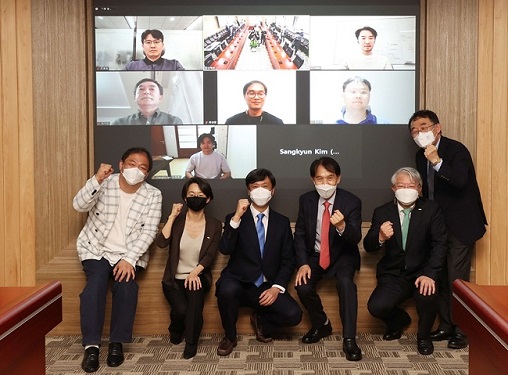
Alumni from the KAIST School of Computing who are current and former developers at the leading game company Krafton, established by KAIST alumna Byung-Gyu Chang, made an agreement to help raise 11 billion KRW during a ceremony on June 4. The funds raised in the matching grant will be used to nurture software developers.
Krafton Chairman Chang donated 10 billion won last January. His donation inspired other alumni working at Krafton as well as its former developers. Eleven KAIST alumni raised 5.5 billion KRW in two months and discussed the matching grant idea with Chairman Chang.
The Krafton matching grant ceremony was attended by President Kwang Hyung Lee, Provost and Executive Vice President Seung Seob Lee, Vice President for Research Sang Yup Lee, Head of the School of Computing Sukyoung Ryu, Krafton Chairman Byung-gyu Chang, and KAIST alumnus from Krafton Seung-woo Shin. Other alumni donors including Krafton CEO Changhan Kim joined the ceremony online.
Krafton CEO Changhan Kim said, “Just as our alma mater played an important role in growing our company, we hope that our donation could help support good developers. This will not only help our company, but advance our industry.”
KAIST and Krafton also signed a business agreement to foster competitive developers. Krafton said it plans to continue giving back to society through the matching grant program.
Head of the School of Computing Sukyoung Ryu thanked Chairman Chang and alumni who took part in the fund raising, saying, “To take the lead in rapidly changing computer technology, we desperately need more top students, faculty members, and facilities. We need more resources and infrastructure for interdisciplinary research.”
The School of Computing has seen significant growth recently. Its number of undergraduate students has increased from 450 in 2016 to more than 900 in 2021. With this donation, the school will expand its current buildings to provide diverse educational and mentoring programs in more spacious facilities.
Seung-woo Shin (Class of ’92), who joined Krafton’s matching grant, said, “I have always been thankful for the people I met and what I learned at KAIST. I was moved by the idea of giving back to the school.”
Seong-jung Ryu (Class of ’97) said, “This donation reminded me of the good times I had back then. I thought it was crucial that the department’s facilities be extended, so I naturally wanted to take part.”
Alumni donations, especially from the School of Computing, have also continued to grow more recently. Woowa Brothers Corp. CEO Beom-Jun Kim, the developer of the meal delivery app ‘Baemin’ donated 100 million KRW in April. Baemin became the most used app in the country during the COVID-19 pandemic.
He explained, “I have been thinking about ways to give something to the next generation, rather than ‘paying back’ those who helped me in the past.”
Encouraged by Baemin’s donation, alumni couple Ha-Yeon Seo and Dong-Hun Hahn from the School of Computing and eleven alumni engineers working at Devsisters Corp. also followed suit.
2021.06.09 View 12053
Krafton Matches Alumni Donations to Raise 11 Billion KRW for SW Developers
Alumni donations from the School of Computing, including Baemin and Devsisters, continue to grow
Alumni from the KAIST School of Computing who are current and former developers at the leading game company Krafton, established by KAIST alumna Byung-Gyu Chang, made an agreement to help raise 11 billion KRW during a ceremony on June 4. The funds raised in the matching grant will be used to nurture software developers.
Krafton Chairman Chang donated 10 billion won last January. His donation inspired other alumni working at Krafton as well as its former developers. Eleven KAIST alumni raised 5.5 billion KRW in two months and discussed the matching grant idea with Chairman Chang.
The Krafton matching grant ceremony was attended by President Kwang Hyung Lee, Provost and Executive Vice President Seung Seob Lee, Vice President for Research Sang Yup Lee, Head of the School of Computing Sukyoung Ryu, Krafton Chairman Byung-gyu Chang, and KAIST alumnus from Krafton Seung-woo Shin. Other alumni donors including Krafton CEO Changhan Kim joined the ceremony online.
Krafton CEO Changhan Kim said, “Just as our alma mater played an important role in growing our company, we hope that our donation could help support good developers. This will not only help our company, but advance our industry.”
KAIST and Krafton also signed a business agreement to foster competitive developers. Krafton said it plans to continue giving back to society through the matching grant program.
Head of the School of Computing Sukyoung Ryu thanked Chairman Chang and alumni who took part in the fund raising, saying, “To take the lead in rapidly changing computer technology, we desperately need more top students, faculty members, and facilities. We need more resources and infrastructure for interdisciplinary research.”
The School of Computing has seen significant growth recently. Its number of undergraduate students has increased from 450 in 2016 to more than 900 in 2021. With this donation, the school will expand its current buildings to provide diverse educational and mentoring programs in more spacious facilities.
Seung-woo Shin (Class of ’92), who joined Krafton’s matching grant, said, “I have always been thankful for the people I met and what I learned at KAIST. I was moved by the idea of giving back to the school.”
Seong-jung Ryu (Class of ’97) said, “This donation reminded me of the good times I had back then. I thought it was crucial that the department’s facilities be extended, so I naturally wanted to take part.”
Alumni donations, especially from the School of Computing, have also continued to grow more recently. Woowa Brothers Corp. CEO Beom-Jun Kim, the developer of the meal delivery app ‘Baemin’ donated 100 million KRW in April. Baemin became the most used app in the country during the COVID-19 pandemic.
He explained, “I have been thinking about ways to give something to the next generation, rather than ‘paying back’ those who helped me in the past.”
Encouraged by Baemin’s donation, alumni couple Ha-Yeon Seo and Dong-Hun Hahn from the School of Computing and eleven alumni engineers working at Devsisters Corp. also followed suit.
2021.06.09 View 12053 -
 A Self-Made Couple in Their 90s Donates to KAIST
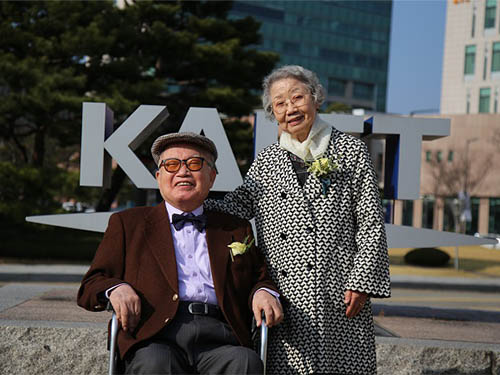
A self-made elderly couple in their 90s made a 20 billion KRW donation to KAIST on March 13. Chairman of Samsung Brush Sung-Hwan Chang and his wife Ha-Ok Ahn gave away their two properties valued at 20 billion in Nonhyon-dong in Seoul to KAIST during a ceremony on March 13 in Seoul.
Chairman Chang, 92, made a huge fortune starting his business manufacturing cosmetic brushes. Building two factories in China, he expanded his business to export to high-end cosmetic companies. Chairman Chang, a native of North Korea, is a refugee who fled his hometown with his sister at age 18 during the Korean War. He said remembering his mother who was left behind in North Korea was the most painful thing.
“We always wanted to help out people in need when we would earn enough money. We were inspired by our friends at our retirement community who made a donation to KAIST several years ago. We believe this is the right time to make this decision,” said Chairman Chang.
The couple lives in same retirement community, a famous place for many successful businessmen and wealthy retired figures, located in Yongin, Kyonggi-do with Chairmen Beang-Ho Kim, Chun-Shik Cho, and Chang-Keun Son. With their gift, KAIST established Kim Beang-Ho & Kim Sam-Youl ITC Building as well as the Cho Chun-Shik Graduate School of Green Transportation. The four senior couples’ donations amount to 76.1 billion KRW.
“It would be the most meaningful way if we could invest in KAIST for the country’s future,” said Chairman Chang. “I talked a lot with Chairman Kim on how KAIST utilizes its donations and have developed a strong belief in the future of KAIST.”
Chairman and Mrs. Chang already toured the campus several times at the invitation of President Kwang-Hyung Lee and President Lee himself presented the vision of KAIST to the couple. The couple also attended President Lee’s inauguration ceremony on March 8.
President Lee thanked the couple for their donation, saying “I take my hat off to Chairman Chang and his wife for their generous donation that was amassed over their lifetime. They lived very fiscally responsible lives. We will efficiently utilize this fund for educating future global talents."
(END)
2021.03.15 View 9575
A Self-Made Couple in Their 90s Donates to KAIST
A self-made elderly couple in their 90s made a 20 billion KRW donation to KAIST on March 13. Chairman of Samsung Brush Sung-Hwan Chang and his wife Ha-Ok Ahn gave away their two properties valued at 20 billion in Nonhyon-dong in Seoul to KAIST during a ceremony on March 13 in Seoul.
Chairman Chang, 92, made a huge fortune starting his business manufacturing cosmetic brushes. Building two factories in China, he expanded his business to export to high-end cosmetic companies. Chairman Chang, a native of North Korea, is a refugee who fled his hometown with his sister at age 18 during the Korean War. He said remembering his mother who was left behind in North Korea was the most painful thing.
“We always wanted to help out people in need when we would earn enough money. We were inspired by our friends at our retirement community who made a donation to KAIST several years ago. We believe this is the right time to make this decision,” said Chairman Chang.
The couple lives in same retirement community, a famous place for many successful businessmen and wealthy retired figures, located in Yongin, Kyonggi-do with Chairmen Beang-Ho Kim, Chun-Shik Cho, and Chang-Keun Son. With their gift, KAIST established Kim Beang-Ho & Kim Sam-Youl ITC Building as well as the Cho Chun-Shik Graduate School of Green Transportation. The four senior couples’ donations amount to 76.1 billion KRW.
“It would be the most meaningful way if we could invest in KAIST for the country’s future,” said Chairman Chang. “I talked a lot with Chairman Kim on how KAIST utilizes its donations and have developed a strong belief in the future of KAIST.”
Chairman and Mrs. Chang already toured the campus several times at the invitation of President Kwang-Hyung Lee and President Lee himself presented the vision of KAIST to the couple. The couple also attended President Lee’s inauguration ceremony on March 8.
President Lee thanked the couple for their donation, saying “I take my hat off to Chairman Chang and his wife for their generous donation that was amassed over their lifetime. They lived very fiscally responsible lives. We will efficiently utilize this fund for educating future global talents."
(END)
2021.03.15 View 9575 -
 Dongwon Chairman Donates ₩50 Billion to Fund AI Graduate School
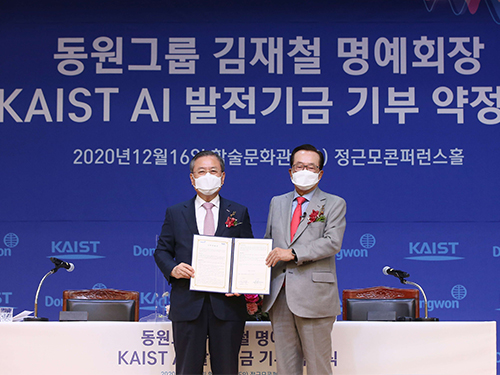
Dongwon Group Honorary Chairman and Founder Jae-chul Kim donated his private property worth ₩50 billion (US $46 million) to KAIST on December 16. Honorary Chairman Kim’s gift will fund the KAIST Graduate School of AI (GSAI), which was established last year. The KAIST GSAI will be re-named the ‘Kim Jae-chul Graduate School of AI’ to honor Honorary Chairman Kim.
This is the third major donation that KAIST has received this year following KAIST Development Foundation Chairman Soo-Young Lee’s ₩67.6 billion in real estate in July and another ₩10 billion from a KAIST alumnus, Chairman Byeong-Gyu Chang of Krafton, in January.
“KAIST, as the cradle that trains Korea’s best talents in science and technology, has been at the forefront of leading national development over the past 50 years. I hope that KAIST will also strive to nurture global talents who excel in AI innovation and steer Korea’s new advancements to lead the Fourth Industrial Revolution,” said Honorary Chairman Kim during the donation ceremony at KAIST’s main campus in Daejeon.
The ceremony was held in strict compliance with Level Two social distancing guidelines and measures in response to the persistent coronavirus. Less than 50 people, including Honorary Chairman Kim’s family, President Sung-Chul Shin, and professors from key posts at KAIST, attended the ceremony.
Dongwon Group is one of the leading fishery companies in Korea, established in 1969 by Honorary Chairman Kim. He recalled memories of his childhood as he explained the background of the donation, saying, “When I was young, I searched for Korea’s future in the world’s oceans. However, a new future lies in the ‘oceans of data.’”
“I have been pondering how I could further contribute to my country, and realized that bringing up talented individuals in the AI and data science-related fields is important. I hope that my donation today will aid the take-off of KAIST’s great voyage towards becoming a global “flagship” in the new eras to come,” Honorary Chairman Kim added.
To this, President Shin responded acclaiming the noblesse oblige held by Honorary Chairman Kim to further develop Korea’s science and technology and make Korea into a leader in AI innovation.
“We will always keep KAIST’s role and mission close to our hearts and do our best to make KAIST into a global hub for talent cultivation and R&D in AI, based on Honorary Chairman Kim’s donation,” said President Shin.
With Honorary Chairman Kim’s donation, the KAIST GSAI will first expand its faculty in both quantity and quality. By expanding the number of full-time, highly qualified professors to 40 by 2030, the School will train the most talented personnel in fusion and convergence AI.
The KAIST GSAI opened in August 2019 as the first school in Korea to be selected as part of the ‘2019 Graduate School for AI Support Project’ by the Ministry of Science and ICT. The current faculty is composed of 13 full-time professors including ex-researchers from AI labs of global conglomerates including Google, IBM Watson, and Microsoft, as well as eight adjunct professors, making a total of 21 faculty members. There are currently 138 students attending the School, including 79 master’s students, 17 in the integrated MS-PhD program, and 42 PhD candidates.
(END)
2020.12.16 View 9859
Dongwon Chairman Donates ₩50 Billion to Fund AI Graduate School
Dongwon Group Honorary Chairman and Founder Jae-chul Kim donated his private property worth ₩50 billion (US $46 million) to KAIST on December 16. Honorary Chairman Kim’s gift will fund the KAIST Graduate School of AI (GSAI), which was established last year. The KAIST GSAI will be re-named the ‘Kim Jae-chul Graduate School of AI’ to honor Honorary Chairman Kim.
This is the third major donation that KAIST has received this year following KAIST Development Foundation Chairman Soo-Young Lee’s ₩67.6 billion in real estate in July and another ₩10 billion from a KAIST alumnus, Chairman Byeong-Gyu Chang of Krafton, in January.
“KAIST, as the cradle that trains Korea’s best talents in science and technology, has been at the forefront of leading national development over the past 50 years. I hope that KAIST will also strive to nurture global talents who excel in AI innovation and steer Korea’s new advancements to lead the Fourth Industrial Revolution,” said Honorary Chairman Kim during the donation ceremony at KAIST’s main campus in Daejeon.
The ceremony was held in strict compliance with Level Two social distancing guidelines and measures in response to the persistent coronavirus. Less than 50 people, including Honorary Chairman Kim’s family, President Sung-Chul Shin, and professors from key posts at KAIST, attended the ceremony.
Dongwon Group is one of the leading fishery companies in Korea, established in 1969 by Honorary Chairman Kim. He recalled memories of his childhood as he explained the background of the donation, saying, “When I was young, I searched for Korea’s future in the world’s oceans. However, a new future lies in the ‘oceans of data.’”
“I have been pondering how I could further contribute to my country, and realized that bringing up talented individuals in the AI and data science-related fields is important. I hope that my donation today will aid the take-off of KAIST’s great voyage towards becoming a global “flagship” in the new eras to come,” Honorary Chairman Kim added.
To this, President Shin responded acclaiming the noblesse oblige held by Honorary Chairman Kim to further develop Korea’s science and technology and make Korea into a leader in AI innovation.
“We will always keep KAIST’s role and mission close to our hearts and do our best to make KAIST into a global hub for talent cultivation and R&D in AI, based on Honorary Chairman Kim’s donation,” said President Shin.
With Honorary Chairman Kim’s donation, the KAIST GSAI will first expand its faculty in both quantity and quality. By expanding the number of full-time, highly qualified professors to 40 by 2030, the School will train the most talented personnel in fusion and convergence AI.
The KAIST GSAI opened in August 2019 as the first school in Korea to be selected as part of the ‘2019 Graduate School for AI Support Project’ by the Ministry of Science and ICT. The current faculty is composed of 13 full-time professors including ex-researchers from AI labs of global conglomerates including Google, IBM Watson, and Microsoft, as well as eight adjunct professors, making a total of 21 faculty members. There are currently 138 students attending the School, including 79 master’s students, 17 in the integrated MS-PhD program, and 42 PhD candidates.
(END)
2020.12.16 View 9859 -
 Chairman Soo-Young Lee Named Among the Heroes of Philanthropy in Asia
Chairman Soo-Young Lee from the KAIST Development Foundation was named one of 15 philanthropists who made the biggest donations in the Asia-Pacific region by Forbes Asia on November 11.
The annual Heroes of Philanthropy list features the 15 the most generous individual philanthropists who are donating from their personal fortunes, not through companies. This year, the biggest philanthropies donated to make a difference in wide arrays of sectors such as Covid-19 relief to education and the arts.
Chairman Lee donated totaling 68 billion KRW to KAIST in July. Her donation marked the largest donation KAIST has ever received. She is one of two Korean philanthropists that Forbes selected. Honorary Chairman of GS Caltex Dong-Soo Huh also made the list.
Her donation will establish the Soo-Young Lee Science Education Foundation to support ‘the Singularity Professor program’ that KAIST is launching. She expressed confidence that her donation will fund KAIST researchers to make breakthroughs that will lead to a Nobel Prize.
“Without the advancement of science and technology, Korea cannot be one of the top countries in the world. I believe KAIST can make it with our all supports,” she frequently said when asked why she selected KAIST for her donation.
Chairman Lee previously made generous donations in 2012 and 2016 and said she plans to make another gift to KAIST in the very near future.
2020.11.13 View 7393
Chairman Soo-Young Lee Named Among the Heroes of Philanthropy in Asia
Chairman Soo-Young Lee from the KAIST Development Foundation was named one of 15 philanthropists who made the biggest donations in the Asia-Pacific region by Forbes Asia on November 11.
The annual Heroes of Philanthropy list features the 15 the most generous individual philanthropists who are donating from their personal fortunes, not through companies. This year, the biggest philanthropies donated to make a difference in wide arrays of sectors such as Covid-19 relief to education and the arts.
Chairman Lee donated totaling 68 billion KRW to KAIST in July. Her donation marked the largest donation KAIST has ever received. She is one of two Korean philanthropists that Forbes selected. Honorary Chairman of GS Caltex Dong-Soo Huh also made the list.
Her donation will establish the Soo-Young Lee Science Education Foundation to support ‘the Singularity Professor program’ that KAIST is launching. She expressed confidence that her donation will fund KAIST researchers to make breakthroughs that will lead to a Nobel Prize.
“Without the advancement of science and technology, Korea cannot be one of the top countries in the world. I believe KAIST can make it with our all supports,” she frequently said when asked why she selected KAIST for her donation.
Chairman Lee previously made generous donations in 2012 and 2016 and said she plans to make another gift to KAIST in the very near future.
2020.11.13 View 7393