%65%6c%65%63%74%72%69%63%69%74%79
-
 KAIST, Production Temperature ↓ by 500°C, Power Output ↑ 2x… Next-Generation Ceramic Electrochemical Cell Reborn
<(Top row, from left) Professor Kang Taek Lee, Ph.D candidate Yejin Kang, Dr. Dongyeon Kim, (Bottom row, from left) M.S candidate Mincheol Lee, Ph.D candidate Seeun Oh, Ph.D candidate Seungsoo Jang, Ph.D candidate Hyeonggeun Kim>
As power demand surges in the AI era, the “protonic ceramic electrochemical cell (PCEC),” which can simultaneously produce electricity and hydrogen, is gaining attention as a next-generation energy technology. However, this cell has faced the technical limitation of requiring an ultra-high production temperature of 1,500°C. A KAIST research team has succeeded in establishing a new manufacturing process that lowers this limit by more than 500°C for the first time in the world.
KAIST (President Kwang Hyung Lee) announced on the 4th of December that Professor Kang Taek Lee’s research team in the Department of Mechanical Engineering developed a new process that enables the fabrication of high-performance protonic ceramic electrochemical cells at temperatures more than 500°C lower than before, using “microwave + vapor control technology” that leverages microwave heating principles and the diffusion environment of chemical vapor generated from specific chemical components.
The electrolyte—the key material of protonic ceramic electrochemical cells—contains barium (Ba), and barium easily evaporates at temperatures above 1,500°C, which has been the main cause of performance degradation. Therefore, the ability to harden the ceramic electrolyte at a lower temperature has been the core issue that determines cell performance.
As power demand surges in the AI era, the “protonic ceramic electrochemical cell (PCEC),” which can simultaneously produce electricity and hydrogen, is gaining attention as a next-generation energy technology. However, this cell has faced the technical limitation of requiring an ultra-high production temperature of 1,500°C. A KAIST research team has succeeded in establishing a new manufacturing process that lowers this limit by more than 500°C for the first time in the world.
KAIST (President Kwang Hyung Lee) announced on the 4th of December that Professor Kang Taek Lee’s research team in the Department of Mechanical Engineering developed a new process that enables the fabrication of high-performance protonic ceramic electrochemical cells at temperatures more than 500°C lower than before, using “microwave + vapor control technology” that leverages microwave heating principles and the diffusion environment of chemical vapor generated from specific chemical components.
The electrolyte—the key material of protonic ceramic electrochemical cells—contains barium (Ba), and barium easily evaporates at temperatures above 1,500°C, which has been the main cause of performance degradation. Therefore, the ability to harden the ceramic electrolyte at a lower temperature has been the core issue that determines cell performance.
To solve this, the research team devised a new heat-treatment method called “vapor-phase diffusion.” This technique places a special auxiliary material (a vapor source) next to the cell and irradiates it with microwaves to quickly diffuse vapor. When the temperature reaches approximately 800°C, the vapor released from the auxiliary material moves toward the electrolyte and tightly bonds the ceramic particles. Thanks to this technology, a process that previously required 1,500°C can now be completed at just 980°C. In other words, a world-first ceramic electrochemical cell fabrication technology has been created that produces high-performance electricity at a “low temperature” without damaging the electrolyte.
A cell fabricated with this process produced 2 W of power stably from a 1 cm² cell (roughly the size of a fingernail) at 600°C and generated 205 mL of hydrogen per hour at 600°C (about the volume of a small paper cup, among the highest in the industry). It also maintained stability without performance degradation during 500 hours of continuous operation.
In other words, this technology reduces the production temperature (−500°C), lowers the operating temperature (600°C), doubles performance (2 W/cm²), and extends the lifespan (500-hour stability), achieving world-class performance in ceramic cell technology.
The research team also enhanced the reliability of the technology by using digital twins (virtual simulations) to analyze gas-transport phenomena occurring in the microscopic internal structure of the cell − phenomena that are difficult to observe in actual experiments.
<Figure 1. (a) Schematic of the vapor-diffusion-based process; (b) Surface microstructure of the electrolyte; (c) Internal barium composition ratio of the electrolyte according to processing conditions; (d) Comparison of power-generation performance with previous studies>
< Figure 2. (a) Three-dimensional reconstructed image of the protonic ceramic electrochemical cell fuel electrode according to processing conditions (b) Pore structure (c) Gas-transport simulation results >
Professor Kang Taek Lee emphasized, “This study is the world’s first case of using vapor to lower the heat-treatment temperature by more than 500°C while still producing a high-performance, high-stability cell.” He added, “It is expected to become a key manufacturing technology that addresses the power challenges of the AI era and accelerates the hydrogen society.”
Dongyeon Kim (KAIST PhD) and Yejin Kang (KAIST PhD candidate) participated as co–first authors. The research results were published in Advanced Materials (IF: 26.8), one of the world’s leading journals in energy and materials science, and were selected as the Inside Front Cover article on October 29.
(Paper title: “Sub-1000°C Sintering of Protonic Ceramic Electrochemical Cells via Microwave-Driven Vapor Phase Diffusion,” DOI: https://doi.org/10.1002/adma.202506905)
This research was supported by the MSIT’s Mid-career Researcher Program and the H2 Next Round Program.
2025.12.05 View 6560
KAIST, Production Temperature ↓ by 500°C, Power Output ↑ 2x… Next-Generation Ceramic Electrochemical Cell Reborn
<(Top row, from left) Professor Kang Taek Lee, Ph.D candidate Yejin Kang, Dr. Dongyeon Kim, (Bottom row, from left) M.S candidate Mincheol Lee, Ph.D candidate Seeun Oh, Ph.D candidate Seungsoo Jang, Ph.D candidate Hyeonggeun Kim>
As power demand surges in the AI era, the “protonic ceramic electrochemical cell (PCEC),” which can simultaneously produce electricity and hydrogen, is gaining attention as a next-generation energy technology. However, this cell has faced the technical limitation of requiring an ultra-high production temperature of 1,500°C. A KAIST research team has succeeded in establishing a new manufacturing process that lowers this limit by more than 500°C for the first time in the world.
KAIST (President Kwang Hyung Lee) announced on the 4th of December that Professor Kang Taek Lee’s research team in the Department of Mechanical Engineering developed a new process that enables the fabrication of high-performance protonic ceramic electrochemical cells at temperatures more than 500°C lower than before, using “microwave + vapor control technology” that leverages microwave heating principles and the diffusion environment of chemical vapor generated from specific chemical components.
The electrolyte—the key material of protonic ceramic electrochemical cells—contains barium (Ba), and barium easily evaporates at temperatures above 1,500°C, which has been the main cause of performance degradation. Therefore, the ability to harden the ceramic electrolyte at a lower temperature has been the core issue that determines cell performance.
As power demand surges in the AI era, the “protonic ceramic electrochemical cell (PCEC),” which can simultaneously produce electricity and hydrogen, is gaining attention as a next-generation energy technology. However, this cell has faced the technical limitation of requiring an ultra-high production temperature of 1,500°C. A KAIST research team has succeeded in establishing a new manufacturing process that lowers this limit by more than 500°C for the first time in the world.
KAIST (President Kwang Hyung Lee) announced on the 4th of December that Professor Kang Taek Lee’s research team in the Department of Mechanical Engineering developed a new process that enables the fabrication of high-performance protonic ceramic electrochemical cells at temperatures more than 500°C lower than before, using “microwave + vapor control technology” that leverages microwave heating principles and the diffusion environment of chemical vapor generated from specific chemical components.
The electrolyte—the key material of protonic ceramic electrochemical cells—contains barium (Ba), and barium easily evaporates at temperatures above 1,500°C, which has been the main cause of performance degradation. Therefore, the ability to harden the ceramic electrolyte at a lower temperature has been the core issue that determines cell performance.
To solve this, the research team devised a new heat-treatment method called “vapor-phase diffusion.” This technique places a special auxiliary material (a vapor source) next to the cell and irradiates it with microwaves to quickly diffuse vapor. When the temperature reaches approximately 800°C, the vapor released from the auxiliary material moves toward the electrolyte and tightly bonds the ceramic particles. Thanks to this technology, a process that previously required 1,500°C can now be completed at just 980°C. In other words, a world-first ceramic electrochemical cell fabrication technology has been created that produces high-performance electricity at a “low temperature” without damaging the electrolyte.
A cell fabricated with this process produced 2 W of power stably from a 1 cm² cell (roughly the size of a fingernail) at 600°C and generated 205 mL of hydrogen per hour at 600°C (about the volume of a small paper cup, among the highest in the industry). It also maintained stability without performance degradation during 500 hours of continuous operation.
In other words, this technology reduces the production temperature (−500°C), lowers the operating temperature (600°C), doubles performance (2 W/cm²), and extends the lifespan (500-hour stability), achieving world-class performance in ceramic cell technology.
The research team also enhanced the reliability of the technology by using digital twins (virtual simulations) to analyze gas-transport phenomena occurring in the microscopic internal structure of the cell − phenomena that are difficult to observe in actual experiments.
<Figure 1. (a) Schematic of the vapor-diffusion-based process; (b) Surface microstructure of the electrolyte; (c) Internal barium composition ratio of the electrolyte according to processing conditions; (d) Comparison of power-generation performance with previous studies>
< Figure 2. (a) Three-dimensional reconstructed image of the protonic ceramic electrochemical cell fuel electrode according to processing conditions (b) Pore structure (c) Gas-transport simulation results >
Professor Kang Taek Lee emphasized, “This study is the world’s first case of using vapor to lower the heat-treatment temperature by more than 500°C while still producing a high-performance, high-stability cell.” He added, “It is expected to become a key manufacturing technology that addresses the power challenges of the AI era and accelerates the hydrogen society.”
Dongyeon Kim (KAIST PhD) and Yejin Kang (KAIST PhD candidate) participated as co–first authors. The research results were published in Advanced Materials (IF: 26.8), one of the world’s leading journals in energy and materials science, and were selected as the Inside Front Cover article on October 29.
(Paper title: “Sub-1000°C Sintering of Protonic Ceramic Electrochemical Cells via Microwave-Driven Vapor Phase Diffusion,” DOI: https://doi.org/10.1002/adma.202506905)
This research was supported by the MSIT’s Mid-career Researcher Program and the H2 Next Round Program.
2025.12.05 View 6560 -
 Stretchable Multi-functional Fiber for Energy Harvesting and Strain Sensing
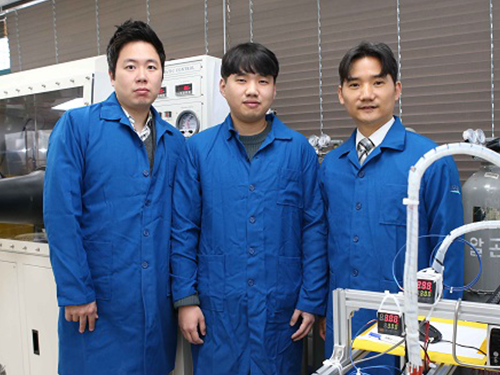
(from left: Professor Steve Park, Jeongjae Ryu and Professor Seungbum Hong)
Fiber-based electronics are expected to play a vital role in next-generation wearable electronics. Woven into textiles, they can provide higher durability, comfort, and integrated multi-functionality. A KAIST team has developed a stretchable multi-functional fiber (SMF) that can harvest energy and detect strain, which can be applied to future wearable electronics.
With wearable electronics, health and physical conditions can be assessed by analyzing biological signals from the human body, such as pulse and muscle movements. Fibers are highly suitable for future wearable electronics because they can be easily integrated into textiles, which are designed to be conformable to curvilinear surfaces and comfortable to wear. Moreover, their weave structures offer support that makes them resistant to fatigue. Many research groups have developed fiber-based strain sensors to sense external biological signals. However, their sensitivities were relatively low.
The applicability of wearable devices is currently limited by their power source, as the size, weight, and lifetime of the battery lessens their versatility. Harvesting mechanical energy from the human body is a promising solution to overcome such limitations by utilizing various types of motions like bending, stretching, and pressing. However, previously reported, fiber-based energy harvesters were not stretchable and could not fully harvest the available mechanical energy.
Professor Seungbum Hong and Professor Steve Park from the Department of Materials Science and Engineering and their team fabricated a stretchable fiber by using a ferroelectric layer composed of P(VDF-TrFE)/PDMS sandwiched between stretchable electrodes composed of a composite of multi-walled carbon nanotubes (MWCNT) and poly 3,4-ethylenedioxythiophene polystyrenesulfonate (PEDOT:PSS).
Cracks formed in MWCNT/PEDOT:PSS layer help the fiber show high sensitivity compared to the previously reported fiber strain sensors. Furthermore, the new fiber can harvest mechanical energy under various mechanical stimuli such as stretching, tapping, and injecting water into the fiber using the piezoelectric effect of the P(VDF-TrFE)/PDMS layer.
Professor Hong said, “This new fiber has various functionalities and makes the device simple and compact. It is a core technology for developing wearable devices with energy harvesting and strain sensing capabilities.”
This article, led by PhD candidate Jeongjae Ryu, was published in the January 2019 issue of Nano Energy.
Figure 1.Schematic illustration of an SMF fiber and its piezoelectric voltage output and response to strain.
Figure 2. Photographs of a stretchable multi-functional fiber being stretched by 100%, bent, and twisted.
2019.01.31 View 15480
Stretchable Multi-functional Fiber for Energy Harvesting and Strain Sensing
(from left: Professor Steve Park, Jeongjae Ryu and Professor Seungbum Hong)
Fiber-based electronics are expected to play a vital role in next-generation wearable electronics. Woven into textiles, they can provide higher durability, comfort, and integrated multi-functionality. A KAIST team has developed a stretchable multi-functional fiber (SMF) that can harvest energy and detect strain, which can be applied to future wearable electronics.
With wearable electronics, health and physical conditions can be assessed by analyzing biological signals from the human body, such as pulse and muscle movements. Fibers are highly suitable for future wearable electronics because they can be easily integrated into textiles, which are designed to be conformable to curvilinear surfaces and comfortable to wear. Moreover, their weave structures offer support that makes them resistant to fatigue. Many research groups have developed fiber-based strain sensors to sense external biological signals. However, their sensitivities were relatively low.
The applicability of wearable devices is currently limited by their power source, as the size, weight, and lifetime of the battery lessens their versatility. Harvesting mechanical energy from the human body is a promising solution to overcome such limitations by utilizing various types of motions like bending, stretching, and pressing. However, previously reported, fiber-based energy harvesters were not stretchable and could not fully harvest the available mechanical energy.
Professor Seungbum Hong and Professor Steve Park from the Department of Materials Science and Engineering and their team fabricated a stretchable fiber by using a ferroelectric layer composed of P(VDF-TrFE)/PDMS sandwiched between stretchable electrodes composed of a composite of multi-walled carbon nanotubes (MWCNT) and poly 3,4-ethylenedioxythiophene polystyrenesulfonate (PEDOT:PSS).
Cracks formed in MWCNT/PEDOT:PSS layer help the fiber show high sensitivity compared to the previously reported fiber strain sensors. Furthermore, the new fiber can harvest mechanical energy under various mechanical stimuli such as stretching, tapping, and injecting water into the fiber using the piezoelectric effect of the P(VDF-TrFE)/PDMS layer.
Professor Hong said, “This new fiber has various functionalities and makes the device simple and compact. It is a core technology for developing wearable devices with energy harvesting and strain sensing capabilities.”
This article, led by PhD candidate Jeongjae Ryu, was published in the January 2019 issue of Nano Energy.
Figure 1.Schematic illustration of an SMF fiber and its piezoelectric voltage output and response to strain.
Figure 2. Photographs of a stretchable multi-functional fiber being stretched by 100%, bent, and twisted.
2019.01.31 View 15480 -
 Flexible Nanogenerator Technology
KAIST research team successfully developed the foundation technology that will enable to fabrication of low cost, large area nanogenerator.
Professor Lee Gun Jae’s team (Department of Materials Science and Engineering) published a dissertation on a nanogenerator using nanocomplexes as the cover dissertation of the June edition of Advanced Materials.
The developed technology is receiving rave reviews for having overcome the complex and size limitations of the nanogenerator fabrication process.
A nanogenerator is an electricity generator that uses materials in the nanoscale and uses piezoelectricity that creates electricity with the application of physical force.
The generation technology using piezoelectricity was appointed as one of top 10 promising technologies by MIT in 2009 and was included in the 45 innovative technologies that will shake the world by Popular Science Magazine in 2010.
The only nanogenerator thus far was the ZnO model suggested by Georgia Tech’s Professor Zhong Lin Wang in 2005.
Professor Lee’s team used ceramic thin film material BaTiO3 which has 15~20 times greater piezoelectric capacity than ZnO and thus improved the overall performance of the device. The use of a nanocomplex allows large scale production and the simplification of the fabrication process itself.
The team created a mixture of PDMS (polydimethylsiloxane) with BaTiO3 and either of CNT (Carbon Nanotube) or RGO (Reduced Graphene Oxide) which has high electrical conductivity and applied this mixture to create a large scale nanogenerator.
2012.06.18 View 23188
Flexible Nanogenerator Technology
KAIST research team successfully developed the foundation technology that will enable to fabrication of low cost, large area nanogenerator.
Professor Lee Gun Jae’s team (Department of Materials Science and Engineering) published a dissertation on a nanogenerator using nanocomplexes as the cover dissertation of the June edition of Advanced Materials.
The developed technology is receiving rave reviews for having overcome the complex and size limitations of the nanogenerator fabrication process.
A nanogenerator is an electricity generator that uses materials in the nanoscale and uses piezoelectricity that creates electricity with the application of physical force.
The generation technology using piezoelectricity was appointed as one of top 10 promising technologies by MIT in 2009 and was included in the 45 innovative technologies that will shake the world by Popular Science Magazine in 2010.
The only nanogenerator thus far was the ZnO model suggested by Georgia Tech’s Professor Zhong Lin Wang in 2005.
Professor Lee’s team used ceramic thin film material BaTiO3 which has 15~20 times greater piezoelectric capacity than ZnO and thus improved the overall performance of the device. The use of a nanocomplex allows large scale production and the simplification of the fabrication process itself.
The team created a mixture of PDMS (polydimethylsiloxane) with BaTiO3 and either of CNT (Carbon Nanotube) or RGO (Reduced Graphene Oxide) which has high electrical conductivity and applied this mixture to create a large scale nanogenerator.
2012.06.18 View 23188