%66%6f%6c%64%61%62%6c%65
-
 Zero-Crease Foldable Technology to Shift the Paradigm of Next-Generation Displays
< Professor Phil-Seung Lee (center), Master’s graduate Jun-han Bae (top left) >
The "crease," long considered the biggest weakness of foldable smartphones, has been pointed out as a major obstacle to market expansion, causing screen distortion and reduced durability over repeated use. A research team at KAIST has presented a solution to this problem, marking a turning point for foldables to leap forward as the standard for next-generation smartphones. Furthermore, the technology is expected to establish itself as a core component of the future mobile industry, expanding into various devices such as laptops.
KAIST announced on April 20th that a research team led by Professor Phil-Seung Lee of the Department of Mechanical Engineering has developed an original technology capable of fundamentally solving the crease issue that occurs at the folding area of foldable smartphone displays and has registered a patent for it. The team has secured global technological competitiveness by filing patent applications in the United States, China, and the European Union (EU), in addition to South Korea.
While global smartphone companies have attempted to solve this issue through massive R&D investments for years, they have yet to achieve the complete removal of the crease. Consequently, the industry has identified the crease problem as the single greatest barrier to the widespread adoption of the foldable smartphone market.
The research team began their study to resolve the inconveniences they personally experienced while using mobile foldable phones. After disassembling dozens of used foldable phones and repeating various experiments, they derived a solution by innovatively redesigning the "adhesive area" between the display and the supporting plate. The core of the design is ensuring that deformation is not concentrated in a specific folding area but is instead distributed to the surrounding sections. Through this, they perfectly demonstrated the feasibility of a "crease-free foldable" while maintaining normal smartphone functionality.
To verify performance, the team shone a straight-line LED light onto the screen. Unlike commercial products where the light refracts and the straight line appears curved at the fold, the prototype maintained a sharp, straight reflection without any distortion. Notably, no visual distortion appeared even under conditions sensitive enough to detect minute curves with a crease depth of less than 0.1mm.
< Display surface reflecting a straight-line LED lamp >
This technology presents a new design paradigm that surpasses the limitations faced by the current industry. It not only fundamentally suppresses the formation of creases but also ensures superior durability by minimizing deformation even after tens of thousands of folding cycles.
Furthermore, because the structure is intuitive and simple, it can be easily integrated into existing manufacturing processes. It is expected to have high industrial utility, as it can be expanded beyond smartphones to various foldable display devices, including tablets and laptops.
< Core idea of the invention: (a) Adhesive and non-adhesive areas of a conventional foldable smartphone, (b) Adhesive and non-adhesive areas in this invention, (c) Stress distribution in a conventional foldable smartphone display, (d) Stress distribution in a foldable smartphone display applying this technology >
Industry experts anticipate that the commercialization of this technology will encourage global companies—which have been hesitant to enter the market due to crease issues—to participate. This is projected to significantly improve consumer satisfaction and accelerate the growth of the stagnating foldable market.
Professor Phil-Seung Lee stated, "We have solved a challenge that global giants could not resolve, using a relatively simple and clear method. We expect this technology to spread across next-generation displays, including laptops and tablets, further strengthening Korea's technological competitiveness."
Meanwhile, this research was conducted with support from the "2022 Daedeok Innopolis Campus Project," and the patent for the related original technology was registered on September 9, 2025.
2026.04.21 View 5284
-
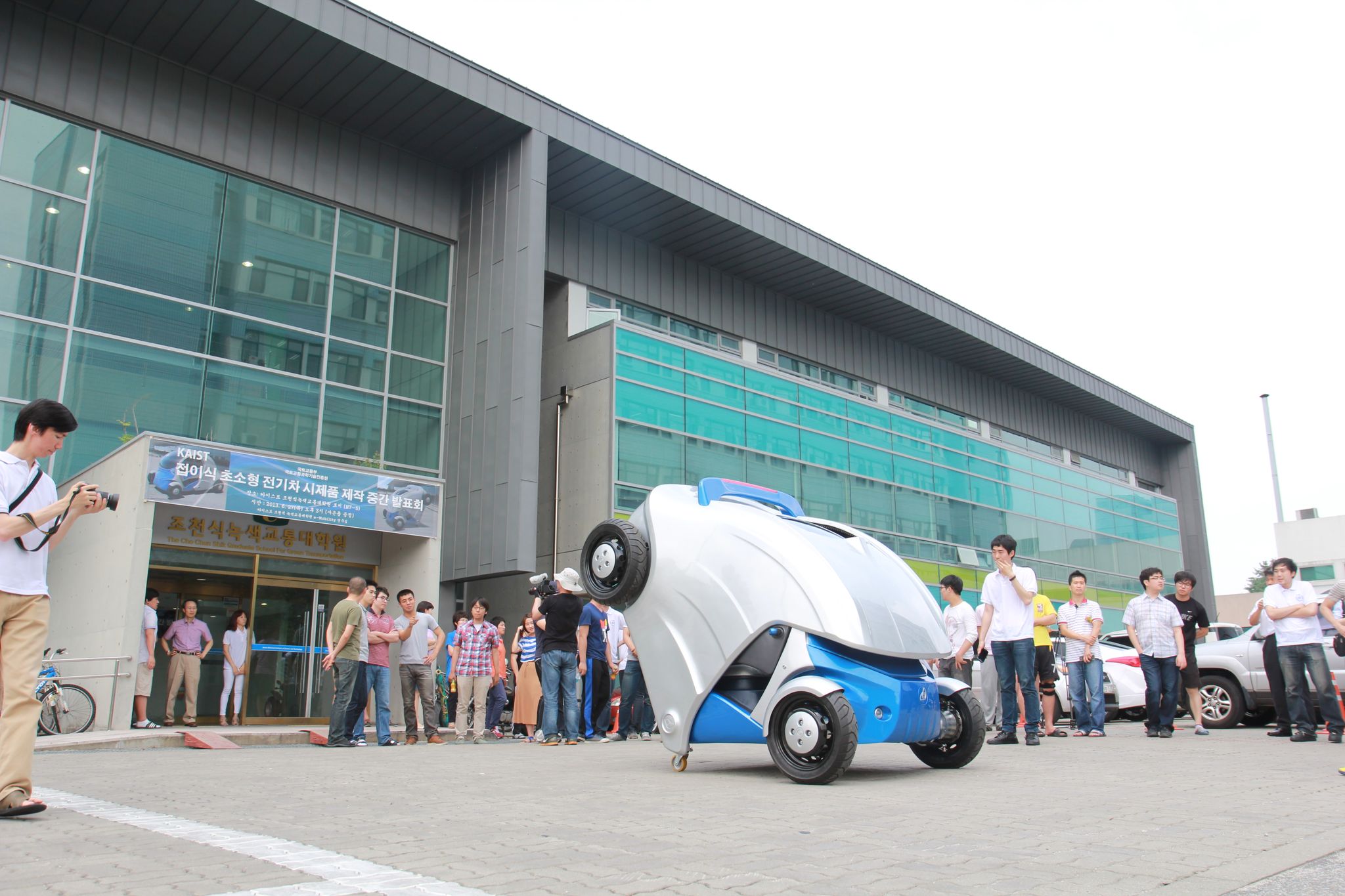 KAIST unveils foldable micro electric car, Armadillo-T
The small and light electric car completely folds in half when parking, making it a perfect fit for public or private transportation in an urban environment.
Looking for a parking space for hours at a busy shopping mall or being stuck on roads jammed with cars releasing large amounts of carbon dioxide are all-too-familiar scenes for city dwellers.
A group of researchers at the Korea Advanced Institute of Science and Technology (KAIST) recently developed a possible solution to such problems: a foldable, compact electric vehicle that can be utilized either as a personal car or part of the public transit system to connect major transportation routes within a city.
In-Soo Suh, associate professor of the Graduate School for Green Transportation at KAIST, and his research team introduced a prototype micro electric car called "Armadillo-T," whose design is based on a native animal of South America, the armadillo, a placental mammal with a leathery armor shell.
The research team imitated the animal"s distinctive protection characteristic of rolling up into a ball when facing with threat from predators. Just as armadillos hide themselves inside the shell, Armadillo-T tucks its rear body away, shrinking its original size of 2.8 meters (110 inches) down to almost half, 1.65 meters (65 inches), when folding.
Armadillo-T is a four-wheel-drive, all-electric car with two seats and four in-wheel motors. Since the motors are installed inside the wheels, and the 13.6 kWh capacity of lithium-ion battery pack is housed on the front side, the battery and motors do not have to change their positions when the car folds. This not only optimizes the energy efficiency but also provides stability and ample room to drivers and passengers.
Once folded, the small and light (weighs 450 kg) electric vehicle takes up only one-third of a 5-meter parking space, the standard parking size in Korea, allowing three of its kind to be parked. With a smartphone-interfaced remote control on the wheels, the vehicle can turn 360 degrees, enhancing drivers" convenience to park the car, even in an odd space in a parking lot, the corner of a building, for example.
Professor In-Soo Suh said, "I expect that people living in cities will eventually shift their preferences from bulky, petro-engine cars to smaller and lighter electric cars. Armadillo-T can be one of the alternatives city drivers can opt for. Particularly, this car is ideal for urban travels, including car-sharing and transit transfer, to offer major transportation links in a city. In addition to the urban application, local near-distance travels such as tourist zones or large buildings can be another example of application."
The concept car has loads of smart features on board, too: the cameras installed inside the car eliminate the need for side mirrors and increase the driver"s ability to see the car"s right and left side, thereby reducing blind spots. With a smartphone, the driver can control Armadillo-T and enable remote folding control. The car has a maximum speed of 60 km/h, and with a ten-minute fast charge, it can run up to 100 km.
Professor Suh explained that the concept of Armadillo-T was originally initiated in 2011 as he focused his research interest on the sub-A segment of personal mobility vehicles (PMVs), which are smaller and lighter than the current compact cars, as a new personalized transport mode.
"In coming years, we will see more mega-size cities established and face more serious environmental problems. Throughout the world, the aging population is rapidly growing as well. To cope with climate, energy, and limited petroleum resources, we really need to think outside the box, once again, to find more convenient and eco-friendly transportation, just as the Ford Model T did in the early 1920s. A further level of R&D, technical standards, and regulatory reviews are required to have these types of micro vehicles or PMVs on the market through test-bed evaluations, but we believe that Armadillo-T is an icon toward the future transport system with technology innovation."
The research project has been supported by the Korean government, the Ministry of Land, Infrastructure and Transport and the Korea Agency for Infrastructure Technology Advancement, since December 2012.Youtube Link: http://www.youtube.com/watch?v=8DoZH7Y-sR0
2013.08.21 View 24015