%6d%61%6e%75%66%61%63%74%75%72%69%6e%67
-
 KAIST Develops a Genetic Switch That Works in Both Bacteria and Yeast
Microbial cell factories that produce pharmaceutical ingredients and other useful compounds include both the bacterium Escherichia coli and yeast, the organism used to leaven bread and ferment alcohol. The two organisms turn genes on by different rules, so a production design built for one has been hard to transfer to the other. A KAIST research team has now built a gene control element that works in both and tested it using a green pigment whose production requires several genes working together. The work is expected to help researchers select the microbe best suited to producing a target compound.
KAIST (President Choongsik Bae) announced on September 28 that a research team led by Professor Juyoung Lee from the Graduate School of Engineering Biology has developed a "hybrid promoter," a gene control element that works in both E. coli and yeast, two very different types of microorganism.
For a microbe to make a target compound, the genes responsible for producing it must be turned on. A promoter is the stretch of DNA located in front of a gene that controls how strongly that gene works.
The challenge is that E. coli and yeast turn genes on in different ways, and a promoter that performs well in E. coli may not work at all in yeast. Making the same compound in a different microbe has therefore required choosing a promoter suited to that host and retuning the output of each gene from the beginning.
The team's hybrid promoter combines, within a single sequence, DNA elements that E. coli and yeast each recognize. It is, in effect, a shared control element designed so that each organism can find the signals it needs even though the two read genes differently. By varying the combination of these elements, the researchers built a series of promoters spanning a range of strength from weak to strong.
The promoters worked in both hosts, and combinations that were strong in E. coli were generally strong in yeast as well. That does not mean the two microbes make equal amounts of a compound; it means the relative ranking of promoter strengths from weak to strong is preserved across hosts.
The team then tested whether the new control element could do more than turn on a single gene and could also be used for actual compound production. For this, they chose a green pigment whose production requires three genes acting in sequence. Under the strong control element, pigment output was about 3.1 times higher in E. coli and about 2.6 times higher in yeast than under the weak one. The result shows that the system can control the amount of a compound produced in both microbes. The team also confirmed that the promoters worked in other types of bacteria and yeast.
The approach could help researchers identify which microbe is best suited to producing a given compound, since the same gene control design can be applied across several microbes and the production results can be compared. It may reduce the need to redesign control elements from scratch whenever the host changes, although improving actual output will still require host-specific tuning.
"What matters about this work is that it gives us a common design principle, one that lets us predict a promoter's relative strength even when the microbe changes," said Professor Juyoung Lee. She added that she expects the approach to speed up biomanufacturing by making it faster to design and compare a range of microbial cell factories.
So-Hee Son, Soo Young Moon, and Nan-Yeong An of KAIST are co-first authors on the paper, which was published in Nucleic Acids Research on September 23 and first appeared online on September 8.
Paper title: Modular synthetic cross-kingdom promoters enable coordinated expression in Escherichia coli and Saccharomyces cerevisiae,
DOI: https://doi.org/10.1093/nar/gkag868
This work was supported by the Ministry of Science and ICT (MSIT) and the National Research Foundation of Korea (NRF) through the Bio & Medical Technology Development Program (RS-2024-00445145) and the Basic Science Research Program (RS-2025-00518119), with additional support from the Korea-US Collaborative Research Fund (KUCRF), funded by MSIT and the Ministry of Health & Welfare (RS-2024-00468410).
2026.09.28 View 2090
KAIST Develops a Genetic Switch That Works in Both Bacteria and Yeast
Microbial cell factories that produce pharmaceutical ingredients and other useful compounds include both the bacterium Escherichia coli and yeast, the organism used to leaven bread and ferment alcohol. The two organisms turn genes on by different rules, so a production design built for one has been hard to transfer to the other. A KAIST research team has now built a gene control element that works in both and tested it using a green pigment whose production requires several genes working together. The work is expected to help researchers select the microbe best suited to producing a target compound.
KAIST (President Choongsik Bae) announced on September 28 that a research team led by Professor Juyoung Lee from the Graduate School of Engineering Biology has developed a "hybrid promoter," a gene control element that works in both E. coli and yeast, two very different types of microorganism.
For a microbe to make a target compound, the genes responsible for producing it must be turned on. A promoter is the stretch of DNA located in front of a gene that controls how strongly that gene works.
The challenge is that E. coli and yeast turn genes on in different ways, and a promoter that performs well in E. coli may not work at all in yeast. Making the same compound in a different microbe has therefore required choosing a promoter suited to that host and retuning the output of each gene from the beginning.
The team's hybrid promoter combines, within a single sequence, DNA elements that E. coli and yeast each recognize. It is, in effect, a shared control element designed so that each organism can find the signals it needs even though the two read genes differently. By varying the combination of these elements, the researchers built a series of promoters spanning a range of strength from weak to strong.
The promoters worked in both hosts, and combinations that were strong in E. coli were generally strong in yeast as well. That does not mean the two microbes make equal amounts of a compound; it means the relative ranking of promoter strengths from weak to strong is preserved across hosts.
The team then tested whether the new control element could do more than turn on a single gene and could also be used for actual compound production. For this, they chose a green pigment whose production requires three genes acting in sequence. Under the strong control element, pigment output was about 3.1 times higher in E. coli and about 2.6 times higher in yeast than under the weak one. The result shows that the system can control the amount of a compound produced in both microbes. The team also confirmed that the promoters worked in other types of bacteria and yeast.
The approach could help researchers identify which microbe is best suited to producing a given compound, since the same gene control design can be applied across several microbes and the production results can be compared. It may reduce the need to redesign control elements from scratch whenever the host changes, although improving actual output will still require host-specific tuning.
"What matters about this work is that it gives us a common design principle, one that lets us predict a promoter's relative strength even when the microbe changes," said Professor Juyoung Lee. She added that she expects the approach to speed up biomanufacturing by making it faster to design and compare a range of microbial cell factories.
So-Hee Son, Soo Young Moon, and Nan-Yeong An of KAIST are co-first authors on the paper, which was published in Nucleic Acids Research on September 23 and first appeared online on September 8.
Paper title: Modular synthetic cross-kingdom promoters enable coordinated expression in Escherichia coli and Saccharomyces cerevisiae,
DOI: https://doi.org/10.1093/nar/gkag868
This work was supported by the Ministry of Science and ICT (MSIT) and the National Research Foundation of Korea (NRF) through the Bio & Medical Technology Development Program (RS-2024-00445145) and the Basic Science Research Program (RS-2025-00518119), with additional support from the Korea-US Collaborative Research Fund (KUCRF), funded by MSIT and the Ministry of Health & Welfare (RS-2024-00468410).
2026.09.28 View 2090 -
 KAIST Develops Microbially Produced Adhesive Materials from Glucose Instead of Petroleum
KAIST researchers have demonstrated the potential of using microorganisms to produce a bio-based alternative to petroleum-derived materials for hot-melt adhesives. These heat-activated glues are widely used in packaging, furniture, electronics, and automobiles. Using Escherichia coli, the team produced a new polymer from glucose and demonstrated adhesive performance and thermal properties that support its potential use as a hot-melt adhesive.
KAIST (President Choongsik Bae) announced on September 17 that a research team led by Distinguished Professor Sang Yup Lee from the Department of Chemical and Biomolecular Engineering developed a microbial cell factory by engineering E. coli to produce the new aromatic polyhydroxyalkanoate (PHA) polymers from glucose for adhesive applications.
The research team applied systems metabolic engineering, an approach that redesigns a microorganism's overall metabolism to produce a target compound, to re-engineer the metabolic pathways of E. coli. Through this approach, the researchers successfully produced two new adhesive materials from glucose, poly(4HB-co-PhLA) and poly(3HB-co-4HB-co-PhLA), both belonging to the PHA family of biodegradable polymers.
Adhesives are essential materials used in a wide range of industries, including packaging materials, electronics, automobiles, and construction materials. In particular, hot-melt adhesives (HMAs) are solid adhesives that are melted with heat for bonding and then solidify as they cool. Because they do not require separate organic solvents and enable rapid bonding, they are widely used in industry.
However, most hot-melt adhesives currently in use are based on petroleum-derived polymers such as ethylene-vinyl acetate (EVA). Although they offer excellent adhesive performance, most do not readily degrade in nature and can cause waste and microplastic problems. In particular, even when biodegradable packaging materials are used, if the adhesive does not degrade, the biodegradability and recyclability of the entire product may be reduced.
To address this problem, the research team focused on PHA, a type of biodegradable plastic produced by microorganisms. PHA can be produced by microorganisms using renewable feedstocks such as glucose. It also has the advantage that properties such as polymer flexibility, strength, and heat resistance can be adjusted in various ways depending on which components are included and in what proportions.
Using this principle, the research team incorporated 4-hydroxybutyrate (4HB) and phenyllactate (PhLA) into a single polymer. 4HB contributes to the material’s softness and adhesion, while PhLA increases the material’s rigidity and heat resistance. When the research team varied the relative proportions of the two components, the thermal properties and adhesive performance of the polymers also changed. In particular, polymers containing approximately 24–34 mol% 4HB showed excellent adhesive performance.
The research team designed intracellular metabolic pathways so that E. coli consumes glucose, produces 4HB and PhLA on its own, and then links them together into polymers.
To address metabolic imbalances that arise when multiple monomers are produced simultaneously, the team adjusted the strength and timing of gene expression, added a CoA transferase to facilitate the reactions, and used a genome-scale metabolic model to identify and optimize metabolic pathways associated with insufficient precursor supply and production bottlenecks.
As a result, through fed-batch fermentation, in which nutrients are continuously supplied during microbial cultivation, the team successfully produced 10.2 g of poly(4HB-co-PhLA) per liter of culture medium. By additionally introducing a biosynthetic pathway for producing 3HB, the team successfully produced up to 52.8 g/L of poly(3HB-co-4HB-co-PhLA).
The research team also tested whether the produced polymers could be used as hot-melt adhesives.
In a lap shear adhesion test using stainless steel as the substrate, poly(4HB-co-PhLA) recorded a lap-shear strength of 4.58 MPa. This is higher than the 4.20 MPa achieved by a commercial EVA adhesive. Poly(3HB-co-4HB-co-PhLA) also showed performance comparable to EVA in a wood adhesion test.
In addition, poly(4HB-co-PhLA) retained a substantial level of adhesive strength even after repeated melting and rebonding. The incorporation of the PhLA component improved heat resistance.
Furthermore, after treatment with lipase, an enzyme that breaks down fats, surface damage to the polymers was observed, while the molecular weight and overall mass of the polymers also decreased. These results indicate that the newly developed aromatic PHA can be degraded by enzymes.
This study is significant not only for the development of an eco-friendly adhesive but also for demonstrating the potential of metabolic engineering to produce functional materials with tunable properties. Going forward, this approach could be extended into a biomanufacturing technology that tunes polymer properties, such as adhesion strength, flexibility, and heat resistance, to meet specific application needs, and produces such materials using microorganisms.
The approach also makes it possible to produce functional polymers that have traditionally been produced through petrochemical processes, from renewable feedstocks such as glucose instead. This is expected to serve as a sustainable production technology not only for adhesives but for a wide range of functional polymer materials going forward.
Distinguished Professor Sang Yup Lee said, “This study demonstrates that by engineering microbial metabolism, it is possible to go beyond simply producing polymers and directly produce functional materials,” adding, “In the future, by utilizing various non-natural monomers and microbial cell factories, this approach could be expanded into biomanufacturing technologies for the sustainable production not only of petroleum-based adhesive alternatives but also of a wide range of functional polymers.”
The study, co-authored by Ph.D. student Minju Kang, Dr. Youngjoon Lee, and Dr. Gi Bae Kim of the KAIST Department of Chemical and Biomolecular Engineering, was published online on July 20 in the international journal Nature Communications.
Paper title: Synthesis of poly(4HB-co-PhLA) and poly(3HB-co-4HB-co-PhLA) as sustainable hot-melt adhesives using engineered Escherichia coli
DOI: 10.1038/s41467-026-75809-9
Author information: Minju Kang (KAIST), Youngjoon Lee (KAIST), Gi Bae Kim (KAIST), Sang Yup Lee (KAIST, corresponding author)
This research was supported by the National Research Foundation of Korea through a grant funded by the Ministry of Science and ICT. (Grant No. 2022M3J5A1056117).
2026.09.17 View 4877
KAIST Develops Microbially Produced Adhesive Materials from Glucose Instead of Petroleum
KAIST researchers have demonstrated the potential of using microorganisms to produce a bio-based alternative to petroleum-derived materials for hot-melt adhesives. These heat-activated glues are widely used in packaging, furniture, electronics, and automobiles. Using Escherichia coli, the team produced a new polymer from glucose and demonstrated adhesive performance and thermal properties that support its potential use as a hot-melt adhesive.
KAIST (President Choongsik Bae) announced on September 17 that a research team led by Distinguished Professor Sang Yup Lee from the Department of Chemical and Biomolecular Engineering developed a microbial cell factory by engineering E. coli to produce the new aromatic polyhydroxyalkanoate (PHA) polymers from glucose for adhesive applications.
The research team applied systems metabolic engineering, an approach that redesigns a microorganism's overall metabolism to produce a target compound, to re-engineer the metabolic pathways of E. coli. Through this approach, the researchers successfully produced two new adhesive materials from glucose, poly(4HB-co-PhLA) and poly(3HB-co-4HB-co-PhLA), both belonging to the PHA family of biodegradable polymers.
Adhesives are essential materials used in a wide range of industries, including packaging materials, electronics, automobiles, and construction materials. In particular, hot-melt adhesives (HMAs) are solid adhesives that are melted with heat for bonding and then solidify as they cool. Because they do not require separate organic solvents and enable rapid bonding, they are widely used in industry.
However, most hot-melt adhesives currently in use are based on petroleum-derived polymers such as ethylene-vinyl acetate (EVA). Although they offer excellent adhesive performance, most do not readily degrade in nature and can cause waste and microplastic problems. In particular, even when biodegradable packaging materials are used, if the adhesive does not degrade, the biodegradability and recyclability of the entire product may be reduced.
To address this problem, the research team focused on PHA, a type of biodegradable plastic produced by microorganisms. PHA can be produced by microorganisms using renewable feedstocks such as glucose. It also has the advantage that properties such as polymer flexibility, strength, and heat resistance can be adjusted in various ways depending on which components are included and in what proportions.
Using this principle, the research team incorporated 4-hydroxybutyrate (4HB) and phenyllactate (PhLA) into a single polymer. 4HB contributes to the material’s softness and adhesion, while PhLA increases the material’s rigidity and heat resistance. When the research team varied the relative proportions of the two components, the thermal properties and adhesive performance of the polymers also changed. In particular, polymers containing approximately 24–34 mol% 4HB showed excellent adhesive performance.
The research team designed intracellular metabolic pathways so that E. coli consumes glucose, produces 4HB and PhLA on its own, and then links them together into polymers.
To address metabolic imbalances that arise when multiple monomers are produced simultaneously, the team adjusted the strength and timing of gene expression, added a CoA transferase to facilitate the reactions, and used a genome-scale metabolic model to identify and optimize metabolic pathways associated with insufficient precursor supply and production bottlenecks.
As a result, through fed-batch fermentation, in which nutrients are continuously supplied during microbial cultivation, the team successfully produced 10.2 g of poly(4HB-co-PhLA) per liter of culture medium. By additionally introducing a biosynthetic pathway for producing 3HB, the team successfully produced up to 52.8 g/L of poly(3HB-co-4HB-co-PhLA).
The research team also tested whether the produced polymers could be used as hot-melt adhesives.
In a lap shear adhesion test using stainless steel as the substrate, poly(4HB-co-PhLA) recorded a lap-shear strength of 4.58 MPa. This is higher than the 4.20 MPa achieved by a commercial EVA adhesive. Poly(3HB-co-4HB-co-PhLA) also showed performance comparable to EVA in a wood adhesion test.
In addition, poly(4HB-co-PhLA) retained a substantial level of adhesive strength even after repeated melting and rebonding. The incorporation of the PhLA component improved heat resistance.
Furthermore, after treatment with lipase, an enzyme that breaks down fats, surface damage to the polymers was observed, while the molecular weight and overall mass of the polymers also decreased. These results indicate that the newly developed aromatic PHA can be degraded by enzymes.
This study is significant not only for the development of an eco-friendly adhesive but also for demonstrating the potential of metabolic engineering to produce functional materials with tunable properties. Going forward, this approach could be extended into a biomanufacturing technology that tunes polymer properties, such as adhesion strength, flexibility, and heat resistance, to meet specific application needs, and produces such materials using microorganisms.
The approach also makes it possible to produce functional polymers that have traditionally been produced through petrochemical processes, from renewable feedstocks such as glucose instead. This is expected to serve as a sustainable production technology not only for adhesives but for a wide range of functional polymer materials going forward.
Distinguished Professor Sang Yup Lee said, “This study demonstrates that by engineering microbial metabolism, it is possible to go beyond simply producing polymers and directly produce functional materials,” adding, “In the future, by utilizing various non-natural monomers and microbial cell factories, this approach could be expanded into biomanufacturing technologies for the sustainable production not only of petroleum-based adhesive alternatives but also of a wide range of functional polymers.”
The study, co-authored by Ph.D. student Minju Kang, Dr. Youngjoon Lee, and Dr. Gi Bae Kim of the KAIST Department of Chemical and Biomolecular Engineering, was published online on July 20 in the international journal Nature Communications.
Paper title: Synthesis of poly(4HB-co-PhLA) and poly(3HB-co-4HB-co-PhLA) as sustainable hot-melt adhesives using engineered Escherichia coli
DOI: 10.1038/s41467-026-75809-9
Author information: Minju Kang (KAIST), Youngjoon Lee (KAIST), Gi Bae Kim (KAIST), Sang Yup Lee (KAIST, corresponding author)
This research was supported by the National Research Foundation of Korea through a grant funded by the Ministry of Science and ICT. (Grant No. 2022M3J5A1056117).
2026.09.17 View 4877 -
 KAIST Opens the Era of Industrial-Scale Microbial Foods, Proposing Growth Strategies for the Next-Generation Protein Market
The question is no longer whether microbial foods can be made. The question now is who can turn them into an industry first. KAIST researchers have comprehensively analyzed the conditions required for the microbial food industry to succeed across manufacturing, markets, and regulation, and have proposed growth strategies for the next-generation protein industry.
KAIST (President Choongsik Bae) announced on the 31st of July that a research team led by Distinguished Professor Sang Yup Lee from the Department of Chemical and Biomolecular Engineering, together with researchers from SilicoBio, a KAIST faculty startup, has comprehensively analyzed the conditions needed for the microbial food industry to succeed in terms of manufacturing, market entry, and regulatory readiness, and has presented an industrialization strategy and roadmap.
This study is significant in that it did not develop a new microorganism or production technology, but instead systematically analyzed the key challenges involved in connecting laboratory-based core technologies to real-world industry. In particular, by presenting an integrated perspective that encompasses manufacturing readiness, market entry strategies, and regulatory responses, the study proposes a direction for developing microbial foods beyond the next-generation protein industry into a future biomanufacturing platform. It is expected to serve as an important milestone for strengthening national biomanufacturing competitiveness and fostering the global sustainable food industry.
The researchers analyzed that competition in the microbial food industry is shifting from productivity at the laboratory level to manufacturing readiness. They identified stable raw material supply and quality control, control and safety assurance of non-model microorganisms, reduction of downstream processing costs, and regulatory compliance for byproduct recycling as key factors that will determine the pace of commercialization. Manufacturing Readiness refers to the level at which a laboratory technology can be reliably produced at industrial scale. Non-model microorganisms are microorganisms with high industrial potential but insufficient accumulated research infrastructure. Downstream processing refers to the processes of separating, purifying, concentrating, and drying target components after fermentation.
The researchers particularly emphasized that future competitiveness will depend less on the excellence of any single technology and more on the ability to build integrated manufacturing platforms. An Integrated Manufacturing Platform refers to a production system that operates the entire process as one connected framework, from strain development and large-scale fermentation to purification, quality control, and product formulation. Even for the same microbial food product, the choice of raw material can affect pretreatment costs and quality variability, while the choice of strain and fermentation process can greatly influence production cost, energy use, and product quality. The researchers therefore concluded that future industrial competitiveness will depend on how quickly companies can build manufacturing platforms that optimize these factors in an integrated way.
On the market side, the researchers also identified the conditions needed for the microbial food industry to succeed. Based on consumer surveys and industry cases, they found that microbial foods cannot spread simply by emphasizing environmental sustainability. Consumers place importance on taste, texture, familiarity, and safety, while food manufacturers value functionality that can be applied to actual products. Companies and investors, meanwhile, consider the predictability of regulatory approval procedures and speed of market entry to be especially important. In other words, the microbial food market has entered an industrial stage where not only technology, but also product development capability and regulatory readiness are evaluated together.
The researchers also argued that microbial foods should not be viewed merely as an alternative protein industry. They suggested that microbial foods have the potential to develop into a core platform for precision fermentation-based functional food ingredients, high-value biomaterials, and circular biomanufacturing. Precision Fermentation is a technology that uses microorganisms to selectively produce specific proteins or functional substances. Circular Biomanufacturing refers to a sustainable manufacturing system that uses byproducts and renewable resources to produce new bio-based products. This means that microbial foods could become not only a future food source, but also a new production system connecting the global food, materials, and biomanufacturing industries.
The industrialization strategy proposed in this study is also closely aligned with the business direction of SilicoBio, which participated in the joint research. Based on the manufacturing readiness strategy presented in the study, SilicoBio is working to build a platform that connects microbial proteins and functional food ingredients to industrial-scale fermentation, scale-up, and product development. Scale-up refers to the process of expanding production from laboratory scale to industrial scale.
Distinguished Professor Sang Yup Lee of KAIST said, “As global competition surrounding synthetic biology and biomanufacturing intensifies, microbial foods are growing into a key industry that will shape national biomanufacturing competitiveness beyond future food.” He added, “Going forward, competitiveness will be determined by how quickly we can build an industrialization ecosystem that connects core technologies to real production and markets.”
A SilicoBio representative said, “Our goal is to connect the industrialization strategy proposed in this study to actual production and commercialization,” adding, “We will build a platform capable of stably producing microbial-based next-generation foods and functional biomaterials.”
This study, with Seok Yeong Jung, a doctoral student in the Department of Chemical and Biomolecular Engineering, as first author and researchers from SilicoBio participating as co-authors, was published on July 17 in the international journal One Earth (Impact Factor 15.3, JCR top 2.07%).
Paper title: Microbial foods as scalable platforms toward a circular protein economy for sustainable nutrition
DOI: https://doi.org/10.1016/j.oneear.2026.101772
Authors: Sang Yup Lee (KAIST, corresponding author), Seok Yeong Jung (KAIST, first author), Sol Choi (SilicoBio, second author), Jun-Woo Kim (SilicoBio and Inha University, third author), and two others
SilicoBio is a KAIST faculty startup founded in June 2025 by Distinguished Professor Sang Yup Lee, a world-renowned scholar in synthetic biology. The company focuses on connecting laboratory-level achievements in systems metabolic engineering to real industrialization. By combining KAIST’s core technologies with the industrialization experience of personnel from CJ BIO, SilicoBio has built a team capable of reviewing not only strain design, but also industrial-scale fermentation and scale-up, material purification and product development, pilot production, and process validation. Based on this foundation, SilicoBio is pursuing a phased commercialization strategy, starting with next-generation protein products and expanding into functional ingredients and eventually new drug and novel material candidates.
This research was supported by the “Development of Next-Generation Biorefinery Core Technologies to Lead the Biochemical Industry” project under the Petroleum-Alternative Eco-Friendly Chemical Technology Development Program funded by the Ministry of Science and ICT, and by the “Advancement of a Synthetic Biology-Based Industrial Cell Factory Platform and Commercialization of High-Value Functional Biomaterials” project under the Deep Science Startup Activation Support Program funded by the Commercialization Promotion Agency for R&D Outcome.
2026.08.31 View 3011
KAIST Opens the Era of Industrial-Scale Microbial Foods, Proposing Growth Strategies for the Next-Generation Protein Market
The question is no longer whether microbial foods can be made. The question now is who can turn them into an industry first. KAIST researchers have comprehensively analyzed the conditions required for the microbial food industry to succeed across manufacturing, markets, and regulation, and have proposed growth strategies for the next-generation protein industry.
KAIST (President Choongsik Bae) announced on the 31st of July that a research team led by Distinguished Professor Sang Yup Lee from the Department of Chemical and Biomolecular Engineering, together with researchers from SilicoBio, a KAIST faculty startup, has comprehensively analyzed the conditions needed for the microbial food industry to succeed in terms of manufacturing, market entry, and regulatory readiness, and has presented an industrialization strategy and roadmap.
This study is significant in that it did not develop a new microorganism or production technology, but instead systematically analyzed the key challenges involved in connecting laboratory-based core technologies to real-world industry. In particular, by presenting an integrated perspective that encompasses manufacturing readiness, market entry strategies, and regulatory responses, the study proposes a direction for developing microbial foods beyond the next-generation protein industry into a future biomanufacturing platform. It is expected to serve as an important milestone for strengthening national biomanufacturing competitiveness and fostering the global sustainable food industry.
The researchers analyzed that competition in the microbial food industry is shifting from productivity at the laboratory level to manufacturing readiness. They identified stable raw material supply and quality control, control and safety assurance of non-model microorganisms, reduction of downstream processing costs, and regulatory compliance for byproduct recycling as key factors that will determine the pace of commercialization. Manufacturing Readiness refers to the level at which a laboratory technology can be reliably produced at industrial scale. Non-model microorganisms are microorganisms with high industrial potential but insufficient accumulated research infrastructure. Downstream processing refers to the processes of separating, purifying, concentrating, and drying target components after fermentation.
The researchers particularly emphasized that future competitiveness will depend less on the excellence of any single technology and more on the ability to build integrated manufacturing platforms. An Integrated Manufacturing Platform refers to a production system that operates the entire process as one connected framework, from strain development and large-scale fermentation to purification, quality control, and product formulation. Even for the same microbial food product, the choice of raw material can affect pretreatment costs and quality variability, while the choice of strain and fermentation process can greatly influence production cost, energy use, and product quality. The researchers therefore concluded that future industrial competitiveness will depend on how quickly companies can build manufacturing platforms that optimize these factors in an integrated way.
On the market side, the researchers also identified the conditions needed for the microbial food industry to succeed. Based on consumer surveys and industry cases, they found that microbial foods cannot spread simply by emphasizing environmental sustainability. Consumers place importance on taste, texture, familiarity, and safety, while food manufacturers value functionality that can be applied to actual products. Companies and investors, meanwhile, consider the predictability of regulatory approval procedures and speed of market entry to be especially important. In other words, the microbial food market has entered an industrial stage where not only technology, but also product development capability and regulatory readiness are evaluated together.
The researchers also argued that microbial foods should not be viewed merely as an alternative protein industry. They suggested that microbial foods have the potential to develop into a core platform for precision fermentation-based functional food ingredients, high-value biomaterials, and circular biomanufacturing. Precision Fermentation is a technology that uses microorganisms to selectively produce specific proteins or functional substances. Circular Biomanufacturing refers to a sustainable manufacturing system that uses byproducts and renewable resources to produce new bio-based products. This means that microbial foods could become not only a future food source, but also a new production system connecting the global food, materials, and biomanufacturing industries.
The industrialization strategy proposed in this study is also closely aligned with the business direction of SilicoBio, which participated in the joint research. Based on the manufacturing readiness strategy presented in the study, SilicoBio is working to build a platform that connects microbial proteins and functional food ingredients to industrial-scale fermentation, scale-up, and product development. Scale-up refers to the process of expanding production from laboratory scale to industrial scale.
Distinguished Professor Sang Yup Lee of KAIST said, “As global competition surrounding synthetic biology and biomanufacturing intensifies, microbial foods are growing into a key industry that will shape national biomanufacturing competitiveness beyond future food.” He added, “Going forward, competitiveness will be determined by how quickly we can build an industrialization ecosystem that connects core technologies to real production and markets.”
A SilicoBio representative said, “Our goal is to connect the industrialization strategy proposed in this study to actual production and commercialization,” adding, “We will build a platform capable of stably producing microbial-based next-generation foods and functional biomaterials.”
This study, with Seok Yeong Jung, a doctoral student in the Department of Chemical and Biomolecular Engineering, as first author and researchers from SilicoBio participating as co-authors, was published on July 17 in the international journal One Earth (Impact Factor 15.3, JCR top 2.07%).
Paper title: Microbial foods as scalable platforms toward a circular protein economy for sustainable nutrition
DOI: https://doi.org/10.1016/j.oneear.2026.101772
Authors: Sang Yup Lee (KAIST, corresponding author), Seok Yeong Jung (KAIST, first author), Sol Choi (SilicoBio, second author), Jun-Woo Kim (SilicoBio and Inha University, third author), and two others
SilicoBio is a KAIST faculty startup founded in June 2025 by Distinguished Professor Sang Yup Lee, a world-renowned scholar in synthetic biology. The company focuses on connecting laboratory-level achievements in systems metabolic engineering to real industrialization. By combining KAIST’s core technologies with the industrialization experience of personnel from CJ BIO, SilicoBio has built a team capable of reviewing not only strain design, but also industrial-scale fermentation and scale-up, material purification and product development, pilot production, and process validation. Based on this foundation, SilicoBio is pursuing a phased commercialization strategy, starting with next-generation protein products and expanding into functional ingredients and eventually new drug and novel material candidates.
This research was supported by the “Development of Next-Generation Biorefinery Core Technologies to Lead the Biochemical Industry” project under the Petroleum-Alternative Eco-Friendly Chemical Technology Development Program funded by the Ministry of Science and ICT, and by the “Advancement of a Synthetic Biology-Based Industrial Cell Factory Platform and Commercialization of High-Value Functional Biomaterials” project under the Deep Science Startup Activation Support Program funded by the Commercialization Promotion Agency for R&D Outcome.
2026.08.31 View 3011 -
 KAIST Brings the Era of Microbial Cell Factories One Step Closer
The era of "biomanufacturing", in which microbes, not petroleum, produce chemical products, is one step closer. A KAIST research team has analyzed the key challenges limiting the commercialization of biomanufacturing and proposed an AI-driven strategy for industrialization.
KAIST (President Choongsik Bae) announced on the 14th of July that a research team led by Distinguished Professor Sang Yup Lee from the Department of Chemical and Biomolecular Engineering has comprehensively analyzed the key bottlenecks to commercializing biomanufacturing and proposed an industrialization strategy and a roadmap for future growth to address them.
Most chemical products today — including plastics, textiles, and pharmaceutical raw materials — are produced from petroleum. But as concerns over carbon emissions and environmental pollution grow, biomanufacturing, which uses microbes to produce chemicals, is drawing attention as a next-generation manufacturing technology. Still, scaling up lab-developed technologies into economically viable mass production at actual factories remains a major challenge.
Systems metabolic engineering, a core technology in biomanufacturing, designs and optimizes microbial metabolic pathways to build "microbial cell factories" that produce desired chemicals. But technologies that show high productivity in the lab often perform worse once moved to industrial settings — productivity drops, production costs rise, and many fail to achieve price competitiveness, ultimately failing to commercialize.
The research team analyzed succinic acid, a bio-based chemical feedstock, and polyhydroxyalkanoate (PHA), a biodegradable plastic, as representative cases illustrating this "gap between the lab and industry," often called the "valley of death."
Succinic acid is a key raw material for producing eco-friendly plastics and various chemical materials. The team explained that for succinic acid to compete with existing petrochemical products, competitiveness depends not just on production volume, but also on raw material and separation/purification costs, the fermentation process, and market size — all of which must be weighed together. The team also suggested that a phased strategy — entering high-value markets such as pharmaceuticals, cosmetics, and food ingredients first — could be a realistic solution.
PHA is a biodegradable plastic that microbes accumulate inside their cells, an eco-friendly material that breaks down naturally in the environment after use. But PHA is currently less price-competitive than conventional plastics due to high production and recovery costs, and its intrinsic material properties pose a separate barrier: the archetypal polymer P(3HB) is highly crystalline, becomes brittle with age, and has a narrow window between its melting and decomposition temperatures, meaning PHAs are generally not suitable as direct "drop-in" replacements.The team found that a phased approach is needed — simplifying the production process and first applying it to high-value fields such as medical applications and food packaging before expanding into general-purpose markets.
The team predicted that artificial intelligence will become a key to industrializing biomanufacturing going forward. AI can optimize the entire biomanufacturing process — from enzyme and microbial design to digital twins that virtually simulate production processes, and technologies that simultaneously analyze economic feasibility and environmental impact. The team explained that this can shorten development timelines, reduce production costs, and increase the likelihood of successful commercialization.
The team also proposed that techno-economic analysis (TEA) and life cycle assessment (LCA) should be applied as design criteria from the earliest stages of research, rather than as evaluations conducted only after research is complete. The team further emphasized that supply chain resilience — accounting for raw material availability and shifts in the international landscape — should be considered a new design standard for biomanufacturing.
This study is significant not for developing a new production technology, but for comprehensively analyzing the conditions for successful biomanufacturing industrialization and presenting an industrialization roadmap spanning the entire cycle — from securing raw materials to microbial design, fermentation, separation and purification, and market entry. The team expects the study to accelerate the commercialization of the bio-based chemical industry and, over the long term, contribute to shifting the petroleum-centered chemical industry toward an eco-friendly bioeconomy.
The paper, with Ji Yeon Kim and Hye Eun Yu as co-first authors, both Ph.D. candidates in KAIST's Department of Chemical and Biomolecular Engineering, was published online on May 30 in the international journal Nature Communications.
※ Paper title: Beyond petrochemicals: challenges and opportunities in industrial-scale biomanufacturing
※ DOI: 10.1038/s41467-026-73835-1
※ Authors: Ji Yeon Kim (KAIST, co-first author), Hye Eun Yu (KAIST, co-first author), Min Ho Kim (KAIST), Sang Yup Lee (KAIST, corresponding author)
This research was supported by the National Research Foundation of Korea, funded by the Ministry of Science and ICT, through the “Development of Platform Technologies of Microbial Cell Factories for Next-Generation Biorefineries” project (Project No. 2022M3J5A1056117) and the “Development of Advanced Synthetic Biology Source Technologies for Leading the Biomanufacturing Industry” project (Project No. RS-2024-00399424).
2026.07.14 View 4138
KAIST Brings the Era of Microbial Cell Factories One Step Closer
The era of "biomanufacturing", in which microbes, not petroleum, produce chemical products, is one step closer. A KAIST research team has analyzed the key challenges limiting the commercialization of biomanufacturing and proposed an AI-driven strategy for industrialization.
KAIST (President Choongsik Bae) announced on the 14th of July that a research team led by Distinguished Professor Sang Yup Lee from the Department of Chemical and Biomolecular Engineering has comprehensively analyzed the key bottlenecks to commercializing biomanufacturing and proposed an industrialization strategy and a roadmap for future growth to address them.
Most chemical products today — including plastics, textiles, and pharmaceutical raw materials — are produced from petroleum. But as concerns over carbon emissions and environmental pollution grow, biomanufacturing, which uses microbes to produce chemicals, is drawing attention as a next-generation manufacturing technology. Still, scaling up lab-developed technologies into economically viable mass production at actual factories remains a major challenge.
Systems metabolic engineering, a core technology in biomanufacturing, designs and optimizes microbial metabolic pathways to build "microbial cell factories" that produce desired chemicals. But technologies that show high productivity in the lab often perform worse once moved to industrial settings — productivity drops, production costs rise, and many fail to achieve price competitiveness, ultimately failing to commercialize.
The research team analyzed succinic acid, a bio-based chemical feedstock, and polyhydroxyalkanoate (PHA), a biodegradable plastic, as representative cases illustrating this "gap between the lab and industry," often called the "valley of death."
Succinic acid is a key raw material for producing eco-friendly plastics and various chemical materials. The team explained that for succinic acid to compete with existing petrochemical products, competitiveness depends not just on production volume, but also on raw material and separation/purification costs, the fermentation process, and market size — all of which must be weighed together. The team also suggested that a phased strategy — entering high-value markets such as pharmaceuticals, cosmetics, and food ingredients first — could be a realistic solution.
PHA is a biodegradable plastic that microbes accumulate inside their cells, an eco-friendly material that breaks down naturally in the environment after use. But PHA is currently less price-competitive than conventional plastics due to high production and recovery costs, and its intrinsic material properties pose a separate barrier: the archetypal polymer P(3HB) is highly crystalline, becomes brittle with age, and has a narrow window between its melting and decomposition temperatures, meaning PHAs are generally not suitable as direct "drop-in" replacements.The team found that a phased approach is needed — simplifying the production process and first applying it to high-value fields such as medical applications and food packaging before expanding into general-purpose markets.
The team predicted that artificial intelligence will become a key to industrializing biomanufacturing going forward. AI can optimize the entire biomanufacturing process — from enzyme and microbial design to digital twins that virtually simulate production processes, and technologies that simultaneously analyze economic feasibility and environmental impact. The team explained that this can shorten development timelines, reduce production costs, and increase the likelihood of successful commercialization.
The team also proposed that techno-economic analysis (TEA) and life cycle assessment (LCA) should be applied as design criteria from the earliest stages of research, rather than as evaluations conducted only after research is complete. The team further emphasized that supply chain resilience — accounting for raw material availability and shifts in the international landscape — should be considered a new design standard for biomanufacturing.
This study is significant not for developing a new production technology, but for comprehensively analyzing the conditions for successful biomanufacturing industrialization and presenting an industrialization roadmap spanning the entire cycle — from securing raw materials to microbial design, fermentation, separation and purification, and market entry. The team expects the study to accelerate the commercialization of the bio-based chemical industry and, over the long term, contribute to shifting the petroleum-centered chemical industry toward an eco-friendly bioeconomy.
The paper, with Ji Yeon Kim and Hye Eun Yu as co-first authors, both Ph.D. candidates in KAIST's Department of Chemical and Biomolecular Engineering, was published online on May 30 in the international journal Nature Communications.
※ Paper title: Beyond petrochemicals: challenges and opportunities in industrial-scale biomanufacturing
※ DOI: 10.1038/s41467-026-73835-1
※ Authors: Ji Yeon Kim (KAIST, co-first author), Hye Eun Yu (KAIST, co-first author), Min Ho Kim (KAIST), Sang Yup Lee (KAIST, corresponding author)
This research was supported by the National Research Foundation of Korea, funded by the Ministry of Science and ICT, through the “Development of Platform Technologies of Microbial Cell Factories for Next-Generation Biorefineries” project (Project No. 2022M3J5A1056117) and the “Development of Advanced Synthetic Biology Source Technologies for Leading the Biomanufacturing Industry” project (Project No. RS-2024-00399424).
2026.07.14 View 4138 -
 KAIST, AI judges manufacturing beyond craftsmanship and language barriers
<(From Left) M.S candidate Inhyo Lee, Ph.D candidate Heekyu Kim, Ph.D candidate joonyoung Kim, Professor Seunghwa Ryu>
Most of the plastic products we use are made through injection molding, a process in which molten plastic is injected into a mold to mass-produce identical items. However, even slight changes in conditions can lead to defects, so the process has long relied on the intuition of highly skilled workers. Now, KAIST researchers have proposed an AI-based solution that autonomously optimizes processes and transfers manufacturing knowledge, addressing concerns that expertise could be lost due to the retirement of skilled workers and the increase in foreign labor.
KAIST (President Kwang Hyung Lee) announced on the 22nd of December that a research team led by Professor Seunghwa Ryu from the Department of Mechanical Engineering · InnoCORE PRISM-AI Center has, for the first time in the world, developed generative AI technology that autonomously optimizes injection molding processes, along with an LLM-based knowledge transfer system that makes on-site expertise accessible to anyone. The team also reported that these achievements were published consecutively in an internationally renowned journal.
The first achievement is a generative AI–based process inference technology that automatically infers optimal process conditions based on environmental changes or quality requirements. Previously, whenever temperature, humidity, or desired quality levels changed, skilled workers had to rely on trial and error to readjust conditions.
The research team implemented a diffusion model–based approach that reverse-engineers process conditions satisfying target quality requirements, using environmental data and process parameters collected over several months from an actual injection molding factory.
In addition, the team built a surrogate model that substitutes for actual production, enabling quality prediction without running the real process. As a result, they achieved an error rate of just 1.63%, significantly lower than the 23~44% error rates of representative existing technologies such as GAN* and VAE** models traditionally used for process prediction. Experiments applying the AI-generated conditions to real processes confirmed successful production of acceptable products, demonstrating practical applicability.
*GAN (Generative Adversarial Network): a method in which two AI models compete with each other to generate data
**VAE (Variational Autoencoder): a method that compresses and learns common patterns in data and then reconstructs them
<Figure 1. Generative AI–Based Process Reasoning Technology>
The second achievement is the IM-Chat, an LLM-based knowledge transfer system designed to address skilled worker retirement and multilingual work environments. IM-Chat is a multi-agent AI system that combines large language models (LLMs) with retrieval-augmented generation (RAG), serving as an AI assistant for manufacturing sites by providing appropriate solutions to problems encountered by novice or foreign workers.
When a worker asks a question in natural language, the AI understands it and, if necessary, automatically calls the generative process inference AI, simultaneously providing optimal process condition calculations along with relevant standards and background explanations.
For example, when asked, “What is the appropriate injection pressure when the factory humidity is 43.5%?”, the AI calculates the optimal condition and presents the supporting manual references as well. With support for multilingual interfaces, foreign workers can receive the same level of decision-making support.
This research is regarded as a core manufacturing AI transformation (AX) technology that can be extended beyond injection molding to molds, presses, extrusion, 3D printing, batteries, bio-manufacturing, and other industries.
In particular, the work is significant in that it presents a paradigm for autonomous manufacturing AI, integrating generative AI and LLM agents through a Tool-Calling approach*, enabling AI to make its own judgments and invoke necessary functions.
*Tool-Calling approach: a method in which AI autonomously calls and uses the functions or programs required for a given situation
<Figure 2. Large Language Model–Based Multilingual Knowledge Transfer Multi-Agent IM-Chat>
<Figure 3. Example of Operation of the Large Language Model (LLM)–Based Multilingual Knowledge Transfer Multi-Agent IM-Chat>
<Figure 4. Illustration of the Application of an LLM-Based Multilingual Knowledge Transfer Multi-Agent IM-Chat (AI-Generated)>
Professor Seunghwa Ryu explained, “This is a case where we addressed fundamental problems in manufacturing in a data-driven way by combining AI that autonomously optimizes processes with LLMs that make on-site knowledge accessible to anyone,” adding, “We will continue expanding this approach to various manufacturing processes to accelerate intelligence and autonomy across the industry.”
This research involved doctoral candidates Junhyeong Lee, Joon-Young Kim, and Heekyu Kim from the Department of Mechanical Engineering as co–first authors, with Professor Seunghwa Ryu as the corresponding author. The results were published consecutively in the April and December issues of Journal of Manufacturing Systems (JCR 1/69, IF 14.2), the world’s top-ranked international journal in engineering and industrial fields.
※ Paper 1: “Development of an Injection Molding Production Condition Inference System Based on Diffusion Model,” DOI: https://doi.org/10.1016/j.jmsy.2025.01.008 ※ Paper 2: “IM-Chat: A multi-agent LLM framework integrating tool-calling and diffusion modeling for knowledge transfer in injection molding industry,” DOI: https://doi.org/10.1016/j.jmsy.2025.11.007
This research was supported by the Ministry of Science and ICT, the Ministry of SMEs and Startups, and the Ministry of Trade, Industry and Energy.
2025.12.22 View 6456
KAIST, AI judges manufacturing beyond craftsmanship and language barriers
<(From Left) M.S candidate Inhyo Lee, Ph.D candidate Heekyu Kim, Ph.D candidate joonyoung Kim, Professor Seunghwa Ryu>
Most of the plastic products we use are made through injection molding, a process in which molten plastic is injected into a mold to mass-produce identical items. However, even slight changes in conditions can lead to defects, so the process has long relied on the intuition of highly skilled workers. Now, KAIST researchers have proposed an AI-based solution that autonomously optimizes processes and transfers manufacturing knowledge, addressing concerns that expertise could be lost due to the retirement of skilled workers and the increase in foreign labor.
KAIST (President Kwang Hyung Lee) announced on the 22nd of December that a research team led by Professor Seunghwa Ryu from the Department of Mechanical Engineering · InnoCORE PRISM-AI Center has, for the first time in the world, developed generative AI technology that autonomously optimizes injection molding processes, along with an LLM-based knowledge transfer system that makes on-site expertise accessible to anyone. The team also reported that these achievements were published consecutively in an internationally renowned journal.
The first achievement is a generative AI–based process inference technology that automatically infers optimal process conditions based on environmental changes or quality requirements. Previously, whenever temperature, humidity, or desired quality levels changed, skilled workers had to rely on trial and error to readjust conditions.
The research team implemented a diffusion model–based approach that reverse-engineers process conditions satisfying target quality requirements, using environmental data and process parameters collected over several months from an actual injection molding factory.
In addition, the team built a surrogate model that substitutes for actual production, enabling quality prediction without running the real process. As a result, they achieved an error rate of just 1.63%, significantly lower than the 23~44% error rates of representative existing technologies such as GAN* and VAE** models traditionally used for process prediction. Experiments applying the AI-generated conditions to real processes confirmed successful production of acceptable products, demonstrating practical applicability.
*GAN (Generative Adversarial Network): a method in which two AI models compete with each other to generate data
**VAE (Variational Autoencoder): a method that compresses and learns common patterns in data and then reconstructs them
<Figure 1. Generative AI–Based Process Reasoning Technology>
The second achievement is the IM-Chat, an LLM-based knowledge transfer system designed to address skilled worker retirement and multilingual work environments. IM-Chat is a multi-agent AI system that combines large language models (LLMs) with retrieval-augmented generation (RAG), serving as an AI assistant for manufacturing sites by providing appropriate solutions to problems encountered by novice or foreign workers.
When a worker asks a question in natural language, the AI understands it and, if necessary, automatically calls the generative process inference AI, simultaneously providing optimal process condition calculations along with relevant standards and background explanations.
For example, when asked, “What is the appropriate injection pressure when the factory humidity is 43.5%?”, the AI calculates the optimal condition and presents the supporting manual references as well. With support for multilingual interfaces, foreign workers can receive the same level of decision-making support.
This research is regarded as a core manufacturing AI transformation (AX) technology that can be extended beyond injection molding to molds, presses, extrusion, 3D printing, batteries, bio-manufacturing, and other industries.
In particular, the work is significant in that it presents a paradigm for autonomous manufacturing AI, integrating generative AI and LLM agents through a Tool-Calling approach*, enabling AI to make its own judgments and invoke necessary functions.
*Tool-Calling approach: a method in which AI autonomously calls and uses the functions or programs required for a given situation
<Figure 2. Large Language Model–Based Multilingual Knowledge Transfer Multi-Agent IM-Chat>
<Figure 3. Example of Operation of the Large Language Model (LLM)–Based Multilingual Knowledge Transfer Multi-Agent IM-Chat>
<Figure 4. Illustration of the Application of an LLM-Based Multilingual Knowledge Transfer Multi-Agent IM-Chat (AI-Generated)>
Professor Seunghwa Ryu explained, “This is a case where we addressed fundamental problems in manufacturing in a data-driven way by combining AI that autonomously optimizes processes with LLMs that make on-site knowledge accessible to anyone,” adding, “We will continue expanding this approach to various manufacturing processes to accelerate intelligence and autonomy across the industry.”
This research involved doctoral candidates Junhyeong Lee, Joon-Young Kim, and Heekyu Kim from the Department of Mechanical Engineering as co–first authors, with Professor Seunghwa Ryu as the corresponding author. The results were published consecutively in the April and December issues of Journal of Manufacturing Systems (JCR 1/69, IF 14.2), the world’s top-ranked international journal in engineering and industrial fields.
※ Paper 1: “Development of an Injection Molding Production Condition Inference System Based on Diffusion Model,” DOI: https://doi.org/10.1016/j.jmsy.2025.01.008 ※ Paper 2: “IM-Chat: A multi-agent LLM framework integrating tool-calling and diffusion modeling for knowledge transfer in injection molding industry,” DOI: https://doi.org/10.1016/j.jmsy.2025.11.007
This research was supported by the Ministry of Science and ICT, the Ministry of SMEs and Startups, and the Ministry of Trade, Industry and Energy.
2025.12.22 View 6456 -
 KAIST Research Team Develops an AI Framework Capable of Overcoming the Strength-Ductility Dilemma in Additive-manufactured Titanium Alloys
<(From Left) Ph.D. Student Jaejung Park and Professor Seungchul Lee of KAIST Department of Mechanical Engineering and , Professor Hyoung Seop Kim of POSTECH, and M.S.–Ph.D. Integrated Program Student Jeong Ah Lee of POSTECH. >
The KAIST research team led by Professor Seungchul Lee from Department of Mechanical Engineering, in collaboration with Professor Hyoung Seop Kim’s team at POSTECH, successfully overcame the strength–ductility dilemma of Ti 6Al 4V alloy using artificial intelligence, enabling the production of high strength, high ductility metal products. The AI developed by the team accurately predicts mechanical properties based on various 3D printing process parameters while also providing uncertainty information, and it uses both to recommend process parameters that hold high promise for 3D printing.
Among various 3D printing technologies, laser powder bed fusion is an innovative method for manufacturing Ti-6Al-4V alloy, renowned for its high strength and bio-compatibility. However, this alloy made via 3D printing has traditionally faced challenges in simultaneously achieving high strength and high ductility. Although there have been attempts to address this issue by adjusting both the printing process parameters and heat treatment conditions, the vast number of possible combinations made it difficult to explore them all through experiments and simulations alone.
The active learning framework developed by the team quickly explores a wide range of 3D printing process parameters and heat treatment conditions to recommend those expected to improve both strength and ductility of the alloy. These recommendations are based on the AI model’s predictions of ultimate tensile strength and total elongation along with associated uncertainty information for each set of process parameters and heat treatment conditions. The recommended conditions are then validated by performing 3D printing and tensile tests to obtain the true mechanical property values. These new data are incorporated into further AI model training, and through iterative exploration, the optimal process parameters and heat treatment conditions for producing high-performance alloys were determined in only five iterations. With these optimized conditions, the 3D printed Ti-6Al-4V alloy achieved an ultimate tensile strength of 1190 MPa and a total elongation of 16.5%, successfully overcoming the strength–ductility dilemma.
Professor Seungchul Lee commented, “In this study, by optimizing the 3D printing process parameters and heat treatment conditions, we were able to develop a high-strength, high-ductility Ti-6Al-4V alloy with minimal experimentation trials. Compared to previous studies, we produced an alloy with a similar ultimate tensile strength but higher total elongation, as well as that with a similar elongation but greater ultimate tensile strength.” He added, “Furthermore, if our approach is applied not only to mechanical properties but also to other properties such as thermal conductivity and thermal expansion, we anticipate that it will enable efficient exploration of 3D printing process parameters and heat treatment conditions.”
This study was published in Nature Communications on January 22 (https://doi.org/10.1038/s41467-025-56267-1), and the research was supported by the National Research Foundation of Korea’s Nano & Material Technology Development Program and the Leading Research Center Program.
2025.02.21 View 18975
KAIST Research Team Develops an AI Framework Capable of Overcoming the Strength-Ductility Dilemma in Additive-manufactured Titanium Alloys
<(From Left) Ph.D. Student Jaejung Park and Professor Seungchul Lee of KAIST Department of Mechanical Engineering and , Professor Hyoung Seop Kim of POSTECH, and M.S.–Ph.D. Integrated Program Student Jeong Ah Lee of POSTECH. >
The KAIST research team led by Professor Seungchul Lee from Department of Mechanical Engineering, in collaboration with Professor Hyoung Seop Kim’s team at POSTECH, successfully overcame the strength–ductility dilemma of Ti 6Al 4V alloy using artificial intelligence, enabling the production of high strength, high ductility metal products. The AI developed by the team accurately predicts mechanical properties based on various 3D printing process parameters while also providing uncertainty information, and it uses both to recommend process parameters that hold high promise for 3D printing.
Among various 3D printing technologies, laser powder bed fusion is an innovative method for manufacturing Ti-6Al-4V alloy, renowned for its high strength and bio-compatibility. However, this alloy made via 3D printing has traditionally faced challenges in simultaneously achieving high strength and high ductility. Although there have been attempts to address this issue by adjusting both the printing process parameters and heat treatment conditions, the vast number of possible combinations made it difficult to explore them all through experiments and simulations alone.
The active learning framework developed by the team quickly explores a wide range of 3D printing process parameters and heat treatment conditions to recommend those expected to improve both strength and ductility of the alloy. These recommendations are based on the AI model’s predictions of ultimate tensile strength and total elongation along with associated uncertainty information for each set of process parameters and heat treatment conditions. The recommended conditions are then validated by performing 3D printing and tensile tests to obtain the true mechanical property values. These new data are incorporated into further AI model training, and through iterative exploration, the optimal process parameters and heat treatment conditions for producing high-performance alloys were determined in only five iterations. With these optimized conditions, the 3D printed Ti-6Al-4V alloy achieved an ultimate tensile strength of 1190 MPa and a total elongation of 16.5%, successfully overcoming the strength–ductility dilemma.
Professor Seungchul Lee commented, “In this study, by optimizing the 3D printing process parameters and heat treatment conditions, we were able to develop a high-strength, high-ductility Ti-6Al-4V alloy with minimal experimentation trials. Compared to previous studies, we produced an alloy with a similar ultimate tensile strength but higher total elongation, as well as that with a similar elongation but greater ultimate tensile strength.” He added, “Furthermore, if our approach is applied not only to mechanical properties but also to other properties such as thermal conductivity and thermal expansion, we anticipate that it will enable efficient exploration of 3D printing process parameters and heat treatment conditions.”
This study was published in Nature Communications on January 22 (https://doi.org/10.1038/s41467-025-56267-1), and the research was supported by the National Research Foundation of Korea’s Nano & Material Technology Development Program and the Leading Research Center Program.
2025.02.21 View 18975 -
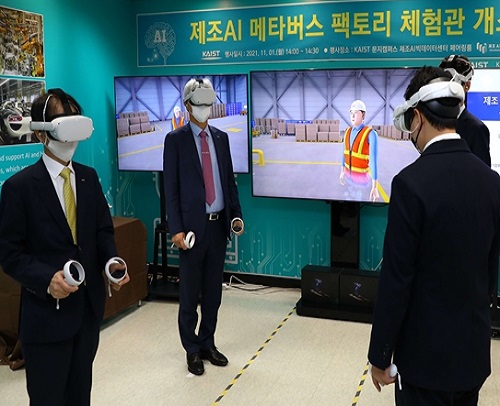 Metaverse Factory Center to Improve SME’s Competitiveness
The center is expected to enhance the manufacturing competitiveness of SMEs and root industry
KAIST opened the ‘Metaverse Factory Experience Center for Manufacturing AI’ on November 1 at the KAIST Bigdata Center for Manufacturing AI. The AI-powered manufacturing metaverse factory will provide real-life experiences for the analysis and application of manufacturing data. Funded by the Ministry of SMEs and Startups, the center is a collaboration with Digiforet, which donated the software system to KAIST.
The center allows users to experience the collection, analysis, and utilization process of manufacturing data equivalent to that of real manufacturing sites. Users can connect to the service from anywhere in the world using AR/VR/XR equipment and a metaverse solution, which allows small and middle-sized domestic manufacturing companies to overcome the challenges of entering and selling their production lines overseas in the post-COVID-19 era. The platform is an opportunity for such companies to introduce and export their excellent manufacturing techniques.
With the same manufacturing and AI processes of real production sites, the injection molding metaverse factory for plastic screw production runs simulations of the products they will make. Based on the data collection parameters (temperature, pressure, speed, location, time, etc.) built into the Korea AI Manufacturing Platform, an AI-powered SME manufacturing platform, the metaverse factory can detect causes of defects, provide analysis, and guide improvements in productivity and product quality.
Starting with the injection molding equipment metaverse factory, the platform aims to expand into plating, welding, molding, casting, forging, and annealing, and become a root industry to contribute greatly to enhancing the manufacturing competitiveness of Korea’s small and middle-sized root industries.
Il-Joong Kim, head of the KAIST Manufacturing AI Bigdata Center where the metaverse factory is located, said, “To successfully incorporate manufacturing AI into production sites, it is indispensable that various AI algorithms are tested to optimize decisions. The platform allows users to collect manufacturing data and to experience and test AI analysis simultaneously without interrupting the production process, making it highly effective.”
KAIST President Kwang Hyung Lee said, “We will support the close academic-industrial cooperation with Digiforet such as this collaborative for improving SMEs’ competitiveness.”
Digiforet CEO Sunghoon Park, who donated a whole HW/SW interface for the construction of the Metaverse Factory Experience Center for Manufacturing AI, said, “I will do my best to realize the best “Metaverse Factory for Manufacturing AI” in the world by combining the AI and bigdata accumulated at KAIST and Digiforet’s XR metaverse technology.”
2021.11.03 View 13635
Metaverse Factory Center to Improve SME’s Competitiveness
The center is expected to enhance the manufacturing competitiveness of SMEs and root industry
KAIST opened the ‘Metaverse Factory Experience Center for Manufacturing AI’ on November 1 at the KAIST Bigdata Center for Manufacturing AI. The AI-powered manufacturing metaverse factory will provide real-life experiences for the analysis and application of manufacturing data. Funded by the Ministry of SMEs and Startups, the center is a collaboration with Digiforet, which donated the software system to KAIST.
The center allows users to experience the collection, analysis, and utilization process of manufacturing data equivalent to that of real manufacturing sites. Users can connect to the service from anywhere in the world using AR/VR/XR equipment and a metaverse solution, which allows small and middle-sized domestic manufacturing companies to overcome the challenges of entering and selling their production lines overseas in the post-COVID-19 era. The platform is an opportunity for such companies to introduce and export their excellent manufacturing techniques.
With the same manufacturing and AI processes of real production sites, the injection molding metaverse factory for plastic screw production runs simulations of the products they will make. Based on the data collection parameters (temperature, pressure, speed, location, time, etc.) built into the Korea AI Manufacturing Platform, an AI-powered SME manufacturing platform, the metaverse factory can detect causes of defects, provide analysis, and guide improvements in productivity and product quality.
Starting with the injection molding equipment metaverse factory, the platform aims to expand into plating, welding, molding, casting, forging, and annealing, and become a root industry to contribute greatly to enhancing the manufacturing competitiveness of Korea’s small and middle-sized root industries.
Il-Joong Kim, head of the KAIST Manufacturing AI Bigdata Center where the metaverse factory is located, said, “To successfully incorporate manufacturing AI into production sites, it is indispensable that various AI algorithms are tested to optimize decisions. The platform allows users to collect manufacturing data and to experience and test AI analysis simultaneously without interrupting the production process, making it highly effective.”
KAIST President Kwang Hyung Lee said, “We will support the close academic-industrial cooperation with Digiforet such as this collaborative for improving SMEs’ competitiveness.”
Digiforet CEO Sunghoon Park, who donated a whole HW/SW interface for the construction of the Metaverse Factory Experience Center for Manufacturing AI, said, “I will do my best to realize the best “Metaverse Factory for Manufacturing AI” in the world by combining the AI and bigdata accumulated at KAIST and Digiforet’s XR metaverse technology.”
2021.11.03 View 13635 -
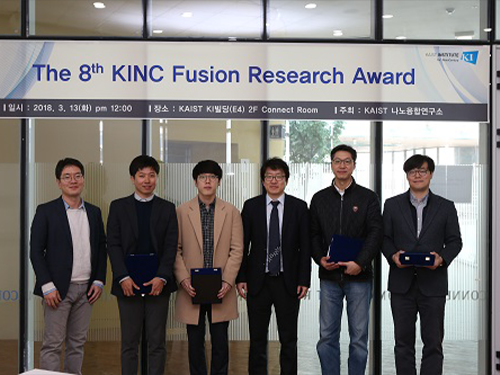 The 8th KINC Fusion Research Awardees
The KAIST Institute for NanoCentury held the 8th KINC Fusion Research Award in order to encourage professors’ convergence studies and instill students’ willingness to research. The award ceremony took place in the KI Building at KAIST on March 13.
The KINC Fusion Research Award selects the most outstanding convergence studies among research undertaken last year, and awards researchers who participated in that research.
The 8th KINC Fusion Research Award went to Professor Yoon Sung Nam from the Department of Materials Science and Engineering and Professor Inkyu Park from the Department of Mechanical Engineering. Their research reported the spontaneous self-biomineralization of palladium (Pd) ions on a filamentous virus to form ligand-free Pd nanowires without reducing reagents or using additional surface stabilizers (Title: Virus-Templated Self-Mineralization of Ligand-Free Colloidal Palladium Nanostructures for High Surface Activity and Stability, Advanced Functional Materials (2017)).
Professor Hee-Tae Jung, the Director of KAIST Institute for the NanoCentury and the host of the KINC Fusion Research Award said, “Convergence will be the crucial keyword that will lead to revolutionary change. Hence, the importance of convergence study should be improved. We will put every effort into creating a research environment for increasing convergence study.
The KAIST Institute for the NanoCentury was established in June 2006 under the KAIST Institute with a mission of creating convergence study by tearing down boarders among departments and carrying out interdisciplinary joint research. Currently, approximately 90 professors from 14 departments participate the institute. It aims to become a hub of university institutes for nano-fusion research.
2018.03.19 View 23940
The 8th KINC Fusion Research Awardees
The KAIST Institute for NanoCentury held the 8th KINC Fusion Research Award in order to encourage professors’ convergence studies and instill students’ willingness to research. The award ceremony took place in the KI Building at KAIST on March 13.
The KINC Fusion Research Award selects the most outstanding convergence studies among research undertaken last year, and awards researchers who participated in that research.
The 8th KINC Fusion Research Award went to Professor Yoon Sung Nam from the Department of Materials Science and Engineering and Professor Inkyu Park from the Department of Mechanical Engineering. Their research reported the spontaneous self-biomineralization of palladium (Pd) ions on a filamentous virus to form ligand-free Pd nanowires without reducing reagents or using additional surface stabilizers (Title: Virus-Templated Self-Mineralization of Ligand-Free Colloidal Palladium Nanostructures for High Surface Activity and Stability, Advanced Functional Materials (2017)).
Professor Hee-Tae Jung, the Director of KAIST Institute for the NanoCentury and the host of the KINC Fusion Research Award said, “Convergence will be the crucial keyword that will lead to revolutionary change. Hence, the importance of convergence study should be improved. We will put every effort into creating a research environment for increasing convergence study.
The KAIST Institute for the NanoCentury was established in June 2006 under the KAIST Institute with a mission of creating convergence study by tearing down boarders among departments and carrying out interdisciplinary joint research. Currently, approximately 90 professors from 14 departments participate the institute. It aims to become a hub of university institutes for nano-fusion research.
2018.03.19 View 23940 -
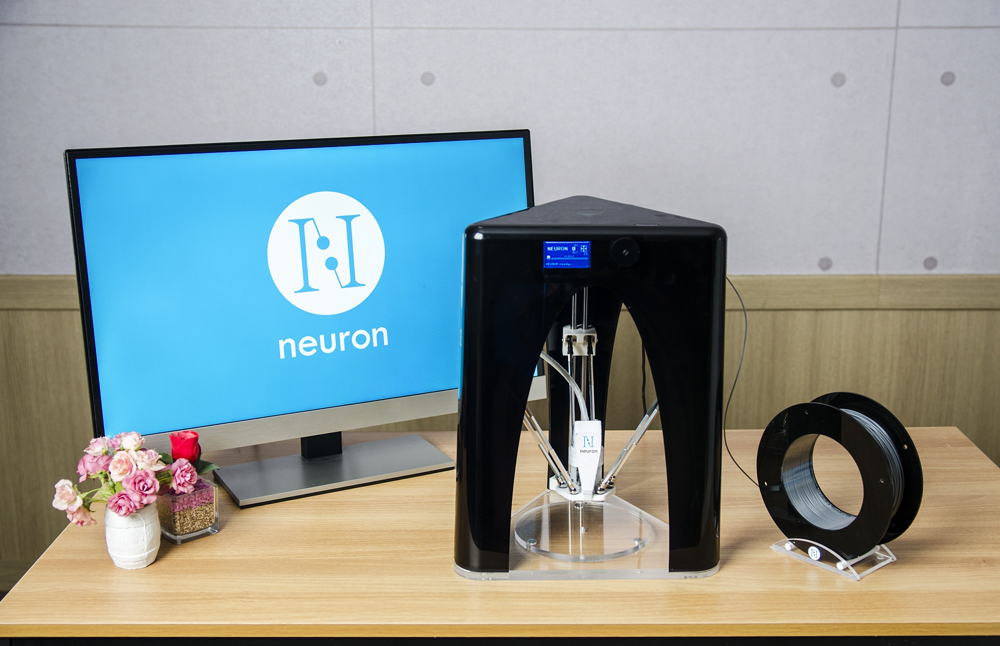 3D Printer Developed by KAIST Undergraduate Students
More than 100 Pre-orders Prior to Product Launch Made
KAIST undergraduate students received more than 100 pre-orders before the launch for 3D printers they developed and became a hot topic of interest.
KAIST Research Institute for Social Technology and Innovations (Head Hong-Kyu Lee) had a launch party at Daejeon Riviera Hotel on 17 November 2014 for “Commercial Delta 3D Printer” developed by KAIST undergraduate students inviting around 50 businesses, buyers and representatives of 3D Printing Industry Association.
“3D Printer” uses blueprints of products such as toys, mug cups and chairs to make 3D objects and is thought to be revolutionary technology in manufacturing industry. The interest has grown as recent printers could print even fruits and cosmetics.
The printing structure of 3D printer can be divided roughly into horizontal Mendel method and Delta method. KAIST students focused on the Delta method to give a differentiated product from 90% of commercial products that use Mendel method.
First, the students focused on lowering the cost of unit price by using self-developed components. The carriage (transport machine) of the product is replaced by self-developed components instead of bearing to reduce the noise and the linking method was changed to beads from loop guide to increase the completeness of the printed product. Also, an auto-levelling is loaded to ensure the nozzle and the bed is parallel and hence increasing convenience for the users. Further, the printer, designed by a product designer in Germany, is linked to a smartphone application for blueprints.
A student in the development team, Seokhyeon Seo (Department of Computer Science, 3rd Year Undergraduate) said, “The biggest merits of the product are lowering the price to a 1/3 by using self-developed components and reducing the noise.” He continued, “By using a smartphone application, anyone can easily design the product. So it is applicable to use for education or at home”
In the exhibit, “3D Printing Korea 2014,” in Coex, Seoul the printer had a preview demonstration, and received more than 100 pre-orders from educational and business training institutions. Further, buyers from Canada and the US requested opening agencies in their countries.
KAIST Research Institute for Social Technology and Innovations Head Hong-Kyu Lee said, “3D printing is an innovative technology that could bring the 3rd industrial revolution.” He continued, “It is still early days but the demand will increase exponentially.”
This project was a research project of KAIST Research Institute for Social Technology and Innovations led by a development team consisting of 4 undergraduate students of KAIST, one student from University of Oxford and one German product designer.
Students in the picture below are Won-Hoi Kim (Department of Mechanical Engineering), Sung-Hyun Cho (Department of Mechanical Engineering), and Suk-Hyun Seo (Department of Computer Science) from left to right.
2014.11.19 View 16503
3D Printer Developed by KAIST Undergraduate Students
More than 100 Pre-orders Prior to Product Launch Made
KAIST undergraduate students received more than 100 pre-orders before the launch for 3D printers they developed and became a hot topic of interest.
KAIST Research Institute for Social Technology and Innovations (Head Hong-Kyu Lee) had a launch party at Daejeon Riviera Hotel on 17 November 2014 for “Commercial Delta 3D Printer” developed by KAIST undergraduate students inviting around 50 businesses, buyers and representatives of 3D Printing Industry Association.
“3D Printer” uses blueprints of products such as toys, mug cups and chairs to make 3D objects and is thought to be revolutionary technology in manufacturing industry. The interest has grown as recent printers could print even fruits and cosmetics.
The printing structure of 3D printer can be divided roughly into horizontal Mendel method and Delta method. KAIST students focused on the Delta method to give a differentiated product from 90% of commercial products that use Mendel method.
First, the students focused on lowering the cost of unit price by using self-developed components. The carriage (transport machine) of the product is replaced by self-developed components instead of bearing to reduce the noise and the linking method was changed to beads from loop guide to increase the completeness of the printed product. Also, an auto-levelling is loaded to ensure the nozzle and the bed is parallel and hence increasing convenience for the users. Further, the printer, designed by a product designer in Germany, is linked to a smartphone application for blueprints.
A student in the development team, Seokhyeon Seo (Department of Computer Science, 3rd Year Undergraduate) said, “The biggest merits of the product are lowering the price to a 1/3 by using self-developed components and reducing the noise.” He continued, “By using a smartphone application, anyone can easily design the product. So it is applicable to use for education or at home”
In the exhibit, “3D Printing Korea 2014,” in Coex, Seoul the printer had a preview demonstration, and received more than 100 pre-orders from educational and business training institutions. Further, buyers from Canada and the US requested opening agencies in their countries.
KAIST Research Institute for Social Technology and Innovations Head Hong-Kyu Lee said, “3D printing is an innovative technology that could bring the 3rd industrial revolution.” He continued, “It is still early days but the demand will increase exponentially.”
This project was a research project of KAIST Research Institute for Social Technology and Innovations led by a development team consisting of 4 undergraduate students of KAIST, one student from University of Oxford and one German product designer.
Students in the picture below are Won-Hoi Kim (Department of Mechanical Engineering), Sung-Hyun Cho (Department of Mechanical Engineering), and Suk-Hyun Seo (Department of Computer Science) from left to right.
2014.11.19 View 16503 -
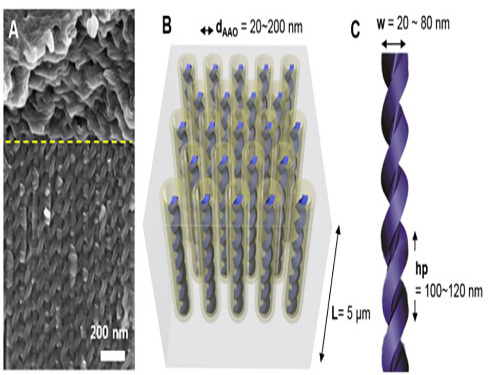 KAIST Develops Core Technology to Synthesize a Helical Nanostructure
Professor Dong-Ki Yoon’s research team of the Graduate School of Nanoscience and Technology (GSNT) at KAIST has developed helical nanostructures using self-assembly processes. The results were published in the Proceedings of the National Academy of Sciences of the United States of America(PNAS) on the October 7th.
This technology enables the synthesis of various helical structures on a relatively large confined area. Its synthesis is often considered the most arduous for three dimensional structures. Formed from liquid crystal, the structure holds a regular helical structure within the confined space of 20 to 300 nanometers. Also, the distance between each pattern increased as the diameter of the nanostructure increased.
Liquid crystals have a unique property of responding sensitively to the surrounding electromagnetic field. The technology, in combination with the electromagnetic property of liquid crystal, is expected to foster the development of highly efficient optoelectronic devices.
Using this technology, it is possible to develop three dimensional patterning technology beyond the current semiconductor manufacturing technology which uses two dimensional photolithography processes. Three-dimensional semiconductor devices are expected to store hundred times more data than current devices. They will also lower costs by simplifying manufacturing processes.
The essence of this research, “self-assembly in confined space,” refers to controlling complex nanostructures, which can be synthesized from materials such as macromolecules, liquid crystal molecules, and biomolecules in relation to surrounding environments including the temperature, concentration, and pH.
The research team produced a confined space with a length of tens of nanometers by using a porous anodized aluminum membrane induced from an electrochemical reaction. They successfully synthesized independently controlled helical nanostructures by forming the helical structures from liquid crystal molecules within that space.
Professor Yoon said, “This research examines the physicochemical principle of controlling helical nanostructures.” He highlighted the significance of the research and commented, “The technology enables the control of complex nanostructures from organic molecules by using confined space and surface reforming.”
He added that, “When grafted with nanotechnology or information technology, this technology will spur new growth to liquid crystal-related industries such as the LCD.”
The research was led by two Ph.D. candidates, Hanim Kim and Sunhee Lee, under the guidance of Professor Yoon. Dr. Tae-Joo Shin of the Pohang Accelerator Laboratory, Professor Sang-Bok Lee of the University of Maryland, and Professor Noel Clark of the University of Colorado also participated.
Picture 1. Electron Microscopy Pictures and Conceptual Diagrams of Helical Nanostructures
Picture 2. Electron Microscopy Pictures of Manufactured Helical Nanostructures
2014.10.29 View 13301
KAIST Develops Core Technology to Synthesize a Helical Nanostructure
Professor Dong-Ki Yoon’s research team of the Graduate School of Nanoscience and Technology (GSNT) at KAIST has developed helical nanostructures using self-assembly processes. The results were published in the Proceedings of the National Academy of Sciences of the United States of America(PNAS) on the October 7th.
This technology enables the synthesis of various helical structures on a relatively large confined area. Its synthesis is often considered the most arduous for three dimensional structures. Formed from liquid crystal, the structure holds a regular helical structure within the confined space of 20 to 300 nanometers. Also, the distance between each pattern increased as the diameter of the nanostructure increased.
Liquid crystals have a unique property of responding sensitively to the surrounding electromagnetic field. The technology, in combination with the electromagnetic property of liquid crystal, is expected to foster the development of highly efficient optoelectronic devices.
Using this technology, it is possible to develop three dimensional patterning technology beyond the current semiconductor manufacturing technology which uses two dimensional photolithography processes. Three-dimensional semiconductor devices are expected to store hundred times more data than current devices. They will also lower costs by simplifying manufacturing processes.
The essence of this research, “self-assembly in confined space,” refers to controlling complex nanostructures, which can be synthesized from materials such as macromolecules, liquid crystal molecules, and biomolecules in relation to surrounding environments including the temperature, concentration, and pH.
The research team produced a confined space with a length of tens of nanometers by using a porous anodized aluminum membrane induced from an electrochemical reaction. They successfully synthesized independently controlled helical nanostructures by forming the helical structures from liquid crystal molecules within that space.
Professor Yoon said, “This research examines the physicochemical principle of controlling helical nanostructures.” He highlighted the significance of the research and commented, “The technology enables the control of complex nanostructures from organic molecules by using confined space and surface reforming.”
He added that, “When grafted with nanotechnology or information technology, this technology will spur new growth to liquid crystal-related industries such as the LCD.”
The research was led by two Ph.D. candidates, Hanim Kim and Sunhee Lee, under the guidance of Professor Yoon. Dr. Tae-Joo Shin of the Pohang Accelerator Laboratory, Professor Sang-Bok Lee of the University of Maryland, and Professor Noel Clark of the University of Colorado also participated.
Picture 1. Electron Microscopy Pictures and Conceptual Diagrams of Helical Nanostructures
Picture 2. Electron Microscopy Pictures of Manufactured Helical Nanostructures
2014.10.29 View 13301 -
 Tae-Wan Kim, a doctoral candidate, receives the best paper award from ECTC
The 2014 Electronic Components and Technology Conference (ECTC) will take place on May 27-30 in Florida, USA. Tae-Wan Kim, a Ph.D. candidate at the Department of Materials Science Engineering (MSE), KAIST, will receive the Intel Best Student Paper Award at the conference.ECTC is the premier international conference that brings together the best researchers and engineers in packaging, components and microelectronic systems science, technology and education in an environment of cooperation and technical exchange. The conference is sponsored by the Components, Packaging and Manufacturing Technology (CPMT) Society of IEEE (Institute of Electrical and Electronics Engineering).The paper describes research on novel nanofiber anisotropic conductive films for ultra fine pitch electronic package application, which was written under the guidance of Professor Kyung-Wook Paik of the MSE Department. In the past ten years, two of his students have received the best paper award from ECTC.
2014.03.14 View 19980
Tae-Wan Kim, a doctoral candidate, receives the best paper award from ECTC
The 2014 Electronic Components and Technology Conference (ECTC) will take place on May 27-30 in Florida, USA. Tae-Wan Kim, a Ph.D. candidate at the Department of Materials Science Engineering (MSE), KAIST, will receive the Intel Best Student Paper Award at the conference.ECTC is the premier international conference that brings together the best researchers and engineers in packaging, components and microelectronic systems science, technology and education in an environment of cooperation and technical exchange. The conference is sponsored by the Components, Packaging and Manufacturing Technology (CPMT) Society of IEEE (Institute of Electrical and Electronics Engineering).The paper describes research on novel nanofiber anisotropic conductive films for ultra fine pitch electronic package application, which was written under the guidance of Professor Kyung-Wook Paik of the MSE Department. In the past ten years, two of his students have received the best paper award from ECTC.
2014.03.14 View 19980 -
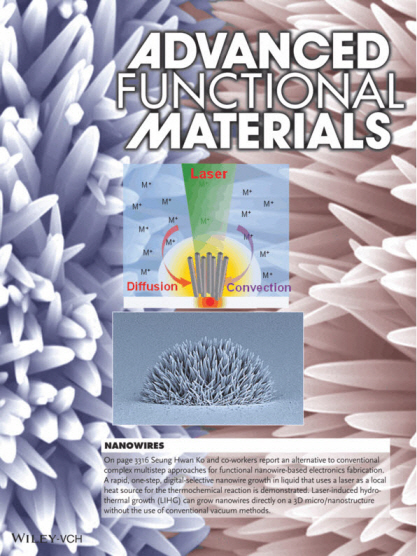 Ultra High Speed Nanomaterial Synthesis Process Developed Using Laser
Dr. Jun-Yeop, Yeo and the research team led by Professor Seung-Hwan, Ko (both of the Department of Mechanical Engineering) successfully developed a process enabling the location-determinable, ultra high speed synthesis of nanomaterials using concentrated laser beams.
The result of the research effort was published as the frontispiece in the July 9th issue of Advanced Functional Materials, a world renowned material science and engineering academic journal.
Application of the technology reduced the time needed to process nanomaterial synthesis from a few hours to a mere five minutes. In addition, unlike conventional nanomaterial synthesis processes, it is simple enough to enable mass production and commercialization.
Conventional processes require the high temperatures of 900~1,000 °C and the use of toxic or explosive vapors. Complex processes such as separation after synthesis and patterning are needed for application in electronic devices. The multi-step, expensive, environmentally unfriendly characteristics of nanomaterial synthesis served as road blocks to its mass production and commercialization.
Exposing the precursor to concentrated continuous laser beam (green wavelength) resulted in the synthesis of nanowires in the desired location; the first instance in the world to accomplish this feat. The technology, according to the research team, makes possible the production, integration and patterning of nanomaterials using a single process. Applicable to various surfaces and substrates, nanowires have been successfully synthesized on flexible plastic substrates and controlled patterning on the surface of 3-dimensional structures.
Dr. Yeo commented that the research effort has “yielded the creation of a nanomaterial synthesis process capable of synthesis, integration, pattern, and material production using light energy” and has “reduced the synthesis process time of nanomaterial to one tenths of the conventional process.” Dr. Yeo continues to devise steps to commercialize the new multifunctional electronic material and methods for mass production.
The research effort, led by Dr. Yeo and Professor Ko, received contribution from Professor Hyung-Jin Sung (KAIST Department of Mechanical Engineering), Seok-Joon Hong, a Ph.D. candidate, Hyun-Wook Kang, also a Ph.D. candidate, Professor Costas Grigoropoulos of UC Berkeley, and Dr. Dae Ho Lee. In addition, the team received support from the National Research Foundation, Ministry of Knowledge Economy, Global Frontier Program, and KAIST EEWS.
Picture I: Synthesized nanomaterials produced at a desirable location by laser beams
Picture 2: Synthesized nanomaterials built on the 3D structure by using the developed technology
Picture 3: Functional electric circuit made with synthesized nanomaterials
Picture 4: Cover page of July 9th issue of Advanced Functional Materials
2013.08.23 View 16913
Ultra High Speed Nanomaterial Synthesis Process Developed Using Laser
Dr. Jun-Yeop, Yeo and the research team led by Professor Seung-Hwan, Ko (both of the Department of Mechanical Engineering) successfully developed a process enabling the location-determinable, ultra high speed synthesis of nanomaterials using concentrated laser beams.
The result of the research effort was published as the frontispiece in the July 9th issue of Advanced Functional Materials, a world renowned material science and engineering academic journal.
Application of the technology reduced the time needed to process nanomaterial synthesis from a few hours to a mere five minutes. In addition, unlike conventional nanomaterial synthesis processes, it is simple enough to enable mass production and commercialization.
Conventional processes require the high temperatures of 900~1,000 °C and the use of toxic or explosive vapors. Complex processes such as separation after synthesis and patterning are needed for application in electronic devices. The multi-step, expensive, environmentally unfriendly characteristics of nanomaterial synthesis served as road blocks to its mass production and commercialization.
Exposing the precursor to concentrated continuous laser beam (green wavelength) resulted in the synthesis of nanowires in the desired location; the first instance in the world to accomplish this feat. The technology, according to the research team, makes possible the production, integration and patterning of nanomaterials using a single process. Applicable to various surfaces and substrates, nanowires have been successfully synthesized on flexible plastic substrates and controlled patterning on the surface of 3-dimensional structures.
Dr. Yeo commented that the research effort has “yielded the creation of a nanomaterial synthesis process capable of synthesis, integration, pattern, and material production using light energy” and has “reduced the synthesis process time of nanomaterial to one tenths of the conventional process.” Dr. Yeo continues to devise steps to commercialize the new multifunctional electronic material and methods for mass production.
The research effort, led by Dr. Yeo and Professor Ko, received contribution from Professor Hyung-Jin Sung (KAIST Department of Mechanical Engineering), Seok-Joon Hong, a Ph.D. candidate, Hyun-Wook Kang, also a Ph.D. candidate, Professor Costas Grigoropoulos of UC Berkeley, and Dr. Dae Ho Lee. In addition, the team received support from the National Research Foundation, Ministry of Knowledge Economy, Global Frontier Program, and KAIST EEWS.
Picture I: Synthesized nanomaterials produced at a desirable location by laser beams
Picture 2: Synthesized nanomaterials built on the 3D structure by using the developed technology
Picture 3: Functional electric circuit made with synthesized nanomaterials
Picture 4: Cover page of July 9th issue of Advanced Functional Materials
2013.08.23 View 16913