%6d%65%6e%74%61%6c%20%68%65%61%6c%74%68
-
 KAIST Reads “Stress” from Smartphone Chatting, Searching, and Payment Habits
Clues to stress can be hidden in everyday habits such as chatting, searching, and making payments on a smartphone. KAIST researchers have developed a technology that analyzes several routine behaviors repeatedly performed within apps to identify a person’s daily stress state.
KAIST (President Choongsik Bae) announced on October 15 that a research team led by Professor Uichin Lee from the Department of AI Computing developed “SHIRBT-MMF,” a technology that automatically identifies repeated smartphone behaviors and uses factors such as the duration and frequency of each behavior and text-input patterns to determine daily stress status.
Previous smartphone-based stress research has mainly analyzed factors such as screen time, the number of app launches, time and frequency of use by app category, and typing behavior. However, when the apps being used or their interfaces change, the data being analyzed also change, which can reduce the stability of models designed to track stress over long periods.
The research team therefore focused on “what a person does” rather than “which app they use.” Even if a user switches from KakaoTalk to LINE or WhatsApp, the activity itself remains “messenger chatting.” In other words, the analysis is based on the purpose of the behavior rather than the name of the app.
The team defined these repeated behaviors as “Smartphone Human Interaction Routine Behavior Tasks (SHIRBTs).” Using its independently developed “Multi-Level Sequential Pattern Mining (ML-SPM)” technique, the team identified recurring screen-transition patterns across multiple days and then used a large language model (LLM) to assign easily understandable behavior labels such as “messenger chatting,” “web browsing,” “financial payment,” and “reading/writing email.” In evaluations of whether the same behavior could be consistently classified across different email, web browser, and messenger apps, the system achieved an accuracy of more than 95%.
To protect privacy, the system did not store the actual text or message content entered by users, recording only behavioral information such as whether text was entered, how often it was entered, and screen transitions. Information about message recipients or call partners was also processed using hashing, which converts the original information into values that do not directly reveal it.
The research team analyzed real-life data from 26 university students and office workers in their 20s and 30s. Among participants for whom both self-reported stress assessments and smartphone records were available, 16 short-term participants provided an average of 30.5 days of data, while 10 long-term participants provided an average of 105.1 days. Based on the participants’ daily self-assessments, the researchers built personalized models that distinguished between days with and without stress.
A total of 29 types of repeated behaviors were identified in participants’ smartphone use, with each person routinely repeating an average of about seven behaviors. The research team used personalized artificial intelligence models trained on these behavioral patterns to determine whether a person was experiencing stress on a given day. The best-performing model achieved an average accuracy of 75.9% for short-term participants and 73.8% for long-term participants, meaning it was correct roughly three out of four times. These results were 5.5 percentage points and 3.5 percentage points higher, respectively, than the conventional approach of analyzing app usage using the same AI technique.
Performance could also be maintained even when the number of behaviors used in the analysis was reduced. With the same personalized model, using only two behaviors, “messenger chatting” and “financial payment,” or even analyzing “messenger chatting” alone, produced higher average classification accuracy than the conventional method. In the long-term data, analytical indicators based on repeated behaviors also changed less over time and maintained a more stable structure than those used in the conventional approach.
In this experiment, the researchers collected a broad range of smartphone usage records in order to compare their method with conventional approaches. In the future, the team expects that once an individual’s repeated behaviors have been identified, focusing data collection and analysis on those relevant behaviors could reduce the burden of data collection. The study suggests the potential for developing digital mental health monitoring technology that makes it easier to understand which behaviors were used in classification and remains relatively stable even when the app environment changes.
Professor Uichin Lee of the KAIST AI Computing Department said, “We viewed the smartphone not simply as a device for measuring usage time, but as a space in everyday life where an individual’s communication, information seeking, and financial activities are repeatedly carried out,” adding, “This study provides a foundation for converting complex smartphone records into human-understandable behavioral units and offering long-term mental health tracking more reliably.”
However, this study used associations between behavior and stress and did not demonstrate a causal relationship showing that a particular behavior causes or reduces stress. Based on findings from Android smartphone users in their 20s and 30s, the research team plans to expand the study to a broader range of age groups, occupations, and smartphone environments and verify its long-term stability.
In this study, Hansoo Lee participated in the study as the first author, Professor Uichin Lee as the corresponding author, and researchers Taehyeon Park and Youngji Koh, along with Professor Jae-Gil Lee of the School of Computing, as co-authors. The research was published in December 2025 in the international journal Proceedings of the ACM on Interactive, Mobile, Wearable and Ubiquitous Technologies. The study is scheduled to be presented at ACM UbiComp/ISWC 2026, which will be held in Shanghai, China, from October 13 to 15, 2026.
Paper title: Leveraging Smartphone Human Interaction Routine Behavior Task Mining and Modeling for Daily Stress Monitoring, DOI: https://doi.org/10.1145/3770644
Author information: First author (Hansoo Lee), co-authors (Taehyeon Park, Youngji Koh, Jae-Gil Lee), corresponding author (Uichin Lee)
This research was supported by the Institute of Information & Communications Technology Planning & Evaluation (IITP) ICT Convergence Digital Inclusion Technology Development project and the National Research Foundation of Korea (NRF) Sejong Fellowship project, funded by the Ministry of Science and ICT.
2026.10.15 View 238
-
 Refrigerator Use Increases with Stress, IoT Sensors Read Mental Health
<(From Left) Ph.D candidate Chanhee Lee, Professor Uichin Lee, Professor Hyunsoo Lee, Ph.D candidate Youngji Koh from School of Computing>
The number of single-person households in South Korea has exceeded 8 million, accounting for 36% of the total, marking an all-time high. A Seoul Metropolitan Government survey found that 62% of single-person households experience 'loneliness', deepening feelings of isolation and mental health issues. KAIST researchers have gone beyond the limitations of smartphones and wearables, utilizing in-home IoT data to reveal that a disruption in daily rhythm is a key indicator of worsening mental health. This research is expected to lay the foundation for developing personalized mental healthcare management systems.
KAIST (President Kwang Hyung Lee) announced on the 21st of October that a research team led by Professor Uichin Lee from the School of Computing has demonstrated the possibility of accurately tracking an individual's mental health status using in-home Internet of Things (IoT) sensor data.
Consistent self-monitoring is important for mental health management, but existing smartphone- or wearable-based tracking methods have the limitation of data loss when the user is not wearing or carrying the device inside the home.
The research team therefore focused on in-home environmental data. A 4-week pilot study was conducted on 20 young single-person households, installing appliances, sleep mats, motion sensors, and other devices to collect IoT data, which was then analyzed along with smartphone and wearable data.
The results confirmed that utilizing IoT data alongside existing methods allows for a significantly more accurate capture of changes in mental health. For instance, reduced sleep time was closely linked to increased levels of depression, anxiety, and stress, and increased indoor temperature also showed a correlation with anxiety and depression.
<Picture1. Heatmap of the Correlation Between Each User’s Mental Health Status and Sensor Data>
Participants' behavioral patterns varied, including a 'binge-eating type' with increased refrigerator use during stress and a 'lethargic type' with a sharp decrease in activity. However, a common trend clearly emerged: mental health deteriorated as daily routines became more irregular.
Variability in daily patterns was confirmed to be a more important factor than the frequency of specific behaviors, suggesting that a regular routine is essential for maintaining mental health.
When research participants viewed their life data through visualization software, they generally perceived the data as being genuinely helpful in understanding their mental health, rather than expressing concern about privacy invasion. This significantly enhanced the research acceptance and satisfaction with participation.
<Figure 2. Comparison of Average Mental Health Status Between the High Irregularity Group (Red) and the Low Irregularity Group (Blue)>
Professor Uichin Lee stated, "This research demonstrates that in-home IoT data can serve as an important clue for understanding mental health within the context of an individual's daily life," and added, "We plan to further develop this into a remote healthcare system that can predict individual lifestyle patterns and provide personalized coaching using AI."
Youngji Koh, a Ph.D candidate, participated as the first author in this research. The findings were published in the September issue of the Proceedings of the ACM on Interactive, Mobile, Wearable and Ubiquitous Technologies, a prominent international journal in the field of human-computer interaction (HCI). ※ Harnessing Home IoT for Self-tracking Emotional Wellbeing: Behavioral Patterns, Self-Reflection, and Privacy Concerns DOI: https://dl.acm.org/doi/10.1145/3749485 ※ Youngji Koh (KAIST, 1st author), Chanhee Lee (KAIST, 2nd author), Eunki Joung (KAIST, 3rd author), Hyunsoo Lee (KAIST, corresponding author), Uichin Lee (KAIST, corresponding author)
This research was conducted with support from the LG Electronics-KAIST Digital Healthcare Research Center and the National Research Foundation of Korea, funded by the government (Ministry of Science and ICT).
2025.10.21 View 5947
-
 14-Day Drawing Challenge Helps Maintain a Sense of Connection Amid Prolonged Social Distancing
- “You need space, but you also need connections.” -
Schools and workplaces have closed and people are staying at home around the globe. Governments across the world have urged their people to keep a distance from others as a measure to slow the spread of the pandemic.
With the Korean government’s decision to extend the intensive social distancing campaign until at least April 19, people in Korea are advised to avoid nonessential trips, public facilities, and social gatherings for another two weeks or so.
This unprecedented prolonged social distancing drive leads people to feel fatigue and frustration. Such emotional stress is worse for those who live alone in a foreign country.
The International Scholar and Student Services (ISSS) Team at KAIST has been working around the clock to build a dedicated COVID-19 Mental Health Support Service to support the university’s international community on campus and abroad and help get them connected online.
As the COVID-19 situation lingers, there has been a growing demand for mental health support from many KAIST international members including 299 students who have been staying in Korea on their own and away from their families, as well as from those who could not return to campus from their overseas homes.
In response to this, the KAIST ISSS Team has been offering some special online events and programs that can help the KAIST international community stay feeling connected whereever they are, while still keeping a safe distance from each other.
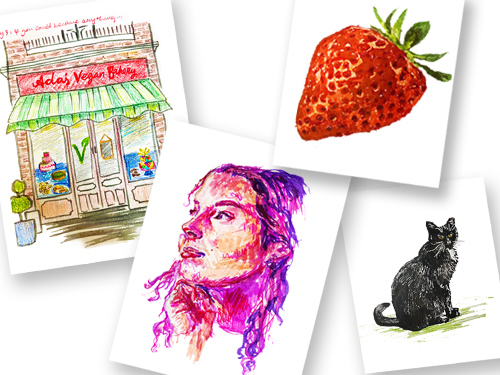
For instance, the team is running an art-therapy program called ‘The 14-day Drawing Challenge’ March 30 through April 12. This program is online and individual-based, so it does not require any physical contact between participants.
Each participant is asked to draw a picture at home using the daily topics previously set by the ISSS Team over 14 days. The topics include (Day 1) self-portrait, (Day 2) spring flowers, (Day 3) if you could become anything…, (Day 4) funniest memory you have, (Day 5) animals at KAIST, (Day 6) something you love, (Day 7) country or city you want to visit, (Day 8) what’s for dinner? (Day 9) person you miss, (Day 10) your favorite place at KAIST, (Day 11) your feeling today, (Day 12) things in your favorite color, (Day 13) song lyrics, and (Day 14) your future self in 10 years.
Once all 14 pieces have been completed, submissions can be made online by sending an e-mail to the ISSS Team after scanning or taking a photo of each drawing. Selected submissions will be awarded small prizes for participation and shared through the university’s official website and SNS channels.
“All the participants need is paper, coloring tools, and their creativity and imagination. They don’t have to be a great artist to join this challenge. There is no right or wrong or good or bad. They just need to have fun drawing every day for two weeks, ease their coronavirus anxiety, and remain emotionally stable just like they did back in the normal days,” said Su-yeon Ahn, the manager of the KAIST ISSS Team. She added, “In times like these, you need space, but you also need connections. Our team wants our international students, professors, and researchers to build strong connections with each other, even online.”
Katherine Michelle Pena Santana, an M.S. candidate from the Department of Industrial and Systems Engineering who is taking part in ‘The 14-day Drawing Challenge,’ looked back and said, “Lately with the new coronavirus spreading around Korea and the entire world, I was feeling very anxious. I didn't get out of my room and lived by just looking at the same walls and creating some kind of a psychological burden on myself.”
Santana added that these kinds of activities could give many foreign members of KAIST an opportunity to not only relieve fear and stress, but also share each other’s experiences dealing with this pandemic. She explained that this is why she decided to participate in this challenge.
An undergraduate student from the Department of Physics, Ada Carpenter, appreciated the KAIST ISSS Team’s efforts to provide a variety of special online mental health support services to help the university’s international community socialize, while strictly following the government’s guidelines for social distancing. She expressed excitement about participating and said, “I’m so looking forward to the challenge of things that I wouldn’t normally draw.”
< Short Self-interview Video Clip Filmed by Ada Carpenter >
The COVID-19 Mental Health Support Service by the KAIST ISSS Team will be continually updated with new information and enhanced with other tools and support over the coming weeks and months. Some of the upcoming events and programs include ‘The Online Guitar Lessons’, ‘The Growing Houseplants Challenge’, and ‘The Any Song Challenge*’.
* The song titled “Any Song” by Korean rapper Zico has been gaining attention on social media thanks to many celebrities taking on the ‘Any Song Challenge’, performing a short dance to the chorus of the song and sharing it on social media.
(END)
2020.04.08 View 17328