%6d%6f%64%75%6c%61%72
-
 A KAIST team develops the world's first modular co-culture platform for the one-pot production of rainbow-colored bacterial cellulose.
<(From Left) Distinguished Professor Sang Yup Lee, Ph.D candidate Pingxin Lin, Ph.D candiate Zhou Hengrui>
The integration of systems metabolic engineering with co-culture strategies that couples bacterial cellulose production with natural colorant biosynthesis enabled the one-pot generation of rainbow-colored bacterial cellulose, establishing a sustainable biomanufacturing platform that can replace petroleum-based textiles and eliminate chemical dyeing processes.
A research group at KAIST has successfully developed a modular co-culture platform for the one-pot production of rainbow-colored bacterial cellulose. The team, led by Distinguished Professor Sang Yup Lee from the Department of Chemical and Biomolecular Engineering, engineered Komagataeibacter xylinus for bacterial cellulose synthesis and Escherichia coli for natural colorants overproduction. A co-culture of these engineered strains enabled the in situ coloration of bacterial cellulose. This research offers a versatile platform for producing living materials in multiple colors, and provides new opportunities for sustainable textiles, wearable biomaterials, and functional living materials that combine optical and structural properties beyond the reach of conventional textile technologies.
Bacterial cellulose is an attractive and biodegradable alternative to petroleum-derived fabrics due to its high purity, mechanical strength, and water-retention properties. However, the limited color range of bacterial cellulose, which is typically white, has limited its broader application in the textile industry, where more vibrant colored fabrics are increasingly desired. Conventional dyeing methods rely on petroleum-based colorants and toxic reagents, creating environmental and processing challenges. These challenges have driven the demand for alternative production methods.
To address these issues, KAIST researchers, including Ph.D. Candidate Hengrui Zhou, Ph.D. Candidate Pingxin Lin, Professor Ki Jun Jeong, and Distinguished Professor Sang Yup Lee, combined systems metabolic engineering with co-culture strategies to develop a bio-based route that integrates bacterial cellulose formation with natural pigment synthesis, enabling the production of colored living materials in a single step without additional chemical processing.
The team’s work, entitled “One-pot production of colored bacterial cellulose,” was published in Trends in Biotechnology on November 12,2025.
This research details the one-pot production of multicolored bacterial cellulose using a modular co-culture platform that integrates a bacterial cellulose-overproducing K. xylinus strain with natural colorant-producing E. coli strains. The team focused on addressing the limitations in bacterial cellulose coloration caused by environmental challenges and complex processing requirements. By employing vesicle engineering and optimizing co-culture parameters, the researchers achieved one-pot production of red, orange, yellow, green, blue, navy, and purple bacterial cellulose, eliminating the need for external dyes and toxic chemical treatments.
To enhance dyeing efficiency, E. coli strains were engineered for the overproduction and secretion of natural colorants. It was determined that the intracellular accumulation of these pigments disrupts cellular metabolism and physiology, thereby inhibiting their production. To overcome this limitation, vesicle engineering has emerged as a key strategy to mitigate these cytotoxic effects, including the induction of inner- and outer-membrane vesicles and the modulation of cell morphology, enabling the more efficient secretion of colorants and increased overall production. The engineered E. coli strains were optimized in fed-batch fermentation, achieving record-breaking production of 16.92 ± 0.10 g/L of deoxyviolacein, 8.09 ± 0.17 g/L of violacein, 1.82 ± 0.07 g/L of proviolacein, and 936.25 ± 9.70 mg/L of prodeoxyviolacein, the highest reported titers to date for all four violacein derivatives.
< Figure 1. Rainbow-colored bacterial cellulose (microbial fiber) with applied color >
A co-culture platform combining the K. xylinus with E. coli strains was further developed and optimized, enabling the in situ one-pot coloration of bacterial cellulose in vibrant green, blue, navy, and purple. Fed-batch fermentation further improved the performance of the platform, achieving the world-first one-pot production of multicolored bacterial cellulose on a larger scale. To expand the bacterial cellulose color palette, engineered carotenoid-producing E. coli strains were incorporated, enabling the successful synthesis of red, orange, and yellow bacterial cellulose. This milestone demonstrates the potential of microbial fermentation as a sustainable alternative to petroleum-based textile processes.
“We can anticipate that this microbial cell factory-based one-pot production of rainbow-colored bacterial cellulose has the potential to replace current petroleum-based textile processes,” said Ph.D. Candidate Hengrui Zhou. “The systems metabolic engineering strategies developed in this study could be broadly applied for the production of diverse sustainable textiles, wearable biomaterials, and functional living materials that combine optical and structural properties beyond the capabilities of conventional textile technologies.” He added, “This platform reduces the environmental impact while greatly expanding design possibilities. Beyond serving as a proof-of-concept, this technology offers a promising route toward scalable, eco-friendly fabrics with in situ coloration. Its modular design allows the incorporation of diverse natural colorant pathways, enabling the creation of living materials in multiple colors.”
< Figure 2. Schematic of a microbe-based platform for one-step production of rainbow-colored bacterial cellulose >
“As demand for sustainable textiles and living materials continues to grow, we expect that the integrated biomanufacturing platform developed here will play a pivotal role in producing diverse functional biomaterials with additional design possibilities in a single step, without additional chemical processing,” explained Distinguished Professor Sang Yup Lee.
This work was supported by the Development of Next-generation Biorefinery Platform Technologies for Leading Bio-based Chemicals Industry project (2022M3J5A1056072) and the Development of Platform Technologies of Microbial Cell Factories for the Next-generation Biorefineries project (2022M3J5A1056117) from the National Research Foundation supported by the Korean Ministry of Science and ICT.
Source:
Hengrui Zhou (1st), Pingxin Lin (2nd), Ki Jun Jeong (3rd), and Sang Yup Lee (Corresponding). “One-pot production of colored bacterial cellulose”. Trends in Biotechnology (Published) doi: 10.1016/j.tibtech.2025.09.019
2025.11.19 View 3305
A KAIST team develops the world's first modular co-culture platform for the one-pot production of rainbow-colored bacterial cellulose.
<(From Left) Distinguished Professor Sang Yup Lee, Ph.D candidate Pingxin Lin, Ph.D candiate Zhou Hengrui>
The integration of systems metabolic engineering with co-culture strategies that couples bacterial cellulose production with natural colorant biosynthesis enabled the one-pot generation of rainbow-colored bacterial cellulose, establishing a sustainable biomanufacturing platform that can replace petroleum-based textiles and eliminate chemical dyeing processes.
A research group at KAIST has successfully developed a modular co-culture platform for the one-pot production of rainbow-colored bacterial cellulose. The team, led by Distinguished Professor Sang Yup Lee from the Department of Chemical and Biomolecular Engineering, engineered Komagataeibacter xylinus for bacterial cellulose synthesis and Escherichia coli for natural colorants overproduction. A co-culture of these engineered strains enabled the in situ coloration of bacterial cellulose. This research offers a versatile platform for producing living materials in multiple colors, and provides new opportunities for sustainable textiles, wearable biomaterials, and functional living materials that combine optical and structural properties beyond the reach of conventional textile technologies.
Bacterial cellulose is an attractive and biodegradable alternative to petroleum-derived fabrics due to its high purity, mechanical strength, and water-retention properties. However, the limited color range of bacterial cellulose, which is typically white, has limited its broader application in the textile industry, where more vibrant colored fabrics are increasingly desired. Conventional dyeing methods rely on petroleum-based colorants and toxic reagents, creating environmental and processing challenges. These challenges have driven the demand for alternative production methods.
To address these issues, KAIST researchers, including Ph.D. Candidate Hengrui Zhou, Ph.D. Candidate Pingxin Lin, Professor Ki Jun Jeong, and Distinguished Professor Sang Yup Lee, combined systems metabolic engineering with co-culture strategies to develop a bio-based route that integrates bacterial cellulose formation with natural pigment synthesis, enabling the production of colored living materials in a single step without additional chemical processing.
The team’s work, entitled “One-pot production of colored bacterial cellulose,” was published in Trends in Biotechnology on November 12,2025.
This research details the one-pot production of multicolored bacterial cellulose using a modular co-culture platform that integrates a bacterial cellulose-overproducing K. xylinus strain with natural colorant-producing E. coli strains. The team focused on addressing the limitations in bacterial cellulose coloration caused by environmental challenges and complex processing requirements. By employing vesicle engineering and optimizing co-culture parameters, the researchers achieved one-pot production of red, orange, yellow, green, blue, navy, and purple bacterial cellulose, eliminating the need for external dyes and toxic chemical treatments.
To enhance dyeing efficiency, E. coli strains were engineered for the overproduction and secretion of natural colorants. It was determined that the intracellular accumulation of these pigments disrupts cellular metabolism and physiology, thereby inhibiting their production. To overcome this limitation, vesicle engineering has emerged as a key strategy to mitigate these cytotoxic effects, including the induction of inner- and outer-membrane vesicles and the modulation of cell morphology, enabling the more efficient secretion of colorants and increased overall production. The engineered E. coli strains were optimized in fed-batch fermentation, achieving record-breaking production of 16.92 ± 0.10 g/L of deoxyviolacein, 8.09 ± 0.17 g/L of violacein, 1.82 ± 0.07 g/L of proviolacein, and 936.25 ± 9.70 mg/L of prodeoxyviolacein, the highest reported titers to date for all four violacein derivatives.
< Figure 1. Rainbow-colored bacterial cellulose (microbial fiber) with applied color >
A co-culture platform combining the K. xylinus with E. coli strains was further developed and optimized, enabling the in situ one-pot coloration of bacterial cellulose in vibrant green, blue, navy, and purple. Fed-batch fermentation further improved the performance of the platform, achieving the world-first one-pot production of multicolored bacterial cellulose on a larger scale. To expand the bacterial cellulose color palette, engineered carotenoid-producing E. coli strains were incorporated, enabling the successful synthesis of red, orange, and yellow bacterial cellulose. This milestone demonstrates the potential of microbial fermentation as a sustainable alternative to petroleum-based textile processes.
“We can anticipate that this microbial cell factory-based one-pot production of rainbow-colored bacterial cellulose has the potential to replace current petroleum-based textile processes,” said Ph.D. Candidate Hengrui Zhou. “The systems metabolic engineering strategies developed in this study could be broadly applied for the production of diverse sustainable textiles, wearable biomaterials, and functional living materials that combine optical and structural properties beyond the capabilities of conventional textile technologies.” He added, “This platform reduces the environmental impact while greatly expanding design possibilities. Beyond serving as a proof-of-concept, this technology offers a promising route toward scalable, eco-friendly fabrics with in situ coloration. Its modular design allows the incorporation of diverse natural colorant pathways, enabling the creation of living materials in multiple colors.”
< Figure 2. Schematic of a microbe-based platform for one-step production of rainbow-colored bacterial cellulose >
“As demand for sustainable textiles and living materials continues to grow, we expect that the integrated biomanufacturing platform developed here will play a pivotal role in producing diverse functional biomaterials with additional design possibilities in a single step, without additional chemical processing,” explained Distinguished Professor Sang Yup Lee.
This work was supported by the Development of Next-generation Biorefinery Platform Technologies for Leading Bio-based Chemicals Industry project (2022M3J5A1056072) and the Development of Platform Technologies of Microbial Cell Factories for the Next-generation Biorefineries project (2022M3J5A1056117) from the National Research Foundation supported by the Korean Ministry of Science and ICT.
Source:
Hengrui Zhou (1st), Pingxin Lin (2nd), Ki Jun Jeong (3rd), and Sang Yup Lee (Corresponding). “One-pot production of colored bacterial cellulose”. Trends in Biotechnology (Published) doi: 10.1016/j.tibtech.2025.09.019
2025.11.19 View 3305 -
 A KAIST research team develops a high-performance modular SSD system semiconductor
In recent years, there has been a rise in demand for large amounts of data to train AI models and, thus, data size has become increasingly important over time. Accordingly, solid state drives (SSDs, storage devices that use a semiconductor memory unit), which are core storage devices for data centers and cloud services, have also seen an increase in demand. However, the internal components of higher performing SSDs have become more tightly coupled, and this tightly-coupled structure limits SSD from maximized performance.
On June 15, a KAIST research team led by Professor Dongjun Kim (John Kim) from the School of Electrical Engineering (EE) announced the development of the first SSD system semiconductor structure that can increase the reading/writing performance of next generation SSDs and extend their lifespan through high-performance modular SSD systems.
Professor Kim’s team identified the limitations of the tightly-coupled structures in existing SSD designs and proposed a de-coupled structure that can maximize SSD performance by configuring an internal on-chip network specialized for flash memory. This technique utilizes on-chip network technology, which can freely send packet-based data within the chip and is often used to design non-memory system semiconductors like CPUs and GPUs. Through this, the team developed a ‘modular SSD’, which shows reduced interdependence between front-end and back-end designs, and allows their independent design and assembly.
*on-chip network: a packet-based connection structure for the internal components of system semiconductors like CPUs/GPUs. On-chip networks are one of the most critical design components for high-performing system semiconductors, and their importance grows with the size of the semiconductor chip.
Professor Kim’s team refers to the components nearer to the CPU as the front-end and the parts closer to the flash memory as back-end. They newly constructed an on-chip network specific to flash memory in order to allow data transmission between the back-end’s flash controller, proposing a de-coupled structure that can minimize performance drop.
The SSD can accelerate some functions of the flash translation layer, a critical element to drive the SSD, in order to allow flash memory to actively overcome its limitations. Another advantage of the de-coupled, modular structure is that the flash translation layer is not limited to the characteristics of specific flash memories. Instead, their front-end and back-end designs can be carried out independently. Through this, the team could produce 21-times faster response times compared to existing systems and extend SSD lifespan by 23% by also applying the DDS defect detection technique.
< Figure 1. Schematic diagram of the structure of a high-performance modular SSD system developed by Professor Dong-Jun Kim's team >
This research, conducted by first author and Ph.D. candidate Jiho Kim from the KAIST School of EE and co-author Professor Myoungsoo Jung, was presented on the 19th of June at the 50th IEEE/ACM International Symposium on Computer Architecture, the most prestigious academic conference in the field of computer architecture, held in Orlando, Florida. (Paper Title: Decoupled SSD: Rethinking SSD Architecture through Network-based Flash Controllers)
< Figure 2. Conceptual diagram of hardware acceleration through high-performance modular SSD system >
Professor Dongjun Kim, who led the research, said, “This research is significant in that it identified the structural limitations of existing SSDs, and showed that on-chip network technology based on system memory semiconductors like CPUs can drive the hardware to actively carry out the necessary actions. We expect this to contribute greatly to the next-generation high-performance SSD market.” He added, “The de-coupled architecture is a structure that can actively operate to extend devices’ lifespan. In other words, its significance is not limited to the level of performance and can, therefore, be used for various applications.”
KAIST commented that this research is also meaningful in that the results were reaped through a collaborative study between two world-renowned researchers: Professor Myeongsoo Jung, recognized in the field of computer system storage devices, and Professor Dongjun Kim, a leading researcher in computer architecture and interconnection networks.
This research was funded by the National Research Foundation of Korea, Samsung Electronics, the IC Design Education Center, and Next Generation Semiconductor Technology and Development granted by the Institute of Information & Communications Technology, Planning & Evaluation.
2023.06.23 View 13049
A KAIST research team develops a high-performance modular SSD system semiconductor
In recent years, there has been a rise in demand for large amounts of data to train AI models and, thus, data size has become increasingly important over time. Accordingly, solid state drives (SSDs, storage devices that use a semiconductor memory unit), which are core storage devices for data centers and cloud services, have also seen an increase in demand. However, the internal components of higher performing SSDs have become more tightly coupled, and this tightly-coupled structure limits SSD from maximized performance.
On June 15, a KAIST research team led by Professor Dongjun Kim (John Kim) from the School of Electrical Engineering (EE) announced the development of the first SSD system semiconductor structure that can increase the reading/writing performance of next generation SSDs and extend their lifespan through high-performance modular SSD systems.
Professor Kim’s team identified the limitations of the tightly-coupled structures in existing SSD designs and proposed a de-coupled structure that can maximize SSD performance by configuring an internal on-chip network specialized for flash memory. This technique utilizes on-chip network technology, which can freely send packet-based data within the chip and is often used to design non-memory system semiconductors like CPUs and GPUs. Through this, the team developed a ‘modular SSD’, which shows reduced interdependence between front-end and back-end designs, and allows their independent design and assembly.
*on-chip network: a packet-based connection structure for the internal components of system semiconductors like CPUs/GPUs. On-chip networks are one of the most critical design components for high-performing system semiconductors, and their importance grows with the size of the semiconductor chip.
Professor Kim’s team refers to the components nearer to the CPU as the front-end and the parts closer to the flash memory as back-end. They newly constructed an on-chip network specific to flash memory in order to allow data transmission between the back-end’s flash controller, proposing a de-coupled structure that can minimize performance drop.
The SSD can accelerate some functions of the flash translation layer, a critical element to drive the SSD, in order to allow flash memory to actively overcome its limitations. Another advantage of the de-coupled, modular structure is that the flash translation layer is not limited to the characteristics of specific flash memories. Instead, their front-end and back-end designs can be carried out independently. Through this, the team could produce 21-times faster response times compared to existing systems and extend SSD lifespan by 23% by also applying the DDS defect detection technique.
< Figure 1. Schematic diagram of the structure of a high-performance modular SSD system developed by Professor Dong-Jun Kim's team >
This research, conducted by first author and Ph.D. candidate Jiho Kim from the KAIST School of EE and co-author Professor Myoungsoo Jung, was presented on the 19th of June at the 50th IEEE/ACM International Symposium on Computer Architecture, the most prestigious academic conference in the field of computer architecture, held in Orlando, Florida. (Paper Title: Decoupled SSD: Rethinking SSD Architecture through Network-based Flash Controllers)
< Figure 2. Conceptual diagram of hardware acceleration through high-performance modular SSD system >
Professor Dongjun Kim, who led the research, said, “This research is significant in that it identified the structural limitations of existing SSDs, and showed that on-chip network technology based on system memory semiconductors like CPUs can drive the hardware to actively carry out the necessary actions. We expect this to contribute greatly to the next-generation high-performance SSD market.” He added, “The de-coupled architecture is a structure that can actively operate to extend devices’ lifespan. In other words, its significance is not limited to the level of performance and can, therefore, be used for various applications.”
KAIST commented that this research is also meaningful in that the results were reaped through a collaborative study between two world-renowned researchers: Professor Myeongsoo Jung, recognized in the field of computer system storage devices, and Professor Dongjun Kim, a leading researcher in computer architecture and interconnection networks.
This research was funded by the National Research Foundation of Korea, Samsung Electronics, the IC Design Education Center, and Next Generation Semiconductor Technology and Development granted by the Institute of Information & Communications Technology, Planning & Evaluation.
2023.06.23 View 13049 -
 Prof. Sang-Min Bae Receives 2017 iF Design Award
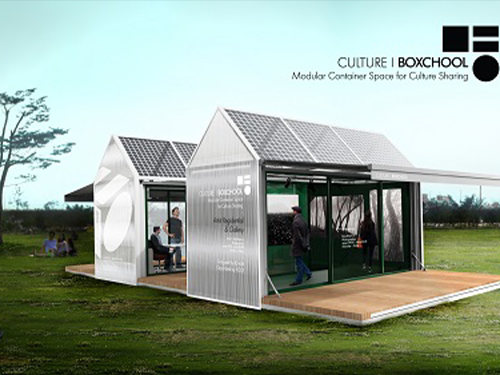
Prof. Sang-Min Bae and his research team from the Industrial Design Department of KAIST submitted a winning entry to the 2017 iF Design Award named ‘Culture BOXCHOOL’.
The iF Design Award is an internationally renowned design contest that is recognized as one of the top three design awards in the world along with the Red Dot Design Award and the IDEA Design Award. It has been held annually by iF International Forum Design since 1953. A total of 5,575 entries from 59 countries entered the last competition.
Culture BOXCHOOL is a modular container space platform designed for culture sharing in isolated areas. It is delivered as a standard shipping container along with its subsidiary modular parts and it transforms into a gallery, office, or classroom. These modular parts build the interior and exterior by attaching them to the corner castings, which are standard parts on all shipping containers. Two Cultural BOXCHOOL containers can be transformed into three different types of layouts.
The containers can generate their own energy using solar panels that provide sustainable energy to equipment inside. Additionally, hot humid air can flow out through the attic vent, doors, and windows.
“With Culture BOXCHOOL, you can easily and quickly create spaces such as offices and classrooms, or you can easily disassemble and move them to another location.
Thus, it can provide everyone with equal educational opportunities and cultural enjoyment regardless of their geographical location. In addition, because it produces its own energy, it is expected to create a cultural space in a relatively harsh environment such as in developing countries. These social and economic values of Culture BOXCHOOL seem to be what led to us winning the contest. I will continue to strive to create the world’s best designs for needy people.” Professor Bae said.
The ID+IM design laboratory, a research team led by Professor Bae, has been studying philanthropy design since 2005, working on solving various problems throughout society through innovative design. They have received more than 50 awards from the most prestigious design competitions in the world.
2017.05.18 View 14315
Prof. Sang-Min Bae Receives 2017 iF Design Award
Prof. Sang-Min Bae and his research team from the Industrial Design Department of KAIST submitted a winning entry to the 2017 iF Design Award named ‘Culture BOXCHOOL’.
The iF Design Award is an internationally renowned design contest that is recognized as one of the top three design awards in the world along with the Red Dot Design Award and the IDEA Design Award. It has been held annually by iF International Forum Design since 1953. A total of 5,575 entries from 59 countries entered the last competition.
Culture BOXCHOOL is a modular container space platform designed for culture sharing in isolated areas. It is delivered as a standard shipping container along with its subsidiary modular parts and it transforms into a gallery, office, or classroom. These modular parts build the interior and exterior by attaching them to the corner castings, which are standard parts on all shipping containers. Two Cultural BOXCHOOL containers can be transformed into three different types of layouts.
The containers can generate their own energy using solar panels that provide sustainable energy to equipment inside. Additionally, hot humid air can flow out through the attic vent, doors, and windows.
“With Culture BOXCHOOL, you can easily and quickly create spaces such as offices and classrooms, or you can easily disassemble and move them to another location.
Thus, it can provide everyone with equal educational opportunities and cultural enjoyment regardless of their geographical location. In addition, because it produces its own energy, it is expected to create a cultural space in a relatively harsh environment such as in developing countries. These social and economic values of Culture BOXCHOOL seem to be what led to us winning the contest. I will continue to strive to create the world’s best designs for needy people.” Professor Bae said.
The ID+IM design laboratory, a research team led by Professor Bae, has been studying philanthropy design since 2005, working on solving various problems throughout society through innovative design. They have received more than 50 awards from the most prestigious design competitions in the world.
2017.05.18 View 14315