research+center
-
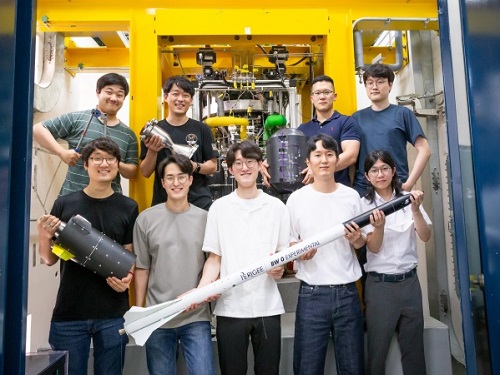 Perigee-KAIST Rocket Research Center Launches Scientific Rocket
Undergraduate startup Perigree Aerospace develops suborbital rocket called Blue Whale 0.1
On December 29, Perigee Aerospace, an undergraduate startup, launched a test rocket with a length of 3.2 m, a diameter of 19 cm, and a weight of 51 kg, using ethanol and liquid oxygen as fuel. The launch took place off Jeju Island. It was aimed at building experience and checking the combustion of a liquid propulsion engine and the performance of pre-set flight and trajectory, communication, and navigation devices. It was also one of the projects marking the 50th anniversary of KAIST in 2021.
However, after flying for several seconds, the rocket lost its track due to a gust of wind that activated the rocket’s automatic flight suspension system. "At the moment the rocket took off, there was a much stronger gust than expected," Dong-Yoon Shin, CEO of Perigee said. "The wind sent it flying off course and the automatic flight suspension system stopped its engine." However, Shin was not disappointed, saying the launch, which was conducted in collaboration with Perigee-KAIST Rocket Research Center provided a good experience.
"Some people say that Blue Whale 0.1 is like a toy because of its small size. Of course, it's much smaller than the rockets I’ve dreamed of, but like other rockets, it has all the technology needed for launch," said Shin, who established his company in 2018 as a KAIST aerospace engineering student to develop small liquid-propellant orbital rockets. Perigee Aerospace aims to develop the world’s lightest launch vehicle using high-powered engines, with a goal of leading the global market for small launch vehicles in the new space generation.
Perigee-KAIST Rocket Research Center was founded in 2019 for the research and development of rocket propellants and has been testing the combustion of rocket engines of various sizes in their liquid propellant rocket combustion lab located on the KAIST Munji Campus.
The research center initiated the 50th anniversary rocket launch project in late April of last year, finished the examination of their preliminary design in late May, and secured a tentative launching site through the KAIST-Jejudo agreement in early July.
The ethanol engine combustion was tested in late July, and an examination meeting regarding the detailed design that took place in late August was followed by two months of static firing tests of the assembled rocket in October and November.
This was a very meaningful trial in which a domestic private enterprise founded by a college student collaborated with a university to successfully develop and launch a technically challenging liquid propellant rocket.
Shin's near-term goal is to launch a two-stage orbital rocket that uses liquid methane as fuel and weighs 1.8 tons. To secure competitiveness in the small projectile market, KAIST and Perigee Aerospace have set up a joint research center to test various rocket engine sizes and develop the world's lightest projectile using a high-performance engine.
Professor Jae-Hung Han, head of the Department of Aerospace Engineering, said, “The scientific rocket system secured through the launch of the celebratory rocket will be utilized for design and system-oriented education, and for carrying out various scientific missions.” He added, “It is very rare both domestically and globally that a scientific rocket designed by the initiatives of a department should be incorporated as part of a regular aerospace system design curriculum. This will be an exemplary case we can boast about to the rest of the world.”
Perigee Aerospace will improve the technology they have developed through the course of this project to develop subminiature vehicles they may use to launch small satellites into the low Earth orbit.
Shin said, “I am happy just with the fact that we have participated in a rocket project to celebrate the 50th anniversary of KAIST, and I would like to thank the engineers at my company and members of the KAIST Department of Aerospace Engineering.” He added, “I’m looking forward to the day that we develop a space launch vehicle that can deliver satellites even higher.”
2022.01.14 View 4570
Perigee-KAIST Rocket Research Center Launches Scientific Rocket
Undergraduate startup Perigree Aerospace develops suborbital rocket called Blue Whale 0.1
On December 29, Perigee Aerospace, an undergraduate startup, launched a test rocket with a length of 3.2 m, a diameter of 19 cm, and a weight of 51 kg, using ethanol and liquid oxygen as fuel. The launch took place off Jeju Island. It was aimed at building experience and checking the combustion of a liquid propulsion engine and the performance of pre-set flight and trajectory, communication, and navigation devices. It was also one of the projects marking the 50th anniversary of KAIST in 2021.
However, after flying for several seconds, the rocket lost its track due to a gust of wind that activated the rocket’s automatic flight suspension system. "At the moment the rocket took off, there was a much stronger gust than expected," Dong-Yoon Shin, CEO of Perigee said. "The wind sent it flying off course and the automatic flight suspension system stopped its engine." However, Shin was not disappointed, saying the launch, which was conducted in collaboration with Perigee-KAIST Rocket Research Center provided a good experience.
"Some people say that Blue Whale 0.1 is like a toy because of its small size. Of course, it's much smaller than the rockets I’ve dreamed of, but like other rockets, it has all the technology needed for launch," said Shin, who established his company in 2018 as a KAIST aerospace engineering student to develop small liquid-propellant orbital rockets. Perigee Aerospace aims to develop the world’s lightest launch vehicle using high-powered engines, with a goal of leading the global market for small launch vehicles in the new space generation.
Perigee-KAIST Rocket Research Center was founded in 2019 for the research and development of rocket propellants and has been testing the combustion of rocket engines of various sizes in their liquid propellant rocket combustion lab located on the KAIST Munji Campus.
The research center initiated the 50th anniversary rocket launch project in late April of last year, finished the examination of their preliminary design in late May, and secured a tentative launching site through the KAIST-Jejudo agreement in early July.
The ethanol engine combustion was tested in late July, and an examination meeting regarding the detailed design that took place in late August was followed by two months of static firing tests of the assembled rocket in October and November.
This was a very meaningful trial in which a domestic private enterprise founded by a college student collaborated with a university to successfully develop and launch a technically challenging liquid propellant rocket.
Shin's near-term goal is to launch a two-stage orbital rocket that uses liquid methane as fuel and weighs 1.8 tons. To secure competitiveness in the small projectile market, KAIST and Perigee Aerospace have set up a joint research center to test various rocket engine sizes and develop the world's lightest projectile using a high-performance engine.
Professor Jae-Hung Han, head of the Department of Aerospace Engineering, said, “The scientific rocket system secured through the launch of the celebratory rocket will be utilized for design and system-oriented education, and for carrying out various scientific missions.” He added, “It is very rare both domestically and globally that a scientific rocket designed by the initiatives of a department should be incorporated as part of a regular aerospace system design curriculum. This will be an exemplary case we can boast about to the rest of the world.”
Perigee Aerospace will improve the technology they have developed through the course of this project to develop subminiature vehicles they may use to launch small satellites into the low Earth orbit.
Shin said, “I am happy just with the fact that we have participated in a rocket project to celebrate the 50th anniversary of KAIST, and I would like to thank the engineers at my company and members of the KAIST Department of Aerospace Engineering.” He added, “I’m looking forward to the day that we develop a space launch vehicle that can deliver satellites even higher.”
2022.01.14 View 4570 -
 KAIST to join Deep Space Exploration Project
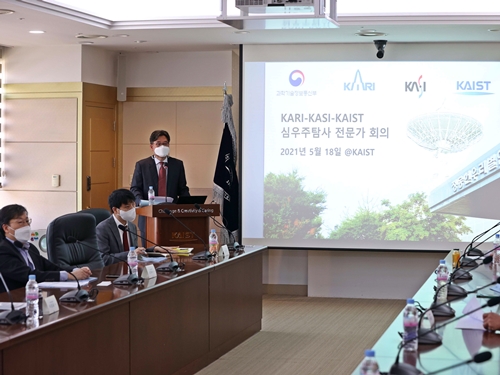
KAIST agreed to launch the Deep Space Exploration Research Consortium with two key leading aerospace research institutes, the Korea Aerospace Research Institute (KARI) and the Korea Astronomy and Space Science Institute (KASI) during a recent meeting at the KAIST campus. President Kwang Hyung Lee, KARI President Sang-Yool Lee, KASI President Young-Deuk Park, and Vice Minister of Science and ICT Hong-taek Yong attended the meeting to discuss medium- and long-term deep space exploration plans and collaborations.
The three entities have cooperated in scientific research for the last 30 years during which Korea has been developing its space exploration expertise. They signed the MoU for Cooperation for R&D and Industrialization on Deep Space Exploration’ last December. The research consortium will share and discuss research plans for space science research and exploration technology, and contribute to planning the nation’s deep space exploration.
At the meeting, KAIST reported its plans to return KITSAT-1 to Earth, Korea’s first satellite using local technology, and to explore the radiation belt (the Van Allen belt) around Earth. KAIST launched Korea’s first satellite KITSAT-1 in 1992. Meanwhile, KARI shared their plans to launch a lunar landing module using a Korean Space Launch Vehicle by 2030 and explained the current technologies and research related to a lunar landing and space exploration. Based on the payload technology it has been building on for the last 20 years, KASI emphasized the importance of research for deep space exploration in relation to the formation of the universe and the origin of mankind.
Vice Minister of Science and Technology Yong also stressed that “to enhance Korea’s capabilities for space research after launching our space launch vehicle, Nuri, in October, there must be continued efforts and preparation for higher level space research, including space exploration planning. The various experts’ opinions discussed in today’s meeting will be taken into consideration for governmental policies related to the ‘National Space Exploration Roadmap’ to be established in the latter half of this year.”
2021.06.07 View 4831
KAIST to join Deep Space Exploration Project
KAIST agreed to launch the Deep Space Exploration Research Consortium with two key leading aerospace research institutes, the Korea Aerospace Research Institute (KARI) and the Korea Astronomy and Space Science Institute (KASI) during a recent meeting at the KAIST campus. President Kwang Hyung Lee, KARI President Sang-Yool Lee, KASI President Young-Deuk Park, and Vice Minister of Science and ICT Hong-taek Yong attended the meeting to discuss medium- and long-term deep space exploration plans and collaborations.
The three entities have cooperated in scientific research for the last 30 years during which Korea has been developing its space exploration expertise. They signed the MoU for Cooperation for R&D and Industrialization on Deep Space Exploration’ last December. The research consortium will share and discuss research plans for space science research and exploration technology, and contribute to planning the nation’s deep space exploration.
At the meeting, KAIST reported its plans to return KITSAT-1 to Earth, Korea’s first satellite using local technology, and to explore the radiation belt (the Van Allen belt) around Earth. KAIST launched Korea’s first satellite KITSAT-1 in 1992. Meanwhile, KARI shared their plans to launch a lunar landing module using a Korean Space Launch Vehicle by 2030 and explained the current technologies and research related to a lunar landing and space exploration. Based on the payload technology it has been building on for the last 20 years, KASI emphasized the importance of research for deep space exploration in relation to the formation of the universe and the origin of mankind.
Vice Minister of Science and Technology Yong also stressed that “to enhance Korea’s capabilities for space research after launching our space launch vehicle, Nuri, in October, there must be continued efforts and preparation for higher level space research, including space exploration planning. The various experts’ opinions discussed in today’s meeting will be taken into consideration for governmental policies related to the ‘National Space Exploration Roadmap’ to be established in the latter half of this year.”
2021.06.07 View 4831 -
 Professor Youngchul Kim Joins Presidential Commission on Architecture Policy
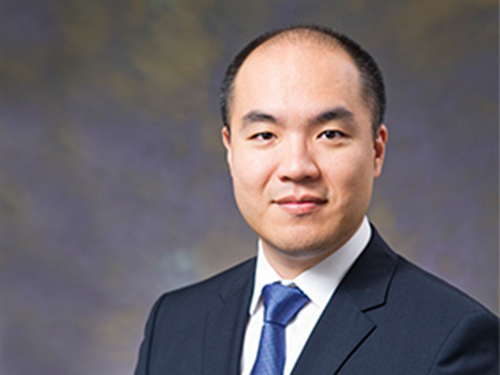
Professor Youngchul Kim from the Department of Civil and Environmental Engineering, who is also the Director of the Smart City Research Center at KAIST, was appointed as a commissioner of the 6th Presidential Commission on Architecture Policy on May 19. Professor Kim will contribute to coordinating and deliberating national architecture and urban development policies. He will serve a two-year term beginning this month.
The Presidential Commission on Architecture Policy is made up of 30 commissioners. Nineteen members, including Professor Kim, are experts from the private sector, and the rest include the Minister of Land, Infrastructure, and Transport, the Minister for Environment, and other government officials. The non-governmental commissioners represent a diverse mixture of genders, ages, and regions for the balanced development of the nation.
(END)
2020.05.21 View 4538
Professor Youngchul Kim Joins Presidential Commission on Architecture Policy
Professor Youngchul Kim from the Department of Civil and Environmental Engineering, who is also the Director of the Smart City Research Center at KAIST, was appointed as a commissioner of the 6th Presidential Commission on Architecture Policy on May 19. Professor Kim will contribute to coordinating and deliberating national architecture and urban development policies. He will serve a two-year term beginning this month.
The Presidential Commission on Architecture Policy is made up of 30 commissioners. Nineteen members, including Professor Kim, are experts from the private sector, and the rest include the Minister of Land, Infrastructure, and Transport, the Minister for Environment, and other government officials. The non-governmental commissioners represent a diverse mixture of genders, ages, and regions for the balanced development of the nation.
(END)
2020.05.21 View 4538 -
 Hubo Debuts as a News Anchor
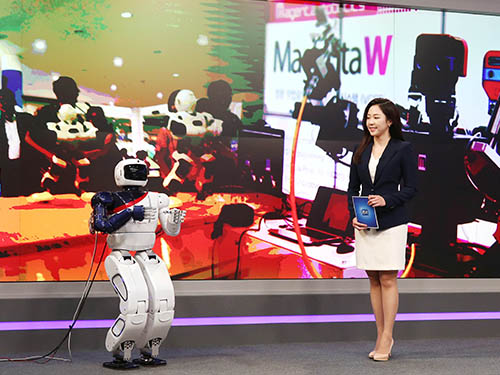
HUBO, a humanoid robot developed by Professor Jun-Ho Oh’s team, made its debut as a co-anchor during the TJB prime time news 8 on May 14.
“Un-contact" became the new normal after Covid-19 and many business solutions are being transformed using robotics. HUBO made two news reports on contactless services using robots in medical, manufacturing, and logistics industries. HUBO 2, the second generation of HUBO, appeared as a special anchor on the local broadcasting network’s special program in celebration of its 25th anniversary.
HUBO is the champion of the 2015 DARPA Robotics Challenge held in the USA. Its FX-2 riding robot also participated in the Olympic torch relay during the 2018 PyeongChang Winter Olympics.
Click here to watch a full video of HUBO anchoring the news.
(END)
2020.05.14 View 7708
Hubo Debuts as a News Anchor
HUBO, a humanoid robot developed by Professor Jun-Ho Oh’s team, made its debut as a co-anchor during the TJB prime time news 8 on May 14.
“Un-contact" became the new normal after Covid-19 and many business solutions are being transformed using robotics. HUBO made two news reports on contactless services using robots in medical, manufacturing, and logistics industries. HUBO 2, the second generation of HUBO, appeared as a special anchor on the local broadcasting network’s special program in celebration of its 25th anniversary.
HUBO is the champion of the 2015 DARPA Robotics Challenge held in the USA. Its FX-2 riding robot also participated in the Olympic torch relay during the 2018 PyeongChang Winter Olympics.
Click here to watch a full video of HUBO anchoring the news.
(END)
2020.05.14 View 7708 -
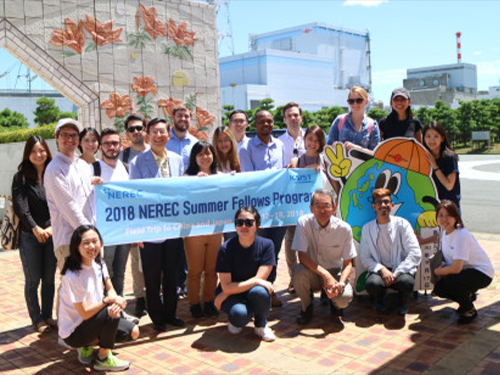 NEREC Summer Program Keeps Fellows Thinking, Engaged in Nuclear Nonproliferation
Nuclear technology is more than just technology. It is the fruit of the most advanced science and technology. It also requires high standards of policymaking and global cooperation for benefiting the technology.
As part of the fifth annual Nuclear Nonproliferation Education and Research Center (NEREC) Summer Fellows Program at KAIST, 24 students from 15 countries participated in six-week intensive education and training program. NEREC is the only university-based center dedicated to nuclear nonproliferation education and research established in 2014.
The program, which provides multidisciplinary lectures and seminars on nuclear technology and policy as well as international relations, was designed to nurture global nuclear technology experts well equipped in three areas: in-depth knowledge of technology, applicability gained from sound policy building, and negotiating for international cooperation. It now has grown into the most popular summer program at KAIST.
During the program from July 6 to August 18, participants were able to engage in enriching and stimulating learning experiences in tandem with policies and technology for the utilization and provision of peaceful and safe nuclear technology.
Participating fellows also had to conduct a group research project on a given topic. This year, they explored nuclear nonproliferation issues in relation to nuclear exports and brainstormed some recommendations for current policy. They presented their outcomes at the 2018 NEREC Conference on Nuclear Nonproliferation. After intensive lecture sessions and group research work, the fellows went off to key policy think-tanks, nuclear research institutes, and research power facilities in Korea, Japan, and China.
“NEREC emphasizes nuclear nonproliferation issues related to civilian nuclear power and the associated nuclear fuel cycle development from the point of technology users. I am very glad that the number of participants are increasing year by year,” said the Director of NEREC Man-Sung Yim, a professor in the Department of Nuclear and Quantum Engineering.
Participants’ majors vary from nuclear engineering to international relations to economics. The fellows divided into two groups of graduate and undergraduate courses. They expressed their deep satisfactory in the multidisciplinary lectures by scholars from KAIST, Seoul National University, and Korea National Defense University.
Many participants reported that they learned a lot, not only about policy and international relations but on the research they are conducting and what the key issues will be in dealing for producing meaningful research work.
Moad Aldbissi from the KTH Royal Institute of Technology is one of the students who shared the same view. He said, “Coming from a technical background in nuclear engineering, I managed to learn a lot about nuclear policy and international relations. The importance of integrating the technical and political fields became even clearer.”
Most students concurred that they recognized how important it was to make international collaboration in this powerful field for each country through this program.
“As an engineering student, I just approached this program like an empty glass in policy areas. While working with colleagues during the program, I came to understand how important it is to make cooperation in these fields for the better result of national development and international relations,” said Thanataon Pornphatdetaudom from the Tokyo Institute of Technology.
To Director Yim, this program is becoming well positioned to educate nuclear policy experts in a number of countries of strategic importance. He believes the continuous supply of these experts will contribute to promoting global nuclear nonproliferation and the peaceful use of nuclear energy while the use of nuclear technology continues.
2018.09.04 View 7104
NEREC Summer Program Keeps Fellows Thinking, Engaged in Nuclear Nonproliferation
Nuclear technology is more than just technology. It is the fruit of the most advanced science and technology. It also requires high standards of policymaking and global cooperation for benefiting the technology.
As part of the fifth annual Nuclear Nonproliferation Education and Research Center (NEREC) Summer Fellows Program at KAIST, 24 students from 15 countries participated in six-week intensive education and training program. NEREC is the only university-based center dedicated to nuclear nonproliferation education and research established in 2014.
The program, which provides multidisciplinary lectures and seminars on nuclear technology and policy as well as international relations, was designed to nurture global nuclear technology experts well equipped in three areas: in-depth knowledge of technology, applicability gained from sound policy building, and negotiating for international cooperation. It now has grown into the most popular summer program at KAIST.
During the program from July 6 to August 18, participants were able to engage in enriching and stimulating learning experiences in tandem with policies and technology for the utilization and provision of peaceful and safe nuclear technology.
Participating fellows also had to conduct a group research project on a given topic. This year, they explored nuclear nonproliferation issues in relation to nuclear exports and brainstormed some recommendations for current policy. They presented their outcomes at the 2018 NEREC Conference on Nuclear Nonproliferation. After intensive lecture sessions and group research work, the fellows went off to key policy think-tanks, nuclear research institutes, and research power facilities in Korea, Japan, and China.
“NEREC emphasizes nuclear nonproliferation issues related to civilian nuclear power and the associated nuclear fuel cycle development from the point of technology users. I am very glad that the number of participants are increasing year by year,” said the Director of NEREC Man-Sung Yim, a professor in the Department of Nuclear and Quantum Engineering.
Participants’ majors vary from nuclear engineering to international relations to economics. The fellows divided into two groups of graduate and undergraduate courses. They expressed their deep satisfactory in the multidisciplinary lectures by scholars from KAIST, Seoul National University, and Korea National Defense University.
Many participants reported that they learned a lot, not only about policy and international relations but on the research they are conducting and what the key issues will be in dealing for producing meaningful research work.
Moad Aldbissi from the KTH Royal Institute of Technology is one of the students who shared the same view. He said, “Coming from a technical background in nuclear engineering, I managed to learn a lot about nuclear policy and international relations. The importance of integrating the technical and political fields became even clearer.”
Most students concurred that they recognized how important it was to make international collaboration in this powerful field for each country through this program.
“As an engineering student, I just approached this program like an empty glass in policy areas. While working with colleagues during the program, I came to understand how important it is to make cooperation in these fields for the better result of national development and international relations,” said Thanataon Pornphatdetaudom from the Tokyo Institute of Technology.
To Director Yim, this program is becoming well positioned to educate nuclear policy experts in a number of countries of strategic importance. He believes the continuous supply of these experts will contribute to promoting global nuclear nonproliferation and the peaceful use of nuclear energy while the use of nuclear technology continues.
2018.09.04 View 7104 -
 The Center for Anthropocene Studies (CAS) Opens
KAIST will start Anthropocene research, a convergence field of study, to address issues related to the commencement of human activities that have had scientific, industrial, and economic impacts on the Earth’s ecosystem. The National Research Foundation (NRF) of Korea endorsed the KAIST Center for Anthropocene Studies as its Convergence Research Center project.
Anthropocene refers to a new geological age in which various polluting materials that humans have made during the post-industrial revolution era have made a significant impact on the Earth and the lives of humankind. The studies expand the diverse socio-economic and environmental sectors for responding to climate change, natural disasters, ecological destruction, the polarization of the inequality and wealth, and many others.
The KAIST research group at the center, in collaboration with the Graduate School of Science and Technology Policy, the Graduate School of Culture Technology, the School of Humanities & Social Sciences, the Department of Industrial Design, the School of Electrical Engineering, the Satellite Technology Research Center (SaRTec), and the KAIST Initiative for Disaster Studies will conduct multidisciplinary research to address intriguing challenges with complex but creative approaches incorporating the fields of engineering, socioeconomics, and art.
The group will investigate topics such as▲ surface and marine changes to the Earth by applying satellite data ▲disaster prediction and governance system building through AI modeling ▲sustainable housing, transportation, and lifestyles ▲ engineering and artistic approaches for envisioning a new future for humankind and the Earth.
Professor Buhm Soon Park, who is in charge of the center, said, “This pioneering research work will inspire the re-creation of a new paradigm of convergence studies in science, engineering, humanities, and social science. We will contribute to making the world better by designing new technologies and social policies.
2018.06.05 View 7883
The Center for Anthropocene Studies (CAS) Opens
KAIST will start Anthropocene research, a convergence field of study, to address issues related to the commencement of human activities that have had scientific, industrial, and economic impacts on the Earth’s ecosystem. The National Research Foundation (NRF) of Korea endorsed the KAIST Center for Anthropocene Studies as its Convergence Research Center project.
Anthropocene refers to a new geological age in which various polluting materials that humans have made during the post-industrial revolution era have made a significant impact on the Earth and the lives of humankind. The studies expand the diverse socio-economic and environmental sectors for responding to climate change, natural disasters, ecological destruction, the polarization of the inequality and wealth, and many others.
The KAIST research group at the center, in collaboration with the Graduate School of Science and Technology Policy, the Graduate School of Culture Technology, the School of Humanities & Social Sciences, the Department of Industrial Design, the School of Electrical Engineering, the Satellite Technology Research Center (SaRTec), and the KAIST Initiative for Disaster Studies will conduct multidisciplinary research to address intriguing challenges with complex but creative approaches incorporating the fields of engineering, socioeconomics, and art.
The group will investigate topics such as▲ surface and marine changes to the Earth by applying satellite data ▲disaster prediction and governance system building through AI modeling ▲sustainable housing, transportation, and lifestyles ▲ engineering and artistic approaches for envisioning a new future for humankind and the Earth.
Professor Buhm Soon Park, who is in charge of the center, said, “This pioneering research work will inspire the re-creation of a new paradigm of convergence studies in science, engineering, humanities, and social science. We will contribute to making the world better by designing new technologies and social policies.
2018.06.05 View 7883 -
 Cross-Generation Collaborative Labs Open
KAIST opened two cross-generation collaborative labs last month. This novel approach will pair up senior and junior faculty members for sustaining research and academic achievements even after the senior researcher retires.
This is one of the Vision 2031 innovation initiatives established to extend the spectrum of knowledge and research competitiveness. The selected labs will be funded for five years and the funding will be extended if necessary. KAIST will continue to select new labs every year.
A five-member selection committee including the Nobel Laureates Professor Klaus Von Klitzing at the Max-Planck Institute for Solid State Research and Dr. Kurt Wüthrich from ETH Zürich selected the first two labs with senior-junior pairs in March.
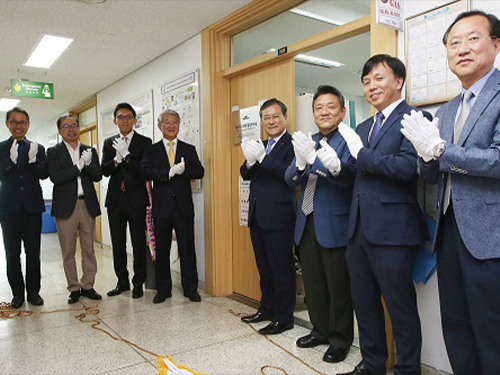
(Two renowned scholars' Cross-Generation Collaborative Labs which opened last month.
Distinguished Professor Lee's lab (above) andChair Professor Sung's lab)
Both labs are run by world-renowned scholars: the Systems Metabolic Engineering and Systems Healthcare Laboratory headed by Distinguished Professor Sang-Yup Lee in the Department of Chemical and Biomolecular Engineering and the Acousto-Microfluidics Research Center for Next-Generation Healthcare led by Chair Professor Hyung Jin Sung in the Department of Mechanical Engineering.
Distinguished Professor Lee will be teamed up with Professor Hyun Uk Kim, and their lab aims to mass produce new eco-friendly chemical materials as well as higher-value-added materials which will be used for medicine. The new platform technologies created in the lab are expected to provide information which will benefit human healthcare.
Meanwhile, the Acousto-Microfluidics Research Center for Next-Generation Healthcare will team up with Professors Hyoungsoo Kim and Yeunwoo Cho under Chair Professor Sung. The lab will conduct research on controlling fluids and objects exquisitely on a micro-nano scale by using high-frequency acoustic waves. The lab plans to develop a next-generation healthcare platform for customized diagnoses as well as disease treatment.
KAIST President Sung-Chul Shin, who introduced this novel idea in his research innovation initiative, said that he hopes the Cross-Generation Collaborative Labs will contribute to honoring senior scholars’ research legacies and passing knowledge down to junior researchers in order to further develop their academic achievements. He said, “I sincerely hope the labs will make numerous research breakthroughs in the very near future.”
2018.05.03 View 7729
Cross-Generation Collaborative Labs Open
KAIST opened two cross-generation collaborative labs last month. This novel approach will pair up senior and junior faculty members for sustaining research and academic achievements even after the senior researcher retires.
This is one of the Vision 2031 innovation initiatives established to extend the spectrum of knowledge and research competitiveness. The selected labs will be funded for five years and the funding will be extended if necessary. KAIST will continue to select new labs every year.
A five-member selection committee including the Nobel Laureates Professor Klaus Von Klitzing at the Max-Planck Institute for Solid State Research and Dr. Kurt Wüthrich from ETH Zürich selected the first two labs with senior-junior pairs in March.
(Two renowned scholars' Cross-Generation Collaborative Labs which opened last month.
Distinguished Professor Lee's lab (above) andChair Professor Sung's lab)
Both labs are run by world-renowned scholars: the Systems Metabolic Engineering and Systems Healthcare Laboratory headed by Distinguished Professor Sang-Yup Lee in the Department of Chemical and Biomolecular Engineering and the Acousto-Microfluidics Research Center for Next-Generation Healthcare led by Chair Professor Hyung Jin Sung in the Department of Mechanical Engineering.
Distinguished Professor Lee will be teamed up with Professor Hyun Uk Kim, and their lab aims to mass produce new eco-friendly chemical materials as well as higher-value-added materials which will be used for medicine. The new platform technologies created in the lab are expected to provide information which will benefit human healthcare.
Meanwhile, the Acousto-Microfluidics Research Center for Next-Generation Healthcare will team up with Professors Hyoungsoo Kim and Yeunwoo Cho under Chair Professor Sung. The lab will conduct research on controlling fluids and objects exquisitely on a micro-nano scale by using high-frequency acoustic waves. The lab plans to develop a next-generation healthcare platform for customized diagnoses as well as disease treatment.
KAIST President Sung-Chul Shin, who introduced this novel idea in his research innovation initiative, said that he hopes the Cross-Generation Collaborative Labs will contribute to honoring senior scholars’ research legacies and passing knowledge down to junior researchers in order to further develop their academic achievements. He said, “I sincerely hope the labs will make numerous research breakthroughs in the very near future.”
2018.05.03 View 7729 -
 Research Center for Smart Submerged Floating Tunnel Systems Opens
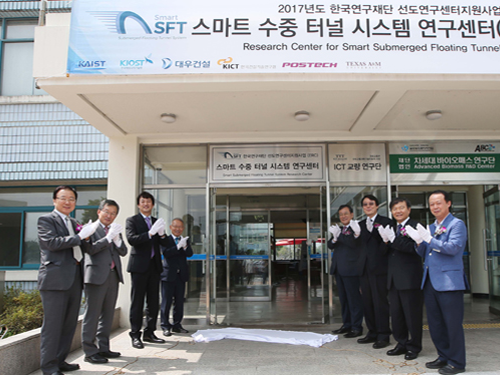
(Distinguished guests including President Shin (fourth from the right) and Director Lee (third from left) at the opening ceremony)
The Research Center for a Smart Submerged Floating Tunnel Systems was recently established at KAIST with the purpose of taking the lead in developing fundamental and applicable technology for submerged floating tunnels as well as fostering creative and talented people. Haeng-Ki Lee, a professor in the Department of Civil & Environmental Engineering at KAIST is heading the center.
KAIST held its opening ceremony on September 7, 2017 in the Applied Engineering Building located on the main campus.
Distinguished guests, including KAIST president Sung-Chul Shin, the President of the Korea Institute of Ocean Science and Technology Gi-Hoon Hong, the President of the Korean Society of Civil Engineering Young-Seok Park, and the Director in the Division of Engineering at the National Research Foundation of Korea Joong-Kon Park attended the ceremony.
The National Research Foundation of Korea provides Engineering Research Center (ERC) projects which find and foster groups with outstanding research performance in a field of engineering. The projects support these groups so that they can strengthen their global competitiveness while enhancing national competence in basic research.
The ‘Research Center for Smart Submerged Floating Tunnel Systems’ was selected as one of the ERC projects in 2017. For the next seven years, the research center will work to develop a submerged floating tunnel system resistant depths greater than 100 meters.
To achieve its goal, the center has defined crucial research topics including: i) a structural analysis program and integrated design technology specific for submerged floating tunnel systems, ii) high-durability marine construction materials and submerged construction integrated systems, and iii) safety and maintenance integrated technology for smart submerged floating tunnel systems.
The ‘Research Center for Smart Submerged Floating Tunnel Systems’ will devote itself to developing a variety of fundamental and applicable technology that will be leading global maritime construction. Moreover, it will concentrate on fostering professional research manpower in related areas.
The Director of the Center Lee said, “The center will cooperate with KAIST researchers who are experts in various fields, including structures, materials, construction, and maritime research. Based on this collaboration, the center will contribute to achieving autonomous technologies by developing fundamental and applicable technology related with submerged floating tunnel systems. It will also take the role of a leading global research hub in the field of submerged floating tunnels as well as construction technologies.”
2017.09.07 View 6241
Research Center for Smart Submerged Floating Tunnel Systems Opens
(Distinguished guests including President Shin (fourth from the right) and Director Lee (third from left) at the opening ceremony)
The Research Center for a Smart Submerged Floating Tunnel Systems was recently established at KAIST with the purpose of taking the lead in developing fundamental and applicable technology for submerged floating tunnels as well as fostering creative and talented people. Haeng-Ki Lee, a professor in the Department of Civil & Environmental Engineering at KAIST is heading the center.
KAIST held its opening ceremony on September 7, 2017 in the Applied Engineering Building located on the main campus.
Distinguished guests, including KAIST president Sung-Chul Shin, the President of the Korea Institute of Ocean Science and Technology Gi-Hoon Hong, the President of the Korean Society of Civil Engineering Young-Seok Park, and the Director in the Division of Engineering at the National Research Foundation of Korea Joong-Kon Park attended the ceremony.
The National Research Foundation of Korea provides Engineering Research Center (ERC) projects which find and foster groups with outstanding research performance in a field of engineering. The projects support these groups so that they can strengthen their global competitiveness while enhancing national competence in basic research.
The ‘Research Center for Smart Submerged Floating Tunnel Systems’ was selected as one of the ERC projects in 2017. For the next seven years, the research center will work to develop a submerged floating tunnel system resistant depths greater than 100 meters.
To achieve its goal, the center has defined crucial research topics including: i) a structural analysis program and integrated design technology specific for submerged floating tunnel systems, ii) high-durability marine construction materials and submerged construction integrated systems, and iii) safety and maintenance integrated technology for smart submerged floating tunnel systems.
The ‘Research Center for Smart Submerged Floating Tunnel Systems’ will devote itself to developing a variety of fundamental and applicable technology that will be leading global maritime construction. Moreover, it will concentrate on fostering professional research manpower in related areas.
The Director of the Center Lee said, “The center will cooperate with KAIST researchers who are experts in various fields, including structures, materials, construction, and maritime research. Based on this collaboration, the center will contribute to achieving autonomous technologies by developing fundamental and applicable technology related with submerged floating tunnel systems. It will also take the role of a leading global research hub in the field of submerged floating tunnels as well as construction technologies.”
2017.09.07 View 6241 -
 2017 Summer Nuclear Nonproliferation Education Program
The Nuclear Nonproliferation Education and Research Center (NEREC) at KAIST announced its 30 scholarship recipients for the 2017 Summer Nuclear Nonproliferation Education Program on April 18. The six-week program, starting from July 10, will be run in Korea, Japan, and China.
The program provides young global scholars with focused and challenging nuclear nonproliferation studies. Young scholars will be exposed to diverse science and technology policies and practices concurrently conducted in many countries and the future direction for enhancing nuclear nonproliferation. They will participate in a series of seminars, projects, international conferences, and field trips.
Since its launch in 2014, the program has educated 71 young scholars. This year, more than 150 scholars from 37 countries applied for the program, reflecting the growing reputation of the program both at home and abroad. The director of the NEREC, Professor Man-Sung Yim of the Department of Nuclear and Quantum Engineering at KAIST said that young scholars from very prestigious foreign universities have shown strong interest in the program. According to Professor Yim, this year’s recipients are from 26 universities from 16 countries including Harvard University, Oxford University, the National Research Nuclear University of Russia, and the Tokyo Institute of Technology
2017.04.19 View 5574
2017 Summer Nuclear Nonproliferation Education Program
The Nuclear Nonproliferation Education and Research Center (NEREC) at KAIST announced its 30 scholarship recipients for the 2017 Summer Nuclear Nonproliferation Education Program on April 18. The six-week program, starting from July 10, will be run in Korea, Japan, and China.
The program provides young global scholars with focused and challenging nuclear nonproliferation studies. Young scholars will be exposed to diverse science and technology policies and practices concurrently conducted in many countries and the future direction for enhancing nuclear nonproliferation. They will participate in a series of seminars, projects, international conferences, and field trips.
Since its launch in 2014, the program has educated 71 young scholars. This year, more than 150 scholars from 37 countries applied for the program, reflecting the growing reputation of the program both at home and abroad. The director of the NEREC, Professor Man-Sung Yim of the Department of Nuclear and Quantum Engineering at KAIST said that young scholars from very prestigious foreign universities have shown strong interest in the program. According to Professor Yim, this year’s recipients are from 26 universities from 16 countries including Harvard University, Oxford University, the National Research Nuclear University of Russia, and the Tokyo Institute of Technology
2017.04.19 View 5574 -
 KAIST and Hanwha Chemical Agree on Research Collaboration
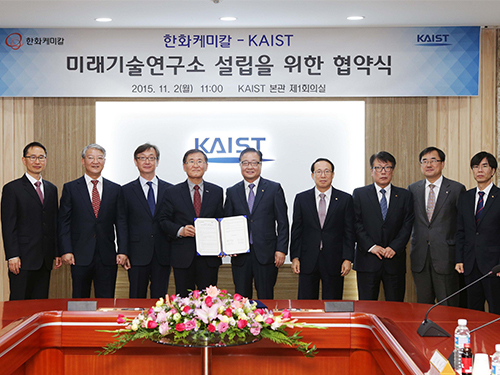
KAIST signed a memorandum of understanding (MOU) with Hanwha Chemical Co., Ltd., a Korean chemical and auto manufacturer, on November 2, 2015 to establish a research center on campus.
The research center, which will be named “KAIST-Hanwha Chemical Future Technology Research Center,” will implement joint research projects for five years beginning from 2016 to develop innovative, green technologies that will help the Korean chemical industry boost its global competitiveness and to nurture top researchers and engineers in chemical engineering.
The research center will lead the development of next-generation petrochemical materials and manufacturing technology and the establishment of pure high-refining processes which are more energy-efficient and environmentally friendly. KAIST and Hanwha will strive to secure new technologies that have the greatest commercialization potential in the global market. They will also establish a scholarship fund for 15 KAIST doctoral students in the Department of Chemical and Biomolecular Engineering.
Many professors from the Chemical and Biomolecular Engineering Department including Distinguished Professor Sang Yup Lee, who was listed in the Top 20 Translational Researchers of 2014 by Nature Biotechnology this year, and Professor Hyunjoo Lee who received the Woman Scholar award at the 2015 World Chemistry Conference, will work at the research center.
Professor Lee, the head of the research center, said, “Collaborating with Hanwha will give us a strong basis for our efforts to carry out original research and train the best researchers in the field.”
Chang-Bum Kim, the Chief Executive Officer (CEO) of Hanwha Chemical, said,
“We hope our collaborations with KAIST will go beyond the typical industry and university cooperation. The two organizations will indeed jointly operate the research center, and this will become a new model for industry and university cooperation. We expect that the research center will play a crucial role in the development of new products and technologies to grow the Korean chemical industry.”
In the photo, President Steve Kang of KAIST (fourth from left) and CEO Chang-Bum Kim of Hanwha Chemical (fifth from left) hold the MOU together.
2015.11.01 View 8101
KAIST and Hanwha Chemical Agree on Research Collaboration
KAIST signed a memorandum of understanding (MOU) with Hanwha Chemical Co., Ltd., a Korean chemical and auto manufacturer, on November 2, 2015 to establish a research center on campus.
The research center, which will be named “KAIST-Hanwha Chemical Future Technology Research Center,” will implement joint research projects for five years beginning from 2016 to develop innovative, green technologies that will help the Korean chemical industry boost its global competitiveness and to nurture top researchers and engineers in chemical engineering.
The research center will lead the development of next-generation petrochemical materials and manufacturing technology and the establishment of pure high-refining processes which are more energy-efficient and environmentally friendly. KAIST and Hanwha will strive to secure new technologies that have the greatest commercialization potential in the global market. They will also establish a scholarship fund for 15 KAIST doctoral students in the Department of Chemical and Biomolecular Engineering.
Many professors from the Chemical and Biomolecular Engineering Department including Distinguished Professor Sang Yup Lee, who was listed in the Top 20 Translational Researchers of 2014 by Nature Biotechnology this year, and Professor Hyunjoo Lee who received the Woman Scholar award at the 2015 World Chemistry Conference, will work at the research center.
Professor Lee, the head of the research center, said, “Collaborating with Hanwha will give us a strong basis for our efforts to carry out original research and train the best researchers in the field.”
Chang-Bum Kim, the Chief Executive Officer (CEO) of Hanwha Chemical, said,
“We hope our collaborations with KAIST will go beyond the typical industry and university cooperation. The two organizations will indeed jointly operate the research center, and this will become a new model for industry and university cooperation. We expect that the research center will play a crucial role in the development of new products and technologies to grow the Korean chemical industry.”
In the photo, President Steve Kang of KAIST (fourth from left) and CEO Chang-Bum Kim of Hanwha Chemical (fifth from left) hold the MOU together.
2015.11.01 View 8101 -
 Professor Woontack Woo Demonstrates an Optical Platform Technology for Augmented Reality at Smart Cloud Show
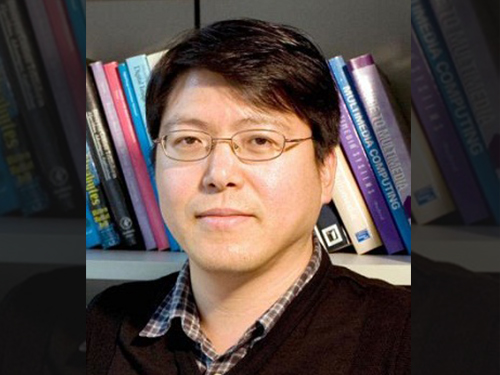
Professor Woontack Woo of the Graduate School of Culture Technology at KAIST participated in the Smart Cloud Show, a technology exhibition, hosted by the university’s Augmented Human Research Center and presented the latest development of his research, an optical platform system for augmented reality.
This event took place on September 16-17, 2015 at Grand Seoul Nine Tree Convention Center in Seoul.
At the event, Professor Woo introduced a smart glass with an embedded augmented reality system, which permits remote collaboration between an avatar and the user’s hand.
The previous remote collaboration was difficult for ordinary users to employ because of its two-dimensional screen and complicated virtual reality system.
However, with the new technology, the camera attached to artificial reality (AR) glasses recognizes the user’s hand and tracks it down to collaborate. The avatar in the virtual space and the user’s hand interact in real space and time.
The key to this technology is the stable, real-time hand-tracking technique that allows the detection of the hand’s locations and the recognition of finger movements even in situations of self-occlusion.
Through this method, a user can touch and manipulate augmented contents as if they were real-life objects, thereby collaborating remotely with another user who is physically distant by linking his or her movements with an avatar.
If this technology is adopted widely, it may bring some economic benefits such as increased productivity due to lower costs for mobility and reduction in social overhead costs from the decrease in the need of traveling long distance.
Professor Woo said, “This technology will provide us with a greater opportunity for collaboration, not necessarily restricted to physical travelling, which can be widely used in the fields of medicine, education, entertainment, and tourism.”
Professor Woo plans to present his research results on hand-movement tracking and detection at the 12th International Conference on Ubiquitous Robots and Ambient Intelligence (URAI 2015), to be held on October 28-30, 2015, at Kintex in Goyang, Korea.
He will also present a research paper on remote collaboration at the ICAT-EGVE 2015 conference, the merger of the 25th International Conference on Artificial Reality and Telexistence (ICAT 2015) and the 20th Eurographics Symposium on Virtual Environments (EGVE 2015), which will take place on October 28-30, 2015 at the Kyoto International Community House, Kyoto, Japan.
2015.09.16 View 6108
Professor Woontack Woo Demonstrates an Optical Platform Technology for Augmented Reality at Smart Cloud Show
Professor Woontack Woo of the Graduate School of Culture Technology at KAIST participated in the Smart Cloud Show, a technology exhibition, hosted by the university’s Augmented Human Research Center and presented the latest development of his research, an optical platform system for augmented reality.
This event took place on September 16-17, 2015 at Grand Seoul Nine Tree Convention Center in Seoul.
At the event, Professor Woo introduced a smart glass with an embedded augmented reality system, which permits remote collaboration between an avatar and the user’s hand.
The previous remote collaboration was difficult for ordinary users to employ because of its two-dimensional screen and complicated virtual reality system.
However, with the new technology, the camera attached to artificial reality (AR) glasses recognizes the user’s hand and tracks it down to collaborate. The avatar in the virtual space and the user’s hand interact in real space and time.
The key to this technology is the stable, real-time hand-tracking technique that allows the detection of the hand’s locations and the recognition of finger movements even in situations of self-occlusion.
Through this method, a user can touch and manipulate augmented contents as if they were real-life objects, thereby collaborating remotely with another user who is physically distant by linking his or her movements with an avatar.
If this technology is adopted widely, it may bring some economic benefits such as increased productivity due to lower costs for mobility and reduction in social overhead costs from the decrease in the need of traveling long distance.
Professor Woo said, “This technology will provide us with a greater opportunity for collaboration, not necessarily restricted to physical travelling, which can be widely used in the fields of medicine, education, entertainment, and tourism.”
Professor Woo plans to present his research results on hand-movement tracking and detection at the 12th International Conference on Ubiquitous Robots and Ambient Intelligence (URAI 2015), to be held on October 28-30, 2015, at Kintex in Goyang, Korea.
He will also present a research paper on remote collaboration at the ICAT-EGVE 2015 conference, the merger of the 25th International Conference on Artificial Reality and Telexistence (ICAT 2015) and the 20th Eurographics Symposium on Virtual Environments (EGVE 2015), which will take place on October 28-30, 2015 at the Kyoto International Community House, Kyoto, Japan.
2015.09.16 View 6108 -
 KAIST and Hancom Sign for Development of Mobile Healthcare
KAIST signed a memorandum of understanding with Hancom, Inc., an office suite developer in Korea, to foster mobile healthcare software programs. President Steve Kang and Chairman Sang-Chul Kim of Hancom held a signing ceremony on March 13, 2015 at the KAIST campus.
Based on the agreement, KAIST and Hancom will exchange research personnel to build Dr. M, a smart healthcare platform developed by the university, collaborate in research and development, and cooperate in the transfer of research developments from the university to the software industry including Hancom.
KAIST and Hancom also signed a memorandum of understanding on the development of software in April 2014. The Hancom-KAIST Research Center opened on campus last October.
2015.03.20 View 7519
KAIST and Hancom Sign for Development of Mobile Healthcare
KAIST signed a memorandum of understanding with Hancom, Inc., an office suite developer in Korea, to foster mobile healthcare software programs. President Steve Kang and Chairman Sang-Chul Kim of Hancom held a signing ceremony on March 13, 2015 at the KAIST campus.
Based on the agreement, KAIST and Hancom will exchange research personnel to build Dr. M, a smart healthcare platform developed by the university, collaborate in research and development, and cooperate in the transfer of research developments from the university to the software industry including Hancom.
KAIST and Hancom also signed a memorandum of understanding on the development of software in April 2014. The Hancom-KAIST Research Center opened on campus last October.
2015.03.20 View 7519