special+lecture
-
 KAIST begins full-scale cooperation with Taiwan’s Formosa Group
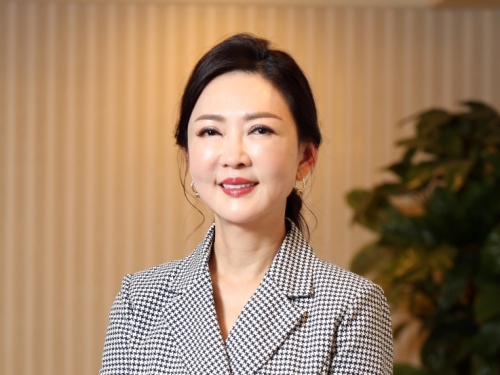
< (From left) Senior Vice President for Planning and Budget Kyung-Soo Kim, and Professor Minee Choi of the Department of Brain and Cognitive Sciences of KAIST along with Chairman of Formosa Group Sandy Wang and KAIST President Kwang-Hyung Lee, and Dean Daesoo Kim of KAIST College of Life Science and Bioengineering >
KAIST is pursuing cooperation in the fields of advanced biotechnology and eco-friendly energy with Formosa Plastics Group, one of Taiwan's three largest companies.
To this end, Chairman Sandy Wang, a member of Formosa Group's standing committee and leader of the group's bio and eco-friendly energy sector, will visit KAIST on the 13th of this month. This is the first time that the owner of Formosa Group has made an official visit to KAIST.
Cooperation between the two institutions began last March when our university signed a memorandum of understanding on comprehensive exchange and cooperation with Ming Chi University of Science and Technology (明志科技大學), Chang Gung University(長庚大學), and Chang Gung Memorial Hospital(長庚記念醫院), three of many institutions established and supported by Formosa Group.
Based on this, Chairman Sandy Wang, who visits our university to promote more exchanges and cooperation, talked about ‘the education of children and corporate social return and practice of his father, Chairman Yung-Ching Wang,’ through a special lecture for the school leadership as a part of the Monthly Lecture on KAIST’s Leadership Innovation Day.
She then visited KAIST's research and engineering facilities related to Taiwan's future industries, such as advanced biotechnology and eco-friendly energy, and discussed global industry-academic cooperation plans. In the future, the two organizations plan to appoint adjunct professors and promote practical global cooperation, including joint student guidance and research cooperation. We plan to pursue effective mid- to long-term cooperation, such as conducting battery application research with the KAIST Next-Generation ESS Research Center and opening a graduate program specialized in stem cell and gene editing technology in connection with Chang Gung University and Chang Gung Memorial Hospital. The newly established cooperative relationship will also promote Formosa Group's investment and cooperation with KAIST's outstanding venture companies related to bio and eco-friendly energy to lay the foundation for innovative industrial cooperation between Taiwan and Korea.
President Kwang-Hyung Lee said, “The Formosa Group has a global network, so we regard it to be a key partner that will position KAIST’s bio and engineering technology in the global stages.” He also said, “With Chairman Sandy Wang’s visit, Taiwan is emerging as a global economic powerhouse,” and added, “We expect to continue our close cooperative relationship with the company.”
Formosa Group is a company founded by the late Chairman Yung-Ching Wang, the father of Chairman Sandy Wang. As the world's No. 1 plastic PVC producer, it is leading the core industries of Taiwan's economy, including semiconductors, steel, heavy industry, bio, and batteries. Chairman Yung-Ching Wang was respected by the Taiwanese people by setting an example of returning his wealth to society under the belief that the companies and assets he built ‘belonged to the people.’ Chang Gung University, Chang Gung Memorial Hospital, and Ming Chi University of Technology, which are pursuing cooperation with our university, were also established as part of the social contribution promoted by Chairman Yung-Ching Wang and are receiving financial support from Formosa Group.
2024.05.09 View 7991
KAIST begins full-scale cooperation with Taiwan’s Formosa Group
< (From left) Senior Vice President for Planning and Budget Kyung-Soo Kim, and Professor Minee Choi of the Department of Brain and Cognitive Sciences of KAIST along with Chairman of Formosa Group Sandy Wang and KAIST President Kwang-Hyung Lee, and Dean Daesoo Kim of KAIST College of Life Science and Bioengineering >
KAIST is pursuing cooperation in the fields of advanced biotechnology and eco-friendly energy with Formosa Plastics Group, one of Taiwan's three largest companies.
To this end, Chairman Sandy Wang, a member of Formosa Group's standing committee and leader of the group's bio and eco-friendly energy sector, will visit KAIST on the 13th of this month. This is the first time that the owner of Formosa Group has made an official visit to KAIST.
Cooperation between the two institutions began last March when our university signed a memorandum of understanding on comprehensive exchange and cooperation with Ming Chi University of Science and Technology (明志科技大學), Chang Gung University(長庚大學), and Chang Gung Memorial Hospital(長庚記念醫院), three of many institutions established and supported by Formosa Group.
Based on this, Chairman Sandy Wang, who visits our university to promote more exchanges and cooperation, talked about ‘the education of children and corporate social return and practice of his father, Chairman Yung-Ching Wang,’ through a special lecture for the school leadership as a part of the Monthly Lecture on KAIST’s Leadership Innovation Day.
She then visited KAIST's research and engineering facilities related to Taiwan's future industries, such as advanced biotechnology and eco-friendly energy, and discussed global industry-academic cooperation plans. In the future, the two organizations plan to appoint adjunct professors and promote practical global cooperation, including joint student guidance and research cooperation. We plan to pursue effective mid- to long-term cooperation, such as conducting battery application research with the KAIST Next-Generation ESS Research Center and opening a graduate program specialized in stem cell and gene editing technology in connection with Chang Gung University and Chang Gung Memorial Hospital. The newly established cooperative relationship will also promote Formosa Group's investment and cooperation with KAIST's outstanding venture companies related to bio and eco-friendly energy to lay the foundation for innovative industrial cooperation between Taiwan and Korea.
President Kwang-Hyung Lee said, “The Formosa Group has a global network, so we regard it to be a key partner that will position KAIST’s bio and engineering technology in the global stages.” He also said, “With Chairman Sandy Wang’s visit, Taiwan is emerging as a global economic powerhouse,” and added, “We expect to continue our close cooperative relationship with the company.”
Formosa Group is a company founded by the late Chairman Yung-Ching Wang, the father of Chairman Sandy Wang. As the world's No. 1 plastic PVC producer, it is leading the core industries of Taiwan's economy, including semiconductors, steel, heavy industry, bio, and batteries. Chairman Yung-Ching Wang was respected by the Taiwanese people by setting an example of returning his wealth to society under the belief that the companies and assets he built ‘belonged to the people.’ Chang Gung University, Chang Gung Memorial Hospital, and Ming Chi University of Technology, which are pursuing cooperation with our university, were also established as part of the social contribution promoted by Chairman Yung-Ching Wang and are receiving financial support from Formosa Group.
2024.05.09 View 7991 -
 KAST Opened the Campus to the Public
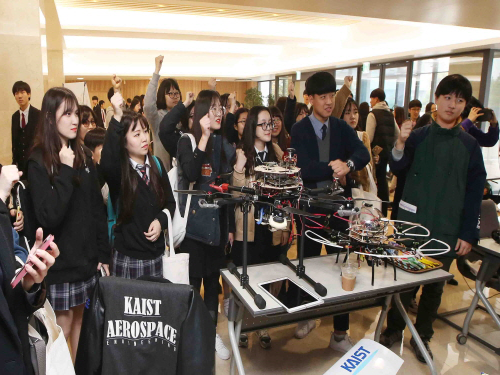
KAIST hosted OPEN KAIST 2017 on the main campus from November 2 to 3, 2017. OPEN KAIST is a science and cultural event designed for students and the general public to experience and take a glance at research labs.
More than 10,000 visitors came to KAIST this year. Groups of families and students came to KAIST to experience various programs related to science.
Twenty departments, including Mechanical Engineering, Aerospace Engineering, the Graduate School of Cultural Technology, and Materials Science and Engineering participated in the event, along with three research centers and the Public Relations Office.
The event was composed of a total of 70 programs in four sections: lab tour, research performance exhibition, department introduction, and special lectures.
The kick off activity for the event was a trial game of the AI World Cup 2017 which will be hosted by KAIST in December 2017. Many people also visited the mobile health care showroom where they could experience what a future smart home and hospital would look like. It was also interesting to visit a futuristic living space for one-person households that provides virtual reality services.
KAIST hopes that the event offers an opportunity for children and students to get to know about science better. Professor Jong-Hwan Kim, the Dean of the College of Engineering at KAIST said, “OPEN KAIST is the one and only opportunity to visit and experience our research labs. KAIST will make every effort to take a step closer to the public by focusing on research that contributes to human society.”
2017.11.06 View 8538
KAST Opened the Campus to the Public
KAIST hosted OPEN KAIST 2017 on the main campus from November 2 to 3, 2017. OPEN KAIST is a science and cultural event designed for students and the general public to experience and take a glance at research labs.
More than 10,000 visitors came to KAIST this year. Groups of families and students came to KAIST to experience various programs related to science.
Twenty departments, including Mechanical Engineering, Aerospace Engineering, the Graduate School of Cultural Technology, and Materials Science and Engineering participated in the event, along with three research centers and the Public Relations Office.
The event was composed of a total of 70 programs in four sections: lab tour, research performance exhibition, department introduction, and special lectures.
The kick off activity for the event was a trial game of the AI World Cup 2017 which will be hosted by KAIST in December 2017. Many people also visited the mobile health care showroom where they could experience what a future smart home and hospital would look like. It was also interesting to visit a futuristic living space for one-person households that provides virtual reality services.
KAIST hopes that the event offers an opportunity for children and students to get to know about science better. Professor Jong-Hwan Kim, the Dean of the College of Engineering at KAIST said, “OPEN KAIST is the one and only opportunity to visit and experience our research labs. KAIST will make every effort to take a step closer to the public by focusing on research that contributes to human society.”
2017.11.06 View 8538 -
 Open KAIST 2015
KAIST’s research environment and its most recent achievements were open to the public.
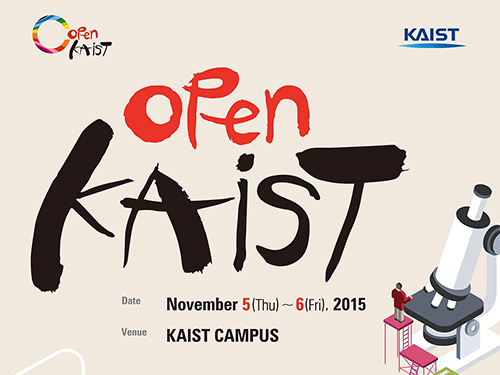
KAIST hosted “Open KAIST 2015” over two days from November 5-6, 2015 in which its 17 departments and three research centers were open to the public. The event is one of the largest events that KAIST holds, which permits such public viewings of its facilities. It is the eighth time it has taken place.
During this event, the departments and centers offered 64 programs including laboratory tours, research achievement exhibitions, department introductions, and special lectures.
The “Motion Capture System”of Professor Jun-Yong Noh’s lab (Graduate School of Culture Technology) drew particular attention.
The “Motion Capture System” expresses human and animal motion in three-dimensional (3D) space using infrared cameras and optic markers, which can then be applied to various industries such as movies, games, and animation. During the program, researchers themselves demonstrated the recording of the movement and its conversion into 3D characters.
Professor Yong-Hoon Cho’s laboratory introduced the scientific mechanism behind the Light Emitting Diode (LED) as well as its manufacturing process under the topic:“A to Z of LED Production.” The reserachers explained that how green LED is much more efficient compared to previous light sources and presented applications that how it is widely used in everyday life in smart phones, electronic displays, and other mobile gadgets.
Professor Jun-tani of the Department of Electronic and Electrical Engineering introduced “Humanoid Robot Nao’s Imitation of Human Motions.” Nao is an autonomous, programmable humanoid robot developed by a French robotics company based in Paris. Nao has an artificial neural circuit, which is the functional equivalent of a human brain, and can thus mimic the subject’s motions through learning.
In addition, Professor Hyo-Choong Bang (Department of Aerospace Engineering) in his lecture on “Unmanned Vehicle Research and Nano Satellites” and Professor Hyun Myung (Department of Civil and Environmental Engineering) on his lecture on “Future Civilization Robot System: the Jellyfish Elimination Robotic Swarm and the Wall-Climbing Drone” provided information on the progress of their respective research.
KAIST also displayed its most recent research achievements. A lecture on “Information Technology Convergence” offered a showroom for “Dr. M,” which is a mobile healthcare platform. Dr. M is a mobile healthcare system that collects and analyzes biosignals via a smart sensor attached to the human body that shows around 20 advanced technologies.
The Satellite Technology Research Center introduced the public to its “Get to Know Satellites” program on Korea’s first satellite “Our Star 1” in addition to showing the satellite assembly room and the satellite communication center.
Special lectures were also held for visitors. Professor Min-Hyuk Kim and Hye-Yeon Oh of the School of Computing talked about “Computer Graphics and Advanced Video Technology” and “Man and the Computer,” respectively, from the perspective of non-experts.
Another interesting feature was the “Wearable Computer Competition” in which college students held fashion shows with computers attached to their clothes.
Professor Jung Kwon Lee, the Dean of the College of Engineering, who led this event, said that “the Open KAIST, which is being held for the eighth time this year, is an excellent opportunity for the general public to experience KAIST’s research environment.” He hoped this could motivate young adults to widen their spectrum of scientific knowledge and raise affection for science.
2015.11.13 View 13268
Open KAIST 2015
KAIST’s research environment and its most recent achievements were open to the public.
KAIST hosted “Open KAIST 2015” over two days from November 5-6, 2015 in which its 17 departments and three research centers were open to the public. The event is one of the largest events that KAIST holds, which permits such public viewings of its facilities. It is the eighth time it has taken place.
During this event, the departments and centers offered 64 programs including laboratory tours, research achievement exhibitions, department introductions, and special lectures.
The “Motion Capture System”of Professor Jun-Yong Noh’s lab (Graduate School of Culture Technology) drew particular attention.
The “Motion Capture System” expresses human and animal motion in three-dimensional (3D) space using infrared cameras and optic markers, which can then be applied to various industries such as movies, games, and animation. During the program, researchers themselves demonstrated the recording of the movement and its conversion into 3D characters.
Professor Yong-Hoon Cho’s laboratory introduced the scientific mechanism behind the Light Emitting Diode (LED) as well as its manufacturing process under the topic:“A to Z of LED Production.” The reserachers explained that how green LED is much more efficient compared to previous light sources and presented applications that how it is widely used in everyday life in smart phones, electronic displays, and other mobile gadgets.
Professor Jun-tani of the Department of Electronic and Electrical Engineering introduced “Humanoid Robot Nao’s Imitation of Human Motions.” Nao is an autonomous, programmable humanoid robot developed by a French robotics company based in Paris. Nao has an artificial neural circuit, which is the functional equivalent of a human brain, and can thus mimic the subject’s motions through learning.
In addition, Professor Hyo-Choong Bang (Department of Aerospace Engineering) in his lecture on “Unmanned Vehicle Research and Nano Satellites” and Professor Hyun Myung (Department of Civil and Environmental Engineering) on his lecture on “Future Civilization Robot System: the Jellyfish Elimination Robotic Swarm and the Wall-Climbing Drone” provided information on the progress of their respective research.
KAIST also displayed its most recent research achievements. A lecture on “Information Technology Convergence” offered a showroom for “Dr. M,” which is a mobile healthcare platform. Dr. M is a mobile healthcare system that collects and analyzes biosignals via a smart sensor attached to the human body that shows around 20 advanced technologies.
The Satellite Technology Research Center introduced the public to its “Get to Know Satellites” program on Korea’s first satellite “Our Star 1” in addition to showing the satellite assembly room and the satellite communication center.
Special lectures were also held for visitors. Professor Min-Hyuk Kim and Hye-Yeon Oh of the School of Computing talked about “Computer Graphics and Advanced Video Technology” and “Man and the Computer,” respectively, from the perspective of non-experts.
Another interesting feature was the “Wearable Computer Competition” in which college students held fashion shows with computers attached to their clothes.
Professor Jung Kwon Lee, the Dean of the College of Engineering, who led this event, said that “the Open KAIST, which is being held for the eighth time this year, is an excellent opportunity for the general public to experience KAIST’s research environment.” He hoped this could motivate young adults to widen their spectrum of scientific knowledge and raise affection for science.
2015.11.13 View 13268 -
 Distinguished Professor Sang Yup Lee Gives Special Lecture at Tianjin University, China
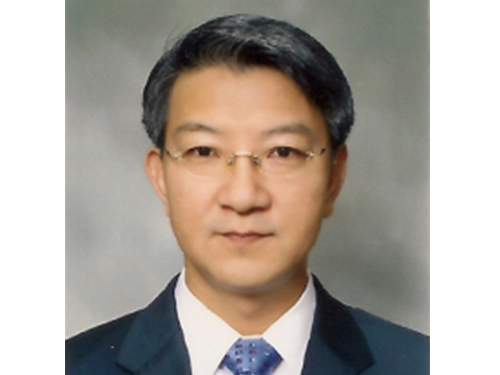
Distinguished Professor Sang Yup Lee from the Department of Chemical and Biomolecular Engineering at KAIST gave a special lecture at Tianjin University, China, on September 12, 2014.
The university has invited prestigious scholars and scientists including Nobel Prize laureates from all around the world to their program called the "BeiYang Lecture Series."
Professor Lee said:
"The lecture series has invited many eminent global leaders such as Dr. Steven Chu, who received the Nobel Prize in Physics in 1997 and also served the 12th United States Secretary of Energy. It is a great honor to participate in the program as a speaker. The university told me that in recognition of my research in the development of sustainable biochemical industry through systems metabolic engineering, I was invited to speak.”
Professor Lee presented his speech entitled “Production of Chemical Materials through Microorganism Metabolic Systems Engineering” and took questions from the audience.
Professor Lee developed the world’s most efficient microorganism and bioprocess such as succinate, butanol, and engineering plastic raw materials. In recent years, he has succeeded in producing a small quantity of gasoline through converting in-vivo generated fatty acids.
2014.09.16 View 10924
Distinguished Professor Sang Yup Lee Gives Special Lecture at Tianjin University, China
Distinguished Professor Sang Yup Lee from the Department of Chemical and Biomolecular Engineering at KAIST gave a special lecture at Tianjin University, China, on September 12, 2014.
The university has invited prestigious scholars and scientists including Nobel Prize laureates from all around the world to their program called the "BeiYang Lecture Series."
Professor Lee said:
"The lecture series has invited many eminent global leaders such as Dr. Steven Chu, who received the Nobel Prize in Physics in 1997 and also served the 12th United States Secretary of Energy. It is a great honor to participate in the program as a speaker. The university told me that in recognition of my research in the development of sustainable biochemical industry through systems metabolic engineering, I was invited to speak.”
Professor Lee presented his speech entitled “Production of Chemical Materials through Microorganism Metabolic Systems Engineering” and took questions from the audience.
Professor Lee developed the world’s most efficient microorganism and bioprocess such as succinate, butanol, and engineering plastic raw materials. In recent years, he has succeeded in producing a small quantity of gasoline through converting in-vivo generated fatty acids.
2014.09.16 View 10924