%48%79%75%6e%6a%6f%6f%20%4c%65%65
-
 Unveiling the Oxygen Usage of Catalysts to Eliminate Greenhouse Gases Views
<(From Left) Professor Hyunjoo Lee, Ph. D candidate Yunji Choi, Ph. D candidate Jaebeom Han, Professor Jeong Young Park>
As the climate crisis becomes a part of daily life with unprecedented heatwaves and cold snaps, technology to effectively remove greenhouse gases is emerging as a critical global challenge. In particular, catalytic technology that decomposes harmful gases using oxygen is a key element of eco-friendly purification. South Korean researchers have identified the principle that catalysts—which were previously vaguely thought to simply ‘use oxygen well’—can selectively utilize different oxygen sources depending on the reaction environment, presenting a new standard for catalyst design.
A joint research team consisting of Professor Hyunjoo Lee from KAIST Department of Chemical and Biomolecular Engineering, Professor Jeong Woo Han from Seoul National University, and Professor Jeong Young Park from KAIST announced on February 4th that they have identified for the first time in the world that ceria (CeO₂), widely used as an eco-friendly catalyst, completely changes its method of using oxygen depending on its size. *Ceria (CeO₂): A compound formed by the combination of the metal cerium and oxygen.
Ceria is a metal oxide catalyst enables high catalytic performance while reducing the need for expensive precious metal catalysts. It is called an ‘oxygen tank’ in the field of catalysis because it can store oxygen and release it when needed. However, until now, it had not been clearly identified where the oxygen came from and under what conditions it was used in the reaction.
The research team focused on a new concept of a catalyst that ‘chooses and uses oxygen according to the situation,’ rather than just a catalyst that ‘uses oxygen well.’ To this end, they fabricated catalysts with precisely controlled ceria sizes, ranging from ultra-small nano-sizes to relatively large sizes, and systematically analyzed the oxygen movement and reaction processes.
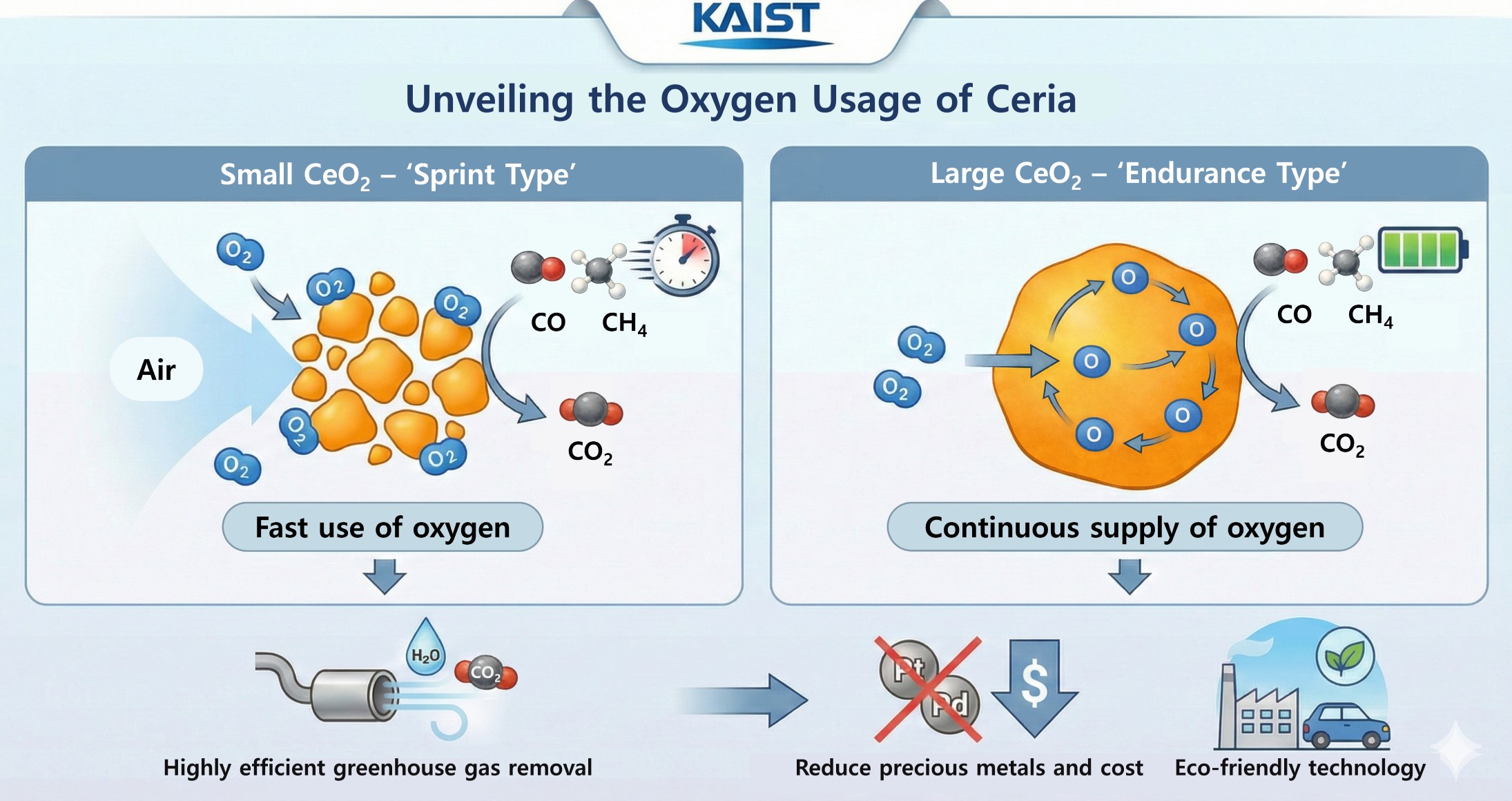
<Schematic Diagram of the Oxygen Transport Mechanism According to Seria Size>
As a result, it was confirmed that small ceria catalysts operate as an ‘agility type’ that quickly takes in oxygen from the air and uses it immediately for reactions, while large ceria catalysts play an ‘endurance type’ role that pulls oxygen stored inside to the surface and supplies it continuously. In other words, the design principle was revealed for the first time that by simply adjusting the size of the catalyst, one can choose whether to use oxygen from the air or oxygen stored internally depending on the reaction conditions. The research team proved this mechanism simultaneously through advanced experimental analysis and artificial intelligence-based simulations.
The research team applied this principle to methane removal. Methane is a greenhouse gas with a global warming effect dozens of times stronger than carbon dioxide, and it is removed through a catalytic oxidation reaction that converts it into carbon dioxide and water using oxygen. The experimental results showed that the small ceria catalyst, by immediately utilizing oxygen from the air, demonstrated stable performance in removing methane even in low-temperature and high-humidity environments. This shows that it is possible to significantly reduce the use of expensive precious metals (platinum and palladium) while actually improving performance.
This achievement is expected to lead to the development of highly durable catalysts that maintain performance even in realistic industrial environments such as rain and moisture, as well as reducing the manufacturing cost of environmental purification equipment, thereby accelerating the commercialization of eco-friendly energy and environmental technologies.
<Schematic Illustration of Ceria Catalyst Applications>
Professor Hyunjoo Lee stated, “This research is an achievement that clearly distinguishes the two core mechanisms of how oxygen operates in catalysts for the first time,” and added, “It has opened a new path to custom-design high-efficiency catalysts required for responding to the climate crisis according to reaction conditions.”
Ph. D candidate Yunji Choi from KAIST, Dr. Seokhyun Choung from Seoul National University, and Ph. D candidate Jaebeom Han from KAIST participated as joint first authors of this study. The research results, also co-authored by Jae-eon Hwang, Hyeon Jin, Yunkyung Kim, and Jeongjin Kim, were published in the international academic journal 'Nature Communications' on January 9th.
This research was supported by the National Research Foundation of Korea (Global Leader Grant, Mid-Career Research Program) funded by the Ministry of Education, Science and Technology, Republic of Korea.
2026.02.09 View 6728
-
 ACS Nano Special Edition Highlights Innovations at KAIST
- The collective intelligence and technological innovation of KAIST was highlighted with case studies including the Post-COVID-19 New Deal R&D Initiative Project. -
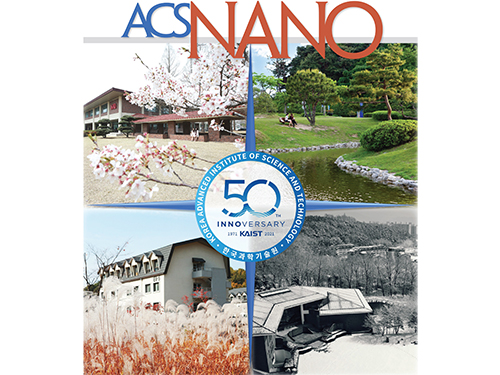
KAIST’s innovative academic achievements and R&D efforts for addressing the world’s greatest challenges such as the COVID-19 pandemic were featured in ACS Nano as part of its special virtual issue commemorating the 50th anniversary of KAIST. The issue consisted of 14 review articles contributed by KAIST faculty from five departments, including two from Professor Il-Doo Kim from the Department of Materials Science and Engineering, who serves as an associate editor of the ACS Nano.
ACS Nano, the leading international journal in nanoscience and nanotechnology, published a special virtual issue last month, titled ‘Celebrating 50 Years of KAIST: Collective Intelligence and Innovation for Confronting Contemporary Issues.’
This special virtual issue introduced KAIST’s vision of becoming a ‘global value-creative leading university’ and its progress toward this vision over the last 50 years. The issue explained how KAIST has served as the main hub for advanced scientific research and technological innovation in South Korea since its establishment in 1971, and how its faculty and over 69,000 graduates played a key role in propelling the nation’s rapid industrialization and economic development.
The issue also emphasized the need for KAIST to enhance global cooperation and the exchange of ideas in the years to come, especially during the post-COVID era intertwined with the Fourth Industrial Revolution (4IR). In this regard, the issue cited the first ‘KAIST Emerging Materials e-Symposium (EMS)’, which was held online for five days in September of last year with a global audience of over 10,000 participating live via Zoom and YouTube, as a successful example of what academic collaboration could look like in the post-COVID and 4IR eras.
In addition, the “Science & Technology New Deal Project for COVID-19 Response,” a project conducted by KAIST with support from the Ministry of Science and ICT (MSIT) of South Korea, was also introduced as another excellent case of KAIST’s collective intelligence and technological innovation. The issue highlighted some key achievements from this project for overcoming the pandemic-driven crisis, such as: reusable anti-virus filters, negative-pressure ambulances for integrated patient transport and hospitalization, and movable and expandable negative-pressure ward modules.
“We hold our expectations high for the outstanding achievements and progress KAIST will have made by its centennial,” said Professor Kim on the background of curating the 14 review articles contributed by KAIST faculty from the fields of Materials Science and Engineering (MSE), Chemical and Biomolecular Engineering (CBE), Nuclear and Quantum Engineering (NQE), Electrical Engineering (EE), and Chemistry (Chem).
Review articles discussing emerging materials and their properties covered photonic carbon dots (Professor Chan Beum Park, MSE), single-atom and ensemble catalysts (Professor Hyunjoo Lee, CBE), and metal/metal oxide electrocatalysts (Professor Sung-Yoon Chung, MSE).
Review articles discussing materials processing covered 2D layered materials synthesis based on interlayer engineering (Professor Kibum Kang, MSE), eco-friendly methods for solar cell production (Professor Bumjoon J. Kim, CBE), an ex-solution process for the synthesis of highly stable catalysts (Professor WooChul Jung, MSE), and 3D light-patterning synthesis of ordered nanostructures (Professor Seokwoo Jeon, MSE, and Professor Dongchan Jang, NQE).
Review articles discussing advanced analysis techniques covered operando materials analyses (Professor Jeong Yeong Park, Chem), graphene liquid cell transmission electron microscopy (Professor Jong Min Yuk, MSE), and multiscale modeling and visualization of materials systems (Professor Seungbum Hong, MSE).
Review articles discussing practical state-of-the-art devices covered chemiresistive hydrogen sensors (Professor Il-Doo Kim, MSE), patient-friendly diagnostics and implantable treatment devices (Professor Steve Park, MSE), triboelectric nanogenerators (Professor Yang-Kyu Choi, EE), and next-generation lithium-air batteries (Professor Hye Ryung Byon, Chem, and Professor Il-Doo Kim, MSE).
In addition to Professor Il-Doo Kim, post-doctoral researcher Dr. Jaewan Ahn from the KAIST Applied Science Research Institute, Dean of the College of Engineering at KAIST Professor Choongsik Bae, and ACS Nano Editor-in-Chief Professor Paul S. Weiss from the University of California, Los Angeles also contributed to the publication of this ACS Nano special virtual issue.
The issue can be viewed and downloaded from the ACS Nano website at https://doi.org/10.1021/acsnano.1c01101.
Image credit: KAIST
Image usage restrictions: News organizations may use or redistribute this image,with proper attribution, as part of news coverage of this paper only.
Publication:
Ahn, J., et al. (2021) Celebrating 50 Years of KAIST: Collective Intelligence and Innovation for Confronting Contemporary Issues. ACS Nano 15(3): 1895-1907. Available online at https://doi.org/10.1021/acsnano.1c01101
Profile:
Il-Doo Kim, Ph.D
Chair Professor
idkim@kaist.ac.kr
http://advnano.kaist.ac.kr
Advanced Nanomaterials and Energy Lab.
Department of Materials Science and Engineering
Membrane Innovation Center for Anti-Virus and Air-Quality Control
https://kaist.ac.kr/
Korea Advanced Institute of Science and Technology (KAIST) Daejeon, Republic of Korea
(END)
2021.03.05 View 54921