%48%65%65%2d%53%75%6e%67%20%50%61%72%6b
-
 KAIST identifies a molecular “switch” that activates cell growth signaling, suggesting a potential basis for next-generation anticancer therapy
Cells carry their own growth switches. When enough nutrients—amino acids in particular—are available, cells flip this switch on and begin to grow. Researchers at KAIST and Yonsei University have now uncovered the molecular mechanism by which amino acid signals activate this cellular growth switch. The findings are expected to open a new avenue for anticancer therapies that target abnormal growth signaling in tumor cells.
KAIST (President Choongsik Bae) announced on July 26 that a research team led by Professors Hee-Sung Park and Jin Young Kang from the Department of Chemistry, working with Professor Sunghoon Kim's team from Yonsei University, has identified a molecular mechanism that links amino acid stimulation to mTORC1-dependent growth signaling.
Cells continually monitor whether enough amino acids—the basic building blocks of proteins—are available in their surroundings, and adjust their growth, protein synthesis, and energy use accordingly. Central to this process is mTORC1 (mammalian Target of Rapamycin Complex 1), a protein complex that functions as the cell's growth switch.
mTORC1 promotes cell growth, protein synthesis, and metabolism when nutrients and energy are abundant. But when mTORC1 becomes excessively active, cells can grow and proliferate beyond what is needed—a pattern of dysregulation observed in numerous cancers. For this reason, mTORC1 has long been considered a prime target for anticancer drug development. Exactly how cells detect external nutrient cues and translate them into mTORC1 activation, however, has remained incompletely understood.
The research team focused on the multi-tRNA synthetase complex (MSC), a large protein assembly composed of multiple aminoacyl-tRNA synthetases and scaffold proteins. While aminoacyl-tRNA synthetases are best known for their essential role in protein synthesis – attaching specific amino acids to their cognate tRNAs – the team showed that, in response to amino acid stimulation the MSC releases LARS1, thereby linking nutrient availability to growth signaling.
The key player within the MSC turned out to be a protein called LARS1 (leucyl-tRNA synthetase 1), an enzyme that attaches leucine to its corresponding tRNA and also functions as an intracellular leucine sensor. When cells receive a signal that nutrients are sufficient, LARS1 undergoes phosphorylation—a modification in which a small chemical tag is attached to a protein, altering its function or binding behavior.
The relationship can be pictured this way: the MSC is a control center where multiple proteins wait on standby, and LARS1 is the field agent dispatched to flip on the growth switch. When nutrients become abundant, LARS1 receives a phosphorylation "deployment signal," dissociates from IARS1, the protein that anchors LARS1 to the MSC, and is thereby released from the complex. The freed LARS1 then goes on to activate mTORC1.
In other words, when nutrients are scarce, LARS1 stays bound within the MSC and the growth signal remains off. Once nutrients become sufficient, LARS1 is released from the MSC and switches on mTORC1.
To investigate the structural basis of this process, the team used cryo-electron microscopy (cryo-EM), a technique that visualizes protein complexes in three dimensions in near-atomic resolution by rapidly freezing samples at extremely low temperatures. This allowed the researchers to determine how LARS1 and IARS1 bind to each other and to structurally explain how phosphorylation could disrupt their interaction.
The results showed that LARS1 and IARS1 are normally bound tightly, but amino acid stimulation induces the phosphorylation of LARS1, weakening its interaction with IARS1. This allows LARS1 to dissociate from the MSC and activate mTORC1.
The researchers also engineered phosphomimetic LARS1 variants—mutant proteins designed to imitate the phosphorylated state—and found that these variants substantially enhanced mTORC1 activity. This confirmed that the phosphorylation of LARS1 functions as the key molecular switch converting a nutrient signal into a cell growth signal.
The significance of this study lies in mapping, in concrete molecular detail, how cells sense amino acids and use that information to activate their growth switch. In particular, the study revealed that, upon receiving nutrient signals, the MSC—a complex involved in protein synthesis—releases its constituent protein LARS1, which then activates cellular growth signaling.
Some existing anticancer drugs work by directly inhibiting mTORC1, the cell's growth switch. However, because mTORC1 is also required for normal cellular growth and metabolism, its direct inhibition may also affect normal cells.
The research team expects that further identifying the kinase responsible for phosphorylating LARS1, along with its regulatory mechanism, could enable a more precise anticancer strategy—one that intercepts the growth signal further upstream, before it reaches mTORC1, rather than blocking mTORC1 itself.
The study was co-first-authored by Youjin Kim and Joo-Chan Kim from KAIST's Department of Chemistry and was published online in Nature Communications on June 11.
Paper title: Cryo-EM structure of the LARS1:IARS1 complex reveals a nutrient-responsive switch controlling mTORC1 signaling
DOI: https://doi.org/10.1038/s41467-026-74085-x
This work was supported by the National Research Foundation of Korea (grant nos. RS-2026-25482352 to H.S.P., RS-2024-00344154 to J.Y.K., and NRF-2021R1A3B1076605 to S.K.) and PNCC (grant no. 160183).
2026.07.27 View 4437
-
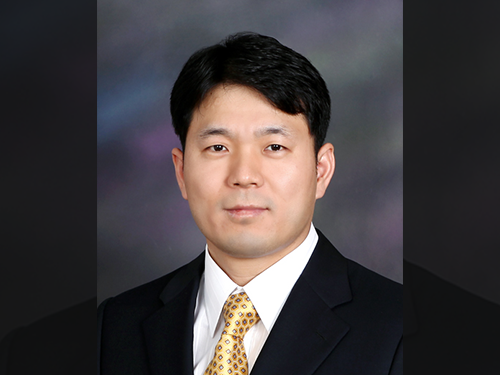 Professor Hee-Sung Park Named Scientist of May
(Professor Hee-Sung Park)
Professor Hee-Sung Park from the Department of Chemistry was named ‘Scientist of May’ sponsored by the Ministry of Science and ICT and the National Research Foundation of Korea. Professor Park was honored in recognition of his developing a tool to engineer designer proteins via diverse chemical modifications. This approach provides a novel platform for investigating numerous diseases such as cancer and dementia.
His research focuses on the production of synthetic proteins and the generation of diverse protein functions as well as the designing and engineering of new translation machinery for genetic code expansion, and the application of synthetic biology techniques for basic cell biology and applied medical science.
Post-translational modifications (PTMs) are constantly taking place during or after protein biosynthesis. PTMs play a vital role in expanding protein functional diversity and, as a result, critically affect numerous biological processes. Abnormal PTMs have been known to trigger various diseases including cancer and dementia. Therefore, this technology enables proteins to reproduce with specific modifications at selected residues and will significantly help establish experimental strategies to investigate fundamental biological mechanisms including the development of targeted cancer therapies.
Professor Park also received 10 million KRW in prize money.
2018.05.04 View 20157
-
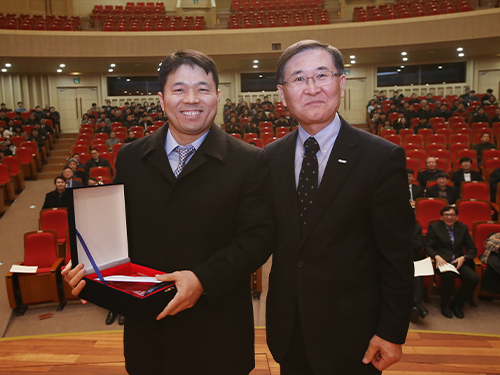 KAISTian of the Year 2016: Professor Hee-Sung Park
Professor Hee-Sung Park of the Department of Chemistry has been named the KAISTian of 2016. President Sung-Mo Kang awarded him at the New Year ceremony on January 2, 2017.
The KAISTian of the Year recognizes the most outstanding professor whose research and scholarship made significant achievements for the year. The Selection Committee announced that Professor Park was chosen as the 16th awardee in recognition of his developing new methods to incorporate unnatural amino acids into proteins.
Earning his Ph.D. in chemical engineering at KAIST in 2000, Professor Park has been a professor at KAIST since 2009. His research focuses on the production of synthetic proteins and the generation of diverse protein functions as well as the designing and engineering of new translation machinery for genetic code expansion, and the application of synthetic biology techniques for basic cell biology and applied medical science.
He developed a tool to engineer designer proteins via diverse chemical modifications, providing a novel platform for investigating numerous diseases such as cancer and dementia. Post-translational modifications (PTMs) are constantly taking place during or after protein biosynthesis. PTMs play a vital role in expanding protein functional diversity and, as a result, critically affect numerous biological processes. Abnormal PTMs have been known to trigger various diseases including cancer and dementia. Therefore, this technology, that enables proteins to reproduce with specific modifications at selected residues, will significantly help establish experimental strategies to investigate fundamental biological mechanisms including the development of targeted cancer therapies.
Professor Park’s research results appeared in the September 28, 2016 edition of Science. For more on Professor Park's research, please visit:
http://kaistcompass.kaist.ac.kr/?issues=fall-2016&magazine=a-chemical-biology-route-to-site-specific-authentic-protein-modifications
http://science.sciencemag.org/content/early/2016/09/28/science.aah4428
http://www.kaist.ac.kr/html/en/news/podcast.html (Podcast: Season 6 Episode 7: When good proteins go bad )
2017.01.10 View 12649