%48%6f%6e%67%20%43%68%75%6c%20%4d%6f%6f%6e
-
 KAIST Develops a Venus Flytrap-Inspired 'Robot Hand' Material That Detects What Comes Near and Grasps It Under UV Light
A Venus flytrap closes its leaves to trap prey when it senses a stimulus. Taking inspiration from this plant, KAIST researchers have combined the roles of a skin that senses approaching objects and a muscle that grasps them in a single soft material. When an electrically charged object comes near, ions inside the material move and produce an electrical signal. When ultraviolet (UV) light is applied, the material bends and grasps the object. Because it holds its deformed shape for more than 10 minutes after the light is turned off, the material shows potential for soft robotic hands that require fewer components and less wiring.
KAIST (President Choongsik Bae) announced on September 30 that a research team led by Professor Hong Chul Moon from the Department of Chemical and Biomolecular Engineering has developed the ‘Ionograsper,’ an ionic soft robot that senses nearby objects and moves in response to light. An ionic material contains ions, small particles that carry a positive or negative electric charge, which allow the material to respond to electrical changes in its surroundings.
Humans notice objects with their eyes or skin and grasp them by moving their muscles. Robots likewise need sensors to detect their surroundings and actuators to generate movement. However, when these devices are attached separately to a soft robot, which bends flexibly, the number of components and the amount of wiring increase, and the structure becomes more complex.
The research team combined the roles of a robot’s skin and muscle in a single soft polymer material. Polymers are substances made of small molecules linked into long chains; plastics and rubber are common examples. The team combined azobenzene, a compound that changes shape when exposed to light, with a hygroscopic polymer that absorbs moisture from the air. This produced a network structure in which ions can move.
When a charged object approaches, its electric field causes the positive and negative ions inside the material to redistribute. As a result, changes occur inside the material even without direct contact. The researchers used the resulting electrical signal to detect the approach and movement of objects without applying a separate sensing voltage.
To make the material move, the researchers irradiate it with UV light. Azobenzene changes its molecular shape when it absorbs light, and moisture escapes from the irradiated side of the material. This causes the material to bend toward the light, which can be used to grasp an object.
When the light is turned off, moisture re-enters the material through nanoscale pores that formed on its surface during irradiation. The material then bends in the opposite direction and holds its deformed shape for more than 10 minutes, until the polymer structure slowly relaxes. This means the light does not need to stay on for the material to maintain its grasping position.
A defining feature of the study is that three functions, sensing an object, moving, and retaining a changed shape for a period of time, are realized in a single material. The researchers also analyzed how light-induced changes in the molecules and in moisture content lead to bidirectional bending and shape retention.
This material design approach could help reduce the components and wiring required when sensors and actuators are mounted separately on soft robots. The work, however, remains at the research stage: the material currently detects charged objects and is actuated by UV light. The team plans to increase the sensing distance, actuation speed, durability under repeated use, and load-bearing capacity, and to make the material responsive to visible or near-infrared light.
“Rather than attaching a robot’s skin and muscles separately, we created a single material that senses objects and moves when it receives light, and a key feature is that it maintains its deformed shape even after the light is turned off,” said Professor Hong Chul Moon. He added that the team plans to combine the material with AI control technologies and develop it into a sensing and actuation material for physical AI robots.
Professor Yong Min Kim of the School of Chemical Engineering at Jeonbuk National University served as the first author, and Professor Hong Chul Moon of KAIST’s Department of Chemical and Biomolecular Engineering served as the corresponding author. The study was published online in the international journal Advanced Materials on September 14, 2026, and was selected as the front cover article of Issue 62.
Paper title: A Multifunctional Ionograsper Enabling Ion-Redistribution Proximity Sensing and Structural-Reconfiguration-Driven Bidirectional Actuation,
DOI: 10.1002/adma.74981
Authors: Yong Min Kim (Jeonbuk National University, first author); Jin Han Kwon, Hyeon Woo Yang, Sungryong Kim, and Gyeong Rok Lee (KAIST, co-authors); Hong Chul Moon (KAIST, corresponding author)
Related Video: https://advanced.onlinelibrary.wiley.com/doi/10.1002/adma.74981
This research was supported by a National Research Foundation of Korea (NRF) grant funded by the Korean government (Ministry of Science and ICT, MSIT) (RS-2025-00554260) and by the Nano & Material Technology Development Program through the NRF, funded by the MSIT (RS-2025-02221332).
2026.09.30 View 1653
-
 KAIST Develops Glare-Free, Heat-Blocking 'Smart Window'... Applicable to Buildings and Vehicles
• Professor Hong Chul Moon of the Department of Chemical and Biomolecular Engineering develops RECM, a next-generation smart window technology, expecting cooling energy savings and effective indoor thermal management.
• When using the developed RECM, a significantly superior temperature reduction effect is observed compared to conventional windows.
• With a 'pedestrian-friendly smart window' design that eliminates glare by suppressing external reflections, it is expected to be adapted in architectural structures, transportation, and more.
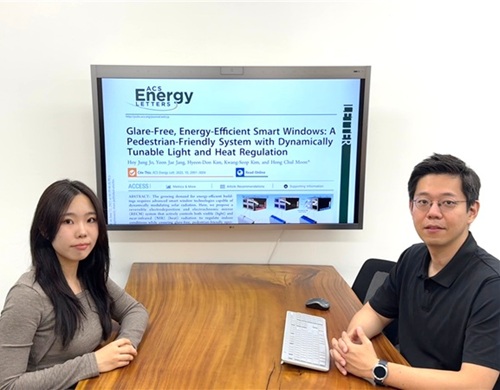
< (From left) First author Hoy Jung Jo, Professor Hong Chul Moon >
In the building sector, which accounts for approximately 40% of global energy consumption, heat ingress through windows has been identified as a primary cause of wasted heating and cooling energy. Our research team has successfully developed a 'pedestrian-friendly smart window' technology capable of not only reducing heating and cooling energy in urban buildings but also resolving the persistent issue of 'light pollution' in urban living.
On the 17th of June, Professor Hong Chul Moon's research team at KAIST's Department of Chemical and Biomolecular Engineering announced the development of a 'smart window technology' that allows users to control the light and heat entering through windows according to their intent, and effectively neutralize glare from external sources.
Recently, 'active smart window' technology, which enables free adjustment of light and heat based on user operation, has garnered significant attention. Unlike conventional windows that passively react to changes in temperature or light, this is a next-generation window system that can be controlled in real-time via electrical signals.
The next-generation smart window technology developed by the research team, RECM (Reversible Electrodeposition and Electrochromic Mirror), is a smart window system based on a single-structured *electrochromic device that can actively control the transmittance of visible light and near-infrared (heat).
*Electrochromic device: A device whose optical properties change in response to an electrical signal.
In particular, by effectively suppressing the glare phenomenon caused by external reflected light—a problem previously identified in traditional metal *deposition smart windows—through the combined application of electrochromic materials, a 'pedestrian-friendly smart window' suitable for building facades has been realized.
*Deposition: A process involving the electrochemical reaction to coat metal ions, such as Ag+, onto an electrode surface in solid form.
The RECM system developed in this study operates in three modes depending on voltage control.
Mode I (Transparent Mode) is advantageous for allowing sunlight to enter the indoor space during winter, as it transmits both light and heat like ordinary glass.
In Mode II (Colored Mode), *Prussian Blue (PB) and **DHV+• chemical species are formed through a redox (oxidation-reduction) reaction, causing the window to turn a deep blue color. In this state, light is absorbed, and only a portion of the heat is transmitted, allowing for privacy while enabling appropriate indoor temperature control.
*Prussian Blue: An electrochromic material that transitions between colorless and blue upon electrical stimulation.
**DHV+•: A radical state colored molecule generated upon electrical stimulation.
Mode III (Colored and Deposition Mode) involves the reduction and deposition of silver (Ag+) ions on the electrode surface, reflecting both light and heat. Concurrently, the colored material absorbs the reflected light, effectively blocking glare for external pedestrians.
The research team validated the practical indoor temperature reduction effect of the RECM technology through experiments utilizing a miniature model house. When a conventional glass window was installed, the indoor temperature rose to 58.7°C within 45 minutes. Conversely, when RECM was operated in Mode III, the temperature reached 31.5°C, demonstrating a temperature reduction effect of approximately 27.2°C.
Furthermore, since each state transition is achievable solely by electrical signals, it is regarded as an active smart technology capable of instantaneous response according to season, time, and intended use.
< Figure 1. Operation mechanism of the RECM smart window. The RECM system can switch among three states—transparent, colored, and colored & deposition—via electrical stimulation. At -1.6 V, DHV•+ and Prussian Blue (PB) are formed, blocking visible light to provide privacy protection and heat blocking. At -2.0 V, silver (Ag) is deposited on the electrode surface, reflecting light and heat, while DHV•+ and Prussian Blue absorb reflected light, effectively suppressing external glare. Through this mechanism, it functions as an active smart window that simultaneously controls light, heat, and glare. >
Professor Hong Chul Moon of KAIST, the corresponding author of this study, stated, "This research goes beyond existing smart window technologies limited to visible light control, presenting a truly smart window platform that comprehensively considers not only active indoor thermal control but also the visual safety of pedestrians." He added, "Various applications are anticipated, from urban buildings to vehicles and trains."
< Figure 2. Analysis of glare suppression effect of conventional reflective smart windows and RECM. This figure presents the results comparing the glare phenomenon occurring during silver (Ag) deposition between conventional reflective smart windows and RECM Mode III. Conventional reflective devices resulted in strong reflected light on the desk surface due to their high reflectivity. In contrast, RECM Mode III, where the colored material absorbed reflected light, showed a 33% reduction in reflected light intensity, and no reflected light was observed from outside. This highlights the RECM system's distinctiveness and practicality as a 'pedestrian-friendly smart window' optimized for dense urban environments, extending beyond just heat blocking. >
The findings of this research were published on June 13, 2025, in Volume 10, Issue 6 of 'ACS Energy Letters'. The listed authors for this publication are Hoy Jung Jo, Yeon Jae Jang, Hyeon-Don Kim, Kwang-Seop Kim, and Hong Chul Moon.
※ Paper Title: Glare-Free, Energy-Efficient Smart Windows: A Pedestrian-Friendly System with Dynamically Tunable Light and Heat Regulation
※ DOI: 10.1021/acsenergylett.5c00637
< Figure 3. Temperature reduction performance verification in a miniature model house. The actual heat blocking effect was evaluated by applying RECM devices to a model building. Under identical conditions, the indoor temperature with ordinary glass rose to 58.7°C, whereas with RECM in Mode III, it reached 31.5°C, demonstrating a maximum temperature reduction effect of 27.2°C. The indoor temperature difference was also visually confirmed through thermal images, which proves the potential for indoor temperature control in urban buildings. >
This research was supported by the Nano & Material Technology Development Program through the National Research Foundation of Korea (NRF) funded by the Ministry of Science and ICT and the internal research program of the Korea Institute of Machinery and Materials.
2025.06.20 View 14357